

Atlanta's metropolitan economy generates $385 billion in GDP, making it one of the largest regional economies in the country. That scale shapes business conditions well beyond metro Atlanta, because the state's strongest flows of capital, talent, freight, and enterprise technology increasingly radiate outward from one concentrated commercial center. For Georgia executives tracking Atlanta's growth as a Southeast tech hub, the larger signal is operational, not just geographic.
Expansion creates hardware turnover. New offices, distribution sites, clinics, branch locations, and remote teams add laptops, servers, storage devices, networking gear, and specialized equipment. A few years later, those same assets become a compliance, security, and disposal problem that many growth plans underprice.
That gap matters more as Georgia businesses scale. Each refresh cycle increases the volume of devices that may still contain customer records, employee data, financial information, or regulated industry data. Growth therefore raises a less visible requirement across the state: disciplined IT asset disposition, documented chain of custody, and secure data destruction that can stand up to audit, litigation, and vendor review.
Atlanta's Economic Impact on Georgia
Metro Atlanta generates $385 billion in GDP. That concentration of output gives one region unusual influence over hiring, procurement, real estate, logistics, and technology decisions across the state. For Georgia executives, the headline is not just that Atlanta is large. It is that Atlanta's scale changes how companies in every market plan growth, fund expansion, and manage operational risk.
The usual discussion stops at jobs, investment, and new facilities. It should go one level deeper. As companies add branches, warehouses, clinics, service fleets, and remote staff, they also accumulate retired laptops, failed drives, decommissioned servers, aging network gear, and specialized devices that may still hold regulated data. Growth increases asset volume first. Disposal risk follows later, often outside the original expansion budget.
That pattern matters in a state where business activity is increasingly digitized. A company opening locations in Macon, Savannah, Augusta, or Columbus may benefit from demand tied to Atlanta's commercial gravity, but it also inherits a larger inventory of end of life technology that must be tracked, sanitized, documented, and recycled correctly. What looks like regional expansion at the macro level becomes a chain of custody problem at the site level.
Three operating pressures tend to rise together:
- Expansion adds hardware. New sites and larger teams require more endpoints, storage, telecom equipment, and supporting infrastructure.
- Modernization retires hardware faster. Cloud migration, security upgrades, and refresh cycles push more assets out of production.
- Compliance exposure widens. More devices means more places where customer, employee, financial, or health data can remain after use.
Leaders following Atlanta's expansion as a Southeast technology center should read the trend through both a growth lens and a control lens. The same economic momentum that creates acquisition and financing opportunities, including for firms that compare SBA lenders for buying a business, also raises the cost of weak IT asset disposition practices. For businesses expanding across Georgia, compliant ITAD and secure data destruction are no longer back office cleanup tasks. They are part of operating a larger company safely.
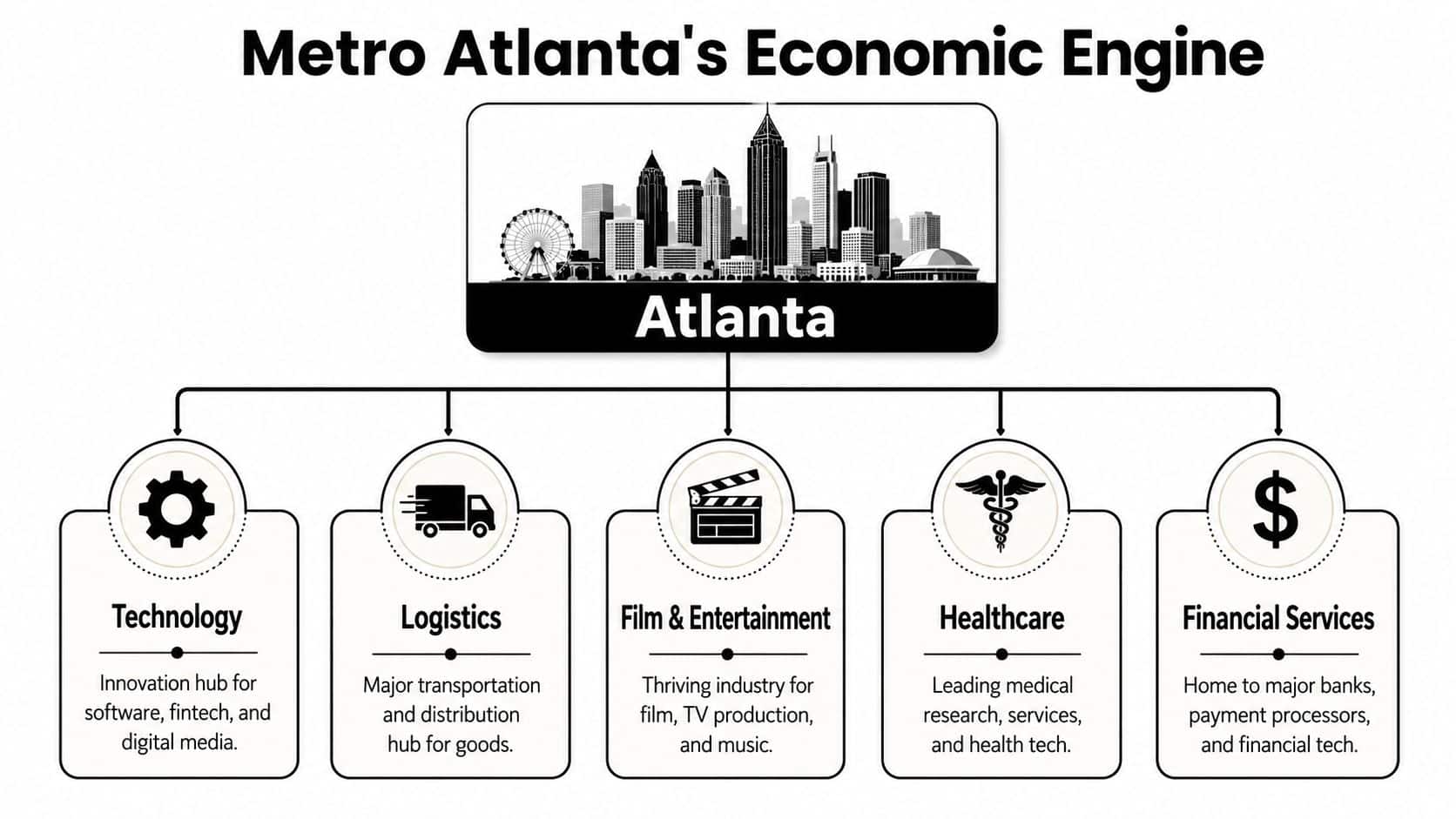
The Metro Atlanta Economic Engine
Metro Atlanta concentrates the state's highest-value business activity in one market. That concentration matters because it links capital, infrastructure, and enterprise demand in ways that spread beyond the city and into day-to-day operating decisions across Georgia.
Technology and logistics reinforce each other
Atlanta has unusual density across transportation, healthcare, information technology, finance, and corporate services. The result is direct cross-sector demand. Technology companies need warehousing, carrier networks, and field support. Logistics operators need software, cybersecurity, mobile devices, and reliable data systems. Healthcare systems and financial firms add another layer of demand because both sectors buy heavily, refresh often, and face stricter controls over retired equipment.
That operating mix matters for more than growth forecasts. It changes the asset lifecycle inside Georgia businesses. A distributor adding warehouse capacity may deploy scanners, tablets, access control hardware, and network gear across several sites. A multi-location healthcare group may add endpoints and storage in one quarter, then retire older devices in the next. The purchasing decision is visible. The disposal obligation often is not.
Capital follows market density
Atlanta attracts lenders, acquirers, service providers, and operators because a dense business market lowers transaction friction and speeds expansion. That is one reason metro growth affects companies well outside the urban core. Firms entering Georgia through acquisition often start with market access, labor, and financing. They should also account for inherited technology inventories, redundant infrastructure, and data-bearing devices left behind by prior owners.
For firms evaluating expansion through acquisition, financing structure matters as much as location strategy. Operators comparing debt options may find it useful to compare SBA lenders for buying a business when planning entry into the Atlanta market or adjacent Georgia regions.
Sector depth raises the ITAD standard
Atlanta's business mix creates a higher bar for IT asset disposition because the region has a larger share of companies handling regulated data, distributed hardware fleets, and frequent office or facility changes. Finance and healthcare are the obvious examples, but the pattern extends to law firms, SaaS providers, logistics networks, and multi-site corporate operations.
Three pressure points stand out:
- Regulated data stays on retired assets. Laptops, servers, phones, backup media, and network appliances can retain customer, employee, payment, or health information after use.
- Real estate churn releases equipment in batches. Office consolidations, warehouse upgrades, and tenant improvements can put hundreds of devices into surplus at once.
- Expansion increases chain of custody risk. The more locations a company opens, acquires, or exits, the harder it becomes to document where each asset went and how data was destroyed.
Leaders tracking the future of commercial real estate in Atlanta should treat outgoing equipment as part of site planning, not as an afterthought. In a market growing as quickly and as densely as metro Atlanta, surplus electronics management becomes a compliance function, a security function, and a source of recoverable value.
How Atlanta's Growth Fuels Regional Georgia
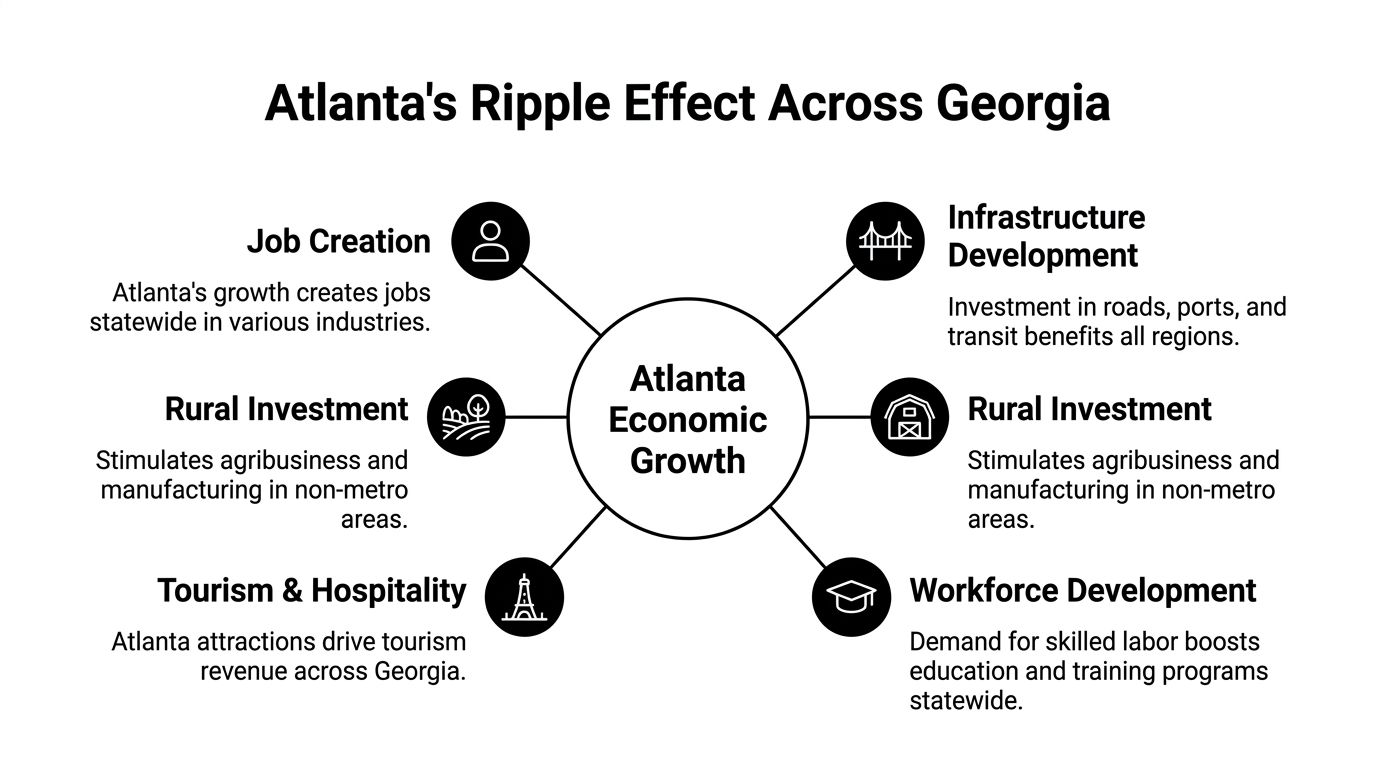
Atlanta's economic gravity shows up outside metro Atlanta in practical ways. A manufacturer in north Georgia may rely on metro transportation and distribution relationships. A healthcare network in central Georgia may source technology vendors, finance partners, or compliance support from the Atlanta market. A university system outside the city may still feel the effects of Atlanta-led procurement norms and enterprise IT practices.
Regional businesses use Atlanta as a platform
Atlanta's role becomes more strategic than symbolic. Businesses don't need to relocate into the city to benefit from it. They can use Atlanta as a platform for reach, talent access, vendor access, and customer access while operating elsewhere in Georgia.
Consider a few typical patterns:
- Savannah-linked operations: Companies can align coastal freight activity with metro warehousing, finance, and back-office support.
- Augusta-area firms: They may tap into Atlanta's business services ecosystem while keeping technical or operational teams local.
- Macon and middle Georgia operators: They often sit in the path of statewide movement, where Atlanta-connected networks shape inventory, service timing, and equipment deployment.
None of those examples requires Atlanta to absorb all the value. The city functions more like a control node. The result is statewide business growth that still depends, directly or indirectly, on metro-scale infrastructure and investment behavior.
Growth ripples through support functions too
The overlooked point is that support functions travel with expansion. If a regional company upgrades devices because customer volume rises, that company also has to handle retired devices securely. If a school system modernizes labs or an outpatient network replaces endpoints, operational risk doesn't disappear because the facility is outside Atlanta.
A regional business may feel Atlanta's growth first through demand, but it often feels the pressure of that growth later through procurement, compliance, and disposal workflows.
That's where the statewide ripple effect gets more complicated. Atlanta creates economic velocity across Georgia. Yet some of the specialized services needed to support that velocity remain concentrated near the metro core. The mismatch isn't obvious during expansion planning, but it becomes obvious the moment a business needs documented pickup, on-site destruction, or certified downstream processing for obsolete assets.
Growth's Hidden Challenge The E-Waste and Data Security Gap
Most commentary on Atlanta's economic rise stops at expansion. That misses a harder operating truth. As Georgia's businesses deploy more technology, they also retire more technology, and the systems for handling that retired equipment aren't evenly distributed.
Existing coverage of Atlanta's economic growth overwhelmingly focuses on corporate expansion and job creation in high-growth sectors like tech and finance, but neglects the critical gap in IT asset disposition and e-waste recycling infrastructure needed to support this growth across Georgia, according to the Atlanta Regional Commission draft update.
The service gap is operational, not abstract
That gap matters because decommissioned equipment carries two kinds of risk at once. The first is data security. The second is process failure. If an organization can't get reliable pickup, verified destruction, and documented chain of custody, disposal becomes inconsistent across locations.
Small and mid-sized facilities outside the metro core may face a simple problem: they don't generate enough volume on a single day to attract the same service options available in dense business corridors. In Atlanta's commercial recycling market, free pickup for business clients is typically tied to a threshold of 10 to 20 major IT items or a full pallet, according to Atlanta business pickup guidance. That structure makes logistical sense for providers. It also means smaller commercial sites can fall into a service gray area.
Security planning has to include disposal planning
Cyber risk and physical asset disposal converge. Many leaders treat cyber insurance, endpoint management, and breach response as separate from electronics recycling. They aren't separate when regulated data still sits on retired drives. Teams reviewing PIA Southern Alliance on cyber coverage should connect that insurance lens to end-of-life hardware controls.
A few warning signs show up repeatedly in growing organizations:
- Storage closets filling up: Devices remain on site because nobody owns the disposition process.
- Informal handoffs: Equipment leaves through movers, landlords, liquidators, or local haulers without data-specific controls.
- No destruction documentation: IT teams can't prove what happened to drives, laptops, or backup media.
The compliance side of this problem is often harder than the environmental side. Businesses usually know they shouldn't throw out electronics casually. What they underestimate is how quickly undocumented disposal creates legal and contractual exposure.
For companies evaluating Georgia ITAD compliance requirements, the central issue is straightforward. Growth has increased the volume of retired equipment faster than many organizations have upgraded the controls around retirement.
Navigating Compliance Risks Across a Growing State
The compliance problem in Georgia isn't only whether rules exist. It's whether businesses across the state can consistently meet them. That's why the geography of service availability matters so much.
The policy gap is visible in local planning too. The One Atlanta Economic Mobility Plan emphasizes job creation and investment in disinvested neighborhoods but does not include provisions for technology asset lifecycle management or data security compliance infrastructure beyond the metro area, as described in the city's plan announcement. For statewide operators, that omission has real consequences.
Where compliance risk shows up first
The risk often surfaces in ordinary events rather than crisis moments. An office relocation. A device refresh. A school lab replacement. A healthcare equipment upgrade. A finance department replacing old desktops after a software migration.
Each event can create exposure if the organization lacks a formal process for:
| Risk point | Why it matters |
|---|---|
| Asset identification | Teams need to separate institutional equipment from personal property before disposition |
| Chain of custody | Liability doesn't transfer cleanly without documented handoff |
| Data destruction | Media-bearing devices require defensible destruction or wiping procedures |
| Final documentation | Certificates matter when auditors, legal teams, or clients ask questions |
Georgia institutions already reflect this logic. Georgia Tech's equipment inventory rules prohibit recycling institute-owned assets without formal surplusing through lab equipment procedures and require certified chain-of-custody documentation, according to Georgia Tech's recycling guidance. That isn't a niche university issue. It reflects how serious organizations treat ownership, accountability, and liability transfer.
Practical rule: If a business can't document where a retired asset went, who handled it, and how data was destroyed, the disposal process isn't mature enough for regulated environments.
The inequity is structural
Atlanta-based enterprises are more likely to have routine access to certified wiping, shredding, and documentation workflows. Smaller organizations in outlying counties may not. The result is a compliance inequity. The rules don't relax outside metro Atlanta, but access to professional disposal infrastructure often does.
That creates a distorted risk picture:
- Healthcare providers may maintain strong patient-data policies yet still struggle with device retirement logistics.
- Financial firms may control live systems tightly while using weak processes for retired hardware.
- Public institutions may track inventory well but lack easy access to formal downstream recycling and destruction services.
Leaders reviewing why ITAD chain of custody matters in Georgia should treat disposition records as part of the compliance file, not as after-the-fact paperwork. In a growing state, disposal discipline is part of governance.
Actionable ITAD Strategies for Georgia Businesses
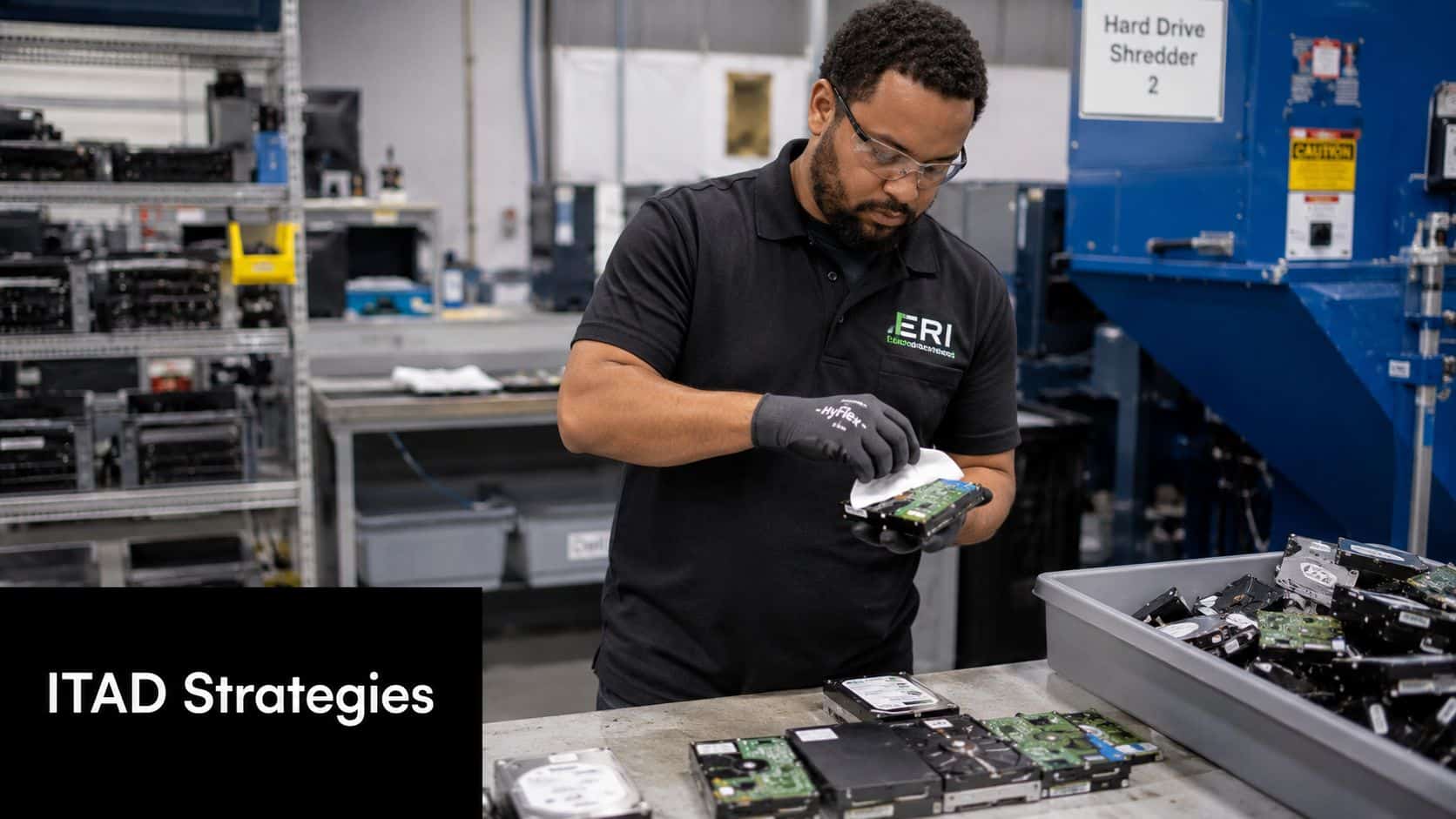
The right response isn't complicated, but it does need to be formal. Businesses across Georgia need an ITAD program that treats retired electronics as governed assets from the moment they leave production.
Build the program around documented control
Start with process ownership. One team should own the chain from inventory review through pickup, destruction, and final certificates. That owner may sit in IT, facilities, procurement, or compliance, but the responsibility should be explicit.
Then establish a standard workflow:
Identify the assets
Separate media-bearing devices from peripherals and distinguish owned equipment from leased, employee-owned, or restricted institutional property.Choose the destruction method
Drives that contain sensitive or regulated data may require on-site shredding or certified wiping before anything leaves the site.Schedule logistics by location
Multi-site companies should consolidate pickups where possible, but they also need a plan for branches that produce lower volumes.Require final paperwork
Certificates of data destruction and recycling should close the file, not sit as optional extras.
Use cost structure to guide decisions
Pricing helps organizations decide when to consolidate loads and when to prioritize urgency. In Atlanta, on-site data destruction for media-bearing devices costs between $5 and $15 per drive, bulk volume pickup ranges from $0.50 to $1.50 per pound, and small device drop-off fees start at $20 per unit, according to Atlanta business recycling pricing. Those figures won't define every statewide engagement, but they do show how services are usually structured.
That cost view can improve planning:
- For drive-heavy projects: On-site destruction may be justified when the primary issue is data sensitivity.
- For warehouse cleanouts: Per-pound pricing can make consolidation more efficient than piecemeal disposal.
- For scattered branch offices: Logistics and minimum-volume realities should be addressed upfront.
Documentation is part of the service, not an administrative add-on. If the provider can't support that standard, the risk stays with the business.
Match the method to the asset type
Not every device should follow the same path. Servers, laptops, backup media, network gear, laboratory systems, and medical electronics often carry different handling requirements. A stronger program uses decision criteria rather than one blanket rule.
A simple operating model looks like this:
- High-sensitivity media: Destroy or wipe under stricter controls.
- Resalable business hardware: Evaluate for value recovery if chain of custody remains intact.
- Mixed e-waste loads: Route through documented recycling with clear downstream accountability.
Teams building that framework can use Georgia IT equipment recycling best practices as a reference point for statewide program design. The main objective is consistency. Economic growth creates more equipment turnover. Consistency is what keeps turnover from becoming exposure.
Secure Your Growth with a Compliant Partner
Atlanta's scale gives Georgia an economic center of gravity that few states can match. It brings capital, sector depth, and statewide commercial momentum. It also creates a quieter requirement for every organization touched by that momentum: technology has to leave the business as securely as it entered.
That is the hidden operating lesson in how Atlanta's economy is driving growth across Georgia. Expansion increases hardware deployment, but it also increases the volume of assets that must be wiped, shredded, tracked, and recycled under defensible controls. Businesses that understand both sides of that equation protect more than data. They protect continuity, audit readiness, and reputation.
The smartest organizations won't treat IT asset disposition as cleanup work at the end of a project. They'll treat it as infrastructure for growth.
If your company needs a secure, documented way to retire laptops, servers, storage media, medical devices, lab equipment, or surplus IT assets, contact Beyond Surplus for certified electronics recycling and secure IT asset disposal. Beyond Surplus supports Georgia businesses with compliant pickup, data destruction, chain-of-custody documentation, and responsible downstream processing.


