

Atlanta, Georgia sits near the top of the investment map, but the most useful signal for operators isn’t just capital flow. It’s the mismatch between real estate growth and technology end-of-life planning. Atlanta ranked as the #4 most attractive U.S. metro for commercial real estate investment in CBRE’s 2025 U.S. Investor Intentions Survey (CBRE). That headline matters. So does what sits behind it: office repositioning, industrial retrofits, and a growing need to handle aging servers, drives, network gear, and embedded building tech correctly.
For business owners, IT managers, and facility teams, the future of commercial real estate in Atlanta isn’t only about leasing strategy or acquisition timing. It’s also about chain of custody, decommissioning logistics, and whether a move, closure, or retrofit creates a hidden compliance problem.
Atlanta’s CRE Market A Resilient Powerhouse
Atlanta entered 2025 as one of the most sought-after U.S. investment markets. The more useful implication for operators is what that ranking suggests about owner behavior. Capital still wants Atlanta exposure, but it is being allocated selectively, toward assets with a credible path to higher rent, stronger tenancy, better power availability, or a second life in logistics and digital infrastructure.
That shift matters on the ground. Real estate decisions now trigger infrastructure decisions much earlier in the asset lifecycle. A building sale, headquarters move, industrial retrofit, or systems upgrade can all produce a wave of retired servers, storage arrays, security hardware, and user devices that falls outside the core underwriting model.
Capital is sorting assets, not backing the whole market evenly
Atlanta’s next cycle looks less like broad expansion and more like asset triage. Owners are choosing where to reinvest, where to reduce operating costs, and where to reposition for a different tenant profile. For occupiers, that means more renovation activity, more turnover in building systems, and more pressure to account for technology that no longer fits the new use case.
For readers comparing sector narratives, the broader market lens in Homebase’s insights for multifamily investors is useful because it shows how investors are separating durable cash-flow stories from assets that need a new operating thesis.
The same sorting process is visible in corporate migration. Companies expanding in Atlanta often change both their footprint and their hardware stack at the same time. This review of why more companies are moving their headquarters to Atlanta helps explain why relocations often create hidden IT disposition work alongside the estate transaction itself.
The overlooked gap is between occupancy change and asset disposition
Market reports usually stop at leasing velocity, cap rates, and construction pipelines. Operators have to manage what happens after the lease decision. If a company exits older space, upgrades a facility, or inherits a retrofit project, someone still has to document chain of custody, remove data-bearing equipment, and determine whether obsolete hardware has resale value, recycling cost, or compliance exposure.
That is the data center-to-ITAD lifecycle gap. Atlanta’s growth in industrial and technology-oriented real estate increases the volume of equipment entering service. It also increases the volume that will eventually need secure, auditable disposition. Many firms plan for acquisition, installation, and commissioning. Far fewer build disposal and recovery into the original property strategy.
Three questions now sit under many Atlanta real estate moves:
- If a tenant upgrades or relocates, who inventories and removes legacy desktops, conference room equipment, racks, and storage gear?
- If an owner repositions a building, who handles embedded IT and data-bearing devices with documented compliance?
- If an industrial or digital facility is reworked, how is retired equipment tracked from removal to resale, recycling, or destruction?
Those issues affect budgets, project timing, and risk allocation. In Atlanta, a resilient CRE market does not just create leasing and investment opportunities. It also creates a larger backlog of technology assets that businesses need to retire correctly.
The Office Sector’s Flight to Quality
Atlanta’s office market is no longer just a recovery story. It’s a sorting process. Vacancy declined to 17.9% in Q2 2025 from 18.7% a year earlier, while leasing activity rose and rents reached an all-time high of $32.14 per square foot in Q2 2024 (NAI Brannen Goddard). That combination points to stabilization, but not evenly across the market.

Why better buildings create more tech waste
When tenants move from older space into newer Class A product, they rarely bring every legacy system with them. Old VoIP hardware, copier fleets, security devices, monitors, docking stations, and local server equipment often stay in the project scope long after leadership has focused on furniture and cabling.
That’s why “flight to quality” often becomes an IT disposition event.
The companies touring premium workspace in guides like the best coworking spaces in Atlanta for growing businesses are usually evaluating more than location and amenities. They’re also deciding how much old infrastructure they can retire, what can be reused, and which devices require certified destruction.
Relocation budgets often miss the hard part
Office exits fail when teams assume decommissioning is simple. It isn’t. Even mid-sized relocations can involve:
- Data-bearing devices: Laptops, desktops, SSDs, hard drives, and multifunction printers all create retention and destruction issues.
- Room technology: Conference displays, control systems, cameras, and small network closets need removal planning.
- Asset recovery decisions: Some equipment still has resale value. Some should be wiped and redeployed. Some belongs in secure recycling.
Practical rule: If a move changes your floor plan, it probably changes your IT disposal plan too.
What owners and tenants should do before lease exit
A disciplined office move needs two workstreams running together: occupancy planning and asset disposition. If only one gets attention, the project drifts.
| Office event | Technology consequence | Management priority |
|---|---|---|
| Consolidation | Duplicate equipment | Decide what to redeploy |
| Upgrade to Class A space | Legacy devices left behind | Schedule pickup and inventory |
| Office closure | Data-bearing assets concentrated in one site | Document destruction and transfer of custody |
For Atlanta occupiers, the key office story isn’t just whether quality space is leasing. It’s that higher-quality space accelerates turnover of older equipment, and that turnover has to be managed like a risk function, not an afterthought.
Atlanta’s Industrial And Logistics Market Adjustment
Industrial real estate in Atlanta has shifted from expansion frenzy to operational recalibration. The sector is in a mid-cycle adjustment with rising vacancy and slowed leasing despite strong pricing and sales, driven by e-commerce saturation and supply chain optimization (TenantBase).
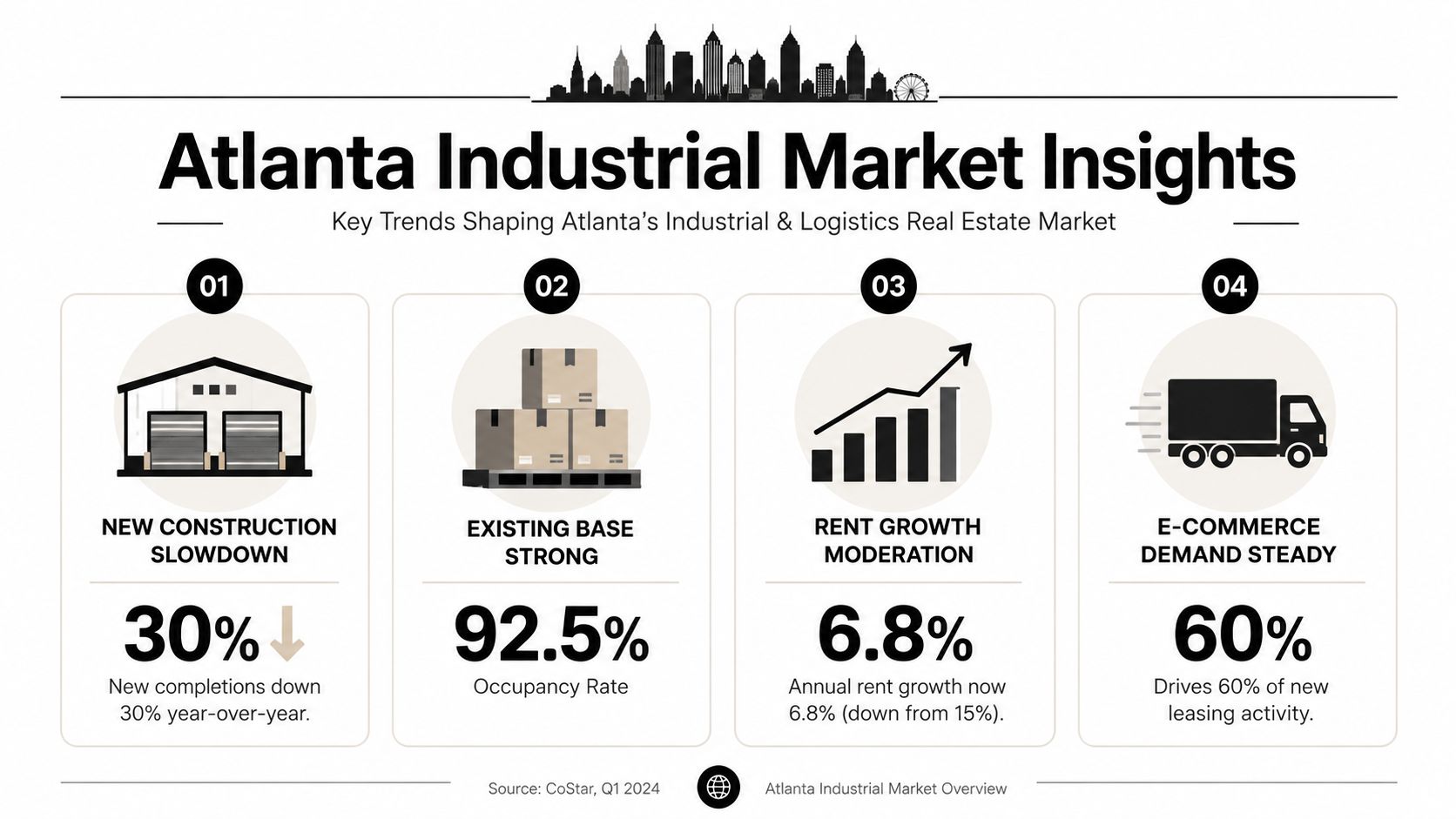
That doesn’t signal weakness in the simple sense. It signals a different kind of work. Operators are spending less time outfitting brand-new boxes and more time reworking existing facilities.
Existing buildings now matter more than ribbon cuttings
In the prior wave, value came from rapid delivery of warehouse and logistics capacity. In the current phase, value often comes from improving what already exists. That includes scanning systems, warehouse workstations, local servers, telecom gear, automation controls, handheld device fleets, and surveillance hardware.
When occupiers retrofit instead of relocate, they create a specific disposal pattern. Equipment comes out in phases. Assets are spread across docks, mezzanines, cages, and office pods. Pickup and reconciliation become harder because the site stays active during the change.
What this means for facility teams
A warehouse technology refresh is rarely a clean swap. Teams usually face a mixed environment:
- Legacy gear still works, but no longer fits workflow.
- Replacement systems arrive in stages, so old equipment sits longer than expected.
- Operations can’t stop, which means disposal has to be coordinated around shipping windows and staffing patterns.
That’s why industrial adjustment should be read as an IT lifecycle story as much as a real estate story. The more Atlanta shifts toward optimization of existing facilities, the more demand rises for structured removal of aging hardware.
In industrial buildings, the challenge isn’t finding obsolete equipment. It’s finding all of it before it gets stranded in active operations.
The operational benchmark to watch
For industrial occupiers, the useful question isn’t whether Atlanta will build forever at the same pace. It’s whether existing sites are being upgraded, consolidated, or repurposed. If they are, end-of-life technology volume follows.
That creates a practical benchmark for asset recovery partners. They need urban routing, dock-level pickup capability, serialized inventory handling, and the ability to separate resale candidates from regulated waste streams without slowing warehouse operations.
Data Centers The Hidden Engine of Atlanta CRE
Most coverage treats data center growth as a construction and power story. That’s incomplete. The more important long-term issue is what happens after deployment.
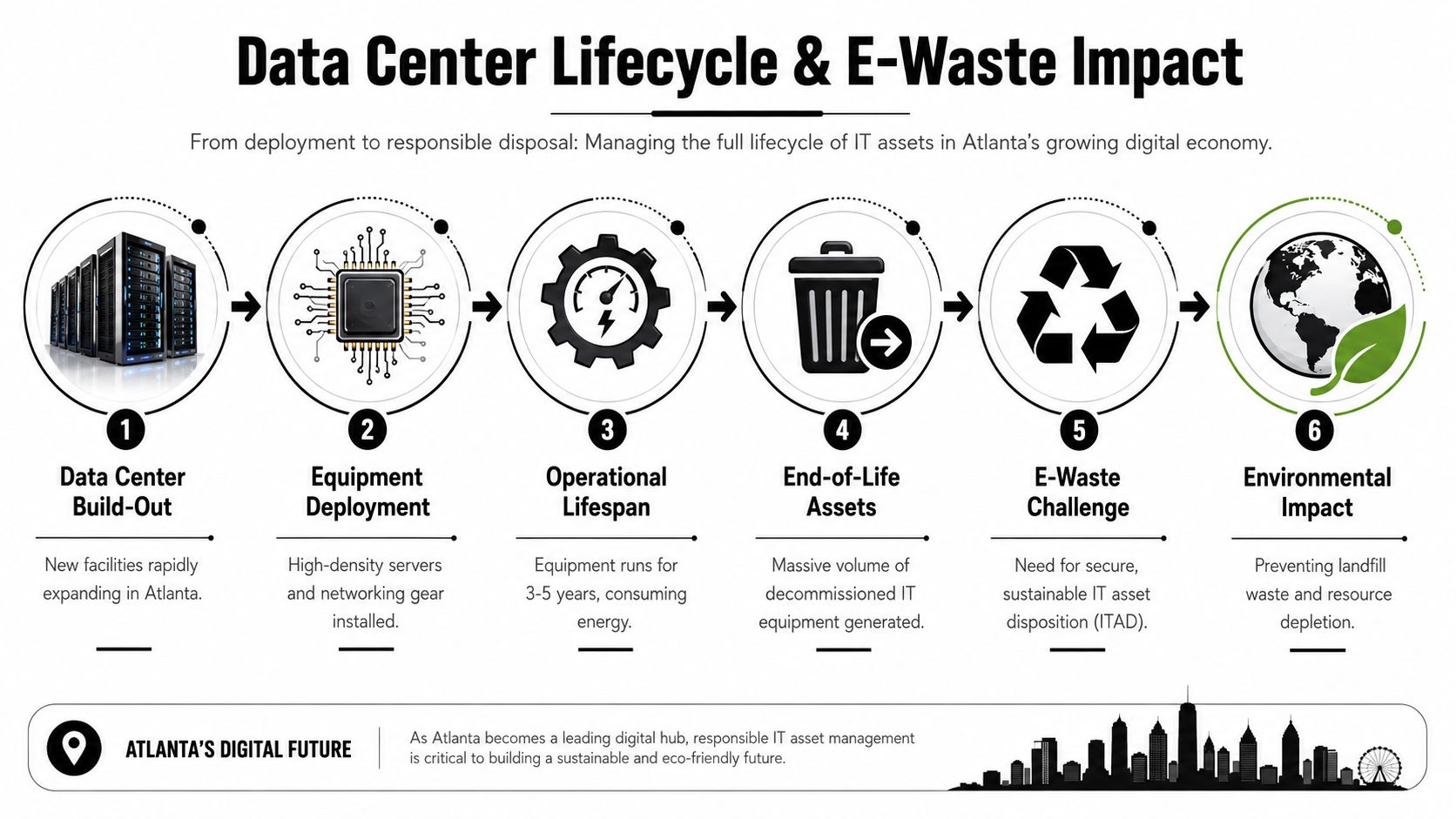
As data centers boom in Atlanta, the volume of decommissioned IT assets such as servers, hard drives, and networking gear will surge, yet local content rarely connects that growth to the need for secure, certified IT asset disposition and e-waste recycling facilities (analysis referenced here).
The lifecycle gap no one prices correctly
Developers, operators, and tenants usually plan for procurement, installation, uptime, and expansion. They don’t always plan with the same rigor for retirement. That’s the Data Center-to-ITAD gap.
A facility can be state-of-the-art and still carry weak end-of-life controls. That happens when de-installation is treated as a vendor cleanup exercise rather than a compliance-sensitive infrastructure event.
Teams evaluating Atlanta’s position as a digital infrastructure hub can see the supply-side appeal in this look at why Atlanta is a prime data center hub. The harder question is what operators do when high-density compute hardware ages out, gets refreshed early, or is removed during tenant turnover.
Why decommissioning risk rises with scale
Data centers don’t generate ordinary office surplus. They generate concentrated volumes of sensitive hardware. Even a partial refresh can involve:
- Server nodes with recoverable components and stored configuration data
- Hard drives and SSDs requiring verified destruction or wiping
- Networking equipment tied to security architecture and routing records
- Racks, PDUs, and support gear that require coordinated physical removal
Each category has different handling requirements. That means operators need a disposition process that works at batch scale without losing item-level accountability.
A rack removed without documentation is both a security issue and a controls issue.
Why CRE teams should care
This matters to landlords and investors too. Data center real estate performance is often evaluated through power access, location, tenant demand, and build quality. But operational resilience also depends on whether the site can support secure refresh cycles.
A building that attracts digital infrastructure users but lacks a clear path for controlled hardware retirement is carrying an unpriced operational weakness. That weakness affects turnover, project scheduling, and liability transfer.
A better way to evaluate data center readiness
Use a simple decision test when reviewing any Atlanta data center project:
- Can the site support staged de-installation without disrupting active operations?
- Is there a documented chain of custody for removed equipment?
- Can storage media be destroyed or wiped to a standard that satisfies internal policy and outside regulators?
- Is there a path for value recovery on reusable equipment before material enters recycling?
The future of commercial real estate in Atlanta will be shaped partly by data centers. But the stronger insight is narrower. The next bottleneck isn’t only power or land. It’s secure end-of-life processing for the hardware already entering the market.
Investment Implications and Operational Imperatives
As noted earlier, Atlanta remains a top-tier investment target. That matters because stronger investor interest usually brings tighter underwriting, stricter diligence, and less tolerance for avoidable operational loss. In that setting, retired technology is not a side issue. It affects project cost, liability, and recovery value.
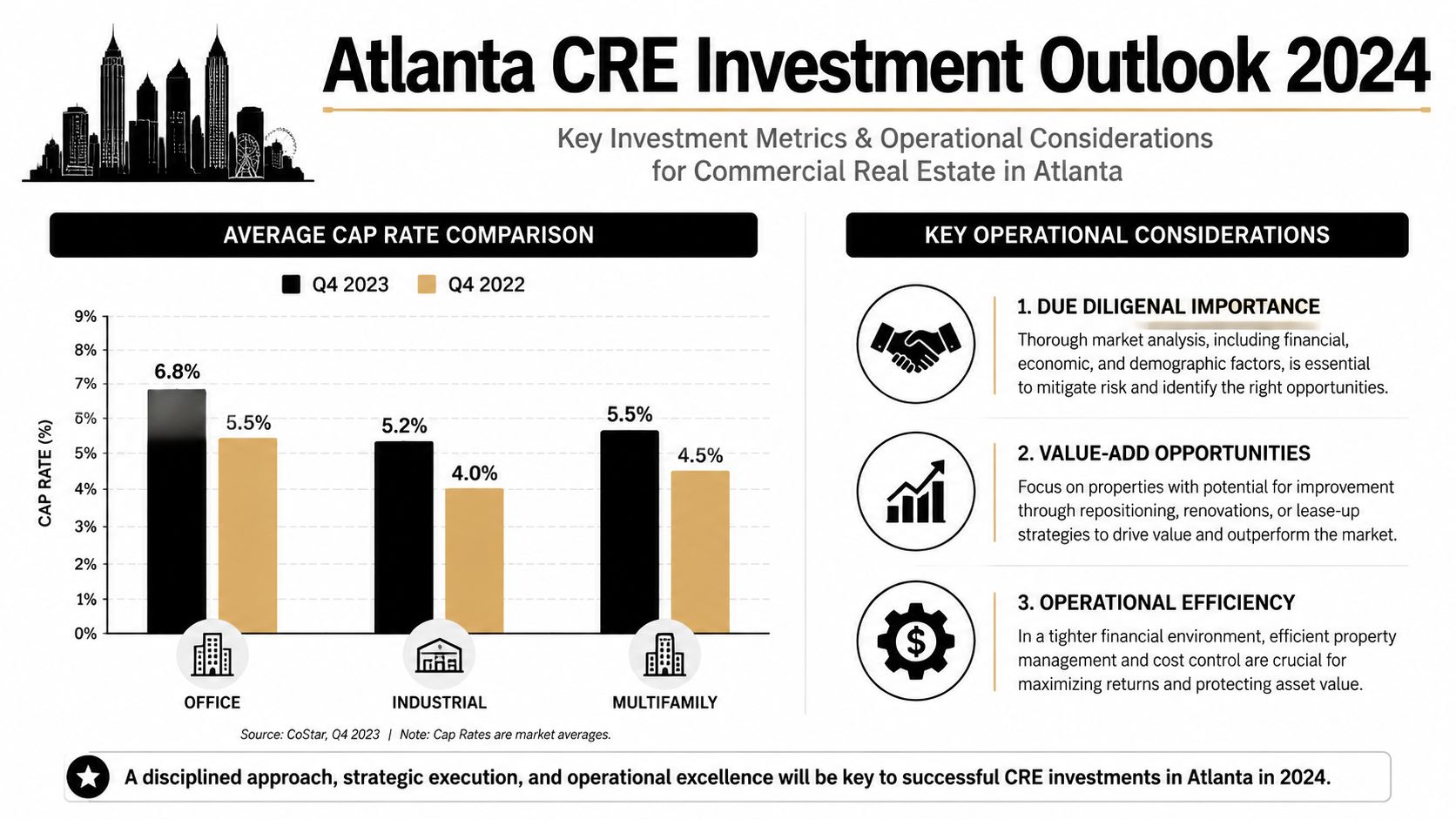
The overlooked point is where Atlanta’s industrial growth and digital infrastructure growth intersect. More warehouses are supporting higher-tech occupiers. More data center capacity is entering service. More offices are being repositioned around denser networking, security, and edge equipment. Each of those shifts expands the volume of equipment that will eventually need secure retirement. Yet many acquisition models and operating plans still treat IT disposition as a late-stage cleanup task instead of a predictable asset lifecycle event.
That gap has real underwriting implications.
A server room shutdown, warehouse automation upgrade, or tenant move-out can produce three different financial outcomes at once. Some equipment retains resale value. Some devices require certified destruction because they contain data or embedded storage. Some materials create disposal cost because they include batteries, regulated components, or equipment with little secondary market demand. If those categories are not sorted early, operators lose recoverable value and increase project risk at the same time.
For relocations, renovations, and decommissions, operators should answer three questions before contractor schedules are locked:
- Which assets have resale or buyback potential, and who will document that recovery?
- Which devices require data destruction, and what standard will be used to verify completion?
- Which records will legal, compliance, and finance teams need to close the project without open liability?
ESG reporting adds another layer. Operators facing investor, customer, or procurement scrutiny need proof that end-of-life electronics were handled through a documented process, not removed as mixed surplus. For teams building that policy, this overview of sustainable IT disposal in Georgia and ESG-focused ITAD is a useful reference.
Georgia’s legal gap increases operator responsibility
The compliance burden is heavier in Georgia because the state does not provide a broad, business-facing e-waste framework that resolves these decisions for enterprises. Companies still have to handle federal rules, internal security policies, lease obligations, and sector-specific requirements on their own. The result is a fragmented operating environment where a hauling vendor may remove equipment physically but leave the harder risk categories untouched.
That is why disposal planning has to distinguish among very different asset types:
| Business action | Why it matters |
|---|---|
| Identify hazardous or regulated components | Some electronics require handling that differs from standard solid waste removal |
| Separate data-bearing devices from general equipment | Physical removal does not satisfy data destruction requirements |
| Verify downstream recycler and ITAD credentials | Documentation quality determines whether liability is actually transferred |
This matters most in the data center-to-ITAD gap that Atlanta’s CRE discussion often misses. Industrial absorption and data center expansion create visible real estate demand. The less visible consequence is a rising stream of decommissioned servers, drives, switches, UPS units, and peripheral electronics that must exit facilities through controlled channels. If that downstream capacity is weak, the operational strain shows up upstream in delayed refresh cycles, slower turnover, and higher exposure during redevelopment or lease transition.
What disciplined operators are changing
The stronger operators in Atlanta are pulling IT asset disposition into capital planning earlier. They assign ownership before a move, refresh, or retrofit begins. They require item-level inventory, custody records, destruction verification, and value-recovery reporting as part of the project file.
That approach fits the current market. In a city attracting capital and building digital infrastructure quickly, disciplined ITAD is no longer an afterthought. It is part of how operators protect NOI, reduce transition risk, and keep high-tech real estate functioning across the full asset lifecycle.
Strategic Recommendations for Atlanta Businesses
Different stakeholders should act differently.
For landlords and investors
Treat technology removal as part of repositioning, not punch-list cleanup. If a building is being upgraded or converted, audit tenant-facing and back-of-house electronics early. Include data-bearing devices, access control hardware, networking closets, and abandoned office equipment in due diligence.
For business tenants
Build IT disposition into your move plan before final furniture counts and cabling schedules are locked. The most common mistake is waiting until lease exit is close, then discovering that inventory records are incomplete and destruction requirements aren’t clearly assigned.
For teams preparing a relocation, this guide to office relocation services for IT directors is a useful planning reference because it frames decommissioning as part of business continuity, not just cleanup.
For data center operators
Write end-of-life controls into standard operating procedures. Don’t separate deployment discipline from retirement discipline. Every refresh cycle should define custody, destruction method, resale screening, and downstream recycling documentation before hardware leaves the floor.
For procurement and compliance leaders
Vet recyclers and ITAD partners on certifications, documentation quality, and logistics capability. Ask for certificates of recycling, certificates of data destruction, and clear asset reporting. If a vendor can move equipment but can’t prove what happened to it, the risk stays with you.
The future of commercial real estate in Atlanta will favor operators who connect occupancy strategy, infrastructure planning, and end-of-life asset control. That’s where hidden cost becomes managed process.
Contact Beyond Surplus for certified electronics recycling, secure data destruction, IT asset disposition, data center decommissioning, and business pickup services in Atlanta and across the United States.


