

A lot of Atlanta IT directors end up in the same spot. There's a storage room with retired laptops, a rack of old servers waiting to be pulled, and a refresh project that already moved on while the retired gear didn't. The equipment looks inactive, but the risk isn't. If those assets still contain company, customer, employee, patient, or financial data, they're an unresolved compliance problem.
That's where the gap between “recycling” and certified IT asset disposition matters. A recycler may remove equipment. An ITAD provider is supposed to document custody, control data destruction, sort assets for reuse or destruction, and issue the records your auditors, legal team, and security team may eventually need.
Your Guide to IT Asset Disposition in Atlanta
The most common mistake is treating end-of-life hardware like junk removal. It isn't. Old desktops, failed drives, network gear, and decommissioned storage arrays still carry business liability until a documented process closes it out.
That matters because the FTC Disposal Rule requires businesses to take “reasonable measures” to protect against unauthorized access during disposal. For an Atlanta organization, that changes the conversation from “How do we get this out of the office?” to “How do we prove we handled this correctly?”
A formal ITAD plan solves several problems at once:
- Data risk: Devices may still hold recoverable information.
- Operational risk: Untracked pickups create custody gaps.
- Financial risk: Assets with resale potential get shredded too early.
- Compliance risk: Your company may still own the liability long after the truck leaves.
A new IT director usually inherits this issue rather than creating it. Equipment accumulates after mergers, relocations, cloud migrations, employee turnover, and phased upgrades. By the time someone asks for disposal, the hard part isn't hauling it away. The hard part is deciding what can be remarketed, what must be destroyed, and what records must follow each asset.
If you're starting from a backlog rather than a clean process, begin with a provider that handles business IT equipment recycling near Atlanta in a way that supports serialized tracking and documented destruction, not just pickup.
Practical rule: If a vendor talks more about removing equipment than documenting control, you're buying recycling, not full ITAD.
What ITAD Really Means for Your Business
ITAD services in Atlanta sit at the intersection of logistics, security, and asset recovery. The industry didn't start there. ITAD evolved from simple electronics recycling into a specialized service combining logistics, refurbishment, resale, and compliance documentation, and Atlanta's logistics role places local providers inside a national reverse-logistics network.
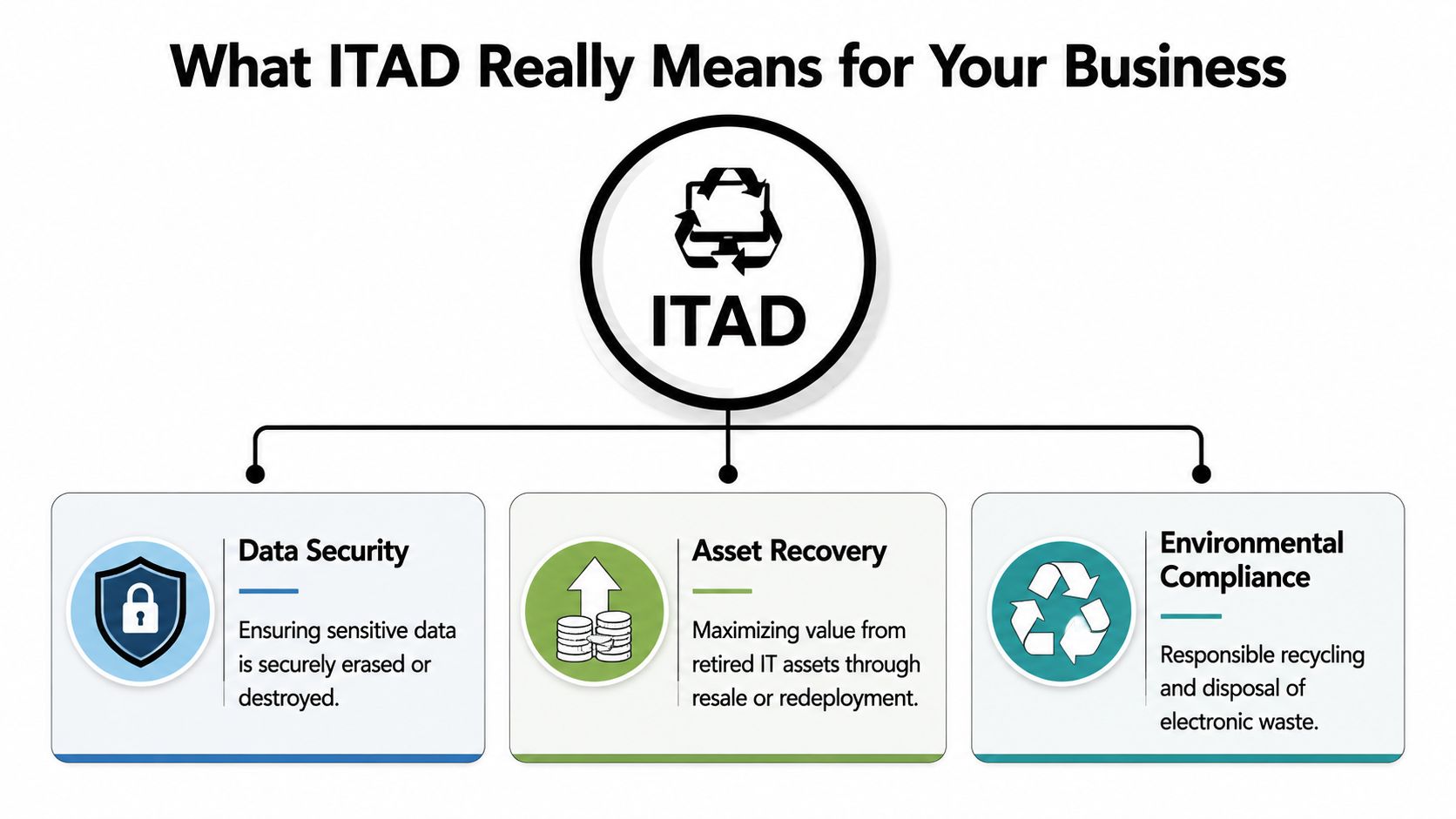
Data security comes first
Every serious ITAD program starts with storage media. That includes laptops, desktops, servers, backup devices, and anything else that may hold data. If the sanitization method doesn't match the media type and risk level, everything else in the process is window dressing.
Asset recovery changes the economics
A good ITAD project doesn't assume every retired asset belongs in the shred stream. Some equipment has reuse value. Some has parts value. Some should be redeployed internally. The wrong disposition decision destroys value that could have offset service costs.
Environmental handling still matters
Recycling is part of ITAD, but it's the final path for assets that can't be reused or harvested responsibly. For commercial clients, the actual standard isn't whether a vendor says “we recycle.” It's whether they can show where assets went and why that path was selected.
Think of ITAD as a controlled exit process for technology. A mover transports boxes. An ITAD provider is supposed to transport data-bearing assets, preserve chain of custody, direct equipment into the right downstream channel, and leave documentation behind.
For teams that need a baseline definition before comparing vendors, this overview of IT asset disposition is a useful starting point.
A scrap hauler removes clutter. An ITAD partner should remove liability.
The End-to-End ITAD Process Explained
A professional project should feel boring in the best possible way. Every step should be documented, repeatable, and easy to audit later.
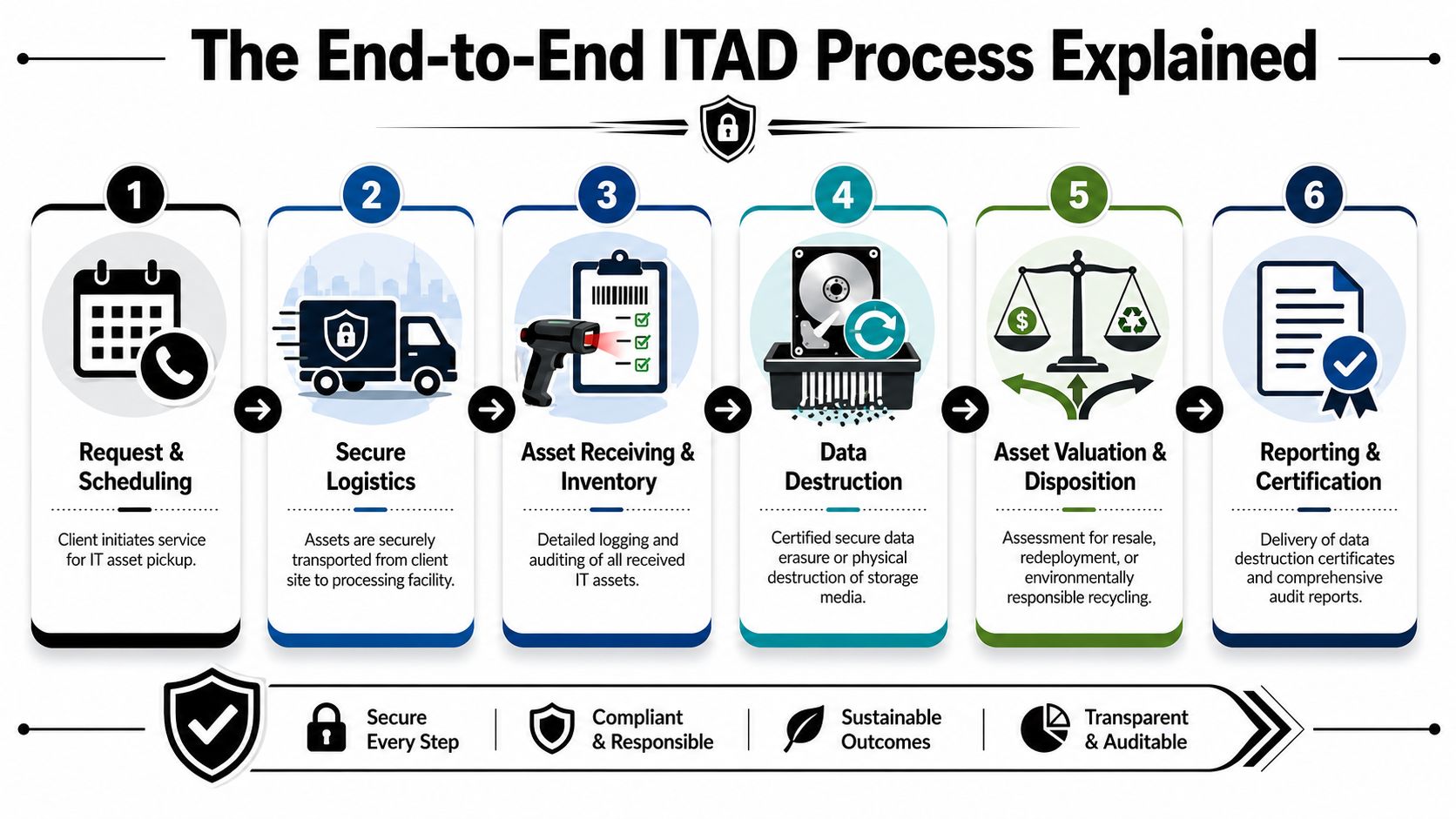
Planning and scope
The work starts before pickup. Someone needs to define locations, asset types, whether work happens onsite or offsite, who signs custody documents, and which devices require physical destruction versus sanitization for reuse.
In the Atlanta market, a standard enterprise ITAD project can take about 5 to 10 weeks end to end, including 1 to 2 weeks for planning, 1 to 4 weeks for onsite execution, 2 to 3 weeks for off-site processing, and about 1 week for final reporting. If a vendor promises a complex decommission in almost no time, ask what they're skipping.
Pickup and custody transfer
Many weak programs fail. Assets leave a site, but records don't clearly show what was picked up, in what quantity, under whose control, and in what condition. For multi-floor offices or data center exits, that gap gets larger fast.
A disciplined handoff usually includes:
- Pickup authorization based on scope and site contacts.
- Manifest creation so equipment leaving the building is recorded.
- Controlled loading to prevent mix-ups between retained and retired gear.
- Transport documentation so the receiving facility can reconcile what arrived.
Receiving and triage
Once assets reach a processing point, the provider should reconcile actual received items against the pickup record. Then comes triage. Working systems with resale potential should be separated from equipment that requires destruction or material recovery.
Clients lose money when the provider uses blanket rules. “Shred everything” is easy. It's rarely the smartest outcome.
The best intake teams sort by model, age, and storage type before making destruction decisions.
Sanitization or destruction
At this stage, devices follow the approved path. Some media are wiped and verified. Some are degaussed. Some drives are shredded. The key is that the method should match the media and the reuse or non-reuse objective.
Final reporting
The final package should close the loop. That means inventory-level reporting, destruction records where applicable, and recycling documentation for downstream handling. If reporting is vague, your liability transfer is vague too.
Navigating Data Destruction and Compliance in Georgia
Data destruction isn't one decision. It's a control framework. The right question isn't “Do you wipe drives?” It's “Which sanitization outcome fits this media, this data class, and this disposition path?”
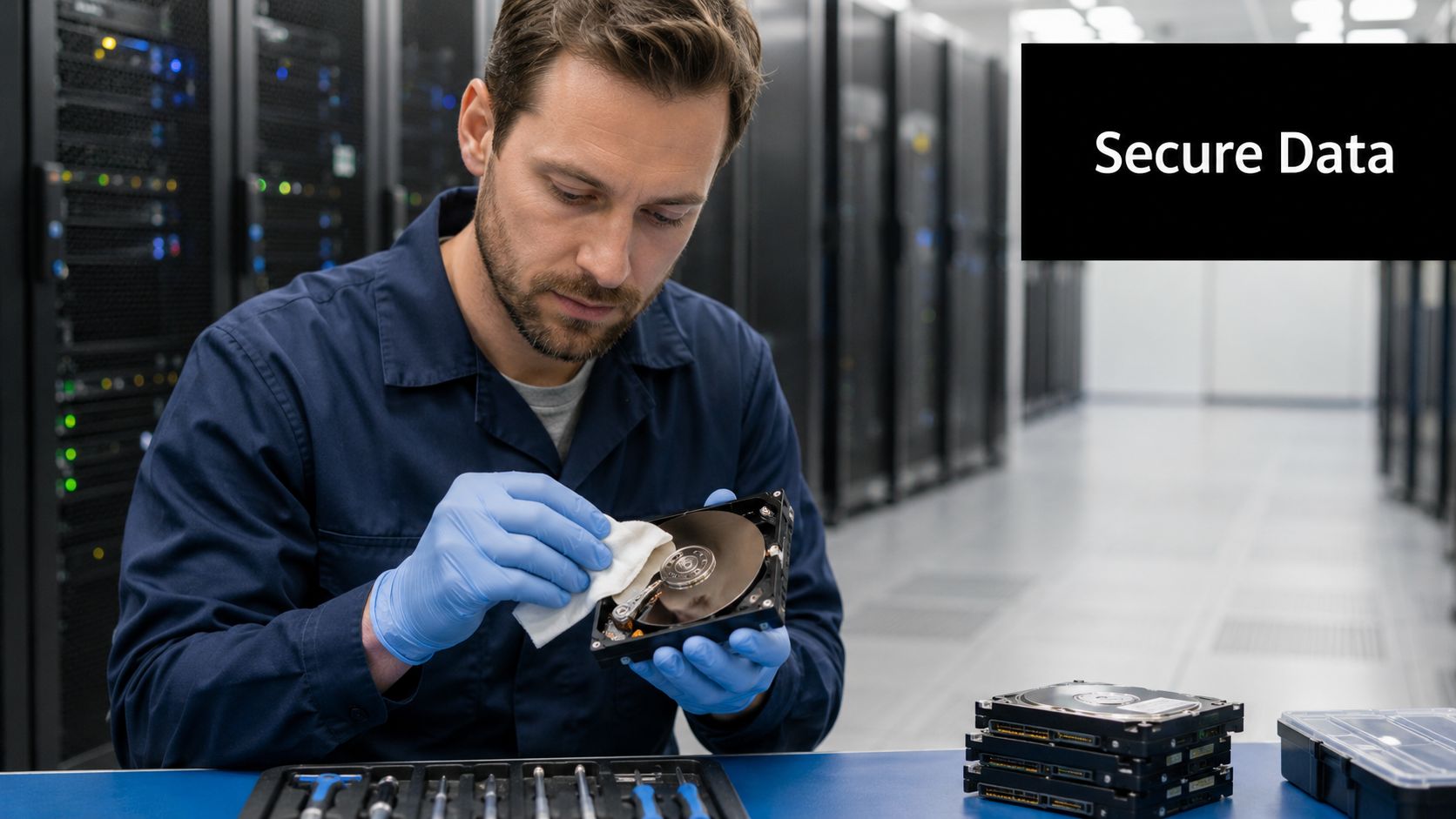
Clear purge and destroy
That matters in practice:
- Clear: Often used when risk is lower and reuse is intended, if the media supports that method appropriately.
- Purge: Used when stronger sanitization is needed while preserving the possibility of reuse in some cases.
- Destroy: Best when the risk profile, media behavior, or policy requirement makes reuse unacceptable.
Why one-size-fits-all fails
A provider that applies one wipe standard to everything is taking a shortcut. Magnetic media, SSDs, flash devices, and failed drives don't behave the same way. If your environment includes healthcare, finance, education, or government data, that shortcut can create a compliance problem long after the project is over.
What works is media-specific handling tied to inventory records. Each drive or device should have a documented serial number, assigned destruction or sanitization method, and certificate-level evidence.
For teams standardizing policy, NIST SP 800-88 guidance for data sanitization is the right benchmark to build around.
Control point: The sanitization method should be selected before disposition, not after a truckload arrives.
Criteria for Choosing Your Atlanta ITAD Partner
Most vendor evaluations focus too much on pickup price and not enough on liability transfer. That's backwards. Cheap disposal becomes expensive if your records don't hold up under an audit, breach review, or internal investigation.
The essential starting point is: the foundation of a secure ITAD program is chain-of-custody discipline, and a single missing handoff or incomplete inventory record can break liability transfer
What to ask before you sign
Ask direct questions. A qualified vendor should answer them plainly.
- How do you document pickup? You want signed manifests and clear site-level procedures.
- Do you track by serial number or only by pallet count? Serial-level reporting is much stronger.
- Which assets are candidates for remarketing? If they can't explain triage logic, expect unnecessary destruction.
- What proof do you provide after processing? Certificates matter, but so do detailed reports.
- Can you support onsite work if required? Some projects need destruction or decommission support at the facility.
ITAD partner evaluation checklist
| Criteria | Why It Matters |
|---|---|
| Chain of custody | It protects liability transfer from pickup through final processing. |
| Serialized inventory | It gives you asset-level accountability instead of batch-level assumptions. |
| Media-specific sanitization | It reduces the risk of using the wrong destruction method for the device. |
| Reporting quality | It determines whether you can prove what happened later. |
| Remarketing capability | It affects whether assets become recovered value or unnecessary scrap. |
| Downstream transparency | It shows whether environmental claims are backed by documentation. |
| Project support | It matters for office moves, refreshes, and data center work that need coordination. |
A practical buying tool is a formal ITAD vendor due diligence checklist. Use it before procurement turns this into a quote-only exercise.
Why Atlanta Businesses Choose Beyond Surplus
Atlanta buyers increasingly ask what happens after pickup, not just during it. That's a sign the market is maturing. Security teams want documented destruction. Sustainability teams want downstream visibility. Procurement wants a vendor that can support distributed locations without losing control of the record trail.
That's also why Atlanta businesses increasingly demand traceability and proof of responsible downstream processing, and Beyond Surplus addresses that with R2-certified processes that document whether assets are reused domestically, exported, or recycled. For a local IT director, that solves a problem many basic recycling vendors still leave unanswered.
The practical advantage is control. An Atlanta-area provider with local processing access, data destruction options, reporting, and pickup coordination can support everything from an office refresh to a staged decommission. For organizations with multiple sites, Beyond Surplus Georgia services also reflect the reality that many Atlanta-based businesses operate well beyond one building or one metro area.
Buyers don't need more recycling promises. They need proof of custody, proof of sanitization, and proof of downstream handling.
Frequently Asked Questions About Atlanta ITAD Services
Does ITAD always cost more than recycling
Not necessarily. The wrong comparison is fee versus no fee. The right comparison is documented risk transfer and potential value recovery versus undocumented disposal. If usable assets are separated for resale or parts harvesting, that can change the net cost of the project.
Can you handle data center decommissioning work
Yes, if the provider has a process for planning, inventory, onsite execution, secure logistics, and final reporting. Data center work is less forgiving than standard office cleanouts because the asset density is higher and the impact of inventory mistakes is larger. Ask how they handle serialized equipment, storage media, and phased removal windows.
Do we need to transport equipment ourselves
Usually no. Most commercial ITAD engagements are built around scheduled pickup and coordinated logistics. That's the safer model because it preserves custody control from the first handoff. For larger projects, the provider should also help define site contacts, loading procedures, and the documentation used at pickup.
Secure Your Assets and Protect Your Business Today
Retired IT equipment doesn't stop being your problem because it left the office. It stops being your problem when data has been sanitized correctly, custody has been documented, and the final disposition is backed by reporting you can defend. That's the difference between basic recycling and real ITAD services in Atlanta.
If you're clearing a backlog, planning a refresh, or preparing a decommission, treat disposition as a security and compliance project, not a cleanup task.
Contact Beyond Surplus for certified electronics recycling and secure IT asset disposal.


