

Georgia IT teams often hit the same wall at the same time. A storage room fills with retired laptops, a rack of aging servers gets pulled during an upgrade, and a stack of failed drives sits waiting for a decision nobody wants to make quickly. The risk isn't the hardware itself. The risk is what's still on it, how it leaves the building, and whether anyone can prove what happened next.
That pressure is sharper in Georgia because the equipment volume keeps rising. The state ranked second nationally in data-center investment in the past year, behind only Northern Virginia, which means more servers, storage, and networking gear eventually enter the retirement pipeline, according to Georgia data center investment coverage. For an Atlanta-area IT manager, secure disposal is no longer a side task for the facilities team. It's part of infrastructure lifecycle management.
Your Guide to Secure IT Asset Disposal in Georgia
An ordinary cleanout can turn into a security event fast. A branch office closes. A hospital refreshes workstations. A finance team replaces encrypted laptops. Someone asks for pickup “by Friday,” but nobody has a final asset list, nobody has confirmed which drives still contain regulated data, and nobody has decided whether the gear should be wiped, shredded, remarketed, or recycled.
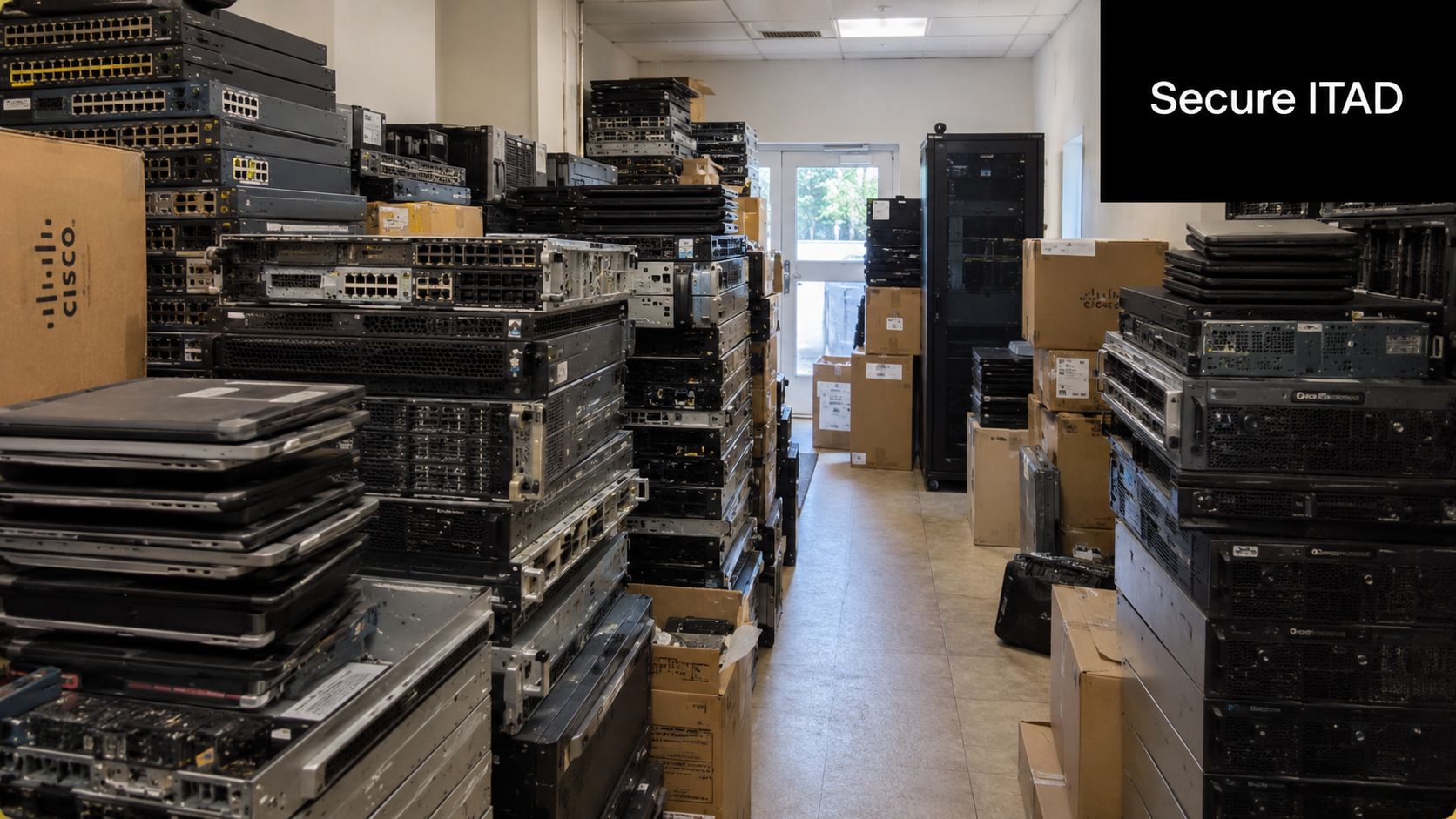
That's where many Georgia organizations make the first mistake. They treat end-of-life equipment as junk removal. IT asset disposition is different. It combines data security, disposition planning, documentation, and environmental handling into one controlled process. If you need a local starting point, Georgia IT recycling services should be evaluated as an IT and compliance function, not just a hauling service.
What usually goes wrong
Three failures show up again and again:
- No asset-level visibility. Teams know they have “about two pallets” of equipment, but not which units contain drives or which assets belong to leased programs.
- No clear destruction standard. A vendor says data will be handled securely, but can't explain whether the method is sanitization, shredding, or both.
- No audit trail. Equipment leaves the dock with a packing slip instead of a serialized manifest.
Practical rule: If your organization can't match each retired device to a final outcome, your disposal process is built on trust instead of proof.
Why this matters in Georgia
Georgia businesses operate in a market with heavy infrastructure turnover, especially around Atlanta. That creates a practical need for ITAD programs that can handle one office move, recurring refresh cycles, or full data center decommissions without improvisation. The right process protects data, captures any residual value that still exists, and keeps unusable hardware out of landfill channels.
Decoding ITAD Services for Georgia Businesses
A full ITAD program includes more than recycling trucks and destruction bins. It's a chain of decisions that starts with inventory and ends with documented final disposition. That's one reason the service category has matured so quickly. One market estimate valued the U.S. ITAD market at $2.66 billion in 2022 and projected $4.90 billion by 2032, with a 6.2% CAGR, according to U.S. ITAD market research.
What ITAD includes
The simplest way to understand it is to separate the work into four operating layers:
Asset identification
The provider records what exists, what condition it's in, and which assets contain data-bearing media.Data sanitization or destruction
Devices are either wiped to an accepted standard, physically destroyed, or routed by sensitivity level.Value recovery
Reusable equipment may be tested, refurbished, and remarketed if the economics and risk profile make sense.Recycling and downstream handling
Non-reusable equipment is dismantled and processed through compliant recycling channels.
For a deeper primer, what IT asset disposition means in practice is less about disposal alone and more about controlled end-of-life management.
What ITAD is not
ITAD is not a generic e-waste pickup where mixed electronics disappear into an opaque process. That model fails regulated organizations because it doesn't answer the questions auditors, legal teams, and security officers ask later.
A recycler may be able to remove equipment. An ITAD partner should also be able to explain:
- which assets were sanitized,
- which were destroyed,
- which were remarketed,
- and which were recycled as scrap.
Secure ITAD works when operations, compliance, and finance all get what they need from the same workflow.
Where businesses get better results
The best programs don't wait until storage rooms are full. They set rules in advance by asset class. Laptops may be wiped and remarketed if they meet policy. Failed SSDs may go straight to shredding. Network gear may be evaluated for resale only after confirming no embedded storage remains. That kind of sorting is what separates a recoverable process from an expensive scramble.
Navigating Georgia's Compliance and Data Security Rules
The legal issue isn't whether an old device looks harmless. The issue is whether it still contains information your organization had a duty to protect. If it does, disposal becomes a compliance event.
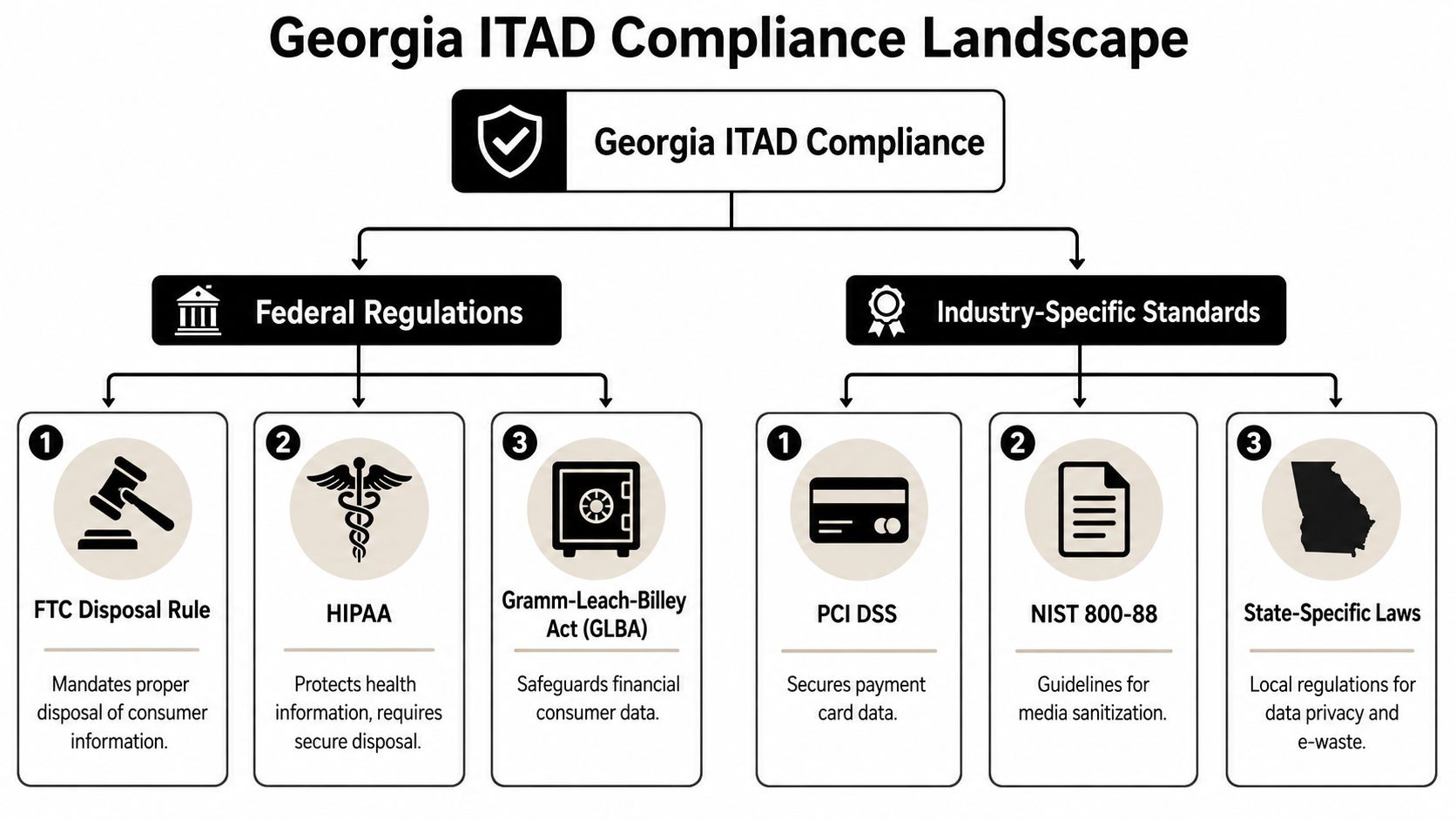
The rules that shape disposal decisions
Georgia businesses usually face a mix of federal requirements, industry rules, and internal governance controls. The exact combination depends on sector.
- Healthcare organizations need disposal practices that protect health information.
- Financial institutions need controls around customer financial data.
- Retail and payment environments need disciplined handling of systems that may contain payment-related data.
- Public sector and education often need stronger documentation and procurement-grade audit trails.
The disposal method should follow the risk, not convenience. If the device contains highly sensitive data and the organization won't accept transport risk, on-site destruction may be the right call. If the equipment set is large, mixed, and operationally difficult to process in place, off-site handling can work, but only if custody and certification are tight.
Standards matter when policies get tested
Many internal policies point back to media sanitization guidance such as NIST SP 800-88, because it gives teams a disciplined framework for deciding when to clear, purge, or destroy media. That matters during audits, but it matters even more after a disposal dispute. If a former asset resurfaces or an incident review begins, vague language like “disposed of securely” won't help much.
Disposal policy should answer one practical question for every asset class: can this media be sanitized defensibly, or should it be destroyed?
What doesn't hold up
These habits create exposure:
- Mixing regulated and non-regulated assets in one removal stream without classification.
- Relying on verbal assurances instead of signed process records.
- Assuming encryption alone solves retirement risk. Encryption helps, but it doesn't replace custody control or documented disposition.
- Using a vendor that can't map final outcomes to specific devices.
Organizations that treat disposal as a legal hold issue, not a janitorial issue, tend to avoid the worst mistakes.
On-Site Versus Off-Site Data Destruction Methods
This is usually the most contested decision in an ITAD project. Security wants maximum control. Operations wants speed. Finance wants a process that doesn't inflate cost without improving the outcome.
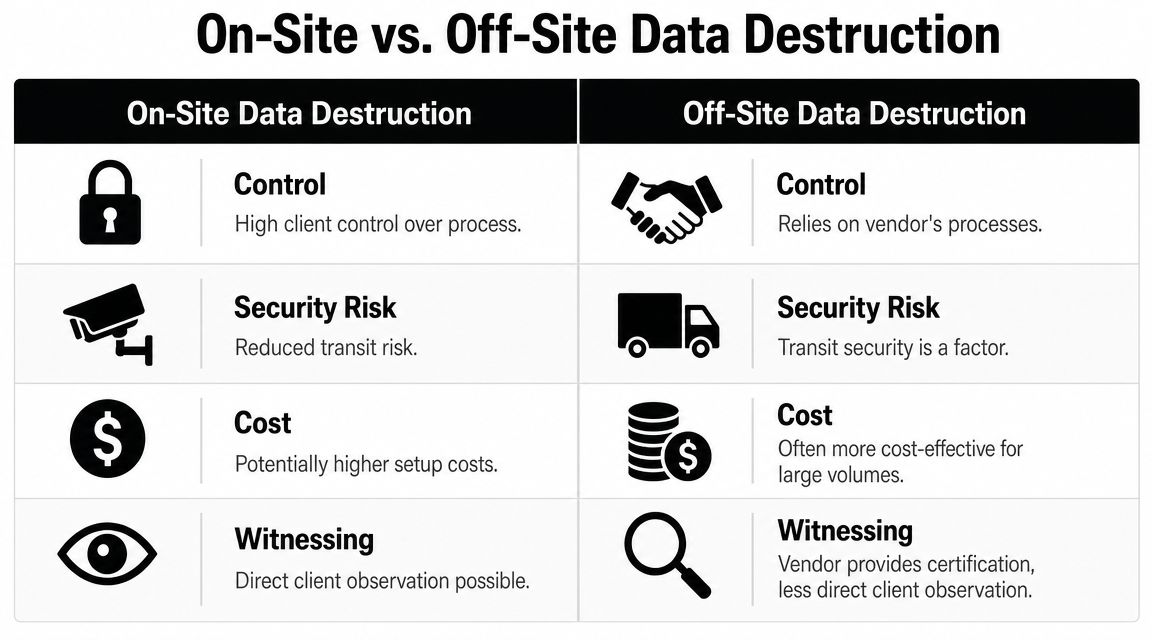
When on-site destruction makes sense
On-site destruction gives your team immediate visual control. Drives are destroyed before they leave the premises, which reduces one specific concern: transport of intact media.
This option usually fits situations such as:
- Highly sensitive environments where leadership wants witnessable destruction
- Incident response or urgent decommissioning where speed and direct oversight matter
- Facilities with strict access controls that don't want intact media crossing the dock
On-site service can also simplify internal signoff. Security, compliance, and facilities can observe the same event and close the loop together. For organizations reviewing on-site data destruction in Georgia, the key operational question is whether your site can support the workflow cleanly and safely.
When off-site processing is the better fit
Off-site destruction is often the more practical choice for large, multi-category loads. A specialized facility can process mixed equipment, separate reusable hardware from scrap, and apply different downstream paths without trying to do everything in a parking lot or loading area.
Off-site usually works well when:
- The project includes more than drives, such as servers, laptops, switches, and peripherals
- You want value recovery on some assets and destruction on others
- The site lacks space or scheduling flexibility for mobile destruction operations
The trade-off is obvious. Once assets leave your site, your confidence depends on custody controls and vendor discipline.
A simple decision table
| Decision factor | On-site destruction | Off-site destruction |
|---|---|---|
| Witnessing | Strong | Limited to documentation and process transparency |
| Transport risk for intact media | Lower | Higher if media leaves site intact |
| Efficiency for mixed loads | Moderate | Strong |
| Support for value recovery | Limited during event | Better in facility workflow |
| Site coordination burden | Higher | Lower |
If the debate stalls, split the stream. Destroy the highest-risk media on-site and send lower-risk, non-media equipment into a documented off-site process.
What works in practice
The strongest programs don't force one method onto every asset. They tier by risk. Failed drives, executive laptops, and regulated storage media may be physically destroyed. Newer enterprise hardware with resale value may be wiped, tested, and processed off-site under a documented chain of custody. That hybrid model is often more defensible than choosing a single method for everything.
The Critical Role of Auditable Documentation
A secure disposal event that can't be proven is weak protection. Documentation is what turns process into evidence.
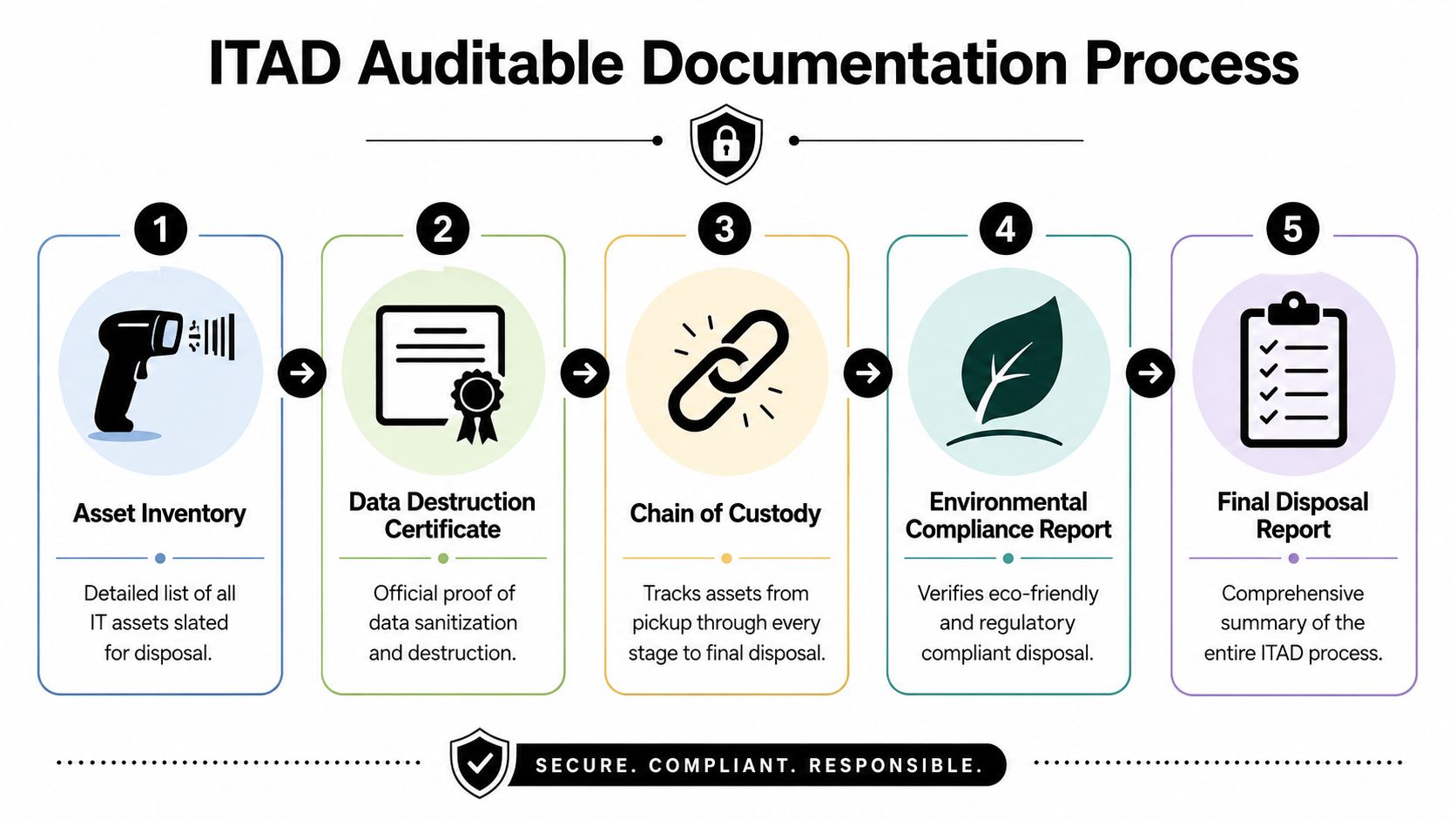
For Georgia organizations, the most defensible control is a serialized chain of custody. Each device should be inventoried by asset tag or serial number before removal, classified by data sensitivity, and transferred under a signed custody record. A compliant Certificate of Destruction should mirror that manifest, according to guidance on Atlanta data destruction and serialized custody.
The documents that matter most
A strong ITAD file usually contains several layers of proof:
- Pickup manifest with asset identifiers and counts
- Transfer-of-custody record signed at handoff
- Destruction certificate tied back to serialized assets
- Recycling documentation for non-reusable material
- Exception log for assets that were missing tags, failed intake, or required alternate handling
If your provider offers hard drive destruction certificates, check whether the certificate ties back to a serialized list or only confirms that a batch was processed. The difference matters.
Why serial-level tracking wins
Serial tracking does two jobs at once. It reduces security ambiguity, and it improves financial sorting. Teams can identify which assets should be wiped and resold, and which should move directly to destruction.
That's more useful than generic batch handling because batch handling creates dead zones. You may know that “a pallet of laptops” was processed, but not which one belonged to the CFO, which one contained regulated data, or which one still had market value.
Audit-ready ITAD records should let you answer a narrow question fast: what happened to this exact device?
Red flags in vendor paperwork
Watch for these warning signs:
- Certificates without serialized references
- Pickup tickets that don't identify data-bearing assets
- Different device counts across manifest and final report
- No separation between destruction records and recycling records
When counsel, auditors, or insurers ask for disposal proof, documentation quality becomes the story.
Maximizing Value Recovery and Streamlining Logistics
Not every retired asset belongs in the shred bin. Some still hold resale value. Others are technically wipeable but operationally awkward to remarket. That gray area is where many organizations lose money or create unnecessary risk.
Decide by asset class, not by habit
A sound value recovery process starts with triage.
- Current business-grade laptops and desktops may justify wiping, testing, and resale if condition and specs support demand.
- Servers and network gear can be worth remarketing, but only after confirming configuration, generation, and whether embedded storage changes the risk profile.
- Failed, obsolete, or damaged units often move faster and more safely into parts recovery or recycling.
The hard cases are the ones in between. Industry guidance has started paying more attention to equipment that is still valuable but not easily remarketable in 2026, including encrypted SSDs, mixed-generation servers, and AI-adjacent systems. At the same time, global e-waste reached 62 million tonnes in 2022, and only 22.3% was formally collected and recycled, according to ITAD guidance discussing the e-waste challenge. That makes the recovery decision more important, not less.
A practical decision rule
Use three filters before approving resale:
Can the data be sanitized defensibly?
If the answer is uncertain, don't force remarketing.Is there enough residual value to justify labor, testing, and handling?
Some equipment still has value on paper but not enough to support the process cost.Does remarketing create support or reputation risk?
Mixed-condition devices, odd configurations, and weak secondary demand can turn a theoretical recovery opportunity into a delay.
A lot of Georgia teams do better when they stop asking, “Can this be sold?” and ask, “Should this be sold?”
Logistics often decide whether the program works
Even good disposition policies fail when collection is disorganized. Multi-site businesses need pickup planning, site contacts, packing instructions, and a way to separate assets by disposition path before the truck arrives. A provider such as Beyond Surplus can handle pickups, secure transportation, certificates of recycling and data destruction, and IT buyback workflow for commercial loads, which helps when your assets are spread across offices, clinics, campuses, or data halls.
The operational aim is simple. Keep the project from becoming a burden on the internal IT team. When pickups, manifests, and downstream decisions are coordinated well, retirement work stops interrupting production work.
Implementing Your Georgia ITAD Program with Beyond Surplus
The cleanest ITAD programs in Georgia usually share one trait. They don't improvise at the moment of pickup. They set policy before the first asset moves.
What that looks like by sector
A healthcare group may prioritize strict media handling and role-based approvals because device retirement touches protected information. A financial firm may focus on destruction controls, custody records, and branch-level consistency. A university may need a repeatable process for labs, offices, and departmental storage rooms, where equipment condition varies widely. A manufacturer may care just as much about logistics and product destruction as about standard office electronics.
The details change, but the operating model doesn't. Classify assets, assign a disposition path, control custody, and keep records that stand up later.
A workable rollout plan
Start with a short internal review:
- Identify asset categories that your organization retires most often
- Define default paths for each category, such as wipe, destroy, resell, or recycle
- Assign approvals for exceptions
- Standardize paperwork so every pickup follows the same evidence trail
- Choose a service cadence that fits refresh cycles instead of waiting for overflow
That approach turns ITAD into a managed business process instead of a periodic cleanup project. It also reduces the conflict between compliance, operations, and finance because each group can see where its requirements fit.
A Georgia IT manager doesn't need a complicated framework. You need a defensible one.
Contact Beyond Surplus to schedule secure IT asset disposal, data destruction, electronics recycling, and value recovery support for your Georgia organization.


