
For businesses all across the Peach State, managing retired technology is no longer a simple disposal task—it's a critical operational challenge. Professional Georgia IT recycling services offer a secure, compliant, and strategic solution for handling outdated servers, laptops, and networking gear. This guide will detail how partnering with a certified expert like Beyond Surplus protects your company from data breaches and regulatory fines while supporting a sustainable, circular economy.
Why Georgia Businesses Need Specialized IT Recycling
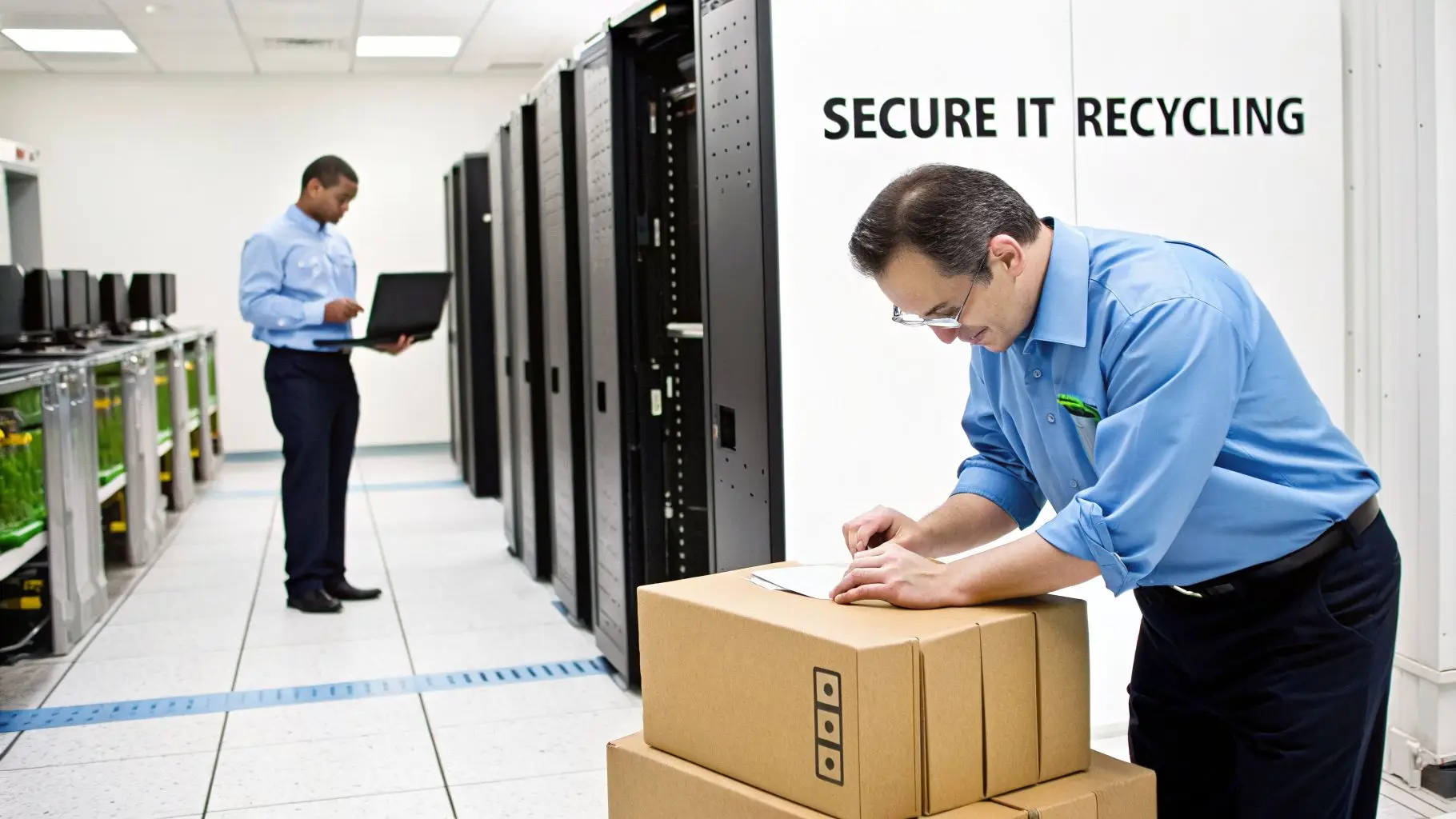
As Georgia's technology and data center industries expand, so does the volume of retired IT hardware. This electronic waste stream represents a significant business risk. Improper disposal of old assets can expose your organization to devastating data breaches, steep regulatory penalties, and brand damage.
That’s why professional IT Asset Disposition (ITAD) has become an essential business strategy, not just a cleanup chore. It transforms a potential liability into a secure, well-managed process focused exclusively on commercial and enterprise needs.
The Impact of Georgia's Data Center Boom
The state’s booming data center industry is a major driver for advanced IT equipment disposal solutions. In the past year, Georgia attracted the second-largest investment in data centers nationwide. This growth creates a constant cycle of outdated servers, storage arrays, and network gear that must be managed securely at the end of its useful life.
With hardware refresh cycles often as short as two to three years, the sheer volume of e-waste generated by enterprises is staggering.
Choosing a certified ITAD partner is essential. It ensures your outdated equipment is handled with a documented chain of custody, protecting your sensitive information and guaranteeing compliance with all relevant regulations.
Neglecting a formal disposal plan for old hard drives and servers leaves your business vulnerable. The risks associated with improper electronics disposal are too significant for any organization to ignore.
Here's a breakdown of the major risks Georgia businesses face when they neglect professional ITAD services.
Key Risks of Improper IT Asset Disposal for Georgia Businesses
| Risk Category | Description | Potential Business Impact |
|---|---|---|
| Data Breaches | Leaving sensitive corporate, employee, or customer data on discarded hard drives and servers. | Severe reputational damage, loss of customer trust, costly legal battles, and potential identity theft. |
| Regulatory Fines | Failing to comply with laws like the FTC Disposal Rule, HIPAA, or FACTA that mandate secure data destruction. | Steep financial penalties from federal and state agencies, which can run into thousands or even millions of dollars. |
| Environmental Non-Compliance | Disposing of e-waste in landfills, which contain hazardous materials like lead, mercury, and cadmium. | Fines for violating environmental laws, negative PR, and contributing to soil and water contamination. |
| Loss of Asset Value | Disposing of equipment that still has resale or component value without attempting to recover it. | Missed revenue opportunities that could have offset the cost of new equipment or the disposal process itself. |
These risks are substantial, but they are entirely avoidable with a qualified partner and a documented disposal strategy.
From Risk Management to Strategic Advantage
A professional ITAD program offers more than just electronic waste pickup; it provides a multi-layered defense for your business. For any company in Georgia, understanding the growing need for specialized IT recycling, often called E-Waste Recycling, is key to managing electronic waste responsibly.
Here’s how a certified partner like Beyond Surplus delivers value:
- Data Security: We guarantee sensitive corporate and customer information is permanently destroyed, meeting strict standards like the FTC Disposal Rule and HIPAA.
- Regulatory Compliance: You receive all necessary documentation, including Certificates of Destruction, to prove your organization met every legal requirement and protect you from fines.
- Value Recovery: We identify any assets with remaining market value, turning your retired equipment into a revenue stream through our buyback or revenue-sharing programs.
- Environmental Responsibility: We ensure every piece of equipment is recycled or disposed of according to strict environmental standards, keeping hazardous materials out of landfills.
Securing Your Data Through Compliant IT Disposal
What happens to the sensitive information on your company’s retired hard drives? Simply deleting files or reformatting a drive is insufficient. That’s the digital equivalent of leaving confidential documents in an unlocked filing cabinet on the curb. Secure data destruction is a non-negotiable step in any professional IT disposal process.
Proper data elimination isn't just a best practice—it's your frontline defense against devastating data breaches and a core part of regulatory compliance. Without it, your business is exposed to significant financial penalties and reputational damage that can be impossible to repair.
Methods That Guarantee Data Elimination
When ensuring data is permanently irrecoverable, two primary methods meet the highest security standards. Any certified partner offering Georgia IT recycling services will provide these options to ensure your information is completely destroyed.
Data Wiping (Sanitization): This is a software-based approach that overwrites every sector of a hard drive with random data, making the original information completely unrecoverable. Professional services use software that meets or exceeds the NIST 800-88 standard, a set of guidelines from the National Institute of Standards and Technology for media sanitization.
Physical Shredding: For the ultimate level of security, or for drives that are non-functional, physical destruction is the solution. Industrial-grade shredders grind hard drives, solid-state drives (SSDs), and other storage media into small, mangled fragments, making it physically impossible to recover any data.
The choice between these methods depends on your organization's internal security policies and whether the drives have potential resale value. Wiping preserves the drive's physical integrity and value, while shredding offers the most absolute and final form of destruction.
A Certificate of Data Destruction is not just a piece of paper; it is your legal proof of compliance. This document officially transfers liability for the disposed assets from your organization to your ITAD partner and serves as a crucial audit trail.
Compliance and Your Legal Protection
Numerous federal and state regulations mandate the secure disposal of sensitive information. Failure to comply can lead to crippling fines and legal consequences. Key regulations that impact Georgia businesses include:
HIPAA (Health Insurance Portability and Accountability Act): This requires any organization handling patient health information to protect it, even on digital media designated for disposal.
Sarbanes-Oxley (SOX): This applies to financial data and corporate records, requiring secure data management from creation until final destruction.
FTC Disposal Rule: This rule mandates that businesses must take appropriate, reasonable measures to dispose of sensitive information gathered from consumer reports.
A professional ITAD provider is an expert in these regulations. For businesses that must maintain a flawless compliance record, exploring certified data destruction services in Georgia is an essential move. The documentation you receive from a certified partner, like a Certificate of Destruction, is your verifiable proof of compliance, shielding your business from liability and providing complete peace of mind.
Mapping the Journey of Your Retired IT Assets
The moment your old equipment leaves your facility, the primary concern should be its security and destination. A professional IT Asset Disposition (ITAD) workflow answers that with a clear, documented process that protects your business from start to finish. Let's examine how certified Georgia IT recycling services handle retired commercial assets with the precision required by enterprises.
This entire journey is built around one critical concept: chain of custody. This is an unbroken, documented trail that follows every single asset from your location to its final disposition. It’s this meticulous tracking that distinguishes professional ITAD from a simple pickup service, providing a solid audit trail for compliance and security.
The Initial Steps: On-Site Logistics and Secure Transport
The process begins at your facility. A true ITAD partner arrives prepared to securely manage the entire asset transfer.
- On-Site Inventory: Every asset—from servers and laptops to individual hard drives—is cataloged and assigned a unique serial number. This initial scan establishes the first link in the chain of custody.
- Secure Packing: Your equipment is then carefully packed into locked, sealed containers. This prevents tampering during transit and protects the assets.
- Secure Transport: Finally, the assets are moved in GPS-tracked vehicles operated by vetted, uniformed drivers, ensuring a secure journey from your location to the processing facility.
This initial phase is crucial. By documenting all equipment before it leaves your building, your ITAD partner officially assumes liability, allowing your team to focus on core business functions.
The diagram below illustrates the data destruction phase, one of the most critical steps in the entire journey.
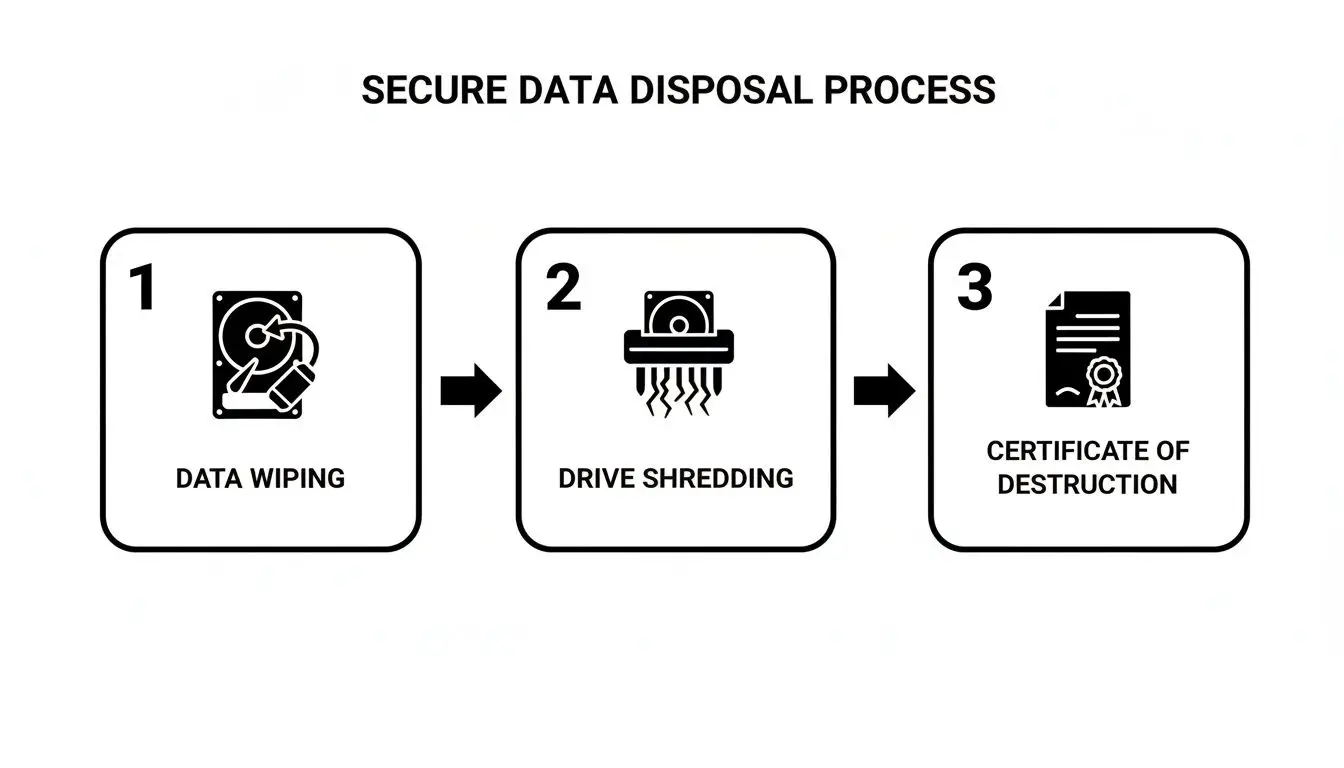
As shown, data is first wiped using industry-standard methods. For ultimate security, drives are then physically shredded, and the entire process is validated with a formal certificate.
Facility Processing and Final Reporting
Once your equipment arrives at a certified facility, the processing work begins. The first step is to reconcile the shipment against the initial inventory, confirming the chain of custody remains intact.
The heart of any effective ITAD process is transparency. You should expect detailed, serialized reporting that accounts for every single asset, from pickup to final disposition, and always includes a Certificate of Data Destruction.
From there, technicians sort the equipment. Assets marked for data destruction are processed according to your specifications—whether that’s a NIST 800-88 compliant wipe or complete physical shredding. Equipment slated for recycling is carefully de-manufactured into its base materials like metals, plastics, and circuit boards in an environmentally compliant manner.
To close the loop, you receive a complete report detailing the final disposition of every asset. This documentation is your proof of compliance and the final step in responsible IT lifecycle management. To see how these stages fit into a broader strategy, you can learn more about our complete IT lifecycle management in Georgia and how it keeps your business secure.
Turning Old Tech Into New Revenue
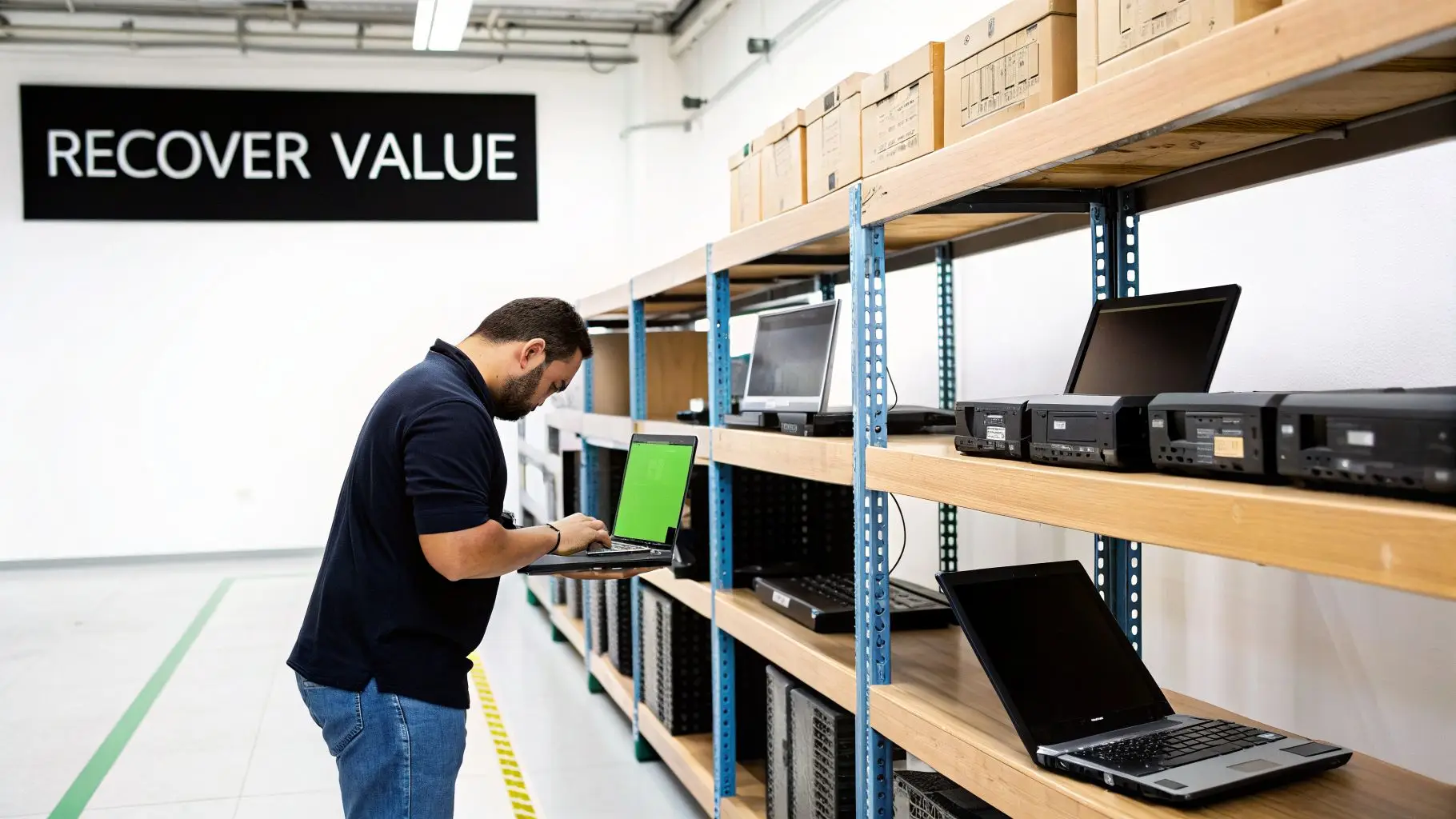
That inventory of retired IT equipment doesn't have to be a disposal cost. For businesses across Georgia, it represents a hidden revenue stream. The paradigm for Georgia IT recycling services is shifting—it's no longer just about cost and compliance, but about strategic financial recovery.
Instead of simply paying for electronic waste pickup, a qualified IT Asset Disposition (ITAD) partner can help you tap into the remaining value of your assets. Through buyback programs or revenue sharing, what was once a logistical and financial burden can directly improve your bottom line.
Finding the Gold in Your Inventory
Not all retired equipment is destined for the shredder. A significant amount of IT hardware retains resale value, especially if it’s a recent model and in good condition. A professional ITAD partner has the market expertise to identify these valuable assets.
Here are a few examples of commercial equipment that often hold their value:
- Enterprise-Grade Servers: Newer models from top brands are consistently in demand for refurbishment or parts harvesting.
- Networking Gear: High-end switches, firewalls, and routers can be redeployed in another company's network infrastructure.
- Corporate Laptops and Desktops: Business-class computers, even those a few years old, are highly marketable when refurbished and sold in bulk.
- Data Center Components: Individual parts like CPUs, enterprise SSDs, and RAM can have significant standalone value.
The key is to work with a partner who understands the secondary IT market and can provide an honest, accurate assessment of your equipment's worth.
The Evaluation and Resale Process
Once valuable items are identified, they undergo a transparent evaluation and resale process. This includes testing each device for functionality, wiping all data according to strict NIST standards, and preparing it for the secondary market. A qualified partner manages this entire workflow for you.
The financial benefit is substantial. Reusing equipment not only extends its life but can also help you recover up to 40-60% of its original cost. This generates cash flow and eliminates disposal fees that can amount to thousands of dollars. It’s why certified vendors like Beyond Surplus are critical—we provide nationwide pickups and the transparent documentation that protects your business from liability.
Your old technology transforms from a liability into a liquid asset. By exploring our specialized IT equipment resale services in Georgia, you can see how we tailor this process to maximize your return. It's a simple way to help fund new equipment purchases and turn your ITAD program into a financial success.
How Your Choice Supports Georgia's Green Economy
Partnering with a local IT recycler does more than protect your business—it actively fuels Georgia's growing leadership in the national circular economy. When you choose a certified provider for your Georgia IT recycling services, your decision creates a ripple effect that supports job creation, innovation, and sustainable infrastructure within the state.
This is more than just recycling; it's about building a self-sustaining system where your retired assets become valuable commodities. These materials feed a local supply chain, reducing the need for virgin raw materials and keeping resources within Georgia's economy. This approach transforms what was once considered waste into a driver of both economic and environmental progress.
Fueling Statewide Investment and Job Growth
Georgia is rapidly becoming a hub for advanced recycling and sustainable manufacturing. In the last year alone, the state's recycling sector has experienced explosive growth, with 10 major projects announced that are injecting over $1.8 billion in new investments and set to create 1,230 high-quality jobs.
This wave of development includes everything from biodegradable packaging to state-of-the-art facilities for recycling electronics and lithium-ion batteries. For example, Igneo Technologies is building an $85 million electronics recycling plant in Savannah specifically to extract valuable metals from IT hardware, underscoring the state's commitment to a sustainable future.
By selecting a Georgia-based ITAD partner, your business directly contributes to this positive momentum. Your choice ensures that the value recovered from your old equipment—both financially and materially—is reinvested locally, strengthening our state's position as a forward-thinking leader in sustainability.
The connection between responsible IT disposal and statewide economic health is powerful. It aligns your company's operational needs with a larger mission of environmental stewardship and innovation. You can dive deeper into how your business can participate by reading our guide on the circular economy for electronics in Georgia.
Every server rack recycled or laptop batch remarketed becomes part of this bigger picture, solidifying your company's role as a responsible corporate citizen.
How to Choose the Right IT Recycling Partner in Georgia
Not all IT recyclers are created equal, and selecting the wrong one for your Georgia IT recycling services can expose your business to the very data security and compliance risks you aim to avoid. Making the right choice requires a practical checklist to properly vet any potential vendor.
Asking the right questions upfront is your best defense against risk. This is not just about finding a vendor for electronic waste pickup; it's about entrusting a partner with your company’s sensitive data and legal responsibilities. A little due diligence now ensures your assets are handled securely and responsibly from start to finish.
Core Credentials to Verify
Before signing any agreement, your first step should be to confirm a potential vendor holds the right certifications. These are not just logos for a website—they prove adherence to strict, independently audited standards for security and environmental stewardship.
Key certifications to look for include:
- R2v3 (Sustainable Electronics Reuse & Recycling): This is the gold standard for the electronics recycling industry. An R2v3 certified company has proven its processes for data security, environmental protection, and worker safety are top-tier.
- e-Stewards: This is another highly respected certification with a strong focus on preventing the illegal export of hazardous e-waste to developing nations.
These credentials provide a solid baseline of trust, but your vetting process should not end there.
Essential Questions for Your Potential Partner
Beyond certifications, you need direct answers about how a vendor operates. Any reputable partner will welcome these questions and be ready to provide clear, documented responses.
A vendor's hesitation or inability to provide detailed information on their downstream partners—the companies that handle materials after them—is a major red flag. Full transparency in the chain of custody is non-negotiable for protecting your business from liability.
Use this list to guide your conversations:
- Data Destruction Standards: Do you follow NIST 800-88 guidelines for data sanitization? Can you provide both on-site and off-site shredding?
- Insurance Coverage: What kind of liability insurance do you carry, especially for data breaches and pollution? Ask to see a Certificate of Insurance.
- Downstream Auditing: How do you vet and audit your downstream recycling partners to guarantee they follow all environmental and security rules?
- Reporting and Documentation: What kind of reports will we receive? Will it include serialized asset tracking and a formal Certificate of Data Destruction?
Making the right choice is even more critical in major urban areas. While Atlanta's municipal recycling efforts have improved, they still lag behind the national average and are not equipped for business-grade IT assets. This gap makes professional services a necessity for managing e-waste risks. Choosing the right ESG recycling partner in Georgia is a strategic move that aligns your operational needs with long-term sustainability and risk management goals.
Frequently Asked Questions About IT Recycling
When it comes to disposing of obsolete company technology, numerous questions arise. Let's address some of the most common inquiries we receive from Georgia businesses to provide the clarity you need.
What Types of Equipment Do You Accept?
We handle the full spectrum of technology that businesses and enterprises rely on. This includes everything from servers, complex data center hardware, and networking gear to corporate laptops, desktops, and specialized laboratory or medical equipment.
Our focus is exclusively on commercial assets, not residential electronics. This specialization ensures we have the correct, business-focused processes in place to manage your equipment securely and efficiently.
Is My Company's Data Really Secure?
Absolutely. Data security is the foundation of our services. We provide two proven methods to ensure your data is permanently eliminated:
- NIST 800-88 Data Wiping: This is a software-based process that completely overwrites your data, rendering it irrecoverable. A key advantage is that it keeps the hard drive intact, preserving its potential resale value.
- Physical Shredding: For the highest level of security assurance, we physically destroy the hardware. We process hard drives, SSDs, and other storage media through industrial shredders that reduce them to small, useless fragments.
Upon completion, we issue a Certificate of Data Destruction. This document is your official proof that the data was securely eliminated and formally transfers liability from your company to us.
Why Are Professional Services Necessary for Compliance?
Regulatory requirements are strict. Regulations like the FTC Disposal Rule legally require businesses to dispose of sensitive data securely, and non-compliance can lead to severe fines. For IT managers in data centers or regulated sectors like finance and healthcare, using a professional ITAD partner is not optional.
While cities like Atlanta have partnerships with recyclers, these programs often lack the robust data security and tracking protocols required by businesses. As you can discover more about recycling challenges and improvements in Atlanta, general recycling cannot provide the assurances a commercial enterprise needs.
We fill that gap by delivering the certified processes and detailed documentation—like destruction certificates and chain-of-custody reports—that general programs lack, ensuring your business is fully protected and compliant.
Can We Get Money Back for Our Old Equipment?
Yes, and this is a key benefit many companies overlook. We evaluate all retired assets to determine if they have resale potential. Equipment such as recent-generation servers, networking gear, and fleets of corporate laptops often retain considerable value.
Through our IT asset buyback program, we can convert that obsolete technology into revenue for your business. This helps offset recycling costs and can contribute to your budget for new equipment.
Ready to implement a secure, compliant, and profitable strategy for your retired IT assets? Contact Beyond Surplus for certified Georgia IT recycling services and nationwide secure IT asset disposal. Visit us at https://www.beyondsurplus.com to schedule a pickup today.


