

Atlanta, Georgia businesses are making infrastructure decisions in a very different market than they were a few years ago. Atlanta more than tripled its data center capacity to 1,279.4 MW while vacancy tightened to 3.6% according to CBRE's global data center trends report. That changes the conversation. Colocation vs cloud isn't a theoretical architecture debate anymore. It's a local business decision tied to access, latency, compliance, and long-term exit planning.
My advice is straightforward. Don't default to all-cloud because it sounds modern. Don't cling to owned infrastructure because it feels familiar. Place each workload where it performs best, costs least to operate over time, and creates the fewest compliance headaches when you eventually retire it. For Atlanta firms with regional users, regulated data, or heavy interconnection needs, that usually means some form of hybrid. If you're reviewing options around network, facility, or carrier strategy, Atlanta enterprise telecom infrastructure planning is part of the same decision.
The Infrastructure Crossroads for Atlanta Businesses
Atlanta sits at a useful intersection for enterprise IT. Companies here can tap public cloud quickly, but they also have access to a dense and growing colocation ecosystem. That matters because most business applications don't share the same requirements. ERP isn't the same as dev environments. Backup replication isn't the same as customer-facing analytics. Video workflows, healthcare systems, payment platforms, and internal databases all behave differently under load.
That's why I push leaders to stop asking, “Should we move to the cloud?” and start asking better questions:
- What needs low latency: Systems that support real-time transactions or local users may belong closer to the network edge.
- What changes unpredictably: Short-lived projects and bursty demand often fit cloud better.
- What needs control: Some teams need direct authority over hardware, storage layout, or network paths.
- What must be retired cleanly: Every migration leaves behind hardware, media, and compliance obligations.
The wrong decision usually comes from treating infrastructure as one big pool instead of a portfolio.
Atlanta companies don't need one perfect platform. They need a repeatable workload placement policy.
Understanding Atlanta's Data Center Market Boom
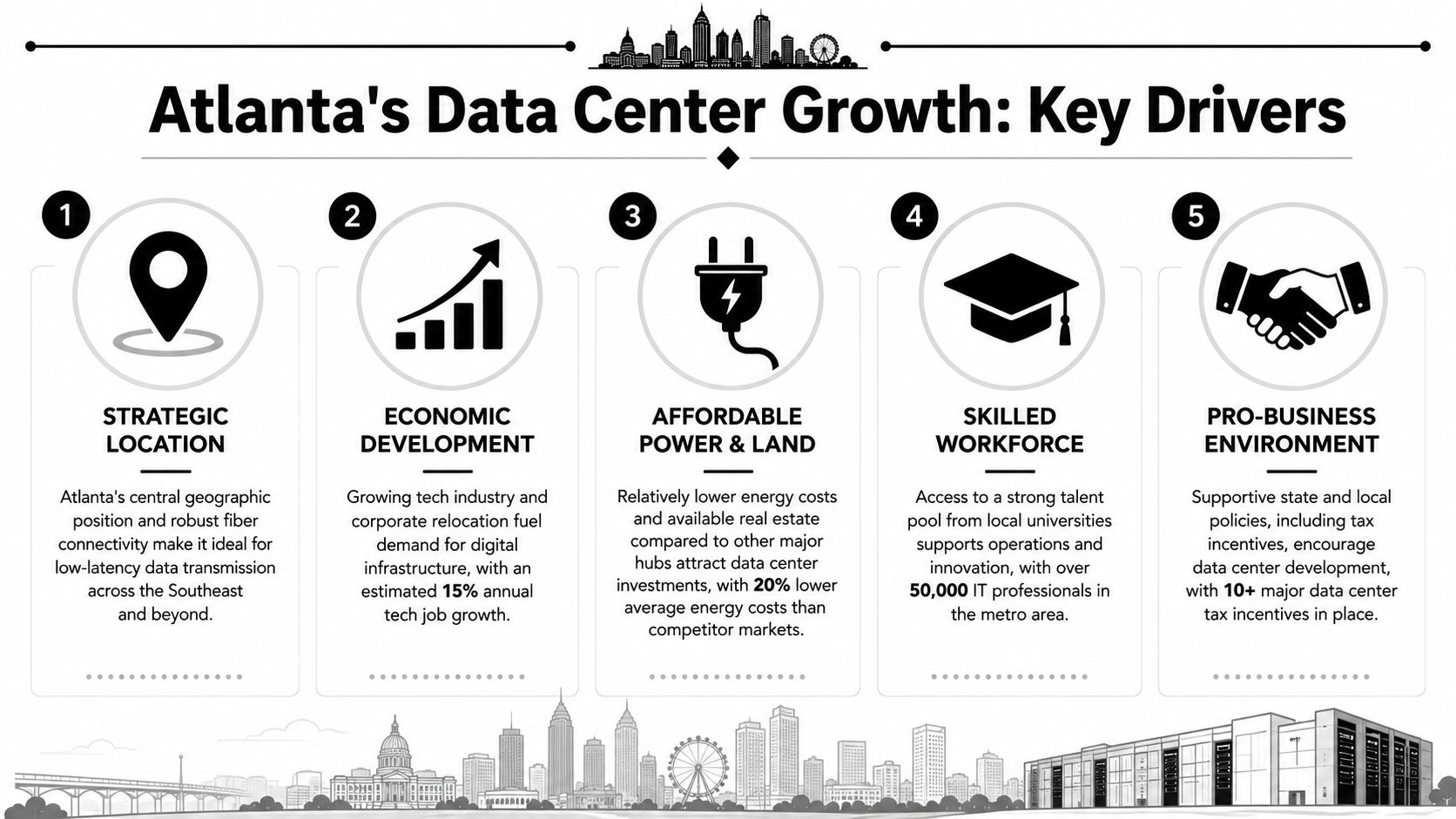
Atlanta's data center market is tightening fast, and that changes how local companies should buy infrastructure. More demand means less margin for indecision on space, power, network access, and migration timing. It also means every infrastructure move should include a plan for the hardware you will retire at the end.
What the market signals
Analysts at Cleanbridge say Atlanta is a large U.S. data center market at around 1.4 GW, with continued expansion tied to major colocation campuses and hyperscale activity in 2024, as outlined in Cleanbridge's U.S. data center market overview. That matters because capacity growth does not automatically mean easy availability. In Atlanta, the best options are usually the ones with the right carrier mix, cloud on-ramps, and power profile for your workloads.
The local market is maturing, not cooling off.
That distinction matters. Mature markets reward companies that plan early, reserve the right footprint, and keep some flexibility in their architecture. They also punish late decisions. If you wait until a migration is already underway to sort out cabinet needs, cross-connects, or hardware retirement, you create avoidable cost and risk.
Why this matters for Atlanta companies
Atlanta businesses benefit when cloud providers, carriers, and colocation operators keep building in the same region. You get more design options, but you also inherit more responsibility for choosing the right operating model and cleaning up the old one after the move.
The practical advantages are straightforward:
- Better private connectivity to major cloud platforms
- More regional options for disaster recovery and data replication
- Stronger fit for latency-sensitive, compliance-heavy, or steady-state workloads
- A clearer path to split long-lived infrastructure from short-term cloud demand
The last point is the one leaders miss. A move into cloud or colocation is not just a hosting decision. It is a lifecycle decision. Every server, storage array, network appliance, and backup device left behind has to be decommissioned, wiped, tracked, and disposed of properly. Companies that ignore that final stage turn a smart migration into a security and compliance problem.
That is why local context matters, and why Atlanta data center market guidance for infrastructure planning should be part of the discussion before you sign a contract or start moving workloads.
The Core Decision Framework Colocation vs Cloud
You don't need another generic pros-and-cons list. You need a decision model that maps to budget, performance, growth, and risk.
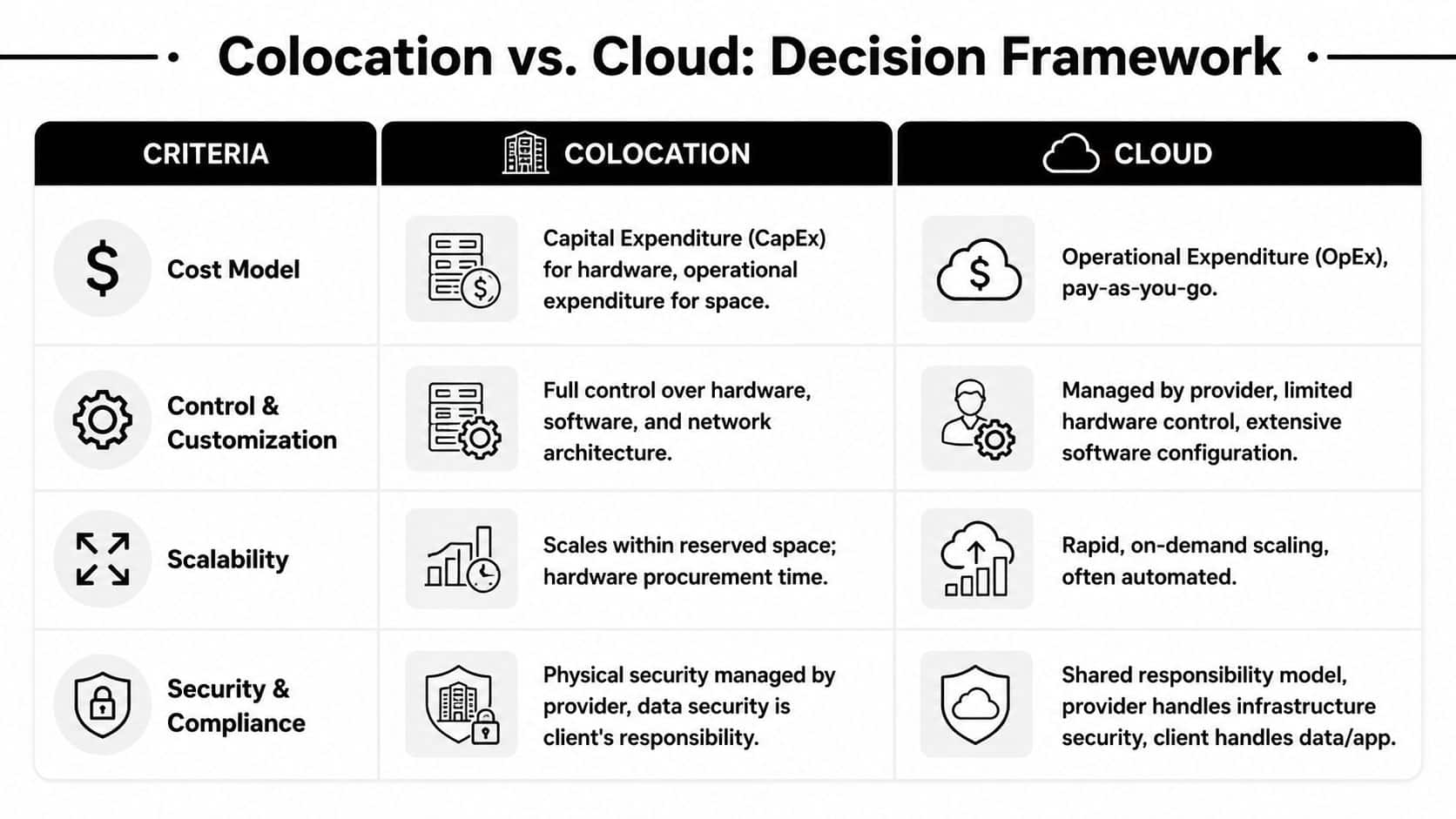
| Factor | Colocation | Public Cloud |
|---|---|---|
| Cost Model | Capital expenditure for hardware, plus operating expense for space, power, bandwidth, and services | Operating expense, pay-as-you-go consumption |
| Control | Full control over hardware, software, and network architecture | Provider manages infrastructure, customer controls software and configuration |
| Scalability | Expansion depends on reserved space and hardware procurement | Fast on-demand provisioning and deprovisioning |
| Security and Compliance | Facility handles physical environment, customer remains responsible for systems and data | Shared responsibility model between provider and customer |
Performance and control
Flexential's colocation versus cloud analysis states the core trade-off clearly: colocation fits workloads that need full hardware control, predictable performance, and low-latency operation, while public cloud is built for rapid elasticity and can provision or deprovision servers in minutes.
That tracks with what I see in the field. If an application needs deterministic performance, fixed network behavior, custom hardware choices, or tighter operational control, colocation stays attractive. If the workload changes fast, has uncertain demand, or needs quick experimentation, cloud wins.
Practical rule: Put steady-state systems where performance is predictable. Put variable-demand systems where capacity is easy to change.
Cost model and scaling behavior
Cloud looks cleaner on paper because it shifts spend into operating expense. That's useful when you need speed or want to avoid buying hardware. But steady workloads can become operationally noisy when teams overprovision, duplicate environments, or keep services running long after projects cool off.
Colocation requires more upfront planning. You own the hardware. You choose the platform stack. You manage refresh cycles. In exchange, your environment is usually easier to model for systems that don't fluctuate much.
Network design and application fit
For network-heavy colocated deployments, one industry source recommends at least 100 Gbps at the data-center core for environments handling cloud on-ramps, replication, and low-latency application tiers, as discussed in DC BLOX's cloud versus colocation infrastructure guidance. That's a useful reminder that colocated systems aren't static islands. In Atlanta, they're often tightly connected to cloud services.
My recommendation for Atlanta firms
Use colocation when your application needs consistency, adjacency, or control. Use cloud when your team needs fast elasticity. Use both when the business has mature operations and mixed workload behavior. That's the practical center of Atlanta data center strategy considerations.
Why Colocation Is Critical for Modern Atlanta Enterprises
The old framing says colocation competes with cloud. That's outdated. Modern colocation often exists because companies are using more cloud, not less.
Colocation now supports cloud-first architecture
A recent industry report comparison found that cloud interconnection is the No. 1 reason enterprises use colocation for nearly 50% of workloads, while only 31% cite another leading factor in the same report series, according to CoreSite's industry trends analysis. This represents a significant shift. Companies aren't renting racks because they failed to modernize. They're doing it because hybrid architecture works.
For Atlanta enterprises, this shows up in a few common patterns:
- Finance and payment systems: Local performance and private interconnection matter.
- Healthcare environments: Teams often need stronger control over data location, system access, and retired media handling.
- Media and digital services: High-throughput workloads benefit from direct connectivity and predictable infrastructure behavior.
- Enterprise back-office systems: Stable applications don't always need cloud-style elasticity.
When colocation is the stronger call
If your workload needs direct hardware control, stable throughput, or low-latency access to users and cloud-connected services, colocate it. Don't force everything into public cloud because that's where your dev team prototypes new apps.
Colocation is no longer the “old way.” In many Atlanta environments, it's the control layer that makes cloud usable at scale.
That also changes how leaders should think about exits and migrations. If you shift some systems out of colo or close a cage, the project doesn't end at cutover. The gear you leave behind still has to be removed, tracked, wiped, destroyed, resold, or recycled correctly. That's why Atlanta data center decommission planning belongs in the same conversation as workload placement.
Planning Your Infrastructure Migration
Most infrastructure migrations fail in the planning phase, not the cutover phase. Teams get excited about target architecture and underestimate dependency mapping, rollback planning, and the work required to retire old assets.
Start with workload classification
Don't migrate by server list. Migrate by business function.
Look at each workload through four filters:
Operational pattern
Is it steady, seasonal, bursty, or experimental?Dependency profile
What databases, identity systems, storage platforms, or third-party tools does it rely on?Risk exposure
What breaks if latency changes, access controls shift, or a rollback is needed?End-of-life impact
What hardware, media, and licensing obligations remain when the workload moves?
Build the migration plan backward from cutover
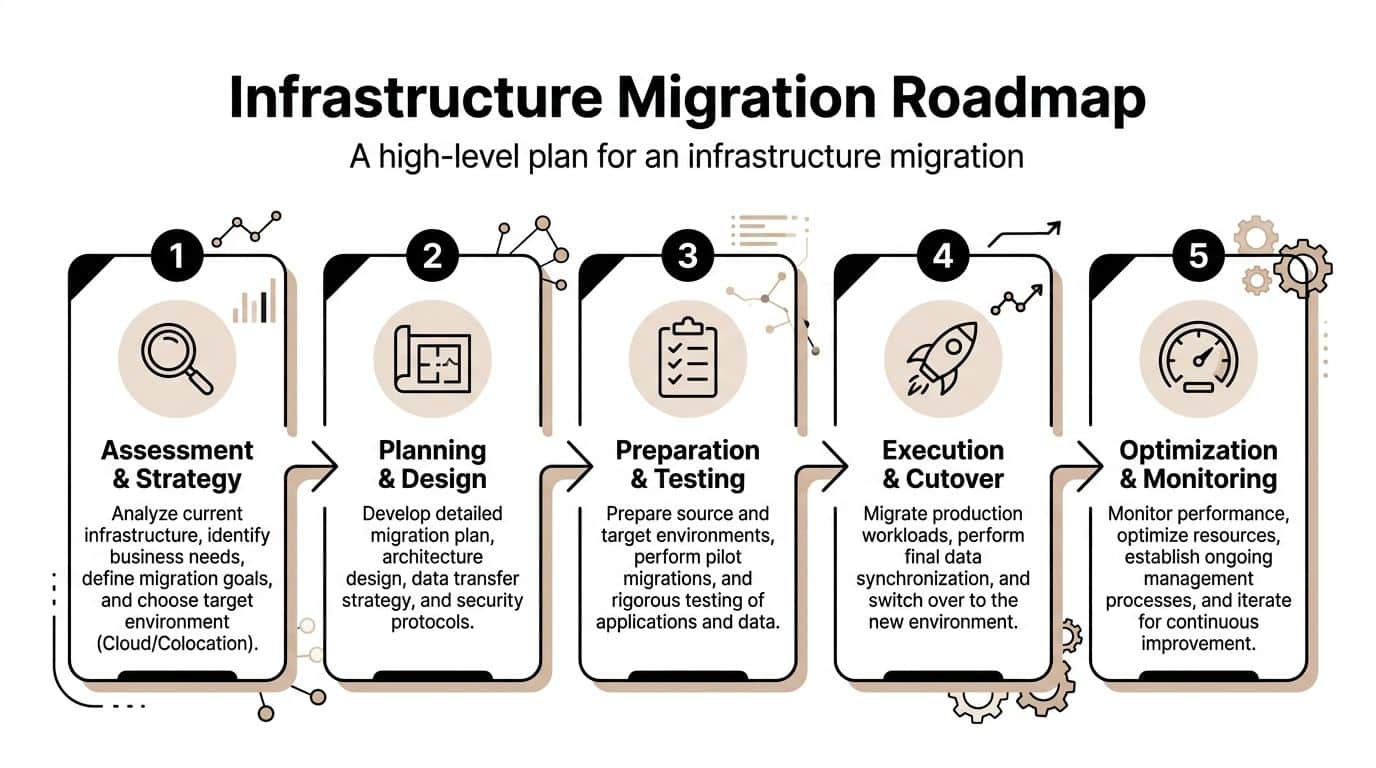
Smart teams define the future state, then work backward through the transition sequence. That means designing the target environment, validating connectivity, testing failover, confirming data handling requirements, and scheduling who signs off at each checkpoint.
A practical migration plan should include:
- Application sequencing: Move low-risk systems first.
- Connectivity design: Confirm how cloud, colo, users, and backups will communicate.
- Testing discipline: Pilot before broad cutover.
- Asset register review: Identify what equipment will be retired, reused, or transferred.
- Compliance workflow: Assign custody, destruction, and recordkeeping responsibilities before racks are emptied.
If the hardware exit plan isn't on the migration checklist from day one, the project isn't fully scoped.
The Overlooked Final Step Secure IT Asset Disposition
This is the part most colocation vs cloud articles ignore, and it's where real risk piles up. After migration, somebody still owns the old servers, storage arrays, backup devices, drives, firewalls, and network switches. If your plan ends when the application goes live in a new environment, your plan is incomplete.
What companies forget after the move
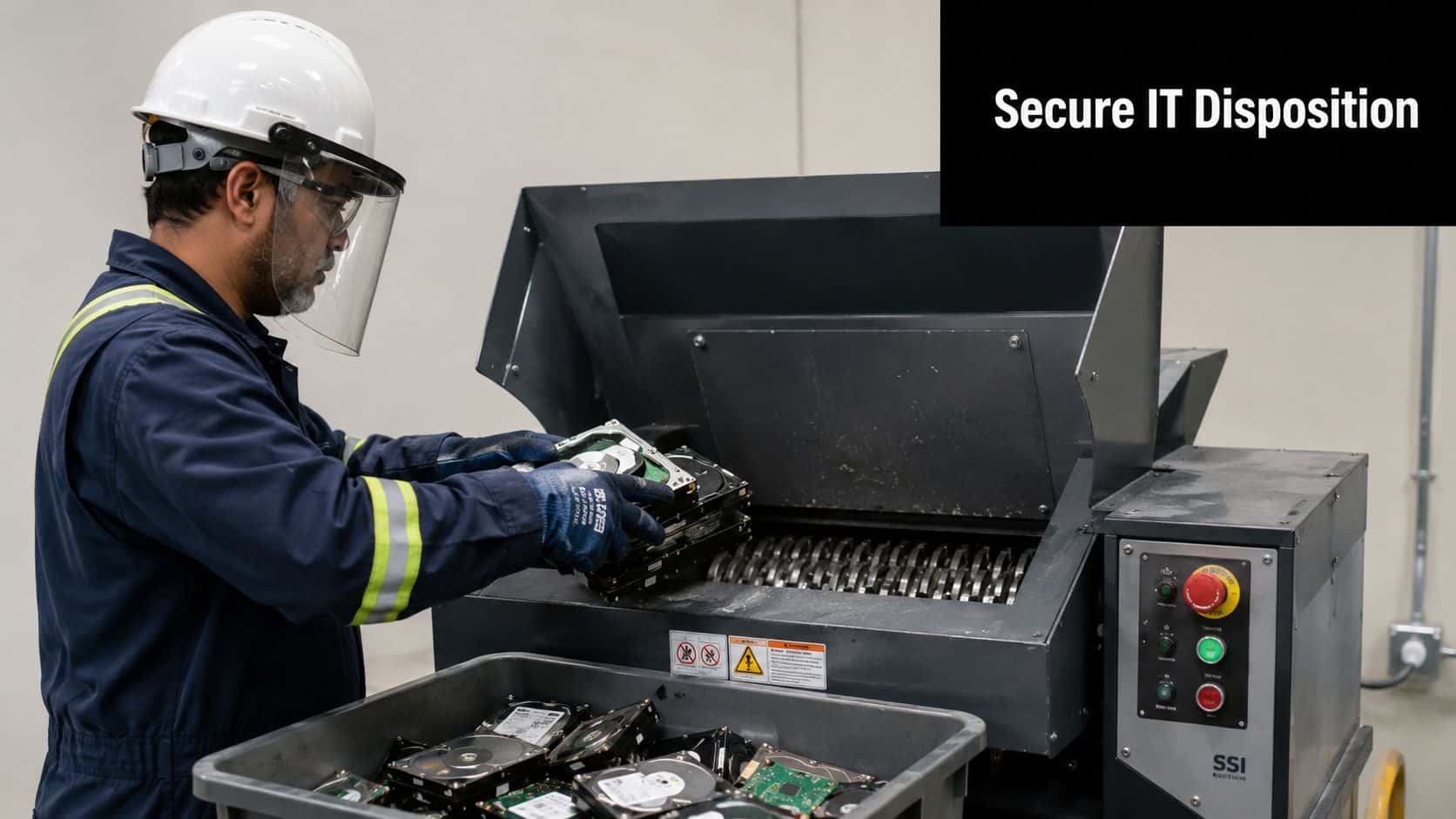
Volico's ROI discussion on colocation versus public cloud makes an important point: most comparisons focus on recurring hosting costs and skip the hidden economics of decommissioning. After migration, organizations still need secure data destruction, chain-of-custody documentation, and responsible asset disposition.
That's not administrative cleanup. It's part of compliance and risk control.
Here's what gets missed most often:
- Retired drives still contain data: Deleting files or reimaging systems isn't the same as documented sanitization or destruction.
- Disconnected hardware still carries liability: If equipment sits in storage, in a cage, or with an unvetted downstream vendor, your risk hasn't ended.
- Audit evidence matters: Regulated organizations need records that show what happened to each asset and when.
- Residual value decisions need structure: Some gear should be redeployed. Some should be remarketed. Some should be physically destroyed.
What a complete exit actually looks like
A proper infrastructure exit includes inventory reconciliation, de-installation, transport controls, serialized tracking, data destruction method selection, environmental processing, and final reporting.
For Atlanta organizations closing racks, reducing colo footprint, or moving workloads to cloud, Atlanta IT asset disposition services can support secure data destruction, chain-of-custody documentation, electronics recycling, and equipment disposition as part of the broader project. That's the right way to treat ITAD. Not as a cleanup vendor at the end, but as an operational control in the migration plan.
Your Next Steps for a Future-Proof Atlanta Infrastructure
Atlanta companies don't need a slogan. They need discipline. The market supports cloud, colocation, and hybrid design. The right answer depends on workload behavior, operational maturity, and what happens to the equipment when the transition is over.
Use this checklist before making a move:
- Map workload fit: Keep stable, performance-sensitive systems in environments built for predictability.
- Use cloud deliberately: Put bursty, temporary, or fast-scaling workloads where elasticity helps.
- Design for interconnection: Hybrid only works when the network is treated as core infrastructure.
- Plan the exit early: List every asset that will be retired before migration starts.
- Require documentation: Data destruction, custody records, and disposition reporting should be mandatory, not optional.
- Align finance and compliance: CapEx, OpEx, lease terms, refresh cycles, and decommission obligations need one shared view.
My recommendation is simple. For most mid-market and enterprise firms in Atlanta, hybrid is the practical model. Put the right workload in the right place. Keep optionality. Don't confuse convenience with strategy. And don't close the project until the last retired asset is accounted for.
If your organization is planning a cloud migration, reducing a colocation footprint, or decommissioning legacy infrastructure in Atlanta, contact Beyond Surplus for certified electronics recycling and secure IT asset disposal.


