

Atlanta isn't just adding capacity. It's setting up the next wave of retirements. Metro Atlanta had 97 in-use data centers and 19 planned facilities in summer 2025, with a combined capacity of 12,700 MW according to Science for Georgia's data center market overview. For an IT director, that matters because every major buildout, migration, and consolidation cycle eventually leaves behind legacy rooms, partial suites, orphaned racks, and aging hardware that still carries data risk.
That's why Data Center Decommissioning Trends in Atlanta deserve more attention than they usually get. In a market moving this fast, decommissioning isn't a back-end cleanup task. It's a controlled project that touches security, facilities, finance, sustainability, and lease obligations all at once.
Atlanta's Data Center Boom and the Decommissioning Wave
Atlanta's growth has changed the way decommissioning projects show up. A few years ago, many projects were driven by an office relocation, a hardware refresh, or a lease expiration. Today, they're often triggered by a broader infrastructure shift. A company moves workloads to colocation, exits an older enterprise data hall, or consolidates several server rooms into one cleaner environment.
That change creates a second-order problem. The migration gets executive attention. The retirement work often doesn't, until the deadline is close and the room still contains production-adjacent assets, backup media, cabling, PDUs, and undocumented gear.
What decommissioning means in practice
A proper decommissioning plan includes far more than removing servers. It usually involves:
- Asset identification: confirming what's installed versus what the CMDB says
- Data-bearing device handling: separating drives, arrays, appliances, and backup systems for sanitization or destruction
- Infrastructure removal: taking out racks, cabling, power distribution, and related equipment when the scope requires it
- Facility closeout: restoring the space to the condition required for turnover, sublease, or reuse
A fast-growth market makes these projects less forgiving. Timelines compress. Loading dock access gets tighter. Internal teams are already focused on the new environment, not the retired one.
Older Atlanta facilities don't disappear when new capacity comes online. They become risk if nobody owns the shutdown work.
The practical takeaway is simple. If your company is planning a move, a consolidation, or a hardware refresh in Georgia, treat decommissioning as its own workstream from day one. That's especially true in a market shaped by rapid expansion, as discussed in Beyond Surplus's overview of Atlanta's data center boom.
Market Drivers Fueling Decommissioning in the Atlanta Area
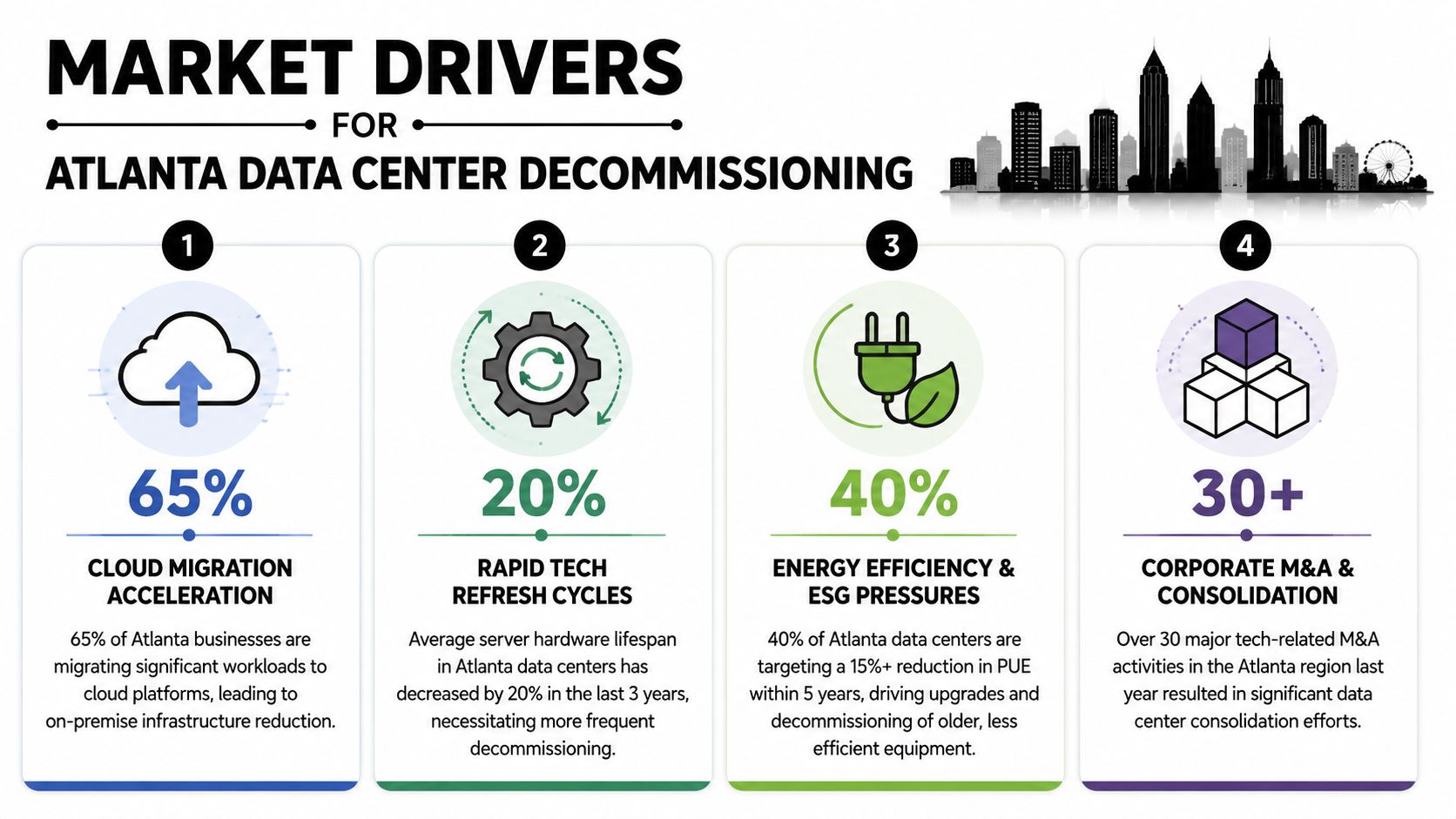
Atlanta's decommissioning activity is being pushed by several forces at the same time, not one. The big one is market velocity. Atlanta's data center market led the nation in 2024 with 705.8 megawatts of positive net absorption, and that leasing activity was 56% greater than Northern Virginia's according to GovTech's report on Atlanta's unprecedented data center growth. When that much new capacity gets leased, older footprints don't stay untouched.
Hyperscale growth changes the economics
When a region attracts more large-scale infrastructure, many enterprises stop defending marginal legacy environments. They don't want to keep paying for underutilized rooms, aging UPS dependencies, scattered storage, and unsupported equipment just because it's still running.
In practice, that leads to three common outcomes:
- Full site retirement after migration into colocation or cloud
- Partial decommissioning where one cage, suite, or server room is shut down while another remains active
- Phased refresh projects where reusable assets are pulled for remarketing and the rest goes to certified recycling
Consolidation creates mixed environments
The toughest projects aren't empty rooms. They're hybrid spaces. Some racks are retired. Others are waiting on app owners. Network gear may support both old and new paths during transition. That's where decommissioning teams get into trouble if they work from stale asset lists or assume every unplugged device is cleared for removal.
A clean project usually starts with an audited floor-level inventory and a disposition map. What gets wiped. What gets shredded. What gets remarketed. What must stay in place until the cutover is complete.
Practical rule: Don't schedule truck dates before you've reconciled the asset list with the rack reality.
That's also why infrastructure modernization and end-of-life planning now go together. Many Atlanta organizations treating upgrades as ongoing operational work are also building decommissioning into the same lifecycle, which aligns with the pattern described in how Atlanta companies are upgrading IT in 2026.
The Growing Importance of Sustainability and ESG in ITAD
In Atlanta, decommissioning now carries a visibility problem as much as a disposal problem. Leadership teams are asking what happened to retired equipment, where the material went, and whether the company can document reuse, recycling, and secure destruction in a way that stands up to review.
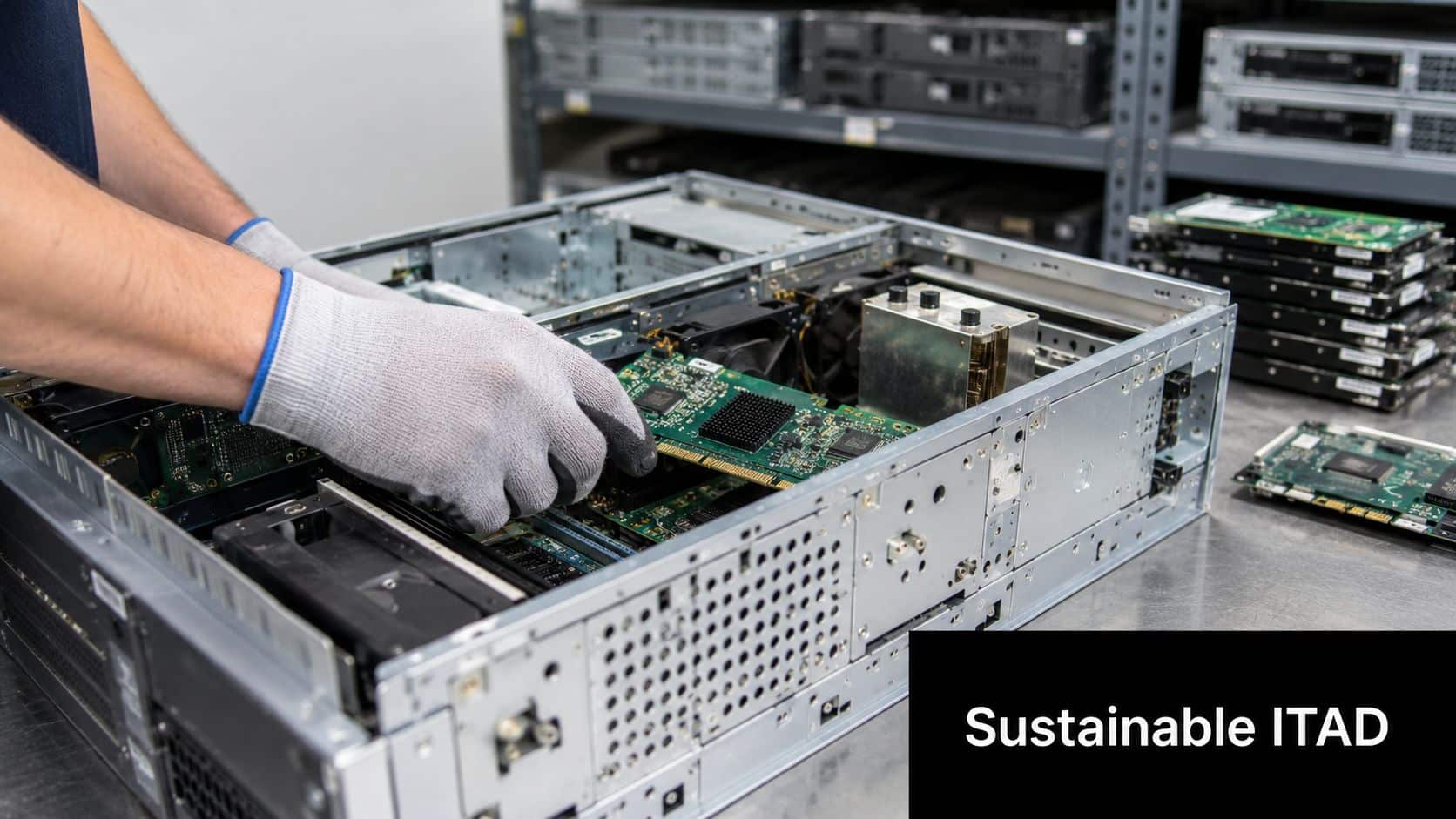
Regional policy research in metro Atlanta says operators should address water resource needs early, consider closed-loop cooling, and evaluate infrastructure reliability and utility impacts. The same research notes the market has over 3 GW of power commitments, which is why decommissioning plans are receiving more scrutiny around environmental documentation and material diversion according to the Atlanta Regional Commission's data center trends material.
What good ESG execution looks like
A solid ITAD strategy doesn't start with the recycler's truck. It starts with disposition hierarchy.
- Reuse first: equipment with secondary market value should be separated early, tested, and routed for resale where appropriate
- Recycling next: non-reusable hardware should move through documented downstream recycling channels
- Destruction only where needed: data-bearing devices and non-remarketable components may require physical destruction or specialized processing
That approach supports both sustainability and finance. It also avoids the lazy outcome where everything is treated as scrap because nobody had time to triage it.
Documentation matters more in high-growth markets
Atlanta's growth means more public attention on infrastructure decisions. If your decommissioning file only contains a pickup receipt, that's weak. Stronger files include asset counts, serial-level records where needed, destruction documentation, weight-based recycling support, and clear downstream accountability.
Teams building ESG-ready disposal programs often use guidance like this Georgia-focused overview of sustainable IT disposal and ESG-aligned ITAD to define what evidence they should request before the project starts.
Navigating Secure Data Destruction and Compliance Mandates
Most failed decommissioning projects fail in the handoff. Someone assumes a system was wiped. A pallet leaves the site before serials are reconciled. Drives removed during de-install are stored in an unsecured area while facilities waits for transport. Those aren't edge cases. They're common planning mistakes.
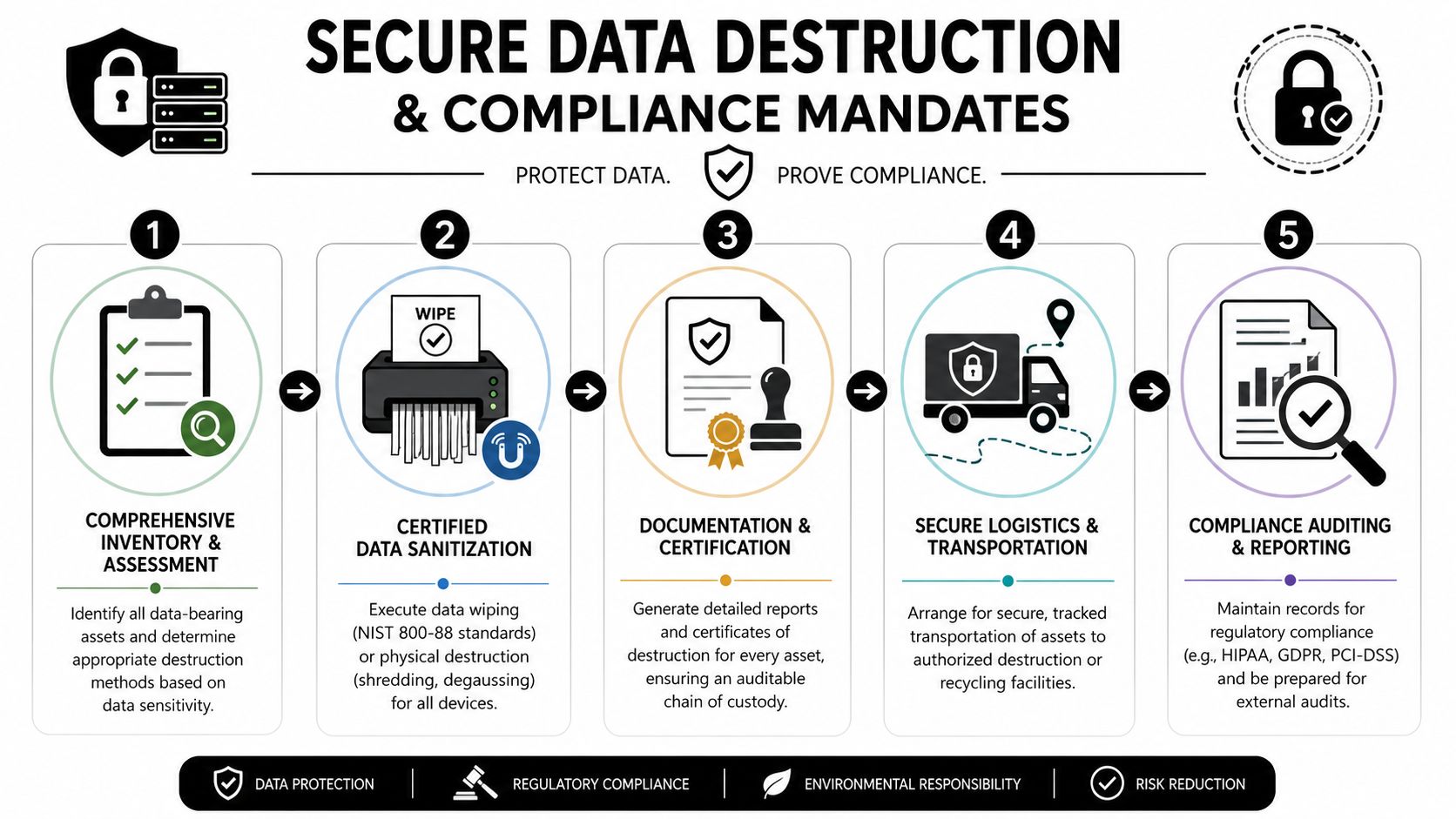
Best-practice decommissioning is a multi-discipline teardown that includes inventory reconciliation, NIST-aligned drive sanitization or physical destruction, de-installation of all hardware, removal of infrastructure such as cabling and PDUs, and facility restoration, as described in DataBank's decommissioning best practices overview.
Wiping versus shredding
Both methods have a place.
| Method | Best fit | Operational note |
|---|---|---|
| NIST-aligned wiping | Reusable drives and systems intended for remarketing or redeployment | Requires validated process control and accurate asset tracking |
| Physical destruction | Failed media, highly sensitive assets, and devices not suitable for resale | Needs witnessed handling, serial capture when required, and destruction records |
The mistake is treating every asset the same. If you shred gear that still has resale potential, you lose recoverable value. If you wipe media that should have been physically destroyed under internal policy, you create a governance problem.
Chain of custody is the real control
Regulations such as HIPAA, GLBA, and the FTC Disposal Rule don't care that your project was rushed. They care whether sensitive information was protected and whether your organization can prove what happened.
A defensible chain of custody should document:
- Who removed the asset
- Where it was staged
- How it was transported
- What destruction or sanitization method was used
- What final certificate or report closed the record
Compliance isn't created by a certificate at the end. It's created by controlled handling from rack to final disposition.
For Georgia organizations with regulated data, this guide to secure data destruction and ITAD compliance is a useful baseline for internal policy reviews.
Logistics and Value Recovery Strategies for Atlanta Projects
An Atlanta decommissioning project usually breaks down long before the truck arrives. The weak point is planning on-site movement. Elevators are shared. Dock windows are short. Building rules may restrict crate staging, after-hours access, or packaging debris. If the de-install crew, security team, and transporter aren't working from the same schedule, the project slows fast.
What efficient logistics look like
A workable plan has a sequence, not just a date.
First, confirm exactly which assets are leaving. Then assign them to disposition paths. After that, match labor, packing materials, carts, lift requirements, dock timing, and secure transport to the actual scope. This sounds basic, but it's where many first-time decommissioning efforts lose control.
A realistic field sequence often looks like this:
- Day-one verification: rack-by-rack confirmation before any removal starts
- Controlled de-install: equipment pulled in the order that protects live dependencies
- Segregated staging: remarketable, recycling, and destruction streams kept separate
- Load-out with records: asset movement logged as it exits the site
Where value recovery is won or lost
The financial side depends on early sorting. Enterprise servers, storage, and networking gear can retain value if they're removed cleanly, matched to serial records, and protected in transit. Equipment that gets mixed, damaged, or stripped of traceability usually falls into a lower-value outcome.
That's why many companies use a specialized data center ITAD workflow that combines de-installation, secure handling, and remarketing assessment in one project motion. The point isn't hype. It's alignment. The team pulling the equipment should understand which assets can still generate recovery and which ones should go straight to recycling or destruction.
A first-time IT director should also expect trade-offs. The fastest removal plan isn't always the highest-value plan. The highest-value plan isn't always the simplest to execute. Good project management makes those trade-offs explicit before work begins.
Choosing the Right Decommissioning Partner in Georgia
The right partner in Atlanta needs more than pickup capability. They need to operate comfortably in a market where projects move fast, facilities are busy, and the margin for documentation mistakes is small.
Questions worth asking before you sign
Start with operating depth, not marketing language.
- Can they manage mixed scopes? Many Atlanta projects involve both IT assets and supporting infrastructure.
- How do they document chain of custody? Ask what records are created at removal, transit, processing, and final disposition.
- What happens to reusable hardware? You want a clear explanation of testing, remarketing, and non-usable segregation.
- Can they support site restoration requirements? Lease-return work often matters as much as asset removal.
Risk transfer isn't just about the recycler
Vendor review should also include insurance, subcontracting, and responsibility boundaries. If your project involves rigging, electricians, freight carriers, or temporary labor, make sure the liability picture is clear. For teams that don't review contractor coverage often, this expert contractor insurance guide from Coverage Axis is a practical primer on what to verify.
One more point matters in Georgia. Ask how the provider handles compressed scheduling without weakening controls. Fast response is useful. Fast and undocumented is dangerous.
A credible decommissioning partner can explain their process in plain language, show where risk is controlled, and tell you what they won't shortcut.
Best Practices for Your Atlanta Data Center Decommissioning Plan
A strong plan is built before anyone unplugs a device. If you're preparing for your first major Atlanta project, keep the process grounded in controls, not assumptions.
A practical checklist
Start with a real inventory
Don't rely on procurement history or old CMDB records. Validate what's in each rack, cabinet, and storage area.Define the project boundary clearly
Decide whether the scope includes only IT hardware or also racks, cabling, PDUs, UPS-adjacent gear, and facility restoration tasks.Set the data destruction policy before removal
Choose which assets will be wiped, which will be physically destroyed, and what documentation each path requires.Separate value recovery from scrap handling
Reusable servers, storage, and networking gear should be identified early so the project doesn't destroy resale value by accident.Coordinate with facilities and building management
Loading dock rules, staging limits, badge access, and after-hours work windows can determine whether the schedule holds.
What works and what doesn't
What works is early cross-functional ownership. IT handles asset truth. Security defines destruction controls. Facilities manages access and space turnover. Finance aligns recovery expectations. Legal or compliance confirms documentation requirements.
What doesn't work is treating decommissioning like a cleanup crew assignment after the migration is done. That approach usually creates missing assets, weak certificates, delayed turnover, and lost recovery.
For Atlanta organizations, the larger lesson is simple. In a market this active, decommissioning is part of infrastructure strategy. It isn't the last task. It's one of the controls that protects the whole project.
If you're planning an Atlanta shutdown, consolidation, or equipment refresh, contact Beyond Surplus for certified electronics recycling, secure IT asset disposal, data destruction, and data center decommissioning support.


