

Atlanta is upgrading fast because the market leaves little room to stand still. More than 70% of Fortune 1000 companies have operations in metro Atlanta according to Select Georgia's Atlanta business profile, and that concentration changes how local IT leaders think. A refresh cycle here isn't just about better laptops or another cloud project. It's about staying operational in a dense, competitive business environment while retiring old equipment without creating a security, compliance, or storage problem.
That second part gets missed too often. A critical insight into how Atlanta companies are upgrading IT in 2026 is that the upgrade and the disposition plan have to be designed together.
The 2026 Atlanta IT Upgrade Imperative
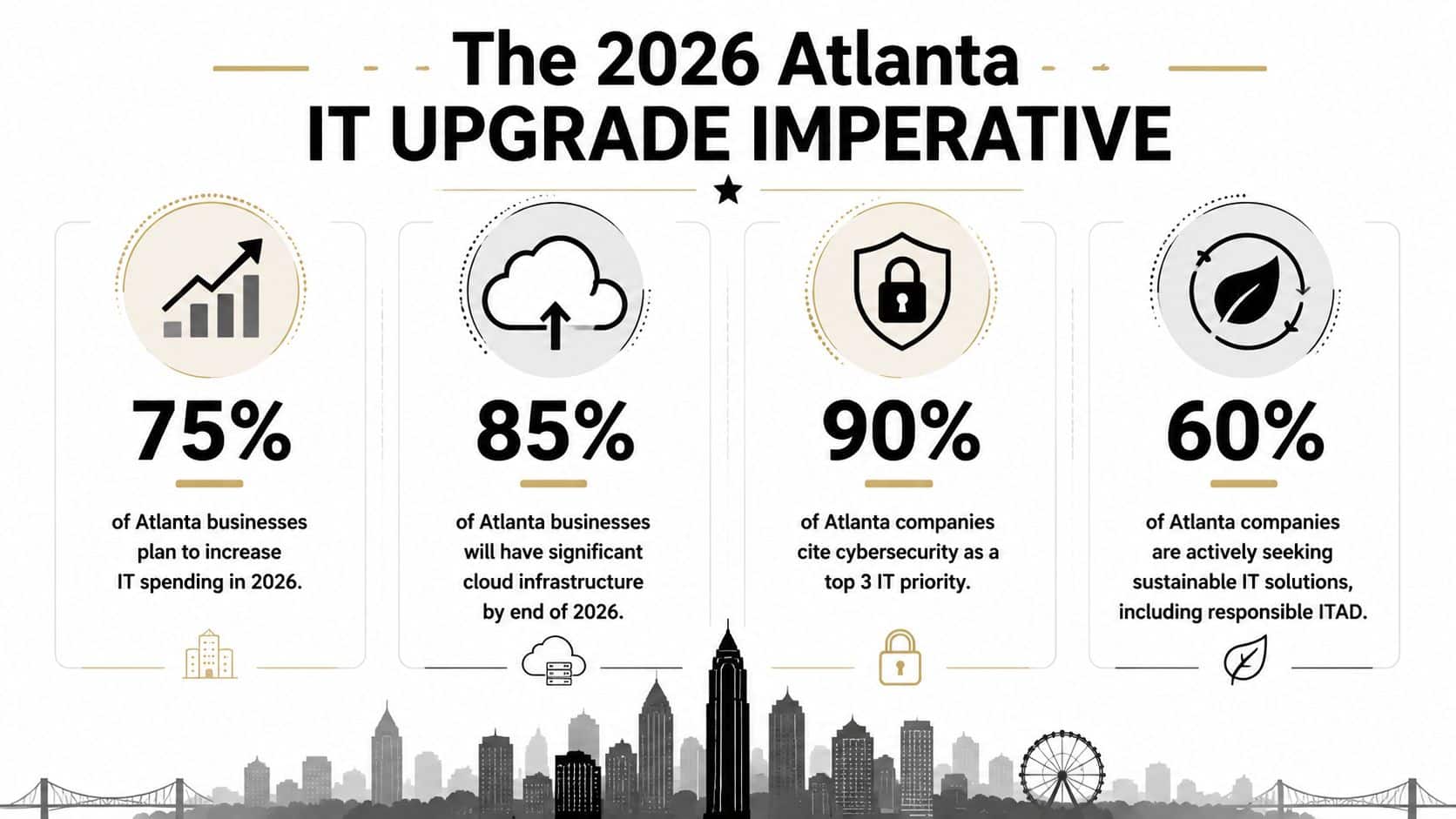
Atlanta's 2026 IT environment is being shaped by two pressures at once. First, it has a large, expensive technology labor market. Motion Recruitment estimates about 137,000 core tech workers in the Atlanta metro area, with average base compensation for an Atlanta IT worker at $131,007 in 2026. The same salary guide shows that infrastructure and security roles are costly to hire, including Information Security Engineers, Network Security Engineers, and senior Infrastructure and Security Architects in six-figure ranges, as detailed in Motion Recruitment's Atlanta IT salary guide.
Why that changes upgrade planning
When talent costs that much, companies stop treating upgrade work as a loose collection of tickets. They standardize. They automate. They use outside specialists where the labor economics make sense.
That shift affects every part of the lifecycle:
- Procurement discipline: Teams narrow hardware standards so deployment and support stay manageable.
- Security design: They invest in controls that reduce manual intervention and exception handling.
- Retirement workflows: They put more structure around collection, sanitization, and documentation instead of leaving old assets in closets.
Practical rule: In a high-cost labor market, any upgrade plan that creates manual end-of-life work will age badly.
Capital planning is changing too. For firms financing expansion, relocations, or equipment-heavy growth, the lending environment matters almost as much as the technology roadmap. That's why local operators often keep an eye on resources like GoSBA Loans' Atlanta lender rankings, especially when IT refreshes are bundled into a broader facilities or growth strategy.
Enterprise density raises the stakes
Atlanta also has a concentration effect. Large enterprises, regional offices, shared-service operations, healthcare systems, financial firms, and public-sector environments all create overlapping demand for network changes, endpoint refreshes, security hardening, and decommissioning. In practice, that means local providers, internal teams, and specialized contractors are all working under time pressure.
A company that waits too long usually pays twice. It pays once in operational drag from aging systems. It pays again when the replacement project turns into a rushed disposal scramble.
Key Upgrade Trajectories for Atlanta Businesses
The most effective Atlanta upgrade programs in 2026 are converging around three connected moves. They may start in different places, but they tend to end in the same operating model: more cloud dependence, tighter security controls, and cleaner infrastructure for analytics and AI initiatives.

Cloud and edge modernization
The cloud move isn't new. What's different now is the discipline around it. Atlanta companies aren't migrating just to say they're in the cloud. They're moving workloads to reduce friction in scaling, support distributed offices, and simplify backup and recovery design.
That usually means keeping some local infrastructure where latency, compliance, or site operations require it. So the actual architecture is rarely all-cloud. It's hybrid, with more intentional placement of apps, data, and security controls.
Security modernization
Security budgets are following the architecture. As companies spread users, devices, and applications across more environments, perimeter-based thinking breaks down. Access decisions now have to follow identity, device state, and policy enforcement, not just office location.
Atlanta businesses are also leaning more heavily on managed services. In 2026, companies are increasingly adopting a model that combines 24/7 monitoring, patch management, backup oversight, and identity/access controls, which creates more predictable response than ad hoc break-fix support, as described by True IT Pros on managed services in Atlanta.
For organizations reviewing communications and infrastructure together, this often overlaps with broader connectivity work such as enterprise telecom solutions in Atlanta.
Strong upgrade programs reduce the number of one-off systems the team has to babysit later.
AI-ready data infrastructure
A lot of AI talk is still vague. The useful version is not. Companies are cleaning up storage tiers, improving data availability, and reducing sprawl so analytics and automation projects have a workable foundation.
What doesn't work is layering AI tools on top of neglected infrastructure. If file shares are chaotic, endpoint fleets are inconsistent, and old devices are still sitting unmanaged after refreshes, the environment stays messy. AI doesn't fix operational disorder. It exposes it.
Operational Realities of a Major IT Refresh
A major refresh looks tidy on a roadmap and messy in the field. Procurement signs off on standards. Facilities confirms timing. Security wants controls in place before cutover. Department leaders don't want interruption. The actual work lands on a few people trying to coordinate all of it without downtime.
What the project really feels like
One week, the challenge is receiving pallets of equipment without clogging a loading area. The next, it's matching users to devices, confirming software readiness, and making sure the old hardware doesn't disappear into unmanaged storage.
Then the exceptions start:
- Executive devices: They need white-glove handling and exact migration timing.
- Shared workstations: They can't go dark during business hours.
- Branch or suburban offices: They require staging, transport, and pickup coordination that urban HQ teams often underestimate.
That's why mature teams write the retirement workflow into the deployment plan, not after it.
The overlooked dependency
Data center and server room work is even less forgiving. A rack migration may involve application owners, networking, security, facilities, and outside hands. If one group treats decommissioning as separate from the move, old hardware lingers powered off but still present, still carrying data, and still owned by someone.
For teams planning that phase, this guide to the data center decommissioning process is useful because it frames removal, documentation, and end-of-life handling as operational tasks, not cleanup.
The projects that run smoothly usually have one thing in common. Someone owns the last mile of the hardware lifecycle.
What works and what fails
A practical comparison makes the pattern obvious:
| Approach | What happens |
|---|---|
| Refresh first, disposal later | Old assets pile up, asset records drift, and risk stays open |
| Refresh with staged collection | Devices move through deployment, retrieval, and sanitization in order |
| Ad hoc vendor handoff | Documentation gaps appear when audit or legal asks questions |
| Chain-of-custody planning from day one | Teams can prove what was removed, when, and how it was processed |
The technical work gets the attention. The retrieval, transport, and documentation work determines whether the project is finished.
The Hidden Liability in Your Upgrade The Old Equipment
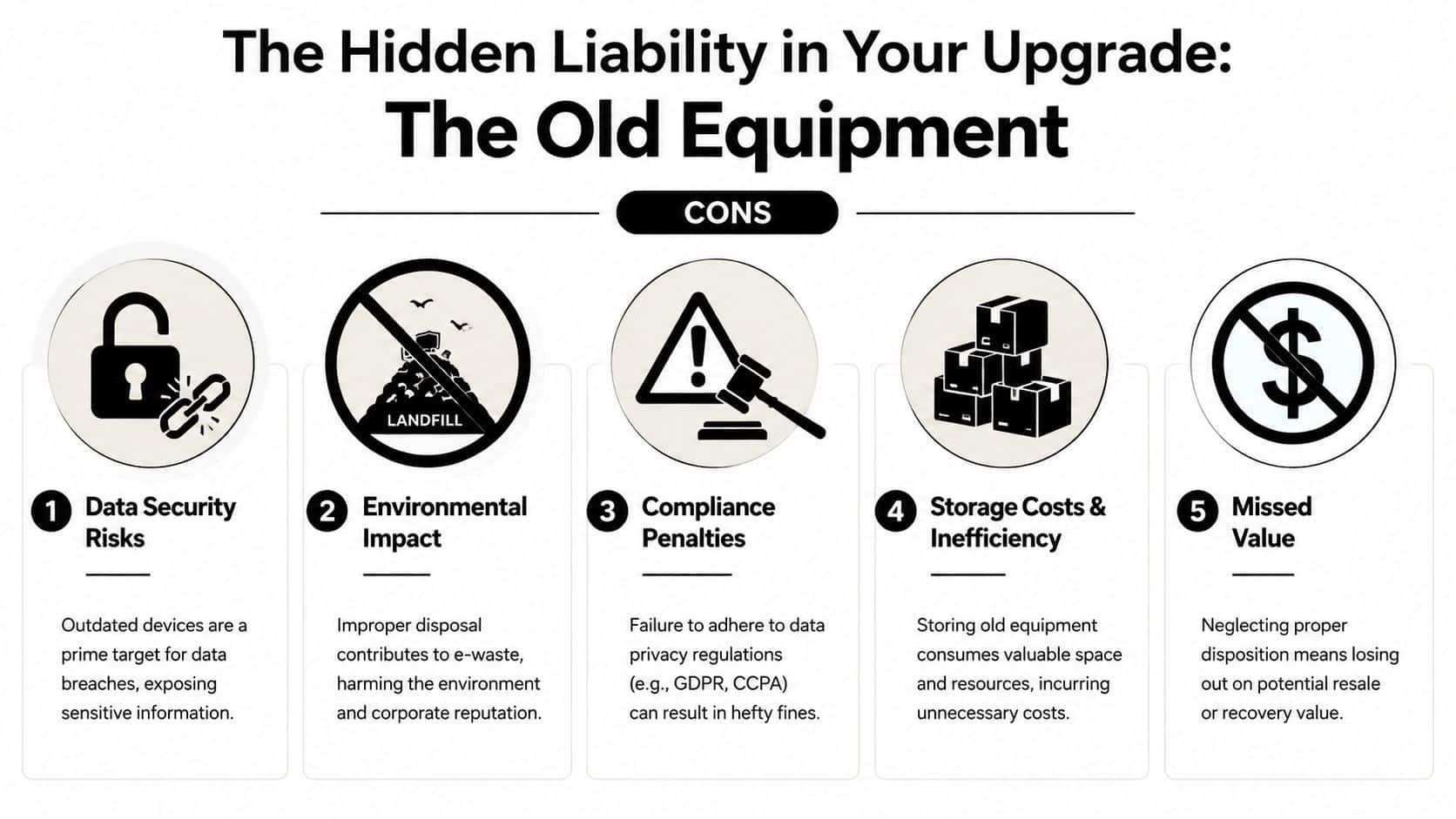
Most upgrade risk doesn't come from the new hardware. It comes from the old hardware after everyone stops paying attention.
Atlanta's office churn makes that problem bigger. Q1 2026 office leasing reached 1.5 million square feet, and over 73% of that activity occurred in suburban markets. That means a large volume of office resets, consolidations, and space changes are creating surplus devices, servers, storage, networking gear, and media. Without certified data destruction and chain-of-custody documentation, firms are at risk of violating the FTC Disposal Rule during upgrades.
Why warehousing is not a neutral choice
A lot of companies still treat retired equipment as something to store until there's time to deal with it. That feels cautious. It usually isn't.
Stored equipment creates several liabilities:
- Data exposure: Drives, SSDs, and embedded storage still need verified sanitization or destruction.
- Asset confusion: Finance, IT, and compliance teams often lose track of what still exists.
- Space loss: Closets, staging rooms, and cages become low-grade e-waste warehouses.
- Delayed value recovery: Recent-model equipment loses resale value while it sits.
The compliance issue is immediate
The FTC Disposal Rule is not a theory problem. If a company handles sensitive data and retires devices without a documented process, the exposure sits with the company, not the recycler it found later.
That's why why ITAD services matter for Georgia companies in 2026 is the more useful conversation than generic “electronics recycling.” Business leaders need liability transfer, documented handling, and proof.
Old equipment is only harmless when you can account for it, sanitize it, and document its final disposition.
From Liability to Asset The Strategic ITAD Framework
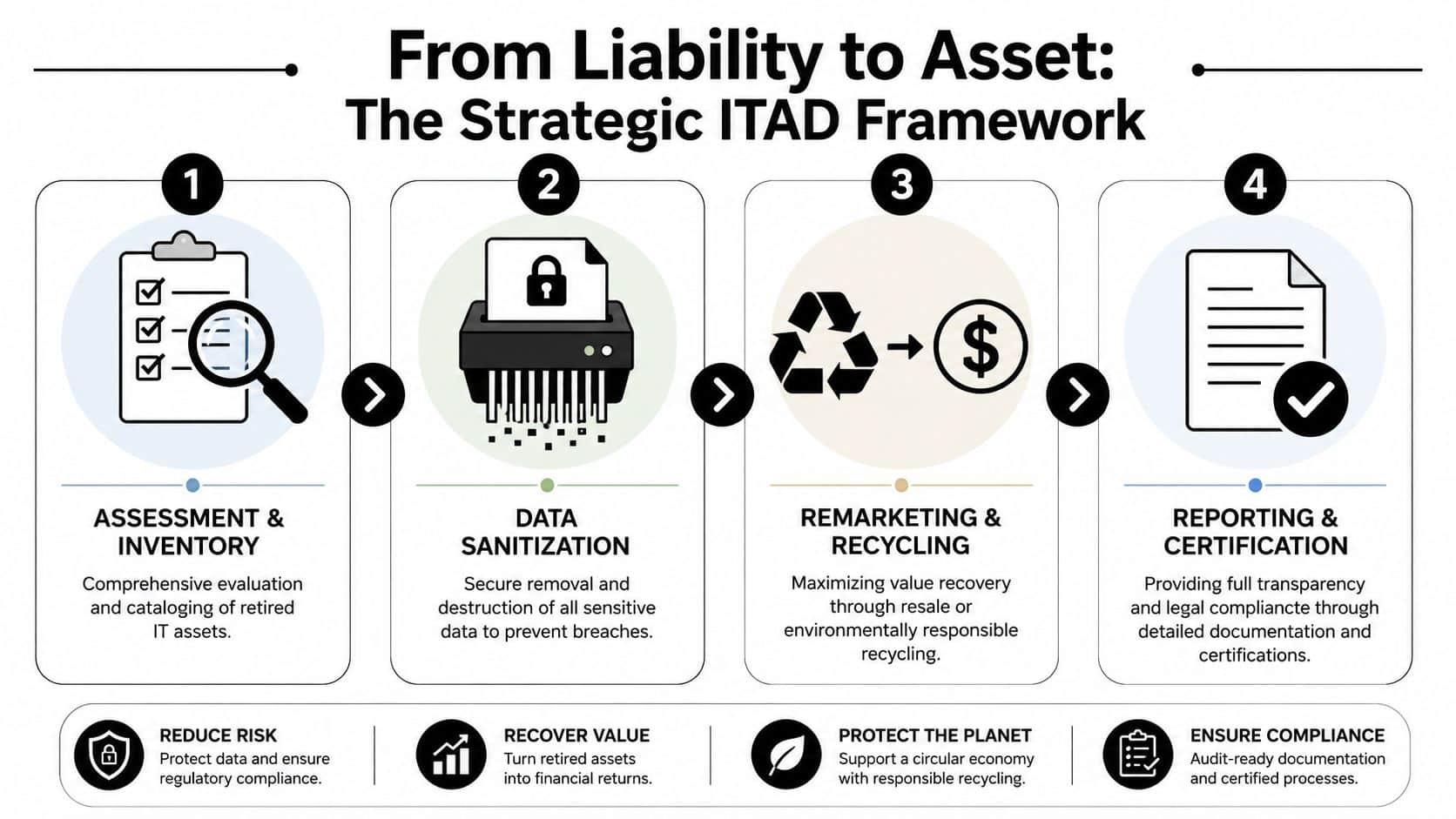
A professional IT asset disposition, or ITAD, program turns end-of-life work into a controlled process. It doesn't eliminate complexity. It contains it.
Step one includes inventory before pickup
If the asset list is wrong, everything downstream gets weaker. Teams need to know what they're retiring, where it sits, what data classes may be involved, and which assets still have resale potential.
That first pass separates devices into workable lanes:
- Sanitize and remarket
- Destroy media and recycle hardware
- Handle specialty or regulated equipment through a stricter workflow
Data destruction has to match the asset
Certified data wiping and physical shredding solve different problems. Reusable assets may be appropriate for wiping if the process is validated and documented. Failed media, high-risk storage, or hardware leaving no reuse path often belongs in physical destruction.
The key is evidence. If your team can't show who handled the asset, what method was used, and when the work was completed, then the process is incomplete.
Recovery and sustainability belong in the same plan
Atlanta companies are trying to reconcile upgrade speed with sustainability. 68% of Atlanta enterprises prioritize sustainability, 74% lack a formal ITAD plan, and 2026 upgrades are projected to generate 12,000 tons of e-waste. That gap is exactly why certified recycling and value recovery need to be built into refresh planning rather than treated as a side task.
A practical framework should include:
- Secure sanitization: Match wiping or shredding to device risk and reuse potential.
- Value recovery: Capture resale where recent-model hardware still has market demand.
- Certified recycling: Route end-of-life assets through documented downstream processing.
- Reporting: Issue certificates and audit-ready records.
One local option companies use for that workflow is Georgia ITAD solutions for reducing risk and recovering asset value, which combines secure disposition, recycling, and value recovery for business equipment.
Selecting the Right ITAD Partner in Atlanta
Vendor selection gets easier when you stop treating ITAD like a hauling job. The right partner is taking legal, security, logistics, and reporting responsibility for a sensitive stage of your infrastructure lifecycle.
Non-negotiables to verify
Start with the controls, not the sales deck.
- Chain of custody: Ask how assets are tracked from pickup through final processing.
- Data destruction evidence: Confirm whether the provider issues certificates of data destruction and what those records include.
- Logistics capability: Make sure they can support office moves, data center work, suburban pickups, and multi-site collections.
- Recycling and remarketing process: You want clarity on what gets resold, what gets dismantled, and how non-remarketable material is handled.
- Insurance and compliance posture: Risk transfer only works when the provider's process is documented and defensible.
Questions that reveal the difference
A weak provider talks mostly about convenience. A serious one can answer operational questions without hand-waving.
Ask things like:
- How do you document custody changes?
- When do you recommend shredding instead of wiping?
- What reporting package do clients receive after processing?
- How do you handle mixed loads from offices, labs, or server rooms?
For buyers building a shortlist, this step-by-step guide to choosing an ITAD vendor in Georgia gives a solid framework for evaluating providers against real business risk.
If a vendor can't explain its documentation process clearly, don't trust it with retired assets that still carry your data.
The companies handling upgrades well in Atlanta aren't just buying new technology. They're closing the loop on the old technology with the same rigor they apply to security, networking, and procurement.
Atlanta businesses upgrading infrastructure in 2026 need more than pickup service. They need secure data destruction, documented chain of custody, responsible electronics recycling, and a clear path for value recovery on retired assets. Contact Beyond Surplus for certified electronics recycling and secure IT asset disposal.


