

Atlanta businesses don't need more generic IT vendors, they need a partner that can keep systems stable, secure, and ready for the next growth push. In a market where managed IT is often sold as an ongoing operating relationship rather than a one-off fix, the right choice has to fit your headcount, your compliance burden, and your internal team's capacity. Atlanta's MSP market is mature, crowded, and specialized, so the smartest buying decision is to compare providers on depth, service model, and how well they handle the full IT asset lifecycle, including secure disposal. This guide gets to the point fast, then helps you separate strong operating partners from providers that only look similar on a website. The list below focuses on providers that can support real business needs, from cybersecurity and cloud work to governance, on-site coverage, and lifecycle planning.
Table of Contents
- 2. iVision
- 2. iVision
- 3. 1Path
- 4. Integris
- 6. InterDev
- 6. InterDev
- 7. Milner, Inc.
- Top 7 Atlanta Managed IT Providers Comparison
- Making Your Choice and Moving Forward
2. iVision
A hybrid-cloud stack gets messy fast. One team owns the network, another manages SaaS, a third handles cloud workloads, and internal IT is left stitching it all together while security gaps grow in the middle. iVision fits that kind of environment because it combines managed services with engineering support, so Atlanta businesses can keep operations stable while still pushing modernization work forward.
Why iVision stands out
iVision earns attention because it covers both ongoing operations and larger technical projects. Its managed services span hybrid cloud, network, security, and end-user support, while its project work supports cloud migrations and modernization. Review the provider's Atlanta presence and service focus on the iVision website, then compare that scope against the systems your team runs.
Complex environments need a provider that can diagnose the issue, implement the fix, and support the result after go-live.
That model matters for mid-market and enterprise buyers that have outgrown basic help desk coverage. iVision's US-based NOC/SOC model also points to a more structured service approach, which is what distributed organizations need when they cannot afford loose oversight. It is a practical fit for firms that want one partner to handle daily support, cloud work, and security operations without splitting responsibility across multiple vendors.
For Atlanta companies that are also planning for device retirement and secure wipe processes, tie your vendor review to the Atlanta cybersecurity threats targeting Atlanta companies conversation and the Atlanta IT asset disposition guide. That keeps security, lifecycle management, and disposal aligned instead of treating them as separate projects.
Best for
- Hybrid-cloud operations: Businesses that need support across cloud, network, and end-user environments.
- Project-heavy IT teams: Organizations that want a provider able to support migrations and modernization, not just tickets.
- Distributed firms: Companies that need structured oversight across multiple locations or work patterns.
Watch for
- Fit for small teams: Very small organizations may not need this level of engineering depth.
- Scope alignment: Buyers should confirm the mix of managed services and project work matches their internal priorities.
2. iVision
A growing Atlanta company can outgrow a basic IT vendor fast. One office becomes three, cloud tools multiply, security reviews get harder to manage, and the internal team spends too much time patching gaps instead of improving systems. iVision fits that kind of environment because it combines managed services with real engineering depth, which gives buyers a way to support day-to-day operations while still handling larger modernization work.
Why iVision stands out
iVision stands out because it can support steady operations and technical change at the same time. Its managed services cover hybrid cloud, network, security, and end-user environments, while its project work supports cloud migrations and modernization. Review the provider's Atlanta presence and service positioning on the iVision website.
Complex environments need a provider that can diagnose the problem, implement the fix, and support the result after go-live.
That engineering-first approach makes iVision a stronger fit for mid-market and enterprise buyers than for small teams that only need basic coverage. The company's US-based NOC/SOC model also points to a more structured service posture, which is what distributed organizations need when they cannot afford loose handoffs between support and security. If your business is also planning office or infrastructure changes, review Beyond Surplus's cybersecurity threats targeting Atlanta companies to keep disposition planning tied to broader security controls.
Best for
- Hybrid and multi-cloud estates: Teams with more than one operating environment to manage.
- Modernization projects: Businesses that need managed services plus architecture work.
- Distributed operations: Organizations that want one partner for support and implementation.
Watch for
- Heavier onboarding: More process often means a longer start.
- Mid-market and enterprise fit: Smaller buyers may not need this level of engineering.
3. 1Path
A regulated SMB in Atlanta cannot afford an MSP that treats compliance as an afterthought. If your firm handles client records, financial data, or protected health information, the provider has to control access, document service activity, and keep incident response tight. 1Path fits that brief for organizations that want scale without giving up local delivery. Its model works well for companies with more than one site, mixed cloud needs, or internal IT teams that need co-managed support instead of a full handoff.
Why 1Path stands out
1Path offers managed IT, cloud services, security and compliance support, and 24/7 response, which places it in the full-service MSP category. Its cloud stack includes Microsoft 365 and Azure, which matters for businesses trying to standardize around widely used enterprise platforms. Review the company's offerings on the 1Path website.
The value is breadth with enough structure to support growing teams. Companies with multiple offices, a mixed remote workforce, or a compliance-sensitive business function need that mix of control and flexibility. For organizations deciding where workloads and infrastructure should live, Beyond Surplus's colocation vs cloud Atlanta business trends helps frame the broader infrastructure and lifecycle decision, including what happens before a system is retired and what happens after it leaves service.
Best for
- Growth-stage businesses: Teams that have outgrown ad hoc support.
- Multi-site operations: Companies that need consistent service across locations.
- Cloud-centered environments: Buyers that rely heavily on Microsoft 365 or Azure.
Watch for
- Procurement time: Larger providers usually move through sales and onboarding more slowly.
- Less boutique feel: Smaller firms may prefer a tighter service relationship.
4. Integris
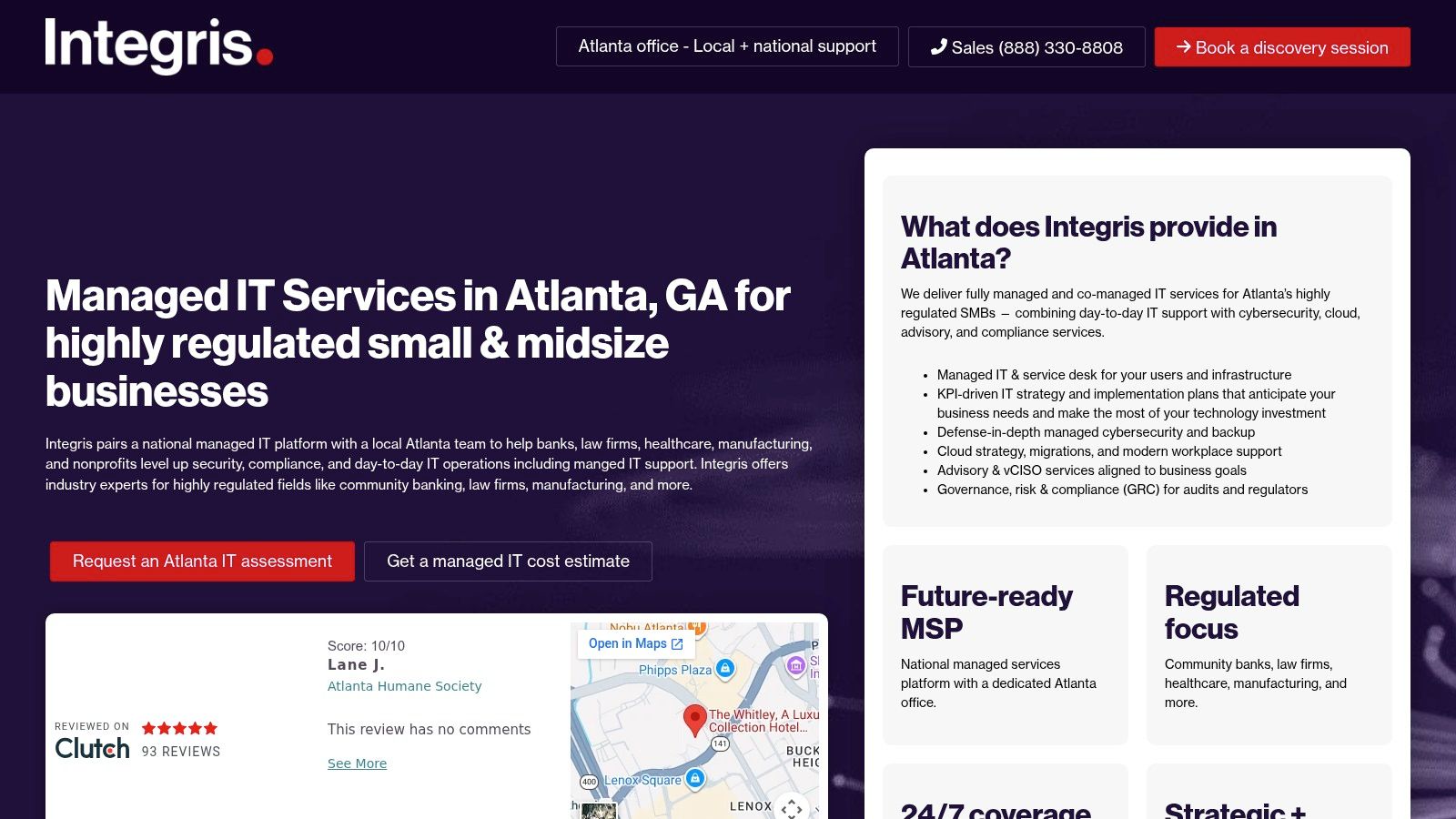
If your employees are waiting on slow support, inconsistent answers, or a provider that cannot keep service standards in line across locations, that problem gets expensive fast. Integris is a fit for companies that want national-scale process with local Atlanta delivery, without losing accountability.
Why Integris stands out
Integris offers managed IT, service desk support, cybersecurity, compliance support, cloud services, and backup and disaster recovery. That mix fits finance, healthcare, legal, nonprofit, and manufacturing teams that need day-to-day support and clear governance in the same relationship. Start with the provider's local page on the Integris Atlanta site.
The primary advantage is operational clarity. Buyers often ask whether an MSP can answer calls, but the sharper question is whether it can keep policy, risk, and service execution aligned over time. Integris works well when you want a controlled operating model with room for planning instead of constant service reinvention. For organizations that are also preparing office changes, Beyond Surplus's IT office relocation services help connect equipment movement, refresh cycles, and secure retirement in one process.
Direct advice: If your internal team needs a provider that can handle lifecycle management without improvising every quarter, Integris deserves a close look.
For Atlanta businesses that also need a clearer view of how local tech demand is shaping provider quality, the rise of Atlanta's technology startup ecosystem adds useful context. Fast-growing companies put more pressure on service desks, security controls, and onboarding, so the right MSP has to support both growth and discipline.
Best for
- Regulated SMBs: Businesses that need process discipline and compliance support.
- Standardized environments: Teams that value repeatable service delivery.
- Leadership-driven IT: Buyers looking for roadmap planning and KPI discipline.
Watch for
- Less customization: A standardized platform can limit edge-case flexibility.
- Quote-based pricing: You need a complete scope before comparing costs.
6. InterDev
InterDev is a strong fit for organizations that need an MSP built around municipal and public-sector operating requirements. In Georgia, procurement rules, documentation standards, and service reliability often shape the buying process as much as technical capability. If your organization answers to public stakeholders, follows formal purchasing procedures, or needs on-site augmentation, InterDev deserves serious consideration.
Why InterDev stands out
InterDev delivers managed IT, cybersecurity, co-managed support, and GIS and mapping services. That mix makes it more specialized than a general MSP and more relevant for municipalities and organizations that work closely with government workflows. Review the InterDev managed IT services page for its core service profile.
Process discipline is the point here. Municipal teams and public agencies often need a partner that understands compliance expectations, local delivery, and the practical demands of blended remote and on-site operations. For businesses comparing providers in the broader Atlanta market, Beyond Surplus's analysis of Atlanta's technology startup ecosystem adds helpful context on how local growth pressures shape service expectations.
InterDev also fits buyers who want support that extends beyond day-to-day help desk work. If your IT partner must coordinate across public-facing offices, handle documentation cleanly, and support geography-based operations, that specialization matters. It is a better match for organizations that value structure and public-sector familiarity than for teams seeking a broad, consumer-style MSP.
Best for
- Municipal and public-sector teams: Organizations with formal procurement and accountability requirements.
- Government-adjacent operations: Buyers that need a provider familiar with public workflows.
- Blended support models: Teams that need both remote coverage and on-site assistance.
Watch for
- Specialized fit: The service model is narrower than a general-purpose MSP.
- Workflow-driven buying: Organizations without public-sector complexity may not need this level of specialization.
6. InterDev
A multi-office Atlanta firm can get buried in vendor sprawl fast. One provider handles help desk, another manages cybersecurity, a third covers mapping or specialized workflows, and internal teams are left stitching the pieces together. InterDev is built for buyers that want a tighter fit around public-sector operations, where that kind of fragmentation creates delays, gaps in accountability, and extra admin work.
Why InterDev stands out
InterDev provides managed IT, cybersecurity, co-managed support, and GIS and mapping services. That mix makes it more specialized than a general MSP and more relevant for municipalities and organizations that work closely with government processes. Visit the InterDev managed IT services page for its core service profile.
Process discipline is the main reason to look here. Municipal teams and public agencies often need a partner that understands compliance expectations, local delivery, and the realities of mixed remote and on-site work. For businesses studying Atlanta's broader innovation economy, Beyond Surplus's rise of Atlanta's technology startup ecosystem gives useful context for how local service demand keeps splitting into more specialized lanes.
Procurement teams should ask for references from similar public-sector or quasi-public clients before they move ahead. That is the fastest way to confirm whether the provider can support documentation standards, reporting habits, and the pace of formal buying cycles.
Best for
- Municipal clients: Organizations with public-sector obligations.
- Hybrid staffing models: Teams that need both remote and on-site support.
- Procurement-heavy buyers: Businesses that value process and documentation.
Watch for
- Highly specialized fit: Private-sector buyers may need more customization.
- RFP-driven sales: Expect a formal procurement cycle.
7. Milner, Inc.
Milner is a practical option for organizations that want one provider across IT, print, and voice. That broader scope can reduce vendor sprawl, especially for distributed businesses that still rely on office infrastructure, copiers, telecom, and support desks. It isn't a pure-play MSP, and that's exactly why some buyers choose it.
Why Milner, Inc. stands out
Milner offers tiered managed network services, 24/7 help desk, cloud, VoIP, security cameras, access control, and managed print. For businesses with multiple offices or a large physical footprint, consolidating those services under one provider can simplify contract management and service escalation. See the company's IT services page for its current offering set.
The tradeoff is focus. Milner's broad mix of services is useful if you want operational convenience, but it's less ideal if you're specifically shopping for a tightly specialized cybersecurity or cloud engineering partner. That said, the regional footprint and field support make it a sensible option for organizations with spread-out operations. If your lifecycle planning extends to surplus hardware and secure disposal, pair this vendor review with an ITAD specialist rather than assuming your MSP should handle everything.
Best for
- Multi-office firms: Organizations that want one relationship for several operational needs.
- Facilities-heavy environments: Teams managing print, voice, and physical security.
- Vendor consolidation: Buyers who want fewer contracts to manage.
Watch for
- Broad focus: It's not a pure MSP model.
- Due diligence required: Ask hard questions if copier-first service is not your priority.
Top 7 Atlanta Managed IT Providers Comparison
| Provider | 🔄 Implementation Complexity | ⚡ Resource Requirements | 📊 Expected Outcomes | 💡 Ideal Use Cases | ⭐ Key Advantages |
|---|---|---|---|---|---|
| Leapfrog Services | Moderate–High: security-first onboarding and governance | Medium–High: SOC/SIEM, 24/7 ops, security specialists | Strong security posture, regulatory alignment, clear SLAs | Regulated mid-market orgs and nonprofits needing managed security | Mature processes, SOC/SIEM capabilities, strategic IT planning |
| iVision | High: architect-led multi-cloud and complex migrations | High: deep engineering bench, US NOC/SOC, specialist skills | High availability, modernized multi-cloud estates, robust monitoring | Mid-market/enterprise with complex distributed environments | Strong architect/engineering depth and enterprise case studies |
| 1Path | Medium: flexible co-managed or fully managed models | Medium: regional on-site coverage, 24/7 support, cloud tools | Scalable IT/security ops, aligned vCIO roadmaps, multi-site support | Growing organizations requiring blended security and IT operations | Broad service catalog, regional presence, vCIO alignment |
| Integris | Medium: standardized national platform with local governance | Medium: national scale resources, compliance tooling | Compliance-ready operations, KPI-driven roadmaps, consistent delivery | Regulated SMBs/mid-market needing governance and compliance | National scale + local delivery, emphasis on compliance and governance |
| Ripple IT | Low–Medium: per-user, user-experience focused deployment | Low–Medium: per-user staffing model, proactive monitoring | Improved end-user experience, predictable per-user costs | Professional services, creative teams, distributed/hybrid users | Transparent pricing, people-first support culture |
| InterDev | Medium: process-driven for public-sector procurement | Medium: flexible on-site teams, GIS/mapping expertise | Government-grade reliability, blended on-site/remote delivery | Municipalities, public-sector agencies, SMBs needing gov compliance | Extensive public-sector references, GIS services, flexible staffing |
| Milner, Inc. | Medium: multi-discipline integration (IT + print/voice) | Medium–High: field techs, print/voice infrastructure, 24/7 desk | Consolidated vendor model, single SLA across IT/print/voice | Organizations wanting single-provider for IT, print, and voice | Single-provider convenience, regional field support, 24/7 help desk |
Making Your Choice and Moving Forward
The best Atlanta MSP for your business is the one that fits your operating model, not the one with the loudest marketing. Start by matching the provider to your size, your industry, and the level of on-site support you need. Then compare the hard edges of each proposal, service scope, response commitments, security stack, backup and recovery, account management, and how clearly the provider handles project work versus recurring support.
Use sales calls to press on the issues that create hidden risk. Ask whether the provider offers 24/7 staffed response, not just monitoring. Ask how they document security controls, how they handle cloud changes, and whether they can support the equipment lifecycle from purchase through retirement. One of the most important questions is how they manage secure IT asset disposition and data destruction for end-of-life hardware, because that's where many IT partnerships stop short. If the MSP cannot explain their disposal process clearly, that gap can leave compliance and liability problems behind after devices leave service.
Sales-call filter: Pick providers that can explain governance, recovery, support coverage, and end-of-life handling without deflecting to a generic brochure.
Use your shortlist to request direct references from similar businesses, then verify that each provider can support your real environment, not just a demo. If you want an Atlanta-based partner for secure electronics recycling, IT asset disposition, data destruction, and business equipment retirement, Beyond Surplus belongs in that conversation alongside your MSP review. You can also use IT department outsourcing at TekRecruiter as a broader lens on how organizations structure support teams and external partners.
Beyond Surplus helps Atlanta businesses manage the end of the IT lifecycle with secure IT asset disposition, electronics recycling, data destruction, and asset recovery. If your managed IT review also needs a disposal plan for retired equipment, visit Beyond Surplus and align your support strategy with a certified, business-ready retirement process.