

IT Asset Disposition (ITAD) Services in Atlanta: Complete Guide for 2026
The world generated a record 62 million metric tons of e-waste in 2022, and that total is projected to reach 82 million metric tons by 2030, a roughly 32% increase in just eight years (UN-backed analysis referenced in Atlanta ITAD guidance). For Atlanta enterprises, that scale changes the conversation. ITAD is no longer a back-office cleanup task, it's a control point for asset tracking, secure transport, data destruction, and documented downstream handling.
Atlanta IT teams also live with a harder reality than most recycling brochures admit. Retired laptops, servers, storage arrays, and network gear carry compliance exposure until somebody can prove where each device went, who handled it, and how the data was removed. Good ITAD programs treat that trail as an operational record, not an afterthought.
Why IT Asset Disposition Matters for Atlanta Enterprises
Atlanta companies retire hardware in batches, and that is where weak controls break down. Once equipment leaves the floor without a serialized inventory, teams lose the ability to reconcile what was collected, what was sanitized, and what was resold or recycled. That gap creates audit risk, and it also makes vendor accountability harder to prove later.
The environmental side matters too. Good ITAD programs can keep most retired hardware out of landfills, and the stronger vendors can show how their downstream process works. For procurement and operations teams, that proof matters as much as the reuse story, because it shows whether the provider is handling devices responsibly end to end.

Why this becomes a budget line, not a cleanup line
ITAD touches three budgets at once. Operations pays for labor and logistics. Security pays for disposal risk. Finance cares about residual value and liability transfer. A disciplined program ties those together, which is why disposition planning belongs before the decommissioning date, not after devices are already stacked in a storage room.
Practical rule: if a vendor cannot trace a device from pickup to final outcome, they are offering hauling, not ITAD.
That same discipline shows up in acquisition planning. Teams that evaluate asset portfolios for resale or replacement often use the same recordkeeping mindset they would apply to a business acquisition loan guide process, because both depend on clean documentation, asset clarity, and a realistic view of value.
For Atlanta organizations, the planning work should also connect to Beyond Surplus's ITAD overview for Georgia companies. If the inventory is messy, the rest of the process gets expensive fast.
Compliance and Legal Requirements for IT Disposal
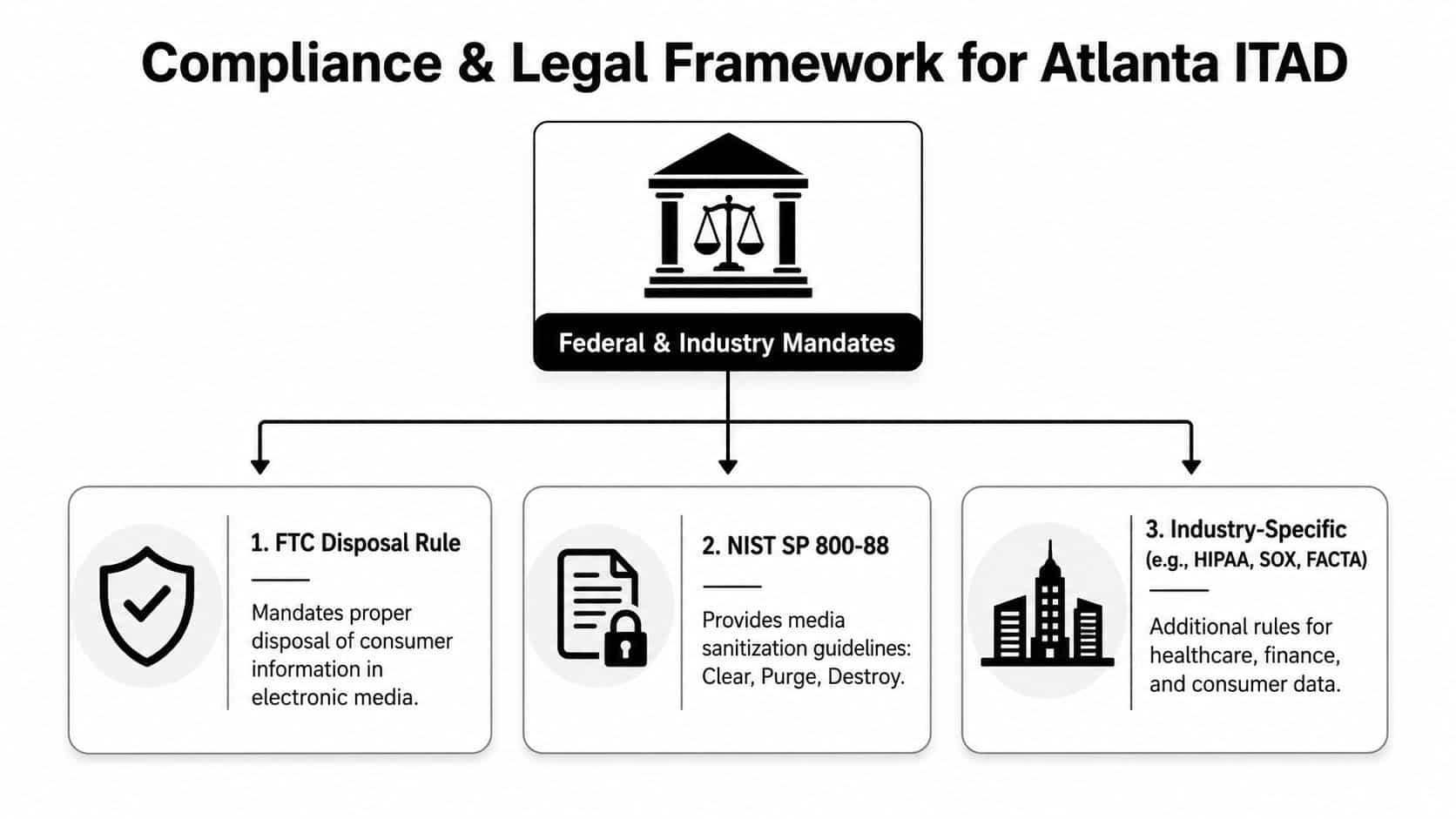
The legal baseline is simple. The workflow isn't. The FTC's Disposal Rule took effect in 2005 and requires covered businesses and individuals to take reasonable measures to protect consumer information when disposing of records and devices containing that information (FTC Disposal Rule guidance). In practice, that means secure wiping, physical destruction where needed, and documentation that proves the handoff happened.
Atlanta IT teams shouldn't think of compliance as one regulation. They should think in layers. The Disposal Rule sets the disposal expectation, NIST 800-88 sets the sanitization benchmark, and industry requirements such as HIPAA, GLBA, SOX, and FACTA shape the retention and evidence burden for different departments and business units.
What the paperwork has to prove
A defensible ITAD file should show serial numbers, custody transfer, destruction method, and final disposition. Atlanta guidance specifically emphasizes a unique certificate number, destruction date, a named destruction method, and one line per device with its serial number, because that granularity supports liability transfer and audit checks (serialized chain-of-custody guidance).
A batch invoice is not the same thing as a compliance record.
That distinction matters for healthcare, finance, government, and education clients that manage regulated information across mixed fleets. The internal link worth keeping handy is electronics recycling laws in Georgia and ITAD compliance, because state-level handling expectations often surface right when a team is already under deadline.
A strong program also assumes that liability transfer is only real when the documents are complete. If a certificate doesn't connect back to an individual serial number, the audit trail has a hole. That hole is where vendors and clients argue later.
Secure Data Destruction Methods Explained
Good ITAD vendors don't force every device through the same destruction path. They triage first. That's the practical difference between a secure program and a wasteful one. Atlanta guidance separates secured logistics, certified wiping, physical destruction, and value recovery because each path fits a different asset condition and risk profile (data destruction guidance).
How the main methods differ
| Method | Best For | Compliance Standard | Value Recovery Potential |
|---|---|---|---|
| Certified data wiping | Devices that are functional and can be sanitized for reuse or resale | NIST 800-88 | High |
| On-site hard drive shredding | High-risk media, sensitive workloads, damaged drives | NIST 800-88 aligned physical destruction | Low |
| Off-site physical destruction | End-of-life media that doesn't need reuse value | NIST 800-88 aligned destruction and recycling | Low |
Certified wiping makes sense when the hardware still has residual life and the business wants to preserve value. Shredding makes sense when the media is too sensitive, too damaged, or too hard to trust after sanitization. Off-site destruction works when the vendor can maintain custody, destroy the media, and document the outcome cleanly.
What a certificate should contain
A real certificate of data destruction should identify the asset, the method used, the date, and the final disposition. If the vendor issues a summary that only says “all drives destroyed,” that's not enough for enterprise audit support. The better documents line up one device at a time and match the original inventory.
Operational rule: triage first, destroy second. That's how teams preserve residual value without weakening compliance.
For teams comparing tools or service methods, the internal resource what a degausser is and when it makes sense helps frame magnetic media decisions. The key point is simple. The method should match the asset, not the vendor's convenience.
What to Expect from a Professional ITAD Engagement
A real engagement starts before pickup day. The internal team should tag data-bearing devices, record make, model, serial number, condition, and location, then hand that inventory to the vendor before anything moves. That discipline creates the baseline for reconciliation later.
A typical enterprise pickup
At pickup, the vendor should present a manifest and collect signatures before assets leave the site. Locked transport containers matter, but the bigger control is the serial-level record. Atlanta chain-of-custody guidance is explicit that item-by-item tracking is what preserves the audit trail from pickup through destruction, resale, or recycling (chain-of-custody guidance).
Once the devices reach processing, the inventory gets matched against the pickup list. Any mismatch needs resolution before sanitization or resale. That is where a lot of weak providers get exposed, because they rely on pallet counts or broad batch notes instead of a one-line record per device.
What the final package should include
The final file should include the certificate of destruction or recycling, the serialized inventory, and the final disposition notes. If the vendor can't reconcile the original list with the ending list asset by asset, the documentation isn't defensible.
The handoff is not complete when the truck leaves. It's complete when the final report matches the serials.
A professional engagement also makes room for resale or redeployment when devices still have value. That's one reason a vendor's documentation matters so much. You can't responsibly recover value if you can't prove what was recovered.
Industry-Specific ITAD Approaches
Different sectors need different controls, even when the hardware looks the same. A hospital and a university may both retire laptops, but the compliance expectations around those devices will not match. That is why mixed fleets need a disposition plan, not a generic pickup.
Healthcare organizations handling protected health information need serialized documentation, verified sanitization, and destruction records that can stand up to audit review. Finance teams focus on consumer and account data, so they usually want written proof and retained evidence that shows exactly what happened to each device. Schools and universities often have large device counts spread across departments, which makes asset-level inventory control more important than a single department's preference.
Sector-specific priorities
- Healthcare: require serialized documentation, verified sanitization, and destruction records that align with PHI handling.
- Finance: require clear proof of disposition for consumer and account data, plus chain-of-custody records that survive internal audit.
- Education: require inventory discipline across labs, faculty offices, and administrative teams, because devices move between units.
- Government: require vendor transparency, documented downstream handling, and procurement records that support public accountability.
Mixed fleets create a second issue. Older servers, newer laptops, mobile devices, and network gear cannot all take the same path. A vendor should be able to separate value recovery from destruction without breaking custody, and that means the paperwork has to track the serial number from pickup through final outcome.
For teams comparing service models, the internal Atlanta planning resource at Beyond Surplus's Georgia service page is useful because it frames secure disposal as a coordinated workflow, not a single pickup event. That perspective matters more in regulated sectors than in office cleanouts, and the same diligence should carry through to vendor selection, including a close review of how to choose an ITAD vendor in Georgia step by step.
How to Evaluate and Select an ITAD Vendor
Price is only one line in the procurement decision. The first question is whether the vendor can prove control. Atlanta business checklists call out R2v3, NAID AAA, e-Stewards, and ISO 14001 as credentials worth demanding, because those certifications tell you something concrete about process, environmental handling, or both (Atlanta vendor checklist).
What to ask before you sign
- Third-party certifications: Request current certificates and verify expiration dates.
- Sanitization methods: Ask how they align wiping and destruction with NIST 800-88.
- Chain-of-custody: Ask whether they track by serial number, not by pallet.
- Downstream handling: Ask for recycler audit evidence and final disposition reporting.
- Insurance and bonding: Ask what covers cargo, liability, and handling mistakes.
- Local capability: Ask whether they can support Atlanta pickups and distributed national locations.
A useful procurement move is to compare the vendor's answers against the paperwork they'll produce. If their sample report is thin, their real report probably will be too. That's also where freight-style thinking helps. A good compare UK freight carriers resource can sharpen how procurement teams think about route control, custody handoffs, and operational transparency, even though the service category is different.
What good vendors do differently
They show you the facility. They explain how they handle incoming assets. They issue itemized reports. And they can explain why one device was wiped while another was physically destroyed.
Practical rule: if a vendor avoids serial-level reporting, keep looking.
For a step-by-step vetting framework, Atlanta buyers should also review how to choose an ITAD vendor in Georgia. It's the kind of checklist that saves procurement teams from learning the hard way.
Partner with Beyond Surplus for Certified ITAD in Atlanta
Beyond Surplus fits the workflow Atlanta businesses need. The company operates from the Smyrna, Atlanta area, uses its own fleet for secured logistics, supports nationwide pickup for distributed organizations, and offers on-site and off-site hard drive shredding, certified data wiping, IT buyback, data center de-installations, and product destruction. It also issues certificates of recycling and data destruction that help transfer liability and support compliance with the FTC Disposal Rule.
That mix matters because ITAD is rarely one service. It's logistics, sanitization, resale, and documentation tied together under one custody chain. For organizations that want the process handled with less friction, the internal overview at Beyond Surplus in Georgia gives a straightforward picture of the service model.
If you're comparing vendors against this checklist, also pay attention to who will handle the work. Background screening, facility access, and transport control all matter, which is why a resource like affordable volunteer background checks can be a useful reference point when you're thinking about personnel screening standards around sensitive operations.
For Atlanta IT teams that need certified electronics recycling, secure data destruction, and asset-level documentation, Beyond Surplus can handle the pickup, chain-of-custody, and final reporting in one controlled process. Visit Beyond Surplus to request a consultation or schedule a pickup for your retired IT assets.


