

Your Kennesaw office probably has one of these rooms. Retired laptops stacked in rolling bins. Old switches on a shelf. A few servers nobody wants to touch because they may still hold production data. The equipment is out of service, but the risk is still active.
That's why Kennesaw ITAD services matter. For businesses in Cobb County and across the Atlanta metro, IT asset disposition isn't just the last step in a hardware refresh. It's a control point for data security, audit readiness, logistics, and cost recovery. If the process is loose, the exposure stays with you. If the process is disciplined, you reduce risk and recover what value still exists.
Why ITAD Is a Critical Business Function in Kennesaw
Many companies still treat retired IT like surplus furniture. They move it into storage, wait for the next office cleanout, then call whoever can haul it away. That approach breaks down fast when the assets include encrypted laptops, failed SSDs, backup appliances, or network gear that touched regulated environments.
In Kennesaw, that problem shows up in ordinary places. Medical groups expand. Manufacturers replace workstations. Multi-site businesses consolidate equipment after upgrades. Every one of those events creates a chain of custody problem, not just a disposal task.
Storage closets create hidden liability
A powered-down device can still create compliance exposure. If nobody can prove where it came from, what data was on it, how it was sanitized, and where it ended up, the asset is still part of your risk surface.
What works is a formal disposition workflow tied to your asset records and procurement cycle. What doesn't work is a one-time purge with incomplete logs.
Old hardware stops being “junk” the moment an auditor asks for proof of disposal.
The reason this has become standard practice is simple. The ITAD market has grown into a mainstream infrastructure category. One industry summary says the market surpassed USD 17.5 billion in 2025 and is projected to reach USD 40.1 billion by 2035 according to this ITAD market analysis from Global Market Insights. That scale tells you something important. Mature organizations no longer see ITAD as an afterthought.
Why local businesses need a repeatable program
Kennesaw companies don't need a theory of ITAD. They need a repeatable operating model that covers pickups, serialized tracking, verified destruction, and downstream handling. That's especially true when equipment moves between branch offices, data rooms, and third-party sites around the Atlanta area.
A useful starting point is to look at why ITAD services matter for Georgia companies in 2026. The local takeaway is straightforward. The business value comes from control. The moment assets leave your office without documentation, your negotiating position, your audit trail, and your liability posture all get weaker.
The Core ITAD Process Explained for Businesses
A solid ITAD engagement should feel boring in the best possible way. It should be predictable, documented, and easy to audit. If a provider can't explain the workflow clearly, expect problems later.
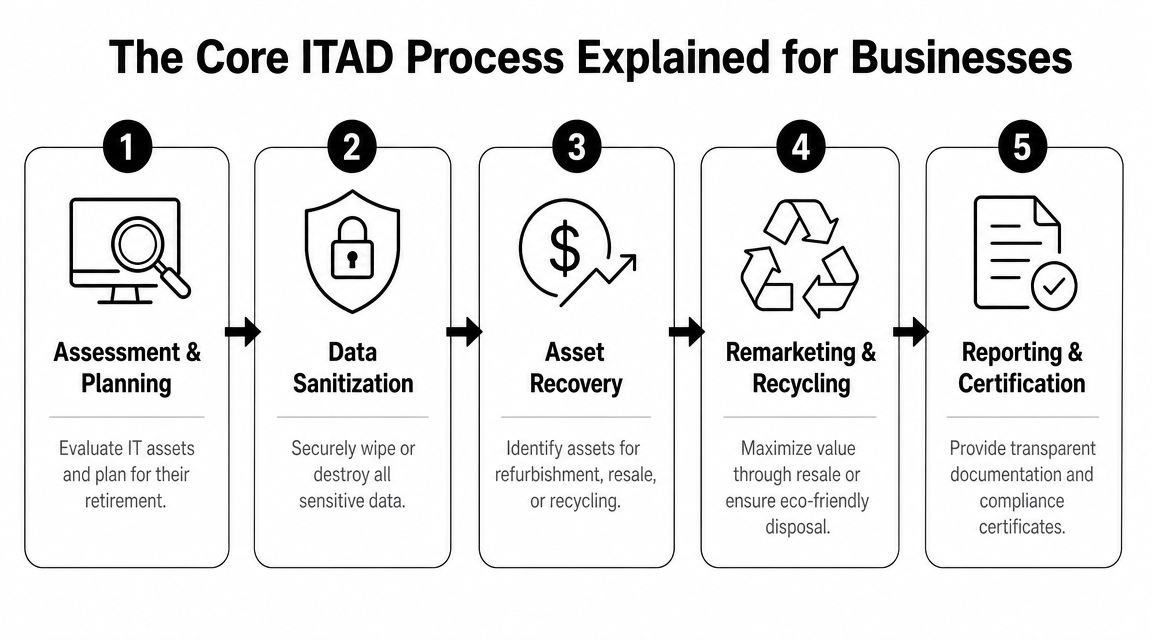
Step one through step three
The first step is assessment and planning. That means identifying asset types, locations, quantities, and handling requirements before pickup day. A data closet with rack equipment needs a different plan than a law office with boxed laptops.
Then comes data sanitization planning. It is often the point at which many projects go sideways. Teams often focus on transportation first and data handling second. The order should be reversed. Decide which devices are eligible for wiping, which need physical destruction, and which require special handling because they're damaged or unsupported.
Third is asset recovery review. Some hardware can be tested, graded, and prepared for resale channels. Some can't. A good provider separates reusable equipment from scrap early so the financial picture stays clear.
If you want a baseline description of the workflow, what IT asset disposition means in practice is a useful reference.
Step four and step five
After sorting and testing, the process splits into remarketing and recycling. Reusable assets move through refurbishment and resale channels. Non-remarketable equipment goes into responsible material recovery. These are different operational paths, and they should never be blurred in reporting.
The last step is reporting and certification. At this stage, the project becomes defensible. You should receive records that tie the asset list to the disposition outcome.
A business-grade ITAD process usually includes:
- Pickup controls that document where assets were collected and who released them
- Serialized inventory for devices that can be individually tracked
- Sanitization records tied to each asset or batch, depending on media and process
- Testing notes for equipment entering reuse channels
- Final disposition reporting that shows resale, recycling, or destruction outcomes
Practical rule: If the provider's final paperwork can't support an internal audit, the process wasn't complete.
The strongest programs also define exceptions up front. Missing drives. Broken labels. Swollen batteries. Unsupported media. Those edge cases matter because they're exactly where undocumented risk tends to hide.
Managing Risk and Ensuring Compliance in Georgia
When Georgia businesses evaluate ITAD, the central question isn't “Can this vendor recycle electronics?” It's “Can this process stand up to scrutiny after a problem, an audit, or a legal review?” That's the standard.
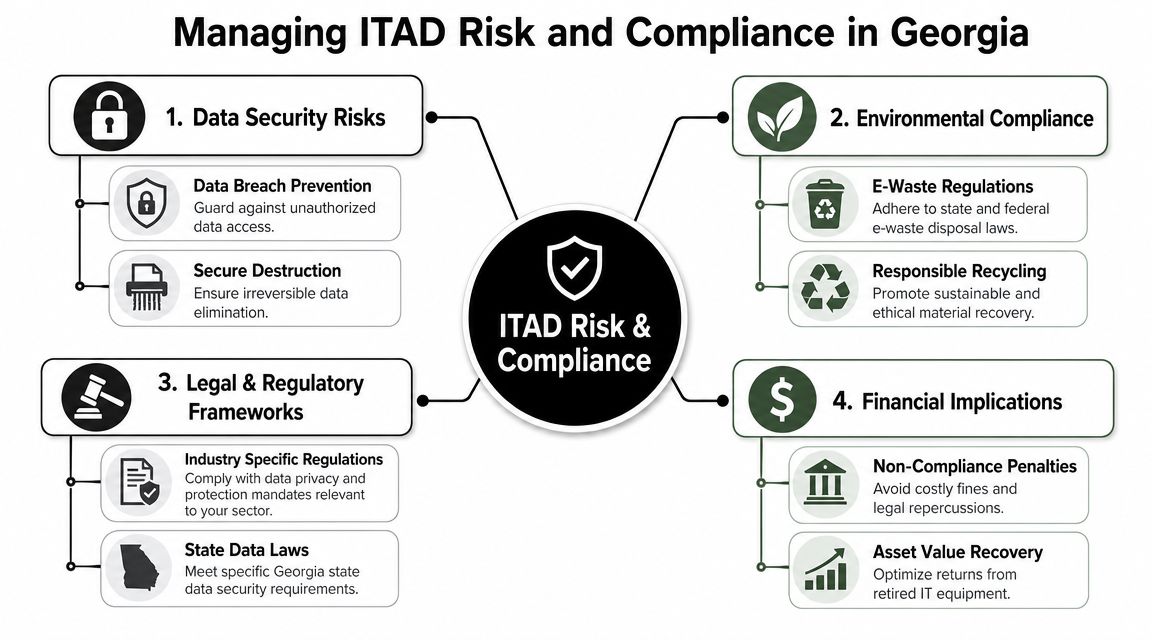
What auditors and counsel care about
They care about control. They want to know whether your organization maintained possession, documented transfer, selected an appropriate sanitization method, and retained evidence of the result.
That's why serialized chain of custody matters so much. According to Park Place Technologies' overview of defensible ITAD controls, a sound ITAD program should enforce serialized chain of custody plus certified data destruction, and NIST SP 800-88 Rev. 1 defines the sanitization categories Clear, Purge, and Destroy. The useful takeaway isn't just the terminology. It's the audit principle behind it. Documentation is what turns disposal activity into a compliance control.
The difference between activity and evidence
A truck showing up doesn't prove secure handling. A recycling receipt doesn't prove data destruction. A verbal assurance from a driver doesn't prove chain of custody.
What does help is evidence like this:
| Control area | What good looks like |
|---|---|
| Asset release | Named contact, pickup date, site location |
| Device tracking | Serial numbers or documented batch controls |
| Data handling | Wipe, purge, or destroy method recorded |
| Final outcome | Reuse, destruction, or recycling shown in report |
For businesses managing collaboration platforms and document sprawl, it also helps to understand how disposal intersects with retention and privacy governance. A practical companion resource is Ollo's SharePoint GDPR strategies, especially for teams trying to connect data lifecycle policy with endpoint and storage retirement.
What prudent buyers ask before signing
Use direct questions. Don't settle for marketing language.
- How is chain of custody recorded? Ask whether each asset is serialized from pickup through final disposition.
- Which sanitization path is used for damaged media? If the answer is vague, that's a problem.
- What proof do you issue? You need more than a general recycling acknowledgement.
- How are exceptions handled? Failed drives and unlabeled devices should trigger a defined process.
For Georgia buyers comparing vendors, what to know about R2-certified ITAD providers in Georgia helps frame those questions in a practical way.
Compliance failures usually start as process gaps, not technical mysteries.
Secure Data Destruction Methods Demystified
The hardest part for many IT managers is choosing between software sanitization and physical destruction. Both can be valid. They solve different problems.
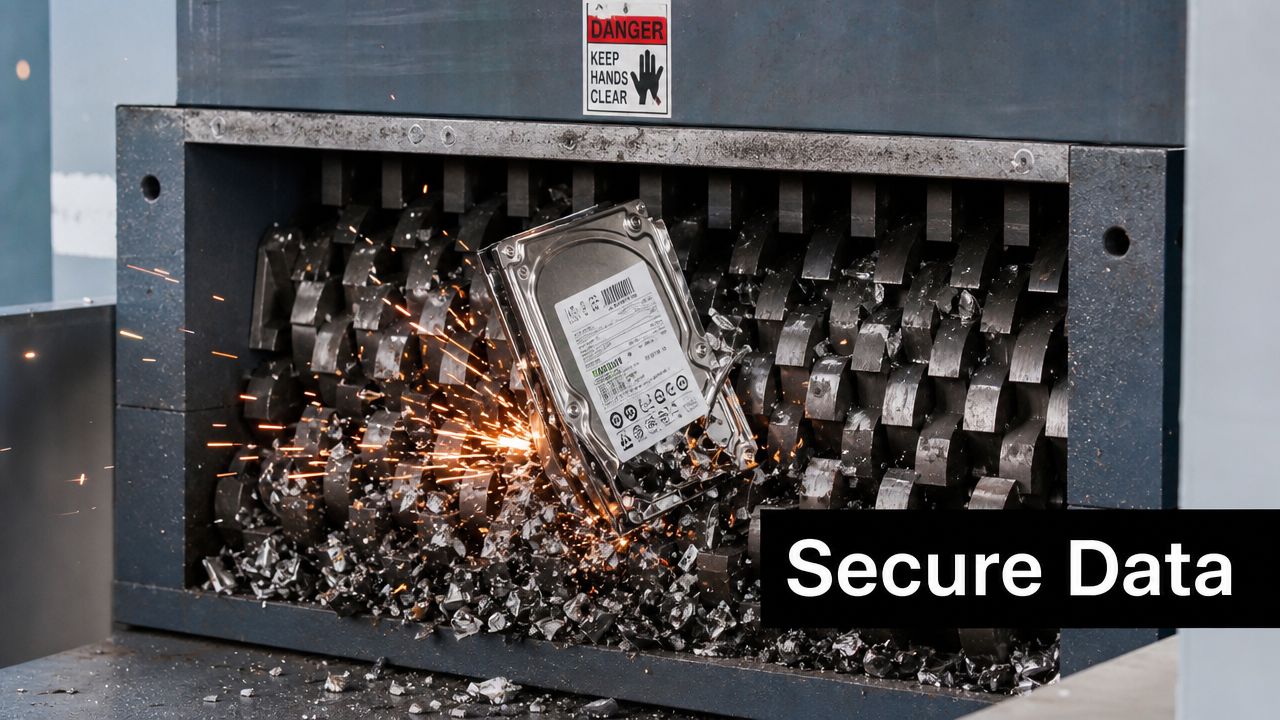
When wiping makes sense
Wiping is the right choice when the media is functional, supported, and intended for reuse or resale. The upside is obvious. You preserve the asset's resale potential. The risk is that wiping only works when the process is validated and the device can complete sanitization.
That's why old or failing drives need more caution. If your team is retiring capacity-heavy storage and needs a refresher on hardware planning assumptions, this 1TB hard disk drive planning guide is a decent reference point for thinking about drive types and usage contexts before disposition decisions are made.
When shredding is the better call
Physical destruction is the safer path when reuse isn't worth the residual risk. That includes failed media, unsupported devices, hardware from highly regulated environments, or situations where your legal team wants irreversible destruction.
A simple comparison helps:
- Wiping preserves resale opportunity, but only if verification succeeds.
- Shredding removes reuse value, but it reduces uncertainty.
- On-site destruction gives teams direct visibility before media leaves the premises.
- Off-site destruction can work well if chain of custody and reporting are tight.
If the drive can't be read consistently, don't build your control plan around a wipe result you may never get.
Certificates matter here, but only when backed by real operational records. A certificate should reflect what happened to the media, not substitute for the underlying log. For organizations reviewing internal policy, how to erase a hard drive can help separate consumer-grade assumptions from enterprise disposal requirements.
Maximizing Value Recovery from Retired IT Assets
A lot of ITAD proposals mix two different goals into one sales pitch. One goal is reducing risk. The other is recovering value. They aren't the same, and you should evaluate them separately.
What actually creates resale value
Value comes from reuse potential. The device has to be functional enough to test, clean, grade, and resell. Equipment that's too old, damaged, locked, incomplete, or missing key components usually moves out of the resale path quickly.
That's why the net outcome depends on several factors working together:
- Condition matters more than original purchase price
- Completeness affects whether a device can be remarketed efficiently
- Age and market demand shape whether buyers still want the model
- Data handling costs can erase upside on low-value hardware
According to ITAD USA's discussion of the state of IT asset disposition in 2026, value recovery is “often missed” and should be treated as a separate decision from risk reduction. That distinction is useful because some projects are mostly about secure destruction, not monetization.
How to read a proposal realistically
A credible ITAD quote should show how reusable assets are separated from destruction-only assets. If those categories are lumped together, it's hard to know whether projected recovery is realistic.
Look for these signals:
- Test and grade discipline rather than blanket promises about resale
- Clear treatment of non-working assets so destruction costs don't disappear in the estimate
- Defined settlement terms for items that sell
- Transparent exclusions for obsolete or damaged gear
How Georgia businesses can maximize value with ITAD services is helpful if you want to build an internal framework for that review.
The best financial outcome usually comes from sorting aggressively, not from assuming every retired device still has a market.
Logistics for Kennesaw and the Atlanta Metro Area
Most ITAD projects succeed or fail before processing starts. The logistics plan decides whether pickup day is controlled or chaotic.
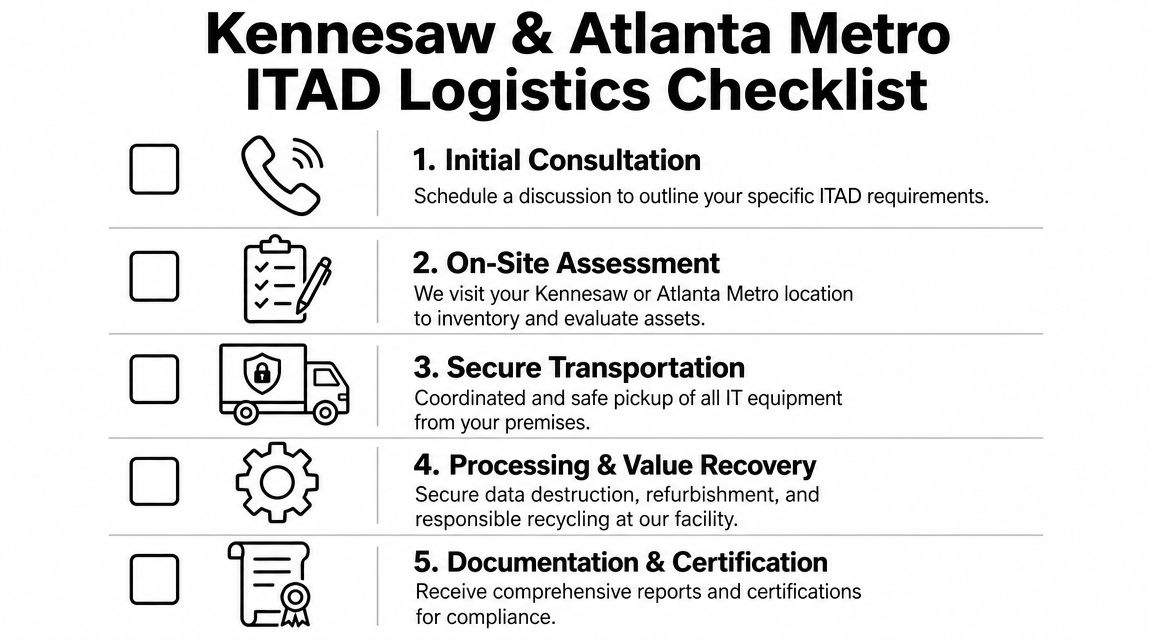
How to prepare your site
For Kennesaw and greater Atlanta locations, the practical issues are straightforward. Where is the equipment staged? Is there dock access? Are loose drives separated from whole systems? Who signs the release? Those details save time and prevent chain-of-custody confusion.
A good pickup plan usually includes:
- A single release contact who can answer questions and approve transfers
- Pre-staged assets grouped by type, such as laptops, servers, network gear, and media
- Access notes covering loading docks, elevators, parking constraints, and security check-in
- Exception tagging for damaged devices, batteries, and anything that needs special handling
What pickup day should look like
The handoff should be calm. Assets are counted or scanned, paperwork is matched to the pickup scope, and any exception items are noted before departure. If the provider is improvising on site, the process wasn't planned well enough.
For companies with recurring refresh cycles, an operating rhythm proves advantageous. Quarterly pickups, site-by-site schedules, or project-based decommissions all work better than emergency cleanouts. An Atlanta-based option some organizations use is Beyond Surplus, which handles IT asset disposition, secure data destruction, pickup coordination, and reporting for business clients across Georgia and beyond.
The local advantage isn't just proximity. It's the ability to coordinate building access, on-site service windows, and multi-location pickups without turning a routine retirement cycle into a special project every time.
Partner with Beyond Surplus for Your ITAD Needs
If you're managing retired technology in Kennesaw, you need more than a recycler. You need a process that protects the business after the equipment is gone. That means documented custody, defensible data destruction, practical pickup logistics, and realistic value recovery.
The demand for that kind of discipline is growing with enterprise refresh cycles and decommissioning activity. One market forecast says the data-center ITAD market is projected to reach USD 24,436.82 million by 2032, with North America expected to reach USD 7,734.52 million according to this data-center ITAD market forecast from Credence Research. For buyers, the operational message is clear. End-of-life handling is recurring work, and partners need experience with large-scale, repeatable execution.
What a solid partner should deliver
Choose a provider that can do four things consistently:
- Control the handoff with clear pickup procedures and documented transfers
- Apply the right destruction method based on media condition and risk tolerance
- Separate resale from scrap accurately so recovery estimates are credible
- Issue reporting that holds up internally when procurement, security, and compliance teams ask questions
That combination is what turns ITAD from a cleanup exercise into a business control. It reduces uncertainty for IT, shortens the debate with compliance teams, and gives procurement a better basis for evaluating end-of-life costs.
For Kennesaw organizations with offices, labs, medical environments, warehouses, or server rooms spread across the Atlanta metro, that's the standard worth holding.
Contact Beyond Surplus for certified electronics recycling and secure IT asset disposition in Kennesaw and across the Atlanta metro. If you need serialized chain of custody, data destruction, pickup logistics, or help evaluating value recovery from retired equipment, start with a business pickup or consultation.


