
If you're clearing out retired laptops, servers, storage arrays, or network gear in Georgia, the hard part isn't finding a recycler. It's proving that the provider you hire can handle data, documentation, and downstream accountability in a way your legal, compliance, and procurement teams can defend later.
That gap matters. A vendor can place an R2 badge on a website and still leave basic questions unanswered. Which facility is certified? What services are included in that certified process? Will you get serialized chain-of-custody, certificates, and a clear record of what was reused, destroyed, or recycled?
For Georgia organizations, those questions come up often because the state has an active commercial market for IT asset disposition. Buyers have options across Atlanta and nearby business corridors, which is useful, but it also means you need a tighter vetting process. The companies that look similar in search results often differ in reporting depth, destruction options, and how clearly they document downstream handling.
Your Guide to Secure IT Asset Disposition in Georgia
A typical Georgia IT refresh starts the same way. Old endpoints pile up in a closet. A server room cleanout gets delayed because no one wants to own the risk. Procurement asks for quotes. Legal asks what happens to the drives. Security asks for proof, not promises.
That's where many disposal projects go sideways. Teams focus on pickup logistics first and auditability second. For business assets, that order should be reversed.
Georgia has a concentrated but mature R2-certified ITAD market with multiple providers serving Atlanta and surrounding business corridors, including Decatur, Tucker, and Norcross. That footprint shows Georgia is an established Southeast hub for certified electronics recycling and ITAD, built to support enterprise pickup, decommissioning, and certified data destruction at scale, as noted by Georgia certified electronics recycling company listings.
What buyers usually need
Most commercial ITAD projects come down to a short list of control points:
- Data handling: You need a documented process for drives, backup media, and any other data-bearing assets.
- Asset visibility: You need to know whether reporting is serialized or handled in bulk.
- Chain of custody: You need proof of what happened from pickup through final disposition.
- Downstream control: You need confidence that materials don't disappear into an undocumented vendor chain.
Practical rule: If a provider can't explain the paperwork before pickup, the risk usually gets worse after pickup.
What works and what doesn't
What works is a provider that treats disposition like a controlled business process. That means intake procedures, asset tracking, destruction options, and final documentation are all defined before the truck arrives.
What doesn't work is relying on broad claims like "secure recycling" or "fully compliant disposal" without asking how those claims are verified. In practice, the strongest Georgia ITAD relationships are built on auditable process, not brand language.
Decoding R2 Certification for Georgia Businesses
A Georgia company schedules a data center pickup, sees an R2 badge on the vendor's site, and assumes the controls behind that badge cover every truck, technician, and downstream outlet involved in the job. That assumption creates risk. R2 is useful, but only if you understand what it verifies and where you still need proof.
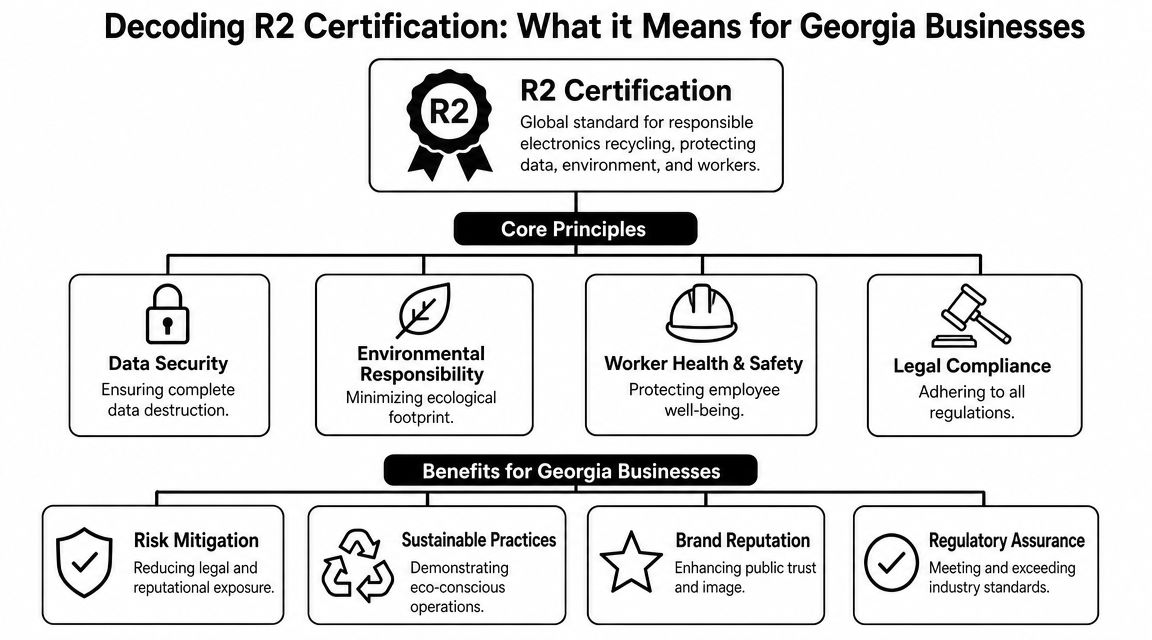
R2 is one of the main standards enterprise buyers use to screen ITAD and electronics recycling providers. It sets process requirements around data security, legal compliance, environmental controls, worker health and safety, and downstream accountability. This overview of R2 certification gives the high-level background, but buyers in Georgia should read the standard as a starting point for vendor review, not the finish line.
R2 sets a baseline. It does not prove every service claim.
R2 requires a certified facility to operate under documented controls and to pass an independent audit against those controls. For a buyer, that matters because it raises the floor. You are not starting from a blank slate. You are reviewing a provider that should already have procedures for intake, storage, sanitization, tracking, and downstream management.
The practical limitation is just as important. Certification does not automatically confirm that the specific Georgia location you plan to use is in scope, that on-site services are included, or that every subcontracted step matches what your contract requires.
That gap is where careful buyers do their work.
A plain-language summary of the framework appears in Beyond Surplus's guide to what R2 certification covers.
Why the ISO alignment matters
R2 carries more weight than a generic recycling claim because certified providers are expected to maintain management systems aligned with ISO 9001, ISO 14001, and ISO 45001. In practice, that usually means there should be documented procedures, internal controls, corrective action records, training expectations, and audit evidence behind the sales language.
For Georgia businesses, that matters during vendor review and after pickup. A provider working within that structure should be able to produce records that show how assets were received, how exceptions were handled, who approved disposition paths, and how downstream vendors were controlled. If those records are thin or slow to appear, the badge is doing more work than the process.
R2 confirms that a controlled system exists at the certified facility and within the certified scope. It does not, by itself, confirm that the provider's proposal gives you the exact chain of custody, reporting detail, or service coverage your organization requires.
That distinction is where weak ITAD engagements usually start.
How to Verify a Provider's R2 Certification Status
A logo on a homepage isn't verification. It's marketing.
If you're evaluating R2 certified ITAD providers in Georgia, the neutral check is the official directory maintained by SERI. That matters because R2 certification applies to a facility and process scope. It is not a blanket guarantee that every office, warehouse, or advertised service is covered the way a buyer may assume.
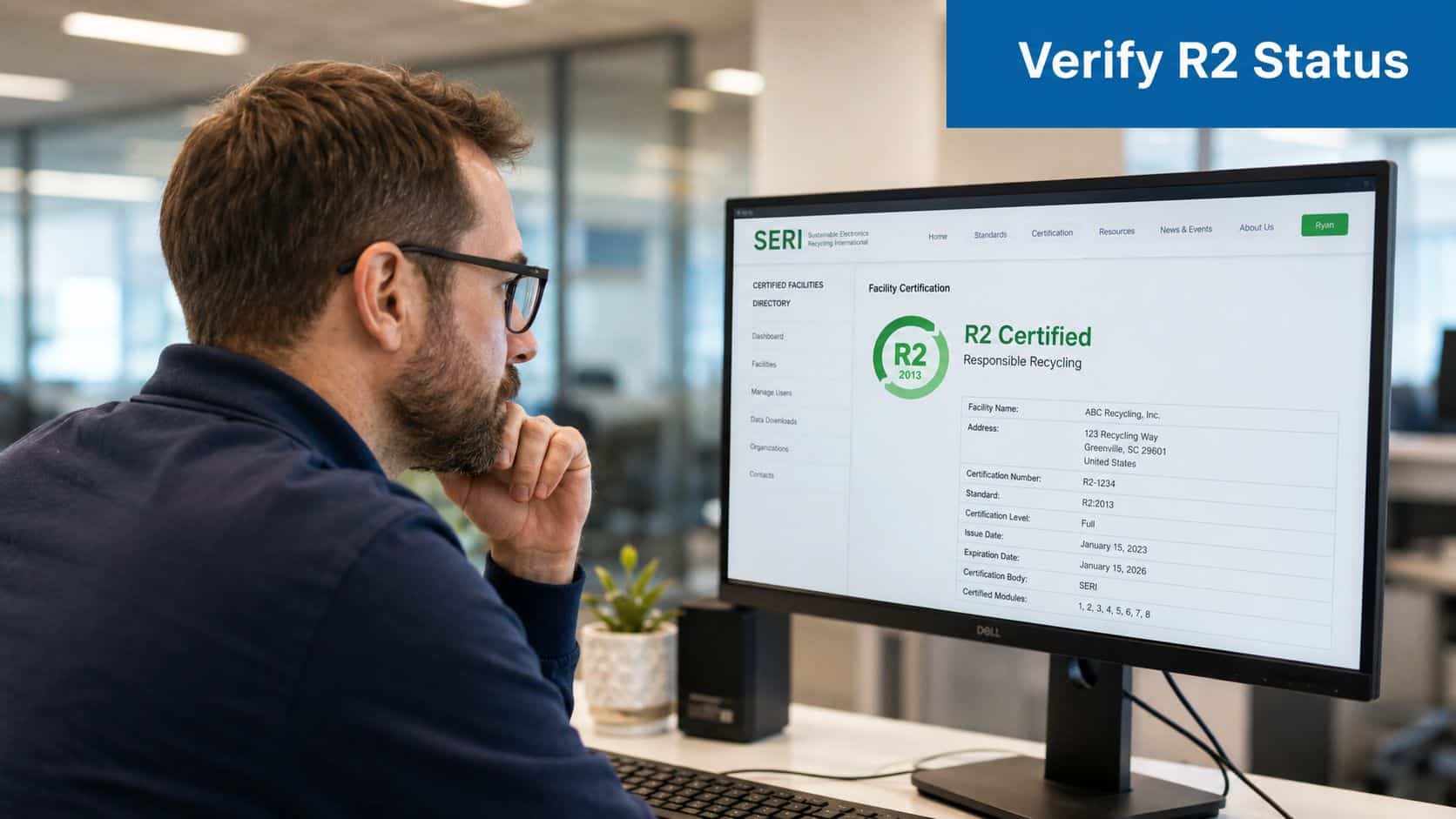
The most useful starting point is the official SERI R2 certified facility directory. It is more reliable than a badge on a sales page because service descriptions in the market vary widely in what they document versus what they imply.
What to check in the directory
Use the directory like an auditor, not like a shopper.
- Match the exact facility name. Confirm the Georgia location you're planning to use is the one listed.
- Check current status. Don't assume a past certification remains active.
- Review the listed scope carefully. Buyers often overread a certification badge and underread the actual facility record.
- Compare the directory entry to the proposal. If the proposal promises services the facility record doesn't clearly support, ask for documentation.
A practical worksheet helps. Many teams use a structured review like this vendor due diligence checklist so procurement, IT, and compliance aren't asking different questions.
Questions worth asking immediately
Once you've verified the listing, move straight to specifics:
- Which Georgia facility will process our assets?
- Is serialized chain-of-custody included, or only available by request?
- Are witnessed destruction and certificates part of the base service?
- Which downstream vendors handle materials that aren't resold or reused?
If a provider answers those questions with generalities instead of documents, keep looking.
Verification is not a paperwork exercise. It's the first filter that separates real control from borrowed credibility.
The Essential Checklist for Auditing Georgia ITAD Vendors
After you confirm certification status, the important assessment begins. Buyers then determine whether an R2-certified provider can deliver the service model they need.
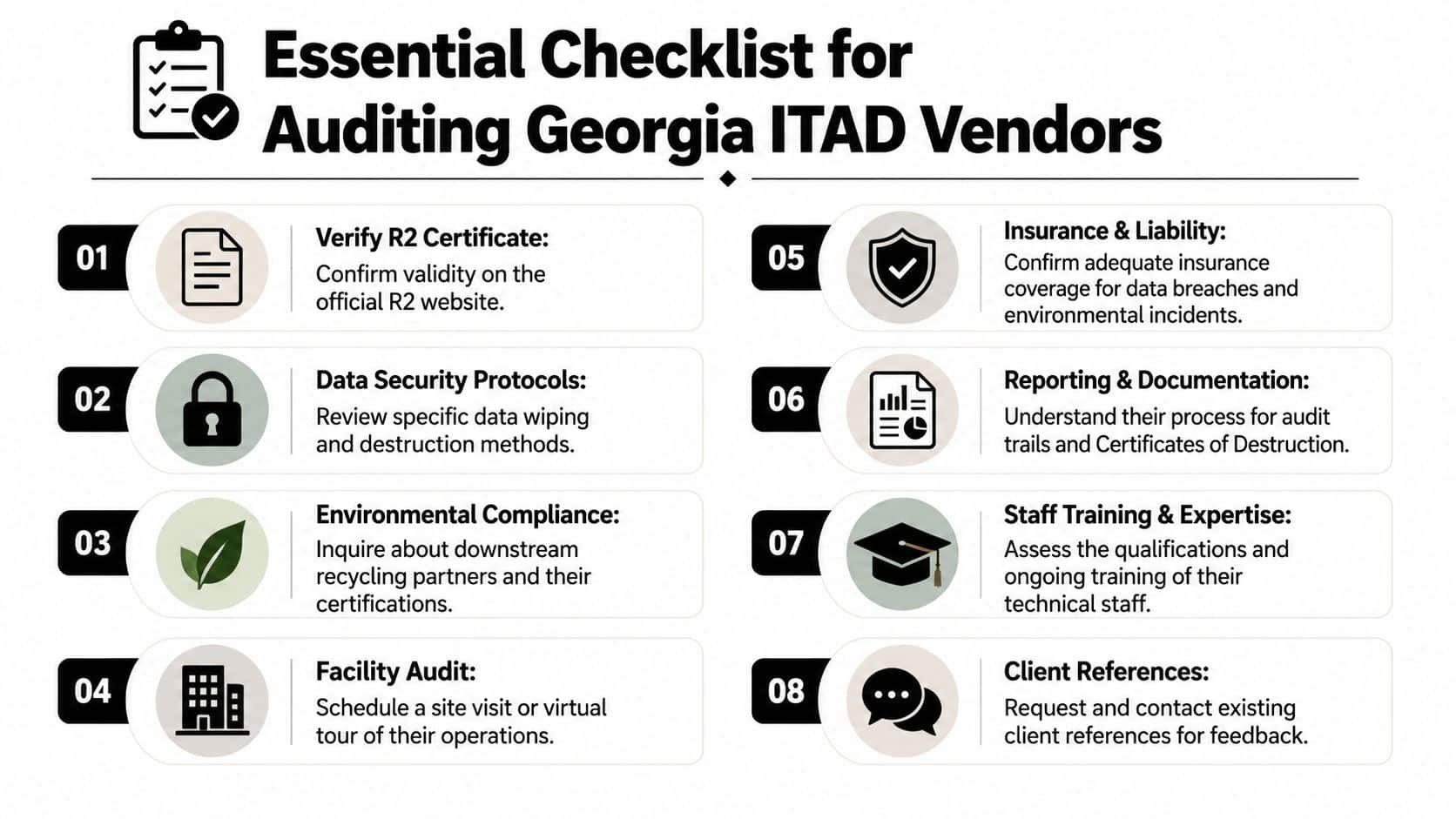
Audit the service, not just the badge
Ask to see the operating details behind the proposal.
- Pickup controls: Who signs for assets at pickup, and what record is created at that moment?
- Receiving process: Are assets counted in bulk or checked against a serialized manifest?
- Storage segregation: How are data-bearing assets separated from non-data equipment before processing?
- Exception handling: What happens if counts don't match or a drive arrives damaged?
These aren't minor details. They're where chain-of-custody either holds up or breaks down.
Focus on data-bearing assets first
The most important question isn't "Do you shred drives?" It's "How do you decide whether to wipe, remarket, or destroy this specific asset, and how will you document that decision?"
A key issue for Georgia buyers is what happens to data-bearing assets after they leave the facility, especially the tradeoff between value recovery and destruction. The best outcome is not always destruction-only. Value recovery can reduce total disposal cost while still meeting compliance needs, but only if the provider has serialized reporting and auditable downstream controls, as explained in this ITAD services overview.
That means your audit questions should split into two tracks:
| Asset path | What to verify |
|---|---|
| Reuse or resale | Certificates of erasure, serialized records, downstream accountability |
| Physical destruction | Method used, witness options, serialized destruction records, final certificate |
Destruction-only sounds safer, but it can be the wrong choice for assets that are reusable and can still be controlled through documented erasure and chain-of-custody.
Review the documents before the project starts
Don't wait until the job is complete to learn what the reporting package looks like. Ask for samples in advance.
Look for:
- A serialized asset report
- A certificate of data destruction
- A certificate of recycling
- Exception reporting for missing or non-readable assets
- Documentation showing downstream handling
If you want a baseline for what a destruction record should cover, review a destruction certificate template and compare it to what the vendor issues.
Separate useful answers from polished answers
Good vendors answer directly. Weak vendors substitute language for evidence.
Ask one operational question in detail, such as: "Show me how asset serial numbers flow from pickup ticket to final disposition report." Then stop talking. The quality of that answer usually tells you more than the rest of the sales meeting.
Navigating Compliance and Limiting Liability
A pickup goes smoothly. Pallets leave the site. Two months later, legal asks for proof that a specific laptop was sanitized, who handled it, and where it ended up. If your provider can only send a generic certificate, your risk did not leave with the truck.
ITAD liability is tied to evidence. Devices may contain customer records, employee data, financial information, or regulated health data. The exposure closes only when your organization can produce records that connect each asset to a documented disposition outcome.
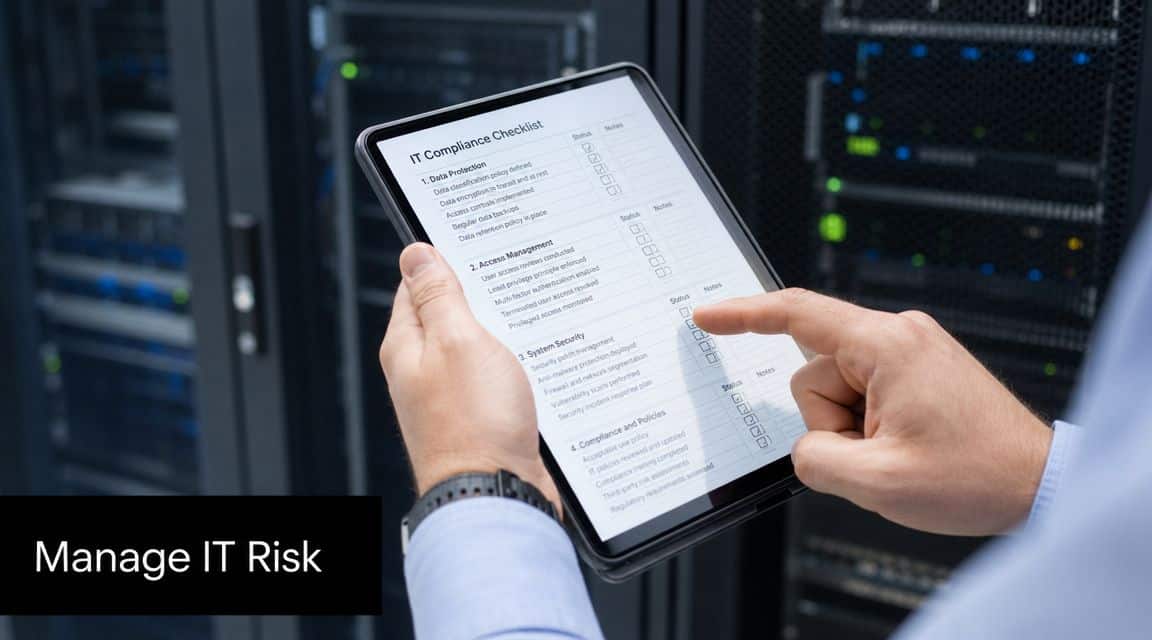
Documentation has to hold up under scrutiny
Buyers often overestimate the value of the R2 badge. Certification matters, but liability decisions are made on records, exceptions, and accountability after the fact. A provider should be able to show how its documented process works when assets are unreadable, when serial numbers are missing, when containers are re-sorted, or when equipment is sent to a downstream processor.
That standard is even harder to meet if your internal inventory discipline is weak. Undocumented laptops, lab devices, and remote-office equipment create disposal gaps before the vendor ever arrives. The same control failure appears in Compliance issues with shadow IT. If ownership and approval are unclear upstream, disposition records are harder to defend downstream.
What actually limits liability
For Georgia organizations, a defensible compliance position usually comes down to a short set of verifiable controls:
- Transfer records tied to the pickup: Dates, locations, quantities, and who released the assets
- Serialized tracking or documented exceptions: A clear record for each device, or an explanation for why a device could not be individually verified
- Data sanitization or destruction evidence: Records that tie the method used to the asset received
- Downstream oversight: Proof that materials sent beyond the first processor stay within documented controls
- Final reporting your team can audit: Certificates and asset-level reports that match the original intake
A provider that cannot produce those records on request is asking you to accept operational risk on trust. That is not a compliance strategy.
For Georgia-specific requirements and recordkeeping expectations, review this guide to compliant IT disposal in Georgia. Use it as a check against the provider's actual reporting package, not just its sales language.
Compliance teams need documents that survive an audit, a customer questionnaire, or a legal hold.
Certificates still matter, but only if they are supported by underlying logs, serialized reports, and a process your provider can explain without hand-waving. The practical test is simple. If an auditor picks one asset at random, can the vendor show custody, handling, and final disposition without gaps? If not, much of the liability remains with the asset owner.
Partner with Beyond Surplus for Auditable R2 Services
The right Georgia ITAD partner should be easy to test against the standards above. Can the company show verifiable certification? Can it support secure pickup, serialized reporting, data destruction options, and documented final disposition? Can it explain what happens to reusable equipment versus non-recoverable scrap without drifting into generalities?
For organizations that need a provider built around those controls, Beyond Surplus ITAD services in Georgia include business pickup, IT asset disposition, data wiping, on-site and off-site hard drive shredding, certificates of data destruction, certificates of recycling, and logistics support for projects ranging from office refreshes to data center de-installations.
That service mix matters because it aligns with how buyers evaluate risk. Some projects need destruction-heavy handling. Others need value recovery with strict serialized reporting. Many need both within the same pickup.
The strongest vendor relationships in Georgia usually come from buyers who audit first, contract second. If a provider can document the chain of custody, define the service scope, and produce records your compliance team can use, you're in a much better position than if you hired the company with the cleanest website and the fastest quote.
If your organization needs auditable electronics recycling and secure IT asset disposition in Georgia, contact Beyond Surplus to review your asset mix, documentation requirements, and data destruction options before pickup is scheduled.