

A lot of Georgia IT directors are staring at the same backlog in 2026. Retired laptops from the last lease cycle. A few racks of aging servers waiting for approval to leave the building. Network switches in a storage room because nobody wants to be the person who signs off on disposal and later learns a drive still held customer data.
That's why ITAD services matter for Georgia companies in 2026. This isn't just about hauling away old equipment. It's about proving what happened to every asset, who handled it, when custody changed, and whether the disposal process reduced your legal exposure. If your current process ends with “we wiped it and sent it out,” you still have a documentation problem.
Why Your 2026 Tech Refresh Demands an ITAD Strategy
Most refresh projects start as an infrastructure task and end as a risk-management problem. The hardware replacement is usually planned. The retirement workflow often isn't. That gap is where old devices pile up, storage rooms fill, and compliance questions start.

The old way stops working
For years, some companies treated end-of-life hardware as a facilities issue. Move it out, recycle what you can, and keep the project moving. That approach breaks down once devices contain regulated data, hold residual resale value, or need an auditable disposition trail.
The market tells the same story. By 2025 the global IT asset disposition market had reached approximately USD 17.5 billion, with projected growth of about 8.9% CAGR between 2026 and 2035, according to ITAD market analysis from GM Insights. That matters because it shows ITAD is now part of mainstream infrastructure and compliance operations, not a side process.
Disposal isn't the whole project
A Georgia business retiring hardware usually has several separate jobs hidden inside one line item:
- Data control: Every laptop, server, SSD, firewall, and copier has to be treated like a potential data source.
- Operations: Someone has to inventory equipment, pull it from service, stage it, and release it securely.
- Real estate: Old assets consume rack space, storage space, and staff time.
- Documentation: If an auditor or regulator asks later, your team needs proof, not assumptions.
When offices are closing or space is being reset, ITAD also intersects with physical decommissioning. In those cases, teams often need both technology disposition and workspace teardown support. For the facilities side, Cubicle By Design decommissioning help can be a useful parallel resource.
Practical rule: If your refresh plan has a procurement workstream but no documented retirement workstream, your project is only half planned.
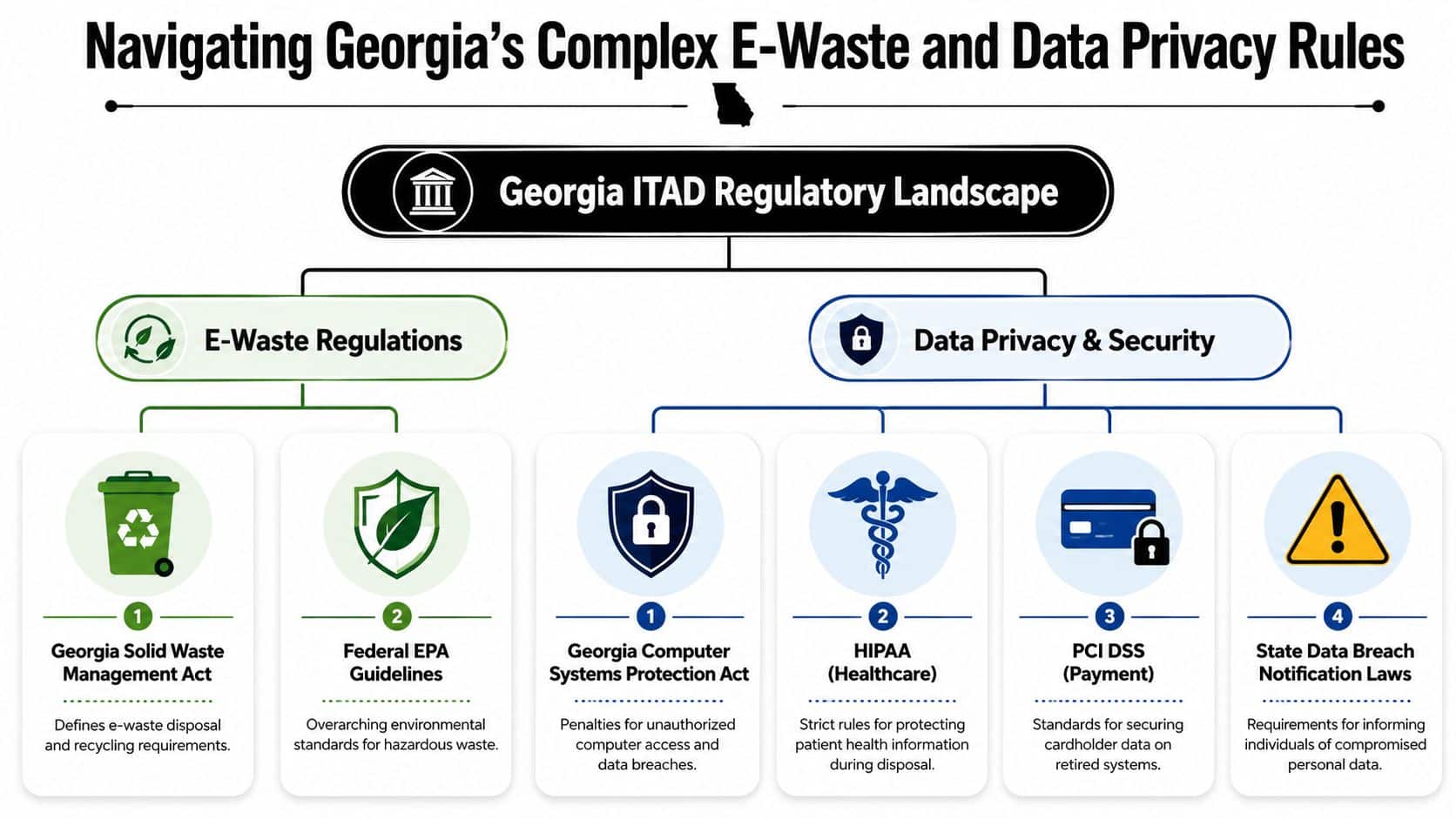
Navigating Georgia's Complex E-Waste and Data Privacy Rules
Georgia companies don't need every lawyerly detail memorized. They do need to know one thing clearly. The disposal step is regulated by the same standards mindset that governs active systems.
Where exposure actually shows up
For Georgia organizations in healthcare, finance, education, and government, disposal obligations aren't abstract. HIPAA-covered entities in the U.S. can face penalties that exceed USD 1.5 million per year for non-compliance, and the FTC Disposal Rule requires reasonable safeguards when disposing of sensitive consumer information stored on IT assets, as noted in Human-I-T's ITAD and circular economy overview.
That changes how retired equipment should be handled. A laptop in storage isn't harmless because it's powered off. A SAN shelf waiting for pickup isn't low-risk because it's no longer in production. If the media still exists and the custody trail is weak, the exposure is still live.
What compliant teams do differently
The practical compliance model is straightforward:
- Identify assets that may contain regulated data.
- Control custody before equipment leaves the facility.
- Use documented sanitization or destruction.
- Keep records that can survive an audit.
Many internal policies cover only the wiping step. That's not enough. You also need evidence that the right asset was processed, with the right method, and that the documentation matches the inventory.
A useful starting point is this Georgia secure IT disposal guide, especially for teams building policy around retirement, pickup, and record retention.
Compliance isn't just “did we destroy the data.” It's “can we prove the process was controlled from release to final disposition.”
What fails in practice
These patterns create problems fast:
- Bulk disposal with no serial-level reporting
- Informal recycler pickups with unclear custody transfer
- Generic certificates that don't tie back to specific assets
- IT and facilities using separate inventories that never reconcile
When an auditor asks for evidence, broad statements don't help. Asset-level records do.
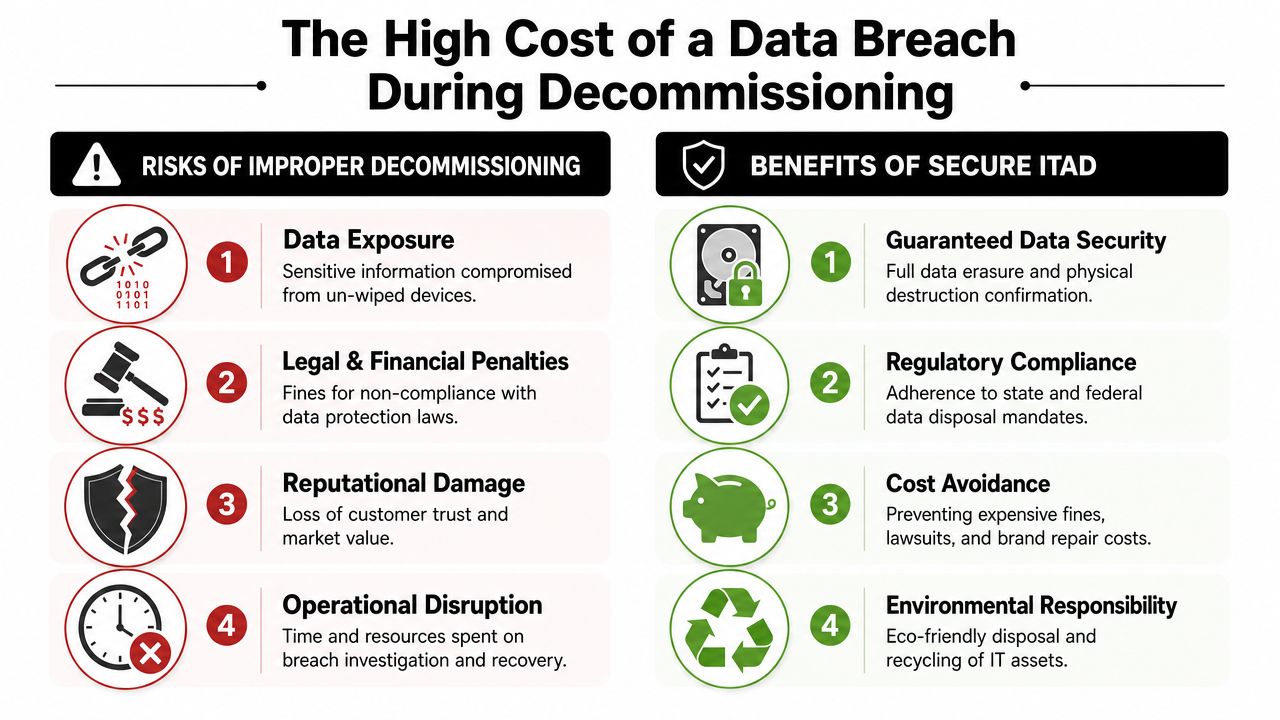
The High Cost of a Data Breach During Decommissioning
The biggest mistake I see in decommissioning is treating retired hardware as if it has already stopped being a security concern. It hasn't. The risk moved from endpoint protection and access control into physical handling, media sanitization, and documentation.
Ad hoc methods create blind spots
A lot of organizations still rely on methods that feel secure but aren't defensible enough on their own. A quick reimage. A drive pulled from a laptop but not logged. A pile of disks sent out for destruction without matching serials. Those are process gaps, not just technical gaps.
According to Everntrade's explanation of ITAD controls, professional ITAD improves data-removal assurance through recognized sanitization workflows such as NIST 800-88-aligned erasure and physical destruction, with audit-ready certificates tied to serial numbers. The key point isn't just the destruction method. It's the verification.
Verification is what makes security defensible
If you can't prove which asset was sanitized and how, you can't close the loop. That matters for reused drives, flash media, and decommissioned data center equipment, where recoverable remnants may still exist if erasure wasn't completed or validated.
A strong process usually includes:
- Serialized intake records that match your internal inventory
- Method selection based on asset condition and downstream use
- Per-asset verification for erasure results or destruction events
- Certificates of destruction that support audit response
For media that requires physical destruction, many Georgia organizations use hard drive shredding services to remove ambiguity. That's especially useful when legal, healthcare, or financial records may have been stored locally.
Retired hardware is still part of your security perimeter until its data has been verified destroyed or verified sanitized.
What works and what doesn't
| Approach | What happens |
|---|---|
| Ad hoc wiping | Fast, but hard to validate later |
| Storage-room accumulation | Preserves equipment, not control |
| Certified erasure with reporting | Supports reuse and auditability |
| Physical destruction with serial tracking | Highest clarity for sensitive media |
The trade-off is simple. The cheaper-looking process often becomes the expensive one when somebody asks for proof.
From Disposal Costs to Value Recovery and ESG Wins
Not every retired asset should be shredded. Some should be remarketed, some harvested for parts, and some recycled responsibly. A mature ITAD program separates those paths instead of treating everything as waste.
Value recovery starts with better sorting
Companies usually lose value before the truck arrives. They mix resale-capable laptops with scrap. They skip testing. They don't separate storage-bearing assets from peripherals. They let equipment age in place until its secondary-market value drops further.
A better workflow looks more like triage than disposal. Functional devices with market demand go through appraisal and remarketing. Non-redeployable equipment goes to compliant recycling. Sensitive media gets destruction or verified sanitization based on policy.
The result is operationally cleaner and financially smarter. Formal ITAD programs can turn part of a retirement cycle into a recovery cycle instead of a pure write-off. For Georgia companies trying to support sustainability reporting, the same workflow also creates clearer records around reuse, recycling, and landfill avoidance.
ESG reporting needs records, not intentions
ESG claims get weak when disposal records are vague. If your organization says it handles e-waste responsibly, you need documentation that shows which assets were recycled, which were refurbished, and which were destroyed. That recordkeeping supports investor questions, procurement reviews, and customer due diligence.
For teams tying disposition into environmental reporting, this Georgia ESG electronics recycling resource is useful because it frames the issue the way operations teams manage it. Through asset categories, pickup workflows, and downstream accountability.
A solid ITAD program creates two kinds of return. It reduces avoidable risk and helps recover value from hardware that still has a second market.
Local Logistics and Chain of Custody in Metro Atlanta
The hardest part of ITAD often isn't sanitization. It's the handoff. Once assets leave your dock, your control either continues through documentation and tracking, or it disappears.
Chain of custody is a logistics discipline
In 2026, ITAD has become a security and compliance control, with operational requirements that include serialized asset tracking, real-time chain-of-custody visibility, and integrated pickup and retrieval workflows, according to Zones' 2026 ITAD trends review. That's the operational shift many organizations still underestimate.
A secure process in Metro Atlanta should answer basic questions immediately:
- Which assets were picked up?
- Who released them?
- When did custody change?
- Were serial numbers reconciled?
- Where are the assets in the workflow now?
If you can't answer those questions without emailing three departments, the process is too loose.
Why local execution matters
Atlanta-area logistics create real-world complications. Multi-site pickups. Equipment staged in offices, clinics, branch locations, and colocation rooms. Access windows that are short. Building rules that limit loading dock time. These aren't edge cases. They're normal conditions.
That's why many organizations prefer a provider with local pickup capability and operational familiarity in the region. A practical example is Metro Atlanta electronics recycling support, where the emphasis is on scheduled retrieval, business pickups, and documentation around asset movement.
The liability question doesn't start at destruction. It starts when the device leaves your control.
What a strong custody process looks like
A dependable chain-of-custody model usually includes receiving logs, serialized manifests, documented custody transfer, and reporting that follows the asset to its final outcome. That outcome may be reuse, resale, recycling, or shredding. The documentation has to reflect the path taken.
What doesn't work is the halfway model. A secure pickup with weak downstream reporting. Or a good destruction process built on a vague intake list. End-to-end control is the point.
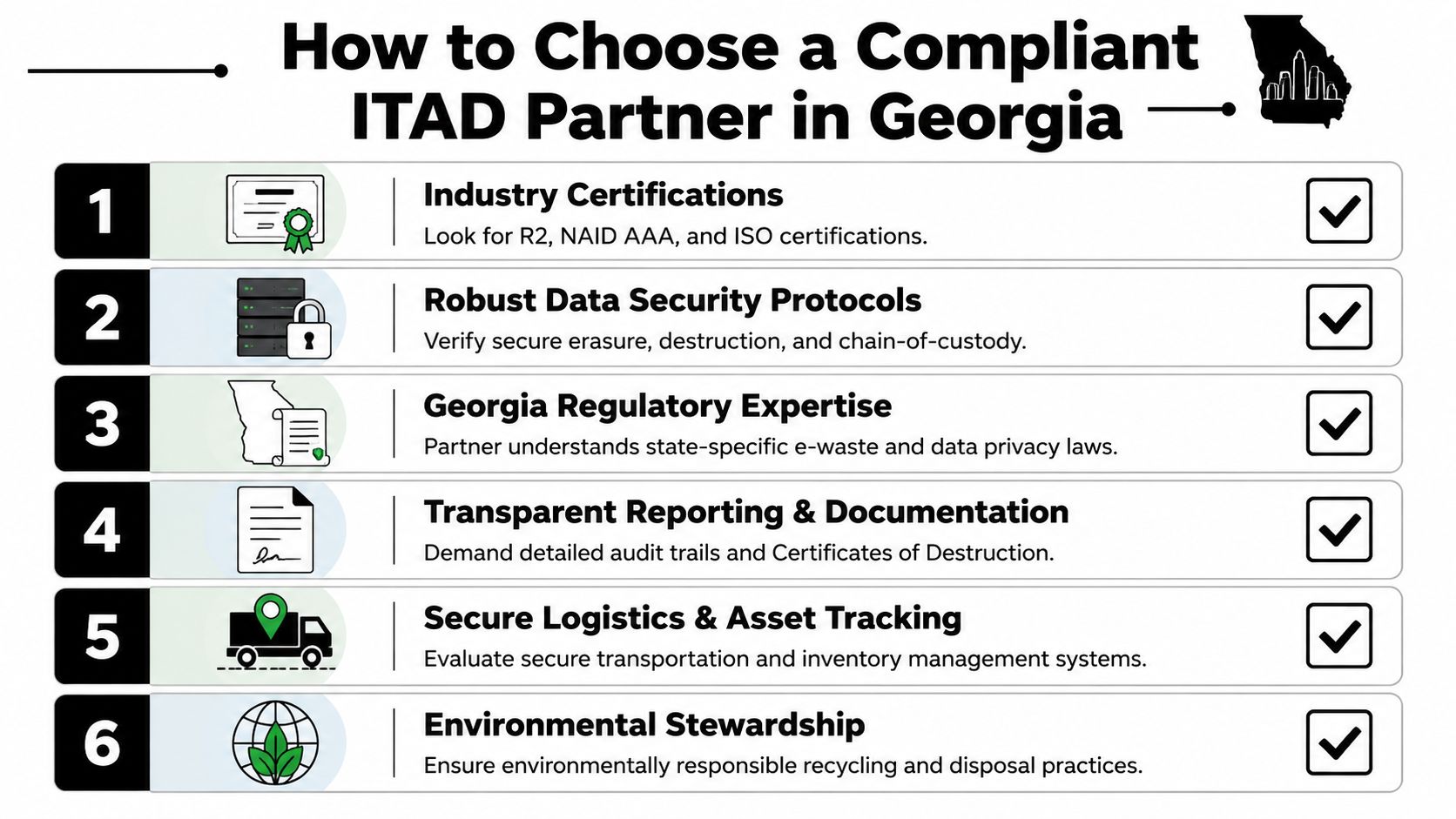
How to Choose a Compliant ITAD Partner in Georgia
Most vendor evaluations focus on one question. Can this company destroy data? That's necessary, but it's incomplete. The more important question is whether the vendor can prove liability transfer with audit-ready records.
The overlooked requirement
That's the gap many Georgia companies miss. As noted in Beyond Surplus's Georgia ITAD planning article, liability transfer after disposal is still a real gap in Georgia ITAD planning, and companies are really buying audit-ready evidence that the workflow reduced legal exposure.
That means your vendor should be able to show more than a recycling promise. They should show how assets are tracked, how outcomes are documented, and how your organization can defend the process later.
Questions worth asking in procurement
Use a due diligence checklist that focuses on evidence, not marketing language. This vendor due diligence checklist is a good baseline.
Ask vendors questions like these:
- How do you document chain of custody? Ask for examples of manifests, serialized reports, and custody transfer records.
- What does your certificate include? A useful certificate ties to specific assets and specific disposition outcomes.
- How do you handle mixed loads? Many projects include equipment for resale, recycling, and destruction in the same pickup.
- What happens if an asset arrives with missing labels or mismatched inventory? Their exception process matters.
- Can your process support audits and legal review? If reporting is only good enough for invoicing, it's not good enough.
What a practical choice looks like
A compliant Georgia ITAD partner should offer secure transport, asset-level reporting, verifiable data sanitization or destruction, and documentation that supports both internal audit and external scrutiny. One local option is Beyond Surplus, which provides certified data wiping, hard drive shredding, and certificates of data destruction and recycling as part of its business ITAD workflow.
The right partner doesn't just remove equipment. The right partner closes the liability loop.
If your team is planning a refresh, office move, data center decommission, or storage-room cleanout, contact Beyond Surplus for certified electronics recycling and secure IT asset disposition with audit-ready documentation.


