The fastest advice you will hear after a recall is simple. Pull every unit, cut the cords, and crush the lot before someone gets hurt. For a commercial holder, that advice can create the problem you were trying to avoid. You may destroy units that were never recalled, cancel a refund you were owed, shred a battery that should have been removed first, or send residue to landfill without a record that satisfies an insurer. Good recalled small appliance destruction doesn't start with a cutter. It starts with an approved remedy, tight custody, and proof that the right units cannot return to service.
Table of Contents
- Confirm the Recall Remedy Before Destruction
- Identify, Quarantine, and Choose a Destruction Method
- Control Energy Before Cutting or Crushing
- Route Residue to Permitted Environmental Recycling
- Keep Proof the Appliance Cannot Return
- Book Certified Destruction With Beyond Surplus
Confirm the Recall Remedy Before Destruction
A recall notice is not a destroy order. The U.S. Consumer Product Safety Commission recall dashboard shows refunds accounted for 1,107 cases, or 54.6%, repairs for 534 cases, or 26.3%, replacements for 343 cases, or 16.9%, and disposal for only 23 cases, or 1.1%, across recalls posted during the five-year period represented. That split should change your first move. In most recalls, the manufacturer wants a claim, a repair, or a return, not immediate destruction by the holder.
That matters when you manage mixed stock. A hotel chain, hospital, school district, landlord, or warehouse may hold the same toaster, coffee maker, hair dryer, or space heater from several purchase years. A recall can cover one production batch, one serial range, or one model identifier, not the whole line. If your team treats every unit with a similar nameplate as recalled, you'll scrap good inventory and may lose eligibility for the units that qualify.
Run the Same Day Remedy Check
Pull the units from service first, but don't disable them yet. Match the model, serial, or lot identifier on each rating plate to the notice, then contact the manufacturer or recall administrator and get the remedy in writing. Ask three direct questions. Does this serial range qualify. Must the old unit be returned to receive payment or a replacement. Who can authorize destruction if return isn't required.
Write the answers into your recall file the same day. Note the contact name, date, claim number, and any photo the manufacturer wants before disposal. Some remedies require a photo of a cut cord. Others require the intact unit back for inspection. You can't satisfy both after you've crushed the housing.
Early destruction can itself be the compliance failure when the approved remedy was return, repair, or refund.
Quarantine while you wait. Put suspect units on a marked pallet or in a locked cage, away from surplus sales, donation bins, employee purchase programs, and ordinary electronics recycling. A unit that leaves through a side channel hasn't been made safe. It has only changed owners, and your organization may still be the last documented holder.
Read the Remedy Table Before You Cut
Use the published remedy as your hold or destroy signal. Destruction belongs after written approval, or after a remedy has lapsed and the notice directs holders to discard the product.
| Remedy | Share of recalls | Business action | Destroy now? |
|---|---|---|---|
| Refund | 54.6% (1,107 cases) | File the claim and keep the unit until return rules are confirmed | No |
| Repair | 26.3% (534 cases) | Quarantine for the kit or authorized service | No |
| Replacement | 16.9% (343 cases) | Hold until the manufacturer confirms whether the old unit must come back | No |
| Disposal | 1.1% (23 cases) | Disable only under written approval, then certificate | Yes, after approval |
Name one owner for that decision. Facilities can pull and count units, procurement can file claims, and compliance can authorize destruction, but one person should sign the release to destroy. Without a named approver, a well-meaning site manager often moves first and documents later. For multi site holdings, align that release process with your recalled product disposal process for warehouses so every location waits for the same written signal.
Keep unaffected units eligible. Segregate them with a different label and return them to service only after the match check clears them. That separation protects value, reduces waste, and gives you a clean count of what the recall covers.
Identify, Quarantine, and Choose a Destruction Method
Custody comes before method. If you can't show which units entered quarantine, who handled them, and where they went, a destruction certificate for a mixed load proves very little. The CPSC Regulated Products Handbook states that recalling firms must keep recalled products separated throughout the distribution chain and monitor any third party performing destruction or disposal. Build your workflow around that separation.
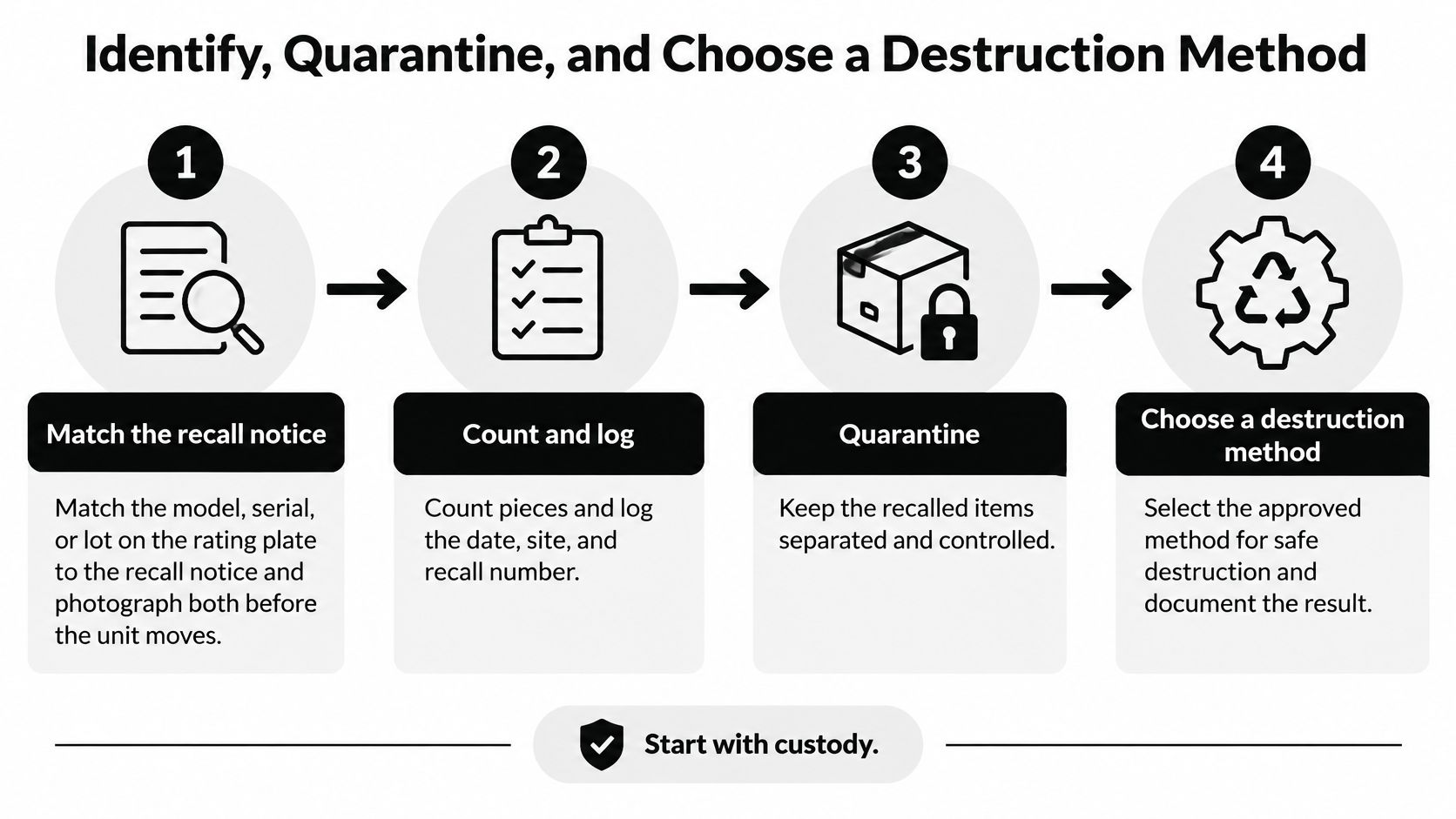
Four Custody Steps That Hold Up Later
- Match the recall notice: Match the model, serial, or lot on the rating plate to the recall notice and photograph both before the unit moves.
- Count and log: Count pieces and log the date, site, and recall number.
- Quarantine: Place units in a locked cage or on a clearly marked pallet that can't mix with surplus, donation, or ordinary e-waste.
- Record every handoff: Log each transfer, including the carrier, driver, date, and pallet count.
Photograph rating plates in batches if serial level tracking isn't practical, but don't rely on a pallet photo alone for high risk recalls. A heater with a fire hazard or a smart appliance with stored data deserves unit level identification. For low risk, identical units from one lot, a batch manifest tied to lot photos and a verified count may be enough. I would decide that threshold before pickup, not after an auditor asks.
Choose Destroy, Not a Reset
Smart small appliances blur the line between product destruction and data sanitization. A Wi-Fi coffee maker, smart heater, or connected minifridge may hold network credentials, usage data, or account tokens on embedded storage. NIST Special Publication 800-88 distinguishes Clear, Purge, and Destroy as three different media sanitization outcomes. Use that language with your vendor so you don't pay for destruction and receive a factory reset.
| Outcome | Recovery after the step | Fit for a recalled unit |
|---|---|---|
| Clear | Stops simple, non-invasive recovery | Not enough for a unit that must stay out of service |
| Purge | Makes laboratory recovery infeasible; media may be reused | Fits only if reuse is intended |
| Destroy | Makes recovery infeasible and media unusable | Matches the recall requirement |
A recalled unit that must not return to service needs the third outcome. Clear protects against simple recovery but leaves the product usable. Purge can be right for IT assets headed to reuse, yet reuse is exactly what a destruction remedy forbids. Destroy aligns the data result with the product result. The media can't be reused for storage, and the appliance can't be plugged back in.
Physical method follows construction. Shredding works for many housings and boards after hazardous parts are removed. Crushing or disintegration may suit dense assemblies. Dismantling and board destruction may be safer where batteries, capacitors, or glass are present. Don't let a vendor sell you one machine for every load. Ask how the method changes for a lithium powered hand dryer versus a corded toaster oven.
Vendor Checks Before You Release the Pallet
Give written instructions and require recalled goods to stay apart from salvage streams. Ask for references, independent audit results where available, and a sample certificate before the truck arrives. If consumer data may be present, review the vendor's information security procedures and how embedded media is handled.
Ordinary recycling isn't destruction. A recycler may accept a unit, strip steel, and leave other parts in a secondary stream. Your manifest should link each unit or batch to its recall notice, disabling method, operator, witness, downstream recycler, and certificate or affidavit. That chain is what turns disposal into recalled small appliance destruction you can defend.
Control Energy Before Cutting or Crushing
The failure I worry about most is premature mechanical processing. A team loads mixed appliances into a baler or shredder to save time, and a hidden lithium-ion cell, charged capacitor, or pressurized component turns a routine job into a fire or injury. Treat disabling as servicing, not scrap handling, even when the end result is scrap.
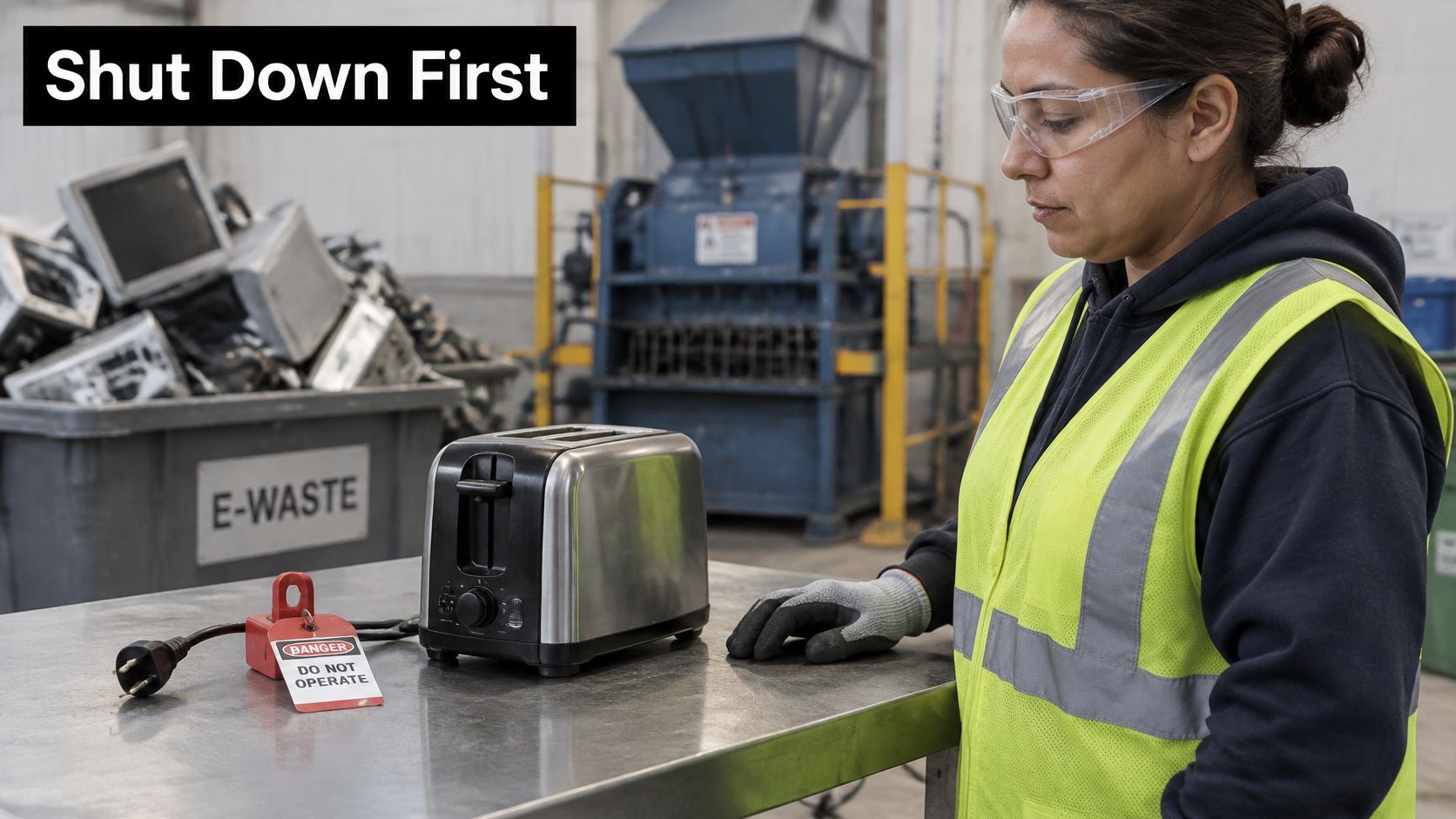
OSHA's lockout and tagout guidance requires an orderly shutdown, operation of energy-isolating devices, application of locks or tags, and release or restraint of stored and residual energy before servicing. Apply that sequence at batch level. Unplug the units, isolate them from any test bench or charging source, apply your lock or tag to the work area controls, and discharge or restrain stored energy before anyone opens a housing.
Name the Hazards in the Actual Appliance
Your hazard review should be specific to the load in front of you. For small appliances, assess:
- Mains electricity: Damaged cords, exposed conductors, and units that were still plugged in at collection.
- Capacitors and heating elements: Stored charge and residual heat after shutdown.
- Motors and pressurized parts: Moving components, fans, and sealed systems that can release energy when cut.
- Sharp housings: Thin steel, broken glass, and cut edges during dismantling.
- Lithium-ion cells: Swelling, leakage, heat, smoke, or unusual odor in cordless and smart models.
Verify a zero-energy state with an appropriate test instrument. A cut cord is not proof that internal capacitors or batteries are safe. That point is easy to miss because cord cutting looks final in a photo. It stops normal plug in use, but it doesn't discharge what's inside the case.
OSHA identifies lockout as more reliable than tagout and requires an equivalent level of protection when tagout is used on lockable equipment. If your bench, compactor, or shredder can accept a lock, use the lock. Use trained authorized employees, a short appliance specific procedure, insulated tools where warranted, eye protection, and cut resistant gloves. Put removed cells straight into nonconductive battery isolation containers, not into a shared parts bin.
Stop Work Signs and the Disabling Sequence
Give every operator stop work authority. Swelling, leakage, smoke, heat, or a sweet chemical odor from a battery compartment ends the job for that unit. Move it to your fire safe isolation area under your site procedure and call your hazardous materials contact. Don't puncture, crush, or soak a damaged cell to keep the line moving.
Once energy checks are complete, follow the manufacturer's disabling instruction exactly. If no instruction exists and destruction is approved, cut the cord close to the housing and remove or destroy the circuit boards so the unit can't be returned to service with a simple cord splice. For cordless products, apply the same logic you would use for recalled cordless tool disposal, where battery removal comes before any crushing.
If your company is the recalling firm, notify the regulator before destruction where required and be ready for witnessed destruction or an affidavit with photographic proof. Record the isolation check, component removal, final disabling action, and operator sign-off for every batch. That record connects worker safety to recall closeout, and it shows you didn't create a second incident while retiring the first hazard.
Route Residue to Permitted Environmental Recycling
Destruction ends the product risk. It doesn't end the materials problem. A disabled minifridge, heater, or smart appliance still contains metals, boards, plastics, oils, refrigerants, heating elements, or batteries that need separate routes. Putting the whole residue stream into one general e-waste bin defeats the care you took during quarantine and disabling.
The scale explains why informal disposal fails. The U.S. Environmental Protection Agency durable goods data shows Americans generated approximately 2.16 million U.S. tons of small-appliance waste in 2018, while only about 120,000 tons, or 5.6%, were recycled, and approximately 1.64 million tons, or 75.9%, were landfilled. A commercial recall program should not add traceable hazardous units to that landfill majority by default.
Route Each Stream by Material
Separate residue at the bench, while the unit is already open and identified. Don't ask a downstream sorter to guess what came from a recalled load.
- Lithium-ion cells: Send cells to a battery specific handler in nonconductive containers, with terminals protected and damaged cells isolated.
- Refrigerants and compressor oils: Recover or treat these materials under local and state rules through a handler equipped for refrigeration equipment, not through general scrap.
- Heating elements and damaged wiring: Route with the electronics or metals stream your permitted recycler specifies for those components.
- Circuit boards and recoverable metals: Move boards, copper wiring, steel, and motor metals to a permitted electronics recycler only after the unit is confirmed unusable.
- Plastic housings and mixed residue: Send nonrecoverable fractions through the recycler's documented downstream outlet, and name that outlet category on your manifest.
Sequence matters. Material recovery is welcome after destruction, not instead of it. A steel housing can be recycled once the appliance can't be reassembled into a working heater. A control board can enter metals recovery once it's destroyed as a functional board. If salvage value drives the process, intact parts start looking like inventory again.
Ask every vendor to show permits or downstream documentation for each stream it will touch. A recycler that's qualified for steel and boards may not be your refrigerant handler. A battery handler may not accept whole appliances. Review the rules that apply to your load, including universal waste regulations where batteries or other regulated components are involved, and write the route for each material on the manifest before pickup.
Routing rule: If a stream has its own hazard, it needs its own named handler on the paperwork.
Reject vague downstream language. "Recycled responsibly" doesn't tell your EHS manager where compressor oil went. Require the recycler name, pickup date, weight or count by stream where available, and a recycling certificate that matches the destruction certificate for the same batch. When those two documents align, you can show both halves of the job. The product cannot return, and its residue didn't disappear into an informal waste channel.
Keep Proof the Appliance Cannot Return
A consumer cord cut photo can close a household claim. It won't close a commercial file for a hotel, clinic, campus, warehouse, or landlord holding dozens or hundreds of units. The gap between those two standards is where most recall programs fail. The work happened, but nobody can prove which units were destroyed, by what method, or where the residue went.
The CPSC recall notice for Frigidaire-brand minifridges involved approximately 634,000 units in a 2025 recall and instructed owners to stop using the products, cut the cord, mark "Recall" on the door, and dispose of them under local and state regulations. At commercial scale, that sequence leaves hard questions unanswered. Who verified every serial number. How were refrigerants and oils handled. Which pallets left which site, and did any unit enter donation or resale on the way out.
Build the File an Auditor Can Follow
Marking and cord cutting still have value. They make the hazard visible and stop casual reuse during storage and transport. For a business holder, treat them as the visible layer of a deeper record. Write "Recall" on the unit where the notice requires it, photograph the mark with the rating plate, and keep that photo tied to the manifest line for that unit or batch.
| Record | What it proves | Who signs |
|---|---|---|
| Recall notice plus model or serial match | The destroyed units are the recalled ones | Facilities lead |
| Photos of labels and disabling | The unit was marked and made unusable | Operator and witness |
| Chain-of-custody log | Units stayed segregated from salvage | Each handoff |
| Manufacturer or CPSC correspondence | Destruction was the approved remedy | Compliance owner |
| Destruction affidavit or certificate | Date, quantity, and method | Destruction vendor |
| Pickup and recycler documents | The disabled unit left through a permitted route | Carrier and recycler |
Keep clearly marked boxes or pallets from intake to pickup. Ban commingling with other products, even when truck space is tight. A mixed pallet forces you to certify a load you didn't fully identify, and it gives a downstream handler a reason to sort units back into value streams. Your written vendor instructions should say that plainly.
Handle Changing Remedies and Stored Data
Recall remedies can change, and a refund or replacement offer may later become unavailable. Holders may then be told to throw out or recycle the product. That instruction doesn't erase your business recordkeeping duty. You still need an environmental route for batteries, refrigerants, or damaged wiring, and you still need a file that shows the unit didn't re-enter use at another property.
Add a data layer when the appliance or associated equipment stores consumer report information. The Federal Trade Commission Disposal Rule guidance applies to every business or individual that uses consumer reports for a business purpose and identifies destroying or erasing electronic files so information cannot be read or reconstructed as an example of appropriate disposal. In practice, that means your destruction vendor due diligence, media handling, and certificate language matter when records are embedded in the equipment being retired.
Close the loop with a signed destruction report or affidavit recording the date and quantity destroyed, plus the method used. Review what a certificate of destruction for recalls should contain before you approve the vendor's template. A cord photo may satisfy a consumer instruction. A manifest with custody, photos, approval, and downstream paperwork satisfies a manufacturer, insurer, customer, or regulator who asks months later whether that recalled appliance cannot return.
Book Certified Destruction With Beyond Surplus
Book the truck only after a short go or no-go check. The remedy is confirmed in writing. Unaffected units are separated and still eligible for refund or repair. The batch is quarantined, serial or lot photos exist, and batteries or other hazardous parts have a removal plan. If any item fails, stop and finish that item first.
When the batch is ready, Beyond Surplus can schedule commercial pickup across the contiguous United States, coordinate logistics through its fleet and transportation partners, and run product destruction with documented custody for recalled electronics. Where storage media is involved, ask how shredding or certified data wiping fits the approved remedy for that specific load, since a unit approved for total destruction shouldn't leave with reusable media intact.
Ask for the outcome by name before pickup. You want a certificate of destruction or recycling that identifies the load, quantity, date, and method, with custody records that support your manufacturer, insurer, or auditor file. Review the scope for certified destruction for recalled products, then describe the recall notice, quantity, sites, and any battery or refrigerant concerns when you request service. That detail lets the destruction plan match the hazard instead of forcing your load into a generic e-waste pickup.
Contact Beyond Surplus for certified electronics recycling and secure IT asset disposal.
If you're holding recalled small appliances across one site or many, Beyond Surplus offers commercial pickup, documented product destruction, and certificates that show your units were rendered unusable and routed through responsible recycling. Share your recall notice, quantities, and locations to get a destruction plan built around the approved remedy, not a generic disposal run.