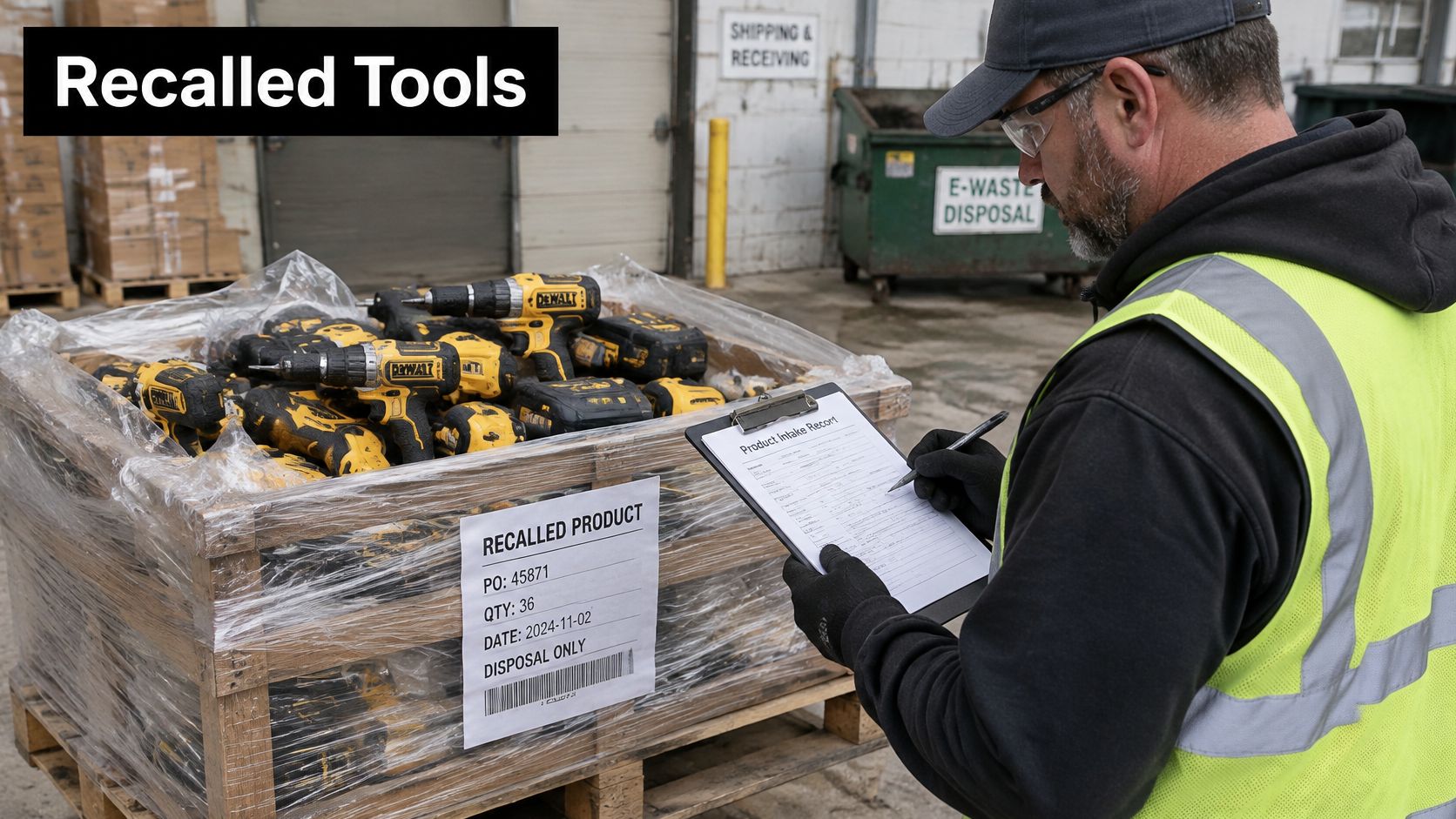
You've just pulled a pallet of cordless drills, impact drivers, and spare packs out of cages at three sites because a recall notice landed in your inbox. Maintenance wants to know if they can keep using the ones that look fine. Procurement wants resale value. EHS wants them gone before a swollen pack starts a fire in storage. That's exactly where recalled cordless tool disposal services have to do more than haul weight. The control objective isn't recovery. It's documented destruction and proof that no recalled unit can re-enter service, with every serial traced from quarantine to final certificate.
Table of Contents
- Verify the Recall Before Any Tool Leaves Your Site
- Sort Every Unit Into One of Three Handling Streams
- Isolate and Contain Recalled Batteries
- Render Tools Inoperable and Choose the Right Data Outcome
- Prove Recalled Tools Cannot Return to Service
- Book Certified Pickup With Costs and Records
Verify the Recall Before Any Tool Leaves Your Site
No unit moves until it has an intake record. A model name that looks close enough isn't verification, and a technician's memory isn't a recall file. I'd start with the recall check, not the pickup request, because every later decision about packing, transport, and destruction depends on whether that specific unit is covered.
Pull the manufacturer, model number, serial or batch code, and battery chemistry from the nameplate on the tool body and the label on the battery housing. Match those fields against the recall notice and the manufacturer's recall page. Then record the owning department, the site, and the date the unit was found, plus its condition at intake.
What Technicians Capture at Intake
| Record field | Where to find it | Why it matters |
|---|---|---|
| Manufacturer and model | Nameplate on tool body | Matches the unit against the recall notice model list |
| Serial or batch number | Label on tool or battery pack | Confirms exactly which units the recall covers |
| Battery chemistry | Battery housing label | Sets the handling and transport rules that apply |
| Recall notice reference | CPSC or manufacturer recall page | Documents why the unit is treated as recalled |
| Condition at intake | Visual inspection at receiving | Decides whether a battery needs special handling |
| Owner, site and date found | Asset register and intake log | Establishes the chain of custody from the first day |
This isn't rare edge work. In 2024, 15 consumer-product recalls involving lithium-ion batteries affected approximately 870,000 units, according to Sedgwick's lithium-ion recall risk review. Asset teams should expect recall matching as routine intake work, not as an exception handled by email.
Where Verification Goes Wrong
Three cases cause most errors. First, the same tool model may ship with different battery packs covered by different notices, so checking the drill alone misses the pack. Second, a tool can be recalled while its battery isn't, or the reverse. Third, a unit with no readable serial number can't be cleared by guesswork.
Practical rule: If you can't match it, you can't release it. Quarantine beats assumption every time.
Give any unmatched unit an intake ID and a quarantine tag before it moves, and keep it quarantined until the manufacturer confirms its status. Record condition in plain terms a handler can act on, such as working, scratched, swollen, leaking, or hot. That single line decides whether the next step is normal containment or immediate isolation.
Sort Every Unit Into One of Three Handling Streams
Sorting comes before packing, pricing, or pickup dates. Treat a recalled tool as ordinary mixed e-waste and you've already lost control of fire risk and traceability.
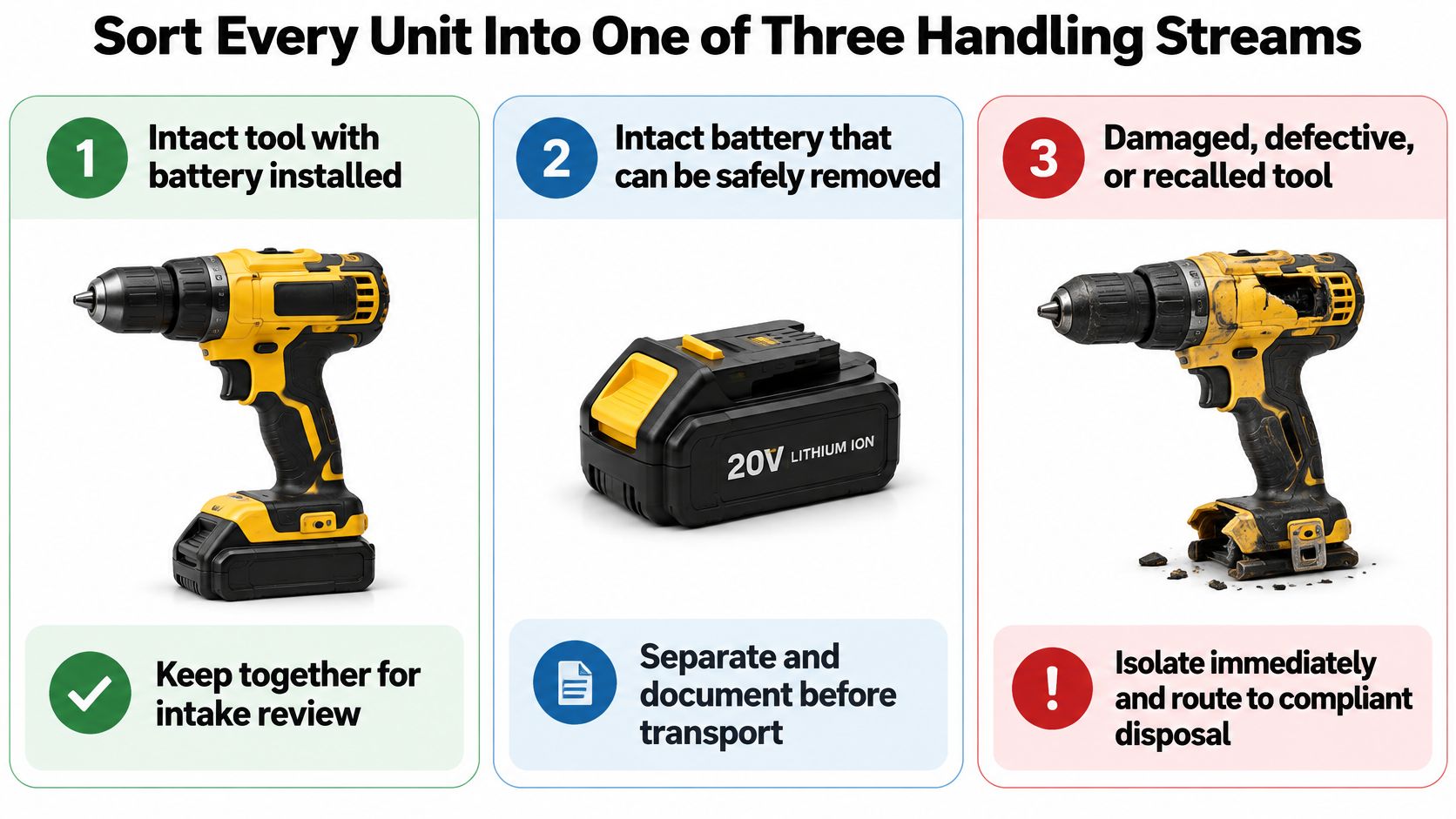
The U.S. Environmental Protection Agency states that most lithium-ion batteries are likely hazardous waste at disposal because they can catch fire or explode when mishandled, and municipal recovery facilities are generally designed for paper, plastic, metal, and glass rather than loose lithium batteries, in its EPA guidance on used household batteries. That distinction drives the three-stream screen and the universal waste regulations your team should check before routing anything.
| Stream | Typical condition | Packaging rule | Routing |
|---|---|---|---|
| Intact tool with installed battery | Functioning, no swelling or heat | Isolate battery terminals, bag the tool, keep ID label visible | Battery-capable recycler that accepts recalled units |
| Removable battery, intact | Separate pack with no visible damage | Tape each terminal or bag each pack individually | Battery recycler or hazardous-materials carrier |
| Damaged, defective or recalled battery | Swelling, puncture, corrosion, heat damage or leakage | Nonmetallic packaging with nonflammable absorbent, no discharge | Specialist hazardous-materials handling after acceptance is confirmed |
The Stream Jump Trap
A tool that starts in stream one moves to stream three the moment its battery shows swelling, heat, or leakage. Repeat the sort at every handoff, including at the loading dock. Don't combine batteries in a box where they can strike one another, and don't read a recycling symbol as permission for municipal bins.
The key handoff question is where a recalled or swollen pack is accepted. Ordinary battery-recycling boxes may take intact packs and still refuse damaged, defective, or recalled units because packaging and transport requirements differ. For a business lot, book a hazardous-materials receiver that has agreed in advance to the recall stream, not a retail drop box.
Set the audit benchmark before anyone packs a pallet. You want zero unmanifested units, zero commingling with general e-waste, and written confirmation that the receiving facility accepts recalled lithium batteries before you set a pickup date.
Isolate and Contain Recalled Batteries
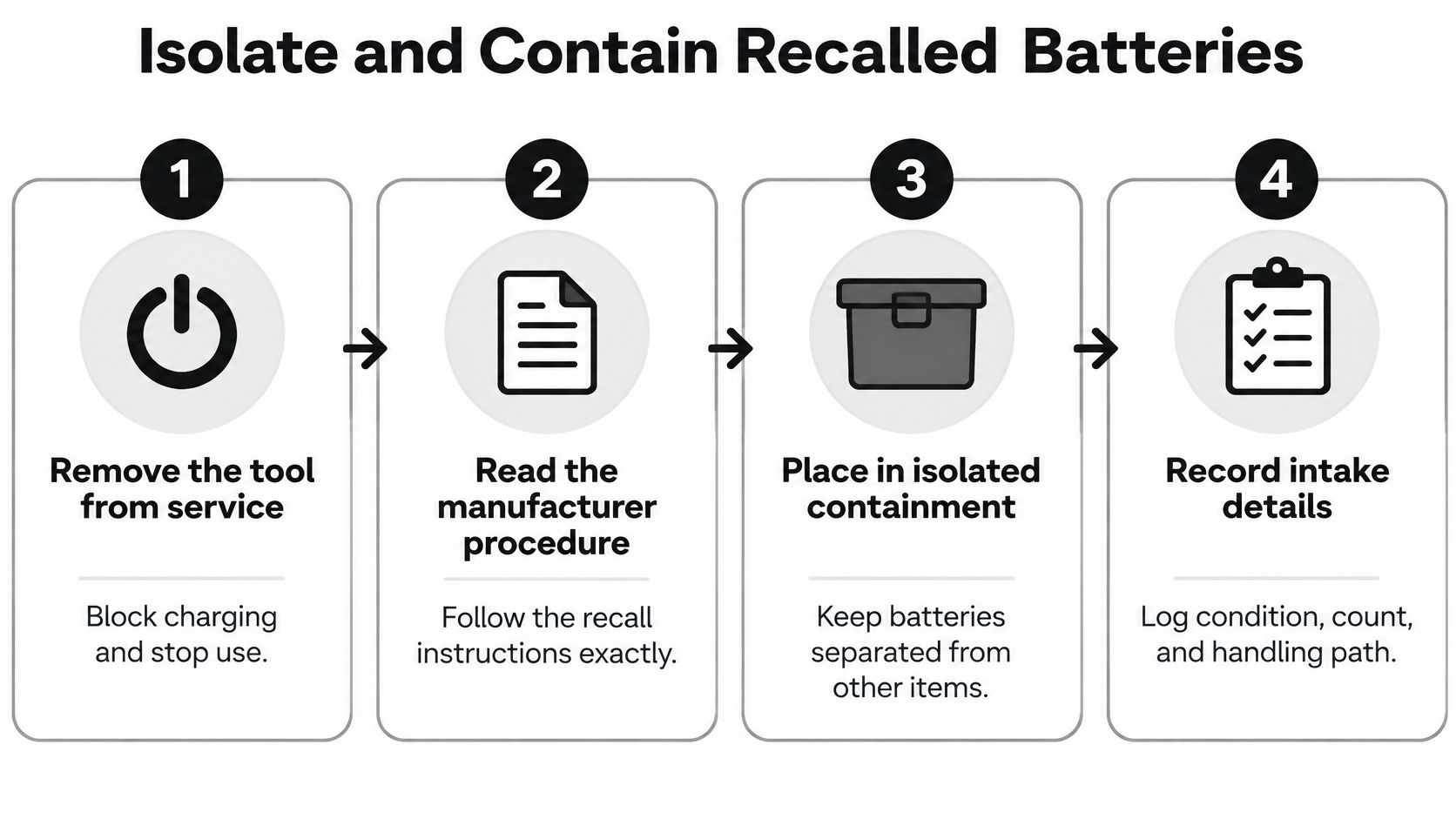
Isolation starts only after the intake record and stream label exist. Work in order, and stop the sequence as soon as damage appears.
The Containment Procedure
- Remove from service: Tag the tool out and block charging so nobody returns it to a job site or plugs it in to test it.
- Read the manufacturer procedure: Confirm the person handling the pack is trained. If removal isn't permitted, leave the battery installed and contain the whole tool.
- Inspect before touching terminals: Look for swelling, puncture, corrosion, heat damage, leakage, or deformation under good light.
- Stop at damage: If any of those signs appear, mark the unit for the damaged stream and call the receiving facility before further handling.
- Remove only permitted intact packs: Use insulated tools, follow the release mechanism, and never force a housing or pry a swollen pack free.
- Isolate terminals: Cover each terminal with nonconductive electrical tape or place each intact pack in its own plastic bag, and keep the intake label readable.
- Contain damaged packs separately: Use nonmetallic packaging with suitable nonflammable absorbent or fire-suppressing material, following manufacturer and carrier instructions.
- Store away from ignition and people: Use a ventilated, climate-controlled area away from flammables, occupied space, and metal bins where crushing or contact can occur.
- Log and prepare for transport: Record handler and time for each intake ID, then match packaging to Department of Transportation requirements.
Those steps reflect EPA guidance on used lithium-ion batteries, which says to remove a battery only if the manufacturer's procedure permits it and personnel are trained, and notes that damaged, defective, or recalled lithium-ion batteries may not be transported by air. The same guidance supports the controls your lithium battery recycling route has to satisfy, including ventilated storage, prevention of physical damage, and employee safety training.
Don't discharge a recalled battery to make it safer unless you have appropriate fire and worker-protection controls. Casual discharge creates the heat and handling you're trying to avoid. Ordinary trash and municipal recycling are also unacceptable, because crushing and metal contact can initiate thermal runaway.
Close each container with evidence, not memory. Take photographs, update the custody log, and tie every intake ID to a destruction or recycling certificate at the end. A weight ticket doesn't prove which serials were inside.
Render Tools Inoperable and Choose the Right Data Outcome
Recalled units default to destroy when reuse can't control the risk. Rendering starts after batteries are isolated, and it has two separate jobs. You must stop the tool from working again, and you must decide what happens to any data stored in connected electronics.
Remove any remaining battery and charger first. Then disable the motor and control board so the tool can't run, and break the housing where your policy requires visible, irreversible disablement. Keep lithium batteries out of ordinary shredders. They belong in the battery stream, not in shredder feed where puncture and heat can start a fire.
Choosing Clear, Purge, or Destroy
Smart drills, connected saws, and fleet-tracked tools can hold embedded memory, usage logs, paired-device records, or removable storage. NIST Special Publication 800-88 Revision 1 distinguishes clear, purge, and destroy, and you should select the outcome according to data sensitivity and your approved sanitization policy.
| Outcome | What it achieves | Use when |
|---|---|---|
| Clear | Protects against simple, non-invasive recovery using standard commands or a factory reset | Low data sensitivity and the unit stays in a controlled reuse channel |
| Purge | Makes recovery infeasible with state-of-the-art laboratory techniques and may leave media reusable | Higher sensitivity where reuse is still acceptable under policy |
| Destroy | Makes recovery infeasible and leaves the media unusable for data storage | Reuse cannot control the risk, or a recalled unit must never return to service |
Clear has a clear limit. A factory reset protects against simple recovery, but it doesn't necessarily address laboratory recovery. Purge goes further and can preserve media for reuse, which is useful only when reuse is allowed.
For a safety recall, reusable media inside an inoperable tool is usually a liability, not an asset.
That's why destroy fits most recalled, data-bearing units. Physical methods such as shredding, pulverizing, incineration, or melting leave the media unusable for storage and remove any argument that the component can return to service. Coordinate that outcome with your recalled product quarantine services workflow so quarantine status carries through to final disablement.
Record four fields for every data-bearing component. Note the media type, the chosen method, the responsible person, and the evidence that the required outcome was reached. Keep hazardous battery handling separate from documented destruction of the data-bearing part, so each stream carries the right packaging, carrier, and certificate.
Prove Recalled Tools Cannot Return to Service
A disposal is judged by the file, not the tonnage. Say a distribution center finds 40 recalled cordless drills across maintenance cages. If no named person owns verification, containment, transport, and certificates, the company can't prove those drills weren't resold, donated, or thrown into a compactor.
The fire record explains why insurers and regulators ask hard questions. A U.S. Environmental Protection Agency analysis identified 245 fires associated with lithium-metal or lithium-ion batteries at 64 waste-management facilities between 2013 and 2020, covering 28 states and all 10 EPA regions. The incidents included 139 fires at landfills, 68 at materials-recovery facilities, 15 during transportation, and 23 at other waste-management locations, rising from two fires at one facility in 2013 to 65 fires at 16 facilities in 2020.
The consequences weren't minor. Among surveyed materials-recovery facilities, 78% contacted emergency responders at least once, 39% temporarily or permanently suspended operations, 22% reported worker injuries, and 43% experienced monetary impacts. Your file is how you show your recalled packs didn't enter that system through trash or curbside recycling.
Regulatory Direction Is Tightening
North Carolina reports that lithium-ion batteries will be barred from landfill disposal beginning December 1, 2026, and the state separately tracks damaged, defective, and recalled batteries, with 650 pounds of damaged, defective, or recalled lithium-ion batteries managed in 2025 compared with 28,600 pounds of removable consumer batteries, as noted alongside the CPSC explosion hazard recall information. That small, distinct stream is exactly the one that needs its own manifest and acceptance record.
The Six Records That Close a Recall
Build the file in this order, by serial or intake ID:
- Recall verification record: Model, serial, chemistry, and notice reference.
- Intake photographs and condition: Visual proof of swelling, damage, or intact status.
- Stream assignment: Which handling stream the unit entered, and any later change.
- Manifests and carrier records: Who transported it, under what paperwork, and to which receiver.
- Sanitization record: Media type, method, responsible person, and result where data exists.
- Certificate of destruction or recycling: Final disposition tied to the intake IDs.
Other regulated end-of-life processes use the same logic. Vehicle owners, for example, focus on confirming your scrapped car is legally destroyed because the certificate, not the tow truck, ends liability. For recalled tools, your certificate of destruction for recalls should name the units it covers.
Don't let value recovery override a safety recall. If return to commerce is forbidden, documented destruction beats resale, even when a tool still runs. Name who handled each serial, and show that no unit left quarantine before disposition was documented.
Book Certified Pickup With Costs and Records
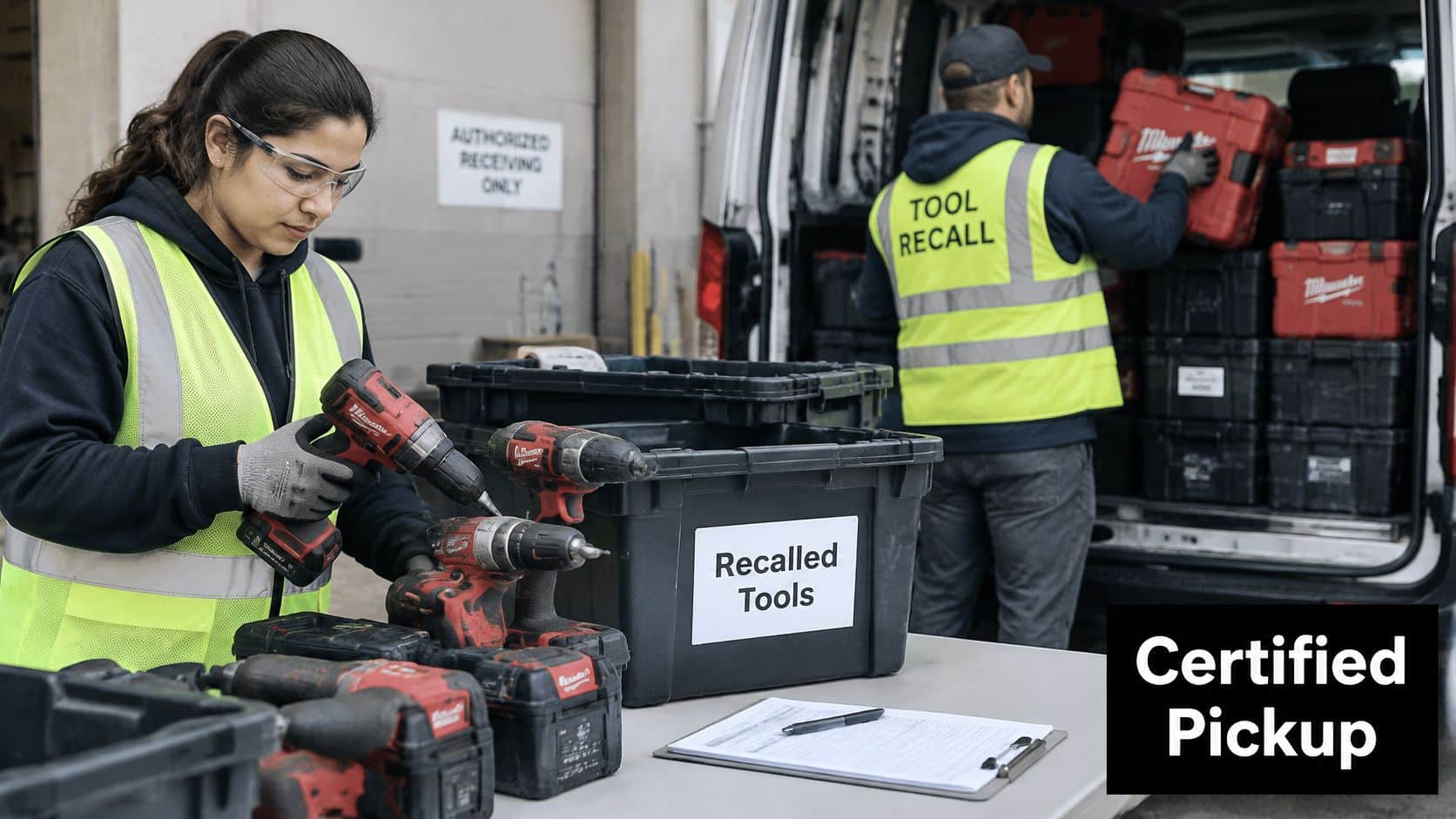
Match volume and condition to a channel before you request a quote. The cheapest route for an intact single pack can be the wrong route for a pallet that includes swollen batteries and connected tools.
| Option | Best for | Documentation |
|---|---|---|
| On-site pickup by an ITAD provider | Large recall lots and data-bearing units | Chain-of-custody record and destruction certificate |
| Off-site drop-off at a certified facility | Small batches with confirmed battery acceptance | Receipt and recycling certificate |
| Mail-in recycling | Single intact items where carrier rules allow it | Shipping record and recycling certificate |
| Hazardous-materials carrier pickup | Damaged, swollen, or defective batteries | Manifest and carrier paperwork |
Cost and transit time are quote-specific. Record both on the intake log for the approved route rather than assuming a flat fee, and confirm what's included: packaging, hazardous-materials surcharges, destruction, reporting, and certificates by serial. Multi-site lots also need collection sequencing, which is where multi-location recall collection services can keep one intake standard across sites.
Apply a Vendor Due Diligence Test
Use the Federal Trade Commission Disposal Rule guidance as a vendor test even though it's written for consumer-report information. The FTC describes due diligence that includes reviewing an independent audit, checking references, requiring recognized trade-association certification, and evaluating the contractor's information-security policies. For electronic assets, it also identifies destroying or erasing files or media so information can't be read or reconstructed as proper disposal.
Ask the same operational questions you'd ask for any regulated clearance. Companies arranging an office exit, for example, may compare local support such as commercial clearance in Bournemouth when they need premises emptied, but a recalled battery lot needs the receiver's written acceptance for that specific stream, not just available truck space.
Beyond Surplus is an Atlanta-based IT asset disposition and electronics recycling firm serving businesses across the contiguous United States with its own fleet and transportation partners. Its services include on-site or off-site hard-drive shredding, certified wiping, product destruction, and certificates of recycling and data destruction. Treat it as one option to evaluate against the audit, reference, certification, and policy checks above.
Book from the finished intake log, not from an estimated pallet count. Confirm acceptance, pack by stream, photograph sealed containers, and release no serial from your asset register until the certificate arrives and matches the IDs you shipped.
If your sites are holding recalled cordless tools, spare packs, or chargers in quarantine, contact Beyond Surplus to arrange certified pickup, documented product destruction, and battery handling tied to each intake ID. Send your verified model and serial list first, confirm acceptance for any damaged or swollen packs, and get a quote that specifies transport, destruction, and the certificates that will close your recall file.