Atlanta, Georgia businesses shouldn't send a recalled tool straight to the shredder. The familiar advice to recycle defective equipment skips the decision that matters most: what remedy the recall owner authorizes. Scrapping a pallet of cordless drills, saws, or diagnostic tools before checking that instruction can destroy claim evidence, surrender recoverable value, and leave the recall unresolved.
Recalled tools disposal services should manage an authorized outcome, not choose one for you. For facility, procurement, and IT managers, that means putting the remedy decision ahead of electronic waste pickup, then matching handling, transportation, data sanitization, and final documentation to each affected unit.
Table of Contents
- Choose the Recall Remedy Before Disposal
- Quarantine Triage and Document Recalled Tools
- Build the Chain of Custody and Sanitization File
- Select a Recalled Tools Disposal Service
- Tips When Pallets Claims or Instructions Collide
- Book Certified Disposition for the Held Lot
Choose the Recall Remedy Before Disposal
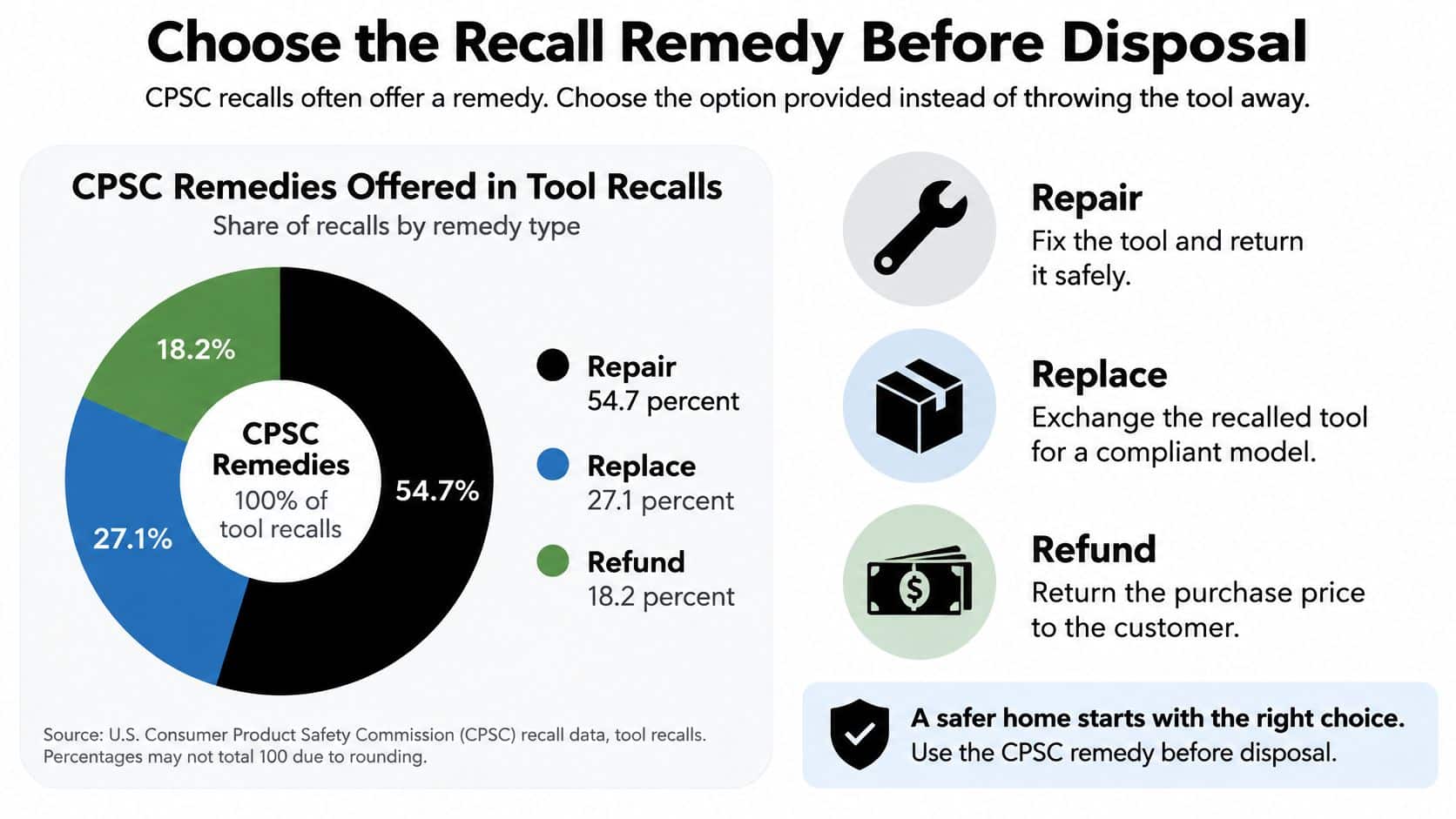
A reserved destruction slot does not authorize disposal. If a contractor's Atlanta tool crib receives a cordless saw recall notice, the warehouse should hold the affected pallet while procurement checks the official notice against each tool. CPSC notices may authorize a refund, repair, replacement, or disposal. The recall owner's instructions, and any required CPSC approval, take precedence over scheduling a shredder.
Give every unit an authorized path
Use the U.S. Consumer Product Safety Commission recall database to locate the official notice and confirm the manufacturer, affected model, serial-number range, and remedy. Record those details in the asset file and retain the notice with the claim documents. A similar-looking drill outside the listed range should not automatically receive the same disposition.
| Remedy | Action before any destruction |
|---|---|
| Refund | Quarantine the tool, photograph its labels, and file the claim. Keep it intact until the recall owner provides instructions. |
| Repair | Stop use, isolate the affected serial range, and follow the manufacturer's repair process. |
| Replacement | Hold the recalled tool and await instructions. Separate accessories only after confirming they are not part of the recall. |
| Disposal | Destroy only when the recall owner authorizes it in writing and any required CPSC approval is in place. |
For a refund, repair, or replacement, preserve the tool in the condition required by the claim process. Photograph the nameplate and battery before removing components. Keep packaging or purchase records if the manufacturer requests them, and link the claim reference to the asset identifier.
Check each accessory and power component separately. Chargers, bits, blades, and cases may not be included in the recall, but do not assume they are exempt. A battery-specific recall may call for a different handling path from a defect involving a saw's guard or switch.
Hold uncertainty instead of improvising
An unreadable serial number is a reason to pause, not scrap. Place the tool on exception hold and ask the recall owner how to determine eligibility. A distributor's verbal suggestion does not replace written disposition instructions from the manufacturer.
Practical rule: A reserved shredder slot is a logistics arrangement, not authorization to destroy a recalled product.
Once the authorized route is clear, use a tools and workshop equipment recycling service that can handle that route. Close the decision with a record for each unit showing the approved path, who authorized it, and what evidence must be retained through processing.
Quarantine Triage and Document Recalled Tools
A recalled-tool lot needs condition-based handling before anyone calculates scrap value. An intact corded drill, a fuel-powered cutter, and a diagnostic instrument with an integrated lithium battery shouldn't enter the same processing stream just because they arrived on the same pallet.
The EPA's universal-waste guidance establishes controls for preventing releases and routing universal waste to a permitted or otherwise authorized destination. Used electronics may also need a waste determination. Don't instruct a recycler to break or crush electronics being managed as universal waste.
Stop circulation and establish the inventory
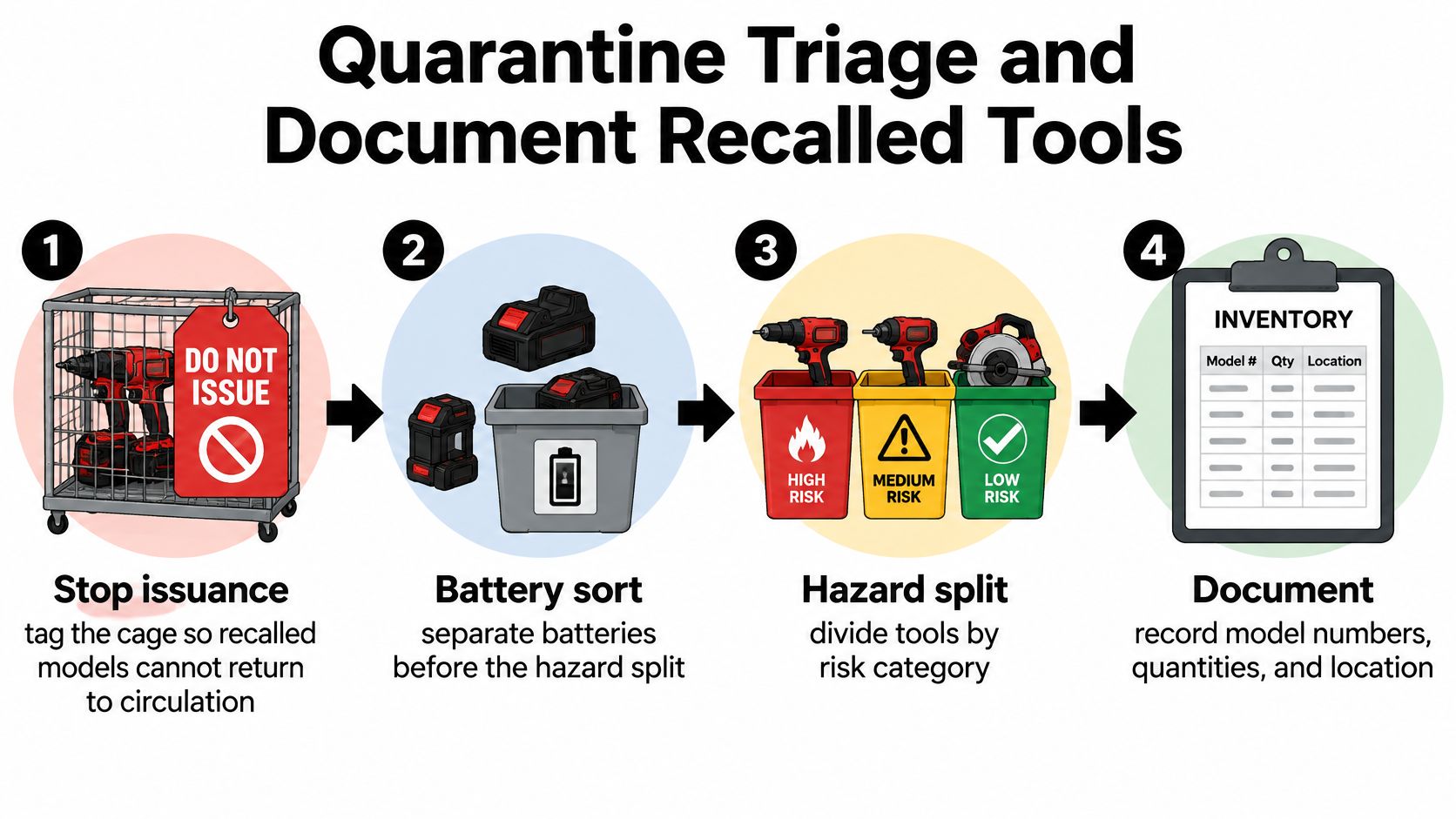
Stop issuance to prevent reuse. Block affected models in the crib checkout system and tag the physical cage. Tell supervisors and remote job-site leads which equipment must come back, so a replacement shift doesn't unknowingly issue it.
Build the serial log to prevent missing units. Compare purchase orders, tool assignments, return records, and physical counts. Give units with illegible labels an exception identifier, photograph distinguishing features, and keep them out of the processing release.
Capture condition to preserve evidence. Photograph the nameplate, serial number, tool body, and battery without energizing the equipment. Attach the recall notice identifier and record where the unit was found, who quarantined it, and whether accessories arrived with it.
A pallet count is useful for freight planning, but it won't explain why a particular serial number disappeared. Keep the unit-level register separate from container and shipment records, then connect them through a pallet or container identifier.
The operating sequence should make the battery check visible before general material sorting.
Sort battery condition before material type
- Assess batteries before dismantling to prevent damage. Leave an intact tool whole until the recall instructions permit removal. Identify integrated packs and visible damage without prying housings open, charging the pack, or running the tool to test it.
The EPA's used lithium-ion battery guidance recommends protecting terminals with tape or placing batteries individually in plastic bags, and directing damaged batteries to manufacturer or hazardous-waste guidance. EPA also identifies most discarded lithium-ion batteries as likely hazardous waste because of ignitability and reactivity. Terminal protection isn't a substitute for condition-specific packaging or transport approval.
Battery condition and temporary control
| Condition | Temporary control | Who decides the next move |
|---|---|---|
| Intact, battery removable | Leave installed until instructions allow removal; then tape terminals or bag each pack | Recall notice or manufacturer |
| Integrated battery | Do not force the pack out | Recall owner or qualified handler |
| Swollen, crushed, wet, hot, or leaking | Isolate in a sound container; no puncture, crush, or curbside bin | Manufacturer or hazardous-waste guidance |
| Recalled, undamaged, many units | Quarantine and label by serial, separate from mixed e-waste | Recall owner, then a qualified transporter |
For visibly damaged batteries, have trained personnel select a compatible, structurally sound containment arrangement that prevents releases. Don't place a hot or actively failing pack into an improvised sealed container. Clear personnel from the immediate hazard and activate the facility's emergency procedure when there's heat, smoke, venting, or another sign of active failure.
Keep the distinction between temporary isolation and shipping preparation explicit. Warehouse staff may secure an area without being qualified to package damaged batteries for transportation. Don't mail a recalled tool merely because it fits in a parcel box.
Assign the processing route by hazard
Split the lot by hazard to prevent incompatible handling. Identify lithium batteries, fuel-powered equipment, embedded electronics, mercury-containing components, and ordinary metal or plastic assemblies. Have the qualified handler assess overlapping hazards rather than forcing each tool into a single convenient category.
Preserve claim and audit evidence before changing condition. Keep photographs, warranty records, purchase evidence, and written approvals attached to the inventory. Don't remove a label, drain equipment, or dismantle an assembly just to make a pallet easier to stack.
Authorize the neutralization method before work starts. Specify manufacturer-approved disabling or controlled dismantling only after the remedy permits it. The work instruction must prevent battery puncture, crushing, thermal damage, and uncontrolled release. If the approved method conflicts with safe handling, stop and obtain revised instructions.
Package by hazard to prevent rejection and releases. Record container identities, contents, counts, and weights. Apply the appropriate waste identity labels, and keep labels readable after wrapping. A stretch-wrapped pallet with a handwritten word such as “tools” doesn't communicate its hazards or recall status.
A commercial recalled-product quarantine service can support controlled storage and inventory management when a tool crib lacks suitable space. Confirm who owns inspections, employee training, release response, and shipment preparation rather than assuming the storage provider handles everything.
Release only against recorded evidence
Approve the carrier and destination to prevent a dead-end shipment. Obtain acceptance for the actual contents and battery conditions before loading. Identify the destination facility, confirm its authorization for the waste stream, and make the transporter aware of exceptions before dispatch.
Measure process quality instead of tonnage alone. Track elapsed time from quarantine to certified disposition, missing-serial and battery-condition exceptions, and loads accepted without rework. Assign an owner to each unresolved item. A heavy shipment isn't a successful shipment if the receiving facility rejects its packaging.
Reconcile the certificate to close individual units. Compare the final disposition record with the released serial list and investigate substitutions, shortages, or unexpected additions. Keep unmatched units open, even when the carrier has signed for the pallet and the warehouse cage is empty.
Don't allow quarantine to become indefinite storage. The federal universal-waste framework generally allows accumulation for up to one year, subject to conditions and applicable state rules. Atlanta and other Georgia facilities should confirm their applicable requirements and use dated inventory reviews to prevent over-accumulation.
Build the Chain of Custody and Sanitization File
The finished product is the disposition file, not the empty cage. A facility manager needs evidence of what left the Atlanta crib; procurement needs the authorized outcome; IT needs proof that stored information received the right treatment.
Create a connected record containing the asset ID, serial number, recall notice, condition photographs, disposition approval, container reference, transporter, shipment weights, receiving facility, and final status. At each handoff, record who released custody, who accepted it, and any discrepancy. Remote job-site transfers deserve the same discipline as the main warehouse pickup.
Match sanitization to the media and remedy
A diagnostic scanner or connected test instrument may retain customer records, job data, Wi-Fi credentials, or configuration files. Don't assume metal recovery erases embedded storage, and don't power up unsafe recalled equipment just to run a reset.
NIST's media-sanitization framework distinguishes clear, purge, and destroy. Select the method under the organization's approved policy, considering media type, information sensitivity, technical feasibility, and whether the recall allows reuse.
| Method | Practical purpose | Decision for recalled equipment |
|---|---|---|
| Clear | Logical techniques protect against simple, non-invasive recovery through the normal interface | Use only where the approved technique is appropriate and safe to execute |
| Purge | Physical or logical techniques make advanced laboratory recovery infeasible while potentially preserving media | Confirm both the media method and any restriction on reuse |
| Destroy | Makes recovery infeasible and leaves the media unusable for storage | Coordinate media destruction with the authorized product disposition |
A factory reset isn't automatically adequate for every storage device. Cryptographic erase also needs more than an assurance that a device used encryption: the implementation and treatment of relevant keys must satisfy the approved sanitization process.
Keep evidence usable for an auditor
NIST's enterprise sanitization guidance places sanitization within an organizational program and aligns it with frameworks including NIST SP 800-53 and ISO/IEC 27040. Treat those as a control structure, not a reason to generate disconnected paperwork.
- Identify the media. Record embedded storage separately when it needs a different treatment from the tool body.
- Record execution. Retain the selected method, operator or provider, verification result, and exceptions.
- Join the certificates. Connect sanitization and product-disposition evidence to the affected serial list.
A product-recall chain-of-custody service should preserve these connections across pickup, processing, and reporting. A certificate describes completed work; it doesn't, by itself, resolve every recall or regulatory obligation.
Select a Recalled Tools Disposal Service
A hauler who quotes only by weight may be suitable for a simple scrap stream. A recalled-tool program needs a provider who can explain what happens when a serial number is missing, a battery arrives damaged, or the recall owner changes the disposition instruction.
Procurement should compare the documented operating scope before comparing the freight charge. Ask bidders to identify their handling facility, transport arrangements, subcontractors, and reporting deliverables. Require written exception procedures, not an assurance that the crew will sort things out at pickup.
Use a bid scorecard rather than a logo check
What to require from a disposal partner
| Requirement | What good looks like | Reject the bid if |
|---|---|---|
| Insurance | Transit and handling coverage named for tools and batteries | Coverage is silent on lithium or job-site pickup |
| Certification and audit | R2 or e-Stewards plus a recent independent audit | Only a self-written policy is offered |
| Chain of custody | Serial scan at pickup and at the destination facility | The quote tracks weight only |
| Data and product destruction | Clear, purge, or destroy chosen to the media, plus a certificate | Every item is treated as ordinary scrap |
| Logistics and reporting | Hazard labels, authorized destination, exception report for missing serials | Mismatches are marked complete anyway |
These are procurement acceptance criteria, not a claim that every certification covers every waste stream. Verify the certification's scope and facility location. Ask the insurer or broker to clarify relevant coverage and exclusions rather than treating a generic insurance certificate as conclusive.
The FTC Disposal Rule guidance applies to businesses or individuals using consumer reports for a business purpose and calls for reasonable measures to prevent unauthorized access to that information. It identifies erasing or destroying electronic information so it can't be read or reconstructed, and gives vendor due-diligence examples including independent audits, references, recognized certification, and information-security policies. Don't broaden that rule into a claim that every recalled power tool falls within its scope.
Put the difficult cases in the contract
Ask bidders to price serial-level inventory, condition assessment, special battery packaging, transport, sanitization, and final reporting separately where practical. A lower processing price can lose its advantage when procurement discovers that exception handling and certificates were excluded.
Contract test: Ask the bidder to explain exactly what happens when the receiving count doesn't match the pickup register.
Require the statement of work to identify who marks shipments, who approves processing release, whether witnessing is required, and how mixed pallets are held or refused. Set reporting expectations for both routine completion and unresolved units.
Beyond Surplus is one commercial option for electronics recycling, secure data destruction, product destruction, and organizational pickup across the contiguous United States. Evaluate the proposed project scope and certificate samples against the same criteria applied to other providers; don't assume a general ITAD capability establishes acceptance for a particular damaged-battery load.
Use this Georgia ITAD vendor selection guide to organize procurement questions. Award the work only when the provider's written process addresses the actual inventory and its exceptions.
Tips When Pallets Claims or Instructions Collide
Sending recalled goods to salvage, or mixing them into a general shred load, isn't a shortcut to recall compliance. It removes the separation your team needs to demonstrate that the affected products followed their authorized route.
The CPSC recall handbook says recalled products shouldn't return to salvage or be mixed with other products, calls for marked shipments and written third-party instructions, and recommends obtaining certification of destruction. It also states that destruction may occur only with CPSC approval and that investigators may witness or otherwise verify it. The recall owner should resolve those approval and verification arrangements before your vendor starts.
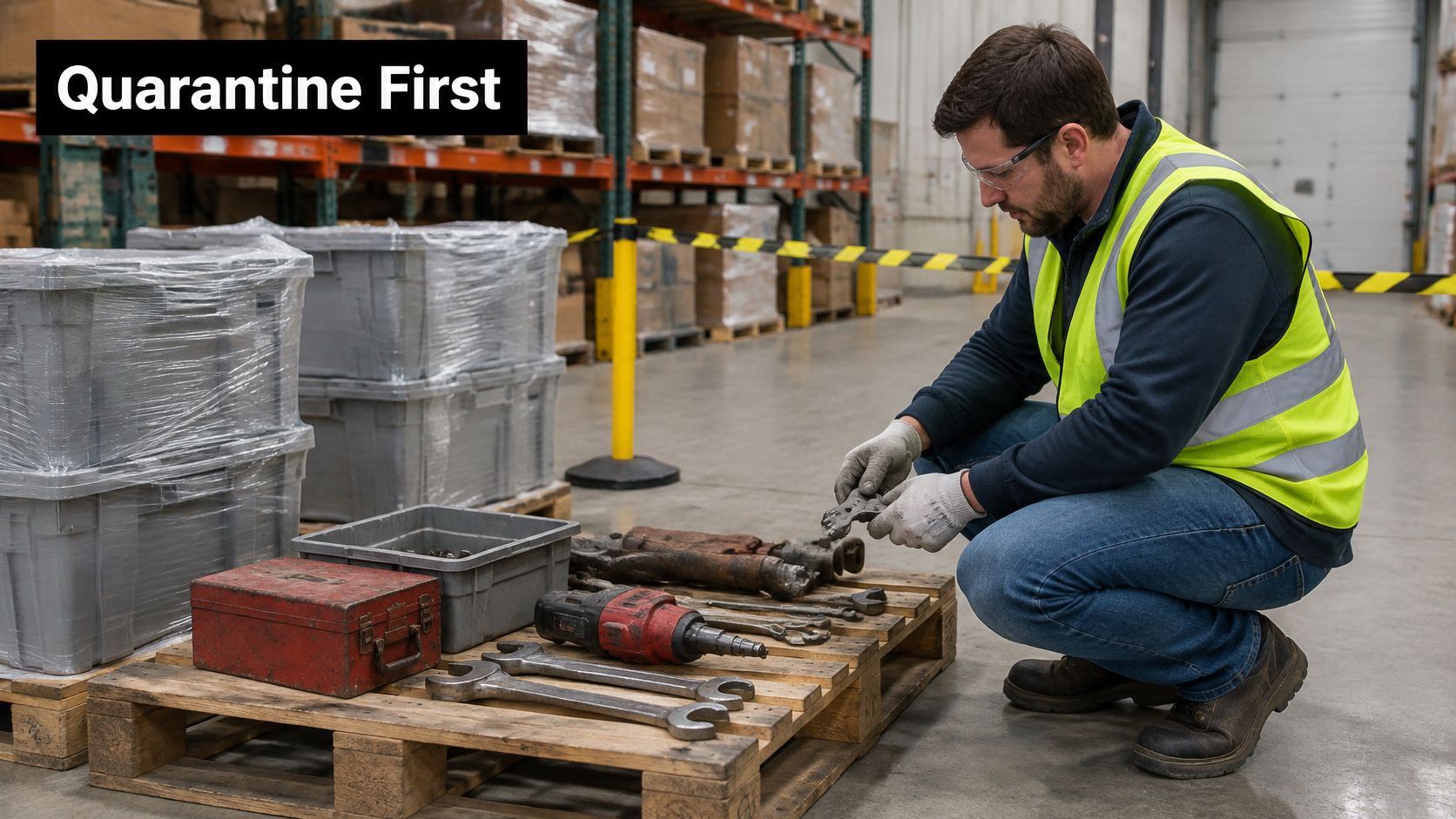
Inspect the pallet while labels and condition remain visible.
Resolve exceptions without changing the remedy
- Mixed pallets. Remove affected serials from ordinary computer recycling or equipment-disposal loads before booking. Give the recalled inventory its own hold status and shipment instructions.
- Conflicting instructions. Ask the recall owner to resolve a distributor's return request that conflicts with a destruction instruction. Retain the written answer rather than choosing whichever route frees warehouse space fastest.
- Working equipment. Don't resell or donate an affected unit because it still operates. Keep it within the recall process until the authorized remedy is completed.
- Manufacturer returns. Have the disposal provider coordinate the required freight rather than substitute local destruction for a return.
- Damage disputes. Preserve quarantine photographs before carrier handling changes the condition or obscures labels.
For purchase-record preparation, Value Tools Co.'s steps for claiming a tool warranty can help staff organize a warranty file. Keep that administrative resource separate from the official recall remedy: warranty eligibility and recall instructions aren't interchangeable.
Recycling alone does not close recall liability.
Retain the notice, claim correspondence, serial register, shipping evidence, and completion records together for the retention period your counsel establishes. If a vendor reports a different outcome from the one authorized, open an exception and obtain a documented resolution instead of filing the certificate as routine completion.
Book Certified Disposition for the Held Lot
Make the next action a written release review, not a truck reservation. Assign one manager to approve the eligible inventory, confirm the remedy, and identify any units still on hold.
Send the proposed provider the inventory and condition information it needs to accept the work. If destruction isn't authorized, keep those units on the manufacturer-directed route. If it is authorized, obtain the handling plan, transport acceptance, receiving location, and reporting scope before scheduling collection.
Ask for the documents before pickup
Request a sample custody form and a certificate of destruction for recalls before the first pallet leaves. Check whether the final document can identify the affected units directly or through an attached serial schedule. Also confirm who will correct a discrepancy and who at your organization can approve closure.
- Send the release packet. Include authorized units, instructions, condition exceptions, and the receiving contact.
- Keep holds visible. Separate unresolved equipment from the collection area so the crew can't load it accidentally.
- Name the file owner. Give one person responsibility for obtaining the final records and resolving outstanding items.
For Atlanta, Georgia businesses and organizations arranging nationwide commercial pickup, the booking should join physical logistics with secure IT asset disposal and documented product destruction. Choose the provider that can execute the approved route and return evidence your facility, procurement, and IT teams can use.
Visit Beyond Surplus to discuss commercial pickup, recalled-product destruction, and data sanitization for your held inventory, and request custody forms and certificate samples before scheduling. Contact Beyond Surplus for certified electronics recycling and secure IT asset disposal.