

A recall notice lands on a Tuesday morning. You've got 1,200 units across two warehouses, another 60 units on consignment at regional resellers, and sales asking whether unaffected lots can still ship today. Recalled product disposal for distributors isn't mainly about finding a dumpster. It's about proving you controlled every unit from the moment you learned about the recall through its final end state, and that proof has to survive an auditor, a regulator, and the recall owner asking the same question months later.
Table of Contents
- Recall Disposal Workflow and Intake Steps
- Mapping Each Recall to Its Regulatory Regime
- Choosing Destruction, Return, Recycling or Rework
- Sanitizing Data-Bearing IT Equipment Before Handoff
- Building a Disposition Packet Auditors Accept
- Recovering Costs and Booking Compliant Destruction
Recall Disposal Workflow and Intake Steps
Don't let the warehouse improvise the sequence. A defensible workflow runs in a fixed order, with one accountable owner per phase and no phase starting until the prior owner signs off. That discipline is what separates a controlled recall from a cleanout.
The FDA recall readiness guidance supports this sequence, including distribution records that identify direct accounts, delivery locations, and contact information, plus destruction plans and memos stating date, quantity, and method. Downstream distributors keep their own consignee records so instructions propagate through the chain instead of stopping at your dock.
Eight Phases With Named Owners
| Phase | Core action | Accountable owner |
|---|---|---|
| 1. Freeze | Stop sales and shipments of affected lots in the ERP and WMS | Sales operations |
| 2. Identify | Map every lot, serial number, quantity and storage location | Inventory control |
| 3. Quarantine | Isolate units physically and in the inventory system | Warehouse lead |
| 4. Notify | Send written return or destruction instructions to each direct consignee | Compliance |
| 5. Approve | Obtain recall owner or regulator sign-off on the disposal method | Compliance and legal |
| 6. Execute | Carry out the approved method through a permitted processor | Logistics coordinator |
| 7. Reconcile | Match received units against returned, destroyed and transferred units | Inventory control |
| 8. Report | Issue the final disposition report and file it with recall records | Compliance |
Ownership matters because gaps hide between teams. Sales operations can freeze orders, but only inventory control can confirm what is on hand. Compliance owns the written instructions, not the account manager who mentioned the recall on a call.
If your reverse flow isn't built for this volume, a structured product recall reverse logistics service can handle pickup, segregation, and documented transfer while your team keeps ownership of counts and approvals. Outsourcing the truck doesn't outsource the record.
Intake Procedure for the First 24 Hours
- Block at lot level, not SKU level. A SKU block stops good stock and tempts staff to override it. A lot level block stops the affected units while clean lots keep moving under normal controls.
- Pull the full lot and serial list. Include stock in transit, returns bins, repair queues, demo pools, and consignment locations. The units you miss are rarely on the main rack.
- Apply a unique quarantine identifier. Tag each pallet, cage, or container with its own ID. That ID follows the units through every movement, transfer, and certificate.
- Move tagged stock to a caged zone. Label the zone, mark the racking location in the system, and restrict access to authorized personnel. Tape on the floor isn't segregation.
- Log every movement. Record user, timestamp, origin, and destination for each quarantine ID. If a pallet moves without a log entry, treat it as a variance, not a clerical shortcut.
- Send written consignee instructions. Name the lots, quantities you shipped them, the required action, the deadline, and where to return proof. Phone calls support the letter, they don't replace it.
Practical rule: If it's not tagged, caged, and blocked in the system, it isn't quarantined, no matter what the spreadsheet says.
Say you're reconciling a 300 unit recall and the count comes up 22 short. A walk of secondary locations finds 22 units sitting in a returns bin that never got scanned back into inventory. That's not an edge case. Returns and repair queues are exactly where recalled units surface late, which is why step two covers them on day one.
Two Sequencing Rules
No destruction before approval. Contact the recall coordinator or recall owner before you destroy anything. The agency or owner may want to witness destruction, verify the method, or review the plan first. Destroying early can make perfectly handled stock impossible to verify.
No closure before reconciliation. Match received units against returned, destroyed, and transferred units one by one. Don't accept a percentage match. Investigate every unit level variance until it's found, transferred with proof, or documented as unrecovered with an explanation.
Within 24 hours of quarantine, walk the caged zone against the system count with a second person. Log any gap as a variance the same day. Retain the whole trail together, including recall communications, movement logs, photographs or witness attestations where appropriate, transporter records, and facility certificates. That's the file you'll hand over when someone asks what happened to unit number 847.
Mapping Each Recall to Its Regulatory Regime
The regime follows the product, not your warehouse. Before you pick a disposal route, map each recalled shipment to the regime that governs it, because the notification, witnessing, and record requirements differ sharply. Guessing wrong usually means you destroyed stock correctly but proved it incorrectly.
For consumer products, the CPSC Regulated Products Handbook requires recalled products to remain quarantined and segregated throughout the distribution chain. You must monitor any third party hired to destroy or dispose of the products, and notify CPSC staff at [email protected] before destruction, disposal, or recycling. CPSC may witness the destruction or require an affidavit and photographic evidence.
| Regime | Trigger | Disposal requirement |
|---|---|---|
| CPSC consumer product recalls | Recall with a disposal remedy or CPSC directed removal | Keep units quarantined, monitor contractors, notify CPSC before destruction, allow witnessing or affidavit |
| FDA medical device recalls | Manufacturer correction or removal under FDA law | Auditable destruction, correction and disposition records supporting recall termination |
| FDA drug and food recalls | Recall of FDA regulated products | Contact recall coordinator before destruction; retain destruction plan and memo |
| FTC Disposal Rule | Business uses consumer reports | Destroy or erase electronic media so information cannot be read or reconstructed; perform contractor due diligence |
| State and local e-waste rules | Varies by state and product type | Use permitted haulers and processors; confirm manifest and reporting requirements |
Medical devices raise the bar further. Recall termination depends on showing the product was removed or corrected and properly dispositioned, so your destruction and correction records feed directly into the manufacturer's termination request. Loose paperwork from a distributor can stall closure for the whole recall.
The data angle catches distributors off guard. If your business uses consumer reports, disposal has to prevent unauthorized access to that information, which for electronic media means erasure or destruction so it can't be read or reconstructed. The same discipline applies in regulated care settings, where protecting resident data in nursing facilities depends on documented handling of devices that held sensitive records.
Contractor Due Diligence
Don't hire a destruction vendor on price and a handshake. Before the first load moves, complete four checks and file the results:
- Independent audit: Review a recent audit of the contractor's operations.
- References: Call commercial clients with similar product types.
- Certification: Confirm recognized trade association certification where applicable.
- Security policies: Read the contractor's information security and chain of custody procedures.
If a contractor can't produce those, they shouldn't touch recalled stock. Your name stays on the recall file long after their truck leaves.
Choosing Destruction, Return, Recycling or Rework
Destroying everything feels safe, but it often isn't. Total destruction eliminates recoverable value and increases environmental impact, while loose reuse can put unsafe goods back into commerce. The goal is controlled disposition, where each category gets the route its hazard, data risk, and remedy require.
CPSC recall guidance confirms recalled products may require disposal or recycling and some remedies demand physical destruction, while certain batteries require hazardous waste handling. Classify units by hazard, data risk, recall remedy, and residual value, then require approved processors and documented end states.
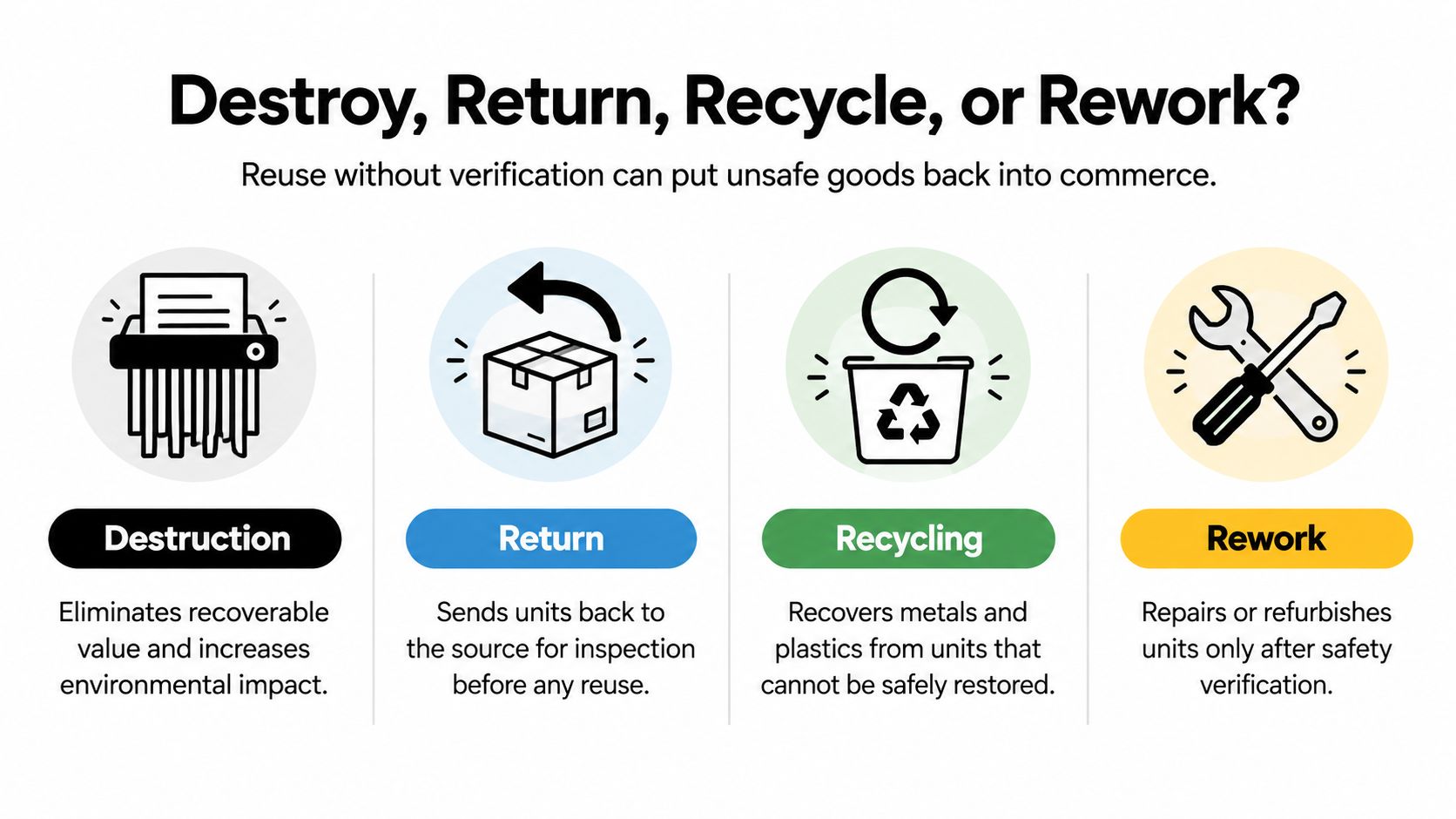
Four Questions Before You Choose
- Can the hazard be removed? If rework, reconditioning, or safe diversion eliminates the risk under an approved plan, destruction may not be required.
- What hazards are present? Check batteries, chemicals, sharp components, and sensitive data. Each one can force a different route.
- Is the processor permitted for this stream? Confirm permits and acceptance criteria in writing before you schedule pickup.
- What proof does the recall owner require? Witnessing, photos, serial lists, and certificate format all need agreement up front.
Other industries face the same trade off between recovery and risk, as shown in work on sustainable apparel manufacturing options, where material recovery only works inside verified controls. For electronics, the deciding factors in refurbish or recycle decisions for IT equipment apply directly, with the recall remedy narrowing your options further.
| Product category | Recommended route | Main risk if mishandled | Proof to retain |
|---|---|---|---|
| Desktops and laptops, no defect, no data concern | Certified recycling or return to manufacturer | Resale into commerce | Recycling certificate with serial list |
| Laptops, workstations and storage arrays holding data | Sanitize then recycle, or destroy media | Data exposure | Sanitization report or destruction certificate per drive |
| UPS units, power supplies, lithium battery devices | Hazardous waste route through a permitted processor | Fire, leakage, improper transport | Hazardous waste manifest and processor permit on file |
| Lab analyzers with chemical residue | Decontamination, then hazardous disposal | Chemical exposure and environmental liability | Decontamination record, waste profile and manifest |
| Medical equipment under a manufacturer correction | Manufacturer directed return or destruction | Unauthorized use of affected devices | Destruction memo and correction records |
| Units with a safety defect and residual value | Controlled rework only where permitted and verified | Reintroducing unsafe goods | Approved rework plan and post rework verification |
| Networking gear, no hazard, no data | Return to supplier or part harvesting under written authorization | Unauthorized redeployment | Return authorization and supplier receipt |
The route is correct only when the hazard is gone, the proof matches the route, and no unit can re-enter the sales channel.
If any of those three fails, change the route. A cheaper option that can't produce matching proof costs more at audit time.
Sanitizing Data-Bearing IT Equipment Before Handoff
Recalled IT assets often arrive with storage intact. Laptops come back with user profiles, servers with logs and credentials, and copiers with scanned documents still on the drive. Ordinary recycling paperwork doesn't prove that data is gone, so sanitization needs its own per serial procedure before handoff.

Per Serial Sanitization Steps
- Inventory each device by asset tag and serial number before it moves.
- List every storage location, including hard drives, SSDs, flash media, eMMC, removable media, and controller or BIOS batteries that may retain settings.
- Choose the method per media type. Use purge or cryptographic erase where the device returns to the manufacturer and media survives. Use physical destruction for failed, unreadable, or non wipeable drives, following NIST 800-88 data destruction standards.
- Verify purges on a sample of units and record pass or fail results against serial numbers.
- Shred drives on site or off site to a stated particle standard, with chain of custody from pickup to destruction.
- Certificate per serial number, never a batch total. A certificate for 400 drives proves nothing about drive number 237.
Edge Cases That Need a Decision
A drive that won't respond to wipe commands gets physically destroyed, no exceptions and no second attempts weeks later. Encrypted drives with lost keys get destroyed too, unless keys are escrowed and erasure can be verified. Devices going back to the manufacturer for failure analysis travel under documented manufacturer custody that names who's responsible for the data on board.
Beyond Surplus offers on site and off site hard drive shredding with per device certificates, which fits recalls where media can't leave your facility unsanitized. Whichever vendor you use, I would require the certificate format in advance and reject any report that lists weight instead of serials.
Building a Disposition Packet Auditors Accept
A vendor destruction certificate alone isn't evidence of control. It proves something was destroyed at a facility on a date. It doesn't prove the units you quarantined are the units that arrived there, or that your counts ever matched. Build a repeatable disposition packet instead, assembled during the recall rather than reconstructed after it.
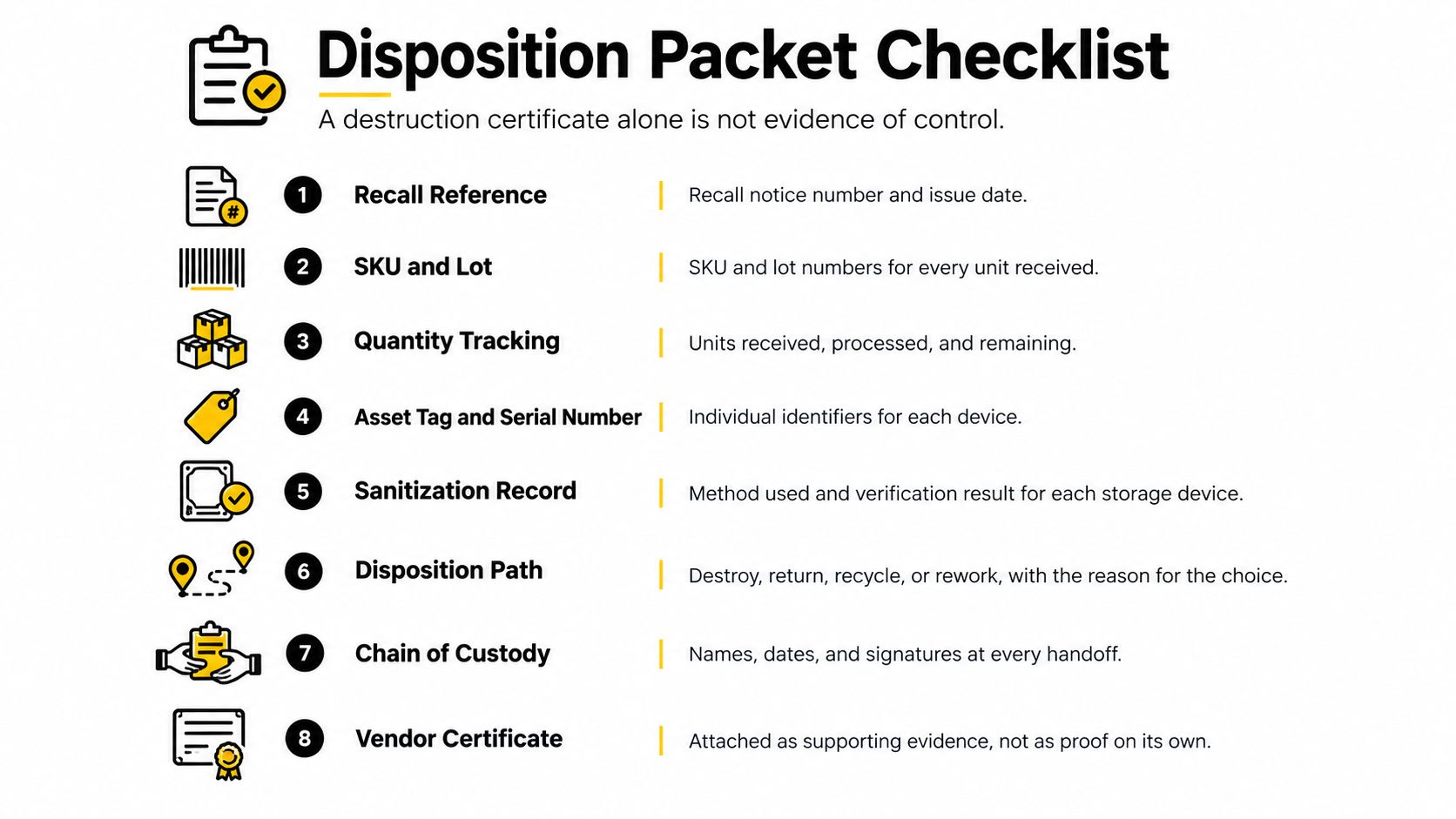
Fields Every Packet Needs
- Recall reference: Notice number, issue date, and recall owner contact.
- SKU and lot numbers: Every affected identifier, matched to your freeze records.
- Serial counts: Units received versus units destroyed, returned, or transferred.
- Custody transfers: Each handoff with names, signatures, and times.
- Destruction method and facility: How units were processed and where.
- Date and location: When and at what address disposition occurred.
- Witness or photo references: Attestation or image file names tied to quarantine IDs.
- Variance resolution: How each discrepancy was closed.
- Retention period: How long the packet stays with the recall file under the applicable regime.
Other regulated sectors lean on the same principle, since CoA documentation for cannabis formulations only carries weight when each result ties back to an identified batch. Your packet does the same job for recalled units, and a properly structured certificate of destruction for recalls becomes one component inside it, not the whole file.
Reconciliation in Practice
Say a packet shows a model and lot identifier, 1,184 units received, 1,181 destroyed, and 3 open variances, plus a driver signature at dock pickup. Those three units don't get written off with a shrug. Escalate each variance to compliance within one business day and close it as found, transferred with proof, or documented as unrecovered with a written explanation.
Third party destruction doesn't transfer your regulatory responsibility. The vendor's records support yours, but your packet must independently show what you controlled and how you resolved exceptions. Keep it with the recall file for the full period the governing regime requires.
Recovering Costs and Booking Compliant Destruction
Recall disposal generates real costs, and who pays depends on your recall agreement and distribution terms. Track each cost from day one with recovery in mind, because reconstructing labor logs two months later rarely survives a chargeback review.
| Cost item | Typical payer | Recovery documentation |
|---|---|---|
| Quarantine labor and storage | Recalling manufacturer under recall agreement | Itemized labor logs and storage dates |
| Reverse logistics freight | Recalling manufacturer or distributor by contract | Bills of lading and carrier invoices |
| Destruction or recycling service fees | Manufacturer if directed, otherwise distributor | Invoice tied to serial list and certificate |
| Data sanitization and media shredding | Shared by contract | Per device sanitization report |
| Write off of unsaleable inventory | Distributor unless the agreement says otherwise | Credit memo or chargeback claim with disposition packet |
Booking Sequence
Confirm recall scope and the lot list first. Get written approval of the method, verify the processor's permits and certificate format, then schedule pickup with a sealed, labeled load. Require witnessing or photo documentation wherever the recall owner asks for it, and agree on that before the truck is booked, not at the dock.
For commercial volumes, nationwide recalled product destruction covers business pickup across the contiguous United States using an in house fleet and transportation partners, with per serial certificates of recycling and data destruction and transparent chain of custody records. Contact Beyond Surplus for certified electronics recycling and secure IT asset disposal on recalled stock before your next notice arrives.
If you're sitting on quarantined electronics, returned IT assets, or recalled medical and lab equipment, Beyond Surplus provides certified electronics recycling, secure IT asset disposal, per serial data destruction, and documented product destruction for commercial clients nationwide. Send your lot list and recall reference, and you'll get a scoped pickup plan with the certificate format agreed before anything leaves your dock.


