

Only an estimated 6% to 10% of recalled products were returned or discarded in 2024, according to the U.S. Public Interest Research Group Education Fund. For manufacturers, that reframes the problem: arranging destruction isn't the same as controlling a recall.
Recalled product disposal for manufacturers needs an evidence trail that connects affected inventory to its final disposition. A regulator, insurer, or litigation team will ask what happened to the units, who controlled them, and how you know they can't return to commerce. A disposal receipt alone won't answer those questions.
Table of Contents
- Recall Disposal Timeline From Notice to Close-Out
- Quarantine and Document Returned Stock Step by Step
- Choosing a Disposition Method by Product Risk
- Sanitizing Storage Media Before Destruction
- Proving Every Unit Was Accounted For
- Vetting Disposal and ITAD Partners Before You Sign
- Pre-Approve Your Disposal Plan Before the Next Recall
Recall Disposal Timeline From Notice to Close-Out
The CPSC's fiscal year 2024 annual report records 333 completed cooperative, voluntary recalls, with 98.08% of Fast-Track recalls initiated within 20 days of the company's report. Manufacturers need operational controls ready while regulatory and notification work is still moving.
In that report's five-year remedy data, disposal represented 23 cases, or 1.1%. That's a count of listed remedy outcomes, not the number of products destroyed. Don't use it to estimate warehouse capacity, transport requirements, or destruction volume.
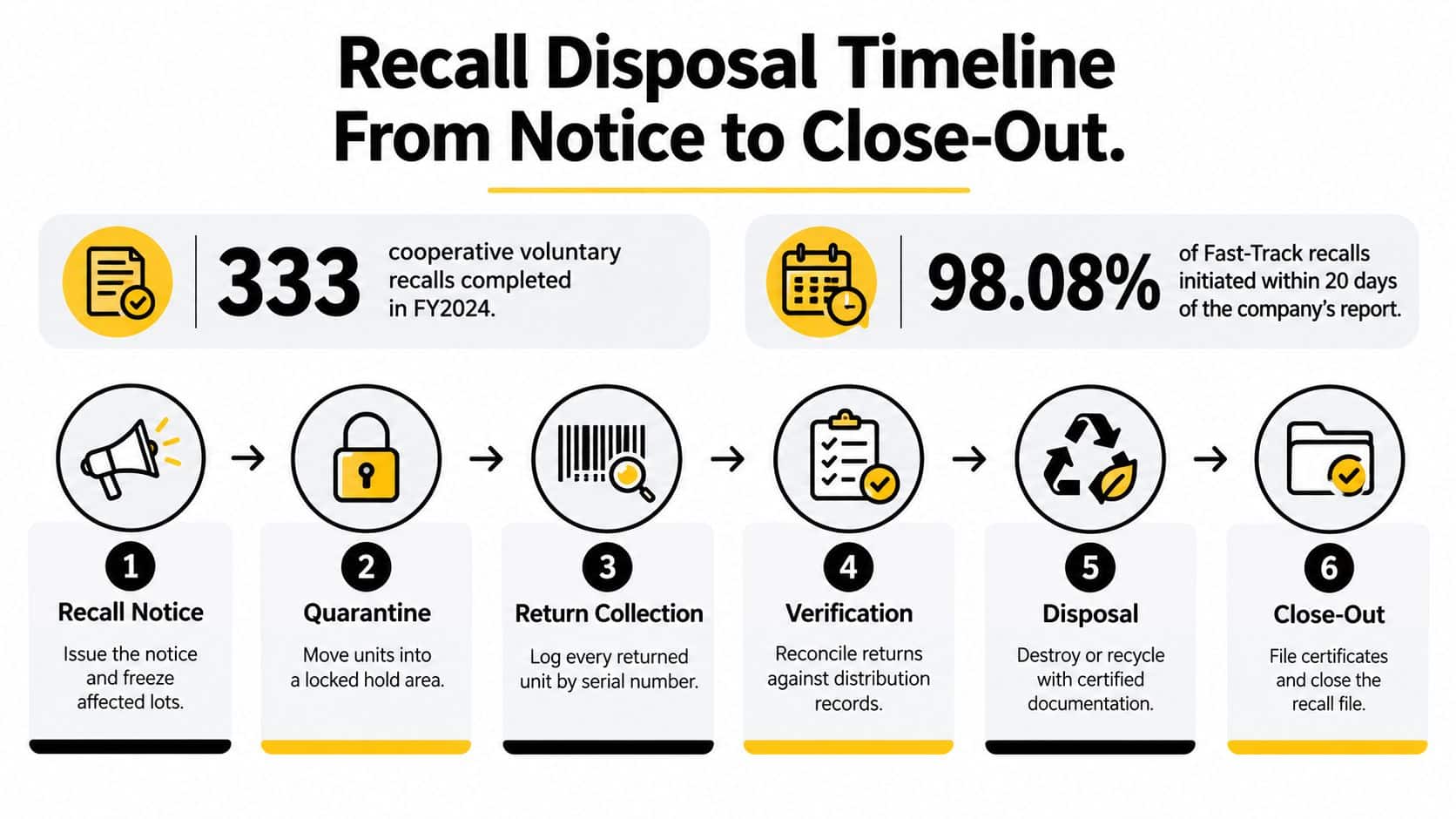
Recall disposal phases, owners and evidence
Use the recall notice and approved corrective-action plan to establish deadlines. The windows below are operational targets and sequencing controls, not universal statutory deadlines.
| Phase | Planning window | Owner | Evidence to retain |
|---|---|---|---|
| Scope affected units | Before public notice issues | Quality and regulatory affairs | Lot, serial and direct-consignee list |
| Consignee notification | Set by recall notice | Distribution and customer service | Notice log with receipt confirmations |
| Quarantine of returns | Same day as receipt | Warehouse lead | Intake record with counts, condition and photos |
| Transport to destruction | Agreed pickup window | Logistics coordinator | Signed manifest and seal numbers |
| Destruction approval | Before any destruction starts | Regulatory affairs | Written approval or regulator response on file |
| Destruction and witness | Per approved plan | Vendor and internal witness | Certificate linked to serials, method and date |
| Reconciliation close-out | Before recall closure | Recall manager | Reconciled unit ledger signed by quality |
Start scoping before the public notice goes out. Quality should establish which product identifiers define the recall, while distribution checks whether those identifiers exist consistently across shipment records, service replacements, and third-party inventory.
A predictable failure is opening returns before the warehouse can identify them correctly. Staff accept mixed shipments under a generic return authorization, and the recall manager later inherits inventory that can't be matched to the affected population.
Planning rule: Don't launch collection with an intake process that records less detail than your final reconciliation will require.
Build product recall reverse logistics around these handoffs, not just pickup availability. Each owner needs an acceptance criterion: what must be recorded before responsibility transfers, and who can stop the process when evidence is missing.
Quarantine and Document Returned Stock Step by Step
Returned goods sitting in saleable inventory create an immediate control failure. A recall label on a carton won't stop a picker from shipping it if the warehouse system still shows available stock.
The FDA recall guidance calls for identifying affected distribution, controlling returned products, documenting disposition, and submitting the proposed destruction or reconditioning method, date, and location to the FDA recall contact before action. It also recommends retaining distribution records beyond shelf life or for the applicable regulatory period, whichever is longer.
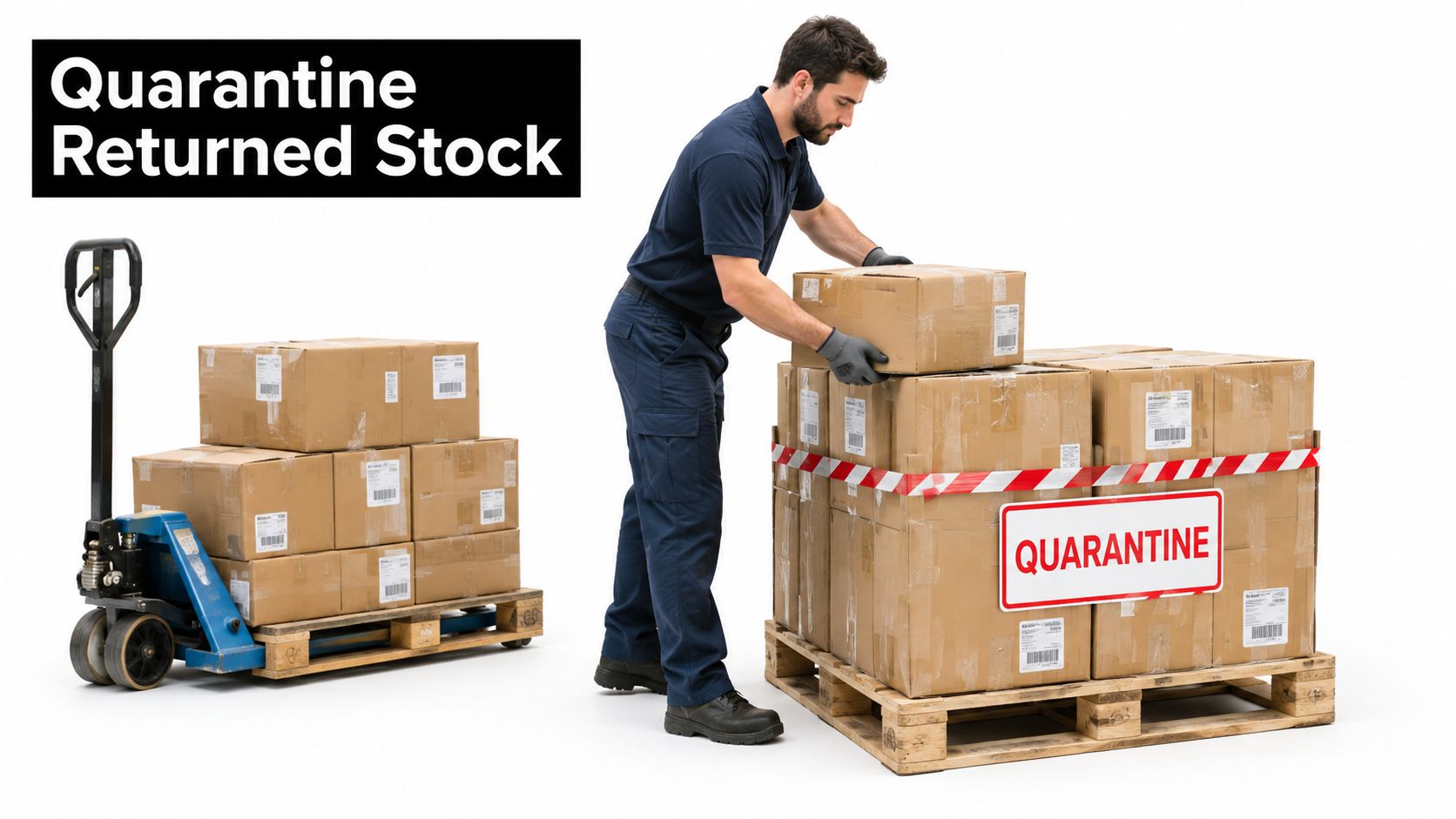
A receiving procedure that blocks accidental release
- Establish the affected population. Pull lots, serial numbers, and direct consignees from distribution records. Flag out-of-business accounts for investigation rather than deleting them.
- Create a controlled quarantine location. Use physical separation and a warehouse hold status that blocks allocation, picking, and shipment.
- Count and inspect returns. Record quantity, condition, lot, serial, and photographs. Distinguish damaged identifiers from genuinely missing units.
- Seal and tag containers. Apply recall identification, assign seal numbers, and record which units each container holds.
- Keep recall stock separate. Don't consolidate unrelated returns merely to fill a pallet. Pallet counts aren't a substitute for the required unit or lot records.
- Document transport handoff. Have the releasing and receiving custodians sign a manifest identifying the load and seals.
- Escalate deviations during the same shift. Missing serials, broken seals, unexpected products, and damaged batteries need named decision-makers.
Say a returned pallet is labeled 240 units, but the receiving team captures only 236 serials. In this hypothetical case, staff should investigate unreadable labels, duplicate scans, and actual shortages before sealing the load. Recording the carton label as the received quantity merely transfers the discrepancy downstream.
Check the route before releasing the load
Regulatory affairs should confirm the FDA notification path or the applicable CPSC corrective-action plan before destruction. For damaged lithium cells, have a qualified hazardous-material specialist determine compliant packaging and transport arrangements at every handoff.
The quarantine log should carry lot, serial, quantity, condition, location, custodian, seal number, and date. Keep corrections traceable, including who changed the record and why.
Choosing a Disposition Method by Product Risk
Destroy everything isn't a disposition strategy. It can sacrifice recoverable materials and increase processing, transport, and waste burdens. Uncontrolled refurbishment creates the opposite problem: defective units or traceable components can re-enter commerce.
Classify each SKU by hazard severity, failure mode, repair validation, resale restrictions, material value, data exposure, and jurisdiction. Treat the routes below as candidates requiring approval, not automatic permission to recycle or resell.
Disposition routes by recalled product type
| Product type | Primary risk | Disposition routes | Pitfall to avoid |
|---|---|---|---|
| Battery-containing devices | Fire and thermal runaway | Certified battery recycling or hazardous-material destruction | Shipping damaged cells in standard packaging |
| Storage-bearing electronics, including laptops, drives and servers | Recoverable stored data | Clear, purge or destroy per NIST SP 800-88 | Treating deletion as sanitization |
| Medical-device components | Patient safety and traceability | Documented destruction or regulator-agreed disposition | Destroying without serial-level records |
| Components with no data or battery | Resale and traceability | Recycling or material recovery | Letting parts reach a secondary market without a record |
| Repairable units | Unresolved failure mode | Controlled rework with validation, or destruction | Returning reworked units without a traceable rework ID |
| Mixed or damaged loads | Commingling and unknown contents | Segregate, reconcile, then dispose | Destroying before reconciliation is complete |
A recall remedy may involve repair, replacement, or refund rather than destruction. Recycling addresses the material destination; it doesn't, by itself, establish that the product's safety defect has been controlled.
- Battery controls: Identify chemistry and condition before selecting packaging or a processor. Damaged cells need a specific handling plan.
- Repair validation: Require documented acceptance testing and a traceable rework lot ID before considering release.
- Medical-device traceability: Specify serial-level destruction records in the work order, including how unreadable identifiers will be handled.
Keep recovery subordinate to safety
The EU General Product Safety Regulation 2023/988 requires an effective, cost-free, timely recall remedy and generally places collection responsibility for nonportable products on the economic operator. U.S. manufacturers selling into the EU shouldn't shift disposal costs or unsafe handling onto customers.
Use a documented refurbish-or-recycle assessment to separate recoverable value from prohibited resale. A valuable board isn't an acceptable recovery candidate if its reuse would defeat the corrective action.
Sanitizing Storage Media Before Destruction
Deleting files isn't sanitization. The IRS media-sanitization guidelines explain that clearing must resist recovery utilities and keystroke-recovery attempts, while purging addresses laboratory attacks; they also describe convergence for certain ATA drives manufactured after 2001 with capacities above 15 GB, including ATA Secure Erase and degaussing as purge examples. Those examples aren't blanket instructions for every storage technology.
NIST Special Publication 800-88 Revision 1 distinguishes clear, which protects against simple, non-invasive recovery; purge, which makes recovery infeasible using state-of-the-art laboratory techniques while potentially preserving reuse; and destroy, which also makes the media unusable for storage. Clear can include rewriting user-addressable locations or an appropriate factory reset when rewriting isn't available.
Select an outcome, then validate the method
- Inventory the media. Record drive type, capacity, serial number, operating condition, and encryption status. Include embedded storage in controllers, laboratory equipment, and medical electronics.
- Route uncertain or failed drives conservatively. For this recall-control workflow, send drives with unknown encryption status or unsuccessful sanitization to destruction.
- Purge media approved for reuse. Match the technique to the device and verify successful completion.
- Limit clear to approved cases. Require verified encryption and an information-security decision that clearing is sufficient. Encryption alone doesn't establish that a reset is adequate.
For a hypothetical batch, 300 recalled laptops with confirmed full-disk encryption could qualify for an approved clear route, while 40 failed drives go directly to shredding. The laptop route still requires a validated method, successful results, and a disposition decision permitting reuse.
Physical options include shredding, pulverizing, incineration, melting, and disintegration. Select a facility and process suitable for the media, rather than assuming damage to the enclosure destroys every storage component.
A broken laptop isn't evidence of destroyed data. Track the storage device, not just the computer chassis.
Use a NIST-based data destruction plan to specify verification and failure handling. Require the partner's certificate to identify the method used for each drive, with exceptions attached rather than hidden in a batch-level completion statement.
Proving Every Unit Was Accounted For
Reconciliation measures control; destruction volume measures an activity. Start with a documented denominator of affected units produced or distributed, then assign each unit to a supported status.
Consider a hypothetical recall involving 12,000 distributed units. The ledger shows 9,500 returned and destroyed, 1,400 reworked and validated, 700 held by responding consignees, and 400 assigned to nonresponding accounts. Those categories total 12,000, with zero diverted to demonstrably safe use, but the unresolved inventory means arithmetic completeness isn't the same as completed corrective action.

Reconciliation buckets and evidence to keep
| Bucket | What counts | Evidence to keep |
|---|---|---|
| Destroyed | Units with a completed, witnessed destruction | Certificate linked to serial or lot, date, facility and method |
| Reworked and verified | Units repaired and passed validation | Validation record and rework lot ID |
| Diverted to demonstrably safe use | Units used in a verified non-commerce setting | Written approval and usage record |
| Held by responding consignees | Units confirmed on site awaiting disposition | Signed consignee confirmation with count |
| Nonresponding accounts | Units assigned from distribution records to accounts that never replied, with current status unverified | Escalation log showing every attempt and date |
A nonresponse doesn't prove that a consignee still possesses the product. Preserve the distribution-based quantity, clearly label its uncertainty, and record the investigation rather than treating an unanswered notice as confirmation.
The FDA recall guidance for industry emphasizes status reporting, consignee instructions, and appropriate disposition; the closure question is whether the agency can reasonably conclude that affected products were removed or corrected commensurate with their hazard. A contractor's receipt doesn't establish that outcome.
Test the evidence against the ledger
Scan serials where feasible and capture photographs or video of the irreversible step when appropriate. Make the recording identifiable by load, facility, date, and work order so reviewers can connect it to the relevant certificate.
- Match quantities: Compare the certificate with intake records and investigate any difference.
- Reject unexplained gaps: A missing unit isn't a rounding difference.
- Escalate nonresponders: Set a fixed follow-up schedule and log every contact attempt.
- Preserve status history: Record transfers between buckets without double-counting units.
Maintain chain-of-custody documentation alongside the ledger. Any unexplained gap needs resolution before the manufacturer seeks closure, while documented outstanding units need an explicit regulatory disposition decision.
Vetting Disposal and ITAD Partners Before You Sign
The lowest-cost destruction vendor isn't necessarily the lowest-risk option. If its records can't establish where products went, procurement may save on processing while leaving quality and legal teams with an unprovable corrective action.
The FTC Disposal Rule guidance applies to businesses and individuals using consumer reports for business purposes, not universally to every recalled device. It nevertheless provides a useful contractor-screening benchmark: independent audits, references, recognized trade-association certification, and information-security policies.
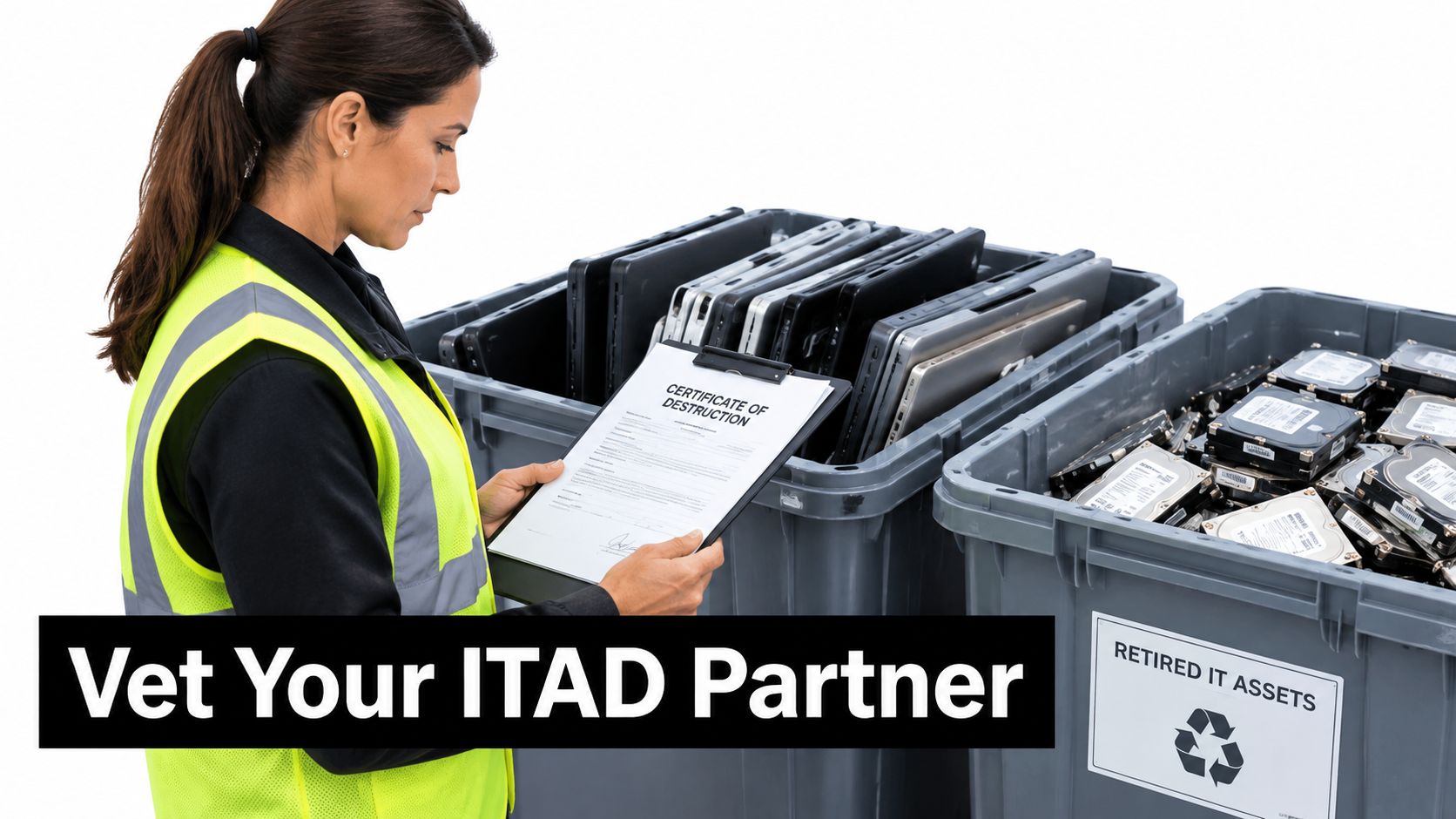
Partner qualification criteria and red flags
| Criterion | Evidence to request | Red flag |
|---|---|---|
| Certifications | Current certificate with stated scope, such as R2 or e-Stewards | Expired certificate or scope that excludes your material |
| Data security | Sanitization policy listing methods mapped to NIST SP 800-88 | Only a general promise to wipe drives |
| Chain of custody | Sample manifest, seal logs and transport tracking | No handoff records for subcontractors |
| Downstream oversight | Final recycler list and facility audit reports | Undisclosed downstream vendors |
| Insurance | Certificate of insurance covering transport and processing | Coverage limited or not provided |
| References | Two references from regulated or recall-experienced clients | Refusal to share any references |
These are procurement criteria, not a claim that every listed credential is legally mandatory. Check the facility address and scope on each certificate rather than accepting a logo in a proposal.
Request documents before committing inventory
Ask for the current scoped certificate, sanitization policy, sample recycling or data-destruction certificate, sample manifest with seal logs, and final recycler list. For enterprise computer recycling, laptop disposal, or data center decommissioning, make sure the samples match the service you're buying.
Beyond Surplus is one provider to evaluate against this checklist for commercial electronics recycling, product destruction, and IT equipment disposal. Request the same evidence from every bidder and use the vendor due-diligence checklist to make comparisons consistent.
For a cross-industry perspective on documenting downstream relationships, Pure Grubs' discussion of supply chain transparency for safer feed offers a useful comparison, though it isn't electronics-disposal guidance.
Require written notice before subcontractor changes, and confirm every downstream recycler by name.
Put those conditions in the contract. A sales representative's assurance won't control an undocumented transfer after pickup.
Pre-Approve Your Disposal Plan Before the Next Recall
Disposal stalls over decisions nobody assigned in advance: who authorizes destruction, which partner accepts the material, and when quarantine capacity runs out. Resolve those questions before a recall puts pressure on warehouse space and staff.
Keep commercial recovery separate from safety authorization. Finance can evaluate value recovery, but quality and regulatory affairs control whether a route is permissible.
Recover value without weakening the recall
- IT buyback: Resell functional equipment only when the recall doesn't restrict the proposed transaction. Obtain legal clearance for resale and exclude defective units.
- Material recovery credits: Define ownership, weighing methods, deductions, and settlement terms before signing. Credits follow the contract and commodity prices, not the original equipment value.
- Warranty or insurance claims: Check eligibility, notice deadlines, and evidence requirements before processing eliminates inspection opportunities.
- Supplier cost-sharing: Preserve defect attribution and supporting records. Recovery depends on an applicable indemnity or a negotiated cost-sharing agreement.
- Reduced storage expense: Schedule collection against the quarantine holding window. A missed pickup can erase anticipated savings and force overflow arrangements.
Don't offset projected recovery value against disposal costs until the route is approved and the commercial terms are documented. Otherwise procurement compares a firm processing quote with speculative revenue, and the plan looks cheaper on paper than it will be in practice.
Make readiness an operating deliverable
- Assign phase owners. Name an accountable person and backup for every handoff in the recall timeline.
- Pre-qualify two partners. Confirm material acceptance, geographic coverage, capacity, and evidence requirements before an emergency forces a rushed choice.
- Write a SKU disposition matrix. Include prohibited routes and the authority needed to approve exceptions.
- Set quarantine limits. Establish available capacity, maximum hold time, and an overflow location.
- Approve media methods. Specify sanitization, verification, and failure handling for each storage type in the inventory.
- Prepare templates. Build consignee notices and destruction memos with lot, serial, quantity, date, method, and witness fields.
- Run a tabletop exercise. Use a hypothetical recall of about 1,000 units, including an unreadable serial, a damaged battery, and an unavailable consignee.
End the exercise with a reviewable evidence package, not a discussion. Procurement should test partner availability, warehouse staff should demonstrate the shipping block, and the recall manager should reconcile the mock ledger. Each output becomes either a working template or a gap to close before a real event.
The standard to aim for: someone outside the response team can follow the records from affected shipment to authorized outcome without relying on verbal explanations. That file is what a regulator, insurer, or litigator will ask to see first.
Contact Beyond Surplus for certified electronics recycling and secure IT asset disposal, including recalled-device pickup, product destruction, and documented data destruction. Use the website's contact page to request a quote for pickup and destruction of recalled devices, and bring your inventory profile, proposed disposition routes, and evidence requirements so the discussion produces a workable plan.


