

A Certificate of Destruction for Recalls is a signed record proving that a defined set of recalled units was irreversibly destroyed, by whom, on what date, and by which method. You've quarantined the pallets, your regulator is asking for a status report, and your vendor just sent a one line pickup receipt. That receipt won't close the recall.
Table of Contents
- What a Certificate of Destruction Proves in a Recall
- Required Fields and a Sample Certificate Template
- Regulatory Rules That Require Destruction Records
- Matching the Destruction Method to the Media
- How to Obtain and Issue Certificates During a Recall
- Vendor Checklist for ITAD and Electronics Recall Destruction
- Confirm the Certificate Before You Close the Recall
What a Certificate of Destruction Proves in a Recall
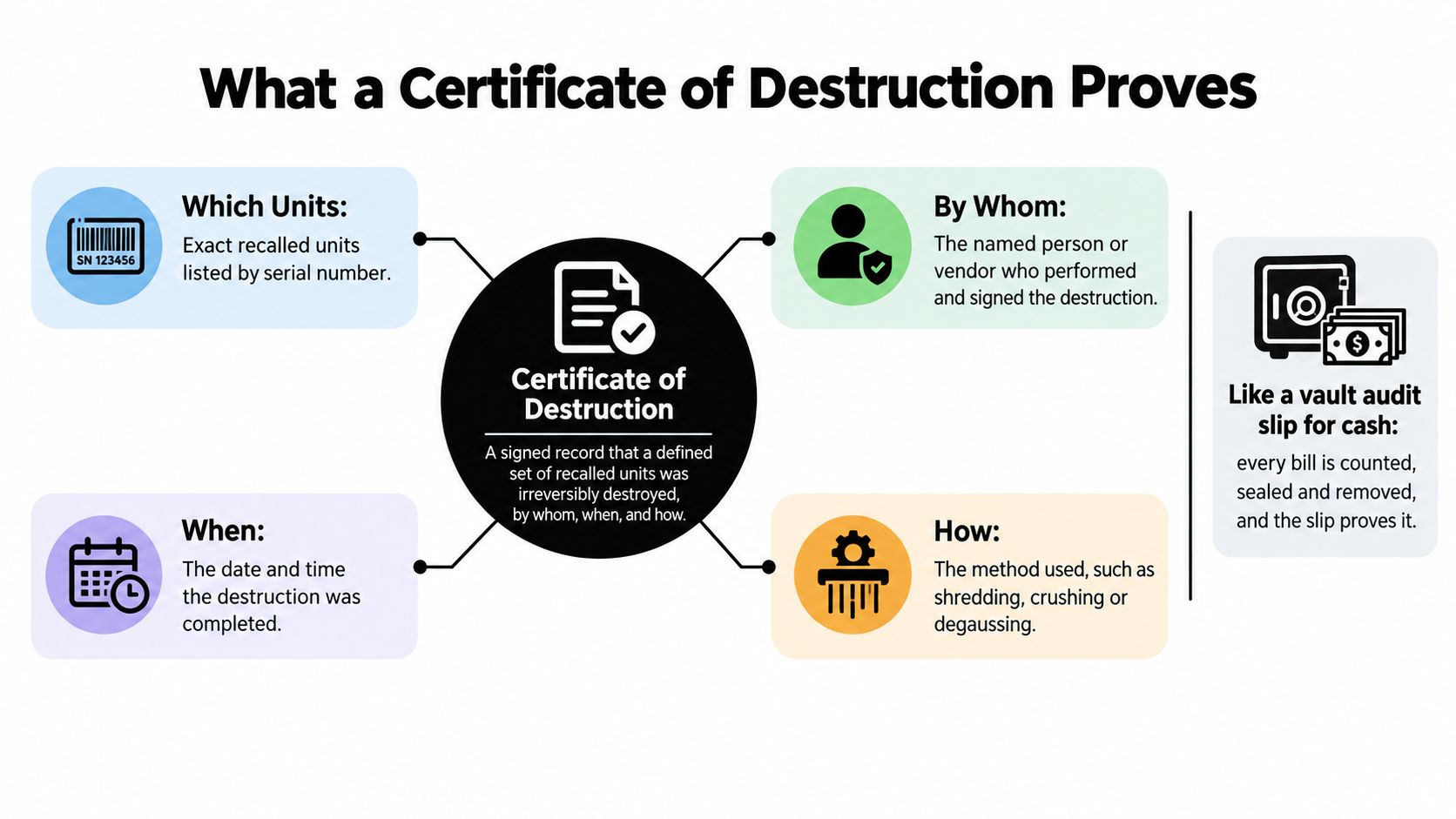
Think of it as a vault audit slip for cash that was shredded. The slip isn't the cash. It proves the count matched, the bills were sealed, and someone named signed for the destruction. A pickup receipt only proves goods left your building.
A regulator or auditor asks three questions. Which units were covered, by lot or serial range. How many were received and destroyed, with any variance explained. How they were destroyed and who verified it.
Three Documents Readers Confuse
Don't swap these documents for each other. Each one proves something different, and auditors reject the wrong one quickly.
- Certificate of destruction for recalled stock: Proves specific recalled units were irreversibly destroyed and can't re-enter commerce.
- Certificate of recycling: Proves material entered a recycling stream, which may not show irreversible destruction of the product itself.
- Certificate of data destruction: Proves data on media was sanitized or destroyed, not that the whole recalled product was destroyed.
The certificate sits in a chain, not on its own. Quarantine comes first, then segregation, approval, destruction, reconciliation, and finally recall closure. The CPSC Regulated Products Handbook requires recalled products to remain quarantined and segregated from acceptable or unrelated returned goods, including when a third party performs destruction.
That same guidance expects notice before disposal, destruction, or recycling, because staff may witness the process or require an affidavit and photographic evidence. For off-site work it recommends written vendor instructions, marked boxes and pallets, and a ban on commingling or salvage. For on-site work, the signed statement should state the date, products, quantities, and employee who did the work, with a witness signature.
If the document doesn't connect units to a count, a method, and a verifier, it's a receipt, not evidence.
Retail and distribution teams handling returns from multiple sites need that chain at lot level, which is why a structured process for recalled product disposal for retailers starts with segregation, not transport. Reconcile the certificate to shipping manifests, receiving records, inventory adjustments, photographs, and recall status reports before you close the case.
Required Fields and a Sample Certificate Template
A certificate missing a field is weaker than one that's short but complete. Fill the form per lot and per shipment, not once per recall. Each destruction event needs its own record, its own count, and its own sign-off.
The Thirteen Fields in Order
| Field | What to Enter | Sample Entry |
|---|---|---|
| Recall reference | Recall number and notice date from the agency or recall notice | Recall notice dated 2 March 2026, [recall number from notice] |
| Product and manufacturer | Brand, model, manufacturer name and originating facility | Handheld scanner model S-500, [manufacturer name], [originating facility] |
| Identifiers | Lot, batch or serial range covered by the certificate | Serials SN40001 to SN40750 |
| Quantity received | Units received from each source, with source and date | 750 units received, 5 March 2026 |
| Quantity destroyed | Units destroyed, with the variance from received units | 748 destroyed, variance of 2, see discrepancy note |
| Destruction date | Date destruction was completed, not the date of pickup | 12 March 2026 |
| Destruction method | Specific method by media type, using NIST category terms | Destroy, pulverization to fine particles, verified by facility log |
| Facility and location | Address where destruction occurred and whether on-site or off-site | Off-site, licensed facility, city and state of processing |
| Operator and witness | Name and title of the person who performed and the person who witnessed | J. Ortiz, Operations Lead, witness QA Manager |
| Chain-of-custody references | Bills of lading, seal numbers, manifests and receiving reports | Bills of lading and seal numbers on manifest, signed receiving report |
| Regulator notice or approval | Date the agency was notified and any approval or witness plan | Notified 3 March 2026, agency concurrence recorded |
| Evidence attached | Photographs, affidavit or vendor statement, with a count of each | 12 photographs, vendor statement, 2 discrepancy photos |
| Authorized sign-off | Signature, printed name, title and date for the responsible manager | Signed and dated by recall manager on 16 March 2026 |
Where Most Certificates Fail
Three fields cause most rejections. First, the variance between units received and units destroyed is left blank or unexplained. In the scanner example, 750 arrived, 748 were destroyed, and 2 were flagged in a discrepancy note with a photo reference. That note turns a shortfall into an auditable exception.
Second, the method says only "destroyed." That's not a method. Name the process, such as pulverization, disintegration, melting, or incineration, and tie it to the media type.
Third, there's no approval or notice reference. If the agency wasn't informed before destruction, a neat form issued afterward is weak evidence. Record who you notified, when, and what they agreed.
Build the template as a one page fill-in form. Number the fields, add an attachment list for photographs and manifests, and use a signature block with three lines for operator, witness, and authorized recall manager.
Practical rule: Use the thirteen fields as a pre-sign checklist. Don't sign while any field that should have an entry is blank.
If two units are pending investigation, write that down and issue a supplemental certificate later. Don't force the numbers to match on paper.
Regulatory Rules That Require Destruction Records
No single rule covers every recall. The authority depends on product category, recall type, and whether the action is voluntary or mandated. A certificate accepted by one agency may not satisfy another, so map each recall to every authority that touches the product.
What Each Framework Expects
| Authority | Product Scope | What the Record Must Show |
|---|---|---|
| FDA recall procedures | Foods, drugs and other FDA-regulated products | Final disposition records, destruction date, quantity and method, notice to FDA contact before destruction |
| 21 CFR Part 806 | Medical devices | Correction and removal records kept two years beyond expected device life |
| 21 CFR Part 7 and Part 810 | Medical devices | Voluntary recall under Part 7, mandatory recall order under Part 810 if a voluntary recall is not conducted |
| CPSC recall handbook | Consumer products under CPSC jurisdiction | Approval before destruction, written vendor instructions, certification of destruction, affidavit for on-site destruction |
| NIST SP 800-88 | Data-bearing media and devices | Sanitization category, Clear, Purge or Destroy, and method used |
| FTC Disposal Rule | Records containing consumer report information | Evidence of reasonable disposal measures for covered records |
The FDA recall procedures state that final disposition records should identify what happened to returned products and, when destruction occurred, include a destruction memo or certificate specifying the date, quantity, and method of destruction. Firms are expected to notify their FDA recall contact before destruction or reconditioning because the agency may review the proposed method or witness the destruction.
That documentation duty doesn't disappear when an investigator isn't present. The firm and its customers still maintain adequate destruction records, and those records support the final recall status report that helps FDA decide whether the recall can be terminated. Keep your internal file aligned through a single set of compliance documentation so the certificate, manifests, and status report tell the same story.
Privacy duties can run alongside product safety duties when recalled devices hold personal data. Teams building connected products in other jurisdictions run into the same overlap, which is covered in Privacy Act considerations for startups from NZ Apps. The lesson travels well. Check privacy, data, and product rules together before you destroy anything.
One certificate rarely satisfies every authority. List every regulator for the product first, then design the record to meet the strictest expectation among them.
Matching the Destruction Method to the Media
Use a book analogy for the three NIST categories. Clear is like erasing the index, the words still exist and a lab can recover them. Purge rewrites every page so the original text can't be read even with laboratory tools, while the media generally stays usable. Destroy turns the book to ash and leaves nothing usable.
Recalled stock that will never return to service needs the Destroy category. Clear alone isn't acceptable for that stock, because it only resists simple, noninvasive recovery attempts. Your certificate has to say which category you used, not just that equipment was discarded.
Acceptable Methods by Media Type
| Media or Product | Acceptable Method | Certificate Must Record |
|---|---|---|
| Magnetic hard drives | High-powered degaussing, or disintegration to small particles | Drive serials, method, degausser or facility reference |
| Solid-state drives | Melting or incineration | SSD count by model, method, facility log |
| Embedded flash or eMMC memory | Pulverization, melting or incineration | Device model, count, method, verification record |
| Whole recalled units with storage | Destroy category, disintegration, pulverization, melting or incineration | Unit count, lot or serial range, facility |
| Non-data components in recalled products | Method approved in recall plan, such as shredding or crushing | Approval reference, method, weight or count |
| Any media returned to service | Clear only for low-risk reuse | Not acceptable for recalled stock, do not certify as destroyed |
Match the technique to the storage technology. Ordinary shredding or pulverization can be ineffective for some modern media because data can be written at depth. Magnetic drives may need high-powered degaussing or disintegration, while solid-state drives and embedded flash need stronger treatment such as melting or incineration.
The common error is a single line saying "shredded" on a mixed lot. Say a pallet holds magnetic drives, SSDs, and tablets with embedded memory. One method word can't prove all three were properly destroyed.
Break the lot by media type on the certificate. List the count for each type, the method applied to that type, and the facility log that verifies it. Guidance on NIST 800-88 data destruction standards helps operations teams translate those categories into a work instruction vendors can follow.
Field check: If the certificate doesn't name the media type next to the method, send it back before you file it.
How to Obtain and Issue Certificates During a Recall
Work in order. Skipping an early step usually creates a gap you can't repair after the units are gone, because destruction is irreversible.
Steps One to Four
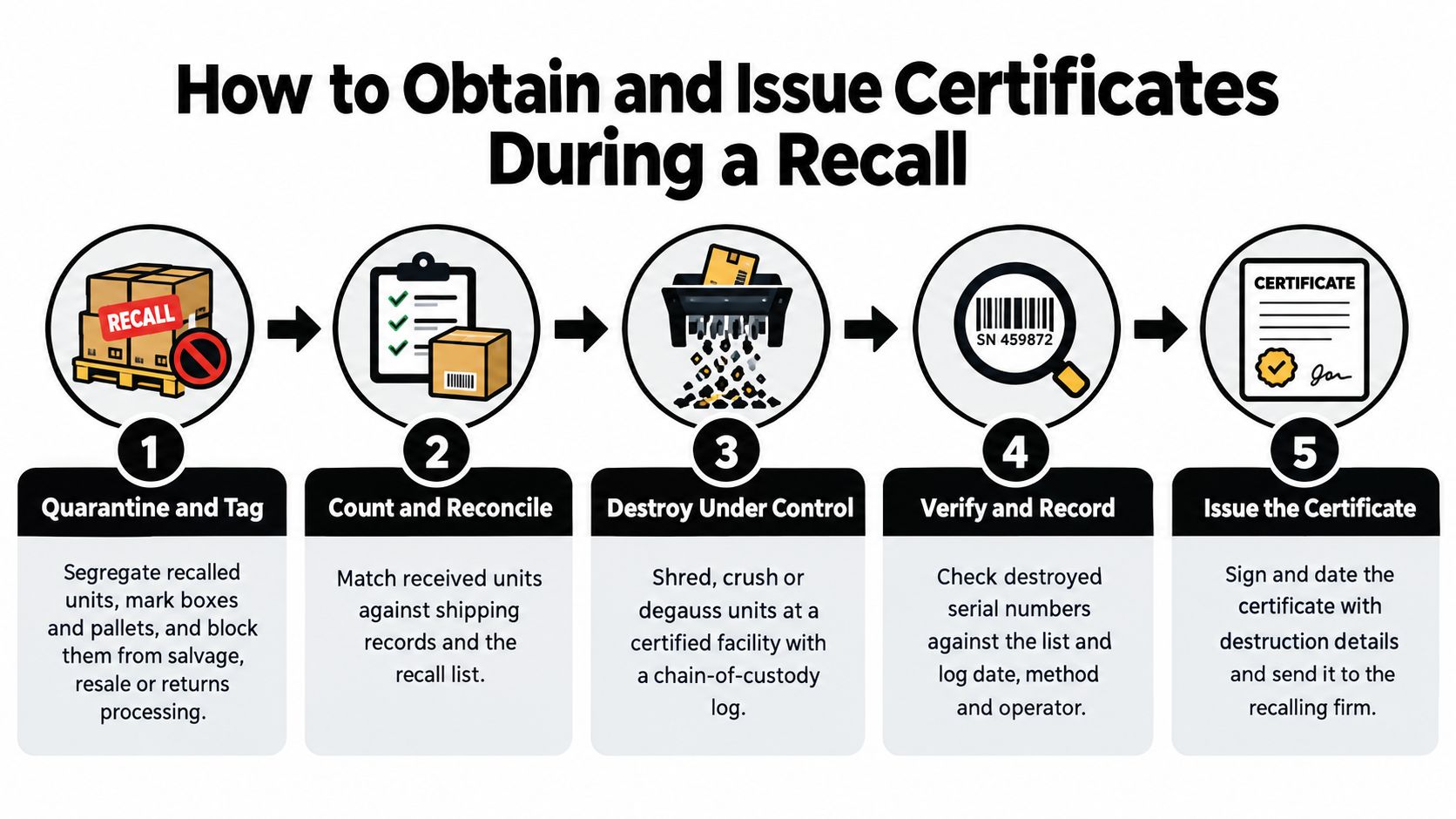
- Quarantine and tag: Segregate recalled units, mark boxes and pallets clearly, and block them from salvage, resale, or returns processing. The common slip is staging recalled stock in the normal returns lane, where it gets commingled.
- Count and reconcile: Count received units against shipping manifests and the recall distribution list, and log any variance the day it appears. Don't wait until destruction day to discover a short shipment.
- Notify and seek approval: Contact your agency recall contact before destruction, state the proposed method, and ask whether they'll witness it or require an affidavit. Destroying before approval is the costliest slip, because you can't undo it.
- Select the vendor or procedure: For off-site destruction, issue written instructions and require no commingling or salvage. For on-site destruction, document the internal procedure and name the operator in advance.
Steps Five to Nine
- Transfer with custody records: Use bills of lading, seal numbers, and signed receiving reports at the destruction facility. The slip here is an unsealed truck with a pallet count but no seal number to tie to the manifest.
- Destroy and record: Capture the date, method, operator, witness, and photographs at key stages, including sealed pallets on arrival and material after processing. Photos without a lot label in frame prove very little.
- Reconcile before signing: Match destroyed units to received units and investigate every discrepancy with a written note. Signing with an unexplained variance tells an auditor the count was never controlled.
- Obtain the certificate: Request the vendor's signed certificate, or for on-site work, a signed statement or affidavit with photographs. Check it against your field list on receipt, not weeks later.
- File and report: Store the certificate in the recall file, keep it for the required retention period, and submit it with the final recall status report. Filing it only in email is a slip, because the next auditor won't search inboxes.
Destroy first and ask later is the one sequence you can't fix with better paperwork afterward.
For multi-site recalls, run these steps per shipment. A national program might produce ten certificates for one recall, each tied to a manifest and seal. That's stronger than one summary certificate covering everything, because each count can be traced.
Keep a single recall log that lists every certificate number, lot, quantity, and variance. When the regulator asks how many units remain outstanding, you'll answer from that log instead of rebuilding totals from attachments.
Vendor Checklist for ITAD and Electronics Recall Destruction
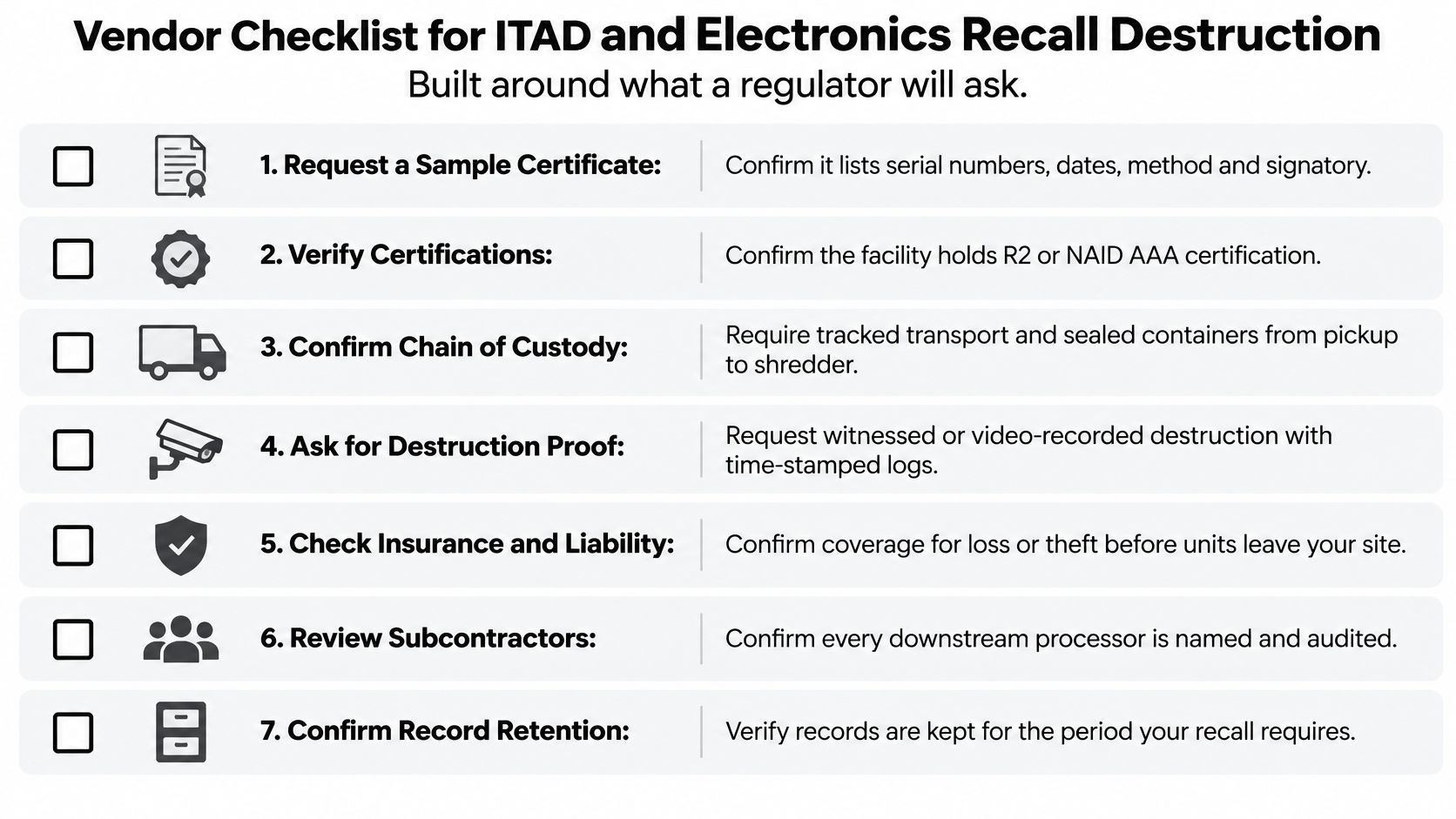
Test vendors against what a regulator will ask, not what a sales brochure highlights. Run every test before you sign a contract, and treat each one as pass or fail.
Nine Pass or Fail Tests
- Sample certificate: Request one and check it against the thirteen fields. Missing variance, method, or witness fields means the vendor's standard output won't close your recall.
- Method by media type: Confirm methods are documented by media type and mapped to a NIST category, with Destroy required for recalled stock.
- Named facility and operator: Confirm every certificate names where destruction happened and who performed it.
- Tracked transport: Require sealed or tracked transport and signed receiving reports for each shipment.
- No commingling or salvage: Get a written commitment that recalled goods won't be commingled, salvaged, or brokered without written approval.
- Written instructions and witnessing: Confirm the vendor accepts your written instructions for recalled stock and allows witnessing or facility visits.
- Variance reporting: Confirm any count variance is reported before the certificate is issued, not buried in a total.
- Lot level traceability: Confirm each certificate ties to the recall lot, serial range, and manifest.
- Credentials and retention: Check third-party certifications, insurance, and how long records are retained.
The CPSC Recall Handbook says destruction should occur only after CPSC approval and that the agency may witness the process or arrange another means of verifying it. For off-site destruction, it expects written instructions to the vendor, no commingling or salvage, clearly marked boxes and pallets, and a certification of destruction after completion.
Apply the same nine tests to every ITAD provider you're considering, using a consistent vendor due diligence checklist so scores are comparable. Exclude residential or consumer drop-off services from the evaluation. Recall destruction needs enterprise controls, sealed custody, and lot level reporting that drop-off programs aren't built to provide.
Confirm the Certificate Before You Close the Recall
Run this five minute test before you file anything. It catches the gaps that cause rejected paperwork while you can still ask the vendor for a correction.
Final Six Checks
- Blank fields: Compare the certificate against the thirteen fields and mark any blank that should have an entry.
- Count math: Confirm destroyed units plus documented variance equal units received, with a written explanation for every variance.
- Date order: Confirm the agency notice or approval date precedes the destruction date.
- Method match: Confirm the method is recorded by media type and matches the approved method.
- Attachments: Confirm the signed certificate, manifests, seal numbers, and photographs are attached.
- Retention: Confirm the retention period in the applicable regulation and the storage location in the recall file.
Store that packet where your recall file lives, supported by complete chain of custody documentation from pickup through final processing. Then request a sample certificate and a process walkthrough before your next recall, not during one.
Beyond Surplus supports business customers across the contiguous United States with secure destruction of recalled electronics, IT equipment, and data-bearing media, with documentation built for audit review. Contact Beyond Surplus for certified electronics recycling and secure IT asset disposal.
Before your next recall forces the issue, ask Beyond Surplus for a sample Certificate of Destruction and a walkthrough of its recall destruction process, from sealed pickup to lot level reconciliation. You'll see exactly which fields, photographs, and custody records you'll receive, so your team can close the recall file with evidence a regulator can verify.


