
A recall notice arrives on Friday afternoon. In a hypothetical enterprise response, it covers 300 laptops spread across branch offices, remote employees, and a storage room. Procurement wants a count, legal wants the units preserved, and IT needs to know whether anyone can safely power them on.
The immediate problem isn't finding an empty cage. It's stopping further deployment while establishing which assets are affected, who holds them, and what must happen before anyone releases them. Recalled product quarantine services should turn those questions into controlled, documented decisions.
Table of Contents
- What Recalled Product Quarantine Services Include
- Regulations That Shape Quarantine and Chain of Custody
- Choosing Repair, Sanitization or Destruction for Each Unit
- How to Run a Recalled Product Quarantine Step by Step
- Risks That Break a Quarantine and How to Prevent Them
- Recovering Recalled Units Held Outside the Warehouse
- Provider Checklist and Sample Chain-of-Custody Terms
- Confirm Your Quarantine Plan Before the Next Recall
What Recalled Product Quarantine Services Include
A recalled product quarantine service is a managed program that isolates identified units, tracks each asset to an approved outcome, and documents custody throughout the process. For IT managers, facility managers, procurement professionals, and operations leads, the deliverable is more than storage space. It's an accountable record of what happened to the equipment.
Think of a bonded vault in a bank. Staff log each item entering and leaving, restrict access, and require authorization before release. A quarantine program needs that same discipline, applied to serial numbers, asset tags, recall identifiers, and disposition orders.
Storage isn't the same as quarantine
A cage holds inventory. A quarantine service holds identified assets under enforceable status controls, so staff can't accidentally return them to deployment or resale.
For an enterprise fleet, that distinction matters during ordinary work. A technician looking for a replacement laptop shouldn't be able to select a recalled unit just because its condition appears acceptable.
| Component | What it covers | Record produced |
|---|---|---|
| Ingress inspection | Count and verify each unit against the recall notice at receipt | Intake log with serial or asset tag and condition photo |
| Tagging and segregation | Apply hold tags and move units to a restricted zone or cage | Tag ID and location map |
| Secure storage | Locked, access-controlled storage that prevents sale or redeployment | Access log and storage record |
| Tracking | Record changes such as held, tested, released, or destroyed | Asset-level status history |
| Testing and triage | Assess recall applicability and perform authorized inspection | Triage report |
| Disposition | Return, repair, rework, component recovery, or destruction | Asset-owner-approved disposition order |
| Certified destruction or data sanitization | Match wiping, shredding, or another authorized method to the media | Destruction or sanitization certificate with serial detail |
| Documentation and certificates | Assemble custody records, certificates, and exceptions | Closure package tied to the recall identifier |
Testing must remain conditional. A quarantine provider shouldn't power on, dismantle, or otherwise examine equipment when the recall instructions or an evidence hold prohibit it.
Practical rule: If the provider can identify the pallet but not the individual assets inside it, the custody record isn't detailed enough for a serialized IT fleet.
Map these components against your current recall process. Mark any point where ownership, authorization, or the resulting record is unclear. Those gaps belong in the service scope before collection begins.
Regulations That Shape Quarantine and Chain of Custody
A returned device may fall under product-safety, information-disposal, or environmental rules, depending on the product, data, and planned disposition. Identify the applicable obligation before authorizing movement or destruction. Guidance can shape good controls without creating a legal requirement.
Identify the obligation before moving the asset
The FTC Disposal Rule guidance applies to organizations that use consumer reports for business purposes, including employers, lenders, insurers, and landlords. It calls for reasonable disposal practices to prevent unauthorized access, with erasure or destruction of electronic information among the examples.
A business device is not automatically covered by this rule because it contains confidential information. Other obligations may apply. Ask counsel to identify them rather than relying on a blanket compliance statement.
| Rule or standard | Applies when | Quarantine requirement or guidance | Evidence to keep |
|---|---|---|---|
| FTC Disposal Rule | An organization uses consumer reports for business purposes | Protect covered information through appropriate disposal and contractor diligence | Due-diligence file and disposal records |
| CPSC recall handling | A covered product is subject to recall corrective action | The CPSC Recall Handbook recommends controls such as isolating affected products and preventing their sale; these are guidance, not a universal quarantine mandate | Records linked to the recall identifier |
| FDA destruction expectations | FDA-regulated products are subject to applicable agency procedures | Follow applicable agency direction before destruction and accommodate witnessing when required | Method approval, destruction documentation, witness records |
| EPA hazardous-waste rules under RCRA | A waste determination establishes applicable hazardous-waste requirements | Follow classification-specific storage, labeling, transport, and disposal requirements | Applicable manifests, classification, and transporter records |
| NIST SP 800-88 | The organization adopts the standard for data-bearing media | Use it as technical guidance to select and document an appropriate sanitization outcome; it does not itself establish a legal trigger | Asset-linked sanitization record |
For batteries, CRT monitors, and mixed equipment, request a documented waste determination. Don't assume every item follows the same route. Have environmental counsel confirm applicable federal and state requirements, including Georgia requirements, before storage or transportation is approved.
At each handoff, record the applicable rule or guidance, the person authorizing the action, and evidence that the work was completed. Use chain-of-custody documentation to connect those decisions to custody records. This helps distinguish a legal obligation from a recommended control when a recall file is reviewed.
Choosing Repair, Sanitization or Destruction for Each Unit
Ask these questions before assigning disposition: Does the unit store data? Is an approved repair available? Is an evidence hold in place? A working device isn't automatically eligible for reuse, and a defective device isn't automatically approved for destruction.
Separate the product-safety decision from the data-security decision. Repair may address the defect without addressing stored information. Sanitization may address stored information without making the product safe.
Match the sanitization outcome to the media
NIST SP 800-88 Revision 1 distinguishes these outcomes:
- Clear: Logical sanitization of user-addressable storage that protects against simple, non-invasive recovery attempts.
- Purge: Physical or logical treatment that makes recovery infeasible using state-of-the-art laboratory techniques, potentially preserving reuse.
- Destroy: Treatment that defeats that laboratory-level recovery and renders the media unusable for future storage.
Don't assume a factory reset satisfies every device's requirements. Specify the approved technique, supported media, verification method, and acceptance criteria in the work order.
| Condition at intake | Typical disposition | NIST sanitization level | Record to keep |
|---|---|---|---|
| Working, data-bearing, confirmed outside recall scope | Controlled return to stock or resale after release approval | Clear or Purge, based on policy and risk | Scope determination and sanitization certificate |
| Defective, repairable under manufacturer program | Authorized repair and re-verification, or manufacturer return | Clear or Purge as appropriate, unless preservation prevents sanitization | Repair order and sanitization or preservation record |
| Defective, not repairable, contains data | Approved component recovery or destruction | Destroy for media assigned to destruction | Destruction certificate and witness record, if applicable |
| Under manufacturer or regulator evidence hold | Preserve sealed without alteration | Deferred until authorized release | Hold notice and written release approval |
| Non-data hardware with a safety issue | Approved recycling or destruction route | Not applicable unless media is present | Recycling record and applicable transport documentation |
These are decision examples, not universal minimums. Manufacturer instructions, recall restrictions, applicable law, and legal holds take priority over internal recovery preferences.
A universal destruction technique won't work across media types. NIST's original media-sanitization guidance notes that degaussing can damage hard-drive firmware and calls for trained, authorized personnel and identification of safety and special-disposition requirements.
The refurbish-or-recycle decision therefore belongs after recall-scope and release decisions. Record the approved route against the asset identity before moving equipment into any recovery channel.
How to Run a Recalled Product Quarantine Step by Step
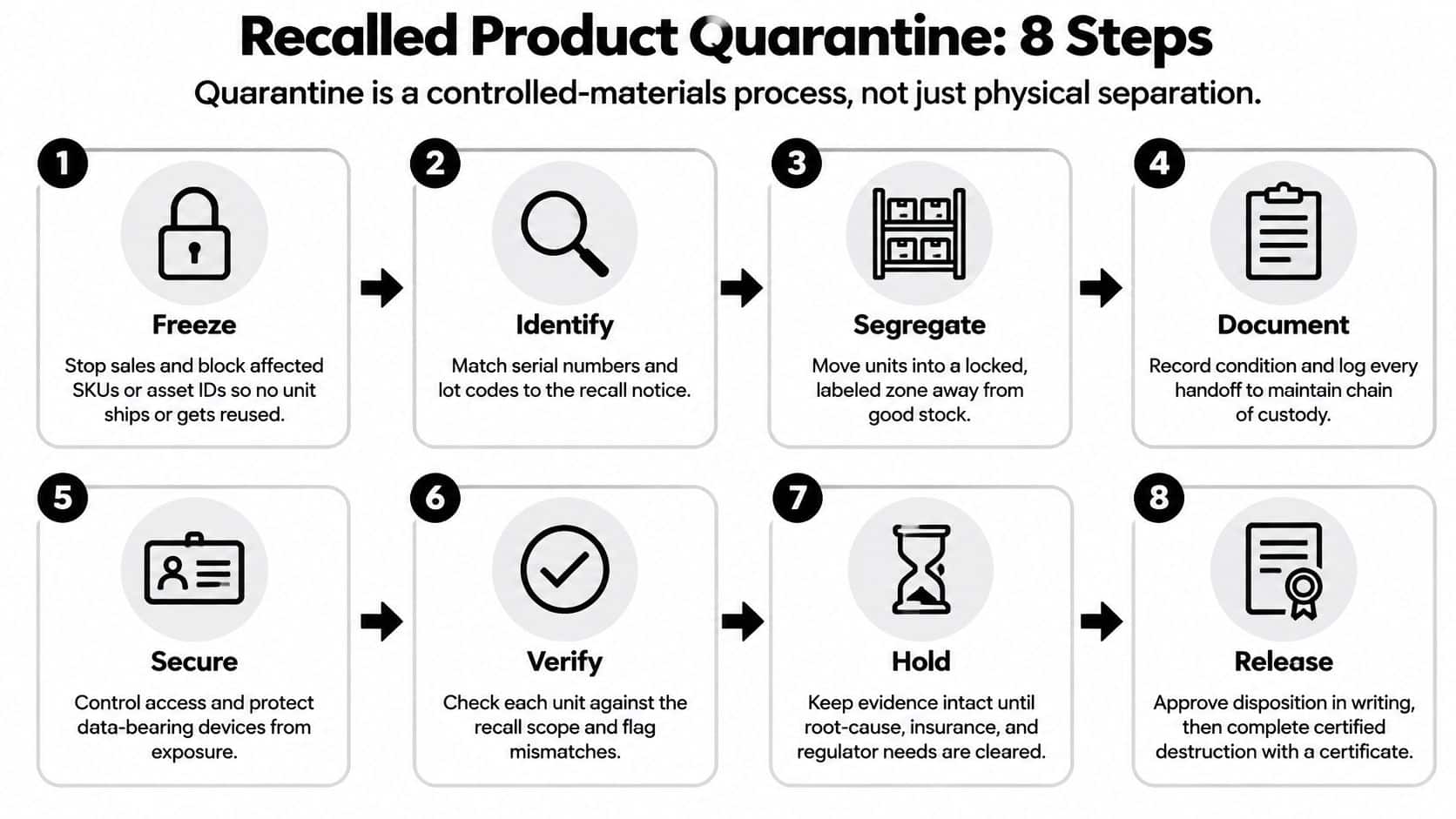
Quarantine is a controlled-materials process, not just physical separation. Write the procedure so receiving staff, technicians, procurement, and the disposal provider use compatible identifiers and understand who can authorize movement.
Establish control before technical work
Freeze sales and deployment. Block affected SKUs and asset records before arranging collection. Physical retrieval takes time, so the system restriction must work while units remain elsewhere.
Complete intake verification. Count received equipment, compare identifiers with the recall notice, and photograph condition where safe. Record unmatched or unreadable identifiers as exceptions instead of guessing.
Tag and segregate. Apply a hold identifier and place equipment in the designated quarantine location. The tag should reference the recall and asset record without exposing unnecessary confidential information.
Secure storage and movement tracking. Restrict access and record the custodian, time, origin, and destination for each movement. A signed collection manifest doesn't replace records of subsequent internal transfers.
The CPSC Recall Handbook recommends permanent quarantine locations, separation or clear marking, shelf-removal verification, coordinated inventory systems, and redirection of in-transit units into quarantine on arrival. Build these controls into receiving instructions, not just the recall manager's checklist.
Authorize work and prove completion
Triage within the permitted scope. Compare model, serial, lot, and other applicable identifiers with the notice. Perform testing only when authorized and safe, recording the basis for affected or unaffected classification.
Approve disposition. Obtain the asset owner's authorization and legal, manufacturer, or regulator approval where required. Resolve evidence holds before issuing a destructive work order.
Execute the approved action. Repair, return, sanitize, or destroy according to that order. If technicians discover a mismatch or unexpected media, stop the affected work and obtain revised instructions.
Reconcile and close. Match completed actions to the intake register and issue the relevant certificates. Keep missing assets, unresolved holds, and disputed identifiers visible rather than closing them administratively.
Coordinate collection and returns through a defined product recall reverse-logistics process. Specify who prepares equipment, who approves packaging, and who resolves discrepancies at receipt.
A completed quarantine file gives every serial number an accountable outcome and supporting evidence. Destruction certificates belong to destroyed assets, while repaired, returned, or preserved assets need records appropriate to those outcomes.
The final disposition register should name what happened to each unit. “Processed” isn't an adequate outcome.
Risks That Break a Quarantine and How to Prevent Them
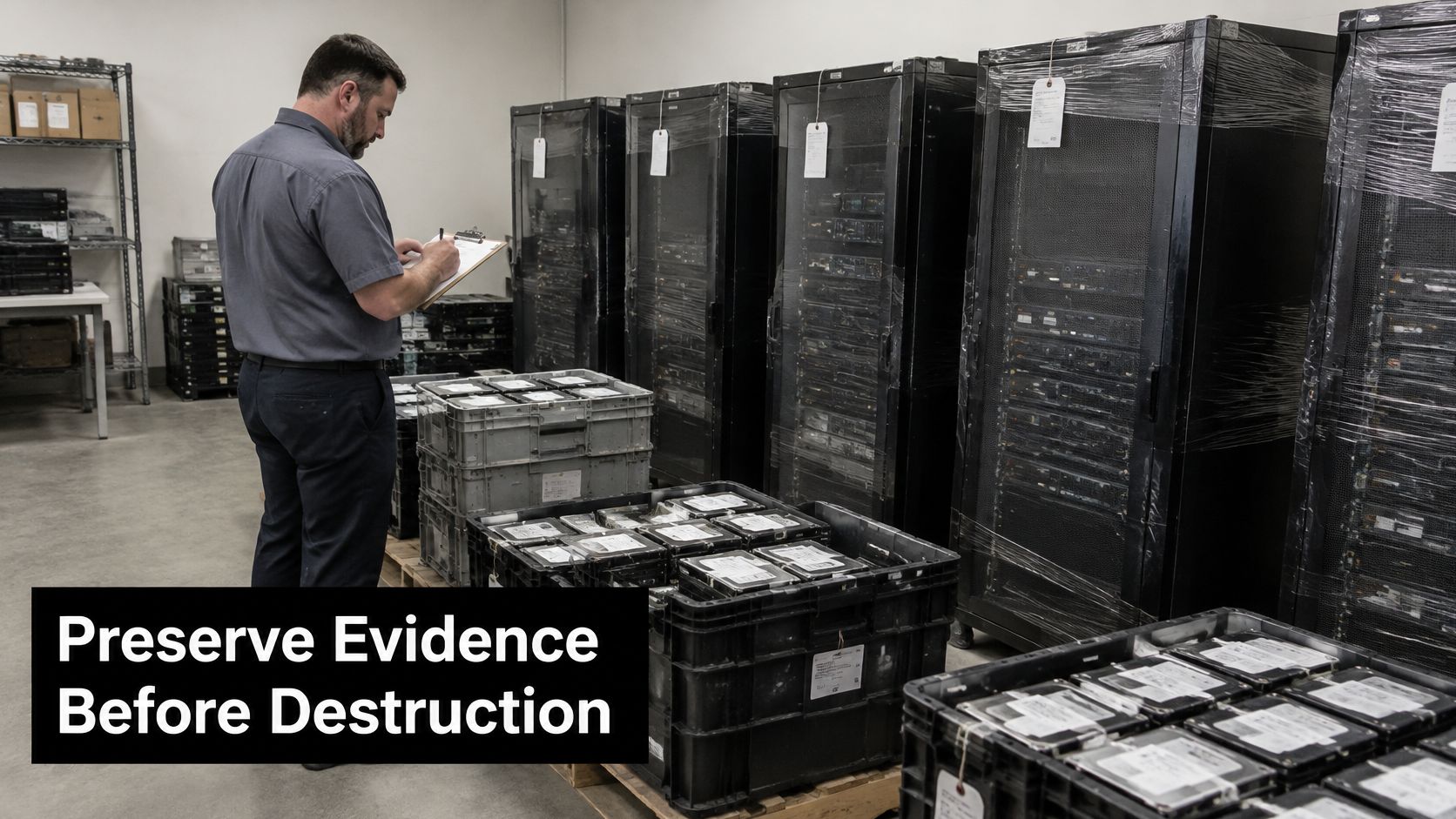
Faster destruction isn't always better. Premature destruction can remove evidence needed for root-cause analysis, insurance review, regulator inquiries, or supplier disputes.
For applicable regulated products, FDA destruction guidance expects a proposed method, agency contact before destruction where applicable, adequate documentation, and acceptance that destruction may be witnessed. An operational deadline doesn't replace those approvals.
Preserve evidence separately from destruction inventory
Use separate authorized paths. Preserve designated representative units and sealed evidence under the hold instructions, while routing confirmed inventory to destruction only after the required approvals.
Don't let a sanitization requirement accidentally override preservation. Devices containing evidence may need secure storage and restricted access rather than immediate wiping.
- Missing or unmatched assets: Reconcile procurement, leasing, and asset-management records. Assign outreach ownership so remote equipment doesn't disappear between departments.
- Data remaining on returns: Require documented sanitization before approved release to an ordinary recovery channel. For evidence-preservation or authorized repair transfers, specify alternative custody and information-security controls.
- Conflicting inventory statuses: Verify that blocks apply across connected purchasing, deployment, warehouse, and resale workflows. A hold in an isolated spreadsheet doesn't prevent another team from issuing equipment.
- Cross-border movement: Confirm destination requirements, transport arrangements, and permitted disposition before shipment. Don't assume a domestic disposal approval covers another jurisdiction.
Test reconciliation before you need it
For a tabletop exercise, use the opening laptop scenario and deliberately place some assets on remote employee desks. Ask the team to find the custodians using existing records without relying on an all-staff email.
The useful result is a documented list of matched assets, unresolved locations, and assigned follow-up. Don't turn an exercise into an unsupported promise about how quickly an actual recall will finish.
Require audit-trail reporting that preserves failed scans, count discrepancies, rejected transfers, and authorization changes. Those records explain exceptions rather than concealing them behind a final total.
Recovering Recalled Units Held Outside the Warehouse
A recalled device may be assigned to a contractor, sitting with a reseller, or still in an employee's home. Track each unit by serial number and custodian, then assign one recovery owner to coordinate outreach, logistics, and status updates.
Who owns outreach?
Name an IT asset manager and a procurement contact. The asset manager maintains the serial-linked list and records each notice, response, promised return date, and follow-up. Use a consistent notice cadence, such as an initial request followed by reminders, and retain delivery evidence.
How do you locate distributed equipment?
Match recall identifiers against purchasing, endpoint-management, and asset records. Ask site contacts and custodians to confirm the device's physical location and whether it is in use. For hosted equipment, coordinate access with the service provider before scheduling retrieval.
What about contractors, resellers, and customers?
Contact the organization holding the unit and agree on a return method: a prepaid, trackable shipment or a scheduled pickup. Provide packaging and handling instructions, identify the approved destination, and require a receipt tied to the serial number. Confirm the unit's authorized disposition in writing.
What happens when nobody responds?
Keep the unit open on the recovery list. Send a final notice to the custodian and their contract owner, then escalate through procurement and the applicable recall process. Record the next action and responsible manager. If the unit remains unreturned, document the attempts and treat it as an unresolved exception, not a completed recovery.
Notifications show outreach. Confirmed returns, approved repairs, documented destruction, and formally reviewed exceptions show asset outcomes.
Include unresolved units in the closure package. Warehouse processing can be complete while recovery obligations remain open. Keep the FY2025 performance report separate from enterprise fleet recovery measures.
Provider Checklist and Sample Chain-of-Custody Terms
The FTC contractor-diligence benchmark includes independent audit review, references, recognized trade-association certification, and examination of information-security procedures. Use that benchmark to request evidence, not just assurances.
A provider might have strong recycling capabilities but limited recall reconciliation capacity. Conversely, a logistics provider might move sealed equipment competently without being qualified to sanitize the installed media.
Ask questions that expose operational limits
- Certification scope: Which recognized certifications cover the actual facility, processes, and subcontractors involved?
- Serial-level evidence: Can the provider connect intake, transfers, disposition, and certificates to individual asset identities?
- Media methods: Which techniques and verification procedures apply to each storage technology?
- Witness access: Can the client or auditor observe destruction under an agreed procedure?
- Insurance coverage: What activities and incidents does coverage address, and what exclusions apply?
- Transport controls: Are shipments sealed, tracked, and reconciled against signed manifests?
- Discrepancy handling: Who investigates mismatched identifiers or counts, and what work stops during investigation?
Request a sample certificate before signing. It should identify the asset serials, method, completion date, processing location, custodian or operator, authorized signatory, and associated recall or work-order identifier.
Negotiate measurable custody obligations
The following targets are contract examples, not published provider commitments or regulatory deadlines. Set thresholds according to recall volume, operating hours, evidence requirements, and regulatory exposure.
| Item | Example target to negotiate | Why it matters |
|---|---|---|
| Intake verification | Reconcile serials and counts by the agreed receiving deadline | Exposes shortfalls while shipment records remain accessible |
| Chain-of-custody log | Record each handoff with name, time, location, and signature | Establishes accountable custody |
| Secure storage | Use a locked, access-controlled, monitored quarantine area | Restricts unauthorized movement |
| Status controls | Require an approved disposition order before release | Prevents accidental reuse |
| Sanitization method | Record Clear, Purge, or Destroy and the actual technique per asset | Connects the decision to execution |
| Destruction witness | Permit client or auditor witnessing under agreed arrangements | Supports independent review |
| Certificates | Supply batch certificates with serial-level detail | Documents completed work and its scope |
| Exception reporting | Notify the client within the negotiated escalation window | Enables timely investigation |
| Audit rights | Provide agreed access to facility records and relevant independent audits | Supports continuing diligence |
| Transport | Specify insurance, seals, GPS tracking, and signed manifests | Establishes transit controls |
A certificate documents an action; it doesn't automatically transfer every legal responsibility. Have counsel review liability allocation, subcontracting, record retention, and access to evidence.
Use a vendor due-diligence checklist to compare proposals against the same evidence requirements. Reject vague commitments such as “industry-standard processing” when the contract could identify the method, authorization, and deliverable.
Confirm Your Quarantine Plan Before the Next Recall
Return to the hypothetical Friday recall. A prepared team has a designated holding area, a serial-level register, an approved decision process, and a closure package connected to the recall identifier. Staff don't need to improvise who can release equipment or authorize destruction.
Take these actions this week:
- Map custody: Follow the equipment from its current custodian through collection, receiving, technical work, and final disposition.
- Confirm sanitization policy: Identify the appropriate outcome for each device class, including exceptions for evidence preservation.
- Evaluate providers: Request sample records, method descriptions, and contractual controls before an emergency collection.
For businesses evaluating an Atlanta, Georgia electronics recycling and IT asset disposition option, Beyond Surplus operates from its Smyrna facility and serves organizations across the contiguous United States. Its commercial offerings include nationwide pickup using its own fleet and transportation partners, on- or off-site hard drive shredding, certified data wiping, and certificates of recycling and data destruction.
Its services also include IT buyback, product destruction, and data center de-installation. For recalled equipment, specify which assets require preservation, which have approved destruction orders, and which may qualify for IT asset recovery before scheduling collection.
Discuss the proposed custody path and required documentation with the provider's team. Secure e-waste management should follow the recall decision, not substitute for it.
Beyond Surplus offers business electronics pickup, data destruction, product destruction, and documented IT asset disposal to support approved recall dispositions. Visit Beyond Surplus to discuss your affected inventory, custody requirements, and collection plan. Contact Beyond Surplus for certified electronics recycling and secure IT asset disposal.


