

CPSC staff implemented 313 voluntary recalls covering 97 million product units in fiscal year 2023, yet the agency's formal recall-response measure reached just 24%, according to its FY 2023 annual report. A recall announcement isn't proof that affected equipment has left circulation.
For a business managing recalled laptops, servers, medical equipment, or connected devices, recalled product pickup and destruction is a custody problem before it's a disposal job. Your certificate is only as strong as the inventory holds, counts, and documented handoffs behind it. Build that evidence before the truck arrives.
Table of Contents
- Which Disposition Path Fits Each Recalled Item
- How to Quarantine Recalled Stock on Intake
- How to Book Pickup and Plan the Timeline
- Keeping Chain of Custody Intact in Transit
- Destruction Methods Compared for IT and Electronics
- Documents and Certificates Auditors Expect
- Book Your Pickup and Certified Destruction Plan
Which Disposition Path Fits Each Recalled Item
An independent analysis of CPSC activity estimated that only 6% to 10% of recalled products are returned or discarded, as discussed in this statement on recall recovery. That isn't a universal recovery rate for every category, but it makes the operational point: someone must organize the recovery.
The recall remedy defines your available options. Your compliance and operations teams must select an authorized route and specify its evidence.
Disposition paths for recalled electronics and IT equipment
| Disposition path | Best when | Check before choosing | Evidence to keep |
|---|---|---|---|
| Return to manufacturer | Recall terms offer credit or vendor pickup | Serial and lot list matches the vendor's written instructions | Vendor receipt listing serials and quantities |
| Correction or repair in place | Remedy is a firmware, part, or battery fix | Fix is validated and no residual hazard remains | Correction log per asset with date and technician |
| Certified recycling | No resale value remains and the authorized remedy permits material recovery | Batteries and data-bearing components are classified first | Recycling certificate with quantities and processor name |
| Witnessed destruction | Regulator or contract requires a witness, or stock warrants additional oversight | Regulator is notified before disposal where required | Witness signatures, photographs, and method record |
| Onsite or offsite destruction | Units cannot be safely reused or appropriately sanitized | Method matches the media and hazard | Destruction certificate with method, date, and quantity |

Run the SKU-level checks
Before approving a route, review:
- Hazard type: Identify lithium batteries, high-voltage parts, and hazardous materials.
- Stored information: Locate drives, embedded memory, and configuration data.
- Resale exposure: Decide which components must never return to service.
- Written instructions: Check regulator directions, recall terms, and contractual restrictions.
Use the universal waste regulations overview to inform classification questions, not as blanket authorization for disposal. Recycled doesn't automatically mean rendered unusable. The route must address the actual hazard and the recall remedy.
Working rule: If you can't name the evidence you'll retain, you haven't finished choosing the disposition path.
How to Quarantine Recalled Stock on Intake
Start with a written intake procedure that warehouse staff, IT, procurement, and compliance can follow without interpretation. Give a named recall lead authority to resolve discrepancies and block unauthorized release.
CPSC's recall handbook requires segregation throughout the distribution chain and monitoring of third-party contractors. Moving stock outside your building doesn't end your responsibility.
Make the hold physical and digital
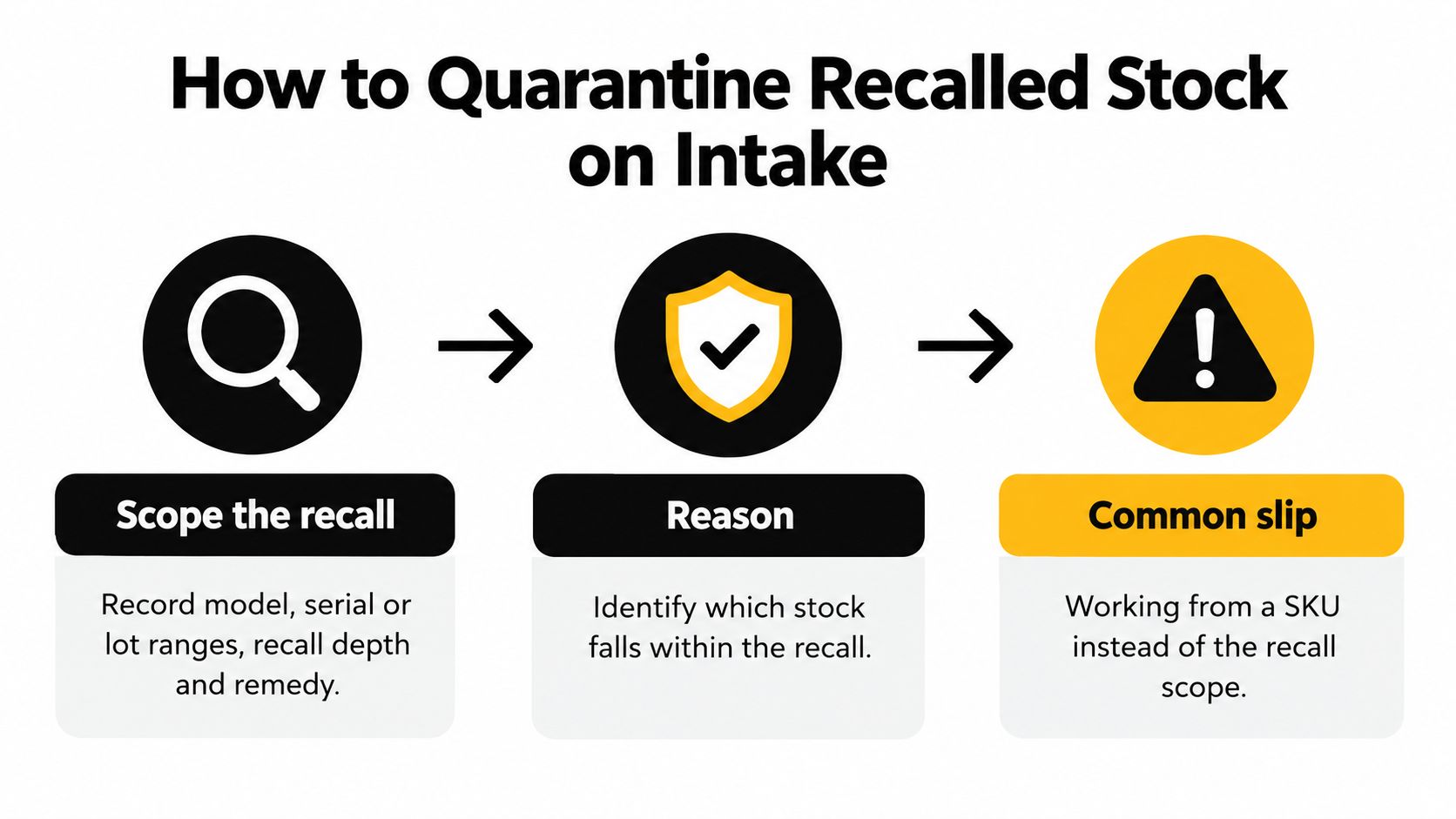
Scope the recall. Record manufacturer, model, serial or lot ranges, recall depth, and remedy so staff can identify affected equipment accurately. Don't rely on a SKU list that misses spare equipment, refurbished units, or returns already in transit.
Identify units at the dock. Assign an intake identifier and scan each applicable serial number before the equipment moves onward. Counting pallets instead of units leaves you unable to explain which assets arrived.
Use a dedicated quarantine area. Move recalled stock into a physically separate, access-controlled cage or room marked Recalled, Do Not Resell. A temporary pallet on the saleable floor defeats the hold, even when someone attaches a warning sheet.
Block inventory transactions. Set system holds against picking, transfer, sale, and unauthorized redeployment. A locked cage won't protect you if another site can still allocate the stock through the inventory system.
Reconcile against distribution records. Compare serials, lot codes, quantities, and locations with the affected population, then open an exception for every gap. Don't hide missing units inside an adjusted total.
Check recipient follow-through. Ask consignees to confirm receipt of instructions and the status of affected equipment, then escalate nonresponders by a fixed internal date. A delivered email doesn't establish that a branch has quarantined its devices.
Require independent release approval. Have two authorized people confirm identity, quantity, and disposition before releasing stock for destruction. Don't let an urgent dock appointment substitute for approval.
Keep ordinary inventory work separate
In a medical or laboratory business, routine stock management and recall quarantine need different release permissions. Staff responsible for replenishment shouldn't be able to override a safety hold just because another department needs equipment.
For adjacent inventory planning, Omega Lasers provides a resource on how to reduce expired serums and stock shortages. Keep that routine stock-control workflow separate from recall disposition approval.
Give contractors written instructions identifying the recalled goods, forbidding commingling and salvage routing, and specifying container markings. Require confirmation that their receiving and processing teams will preserve those restrictions. Segregation must survive every transfer, not just the first move into your quarantine room.
How to Book Pickup and Plan the Timeline
Build the manifest before requesting a firm collection slot. The following is an illustrative planning schedule, not a provider commitment or a regulatory deadline. Hazard review and written processor acceptance take priority over calendar targets.
Recall pickup and destruction timeline
| Phase | Typical window | Owner | Output |
|---|---|---|---|
| Scope and hazard review | Before booking approval | Recall lead and compliance | Recall scope memo |
| Manifest build | Day 1 to 3 | Operations and IT asset team | Serialized manifest |
| Pickup booked | Day 2 to 5, after manifest approval | Facilities or procurement | Confirmed pickup window |
| Quarantine and sealing | Day 3 to 7 | Warehouse lead | Sealed, labeled containers with custody IDs |
| Pickup and handoff | Pickup day | Driver and site lead | Signed chain-of-custody form |
| Arrival reconciliation | Same day as arrival | Receiving team | Exception log with counts |
| Destruction and certificate | Proposed target of 5 to 14 days after arrival | Processor and witness if required | Certificate of destruction |
Prepare the booking packet
Your manifest should identify manufacturer, model, serial or lot number, quantity, consignee, hazard classification, packaging requirements, and planned disposition. Assign a shipment custody identifier that links the load to that record.
An illustrative entry could read: Model X laptops; quantity and serials in attached schedule; consignee identified in site register; lithium-battery hazard flagged; approved disposition recorded separately. Don't approve a generic description such as “mixed computers.”
Provide the scheduler with:
- Site details: Collection address, dock hours, and a named onsite contact.
- Load details: Pallet and container counts, estimated weight, and packaging status.
- Hazard flags: Damaged or recalled batteries and other classified material.
- Access requirements: Badges, escorts, liftgate needs, and loading restrictions.
- Transport qualifications: Confirmation of applicable hazardous-material training and handling arrangements.
Use the business electronics pickup guide to prepare commercial collection requirements. Nationwide organizational pickup still requires site-specific acceptance, packaging, and transport planning.
For expedited requests, disclose the hazard and regulator deadline immediately. Ask for the earliest realistic slot in writing, including dependencies and the expected certificate schedule.
Finish counts before the truck arrives. An incomplete manifest can force the site lead to reconstruct the pickup paperwork while the driver waits, precisely when staff are least equipped to investigate discrepancies.
Keeping Chain of Custody Intact in Transit
Assign a custody identifier to each shipment, link it to the approved manifest, and print it on every container. The receiving team should be able to trace a sealed container without opening unrelated files or guessing which branch shipped it.
Preserve the unit-level or batch-level fields established during booking. If packaging changes, update the container association without losing the original asset references.
Control the loading-dock handoff
At pickup, photograph or scan sealed containers and record seal identifiers where used. Capture the driver's name, site representative, collection time, container count, and signatures.
Record shortages, broken seals, substitutions, or damaged packaging immediately. Don't sign a clean receipt with a plan to explain the difference later.
For complex facilities, TLC Moving & Storage's resource on managing chain-of-custody during lab relocations offers adjacent planning context. A laboratory relocation and a recall both require clear responsibility for sensitive equipment, but recall restrictions must remain explicit in the transport instructions.
Match transport to classification
Non-household generators must determine whether recalled material is hazardous waste and follow applicable storage, treatment, transport, and disposal requirements. EPA's recalled-material guidance also makes clear that state requirements can exceed federal minimums.
Have the environmental lead approve classification before loading. For damaged or recalled lithium batteries, require the carrier to confirm the applicable DOT packaging, handling, and transport requirements rather than assuming ordinary electronics packaging is acceptable.
Keep hazardous and nonhazardous streams separately identified and contained. Don't approve a mixed trailer arrangement without a documented compliance review covering the actual materials and transport conditions.
Close the receiving handoff
At arrival, the processor should weigh and count the shipment, compare it with the manifest, and isolate it from acceptable inventory. Missing, excess, damaged, or unidentified units need an exception investigation before processing authorization.
Specify who receives discrepancy notices and who can approve resolution. A receiving team must not correct your quantities to match whatever arrived without notifying you.
The IT asset disposal chain-of-custody guide provides a framework for connecting these records. Test both critical handoffs, your dock to the carrier and the carrier to the processor, against the same approved manifest.
A signed pickup receipt proves a handoff. It does not prove destruction.
Destruction Methods Compared for IT and Electronics
Match the method to the storage medium and the hazard, not the cheapest quote. A crushed enclosure doesn't establish that its embedded storage is unreadable, and a wiped drive doesn't establish that a recalled product is safe.
The CPSC recall listings and remedies reinforce the need to follow the applicable remedy rather than automatically destroy every asset. Keep the product-safety decision separate from the data-sanitization decision.
Destruction methods for recalled electronics and IT equipment
| Method | Best for | Protects data on storage media | Evidence it supports |
|---|---|---|---|
| Onsite hard drive shredding | Sensitive drives that must not leave the site | Yes, when the process and particle size suit the media and policy | Certificate with drive count and serial numbers |
| Offsite shredding at processor facility | High-volume loads and approved mixed-media streams | Yes, when matched to the media, with witnessing if required | Certificate plus transport and custody records |
| Degaussing | Compatible magnetic hard drives | Not for SSDs or flash memory | Method record identifying compatible media and equipment |
| Crushing or shearing whole units | Non-data hardware after battery removal | Not reliable as a standalone storage-media treatment | Certificate with weight, quantity, and method |
| Component dismantling and recycling | Equipment with recoverable materials | Only with separate storage-media removal and sanitization | Recycling certificate with material quantities |
Separate sanitization from product destruction
The NIST SP 800-88 framework distinguishes clear, purge, and destroy. Clear addresses data through logical techniques; purge uses techniques intended to make recovery infeasible even with more advanced capabilities; destroy renders the media unusable.
Don't treat those labels as automatic authorization to release a recalled device. Clear may fit a permitted internal reuse scenario under an approved data policy. Purge may support an authorized transfer when the technique suits the media and the organization verifies the result. Destroy fits media that must become unusable or cannot be adequately sanitized.
Degaussing applies to magnetic media, not SSDs or flash storage. For solid-state devices, require a validated sanitization process or suitable physical destruction. Use the SSD destruction methods comparison when specifying the processor's media-specific work instructions.
Specify a safe processing sequence
For mixed equipment loads, define the dismantling sequence before machinery starts:
- Identify and isolate hazards: Qualified personnel must address battery condition and safe access before dismantling.
- Remove and account for storage: Record drives and embedded media, then route them to the approved sanitization or destruction process.
- Separate batteries: Keep them out of ordinary crushing and shredding streams.
- Process remaining hardware: Crush, shear, dismantle, or recycle only as the authorized remedy permits.
Don't require staff to remove drives first if doing so would disturb an unsafe battery. Safety review controls the sequence.
Choose onsite shredding when sensitive drives must remain at the premises until destruction. Offsite processing can accommodate larger collections, provided the approved custody and witness arrangements remain intact.
Require the method-specific evidence shown in the table. A processor's service name isn't a substitute for a documented result.
Documents and Certificates Auditors Expect
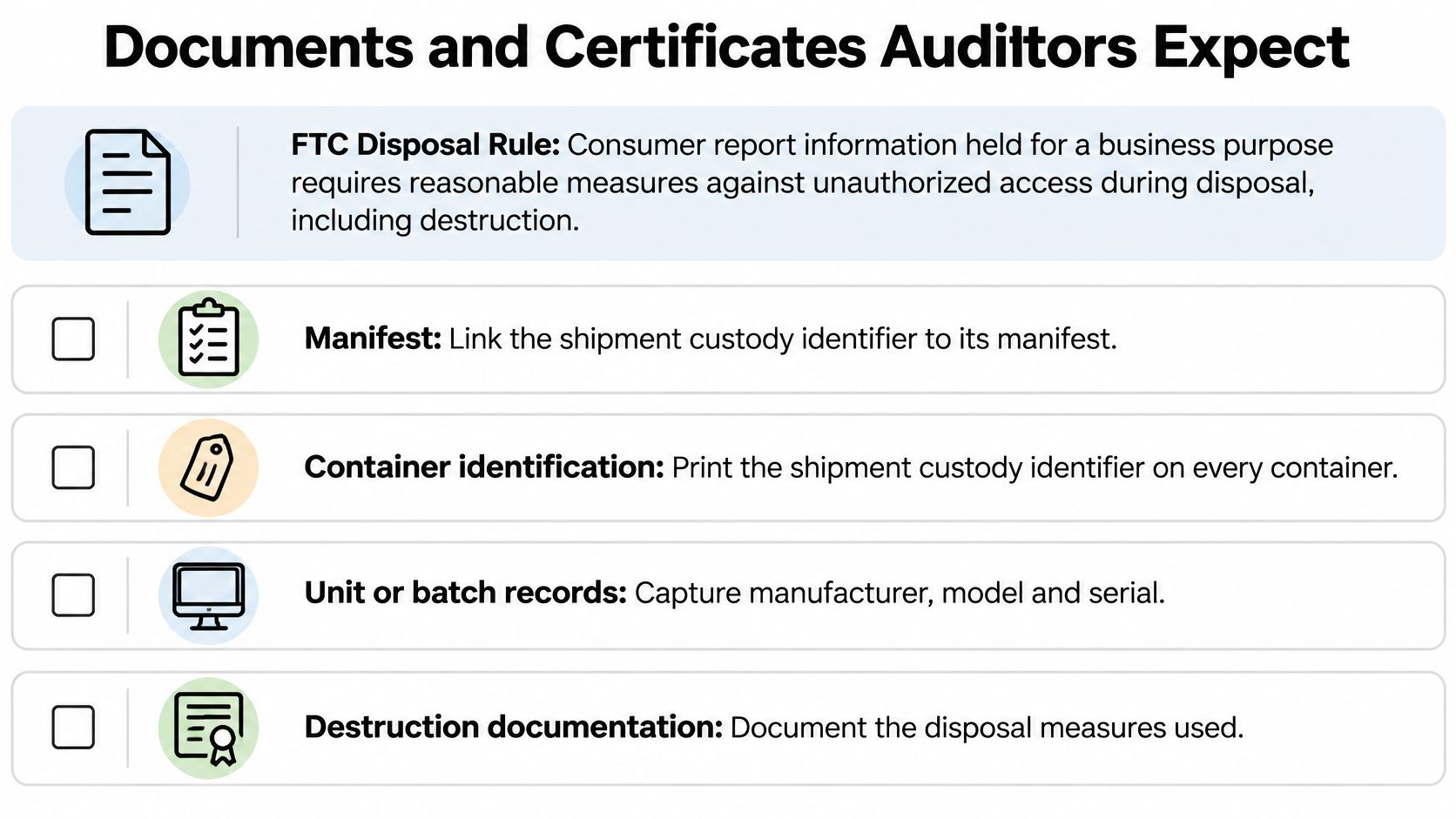
The FTC Disposal Rule covers consumer report information held for a business purpose and requires reasonable measures against unauthorized access or use during disposal. Its examples include destroying or erasing electronic media so information cannot practicably be read or reconstructed, as explained in the FTC's disposal guidance.
That obligation is narrower than a claim that every business file falls under this particular rule. Identify the information involved and the applicable requirements before approving the disposal specification.
Was the contractor properly evaluated?
The FTC lists contractor due-diligence examples including reviewing an independent audit, checking references, requiring recognized trade-association certification, and evaluating information-security policies or procedures. Retain evidence of the checks you perform.
Ask what the contractor's certification covers. A company-level credential doesn't, by itself, identify the method used on your shipment or establish that every recalled asset reached final disposition.
Can you connect the recall to the final result?
FDA guidance on device recalls, corrections, and removals addresses effectiveness checks and disposition documentation. Where applicable, notify the agency before destruction and allow for review or witnessing rather than arranging disposal first.
Use this checklist to test the final record:
- Recall reference: Connect the certificate to the approved recall scope.
- Destruction date and location: Identify when and where processing occurred.
- Product identification: Include manufacturer, model, quantity, and serial or lot references.
- Source locations: Show which branches, warehouses, or facilities supplied the equipment.
- Custody identifiers: Link the certificate to shipments and supporting manifests.
- Processing method: Describe the actual destruction or sanitization performed.
- Witness details: Include names and signatures where witnessing was required.
- Exceptions and resolutions: Explain missing units, rejected items, and approved changes.
- Processor identification: Name the processing company, authorized signatory, and applicable certification details.
Do the supporting records reconcile?
An illustrative certificate entry could read: Model X; quantities and serials listed in the attached schedule; shredded onsite on the recorded date; witnessed by the named authorized staff. Replace every descriptive field with the actual job information.
Keep the certificate with transport records, receiving reconciliation, release approvals, relevant photographs, and exception resolutions. Use a retention schedule approved for your regulatory and contractual obligations rather than inventing a universal retention period.
Compare your current paperwork against the destruction certificate format guide. Check whether someone outside your team could reconstruct the asset movements without asking for an oral explanation.
Audit test: Select a recalled serial number and trace it from the source location to its documented final disposition.
A generic certificate without quantities or a destruction method is inadequate for this control standard. Don't accept it as recall closeout evidence merely because it carries a signature.
Book Your Pickup and Certified Destruction Plan
For enterprise IT equipment disposal, choose a provider whose scope covers collection, custody documentation, media treatment, and final records. You can return equipment through the manufacturer's authorized program or engage a commercial IT asset disposition provider, depending on the remedy.
Beyond Surplus offers business pickup throughout the contiguous United States using its own fleet and transportation partners. Its services include onsite and offsite hard drive shredding, certified data wiping, product destruction, and certificates of recycling and data destruction.
Put the required deliverables in the quote
Ask for a proposal that identifies accepted equipment, packaging responsibilities, transport arrangements, processing methods, and certificate contents. For data center de-installations or multi-site collections, require a location-specific schedule and a consolidated reconciliation plan.
Treat IT buyback as conditional, not automatic. Value recovery belongs in the proposal only where the recall remedy permits reuse or resale and the equipment meets the approved release criteria.
Have your recall scope, manifest, battery information, access restrictions, and witness requirements ready before requesting a pickup window. Ask the provider to confirm unresolved acceptance conditions before dispatch.
Use the services overview and contact form on the company website to request a quote. Make the commercial objective explicit: remove affected equipment while preserving enough evidence to support a defensible recall closeout.
For commercial recalled-product pickup, documented custody, and media-specific destruction, visit Beyond Surplus and submit your recall scope and manifest through the contact form to request a quote and pickup window. Contact Beyond Surplus for certified electronics recycling and secure IT asset disposal.


