
Recalled inventory destruction services provide controlled, documented disposition of defective or noncompliant stock, not routine waste hauling, and the Consumer Product Safety Commission recommends written approval or coordination before disposal. An affidavit or equivalent signed certification is preferred for completion, and compliance records should be retained for at least five years.
That distinction matters the first time you're staring at quarantined pallets and someone says, "just get rid of it." A waste vendor can move material. A recall destruction provider has to prove that specific units were controlled from your floor to final destruction, with no commingling, no salvage, and no route back into commerce.
If you're a plant manager, IT manager, or procurement lead, think of it as two jobs running in parallel. One job is physical: segregate, transport, and destroy. The other job is evidentiary: reconcile every lot, label every pallet, and produce a record an auditor, insurer, or regulator can follow without asking you to reconstruct it from emails.
Table of Contents
- What Recalled Inventory Destruction Services Actually Do
- Why Recalled Stock Must Be Destroyed Under Control
- Destruction Methods and the Chain-of-Custody Records Behind Them
- On-Site Versus Off-Site Destruction Compared
- Compliance Checklist, Cost Drivers, and Scheduling
- How to Choose a Certified Destruction Provider
- The Decisions That Matter Most and Your Next Step
What Recalled Inventory Destruction Services Actually Do
Recall work in the United States isn't rare or informal. The U.S. Government Accountability Office reported that the Consumer Product Safety Commission obtained voluntary recalls for 563 unsafe or potentially unsafe products in fiscal year 2008, the agency's highest annual total during the preceding decade, in its GAO review of CPSC recall activity. That scale is why destruction isn't treated as an afterthought.
Most of those recalls were voluntary and negotiated with responsible companies. In practice, that means destruction is often a formally agreed remedy. Your company commits to a corrective action, and then you need to show you carried it out.
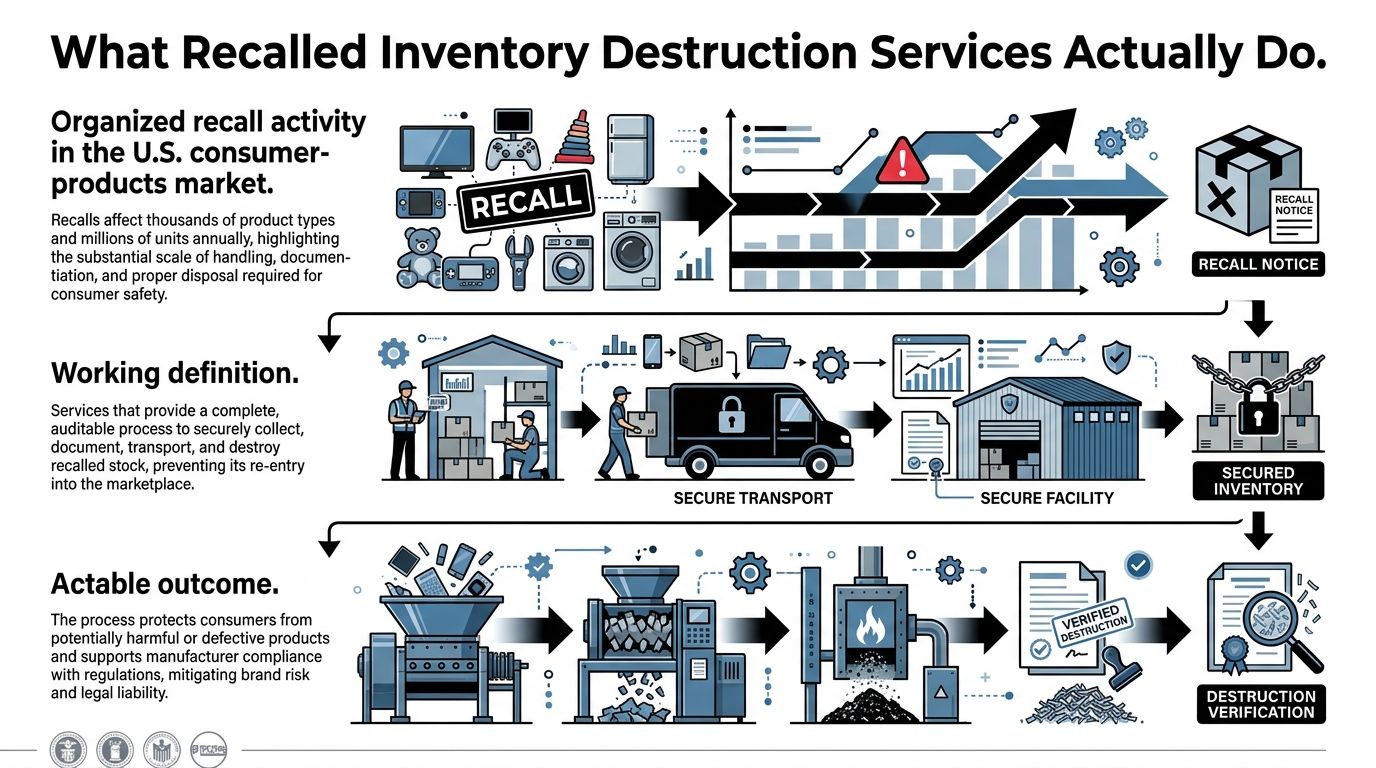
Working definition: Recalled inventory destruction services securely collect, reconcile, transport, and irreversibly destroy defective, unsafe, or noncompliant stock, then document completion so the units cannot be resold, reused, or returned to circulation.
Where Destruction Happens in the Supply Chain
Destruction doesn't only happen after products reach a warehouse shelf. GAO explained that recalled products may be destroyed as part of a company's corrective-action plan or at a U.S. port of entry. For you, that changes the logistics question. You might be controlling imported units that never entered distribution, retailer returns, or stock still sitting in your own facility, and each location needs the same level of control.
A recall notice by itself doesn't remove anything. It announces a problem. Physical control removes the problem.
The Four Capabilities That Define the Service
When you evaluate any provider, look for these functions before you discuss price:
- Reliable logistics: Scheduled pickup, sealed transport, and clear handoffs between your site, carriers, and the destruction facility.
- Inventory reconciliation: Counts tied to SKU, lot, or serial range so received quantities match what your recall plan says should exist.
- Chain-of-custody records: A continuous record of who handled the material, when, and in what condition.
- Completion evidence: Proof that the prescribed corrective action happened, not just that a truck left your dock.
Here's a simple example. You quarantine recalled laptops in a caged area. The provider scans serial numbers at pickup, seals the pallets, records the trailer seal at arrival, destroys the drives and chassis, and issues a certificate listing the serial range destroyed. If three serials are missing, that's flagged as an exception before the job closes. That exception step is what separates a destruction service from hauling.
Why Recalled Stock Must Be Destroyed Under Control
Three separate pressures make controlled destruction necessary. They overlap, but they don't substitute for each other.
The Regulatory Reason
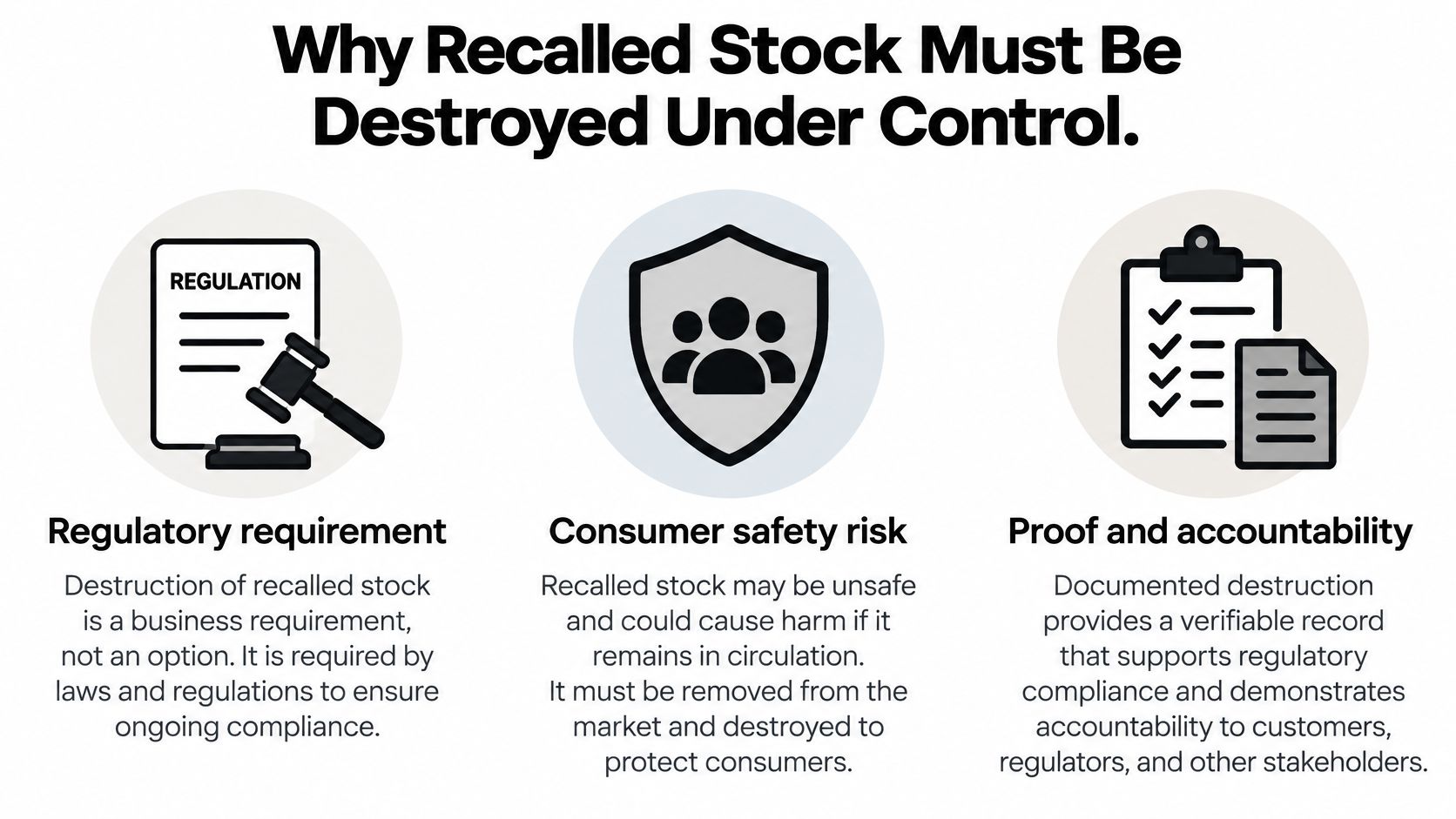
For consumer products, the CPSC recommends obtaining written approval or coordination before disposal because investigators may witness destruction or require another verification method, as set out in the CPSC Recall Handbook guidance on disposal and verification. Inventory must stay physically quarantined and segregated from acceptable or unrelated returned products during transport and processing.
Regulated products add a similar control. FDA recall procedures expect returned product to be promptly inventoried and stored separately from acceptable material, with disposition records showing whether units were destroyed, reworked, or otherwise brought into compliance. If you mix recalled units with good returns, you've lost the ability to prove which units you destroyed.
Why a Notice Alone Doesn't Work
Effectiveness data show the gap between announcing a recall and controlling the goods. A 2014 analysis citing CPSC progress reports found that only 10% of recalled children's products in 2012 were successfully corrected or destroyed, according to the 2014 CPSC recall effectiveness snapshot.pdf). Manufacturers held less than 1% of the recalled products but corrected or destroyed 94% of their inventory.
Consumers held nearly 82% and corrected or destroyed only 4.6%. Distributors held approximately 3% and reached 53%, while retailers held 4% and reached 52%. The pattern is clear for operations teams: once units leave your direct control, recovery gets harder to verify.
Destroying one shipment proves that shipment is gone. It doesn't prove the recall is complete.
The Security and Environmental Reasons
If recalled electronics contain consumer-report information, the Federal Trade Commission's Disposal Rule applies to any business that uses consumer reports for a business purpose and requires practices reasonable and appropriate to prevent unauthorized access, including destroying or erasing electronic files so information cannot be read or reconstructed, under the FTC guidance on disposing of consumer report information.
Environmentally, the EPA identifies R2 and e-Stewards as accredited certification standards whose requirements include safe downstream management and destruction of data on used electronics, as described in the EPA overview of electronics management standards. For recalled IT assets, you need both layers: recall disposition evidence and documented downstream handling of materials and data-bearing components.
Destruction Methods and the Chain-of-Custody Records Behind Them
Choose the method before you choose the schedule. The right method depends on whether the goal is reuse, sanitization, or irreversible removal from commerce, and recalled goods usually fall in the last category.
Clear, Purge, and Destroy Are Not Interchangeable
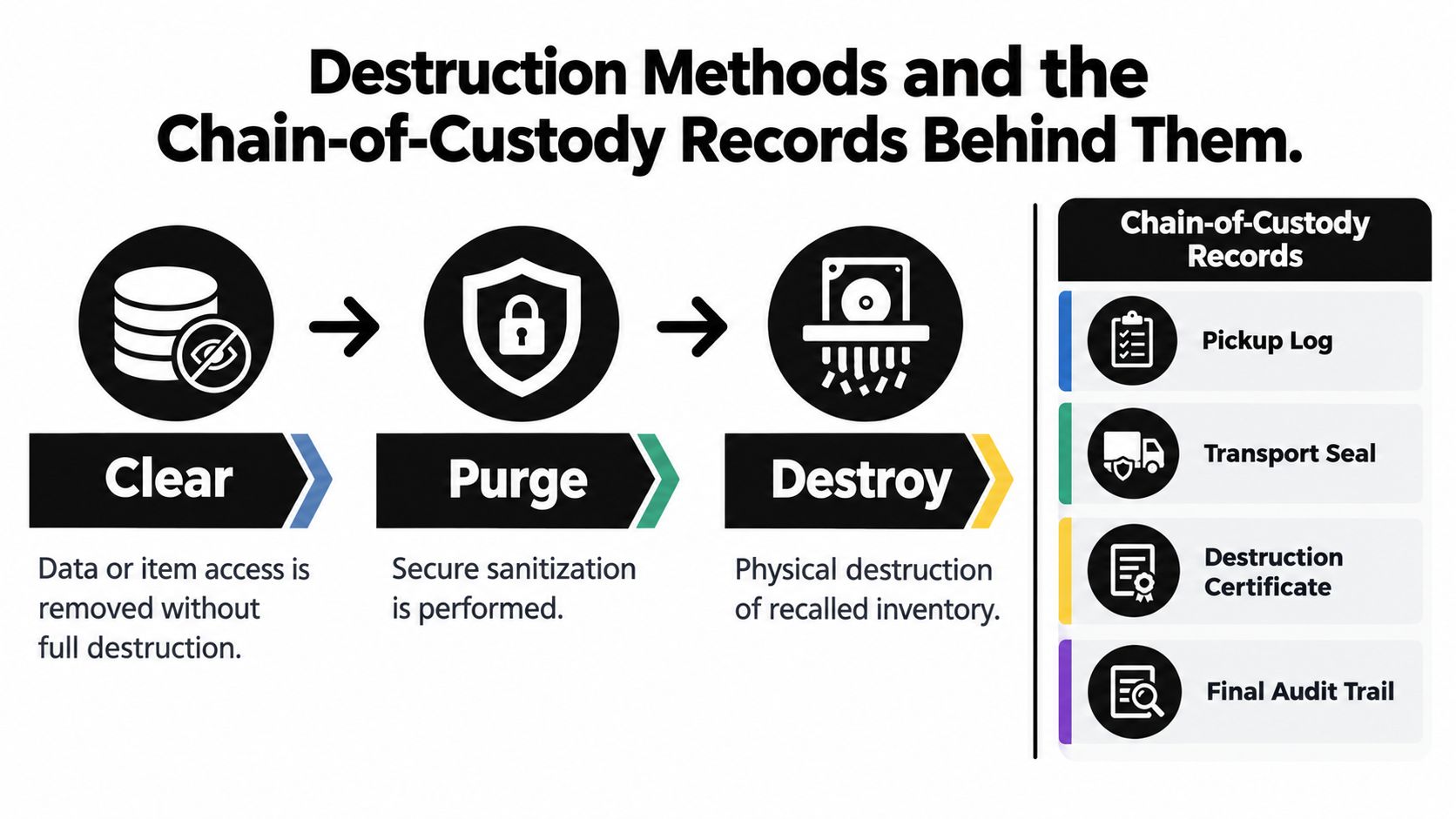
NIST separates three outcomes for media sanitization in its NIST SP 800-88 Rev. 1 media sanitization guidance. Clear uses logical techniques, such as standard read and write commands or a factory reset, to protect against simple non-invasive recovery. Purge uses physical or logical techniques intended to make recovery infeasible with state-of-the-art laboratory techniques while potentially preserving media for reuse.
Destroy makes recovery infeasible with state-of-the-art laboratory techniques and leaves the media unable to store data. That's the key distinction people miss. A recalled laptop slated for product destruction shouldn't be treated like a laptop being wiped for redeployment. A factory reset doesn't satisfy an irreversible disposition requirement.
Physical Methods for Recalled Goods
For physical products, providers typically shred, crush, or otherwise irreversibly destroy items so they cannot be reassembled, resold, or salvaged. The FTC describes proper disposal as a flexible, risk-based obligation rather than one mandated technology, and for electronic records it lists destruction or erasure that prevents reading or reconstruction, in its FTC announcement on the FACTA Disposal Rule. You select reasonable measures based on sensitivity, cost and benefit, and available technology.
In plain terms: document why you chose shredding over wiping, or destruction over degaussing, and make sure the choice matches your recall instructions.
The Record That Must Travel With the Material
A defensible completion record states product identification, quantity destroyed, destruction date, and method. Operationally, you want those fields linked across the whole job:
- Recall identity: SKU, lot, or serial range from the recall notice.
- Movement identity: Shipment ID, seal numbers, pickup log, and receiving count.
- Destruction identity: Batch ID, method, date, and witness or photographic evidence when required.
- Closing identity: Final certificate or signed affidavit tied back to the first three items.
That linkage closes the gap between "something was shredded" and "these exact recalled units were shredded." For a practical reference on how those handoffs are structured, review the guide to chain-of-custody documentation for controlled asset disposition before you write your provider specification.
On-Site Versus Off-Site Destruction Compared
Both models can work. The wrong choice usually shows up as either weak evidence or unnecessary logistics cost, so compare them on the same criteria.
On-Site Destruction
On-site destruction happens at your facility, often with a mobile shredding unit. You or a regulator can witness it directly. That witnessability is valuable when the recall plan requires observed disposition, when units contain sensitive data, or when leadership wants visual confirmation before material leaves the site.
The trade-off is practical. You need dock or yard space, staff to stage and count inventory, and time for the crew to work through volume on your premises. For a small, high-risk lot, that control is often worth it.
Off-Site Destruction
Off-site destruction moves quarantined inventory to a provider facility. It scales better for large volumes and mixed materials, and it keeps heavy processing off your floor. The control burden shifts to paperwork. For off-site work, written instructions should identify the recalled products, prohibit commingling or salvage, and require clear labeling of every box or pallet.
If you choose this route, your receiving count at the facility must match your pickup count, and any variance needs an exception report before destruction starts.
On-Site vs Off-Site Recalled Inventory Destruction
| Criterion | On-Site Destruction | Off-Site Destruction |
|---|---|---|
| Control | You see units destroyed at your site | Control depends on seals, labels, and receiving reconciliation |
| Evidence quality | Direct witness, photos, same-day certificate | Certificate plus transport and facility records |
| Logistics complexity | Provider mobilizes to you, staging is yours | You prepare shipments, provider handles processing at scale |
| Cost drivers | Mobilization and on-site processing time | Transport, facility processing, documentation depth |
| Typical fit | Smaller high-risk lots, witnessed disposition | Larger volumes, multi-site consolidation |
Many enterprise recalls use a hybrid. You quarantine at each site, a provider collects under chain of custody, and destruction occurs at a certified facility with witnessed or photographed batches. If you're weighing that pattern for IT assets specifically, the comparison of on-site versus off-site ITAD service models uses similar decision criteria.
Healthcare, food, and regulated manufacturing teams often default to witnessed on-site work for the first lot, then move to documented off-site processing once the workflow is proven. That sequence reduces risk without paying mobilization costs for every later shipment.
Compliance Checklist, Cost Drivers, and Scheduling
A recall project runs smoothly when the checklist is settled before the truck is booked. Work through controls in the order they occur.
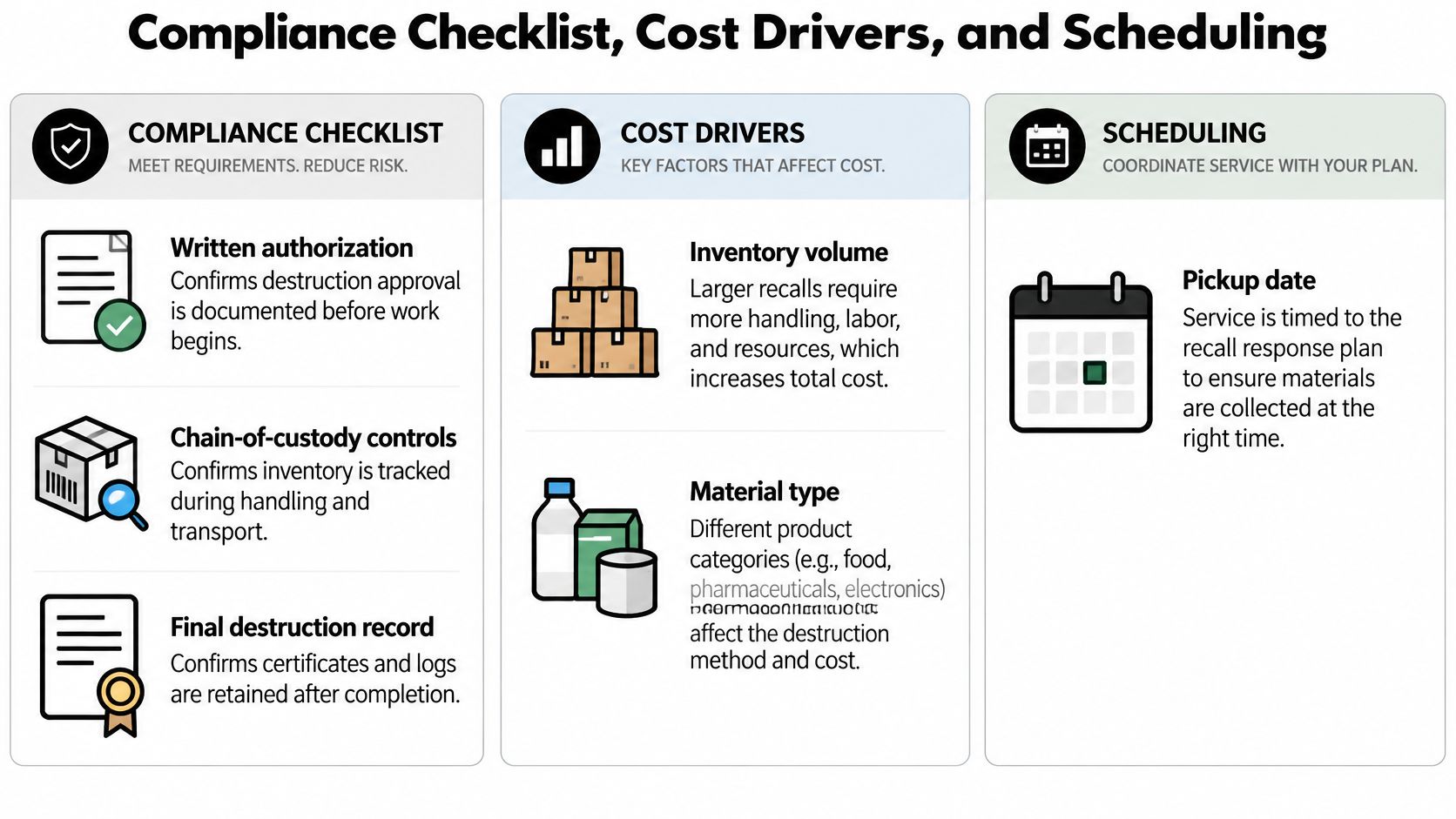
Before, During, and After Destruction
- Written authorization: Confirm approval or coordination with the relevant regulator, and notify the FDA recall contact before destruction where that applies, because the agency may witness the activity or review the process.
- Physical quarantine: Segregate recalled units from acceptable returns and unrelated inventory, with restricted access.
- Written instructions: State the product identity, forbid commingling or salvage, and require labeling on every box or pallet.
- Count reconciliation: Capture SKU, lot, or serial data at release, pickup, and receiving.
- Final record: Retain the certificate, affidavit, photos, and exception reports for at least five years for CPSC-regulated work.
- Medical device records: For devices under 21 CFR Part 806, retain related records for two years beyond the device's expected life, as outlined in the FDA recalls, corrections, and removals framework for devices.
That same FDA framework defines a removal as physically taking a device from its point of use to another location for repair, modification, adjustment, relabeling, destruction, or inspection. Don't blur those categories in your warehouse. A device held for inspection must not sit in the destruction cage.
A Sample Workflow You Can Copy
- Capture the recall scope: List affected SKUs, lots, and locations.
- Assign a shipment ID: Tie each pallet label to that ID.
- Record the receiving count: Provider confirms quantity and condition.
- Assign a destruction batch: Link the batch to method and date.
- Attach evidence: Add witness notes or photos where required.
- Issue the certificate: Reconcile destroyed quantity against the original scope and flag exceptions.
Document how you'll file and retrieve these records using your compliance documentation process for asset disposition, so an auditor can find them years later without relying on one person's inbox.
What Moves Cost and Lead Time
No responsible provider can quote accurately from "some pallets of recalled product." Quotes move with unit count and volume, on-site versus off-site processing, witness requirements, presence of data-bearing media, transport distance, and documentation depth. Serialized reconciliation costs more than pallet-level counts because it takes more handling time, but it also gives you stronger proof.
Scheduling follows the same logic. Regulator coordination, witness availability, and facility capacity all affect dates. Build lead time for approval rather than booking destruction first and asking for permission afterward.
How to Choose a Certified Destruction Provider
Price tells you what processing costs. It doesn't tell you whether the evidence will hold up when legal, quality, or a regulator reviews the file six months later. Judge providers on documentation and certification first.
Due Diligence Questions to Ask
The FTC specifically identifies four due-diligence measures when you hire a destruction contractor. Ask for each one directly:
- Independent audit: Can the provider share a recent audit of its destruction operation?
- References: Can you speak with business clients with similar recall or IT asset work?
- Recognized certification: Does the provider hold certification relevant to data destruction or electronics processing?
- Information-security policies: How does the provider control access, train staff, and handle data-bearing media in transit and at the facility?
Then add recall-specific questions. Can the provider reconcile at lot or serial level? Will it issue exception reports when counts don't match? Can it support witnessed destruction, photographic evidence, and a signed certificate that lists product identity, quantity, date, and method?
Practical rule: If a provider cannot show you a sample certificate and a sample chain-of-custody log before the job, don't assume the real documents will be better.
Matching Capability to a Real Provider
For business and enterprise work, Beyond Surplus provides product destruction alongside electronics recycling and IT asset disposal, including on-site or off-site hard drive shredding and certified data wiping where wiping is the correct disposition. It issues certificates of recycling and data destruction intended to transfer liability and support compliance with requirements such as the FTC Disposal Rule, and it maintains transparent chain-of-custody documentation through pickup and processing.
Its services also include data center de-installations and logistics coordination using its own fleet and transportation partners, with business pickups available anywhere in the contiguous United States. For a recall involving recalled computers, servers, medical electronics, or lab equipment, that combination matters because you need physical product destruction, data sanitization at the correct NIST level, and downstream material handling under one documented workflow.
Use a provider's certification claims as a starting point for verification, not as a substitute for it. Review what its NAID AAA certification covers for secure data destruction, then ask how that certification applies to your specific recalled media, your witness requirements, and your retention period.
Also confirm scope boundaries in writing. State which units are for destruction, which are held for inspection or repair, and which materials can enter recycling after destruction. That single page prevents the most common provider misunderstanding: treating all returned inventory the same.
The Decisions That Matter Most and Your Next Step
Four decisions determine whether your project holds up. Is the inventory quarantined from acceptable stock? Does the destruction method match the disposition requirement, especially where data-bearing media needs destroy rather than clear or purge? Do the records connect your warehouse counts to the final certificate? Can your provider produce regulator-ready evidence without rebuilding it after the fact?
Keep the bigger accounting in view. FDA guidance expects recall plans to include effectiveness checks and appropriate product disposition, and the agency has identified uncertainty over affected lot numbers and incomplete removal from shelves and storage as recurring compliance problems, in its FDA statement on strengthening recall compliance and effectiveness. Destruction can close a physical task while the recall stays open if units remain with retailers, customers, third-party logistics providers, or international affiliates.
That is the question to keep asking throughout the project. What evidence proves every affected unit was controlled, not merely that one shipment was destroyed? Lot-level reconciliation, exception reporting, and certificates tied to specific inventory give you an answer you can defend.
Before you sign a provider agreement, run your final checks against a structured vendor due diligence checklist for destruction providers, confirm your quarantine and labeling are ready, and schedule a consultation to scope volume, witness needs, and data-bearing media. Review the workflow again when products, sites, or regulations change, so your documentation stays defensible over time.
Contact Beyond Surplus for certified electronics recycling and secure IT asset disposal, including documented product destruction for recalled inventory with chain-of-custody records and certificates of destruction. Schedule a business pickup or consultation to scope your recall, confirm the correct destruction method, and set evidence requirements before material moves by visiting Beyond Surplus.


