Your server refresh is finished, but the retired hardware is still sitting beside the loading dock. There are laptops with missing chargers, servers with unfamiliar drive configurations, and a storage shelf nobody wants to sign off on. For electronics recycling in Alpharetta, GA, the business ITAD and data destruction decision starts there, before anyone schedules a truck.
The right question isn't who can collect it fastest. It's who can account for the equipment, select an appropriate sanitization method, and give your team evidence that matches what happened.
Table of Contents
- Why Alpharetta IT Directors Are Rethinking End-of-Life Hardware
- Preparing Your Asset Inventory Before Pickup
- Choosing the Right Sanitization Method by Media Type
- On-Site Shredding Versus Off-Site Certified Wiping
- Chain of Custody, Certificates, and FTC Disposal Rule Compliance
- Scheduling Pickup, Drop-Off, and Value Recovery in Metro Atlanta
- Pre-Engagement Checklist and Next Steps
Why Alpharetta IT Directors Are Rethinking End-of-Life Hardware
A lease return, office consolidation, or data center decommissioning project creates pressure to clear space. Procurement wants the project closed. Facilities wants the staging area back. Your security team wants assurance that retired storage won't leave with recoverable information.
Treat those as separate requirements. Moving equipment satisfies facilities. Recovering resale value satisfies procurement. Neither proves that your organization handled the data appropriately.

Start With the Disposition Decision
My recommendation is to approve the disposition plan before approving collection. Establish who owns the inventory, who authorizes the sanitization method, and who resolves exceptions. Don't leave those decisions to whoever happens to meet the driver.
Use these questions to define the engagement:
- Data outcome: Must the storage remain reusable, or does policy require destruction?
- Media exceptions: Which devices are encrypted, damaged, unsupported, or missing identification?
- Evidence ownership: Who will reconcile the final report and approve unresolved discrepancies?
- Commercial outcome: Which assets should be evaluated for IT asset recovery rather than processed immediately as scrap?
The scale of electronic waste reinforces the need for disciplined processing. The world generated 62 million metric tonnes in 2022, an 82% increase from 2010, while only 22.3% was formally collected and recycled, according to the Global E-waste Monitor.
Those figures don't establish whether a particular contractor handles your equipment securely. Your contract, operating controls, and asset-level evidence must answer that.
Separate Security From Collection
The NIST framework distinguishes Clear, Purge, and Destroy. That gives your team a better starting point than ordering a generic wipe for everything.
Two issues deserve particular attention: unusual media that doesn't follow the normal processing path, and undocumented handoffs between your building and final disposition. A successful wipe doesn't explain where a missing drive went.
Practical rule: Approve an evidence-producing process, not just an electronics pickup.
Think of ITAD as a documented transfer of responsibility. Certificates support that transfer, but they don't automatically eliminate your organization's obligations.
Preparing Your Asset Inventory Before Pickup
A server leaves your Alpharetta facility with four drives installed. The certificate of destruction comes back listing three serial numbers. Without a serialized, media-level inventory taken before pickup, you cannot prove which drive is missing, or whether it ever left the building at all.
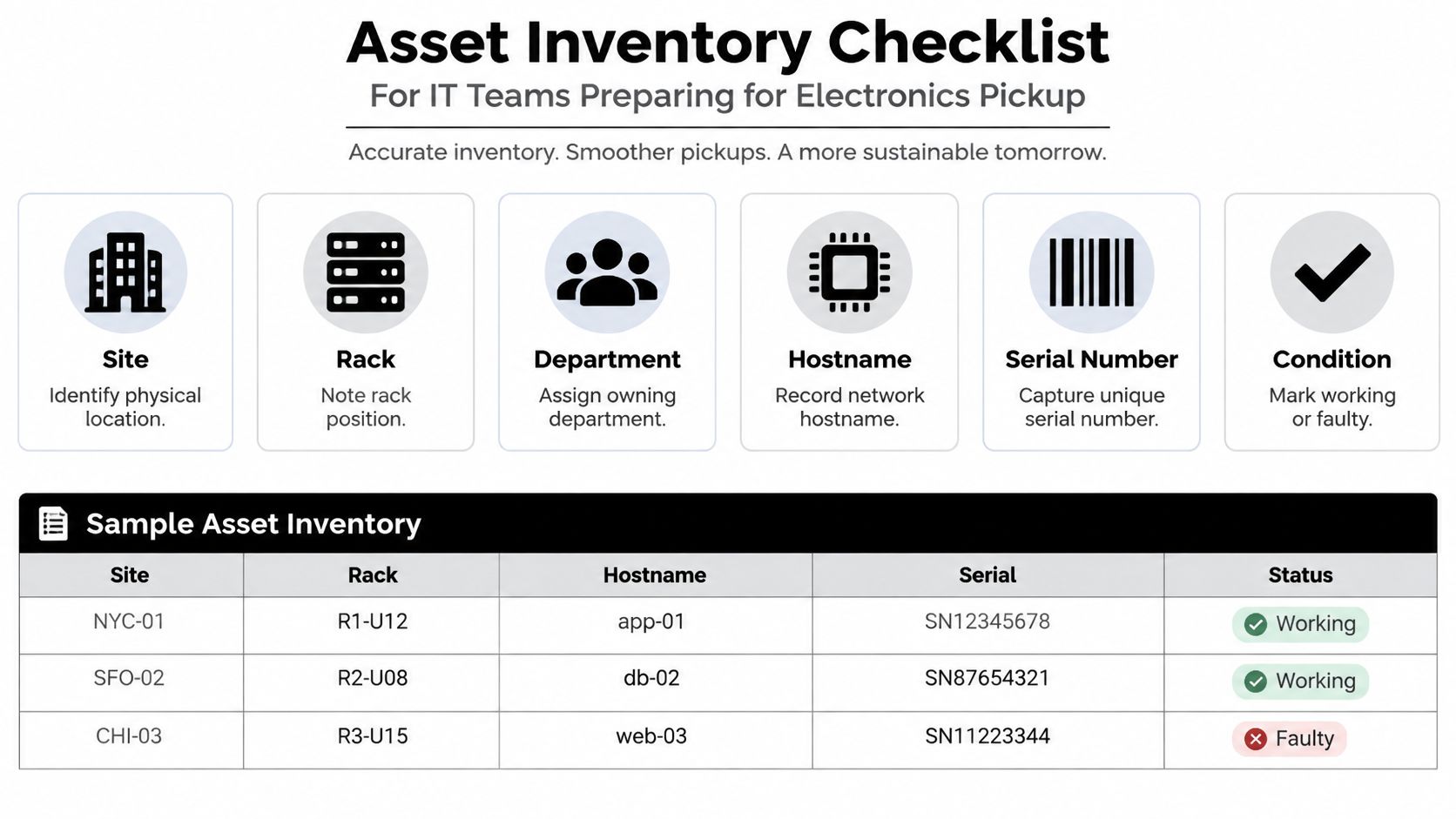
That scenario is why the export from your configuration management database, Microsoft Intune, or Active Directory is only a baseline. Records drift. A laptop gets reassigned without an updated entry, and a replacement drive never reaches the CMDB. Your register has to describe the hardware physically leaving the building, and it has to describe the storage inside that hardware, because the drive count and media type you record now determine the sanitization method each asset receives downstream.
Build a Register Your Processor Can Reconcile
Capture every asset at two levels: the chassis and the media inside it.
| Field | What to record | What it prevents |
|---|---|---|
| Location and ownership | Site, rack, department, person authorized to release | Disputes over who approved the removal |
| Equipment identity | Manufacturer, model, hostname, service tag, serial number | A chassis-level certificate that conceals missing components |
| Storage configuration | Drive count, media type, individual drive serials | A sanitized chassis with unaccounted drives |
| Operational condition | Working, failed, inaccessible, previously sanitized | The wrong sanitization path assigned at intake |
| Data classification | Sensitivity tier and internal handling requirements | Over- or under-processing against policy |
| Encryption status | Encryption state and whether key custody records exist | Unverifiable claims that data was protected |
For a SAN shelf, inventory the enclosure separately from its controllers and installed drives. For a server, link the chassis record to each media record. A certificate naming only the chassis tells you nothing about the storage it held.
An inventory optimization workflow helps at this stage: sort reusable assets, destruction candidates, and unresolved equipment into separate dispositions before the truck arrives, not at the loading dock.
Classify Risk Without Copying Sensitive Data
Flag anything tied to HIPAA, GLBA, FERPA, or PCI for review by the responsible compliance owner. Those labels guide internal handling decisions; they do not describe what the device contains. Keep patient information, employee records, passwords, and encryption keys out of the transport manifest. Record the handling category and an internal reference instead.
The accountability gap behind this discipline is well documented: the Americas generated an estimated 14.1 kilograms of e-waste per person in 2022, with roughly 4.2 kilograms formally recycled, a documented rate near 30%, in the regional figures published alongside EPA's electronics-recycling context.
Your exposure is narrower than the regional picture. Can the receiving facility match its intake log to your release inventory, serial for serial? Freeze the approved manifest before pickup, and require written authorization for any addition or removal after that point.
Choosing the Right Sanitization Method by Media Type
The method must follow the media and the data risk. Don't buy a universal overwrite package and assume it covers every device in the shipment.
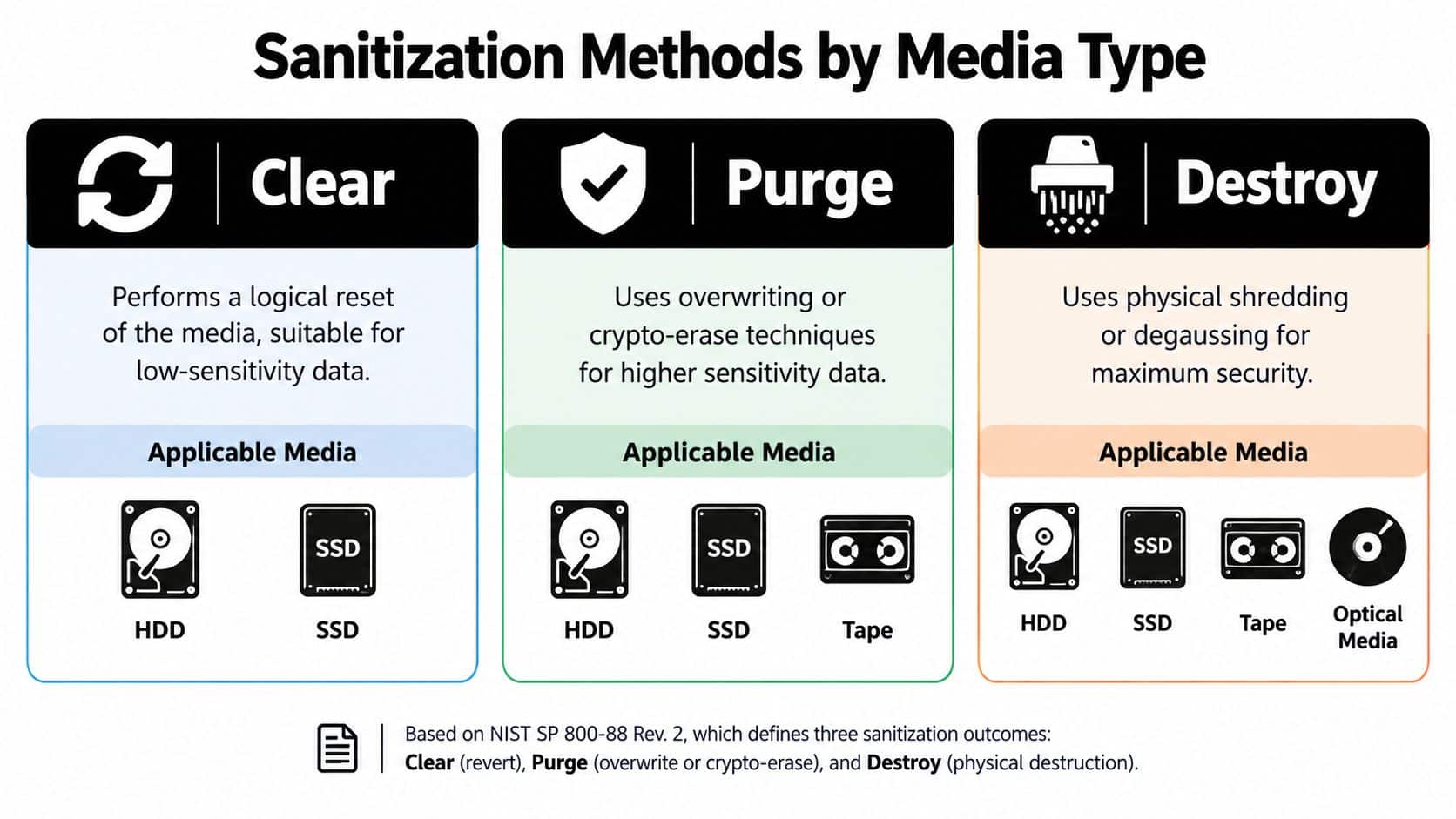
NIST SP 800-88 Revision 2 became operative on September 26, 2025, and organizes sanitization around Clear, Purge, and Destroy, rather than prescribing a universal overwrite method.
Understand the Outcomes Before Selecting Tools
Clear addresses user-accessible storage through logical techniques and protects against basic, non-invasive recovery. A factory reset may be a Clear technique for an appropriate device, but the words “factory reset” aren't sufficient evidence of an acceptable outcome.
Purge makes recovery infeasible using state-of-the-art laboratory techniques while potentially preserving reuse. Depending on the medium, appropriate techniques can include cryptographic erase, supported device-specific commands, or degaussing of magnetic media.
Destroy makes recovery infeasible and renders the media unusable for future storage. Select it when policy requires destruction or when you can't establish an acceptable sanitization result.
One technical distinction matters when interpreting simplified charts: degaussing is a magnetic-media technique, not an SSD sanitization method. Its NIST outcome is Purge when appropriately applied, even if the process also makes a particular device unusable.
Default Sanitization Method by Media Type
These are recommended procurement defaults, not a substitute for device-specific evaluation.
| Media Type | Default Method | Escalate to Destroy When |
|---|---|---|
| Working magnetic HDD | Validated purge appropriate to the drive and reuse plan | The method fails, support is inadequate, or policy prohibits reuse |
| SSD or NVMe storage | Supported device-specific purge or qualified cryptographic erase | Completion or effectiveness can't be established |
| Magnetic backup tape | Appropriate degaussing when reuse isn't required | Media compatibility or processing evidence is inadequate |
| Encrypted drive | Cryptographic erase only after assessing implementation and key handling | Encryption history or key destruction can't be substantiated |
| Failed or inaccessible media | Controlled physical destruction | Treat destruction as the planned route |
| Optical media | Controlled physical destruction | Confirm the destruction process suits the medium |
For HDDs, distinguish an ordinary overwrite from a process approved to achieve the required outcome. For SSDs and other flash devices, don't assume host-level overwriting addresses every relevant storage area.
Encryption isn't an automatic exemption. An encrypted drive with uncertain configuration belongs in the exception workflow until someone establishes whether cryptographic erase is defensible.
Select the least destructive method that meets the approved security requirement and produces evidence you can validate.
Keep unsupported and damaged media quarantined until the authorized destruction path is complete. The NIST data-destruction guide for IT managers provides a useful starting point for framing that discussion with a contractor.
On-Site Shredding Versus Off-Site Certified Wiping
Choose the service model after choosing the security outcome. On-site versus off-site describes location; shredding versus wiping describes treatment. Those aren't interchangeable decisions.
My default is witnessed on-site destruction when policy prohibits media from leaving intact. For reusable equipment, I prefer a controlled off-site sanitization workflow when the custody arrangements and reporting meet the organization's requirements.
When Witnessed Destruction Makes Sense
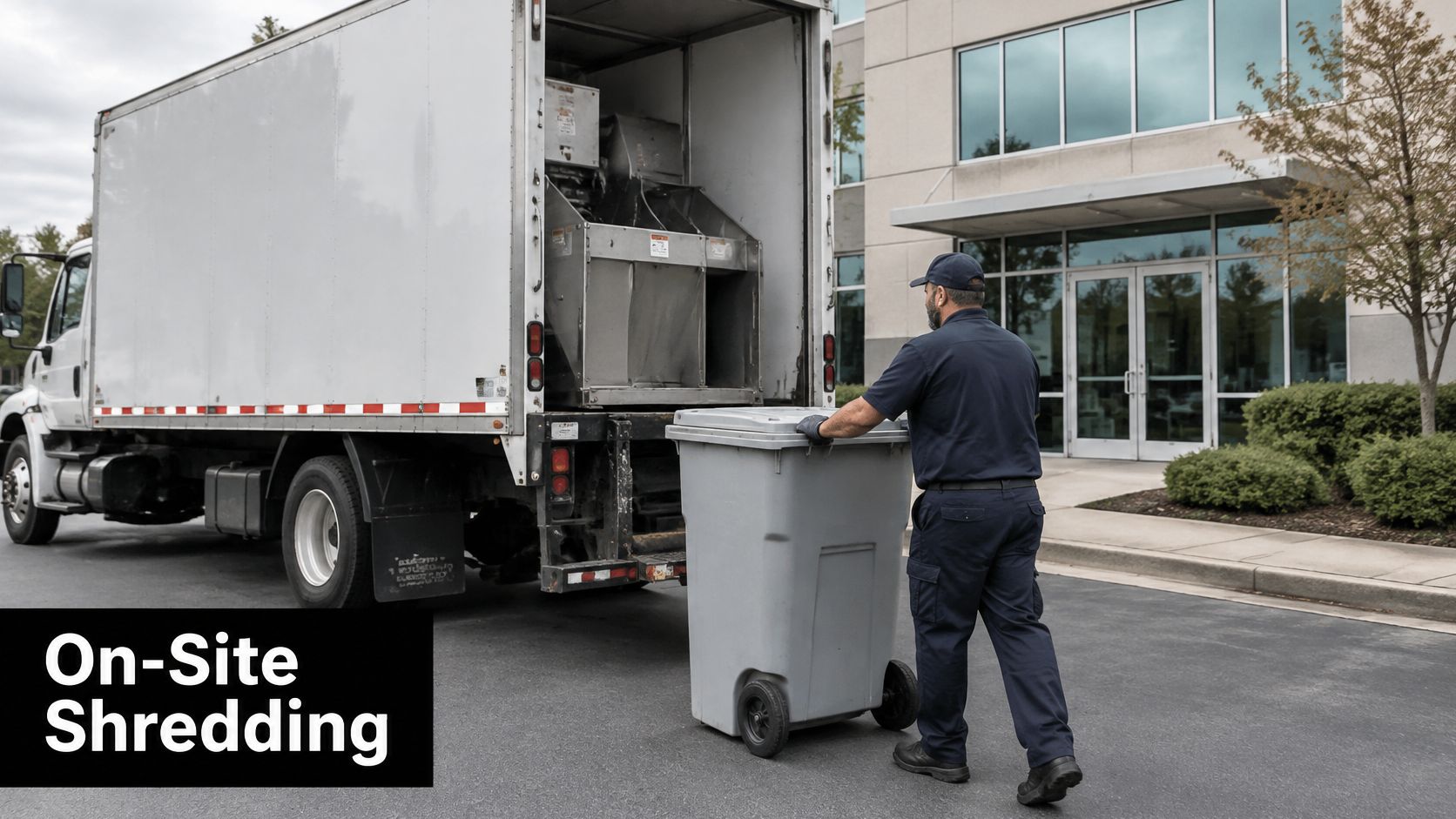
Use on-site shredding when a contract, internal classification policy, or audit requirement calls for witnessing. It also suits a limited group of high-sensitivity drives that your organization doesn't want transported intact.
Specify how the witness connects each drive to the destruction event. Watching material enter a shredder is useful, but your witness still needs a record identifying the media involved.
Also confirm the equipment can process the actual media presented. A document-shredding truck image or a general destruction service description doesn't establish suitability for SSDs, tapes, or other storage formats.
When Controlled Wiping Is the Better Choice
Off-site wiping supports reuse when working laptops, desktops, and servers can meet the approved sanitization standard. It lets the processor stage equipment, run supported procedures, investigate failures, and evaluate remarketing candidates.
Don't accept “certified wiping” as a complete technical specification. Ask which method will be used, how success will be checked, and who approves the evidence.
NIST's earlier media-sanitization guidance warns that checking only a predictable subset of storage can falsely indicate success; its verification guidance calls for randomly selected locations across the addressable space, including user-addressable and reserved areas. Require the contractor to explain how verification applies to the selected method and device.
| Decision factor | Prefer on-site destruction | Consider off-site wiping |
|---|---|---|
| Policy | Witnessed destruction required | Controlled transport and reuse permitted |
| Equipment condition | Media can't support defensible sanitization | Devices support an approved process |
| Business objective | Eliminate future storage use | Preserve remarketing potential |
| Evidence | Witness record tied to media identity | Sanitization results tied to media identity |
A hybrid approach is often sensible: sanitize eligible equipment and destroy failed media under an agreed exception procedure. If failed drives must return for on-site destruction, define their sealed storage and return custody in advance.
Review on-site and off-site ITAD service considerations against your policy, not just the collection quote. Don't assume either model is automatically faster or cheaper; request pricing for the actual work.
Chain of Custody, Certificates, and FTC Disposal Rule Compliance
Nine months after a pickup, an auditor asks you to trace one drive, serial number and all, from your Alpharetta storage room to final disposition. Your team produces a certificate. The auditor asks for the intake scan, the receiving reconciliation, and the exception log behind it. That gap is where engagements fail.
A certificate is an output of the process. It cannot repair missing intake records, unexplained substitutions, or an unresolved drive failure.
The FTC Disposal Rule requires covered businesses and individuals to take reasonable measures against unauthorized access to consumer-report information during disposal. FTC guidance also covers contractor due diligence: reviewing independent audits, checking references, evaluating relevant certification, and examining information-security policies. Complete that review before the first shipment leaves your dock.
Build the Record as a Sequence of Handoffs
A defensible custody record lets an auditor follow a device through every transfer without relying on a technician's memory. Write each handoff into the service agreement:
- Release: your authorized employee signs the manifest, and tamper-evident container numbers are logged against the approved inventory.
- Transit: the carrier, driver, and vehicle are documented, and seal integrity is confirmed on arrival.
- Receiving: barcode scans and physical intake are reconciled against the shipment, with discrepancies flagged the same day.
- Staging: unprocessed media stays physically separated from sanitized equipment and general recycling, under dual-person controls where your risk classification requires them.
- Exceptions: missing, extra, or unidentified assets go through written escalation, never silent correction.
- Disposition: every asset closes with a final status tied to its serial number.
A disciplined chain-of-custody process for IT asset disposal makes discrepancies visible. It never adjusts the inventory so the shipment balances.
Read the Certificate Like an Auditor
A certificate worth keeping identifies the asset or media serial number, the sanitization or destruction method, the processing date, the operator or traceable batch, the result, and the approving authority. Keep the verification evidence filed alongside it.
Verification and validation are different decisions. Verification confirms the operation completed as expected. Validation is your call that the evidence is adequate for the sensitivity of the information.
Contract checkpoint: no final certificate should conceal an unresolved exception.
Keep two evidence streams separate. A recycling certificate does not prove secure sanitization, and a destruction certificate says nothing about how the remaining materials were managed downstream.
In reporting, keep collection yield, reuse and value recovery, downstream material recovery, hazardous-material exceptions, and certificate completion as distinct line items. A single "recycled" status hides everything an auditor wants to see.
Acceptance stays with a named employee in your organization. The contractor supplies operational evidence. You decide whether it satisfies your policy and contractual obligations.
Scheduling Pickup, Drop-Off, and Value Recovery in Metro Atlanta
A Tuesday morning pickup at an Alpharetta office park stalls when the freight elevator is booked to another tenant and the manifest still reads "miscellaneous IT equipment." Access restrictions change the work as much as the hardware list, so send the asset register and data-classification summary through an approved channel before anyone schedules a truck. Include loading-dock hours, elevator reservations, stairs, parking limits, equipment needing de-installation, and the employee authorized to release the shipment.
Run the Service Day Against a Written Scope
Work through the Atlanta business electronics pickup process with the provider and get every responsibility confirmed in writing before the truck arrives.
| Stage | What your side confirms |
|---|---|
| Before arrival | Packaging, disconnection, rack removal, manifest approval |
| At check-in | Carrier identity and driver authorization against the booking |
| At release | Containers and equipment match approved documents before signature |
| After collection | Receipt confirmation, exception reports, final deliverable dates |
Smaller commercial loads may fit an appointment-based drop-off at the Smyrna/Atlanta site. Confirm business eligibility first, and verify how any select-item mail-in option handles media before shipping. A general drop-off or mail-in program does not cover sensitive enterprise drives by default.
Price Value Recovery as Its Own Line of Business
Working laptops, desktops, servers, and networking gear deserve an IT buyback assessment quoted separately from disposal fees. Eligibility and pricing stay quote-specific: condition, configuration, resale demand, and successful sanitization where required.
Get the valuation basis and deductions in writing. The proposal should separate gross recovery value from collection, testing, sanitization, destruction, and other service charges. Ask whether the credit offsets the invoice or arrives as a separate payment.
Medical equipment disposal and laboratory equipment disposal need contamination disclosures and component notes before the provider accepts anything. A power cord does not make a device ordinary computer recycling. The same logic covers data center de-installation, product destruction, and multi-site logistics: write each task into the scope instead of assuming the pickup includes it.
Pre-Engagement Checklist and Next Steps
Before approving the engagement, have the project owner check the following against the proposal and your internal policy.
Release Readiness
- Inventory approved: Physical assets match the serialized release register.
- Risk assigned: Data owners have identified sensitive equipment and handling restrictions.
- Methods authorized: Each media class has an approved treatment and exception route.
- Location selected: Witnessing, transport, and facility requirements are documented.
- Evidence agreed: Sample certificates and reporting fields meet your review requirements.
- Commercial terms clear: Charges, potential recovery credits, and additional-work approvals are explicit.
- Closeout assigned: A named employee will reconcile final reports with the original inventory.
Provider Red Flags
Reject proposals that offer no serial-level records, rely on generic “all data destroyed” statements, or omit an exception workflow for inaccessible media. Question certificates issued before failed devices have a documented outcome.
Don't close the project because the room is empty. Close it when your team has reconciled the assets, accepted the security evidence, resolved discrepancies, and reviewed the commercial settlement.
Beyond Surplus offers business electronics recycling, secure IT asset disposition, on-site and off-site data destruction, and IT buyback evaluation for Alpharetta and metro Atlanta operations. Visit Beyond Surplus to schedule service and request a proposal specifying media-appropriate sanitization, serialized custody records, and certificates of recycling and data destruction.