You're two weeks from handing back the keys, the freight elevator is booked, and someone just found a storage closet full of unlabeled drives nobody put on the asset list. That's the moment most business relocation IT equipment disposal in Atlanta projects stop being a logistics task and become a data risk. Desks and cabling have owners and deadlines. Retired laptops, servers, loose media, and the multifunction printer in accounting usually don't, until the mover asks what goes on the truck.
Treat the move itself as the risk event. If you can't prove, asset by asset, what left the old office, who touched it, how it was sanitized, and where it ended up, you've got an audit problem that a recycling receipt won't fix.
Table of Contents
- Why a Relocation Week Is When Data Walks Out the Door
- The Pre-Move Audit and Asset Inventory That Survives Contact with Reality
- Choosing Between On-Site Wiping, Off-Site Wiping, Cryptographic Erase, and Shredding
- Compliance and Documentation Atlanta Businesses Get Wrong
- Logistics Coordination That Keeps the Move on Schedule
- Recycling Versus Resale and Where Value Recovery Conflicts with Security
- Vetting the Atlanta ITAD Vendor Before You Sign Anything
Why a Relocation Week Is When Data Walks Out the Door
Two weeks out, the spreadsheet says 140 laptops. On the floor you've got loaners in desk drawers, a decommissioned file server still racked because nobody owned the shutdown, and a box of pulled drives from a refresh last quarter with no serial numbers written down. In a normal retirement cycle you'd catch that. During relocation week, equipment changes hands between IT, facilities, movers, temporary storage, and a recycler faster than your normal controls can track.
That's why steady state processes break. Your usual decommissioning flow assumes one team, one location, and time to verify. A move gives you compressed dock windows, mixed crews, and a lease deadline that doesn't care whether your certificates reconcile.
The Four Failure Modes That Repeat
- Unlabeled loose drives: Drives pulled early for safety end up in unmarked boxes, separated from the machines and records they belong to.
- Mixed pallets: Reusable workstations, failed media, and e-waste get shrink wrapped together because the dock is clearing by square foot, not by data class.
- Missing serial numbers: The manifest lists quantities, not identifiers, so nobody can prove which specific device was destroyed.
- Shipment level certificates: Paperwork confirms a truckload arrived somewhere. It doesn't tie a sanitization method or outcome to an individual drive.
None of this requires bad intent. It requires a deadline.
Physical possession isn't proof of data destruction. A signed pickup form tells you where equipment went, not what happened to the data on it.
The legal exposure is real even for smaller firms. The Federal Trade Commission's Disposal Rule, effective June 1, 2005 under the Fair and Accurate Credit Transactions Act, applies to large and small organizations that maintain consumer report information and requires reasonable measures to prevent unauthorized access during disposal. Selling, donating, or transferring equipment can count as disposal. During a move, you're doing all three, often on the same day.
The Pre-Move Audit and Asset Inventory That Survives Contact with Reality
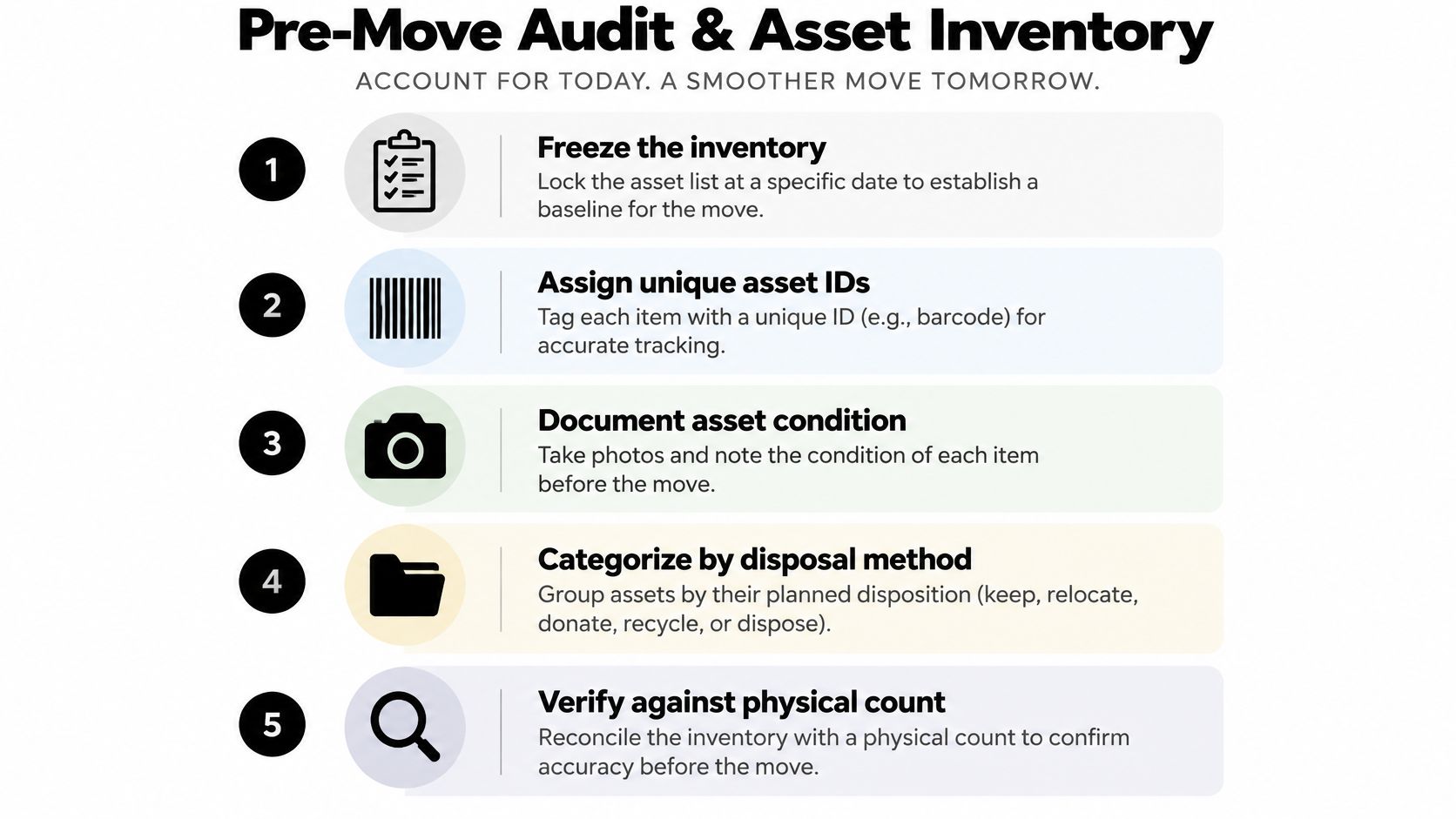
Freeze the inventory before anything gets packed. Pick a date, announce that assets discovered after it go through an exception process, and assign one owner for the list. Without a freeze, your count changes daily and reconciliation at the new site becomes guesswork.
What to Capture for Every Asset
Assign a unique asset identifier to every server, workstation, drive, tape, mobile device, and networking component. For each one, record:
- Serial number and asset ID: The pair you'll later match to certificates and manifests.
- Owner and location: Who had it, and where it was found, including closets and lab benches.
- Data classification: What sensitivity level drives the sanitization decision.
- Disposition decision: Relocate, redeploy, resell, donate, recycle, or destroy.
- Chain of custody transfer: Who handed it to whom, and when.
Plan for late arrivals instead of pretending they won't happen. Loaner laptops come back during move week. Employees return phones on their last day in the old office. Build an exception bin with its own tagging process so late items get identifiers rather than getting tossed on the nearest pallet.
Don't forget the quiet data holders. Printers and multifunction devices often contain internal drives with scanned documents and cached credentials. Backup appliances, SAN shelves, and decommissioned switches with stored configurations count too. If it stores data or credentials, it belongs on the register.
This discipline aligns with how NIST frames the work. NIST describes media sanitization as rendering access to target data infeasible for a specified level of effort, handled as an organization wide program where methods follow data sensitivity, not habit. You can't make that risk based decision without knowing what you have.
Reconcile three times, pre move inventory against loading manifest, manifest against receiving inventory, and both against final certificates before resale or destruction proceeds. Teams working through inventory optimization before a relocation usually find the gaps while there's still time to close them.
Choosing Between On-Site Wiping, Off-Site Wiping, Cryptographic Erase, and Shredding
Wipe versus shred is the wrong framing. The decision matches a sanitization outcome to the asset, the data class, and your timeline.
NIST SP 800-88 defines three outcomes, clear, purge, and destroy. Clear uses logical techniques against ordinary recovery attempts and leaves the device reusable. Purge aims to make recovery infeasible even with laboratory techniques while preserving the media. Destroy hits that same threshold and leaves the media unusable.
Sanitization Methods Matched to Asset and Data Class
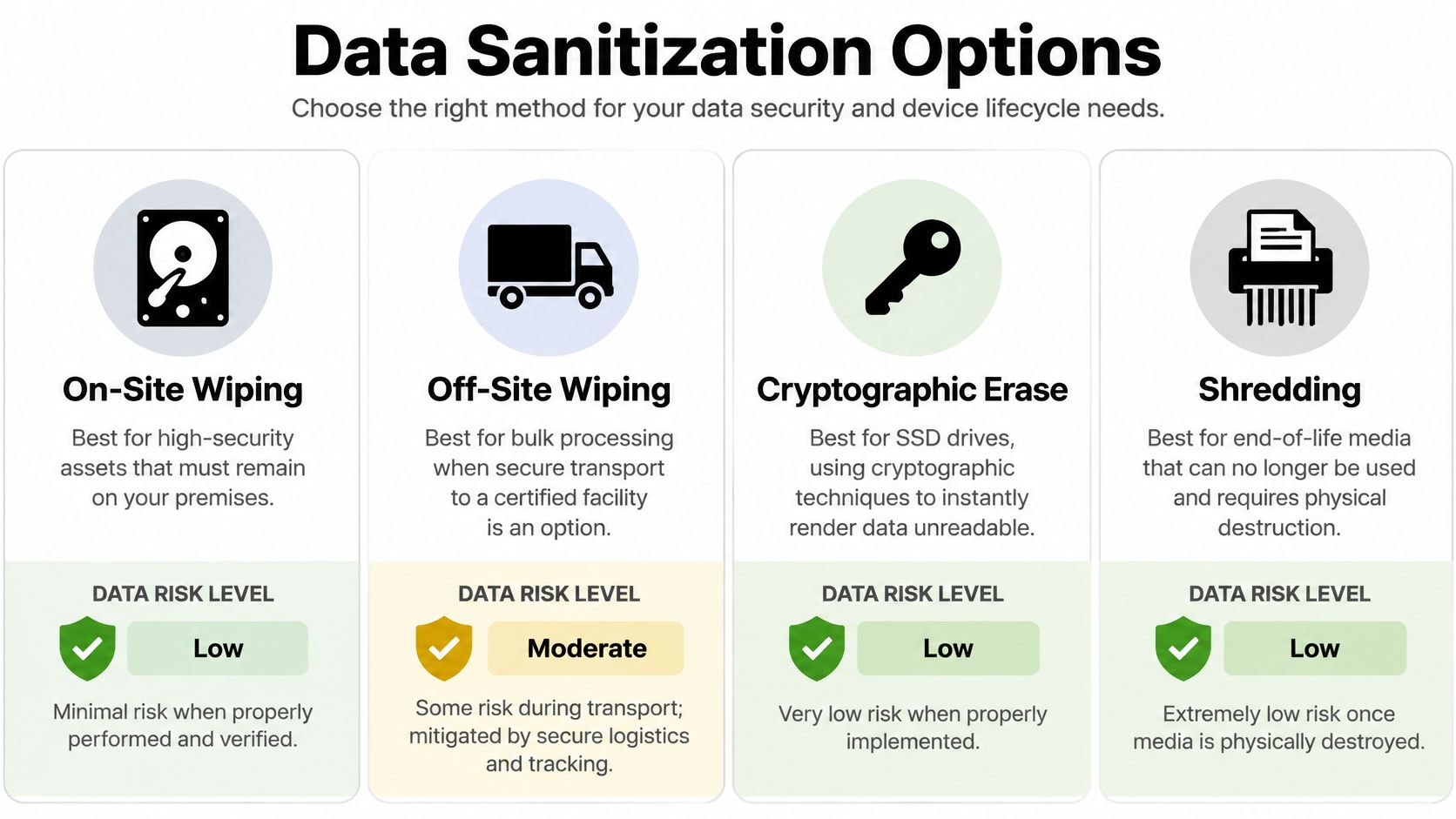
| Method | Best fit assets | Evidence to require |
|---|---|---|
| On-site wiping | Regulated drives that can't leave custody | Tool logs per serial, operator ID, verification result |
| Off-site wiping | Bulk reusable workstations, healthy magnetic disks | Sealed transport records, per asset logs, exception report |
| Cryptographic erase | Encrypted SSDs, NVMe, self encrypting drives | Key destruction record, device support confirmation, validation |
| Shredding | Failed drives, tapes, unknown state media | Serialized destruction certificate, date, facility, method |
On-site wiping keeps custody tight but eats floor space and staff time during the week you have least of both. Off-site wiping is operationally faster for volume, provided transport is sealed and serialized. Don't assume a conventional overwrite equals purge on SSDs, NVMe devices, RAID members, or self encrypting drives, where not all storage areas are reliably exposed. Escalate those to an approved device specific purge or destruction when verification isn't credible.
Shredding everything feels safe, but it's not always the strongest or smartest control. For properly encrypted media, cryptographic erase is a broadly applicable purge method, and it preserves resale value that shredding destroys. The trade-off runs the other way for failed drives. A drive that won't spin up can't be wiped or verified, so physical destruction is the only defensible answer.
Whatever you choose, demand more than a pass or fail summary. Require tool results, exception handling, and independent sampling where feasible, and hold resale release until exceptions are resolved. For a deeper comparison, see data wiping versus hard drive shredding in Atlanta.
Compliance and Documentation Atlanta Businesses Get Wrong
Most documentation failures aren't caused by ignoring regulations. They're caused by accepting paperwork that doesn't prove anything.
A certificate of recycling says material was processed. It doesn't say your drive, by serial number, was sanitized by an approved method on a specific date with a verified outcome. Internal audit, cyber insurance reviewers, and regulated customers will ask for the second thing.
What Each Record Should Contain
- Asset identifier and serial number: Ties the record to one specific device.
- Sanitization method: Clear, purge, cryptographic erase, or destroy, stated plainly.
- Date and operator or facility: Who did the work and where.
- Verification outcome: What was checked, not just what was attempted.
- Final disposition: Resold, redeployed, donated, recycled, or destroyed.
Map those records to the rules that govern your data. The FTC Disposal Rule covers consumer report information across employers, lenders, insurers, landlords, and service providers. Healthcare organizations answer to HIPAA expectations, financial firms to GLBA and PCI obligations. The specific frameworks differ, but the evidence question is the same everywhere. Can you connect every retired device to an approved risk decision?
Vendor selection is part of that compliance posture, not a separate procurement errand. The FTC identifies due diligence in selecting a disposal provider, including reviewing an independent audit, checking references, requiring recognized certification, and evaluating the provider's information security policies. If a vendor can't produce those before pickup, they won't produce defensible records after it.
Practical rule: If a certificate can't survive an auditor matching it against your asset register three years from now, it isn't documentation. It's a receipt.
Retain the full packet, inventory, manifests, custody forms, certificates, exception reports, in one relocation file. Include leased equipment returned at lease end and copiers going back to a lessor, since those transfers carry the same data exposure. Reviewing compliance documentation requirements before the move lets you specify record fields in the statement of work instead of negotiating for them afterward.
Logistics Coordination That Keeps the Move on Schedule
The plan usually dies at the loading dock. Freight elevators are booked in blocks, building management wants certificates of insurance from every vendor, and your mover and ITAD provider are both trying to use the same dock door at 9 a.m.
Sequence the work so data bearing equipment is de-installed, tagged, and segregated before general packing starts. Once furniture crews are wrapping everything that isn't bolted down, your chance to separate a file server from a recycling pallet drops fast.
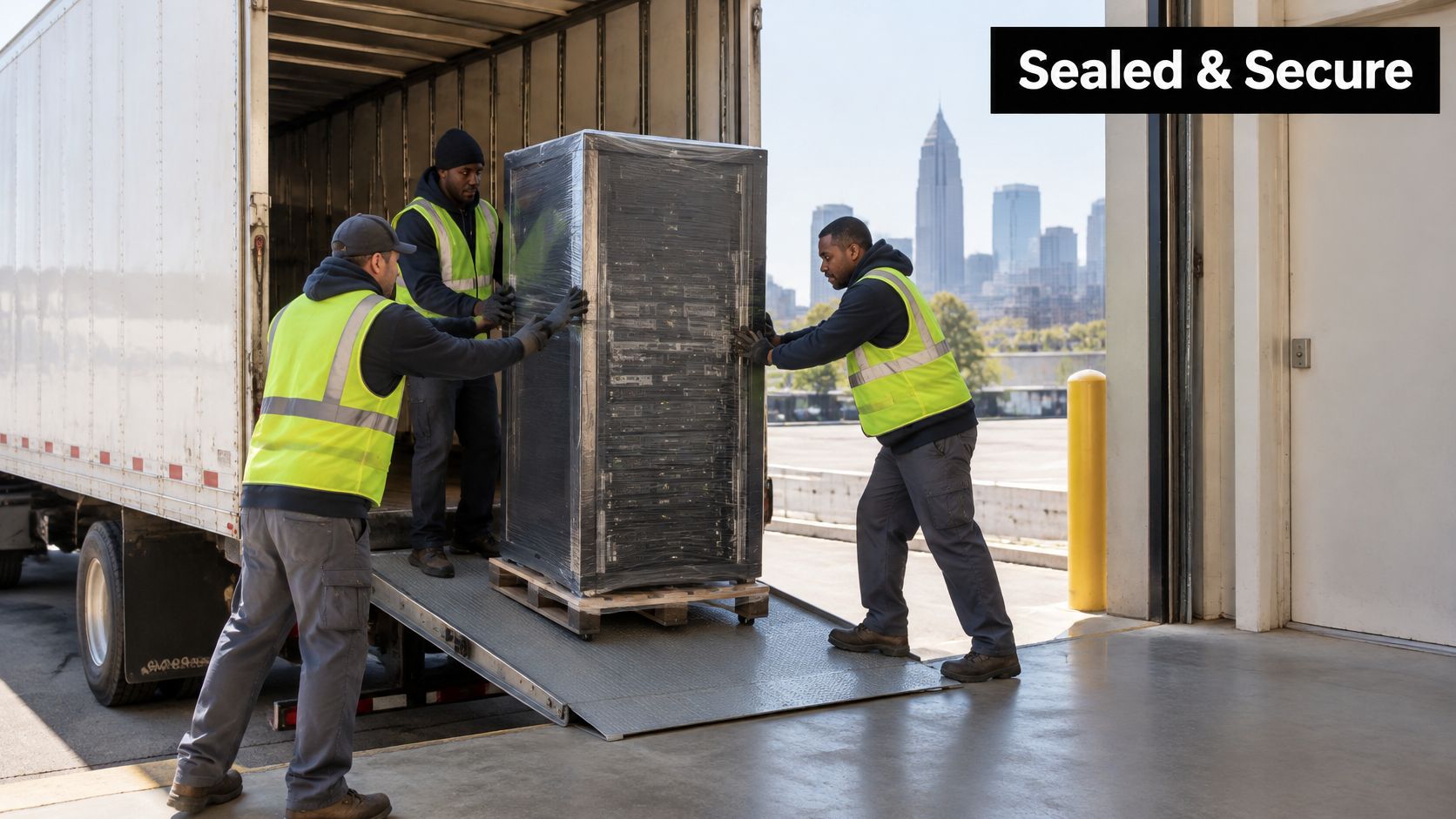
The Operational Sequence That Works
- De-installation first: IT pulls and tags equipment before movers stage the floor.
- Sealed containers for loose media: Drives and tapes travel in tamper evident containers, never loose in crates.
- Staggered pickup windows: Separate ITAD pickups from furniture loads so manifests stay clean.
- Named signer at each handoff: One person from your team signs custody transfers, not whoever is nearby.
- Photographs at loading: Pallet and container photos tied to manifest numbers settle disputes later.
Packing quality matters more than people admit. Monitors cracked in transit lose resale value, and drives jostled loose in a crate become unidentifiable. Sturdy, consistent packing materials, the kind you'd source when reviewing Moving Boxes & Packing Supplies, the Box Shop for a move, protect both the equipment and the labeling that your custody chain depends on.
Settle ownership fights early. IT owns the asset list, facilities owns building access, procurement owns vendor paperwork. When a crate shows up at the new office with equipment that was supposed to be destroyed, you'll want to know exactly whose signature put it there. Put one person on site during loading whose only job is reconciliation against the manifest. That staffer is cheaper than an exception investigation.
Recycling Versus Resale and Where Value Recovery Conflicts with Security
Not everything leaving your old office belongs in the same stream. The vendor will eventually ask one question per asset. Is this reusable, refurbishable, or only fit for material recovery?
Age and condition drive part of that answer. Recent laptops and servers with healthy drives, working screens, and intact components carry genuine secondary market demand. Damaged, incomplete, or obsolete gear usually doesn't, and chasing marginal resale value on it costs more in handling than it returns.
Data class drives the rest, and it overrides the money.
Equipment that's economically reusable still requires controlled sanitization and documented validation before release. Resale value never shortens that sequence.
Failed or inaccessible media warrants destruction regardless of book value, because you can't verify what you can't read. High sensitivity data on older or unknown state drives points the same way. The resale proceeds on a pallet of drives won't cover the cost of explaining one unaccounted device to a regulator or a cyber insurance carrier.
Where resale does make sense, structure it so the audit trail survives the transaction. Release equipment only after sanitization verification is formally accepted, record the buyer channel at the batch or asset level your policy requires, and apply value recovery credits against the project invoice with a paper trail finance can follow. Donated equipment gets the same treatment. Donation is a transfer of custody, not an exemption from it.
Mobile devices deserve a separate look during this sorting. Phones and tablets returned during a move often hold email, authentication apps, and cached files, and models turn over fast enough that it's worth checking current device coverage, such as phone news from NeoTeo, before deciding which returned handsets are worth remarketing and which should be wiped and recycled.
Done properly, IT asset remarketing in Atlanta offsets relocation costs without weakening security. Done casually, it's how a resalable laptop leaves with a recoverable drive and your asset tag still on the lid.
Vetting the Atlanta ITAD Vendor Before You Sign Anything
Procurement often treats disposal as a commodity purchase and picks the low bid. That's backwards. Of every contract attached to your move, the ITAD agreement is the one carrying the data risk.
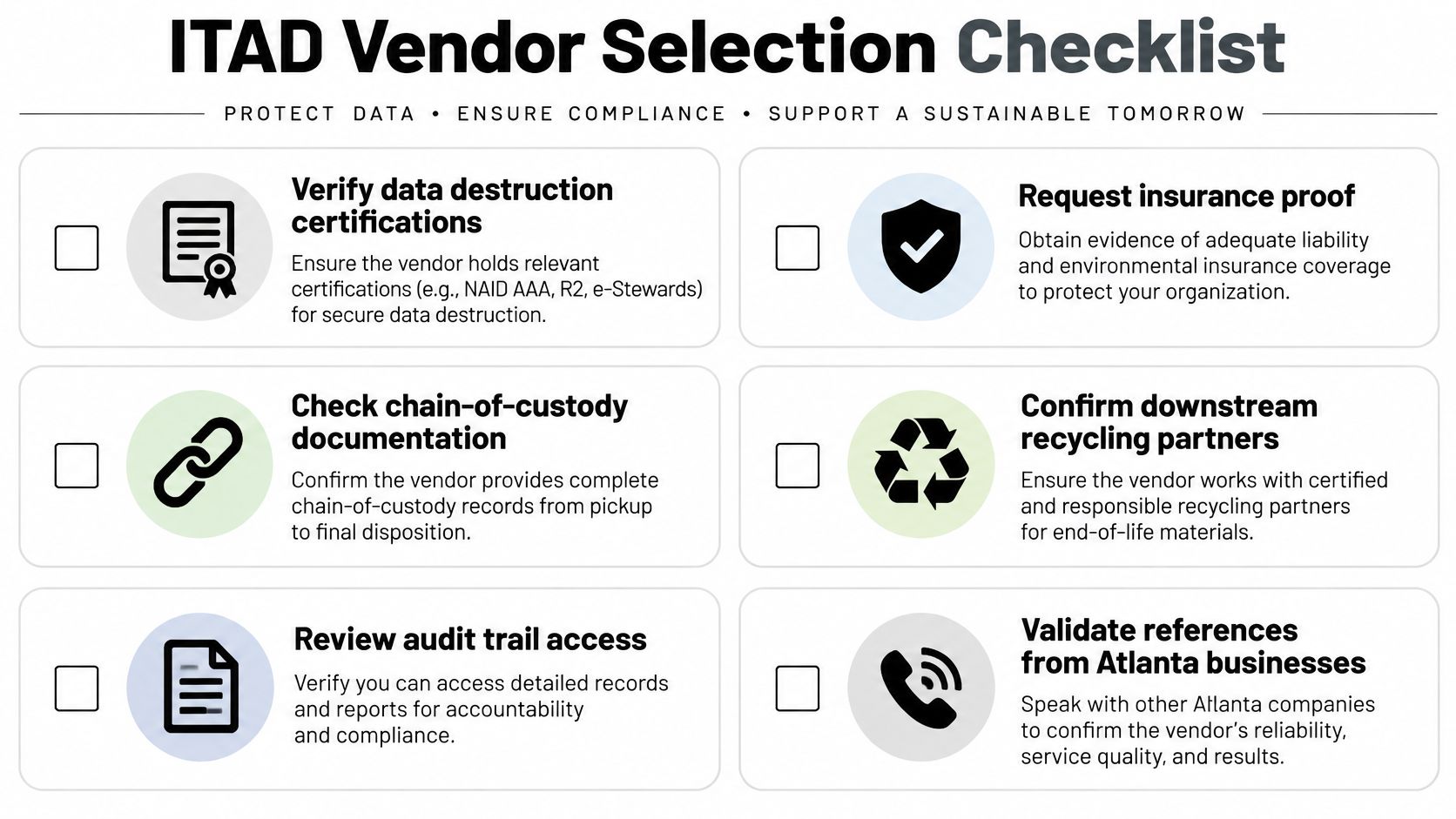
The Vendor Scorecard
- Written chain of custody procedures: Ask for the document, not a verbal description of it.
- Serialized certificates: Confirm the fields cover asset ID, serial, method, date, operator, verification, and disposition.
- Downstream disclosure: Find out where material goes after their facility, by name.
- Independent audit evidence: Review it the way the FTC due diligence guidance suggests.
- Insurance: Verify cyber liability and environmental coverage, plus certificates your building requires.
- Regulated references: Hospitals, banks, and school systems in the Atlanta area make useful reference calls.
Then ask the questions that expose weak providers quickly. How do you handle a drive that fails sanitization mid batch? Do you subcontract transport, and if so, to whom? What happens when a serial number on the certificate doesn't match the manifest? What's your process when a drive turns up missing six months after the move? Confident vendors answer with procedures. Weak ones answer with reassurance.
One provider to evaluate against this list is Beyond Surplus, an Atlanta based ITAD and electronics recycling company in Smyrna offering business pickups, on site or off site data destruction, and certificates of recycling and data destruction. Measure it, and every bidder, against the same scorecard rather than against price alone. Preparing with questions to ask before hiring an ITAD company keeps the evaluation consistent across vendors.
Don't overlook what happens after the trucks leave. Your old space needs cleaning and turnover work before the landlord walkthrough, and coordinating that scope early, the way you'd map commercial cleaning coverage in Toronto for a multi site footprint, prevents last minute scrambling when the lease clock runs out.
The Pre-Move Checklist to Pin on the Wall
- Frozen inventory: Every asset tagged with a unique ID and serial number.
- Written sanitization plan: Method assigned per asset class before packing starts.
- Segregation done: Reusable equipment separated from failed and end of life media.
- Cloud and virtual storage covered: Snapshots, replicas, backups, encryption keys, and admin accounts assigned a deletion owner and evidence standard. Physical drives aren't the whole estate anymore, and NIST SP 800-88 Rev. 2 added logical sanitization guidance for cloud storage for exactly this reason.
- Custody forms signed: At every handoff, with photographs at loading.
- Sealed transport confirmed: Tamper evident containers for loose media.
- Exception process staffed: Late returns and missing items get logged, not improvised.
- Verification evidence required: Logs, sampling, and exception reports specified in the statement of work.
- Serialized certificates received: Matched line by line against the asset register.
- Closing reconciliation complete: Pre move inventory, loading manifest, and final disposition records agree before you close the project.
Complete those ten items and your Atlanta relocation ends with a file you can hand to an auditor without flinching. Skip them, and the move isn't really finished. It's just relocated risk.
If your Atlanta move is on the calendar and the disposition plan is still a sticky note, Beyond Surplus can scope the project around your asset register, handle de-installation, sealed transport, certified data destruction, and serialized documentation, and coordinate pickup around your dock schedule. Contact the team for a relocation specific scope review and a documented statement of work before your freeze date, not after the trucks are loaded.