

Your Atlanta, Georgia office is closing, the landlord wants the floor cleared, and facilities needs a pickup date. Meanwhile, IT still has laptops with remote employees, servers waiting for shutdown approval, and a printer nobody has checked for internal storage. The removal deadline is clear. The evidence trail isn't.
For office closure electronics recycling in Atlanta, complete IT equipment removal means more than emptying rooms. You need an approved disposition for every asset, controlled handoffs, and records that finance, security, and legal can reconcile after the building keys are returned.
Table of Contents
- Why Office Closure Electronics Recycling Is an Atlanta Operations Problem, Not Just Trash Day
- A 30-60-90 Day Closure Timeline for Atlanta IT Directors
- On-Site Versus Off-Site Data Destruction for Atlanta Closures
- Building a Defensible Chain of Custody From Asset Tag to Final Certificate
- Mapping FTC, HIPAA, GLBA, and GDPR to Specific IT Assets in the Closure
- Reuse, Purge, or Destroy Choosing the Right Outcome for Each Device
- Logistics, Scheduling, and Value Recovery for Atlanta Local and Nationwide Closures
- The Pre-Pickup Checklist Every Atlanta IT Director Should Sign
Why Office Closure Electronics Recycling Is an Atlanta Operations Problem, Not Just Trash Day
Consider a Midtown office preparing for its final walkthrough. Workstations and docking stations sit beside monitors, VoIP phones, switches, firewalls, and servers. A multifunction printer remains connected in the copy room, while backup tapes and loose SSDs occupy a cabinet marked for general removal.
That's a planning scenario, not an unusual equipment list. The mistake would be treating everything on those pallets as equivalent. Storage-bearing devices require a data decision before they receive a shipping label. Non-storage equipment still needs an environmental destination and an accountable handoff.
Assign ownership before equipment moves
Put the IT director or designated ITAD project manager in charge of the disposition register. Facilities should control building access, procurement should manage commercial terms, and security should approve handling requirements. None should independently release equipment.
Use separate staging categories:
- Data-bearing assets: Computers, servers, removable media, and devices whose storage configuration requires inspection.
- Non-storage electronics: Displays, docking stations, cables, and peripherals confirmed not to contain media.
- Exceptions: Unidentified equipment, damaged devices, leased assets, and items awaiting legal approval.
- Special-handling equipment: Batteries, legacy CRT displays, and equipment requiring a separate acceptance review.
The environmental stakes extend beyond the office. The world generated 62 billion kilograms of e-waste in 2022, but only 22.3% was documented as formally collected and recycled in an environmentally sound manner, according to the Global E-waste Monitor 2024.
Operating rule: Nobody releases a pallet because it looks ready. The project owner releases it because its contents have approved destinations.
Whether you're closing a Buckhead suite or consolidating an entire building, prevent the same failures: undocumented transfers, unverified wiping, missing accessories, and certificates that don't match the original asset list. A clean floor isn't evidence of a completed IT disposition project.
A 30-60-90 Day Closure Timeline for Atlanta IT Directors
Use longer-range planning for contract approvals and complex decommissioning, then manage the final month against explicit release gates. The schedule below is a recommended operating calendar, not a promise that processing will finish before your lease ends.
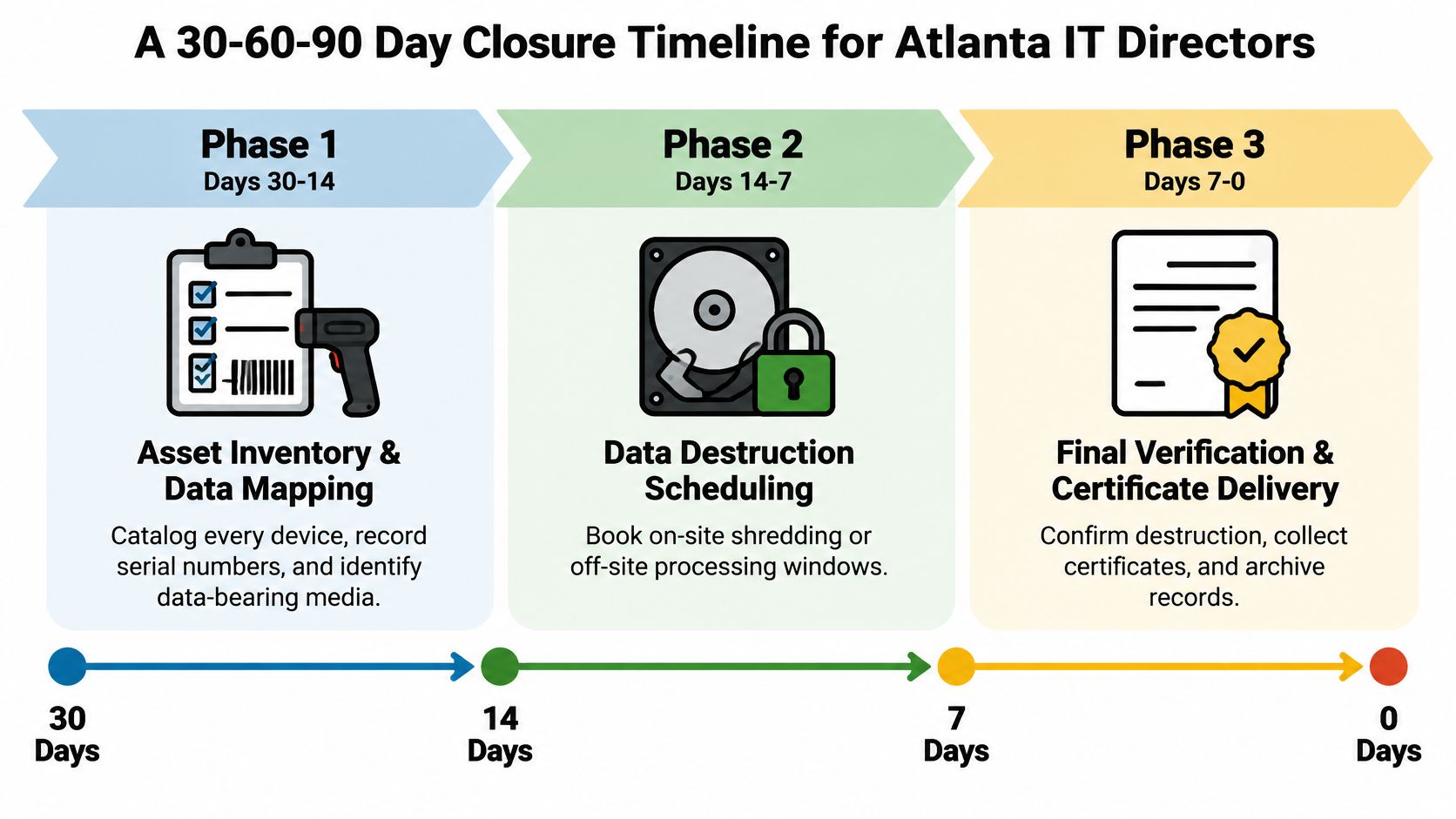
Days 30 to 14 before closure
The IT asset manager should export the asset register and perform a physical walkthrough. Record equipment in offices, communications rooms, storage areas, and remote-worker assignments. Ask finance to identify leased equipment and legal to flag preservation requirements.
Facilities should confirm loading-dock reservations, freight-elevator access, security escorts, and permitted work hours. Procurement should obtain a written scope covering labor, packaging, transport, sanitization, special handling, and reporting.
Deliverable: An approved asset baseline and removal scope.
Checkpoint: IT, facilities, and procurement agree on what can leave and who can authorize exceptions.
Days 14 to 1 before closure
Security should approve destruction or sanitization routes. Schedule the processing window early enough to accommodate building restrictions and witness availability.
Begin remote-worker retrieval before the final packing day. Label containers by destination and handling category, and keep unresolved devices in a controlled exception area. Don't let an employee's delayed return disappear from the closure register.
Deliverable: A dispatch-ready manifest, packaging plan, and access schedule.
Checkpoint: Every listed item has a location, responsible owner, and approved next action.
Pickup day through final acceptance
The project owner should release equipment against the manifest, not a verbal estimate. Receiving discrepancies and failed sanitization results remain open until someone resolves them in writing.
For a small local load, evaluate an arranged Smyrna delivery separately from fleet pickup. Multi-site closures need coordinated dispatch windows and consistent reporting, not independent local arrangements.
- Before departure: Approve the actual released inventory.
- After receiving: Resolve discrepancies against the pickup record.
- At closeout: Accept the disposition package and record unresolved exceptions.
Treat certificate delivery in the infographic as a planning milestone. Don't mark destruction complete before processing and verification occur.
On-Site Versus Off-Site Data Destruction for Atlanta Closures
Choose the processing location around the control you need, not the assumption that a shredding truck automatically provides stronger compliance. Destruction method, witness requirements, transport exposure, and documentation are separate decisions.
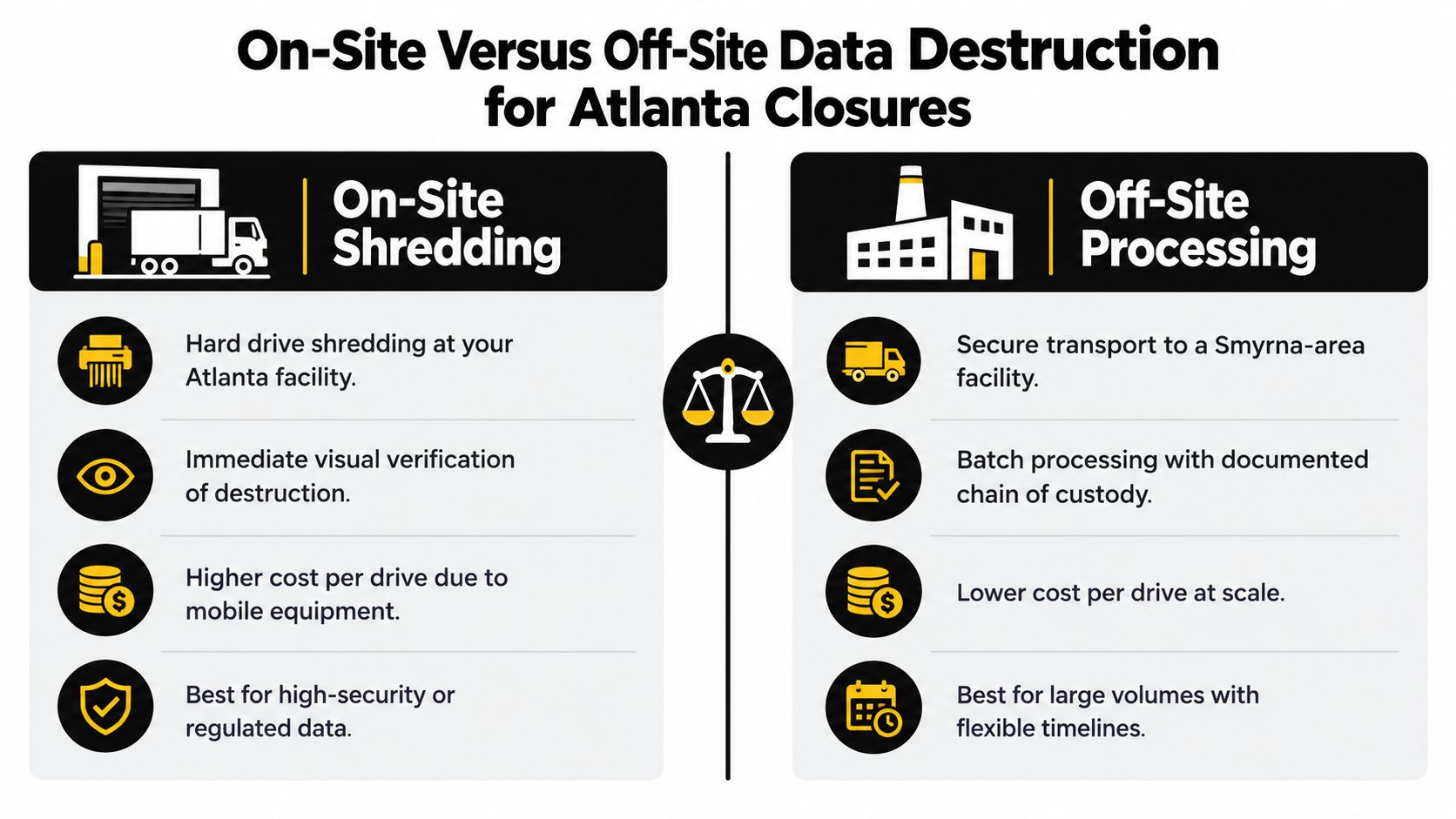
When on-site processing earns its cost
On-site shredding makes sense when your approved policy requires destruction before media leaves company control, or when a designated witness must observe the event. It can also remove uncertainty when a sensitive-media inventory has a hard release deadline.
Budget for the whole operation. Ask about mobile-equipment charges, staging labor, dock occupancy, escort time, and any minimum service requirements. Compare written proposals rather than assuming the illustrated cost relationship applies to your load.
Healthcare and financial records warrant careful review, but sector alone doesn't select the method. Legal-hold equipment must receive preservation approval before any destructive action.
When off-site processing is simpler
Off-site processing at an approved Smyrna-area facility can reduce the work required inside a closing office. It fits projects where security accepts controlled transport and the processor can meet your reporting and completion requirements.
Require a transport plan that addresses sealed containers where appropriate, authorized handlers, receiving confirmation, and discrepancies. Confirm the actual processing destination rather than accepting a vague warehouse reference.
| Decision factor | On-site approach | Off-site approach |
|---|---|---|
| Witness requirement | Arrange observation during processing | Agree on acceptable remote or facility evidence |
| Building constraints | Reserve space and equipment access | Reserve collection access |
| Evidence | Capture media identifiers before destruction | Connect pickup identifiers to processing results |
| Commercial review | Assess mobilization and site labor | Assess transport, processing, and reporting |
Video can support observation; weight tickets can support material accounting. Neither substitutes for identifying which media was processed.
Use the Georgia on-site versus off-site ITAD comparison to frame procurement questions. Then make the selected location, evidence requirements, exception procedure, and completion deadline contractual.
Building a Defensible Chain of Custody From Asset Tag to Final Certificate
An inventory records what you own. A custody record establishes who controlled it, when, and what happened next. You need both, joined through stable asset and media identifiers.
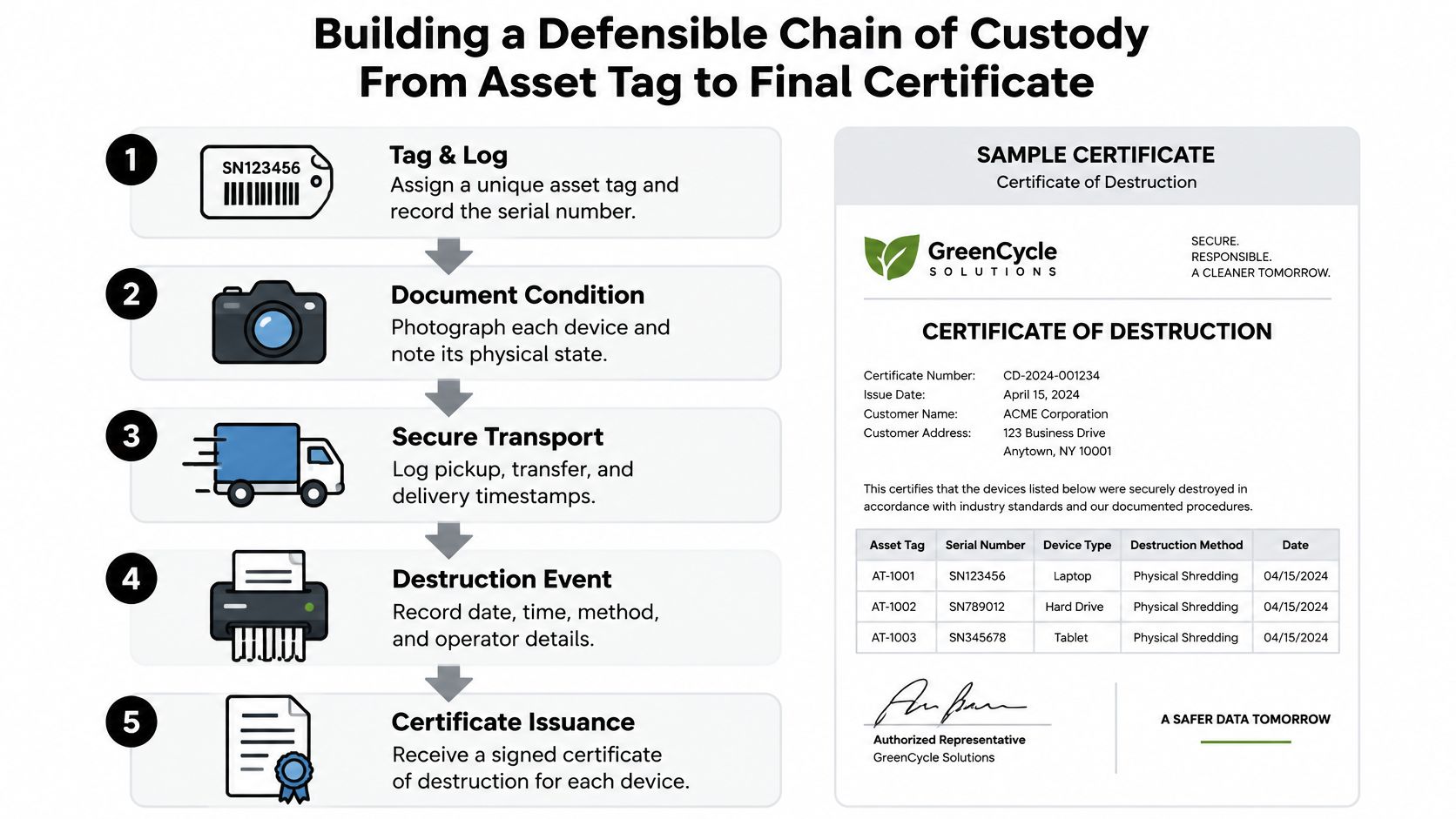
A useful documentation package starts with the released manifest, continues through receiving and processing events, and ends with a disposition report. The FTC's business data-security guidance provides the broader context: secure disposal belongs within the organization's information-security practices.
Require fields that support reconciliation
Build your custody template around identifiable events:
- Asset identity: Asset tag, manufacturer serial number, device type, media type, and originating location.
- Transfer event: Date, releasing handler, receiving handler, destination, and container or seal identifier where used.
- Processing record: Sanitization method, operator or processor, processing date, and verification result.
- Exception decision: Missing identifiers, failed processing, substitutions, and approval by the authorized company representative.
- Final outcome: Reuse, parts recovery, material recycling, or destruction, connected to the relevant certificate.
Record a removed drive against its parent computer before separating them. Otherwise, a laptop may appear closed in the register while its media remains unaccounted for.
For larger staging areas, Overton Security's guide to RFID is a supplementary resource when evaluating inventory-tracking options. Any tracking technology still needs reliable identifier mapping and disciplined handoff records.
Close the register, not just the collection ticket
Import the processor's results into a working copy of the released inventory. Match identifiers, flag missing assets, investigate unexpected additions, and distinguish successful sanitization from failed attempts. Keep unresolved rows open with an owner and next action.
A certificate isn't persuasive evidence if you can't connect its listed assets to the equipment your organization released.
A batch certificate can be usable when its attached serialized schedule supplies that connection. A generic statement that equipment was recycled cannot resolve a missing server or an unmatched SSD.
Specify these requirements using a chain-of-custody framework for IT asset disposal. Store the manifest, event records, exceptions, and certificates together so an auditor can follow the complete transaction.
Mapping FTC, HIPAA, GLBA, and GDPR to Specific IT Assets in the Closure
Start with the information on the device and your organization's obligations. Don't assume a device is low risk because it came from reception, or highly regulated because it came from a financial company.
The FTC Disposal Rule, effective June 1, 2005, applies to organizations using consumer reports for business purposes and requires reasonable measures against unauthorized access or use during disposal, as explained in the FTC's Disposal Rule guidance. Its guidance includes destroying or erasing electronic information so it cannot be read or reconstructed, alongside due diligence when selecting contractors.
Translate legal review into release decisions
For the other regimes, use the following as a review-routing matrix, not a blanket determination of legal applicability. Your privacy officer or counsel should identify the applicable requirements and approve the evidence needed.
| Review area | Equipment to investigate | Decision to obtain |
|---|---|---|
| FTC Disposal Rule | HR endpoints, screening records, storage containing consumer-report information | Approved disposal safeguards and contractor review |
| HIPAA review | Clinical workstations, laptops, mobile devices, backup media, printer storage | Privacy and security approval for the information involved |
| GLBA review | Finance and lending endpoints, servers, exported records | Applicable safeguards and service-provider requirements |
| GDPR review | Returned international laptops and systems containing potentially in-scope personal data | Applicability, retention, and disposal approval |
An EU connection alone isn't a complete GDPR analysis. Likewise, a recycling certificate doesn't establish that an organization has satisfied HIPAA or GLBA obligations.
Avoid unsupported method shortcuts
An encrypted laptop still needs an approved disposition. Require technical confirmation before accepting cryptographic erase or key destruction as the selected sanitization method.
Inspect multifunction-printer storage rather than relying on a settings reset. For backup tapes, approve a media-appropriate treatment and require witness sign-off if company policy calls for it. Don't turn either example into an automatic legal requirement for every device.
The corporate IT equipment disposal workflow should carry these approvals into operational work orders. Document the applicable obligation, authorized method, and acceptance evidence before releasing the equipment. Certificates support accountability; they don't replace legal analysis or automatically eliminate liability.
Reuse, Purge, or Destroy Choosing the Right Outcome for Each Device
Shredding everything is an expensive substitute for classification. It removes the reuse option even when a technically appropriate, verified sanitization process could preserve it.
The environmental rationale for making a deliberate choice is substantial. Selected U.S. consumer electronics generated 2.7 million short tons in 2018, with approximately 1.04 million tons recycled, a 38.5% recycling rate, as reported in the U.S. e-waste research summary. Those figures describe a selected material category, not a recovery forecast for your office.
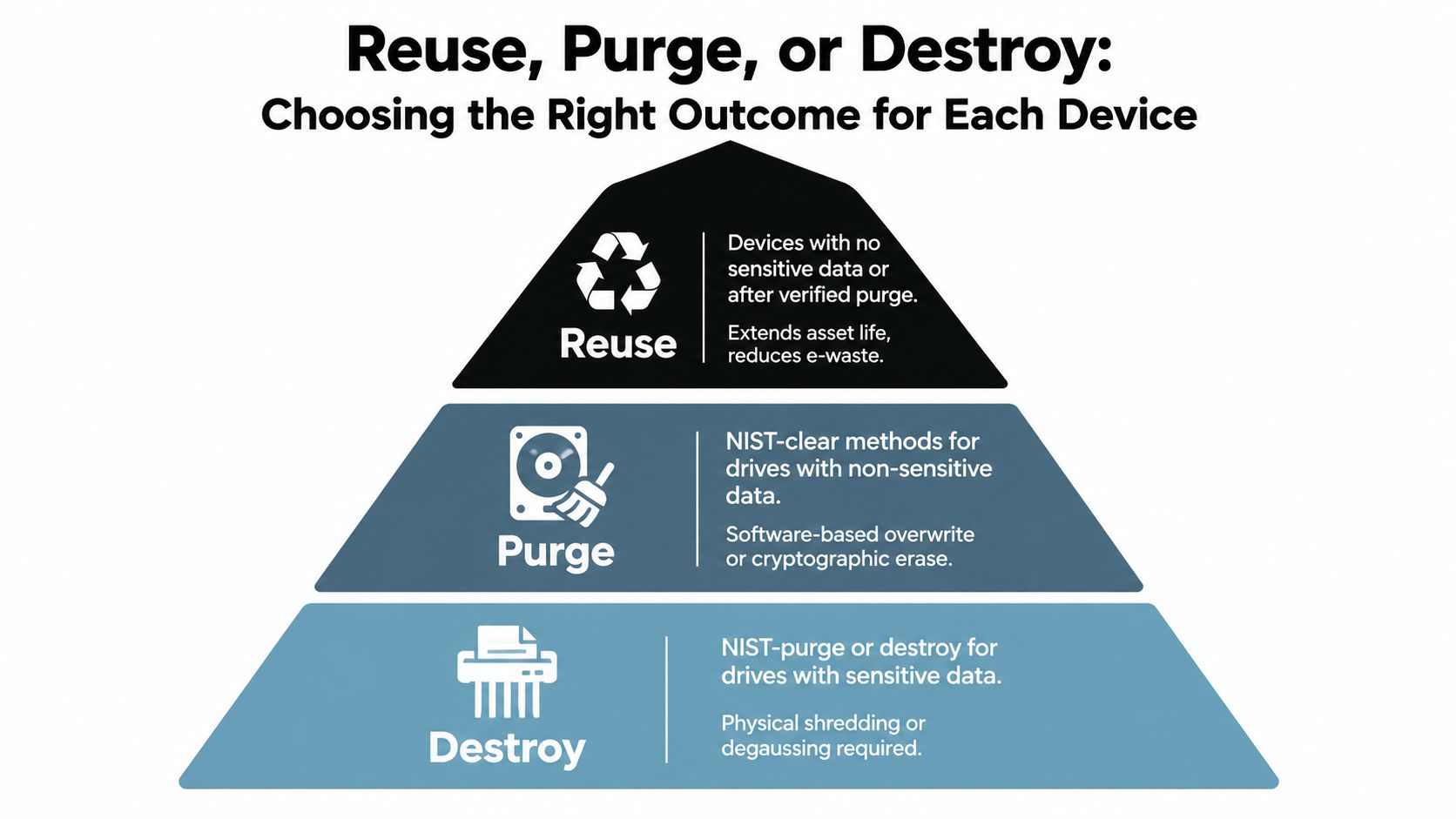
Keep the sanitization outcomes distinct
The illustration is a planning aid, not a technical method specification. In particular, clear and purge aren't interchangeable, and purge doesn't always mean physical destruction.
NIST's media-sanitization framework distinguishes:
- Clear: Logical techniques protecting against ordinary, non-invasive recovery.
- Purge: Logical or physical methods intended to make recovery infeasible even with advanced laboratory techniques.
- Destroy: Treatment that makes recovery infeasible and prevents reuse of the medium for storage.
NIST's revised guidance also separates potentially reusable-media treatment from irreversible destruction. Select methods for the actual technology and risk, not merely the label “hard drive.”
Use security as the gate for value recovery
A functioning workstation can enter a reuse route after an approved purge, verification, and functional testing. Failed or damaged media that can't complete the required treatment should move to an approved destruction route.
Encryption isn't, by itself, a reason to shred. Equally, an apparently successful software operation isn't sufficient without an acceptable verification result.
Inspect switches, firewalls, VoIP phones, thin clients, and printer storage rather than limiting triage to laptops. Where reuse remains appropriate, evaluate Atlanta IT asset remarketing and value recovery against processing costs and equipment condition.
Commercial judgment: Recover value only after security approves the route. Don't weaken the sanitization requirement to improve a buyback offer.
Keep non-reusable components in documented recycling channels, with data-bearing media resolved before bulk material processing.
Logistics, Scheduling, and Value Recovery for Atlanta Local and Nationwide Closures
Treat collection, transport, and receiving as part of the technical scope. A processor can't preserve equipment value if the removal crew breaks it, and IT can't resolve discrepancies if separate sites use incompatible manifests.
For a local Atlanta pickup, facilities should confirm the dock, elevator, route through the building, and security escort. For nationwide closures, procurement should require the same packaging rules, reporting fields, and exception process from every transportation partner.
Closure Logistics at a Glance
| Mode | Best Fit | Key Logistics | Documentation Output |
|---|---|---|---|
| Arranged Smyrna delivery | Consolidated local business equipment | Confirm acceptance, unloading, and authorized handoff | Receiving record and matched inventory |
| Atlanta fleet pickup | Office-floor or building closure | Dock booking, escorts, packing, and loading scope | Released manifest and transfer record |
| Regional coordinated collection | Several Southeast locations | Site contacts, dispatch windows, consistent labels | Site-specific records and consolidated report |
| Nationwide partner transport | Distributed enterprise closures | Approved carriers, receiving destinations, shared controls | Traceable custody and disposition records |
EPA's electronics end-of-life guidance emphasizes collecting peripherals, addressing internal and external media, reducing packaging damage, and completing property-disposal documentation. It also recommends independently evaluated electronics recyclers for organizational purchasers. Verify certification for the actual processing organization and relevant scope, not merely a broker's marketing materials.
If temporary space is unavoidable, Orange Box Self Storage for business space offers a workspace-storage reference, not an Atlanta disposal destination. Any temporary holding arrangement still needs approval for access control, inventory ownership, and permitted materials.
Protect recoverable assets and isolate hazards
Require testing and grading before accepting a buyback settlement. The commercial report should distinguish internal redeployment, resale, parts recovery, and recycling, with agreed deductions shown rather than buried in a net payment.
Separate batteries and damaged equipment before loading. Legacy CRTs need specific review: EPA identifies discarded CRTs as hazardous waste because of lead content and specifies containment, labeling, and processing controls in its CRT handling requirements.
Use a multi-location electronics recycling operating plan to make local execution consistent. The objective isn't identical trucks everywhere. It's comparable evidence from every site.
The Pre-Pickup Checklist Every Atlanta IT Director Should Sign
Sign a release authorization before collection, then retain a separate final-acceptance gate after processing. Combining them encourages teams to mark the project complete while evidence is still outstanding.
The release packet should identify the approved inventory version, pickup scope, responsible contacts, and unresolved items excluded from collection. Give facilities and procurement the same packet IT uses.
Before authorizing release
- Reconcile the equipment baseline: Confirm the physical inventory against the approved register. Keep missing assets and unexpected additions on the exception log established in the custody workflow.
- Resolve remote-worker returns: Record received equipment, outstanding returns, and the manager responsible for recovery. Don't close an employee assignment on a shipping promise.
- Approve data decisions: Apply the regulatory review matrix and device-specific sanitization hierarchy. Confirm legal-hold releases separately.
- Verify packing and labels: Check identifiers, parent-device relationships, protected reusable equipment, and separation of storage media.
- Isolate special-handling items: Confirm the agreed battery, damaged-equipment, and CRT arrangements from the logistics plan.
- Confirm building access: Obtain dock approval, elevator reservations, escort availability, and an escalation contact.
- Assign observation duties: Name the witness where required and specify what that person must record.
- Authorize the actual load: Approve discrepancies before departure rather than letting the crew revise the manifest without company review.
Before closing the project
Apply the reconciliation process to the receiving and processing reports. Require a documented outcome for each released asset, approval for exceptions, and the agreed financial settlement for remarketed equipment.
Retain certificates with the records that connect them to the register. Finance should receive disposition and settlement evidence; security should receive sanitization results and unresolved exceptions. The landlord's walkthrough can confirm an empty space, but it can't confirm secure IT disposal.
Final sign-off: Close the project when released assets have documented outcomes, not when the truck leaves.
Beyond Surplus offers business electronics recycling, secure data destruction, IT equipment removal, and value-recovery services for Atlanta office closures and nationwide projects. Visit Beyond Surplus with your asset list, closure deadline, building-access requirements, and required evidence package to request a scoped removal plan with documented chain of custody.


