

A lot of multi-location companies are living with a disposal process that isn't really a process. One branch calls a local recycler. Another stacks retired laptops in an IT closet. A third waits for an office move, then tries to clear years of old gear in one pickup. When audit, legal, or security asks where a specific device went, nobody can answer with confidence.
That's the issue with secure electronics recycling for multi-location companies. It isn't mainly a shredding problem. It's a governance problem. The organizations that hold up under scrutiny are the ones that standardize pickup, custody, destruction, certificates, and reporting across every site instead of treating each location like its own exception.
The stakes keep rising. The Global E-waste Monitor 2024 reports that global electronics waste reached 62 billion kilograms in 2022, equal to about 7.8 kilograms per person, and only 22.3% was formally collected and recycled in an environmentally sound manner. It also notes that e-waste generation is rising by about 2.6 million tonnes per year and is projected to reach 82 million tonnes by 2030 (Global E-waste Monitor 2024). For enterprise programs, that makes end-of-life handling both an environmental duty and a control issue.
Table of Contents
- Why Multi-Location Companies Need a Standardized Secure Recycling Program
- Building Your Inventory, Policy, and Site Assessment
- Choosing an ITAD Vendor and Writing the RFP
- On-Site Versus Centralized Pickup and Destruction Workflows
- Data Destruction Methods That Map to Real Risk
- Chain of Custody, Certificates, and Compliance Evidence
- Tracking, Cost Recovery, Rollout, and Audit-Ready Verification
Why Multi-Location Companies Need a Standardized Secure Recycling Program
If you manage more than a handful of sites, fragmentation shows up fast. One office wipes drives before pickup. Another sends full devices off-site intact. A third gets a recycling receipt that lists only total weight, which is useless when someone asks about a missing serial number. That's how routine cleanouts turn into compliance problems.
The practical fix is a standardized secure recycling program. Every site follows the same intake rules, the same storage controls, the same release authority, and the same evidence requirements. That doesn't mean every location uses the exact same pickup model. It means every exception is still governed by the same playbook.

Where multi-site programs usually break
Four failure points show up again and again:
- Fragmented disposal choices that let each office use its own recycler, timing, and paperwork
- Weak chain of custody when devices sit in closets, move without seal control, or leave without serial capture
- Compliance gaps when one site follows regulated disposal requirements and another uses a lighter process
- Unverifiable sustainability claims when reported recycling outcomes can't be tied back to actual asset records
A centralized playbook fixes more than consistency. It gives the business one answer to hard questions: what was retired, who handled it, how the data was sanitized, where the material went, and what proof exists.
Practical rule: If a site can retire devices without producing serialized evidence, it doesn't have a secure recycling process. It has a hope-based process.
The companies that do this well usually treat recycling as part of IT asset disposition, not facilities junk removal. That shift matters because a retired laptop still holds data risk until the asset is sanitized, documented, and closed out. A distributed workforce guide like this IT asset recovery framework for distributed workforces is useful because the same control problem appears when devices move between homes, branches, and central processing.
Building Your Inventory, Policy, and Site Assessment
The first job isn't scheduling pickups. It's building a disposal system that reflects what you own and where it sits.
Start with the asset register
Pull assets from the CMDB, endpoint platform, procurement records, and any local spreadsheets that sites still maintain. Include endpoints, servers, storage arrays, removable media, lab systems, network gear with embedded storage, and devices that are often missed during refresh cycles such as printers or multifunction units with drives.
Then classify assets by data exposure. Keep it simple enough that sites will use it:
- Regulated data such as PHI, consumer report information, or payment data
- Confidential business data such as contracts, source files, designs, or HR material
- Internal-use systems that still need controlled retirement
- Public or low-risk assets with no meaningful retained data
Each record should point to an internal owner. Without ownership, retired equipment becomes abandoned equipment.
Write policy around decisions, not slogans
A usable policy answers operational questions. It should define:
- Approved disposal methods by asset and data class
- Required custody records before a device can leave a site
- When on-site destruction is mandatory and when off-site processing is acceptable
- Which vendors are approved for reuse, resale, recycling, and destruction
- Who can authorize release at each location
A policy that says “recycle responsibly” won't survive an audit. A policy that names evidence, methods, and release authority usually will.
This document should also account for jurisdictional exposure. Some sites may be in healthcare workflows, some may support retail payment environments, and some may have cross-border data considerations. The point isn't to write a different policy for every office. It's to build one standard with stricter controls where needed.
Inspect site readiness before rollout
A short site assessment prevents rollout failure. Visit the location or validate it remotely with photos and a checklist. Confirm whether the site has locked storage, who the handoff contact is, whether pickups need dock access, and whether special labor or building rules apply.
Three deliverables matter:
- Asset register with data classification and site mapping
- Electronics disposal policy with methods, approvals, and evidence rules
- Site readiness matrix with logistics constraints and local contacts
That readiness matrix ends arguments later. If a branch can't store pallets securely, doesn't have regular shipping support, or can't host a mobile shred truck, the program owner needs to know that before launch.
Choosing an ITAD Vendor and Writing the RFP
The biggest buying mistake is treating all recyclers as if they provide the same service. They don't. A general e-waste hauler can remove material. An ITAD vendor is supposed to preserve chain of custody, document data destruction, and separate reusable assets from scrap.
The FTC Disposal Rule is part of why this matters. It requires covered businesses handling consumer report information to take reasonable measures to protect information during disposal, and for electronic media that can include destroying or erasing data so it cannot practicably be read or reconstructed (FTC Disposal Rule summary).
What procurement should compare
| Evaluation Criterion | Certified ITAD Vendor | General E-Waste Hauler |
|---|---|---|
| Asset-level tracking | Serialized asset tracking | Often aggregate load tracking |
| Data destruction evidence | Device-specific destruction records | May provide only a load receipt |
| Downstream handling | Reuse, resale, and scrap streams separated | Often focused on commodity recycling |
| Audit support | Certificate fields built for review | Limited documentation depth |
| Multi-site routing | Structured scheduling across locations | Varies widely |
| Policy alignment | Built around security and compliance controls | Built around removal and recycling |
That difference should show up in the RFP.
Questions that survive legal and audit review
Ask direct questions and require direct answers:
Certifications and audit history
Which certifications are current, and what scope do they cover?Sanitization methods
How are wipe, purge, and destroy decisions documented, and how is alignment to NIST 800-88 handled?On-site capability
Can the vendor perform witnessed services where policy requires media destruction before transport?Insurance and liability transfer
What coverage applies while assets are in transit and in processing?Geographic coverage
Can the vendor support branch networks without shifting to undocumented subcontractors?Portal and reporting
Can your team pull serialized certificates, chain-of-custody records, and final disposition by site?Commercial model
How are resale credits, processing fees, and exceptions handled?
One factual option in this market is Beyond Surplus, which provides business pickup, data wiping or shredding, certificates of recycling and data destruction, and nationwide pickup coordination for organizations that need a commercial ITAD workflow.
A buyer-side vendor due diligence checklist is useful here because it forces procurement, security, and facilities to score the same controls instead of talking past each other.
On-Site Versus Centralized Pickup and Destruction Workflows
Most organizations eventually choose a mix of two models. The mistake is pretending one model fits every site.
When on-site destruction makes sense
On-site mobile shredding or wiping keeps custody inside the facility until data-bearing media is sanitized or destroyed. That usually fits regulated sites, executive offices, legal departments, or any location where intact media leaving the premises creates avoidable friction.
Benefits are straightforward:
- Shorter custody chain because media doesn't travel intact
- Direct witnessing by internal staff when policy requires it
- Cleaner exception handling for high-risk devices
Trade-offs are just as real. On-site service can be harder to schedule, especially for low-volume branches. It can also be a poor fit for locations with limited access, strict building restrictions, or no safe staging area.
When centralized processing wins
Centralized pickup works better when you have many smaller sites, uneven retirement volumes, or reusable assets that need triage. Devices move in sealed containers or locked transport to a vetted ITAD facility where wiping, testing, resale, and recycling happen in one controlled workflow.
That model creates efficiency, but only if the custody chain is tighter than most companies expect. The World Bank guidance on electronics management emphasizes traceability through collection, transport, processing, and closeout, and highlights common failures such as delayed wiping, missing audits, and poor serial number records (electronics lifecycle guidance).
| Dimension | On-Site Mobile Destruction | Centralized ITAD Facility |
|---|---|---|
| Data risk during transport | Lower for destroyed media | Higher unless custody is tightly controlled |
| Fit for low-volume branches | Mixed | Strong |
| Reuse and resale potential | Lower if media is shredded immediately | Stronger with testing and processing |
| Scheduling | Event-driven | Route-based |
| Evidence needs | Witness logs and destruction records | Intake reconciliation, seal logs, and certificate linkage |
If high-risk assets and low-risk surplus follow the same lane, the stricter process usually breaks first.
Set separate staging rules. Label bins by workflow. Train site contacts on what goes into local destruction versus centralized shipment. If those lanes blur, the whole model degrades into ad hoc handling.
Data Destruction Methods That Map to Real Risk
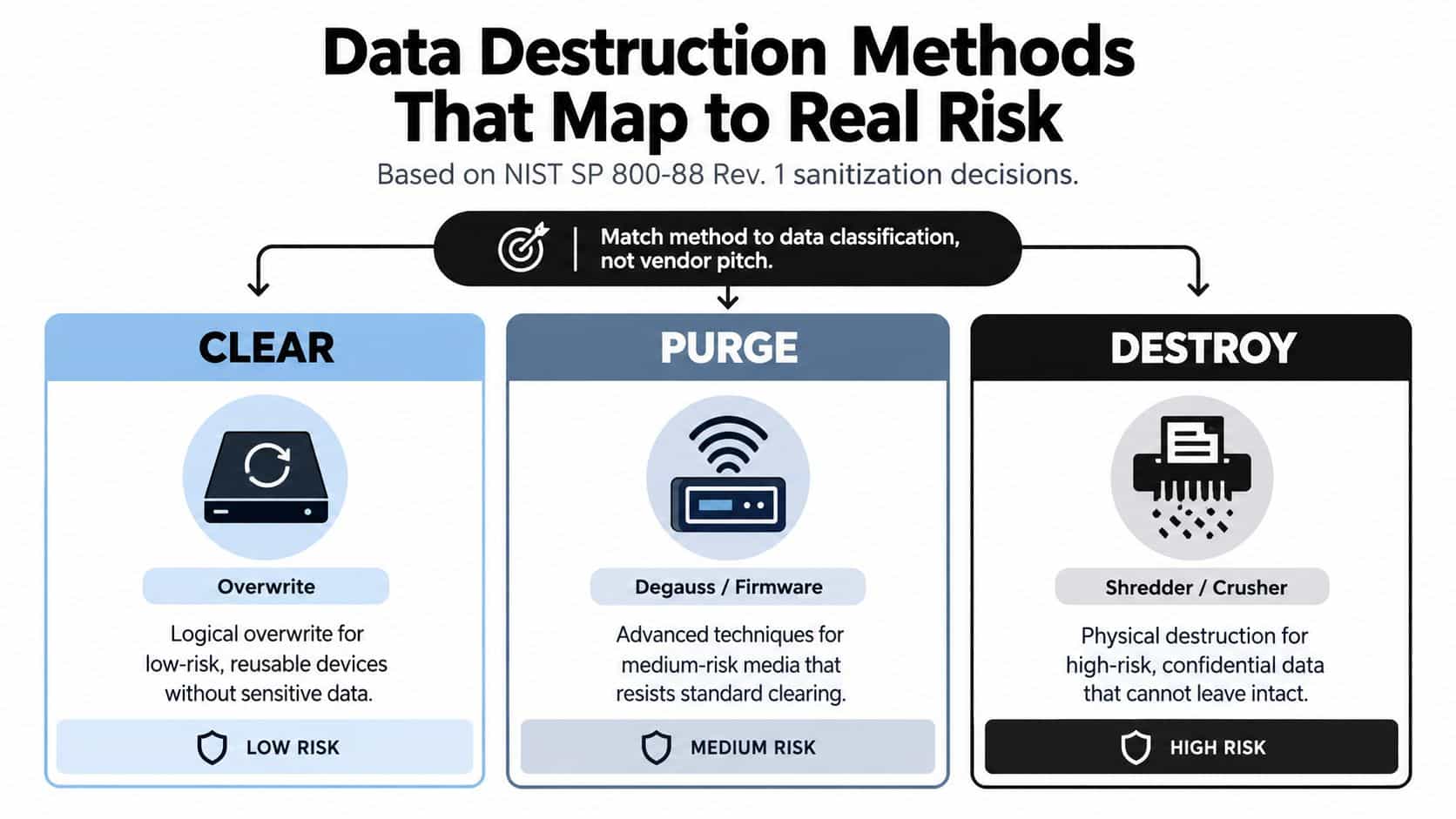
Data destruction decisions should follow risk classification, not vendor preference. The cleanest way to do that is to map the asset to a sanitization level based on NIST 800-88 concepts: clear, purge, and destroy.
Match the method to the media
Clear works for reusable assets in lower-risk environments when approved overwrite or equivalent logical sanitization is appropriate. It supports redeployment and resale, but only if verification is captured and the drive type responds reliably to the method used.
Purge fits situations where stronger sanitization is needed before media leaves control or where the media type calls for more than a standard clear. This can include cryptographic erase, firmware-based methods, or degaussing where applicable.
Destroy is the right lane for end-of-life media, failed drives, or assets holding highly sensitive information where reuse isn't worth the uncertainty. Physical destruction is simple to explain, but only if the organization can prove what was destroyed, where, and to what standard.
Avoid HDD assumptions on SSDs and embedded storage
Programs often drift off course. Teams build a wipe process around hard drives, then apply it to SSDs, self-encrypting drives, removable flash media, or embedded storage inside specialty equipment. That's how exceptions become exposure.
Use a decision model like this:
Reusable office laptop with standard internal data
Clear if validated and policy allows reuseDevice leaving a regulated environment
Purge or destroy, depending on media type and internal policyFailed drive or unreadable media
Destroy, because reuse can't be provenSpecialty equipment with uncertain storage architecture
Assume hidden or embedded storage until verified otherwise
Don't choose a method because it sounds more secure. Choose it because it matches the media, the data class, and the final disposition.
A detailed NIST SP 800-88 reference guide helps internal owners translate those categories into actual retirement decisions without over-destroying every reusable asset.
Chain of Custody, Certificates, and Compliance Evidence
A recycling receipt isn't compliance evidence. What holds up is a serialized record from first touch through final disposition.
Build custody as a device-level timeline
Each transfer should answer the same basic questions: what asset moved, who handled it, when it moved, how it was secured, and where it went next. That sounds obvious. It still breaks constantly when branch offices rely on handwritten notes or generic pickup tickets.
The formal recycling rate in the Global E-waste Monitor 2024 reflects only documented, formally collected material, not the full informal picture. That distinction matters because enterprise programs need documented custody, not just informal diversion claims (formal recycling documentation context).

What a defensible certificate should contain
A certificate of destruction should tie back to the chain log and include, at minimum:
- Asset identity such as asset tag and serial number
- Device details including make, model, and media type
- Custody linkage through pickup reference, seal number, or intake record
- Destruction or sanitization method and the referenced standard
- Sanitization level where applicable
- Date and location of processing
- Technician or authorized operator identification
- Unique certificate ID that maps to the vendor audit trail
A single PDF saying “materials recycled” doesn't answer any regulator's real question. It doesn't show whether a specific device was destroyed, wiped, resold, or received.
The more complex the compliance environment, the more this matters. Multi-jurisdiction guidance consistently points organizations toward serialized certificates, NIST 800-88-aligned sanitization, and unbroken records, especially where GLBA, HIPAA, or SOX controls affect retention and evidence expectations (cross-jurisdiction compliance guidance).
The chain-of-custody documentation model should be readable by audit, security, and procurement without translation. If only the vendor understands it, it isn't good enough.
Tracking, Cost Recovery, Rollout, and Audit-Ready Verification
A multi-site program is mature when field activity rolls up into reporting that finance, security, sustainability, and audit can all use without rebuilding the data. That requires a stable KPI set and a rollout plan that doesn't depend on heroic effort from local staff.
Publish a small KPI set consistently
Track a limited number of operational measures and make every one actionable.
| KPI | Definition | Source | Cadence |
|---|---|---|---|
| Assets received per site | Count of retired assets logged into the program by location | Asset tracking portal and intake logs | Monthly |
| Days from pull to certificate | Time between local collection and final certificate issuance | Custody records and certificate repository | Monthly |
| Destruction method by data class | Which sanitization methods were used for which classifications | Processing records | Monthly |
| Certificate completeness rate | Share of records containing all required fields | QA review | Monthly |
| Audit exceptions | Missing records, unmatched serials, or policy violations | Internal audit sampling | Monthly and quarterly review |
| Diversion from landfill | Material routed to documented reuse or recycling streams | Final disposition reporting | Quarterly |
Treat cost recovery as part of governance
Residual value shouldn't sit in a separate conversation from compliance. If reusable devices produce buyback value, define in advance whether that value returns to the business unit, offsets enterprise program cost, or credits the refresh budget. Do the same for internal redeployment.
This keeps finance and sustainability from reporting different outcomes for the same event.
The market for e-waste recycling is clearly commercial and growing. One 2026 market report estimated the sector at US$44.84 billion in 2026, up from US$40.27 billion in 2025, with a projection of US$76.77 billion by 2031 and an 11.34% CAGR for 2026 to 2031. Another market source projected US$44.61 billion in 2025 and US$76.92 billion by 2035 at a 5.6% CAGR for 2026 to 2035 (e-waste recycling market outlook). That growth doesn't remove the need for discipline. It increases the number of vendors and claims buyers have to sort through.
Roll out in phases and verify annually
Don't launch to every site at once. Pilot a small group of locations first. Confirm that site contacts can stage equipment correctly, that the portal captures the right fields, and that certificate output matches policy before scaling by region.
Use a repeatable rollout pack:
- Site training kit with staging rules, labels, contact list, and escalation path
- Readiness checklist for storage, access, and pickup constraints
- Exception log for unusual devices, missed pickups, or unresolved serials
Recent multi-site disposal guidance keeps returning to the same reality. Organizations struggle most with consistency, logistics coordination, and documentation across locations, which is why a centralized playbook matters more than generic recycling advice (multi-site IT disposal guidance).
The final control is independent verification. An annual audit should sample certificates, reconcile serialized asset tags to the repository, review exceptions, and confirm that downstream reporting matches what the program says happened. If your reporting trail is clean, audit becomes confirmation instead of discovery.
For teams building that reporting layer, an audit trail and reporting workflow helps connect local pickup activity to enterprise oversight.
Beyond Surplus supports business electronics recycling and IT asset disposition programs with serialized tracking, secure data destruction, certificates of recycling and data destruction, and pickup coordination for organizations operating across multiple locations. If you need a standardized process that can stand up to internal review and external audit, visit Beyond Surplus to review service options and start planning your rollout.


