A laptop refresh used to feel like routine housekeeping. In 2026, it's closer to a controlled exit process for business assets that may still hold customer data, residual resale value, and environmental liability. The world generated 62 billion kg of e-waste in 2022, equal to 7.8 kg per person, and only 22.3% was formally collected and recycled in an environmentally sound manner, according to the Global E-waste Monitor 2024. That gap is why IT asset disposition now sits at the intersection of security, finance, operations, and compliance.
The practical shift is simple. Businesses can't treat retired laptops, servers, phones, storage arrays, and lab devices as “stuff to haul away” anymore. They need a repeatable system that decides what gets reused, what gets resold, what gets recycled, and what must be destroyed, with proof at each handoff.
Table of Contents
- Why IT Asset Disposition Matters More Than Ever in 2026
- What IT Asset Disposition Really Means for Businesses
- How to Build a Secure and Compliant ITAD Program Step by Step
- Choosing the Right Data Sanitization Method for Every Device
- Industry Compliance and Chain of Custody Essentials
- Balancing Value Recovery Reuse and Sustainable Recycling
- How to Select an ITAD Vendor and Launch Your Program With Confidence
Why IT Asset Disposition Matters More Than Ever in 2026
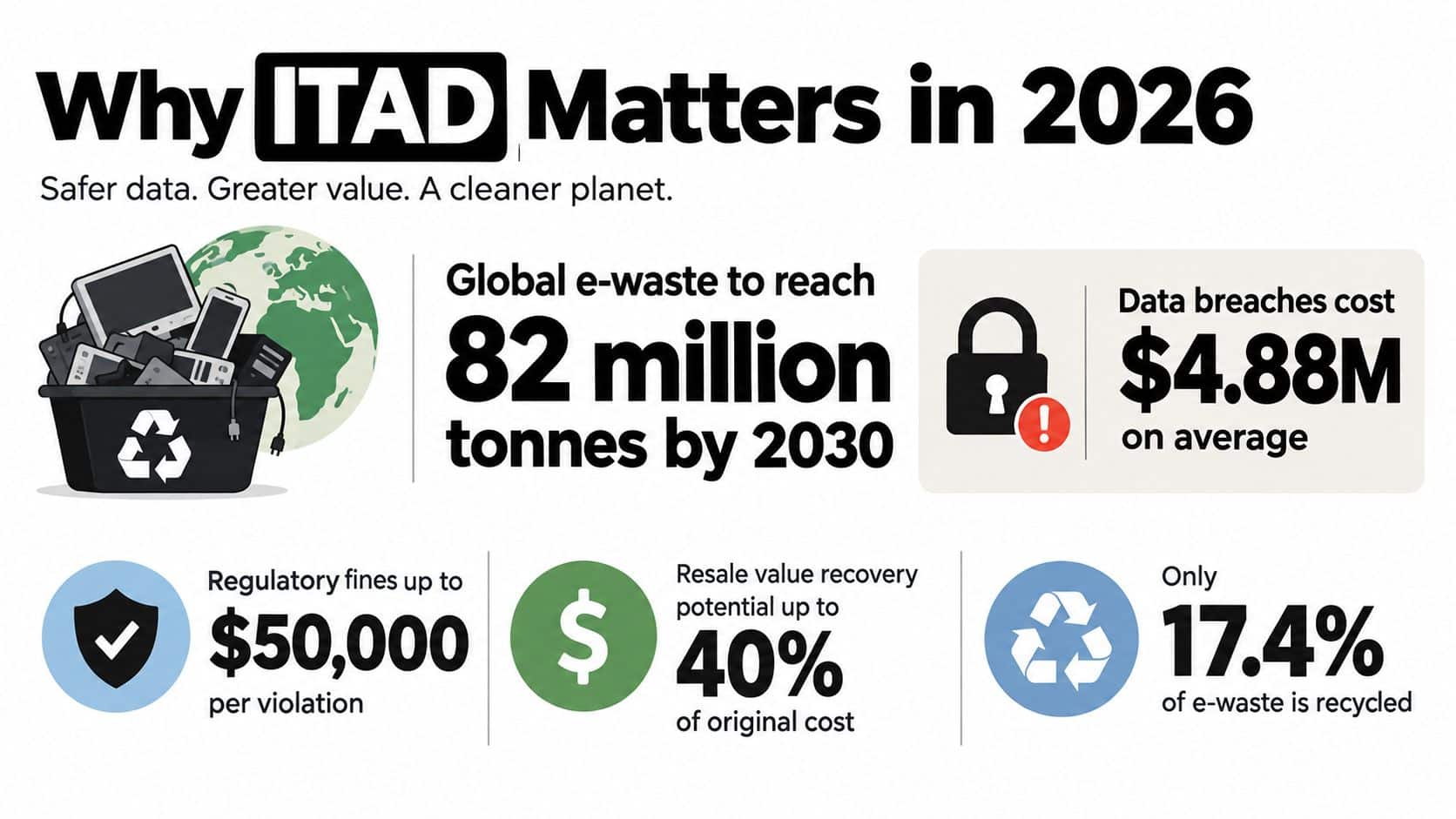
Global e-waste is projected to reach 82 million tonnes by 2030, up from 2022 levels, with annual generation rising by about 2.6 million tonnes per year, as summarized by the ITU coverage of the 2024 monitor. For business leaders, that number matters because every refresh, lease return, office closure, and data center cleanup feeds into the same system. If your company retires devices across multiple sites, ITAD is no longer a back-room cleanup task. It is a control point for risk, value, and accountability.
A common 2026 scenario is easy to recognize. Procurement approves the refresh. Operations wants old equipment out quickly. Security needs proof that no recoverable data leaves the building. Finance wants resale proceeds or accurate write-off records. Facilities wants pallets off the dock. Those priorities are all reasonable, but they pull in different directions unless one process coordinates them.
Why disposal became a business function
The shift happened because retired hardware carries several kinds of consequence at once. A laptop can hold regulated data. A server can contain high-value components. A batch of leased devices can create contract exposure if serials are missing or return conditions are not documented. A poorly handled shipment can turn a routine refresh into a chain-of-custody problem.
That is why ITAD works less like trash removal and more like an airport baggage system. Every asset needs the right tag, the right routing decision, and a record of each handoff. Without that discipline, devices disappear into a gray zone where nobody can easily prove whether data was sanitized, whether value was recovered, or whether downstream recycling met policy requirements.
In practice, the core decision is portfolio management. One group of assets should be reused internally because replacement costs are high and performance is still acceptable. Another group should be resold because market value remains strong after certified data sanitization. Another should be recycled for material recovery. Some devices or media should be destroyed because the data sensitivity, device condition, or media type makes any reuse path a poor business choice.
Practical rule: If an auditor, customer, or regulator asks where a retired device went, who handled it, how data was removed, and what final outcome it reached, your team should be able to answer from records, not from old email threads.
This is why IT asset disposition matters more in 2026 than it did even a few years ago. Buyers are dealing with tighter security expectations, more formal ESG reporting, stricter downstream vendor scrutiny, and heavier pressure to recover value from equipment budgets. The winning program is not the one that removes assets fastest. It is the one that makes the right reuse, recycle, or destroy decision for each asset class, while preserving chain of custody from pickup through final disposition.
Confusion usually starts when companies collapse three separate questions into one. Is the data gone? Is custody documented at every handoff? Did we choose the highest-value responsible outcome for that asset? A mature ITAD program answers all three, every time.
What IT Asset Disposition Really Means for Businesses
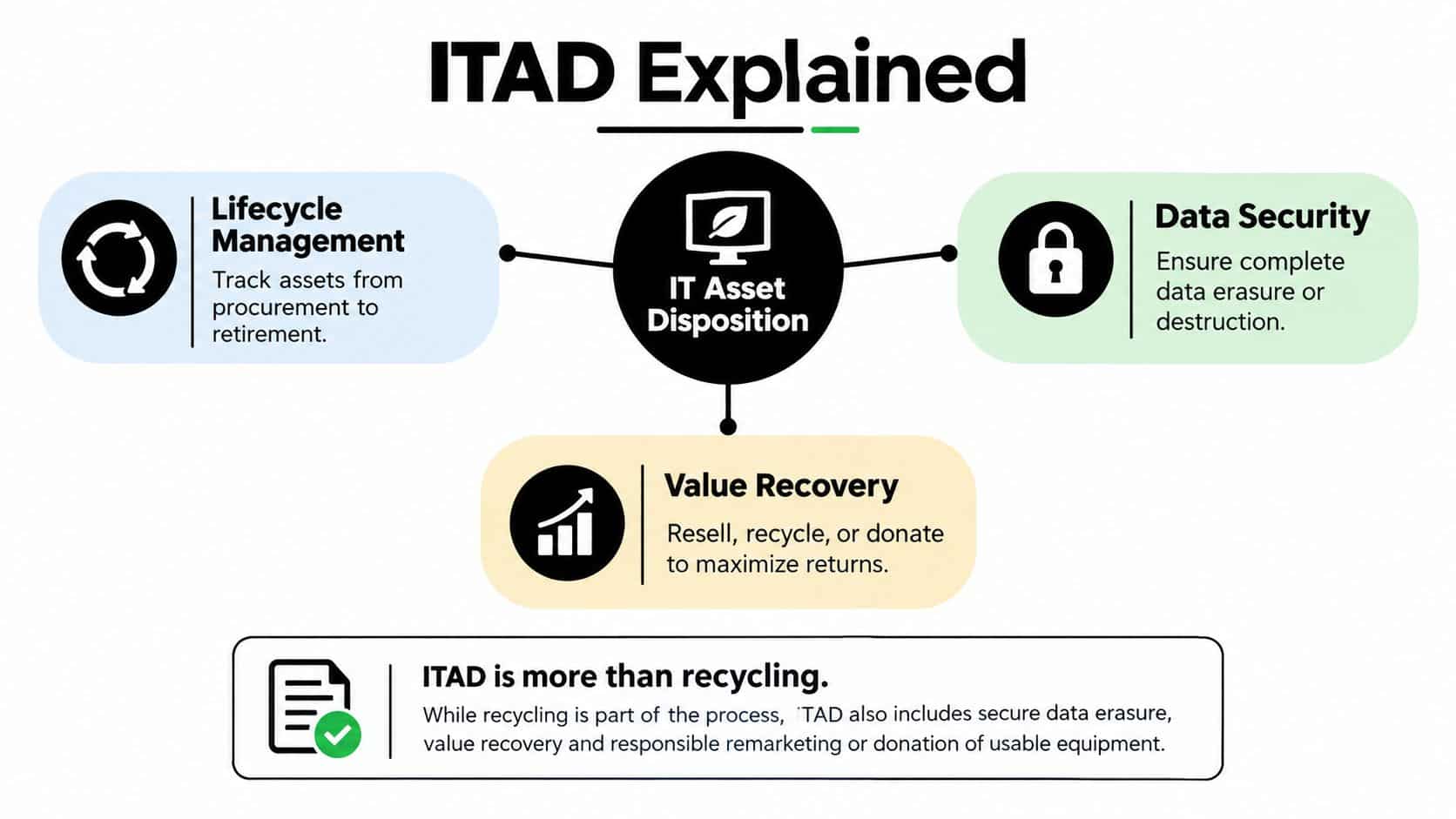
For a business, IT asset disposition is the controlled retirement of technology assets after they leave active service. It works like the closing process on a financial account. You do not just stop using the asset and hope the record sorts itself out later. You retire it through a documented process that covers inventory, data removal, transfer of custody, and the final outcome.
ITAD covers the full decision, not only recycling
A lot of confusion starts here. Business leaders hear “disposition” and picture a loading dock, a recycler, and a certificate. The actual job is broader. ITAD is the operating system for deciding whether an asset should be reused, resold, recycled, or destroyed, then proving that the chosen path was carried out correctly.
That distinction matters because each path has different tradeoffs.
A recent-model laptop with low data sensitivity may be a good candidate for internal redeployment. A batch of standardized notebooks may have resale value after certified wiping and testing. A damaged device with little market value may be better sent to material recovery. A failed drive from a regulated environment may need physical destruction because the risk is in the media, not the outer device.
For a deeper baseline definition, Beyond Surplus has a useful explainer on what IT asset disposition means for organizations.
The business goal is to control risk and recover value at the same time
Mature programs treat ITAD as both a risk function and a value function. Security teams care about whether data is gone. Finance cares about whether reusable equipment was written off too early. Sustainability teams care about where material ends up downstream. Operations cares about getting every serialized item accounted for without slowing down site moves, refresh cycles, or closures.
Those priorities can conflict if the process is weak. For example, a team can maximize speed by shipping everything out quickly, then lose track of which drives were wiped, which systems were resold, and which serial numbers never made it onto the final report. That is not disposition. That is loss of control.
The better model is portfolio triage. Treat the retired fleet like inventory at the end of a product season. Some units still have use. Some still have market value. Some only have commodity recovery value. Some carry enough data or enough physical damage that destruction is the sound business decision.
Three controls define whether the program is working
The first is lifecycle control. Every asset should match a known inventory record so your team can reconcile what was collected against what was supposed to leave service.
The second is data security. Media must be sanitized or destroyed using a defined method, with records that show what was done to which device or drive.
The third is chain of custody. This is the audit trail between “we retired it” and “here is its final documented outcome.” If custody breaks at any handoff, later paperwork does not repair the gap.
Analysts tracking global e-waste have shown a continuing pattern over the last decade: retired electronics are growing faster than formally documented collection and recycling systems. That gap helps explain why business buyers now ask harder questions about downstream vendors, serialized reporting, and proof of final disposition instead of accepting a generic recycling receipt.
ITAD sits at the point where asset management, security operations, compliance, and sustainability all depend on the same records.
Business ITAD also differs from consumer drop-off recycling in a basic way. A consumer usually needs a convenient outlet. A business needs evidence. Chain-of-custody logs, serial reconciliation, sanitization records, certificates, and final reporting are what turn retirement activity into a defensible program.
How to Build a Secure and Compliant ITAD Program Step by Step
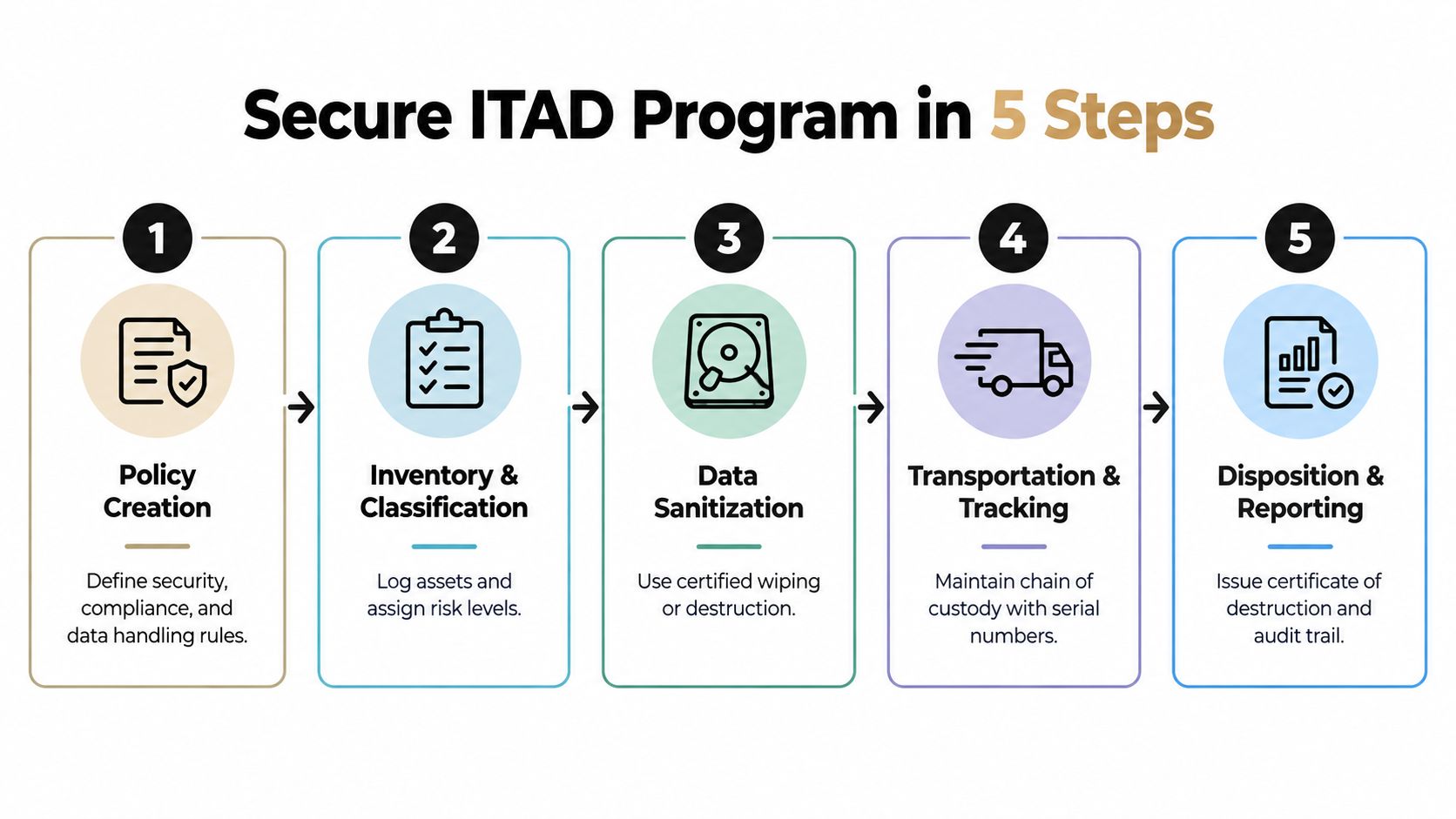
Teams usually get into trouble when they start with pickup logistics instead of policy and classification. A strong program begins long before the truck arrives.
Start with a written operating model
A practical enterprise workflow follows six connected steps: inventory and classification, chain-of-custody documentation, NIST SP 800-88 Rev. 2-aligned data sanitization, value-recovery triage, certified recycling or resale, and final audit reporting, as outlined in this enterprise IT asset disposal workflow summary.
That sequence works because each stage protects the next one. If classification is weak, sanitization choices will be wrong. If custody breaks, later certificates won't repair the missing evidence. If triage happens too early, you may resell something that should have been destroyed or destroy something with recoverable value.
For a practical planning checklist, see best practices for enterprise asset retirement.
The six handoffs that matter
Inventory and classification
Build the retirement list from a real asset register, not an email thread. Record serials, model types, storage media, location, owner, and sensitivity level. A laptop used by general staff and a drive from a finance server shouldn't flow through identical rules.Chain of custody
Log every handoff. Office to staging room. Staging room to pallet. Pallet to carrier. Carrier to processing site. Each transfer should identify who released it, who received it, when, and in what condition.Data sanitization
Apply the method that matches both media type and risk level. Many teams oversimplify by saying “wipe everything” without checking if overwrite is appropriate for the actual device.Value-recovery triage
After sanitization, decide whether the asset should be redeployed, remarketed, harvested for parts, recycled, or physically destroyed.Certified downstream processing
Don't stop at pickup. Ask where material goes next, who processes it, and what documentation returns to you.Final audit reporting
Reconcile the opening inventory to final outcomes. Every serialized item should land in a documented end state.
Multi-site programs need local discipline and central rules
Distributed fleets create the same failure pattern over and over. Headquarters writes a policy, but branch offices improvise collection, packaging, and temporary storage. That's how devices disappear from the record.
Use a short site checklist:
- Assign one local owner who approves asset release at each site.
- Use standard labels and manifests so serial capture looks the same across offices.
- Define a staging rule for locked storage before pickup.
- Require exception logging for missing tags, damaged devices, or mixed pallets.
Treat every handoff like an airport baggage transfer. If custody breaks for even one segment, the whole chain becomes harder to defend.
One option businesses use is Beyond Surplus, which provides secure data destruction, IT buyback, logistics coordination, and certificates of recycling and data destruction for business pickups. What matters most, though, is that any provider fits your workflow instead of forcing your team into undocumented exceptions.
Choosing the Right Data Sanitization Method for Every Device
Sanitization is where many smart teams become either too casual or too destructive. They either assume a standard wipe solves everything, or they shred devices that could have been safely reused. The better approach is to match the method to the media and the sensitivity.
Clear Purge and Destroy in plain language
NIST SP 800-88 defines three sanitization outcomes: Clear, Purge, and Destroy, summarized in this plain-language NIST 800-88 checklist.
- Clear is meant to make data recovery infeasible through normal system functions.
- Purge is stronger and is used when data sensitivity is higher.
- Destroy makes the media unusable so data is irrecoverable.
Overwriting is often misunderstood. NIST SP 800-88 Rev. 2 states that overwrite replaces user-addressable storage with non-sensitive data using standard read/write commands and can include metadata and all user-addressable locations. But it's ineffective for damaged or non-rewriteable media and may miss hidden or inaccessible areas, as stated in NIST SP 800-88 Rev. 2.
If the media can't reliably accept a write command, overwrite isn't a sanitization strategy. It's a hope.
Data Sanitization Method by Device and Sensitivity
| Media and Sensitivity | Recommended Method | When to Use |
|---|---|---|
| Standard user laptop with low to moderate business sensitivity | Clear or Purge | Use when the drive is healthy, accessible, and approved for reuse or resale |
| SSD or mixed modern endpoint storage with higher sensitivity | Purge | Use when stronger assurance is required before reuse or remarketing |
| Damaged hard drive or failed SSD | Destroy | Use when the device can't be reliably sanitized by software methods |
| Server storage from regulated workloads | Purge or Destroy | Use when data class, customer contracts, or internal policy require higher assurance |
| Removable media that is non-rewriteable or unreliable | Destroy | Use when overwrite isn't technically dependable |
The decision point teams miss
The media type matters as much as the policy label. A healthy workstation drive may be a good candidate for sanitization and reuse. A failed SSD from a compliance-heavy workload usually isn't. Don't let “same device category” trick you into “same sanitization path.”
Document the chosen method, who approved it, and the resulting evidence. In audits, consistency matters as much as technical correctness.
Industry Compliance and Chain of Custody Essentials
Compliance questions usually sound legal, but they're operational at heart. Who had the asset. What data may have been on it. What method was used. What proof do you still have.
What reasonable disposal looks like
The FTC Disposal Rule at 16 CFR Part 682 applies to businesses that maintain consumer report information and requires reasonable measures to protect that information during disposal, with no small-business exemption, according to this summary of U.S. IT disposal compliance requirements.
In practice, those reasonable measures include:
- Classifying assets by data sensitivity so not every device is handled identically.
- Using appropriate sanitization or destruction based on the type of information involved.
- Performing vendor due diligence before handing over regulated assets.
- Retaining disposal documentation as evidence that reasonable measures were taken.
For custody controls, this guide to chain of custody for IT asset disposal is a useful operational reference.
What different sectors usually need to prove
Healthcare teams often need strong evidence that retired devices containing patient-related information were controlled from decommission through final outcome. Financial services teams typically care about customer data, retention controls, and vendor oversight. Public sector and education environments often add procurement rules, surplus property procedures, and decentralized ownership challenges.
A good chain-of-custody record usually includes:
- Asset identifiers such as serial number and device type
- Transfer records showing each internal and external handoff
- Sanitization evidence tied to the item or batch
- Final disposition records such as resale, recycling, or destruction
- Certificates and audit summaries retained in a retrievable system
Your certificate matters. Your ability to tie that certificate back to the exact serialized asset matters more.
Cross-border operations add another layer. Public market coverage notes that Europe and Asia-Pacific are growing quickly, with Europe projected to rise from USD 8.14 billion in 2026 to USD 14.89 billion by 2031, while Asia-Pacific is a major growth region shaped by regional regulations, according to GlobeNewswire market coverage. For multinational firms, that means one workflow should support different rules without breaking local evidence requirements.
Balancing Value Recovery Reuse and Sustainable Recycling
The biggest strategic mistake in ITAD is treating reuse, recycling, and destruction as unrelated choices. They're part of one portfolio. Every retired asset should go down the path that best fits its condition, data risk, processing cost, and downstream demand.
Reuse first doesn't mean reuse always
Gartner-linked guidance notes that ITAD is increasingly centered on extending asset life to reduce greenhouse-gas emissions and e-waste, and that organizations are prioritizing asset reuse over recycling because refurbished devices can perform comparably to new ones in typical work settings, as summarized by Iron Mountain's 2026 Gartner Market Guide page.
That doesn't mean every device deserves another life. Reuse has friction. Testing takes labor. Shipping adds cost. Sanitization must be defensible. Warranty exposure can follow the asset. Demand may be weak for some models. Immediate recycling may be the cleaner business decision when those factors stack up badly.
A simple triage model
Use three buckets:
- Redeploy when the asset still fits internal performance needs and can be returned to service with limited effort.
- Resell or refurbish when there's an external market and sanitization plus handling cost still leaves meaningful recovery.
- Recycle or destroy when condition, media risk, age, or support status makes further use impractical.
If your team handles large phone fleets, resale timing and grading can be especially tricky. A practical outside resource on how to price used phones can help procurement or mobility teams think more clearly about condition, storage, and marketability before they send everything to scrap.
The wider sustainability case is hard to ignore. The Global E-waste Monitor 2024 press summary reports that the world generated 62 million tonnes of e-waste in 2022, up 82% from 2010. In business terms, responsible remarketing and certified recycling reduce downstream disposal risk while recovering usable value from equipment that still has a market.
How to Select an ITAD Vendor and Launch Your Program With Confidence
Vendor selection gets easier when you stop buying “pickup” and start buying control. You're choosing a partner to handle serialized assets, regulated data, and evidence your company may need long after the truck leaves.
What to verify before signing
Use a short evaluation list:
Security fit
Ask how the provider handles on-site pickup, staging, tamper control, and escalation for exceptions.Sanitization options
Make sure the vendor supports the methods your policy requires for different media types.Reporting detail
You want serial-level reconciliation, not a generic weight ticket and a broad confirmation.Value-recovery transparency
Ask how redeploy, resale, and recycling decisions are made and documented.Coverage and logistics
Multi-site businesses need pickup coordination that works across offices, clinics, plants, and data centers.Due diligence support
A structured checklist helps procurement and security review a provider consistently. This vendor due diligence checklist is a practical place to start.
How to launch without chaos
Start with one policy owner, one approved workflow, and one reporting template. Pilot the process on a contained batch such as a laptop refresh, a server room cleanout, or a closed office. Fix naming, custody, and exception handling there before scaling nationwide.
Good ITAD programs don't depend on heroic cleanup days. They run as a normal business process.
Beyond Surplus provides business IT asset disposition services that align with the controls in this guide, including secure data destruction, IT buyback, electronics recycling, product destruction, and nationwide pickup coordination with certificates of recycling and data destruction. If you're building or tightening your 2026 program, visit Beyond Surplus to review service options and start a documented disposition workflow for your organization.