

The most popular advice for recalled alarms is simple and often wrong. Unplug it, pull the battery, and throw it away. For a commercial facility, that sequence can destroy your recall evidence, leave a ceiling unprotected, and put a defective unit back into circulation through ordinary scrap. Recalled smoke detector disposal services should start with the exact notice for the exact model you've got, not with a trash container.
That discipline matters because recalls aren't small or uniform. Some affect units spread across many buildings, with different date codes, wiring types, and replacement instructions. If you can't prove which units left service, where they went, and what replaced them, you've got a paperwork failure long before you've got a waste problem. Most business loads fail on records, not on the sealed source inside the detector.
Table of Contents
- Reading the Recall Notice Before You Remove Anything
- Matching Your Detectors to the Right Disposal Route
- How to Quarantine and Prepare Recalled Detectors
- Handling Damaged Mixed and Bulk Ionization Detectors
- Keeping Chain of Custody and Booking the Pickup
Reading the Recall Notice Before You Remove Anything
Read the recall notice before authorizing removal. Match its manufacturer, model, date code, and recall number against the unit or packaging, not a purchase order description such as “hardwired alarm.” Similar-looking models can have different remedies. Confirm that each unit is covered before scheduling work.
The U.S. Consumer Product Safety Commission recalls listing shows that instructions vary by notice. One may require the alarm to remain installed until a replacement is ready. Another may require a tag and photographs before replacement or disposal. Those instructions determine the order of work, so record the applicable remedy for each model.
What Each Instruction Actually Requires
| Recall notice instruction | Action before removal | Record to keep |
|---|---|---|
| Keep installed until a replacement is in place | Keep the unit in service, schedule replacement, then remove batteries | Replacement install date and battery route |
| Mark as recalled and photograph before replacement | Tag the unit, photograph model and date code, replace before disposal | Photos, tag log and replacement invoice |
| Return through the manufacturer | Request the return label and ship as instructed | Return tracking number and remedy confirmation |
| No disposal instruction given | Contact the manufacturer or local fire authority before removal | Written reply and date received |
Use the notice as the starting point for the table. If it says to keep the alarm installed, schedule the replacement and record its installation date before removing the old unit. Handle batteries under local rules after removal. If it requires a tag and photographs, capture the identifying details before replacement, then retain the evidence required for the remedy. If the manufacturer specifies a return, use that channel and keep the tracking information rather than choosing a disposal route.
Do not create a gap in fire protection. Removing alarms from a hospital wing, school corridor, rental floor, or data-center hall before replacements work can leave people and operations exposed. For hardwired or interconnected units, coordinate the changeover with a qualified contractor. A Utah facility could use a licensed electrician in Northern Utah for panel-connected de-installation. The same principle applies elsewhere: qualified electrical work helps keep circuits and monitoring intact during replacement.
Practical rule: Record which recall instruction applies to each unit and when you confirmed it. Do not remove the unit until that check is complete.
Close this stage with a dated entry in the recall file naming the instruction followed. That record links the eventual disposal paperwork to the remedy. When defective units must stay out of resale channels, use a recalled electrical product destruction service that provides a certificate of destruction for the load, and retain the certificate in the same recall file. If the notice is silent about disposal, obtain a written answer from the manufacturer or local fire authority before anyone removes a unit.
Matching Your Detectors to the Right Disposal Route
Sort the batch into one of four routes before you book anything. Each route returns different paperwork, accepts different damage and volumes, and fails in a different way. A mismatch is the usual reason a commercial load gets refused at the dock or sits in quarantine while someone re-papers it.
| Option | Best for | Documentation returned | Main limit |
|---|---|---|---|
| Manufacturer return program | Units from the exact recalled model | Return tracking and remedy confirmation | Covers only the named model and recall |
| Certified electronics recycler | Mixed loads and pickup at scale | Certificate of recycling and destruction for each load | Confirm in writing that detector units are accepted |
| Municipal or county hazardous-waste program | Small, unrecalled batches | Drop-off receipt, if issued | Rarely takes bulk or damaged units without approval |
| Licensed radioactive-waste contractor | Bulk ionization units and damaged devices | Manifest and treatment record | Higher cost and longer scheduling lead time than standard recycling |
Reading the Four Routes Honestly
A manufacturer return program is your first choice when one exists. It preserves remedy traceability for the precise recalled model and keeps defective stock from being resold or redeployed by a downstream buyer. Its limit is scope. It won't take your non-recalled spares, your other brands, or the monitors stacked next to the detectors.
A certified electronics recycler fits mixed business loads and pickup at scale. That's the route for a facility clearing detectors alongside computers, printers, and surplus IT gear, provided the recycler confirms in writing that detector units themselves are accepted, not just general electronics. We operate in this lane for mixed business electronics, and our recalled lighting product disposal service follows the same acceptance discipline for other recalled building products. I would not book this route on a verbal yes.
A municipal or county hazardous-waste program can work for a small, unrecalled batch, but it's rarely built for bulk ionization units or damaged devices without prior approval. Expect a drop-off receipt at most, which won't satisfy a recall file that needs model-level reconciliation.
A licensed radioactive-waste contractor is the route for bulk ionization detectors, damaged units, and anything an authority has flagged. It's slower and costs more, and that's the correct trade-off when the other lanes won't accept the load in writing.
Questions to Ask Before You Book
- Ionization acceptance: Will you accept americium-241 ionization units, confirmed in writing before pickup day?
- Recalled stock: Will you take recalled units, and what recall identification do you need on the manifest?
- Certificate per load: Which certificate do you issue for each load, and does it name the units and treatment route?
- Damaged arrivals: How do you handle a unit that arrives cracked or opened, and who decides its next route?
On certification, be specific about what you're buying. Every client receives NAID certified destruction, whether the pickup is free or carries a flat fee with us, which matters when recalled stock must not re-enter the market. You can also request service on your terms, since customers can request a recycling pickup or drop-off by phone, by email, or by filling out the online form.
Don't let a low pickup quote decide the route. A cheap load that returns no certificate, or a receipt that just says "electronics," leaves your recall file open. The right route is the one whose paperwork matches what your safety, compliance, or procurement team will ask for months from now.
How to Quarantine and Prepare Recalled Detectors
Read the recall-instruction table before anyone pulls a detector. Most commercial loads fail on the paperwork, not on the sealed source. The EPA americium in ionization smoke detectors guidance states that the americium-241 source is sealed in metal foil and breaks only through deliberate force. That limit tells you how to handle the unit. It does not replace a log, a count, or a chain of custody you can reconcile later. Work in order and record each step as you finish it.
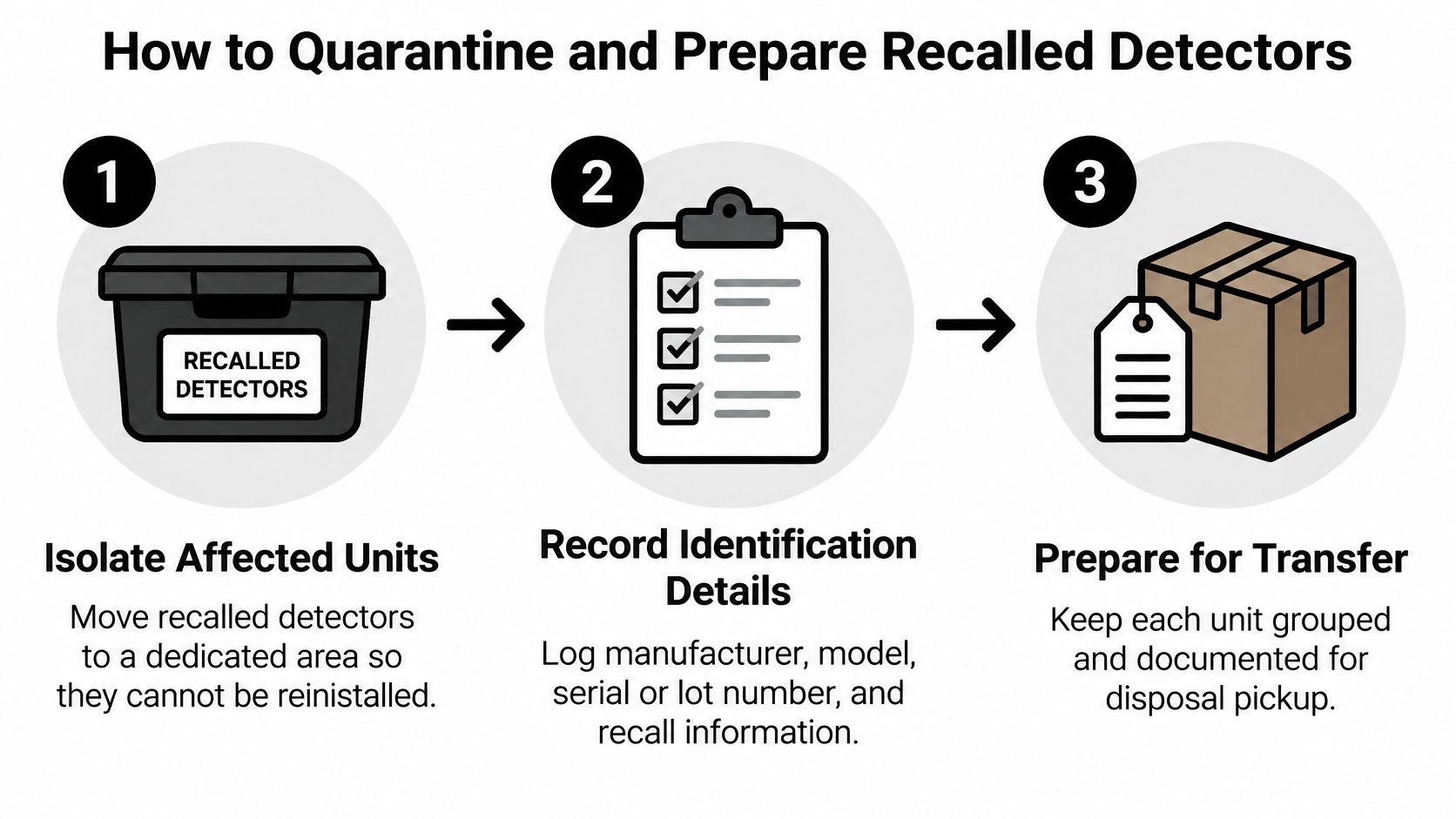
The Eight Preparation Steps
- Isolate the affected units. Move them to a dedicated quarantine area so a maintenance tech cannot grab one to silence a chirping alarm on another floor. Physical separation stops the most common redeployment error.
- Record every unit. Log manufacturer, model, serial or lot number, recall notice, quantity, and condition for each one. You will reconcile this log against the container count and the pickup manifest. A blank serial field becomes a dispute after the truck leaves.
- Confirm the sensing type. Mark each unit ionization or photoelectric. Only ionization units carry the americium-241 source. The label on the back usually states the type. Do not guess from the housing shape.
- Keep every unit intact. Do not open, crush, drill, or dismantle a detector, and do not remove the sensing chamber. The chamber is sealed so the foil stays intact. Tampering turns a routine transfer into a specialized handling problem.
- Handle batteries only as directed. Remove a battery only where the manufacturer or local authority directs it, then put batteries in the applicable battery-recycling stream. Loose batteries tossed into the detector container create a separate rejection risk at receiving.
- Contain and label. Place intact units in a labeled, covered container protected from weather, impact, and unauthorized access. Mark the recall identity and the count inside so anyone moving it knows it is not general e-waste.
- Hold problem units aside. Any unidentified or physically damaged unit waits for regulator or fire-authority guidance. Do not bury it in an otherwise clean load and hope receiving does not notice.
- Arrange de-installation for wired units. If detectors are still wired into ceilings or panels, schedule technician removal instead of having general staff pull them down. Beyond Surplus provides technicians to de-install equipment when necessary, which keeps interconnected circuits and panel programming from being damaged during the swap.
A quarantined unit that is not on the log does not exist for compliance purposes, and it will surface at the worst time, usually during an audit.
Our recalled product quarantine services cover this holding stage, where recalled stock stays segregated and documented until the route the notice allows is confirmed. Quarantine is a controlled state with an owner, a count, and an exit plan.
Finish with a physical check before you book transport. Open the container, count the units, and compare that number to the log. I would not release the load while those two numbers disagree. Find the missing unit while it is still in your building. Reconciling after the truck leaves is slower, weaker, and sometimes impossible to prove.
Handling Damaged Mixed and Bulk Ionization Detectors
An intact ionization detector is not the hazard often imagined. According to EPA material on americium in smoke detectors, americium-241 emits alpha particles and low-energy gamma rays and is bonded to metallic foil sealed within the device. The alarm works when smoke interrupts that ionization inside the chamber. In ordinary storage, the housing contains the source, and the principal risk comes from tampering or damage, not from a sealed unit sitting in a labeled container.

Routine disposal stops in three situations, and each one changes what you do next.
| Case | Action | Record |
|---|---|---|
| Intact ionization unit | Keep sealed and use the approved route | Model count and condition |
| Damaged or opened chamber | Isolate, photograph, and contact contractor or regulator first | Photos and written direction |
| Bulk consignment of about 10 or more | Count units, keep them intact, and get written acceptance | Acceptance criteria and manifest |
| Mixed with computers or other electronics | Sort detectors out of the general e-waste stream | Load list showing detectors separated |
Damaged Units and Bulk Thresholds
Isolate a damaged unit immediately. Photograph the housing and any exposed chamber, then get direction from your licensed contractor or regulator before it moves anywhere. Don't tape it shut and add it to the clean load. A cracked unit that's discovered at receiving can hold up the entire shipment while the receiver decides whether to refuse it.
Bulk loads need a count and written acceptance before shipment. The Australia EPA household smoke detectors guidance reflects thresholds used in several jurisdictions, where typical ionization sources are less than 37 kBq of americium-241 per unit and regulatory requirements may apply to consignments of 10 or more detectors. Single-unit logic doesn't scale. Once you're aggregating detectors from multiple floors or sites, you need the receiver's acceptance criteria in writing, not an assumption borrowed from a household rule.
Mixed Commercial Loads
Separate ionization from photoelectric devices where practicable, and keep all detectors out of the general electronics stream. Say a property manager is clearing a floor with computers, monitors, printers, and forty detectors in the same pickup. If those detectors are buried in gaylords of mixed e-waste, the receiving recycler can refuse the shipment or pull the load for re-sorting at your cost. A load list that shows detectors separated, counted, and containerized prevents that argument.
Our electronics are processed through environmentally compliant recycling channels in accordance with EPA guidelines, and our universal waste regulations guidance covers how regulated streams like this interact with standard e-waste. If a unit's condition or origin is unclear, hold it and ask. That single decision protects the rest of the load.
Keeping Chain of Custody and Booking the Pickup
Treat the pickup as a transfer of liability that must still be provable months later, when the people who loaded the truck may not remember the day. My working rule for recalled-equipment programs: most business loads fail on paperwork, not on the sealed source. You don't need a new set of records for this stage. You need the records you already created to survive transport, receiving, and filing.
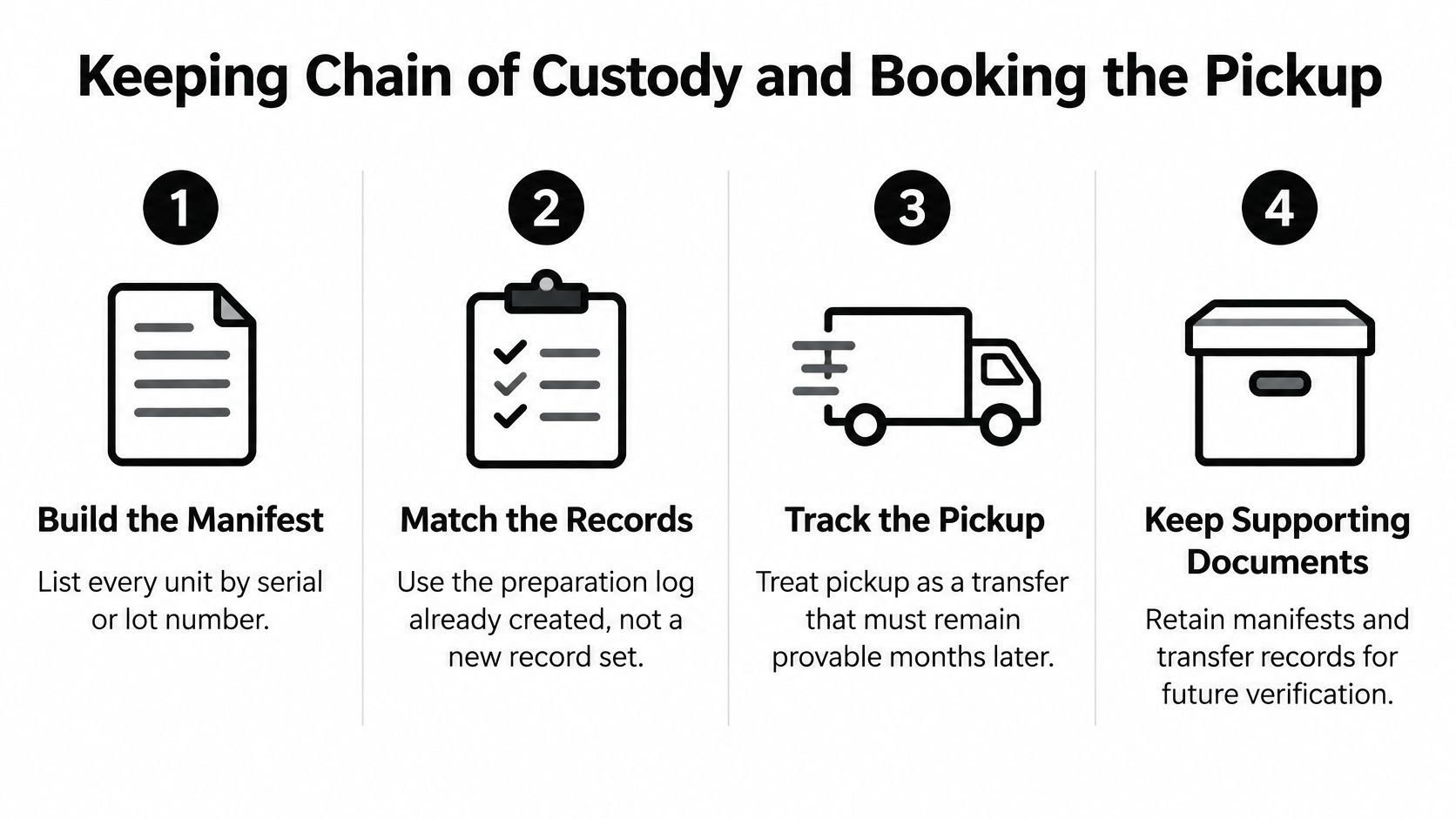
The Custody Checklist
- Build the manifest from your log. List every unit by serial or lot number, condition, and destination, then reconcile the count shipped against the count received. If receiving counts fewer units than you shipped, that discrepancy gets resolved against this document, so it has to be exact.
- Require a certificate that names the load. A certificate of recycling or destruction should identify the units, the date, and the final treatment route. Certificates of recycling and data destruction are available for each load of equipment picked up from us, so keep one in every recall file, and you can review our certificate of destruction for recalls for the terms it covers.
- File one folder per recall. Put the certificate with the recall notice, the confirmation date, photos, tag logs, and replacement invoices. Auditors and fire marshals don't want to assemble your story from four inboxes. One file per recall means anyone can verify removal, replacement, and disposition in minutes.
- Use witnessed verification where compliance requires it. Clients who need to witness the process can do visual verification of destruction at the Smyrna warehouse. That's the right option when a regulator, insurer, or customer contract demands eyes on destruction rather than a paper assurance.
- Resolve mismatches before the truck leaves. A missing unit, an unexpected model, or a damaged container goes on that day's manifest in writing, signed by both sides. Silent discrepancies become your problem alone once the vehicle pulls away.
- Record who signed each transfer. Names, dates, and destinations for every handoff, retained for the period your internal retention policy sets. Custody without signatures is just a shipping estimate.
Closing check: Liability transfers cleanly only when the paperwork matches the physical units, unit for unit.
That last point is structural, not legal fine print. Every load receives a Certificate of Recycling and Data Destruction, and all liability transfers to Beyond Surplus on our pickups, but that transfer is only as strong as your manifest accuracy. If your file says forty units and the container holds thirty-eight, the certificate can't close the gap for the two you can't account for.
Booking the Actual Pickup
With the log reconciled and written acceptance in hand, book the pickup or drop-off and state clearly whether a technician must de-install wired units first. Send the recall details, model list, quantities, and condition notes with the booking, not after it. That information determines the vehicle, the containers, and whether a specialized contractor needs to be part of the route for damaged or bulk ionization units.
We schedule certified electronics recycling for business customers across the contiguous United States, and we work with IT directors, facility managers, schools, healthcare systems, and property managers who need documented end-of-life treatment rather than a handshake. Contact Beyond Surplus for certified electronics recycling and secure IT asset disposal, and send the recall details, model list, and quantities so the acceptance check happens before pickup day, not on your loading dock.
Send us your recall notice, model list, and unit counts, and we'll confirm the right disposal route, document chain of custody, and issue certified records for every load. Visit Beyond Surplus to book your pickup and close out your recalled detector file with paperwork an auditor can verify.


