

Sending recalled equipment straight to an electronics recycler sounds responsible. It can also be the wrong response. Recalled electrical product destruction starts with the recall remedy, not a shredder booking, because premature destruction can eliminate evidence, interrupt a manufacturer's return program, or leave a business unable to prove compliance.
Table of Contents
- Why Recalled Electrical Products Cannot Go Straight to Recycling
- Confirm the Recall Remedy Before Anything Is Destroyed
- Regulatory Requirements Before Recalled Products Are Destroyed
- How to Destroy Recalled Electrical Products Step by Step
- Matching Destruction Methods to Each Product Type
- Verifying Destruction and Avoiding Audit Failures
- Vetting a Destruction Vendor and Booking Your Pickup
Why Recalled Electrical Products Cannot Go Straight to Recycling
Say an IT manager finds 60 recalled docking stations in a storage room and asks whether they can join the next retired-equipment pickup. The warehouse wants the space back, and the usual e-waste vendor already has a truck scheduled. The answer isn't automatically yes.
Those docking stations need a recall-specific disposition decision before they move. A functional check won't establish that they're safe, and a routine recycling order won't establish that destruction is authorized.
Electrical products can still power on despite undersized wiring, loose connections, defective components, or improper grounding. The CPSC warning about faulty extension cords, power strips, and surge protectors explains how electrical defects create overheating, fire, and shock hazards. Testing suspect equipment to see whether it works exposes staff without resolving the recall.
Control the exit route
The risk isn't confined to the equipment room. Once recalled stock enters an ordinary surplus stream, another team may mistake it for usable inventory.
- Surplus sales: Buyers may receive defective equipment without the recall information.
- Donation programs: A worthwhile reuse objective doesn't authorize redistribution of recalled stock.
- Employee take-home arrangements: Informal transfers make affected units difficult to locate.
- Mixed recycling pallets: Processors may assess equipment for resale unless written restrictions prohibit it.
Facility managers, IT directors, procurement leads, retailers, and school districts need a consistent decision across every location holding affected equipment. Local staff shouldn't invent different routes for identical recalled products.
A defensible response establishes the remedy, regulatory conditions, processing method, and required evidence before collection. It also assigns someone to resolve inventory exceptions rather than treating the pickup receipt as project completion.
Practical rule: The recall notice, not the disposal vendor, decides the first move.
Confirm the Recall Remedy Before Anything Is Destroyed
Which remedy does the recall require? That question belongs at the top of the work order. The CPSC's five-year recall-remedy data classify disposal as 1.1% of recorded remedies, compared with refunds at 54.5%, repairs at 26.4%, and replacements at 17.0%. Destruction is an exception, not the default response to every recall.
Recall remedies, required actions and evidence to keep
| Remedy | When it applies | Required action | Evidence to keep |
|---|---|---|---|
| Refund | Recall offers money back on the product | Follow the recall's return or disabling instructions and log the refund claim | Refund receipt or recall claim log |
| Repair | Recall authorizes a manufacturer fix | Keep the unit in quarantine until repair is confirmed; don't destroy | Repair order and serial closure record |
| Replacement | Recall swaps the unit for a new one | Ship or disable the defective unit as the recall directs | Shipping record and replacement serial number |
| Return | Recall requires return to the manufacturer or a designated site | Segregate, label, and ship with written instructions | Bill of lading and receiving confirmation |
| Dispose or destroy | Recall or CPSC instructions require destruction | Notify CPSC staff by email, then follow the documented, authorized procedure | Destruction certificate, photographs, and serial list |
A refund describes the financial remedy, but it may also require a physical action. Don't assume that payment approval means the unit can immediately enter ordinary recycling.
Match the notice to the actual inventory
Read the complete notice, including identification photographs and remedy instructions. Compare the manufacturer, model, serial range, batch, and lot codes against the equipment labels, not just the purchasing description.
A docking-station purchase order may cover several revisions. Some units may fall outside the affected range, while replacement units purchased later may still be included. Mark unresolved matches as hold for identification, not cleared for disposal.
Ask the manufacturer to confirm the proposed route in writing. The CPSC Recall Handbook supports coordinating destruction with the manufacturer and keeping off-site recalled stock segregated, labeled, excluded from salvage, and accompanied by written instructions.
Some notices specify disabling a product by unplugging it and cutting its cord before disposal. That's a particular recall remedy, not general permission for warehouse staff to cut cords on unfamiliar equipment.
Premature destruction can erase identifying labels, remove evidence of a defect, and prevent completion of a required return. If equipment is connected to an injury, property-loss claim, or investigation, involve legal counsel before altering it.
Ambiguous notice, ambiguous inventory, or conflicting directions means stop. Obtain written direction from the manufacturer and CPSC before authorizing destruction.
Regulatory Requirements Before Recalled Products Are Destroyed
Destruction is often the wrong first move. The recall notice and the regulator's instructions set the remedy, and a recycler's truck arriving on schedule changes none of that. Treat regulatory clearance as a release gate: assign one responsible person to hold the correspondence and block loading until every condition is settled.
The responsible party must notify CPSC staff by email before recalled products are destroyed, disposed of, or recycled, as the CPSC Regulated Products Handbook requires. Preserve the notification and any response in the batch file, and resolve supervision or evidence requirements before setting the processing date.
Establish the conditions for release
Work from a written authorization checklist:
- Remedy approval: Attach the recall notice and any manufacturer or regulator clarification authorizing destruction.
- Notification: Record who contacted CPSC, what inventory was described, and what instructions followed.
- Jurisdictional review: Have the environmental lead confirm applicable state and local handling requirements.
- Supervision arrangements: Determine whether government witnessing or other verification must be accommodated.
- Record retention: Agree with legal counsel on retention for recall, warranty, regulatory, and liability records.
CPSC or U.S. Customs and Border Protection personnel may supervise destruction, and CPSC can require an affidavit with photographic evidence. Build those possibilities into the schedule rather than promising documentation after the load is gone.
Separate recall authorization from waste classification
Authorization to destroy a product doesn't settle how its hazardous components are handled. Batteries, capacitors, CRT glass, and refrigerant-bearing equipment each need an assessment matched to the material and the jurisdiction. Our universal waste regulations guidance frames that environmental review; confirm the requirements against the actual batch, because electrical products rarely fall into a single waste category.
A scheduled pickup isn't regulatory permission to process the load.
Name the person who can release the stock, and record any conditions still open. A vendor willing to collect the material cannot substitute for the manufacturer's remedy or the regulator's instructions.
How to Destroy Recalled Electrical Products Step by Step
Give the warehouse lead a controlled work order, not a general instruction to clear the room. The CPSC Regulated Products Handbook requires email notification before destruction, disposal, or recycling, compliance with applicable state and local regulations, and provision for possible supervision, witnessing, or an affidavit with photographic proof.
The warehouse sequence below supports those controls.
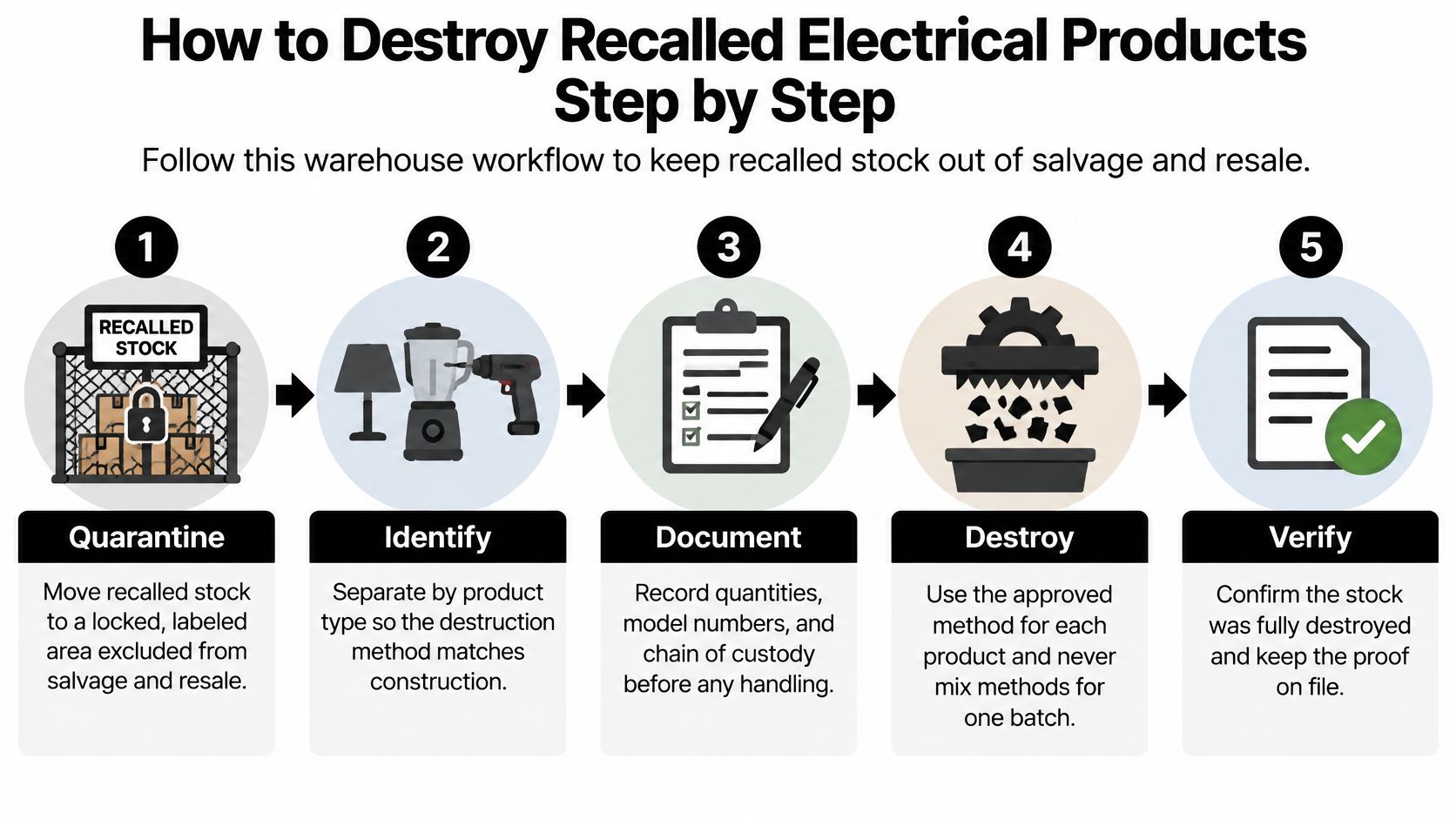
Control the batch before processing
Quarantine the stock. Move affected equipment into a locked, labeled area excluded from salvage and resale. Don't rely on a removable sticky note that another shift may overlook.
Reconcile identifiers. Match serial numbers or lot codes to the recall notice and flag mismatches before processing. An unexplained extra unit needs investigation, not an adjustment made solely to balance the count.
Photograph and assign the batch. Capture readable unit labels and pallet condition before dismantling, then attach the images to a batch ID. Photographing only after the first dismantling pass can leave you with components that no longer have identifiable owners.
Complete the regulatory release. Apply the notification, supervision, and affidavit controls established in the regulatory review before destruction, disposal, or recycling begins. Keep the email correspondence and release decision with the work order instead of leaving them in an individual coordinator's inbox.
Process under an authorized method
Separate hazardous components safely. Qualified personnel should remove batteries, capacitors, CRT glass, and refrigerant-bearing parts under an approved procedure before mechanical processing. Don't ask warehouse staff to open damaged batteries or unfamiliar high-voltage assemblies to keep the line moving.
Route storage and chassis separately where needed. Send data-bearing media to its specified destruction process, then process the remaining product according to its construction and recall instructions. Crushing a chassis while leaving its drive or battery intact doesn't complete the job.
Record the endpoint. Document what was processed, when, how, by whom, and where the resulting materials went. A photograph of a crushed pile cannot replace an inventory-linked disposition record.
Hold the file open for verification. Keep the batch record active until inspection, quantity reconciliation, and signatures are complete. Don't mark the project closed merely because the collection vehicle has departed.
Our processing policy is that equipment failing reuse standards, equipment that's unrepairable, old or obsolete, and equipment contractually prohibited from remarketing is recycled and completely destroyed by de-manufacture and/or physical shredding. For recalled stock, the authorized remedy still controls whether that processing may begin.
A finished batch has every serial accounted for, every hazardous component assigned to an appropriate channel, and every required log entry signed. Exceptions remain visible until someone resolves them.
Matching Destruction Methods to Each Product Type
A recalled pallet can fail before it reaches a shredder: the recall notice and CPSC instructions decide whether units are repaired, replaced, refunded, returned, or destroyed. Match the method only after that clearance, then to the product, its storage media, and its hazards. A mixed pallet is not one destruction category, even when every item carries the same recall number.
Destruction method by product type
| Product | Preferred destruction method | Remove before processing | Data risk |
|---|---|---|---|
| Laptops and desktops with hard drives | Hard-drive shredding to NAID-approved particle size; certified wiping only where the remedy permits it | Batteries and removable media | High |
| Solid-state drives and flash media | Melting or another specified destruction method; ordinary shredding may be ineffective | Batteries in the containing device | High |
| CRT monitors and TVs | Specialist dismantling and controlled glass processing | Leaded CRT funnel glass for controlled handling | Low to medium |
| Lithium batteries and UPS units | Separate battery removal, then recycling through a compliant channel | Lithium cells and sealed lead-acid batteries | Low |
| Printers, copiers, and multifunction devices | Specified destruction of internal storage, then chassis recycling | Toner, drums, and storage modules | Medium |
| Servers and storage arrays | Drive-level destruction followed by chassis recycling | Drive caddies and batteries | High |
| Power supplies and transformers | Dismantling, with capacitors and oil routed to appropriate hazardous handling | Capacitors and transformer oil | Low |
The data-risk labels are screening priorities, not clearance decisions. An unfamiliar printer, display controller, or UPS management module may contain storage even when the main equipment seems non-data-bearing.

Distinguish product destruction from media destruction
The IRS media sanitization guidelines explain the importance of media-specific destruction, including limitations of shredding or pulverizing modern high-density storage. SSDs may require melting or another appropriately specified process; a method suitable for a conventional hard drive is not automatically sufficient.
Beyond Surplus shreds hard drives to NAID-approved particle size, records the work under 24/7 video surveillance, and documents each drive with a serialized certificate of destruction. That hard-drive specification should not be treated as a blanket method for every flash-based device.
A certified wipe also does not physically destroy a recalled product. It can address data only when the governing remedy and security requirements allow that route.
Remove hazards before applying force
Leaded CRT funnel glass requires controlled handling. Batteries and capacitors need separation before mechanical processing, and refrigerants require qualified recovery rather than release during dismantling.
For battery-powered accessories, our recalled charger and power bank disposal guidance helps distinguish the product from its battery-related handling needs.
A retail page can explore LED Hanukkah display features to show how a seasonal display is assembled, but a product description does not establish recall clearance, battery removal instructions, or disposal authorization.
If storage is present and the method remains unclear, treat the unit as data-bearing and hold it until the processing specification is confirmed.
Verifying Destruction and Avoiding Audit Failures
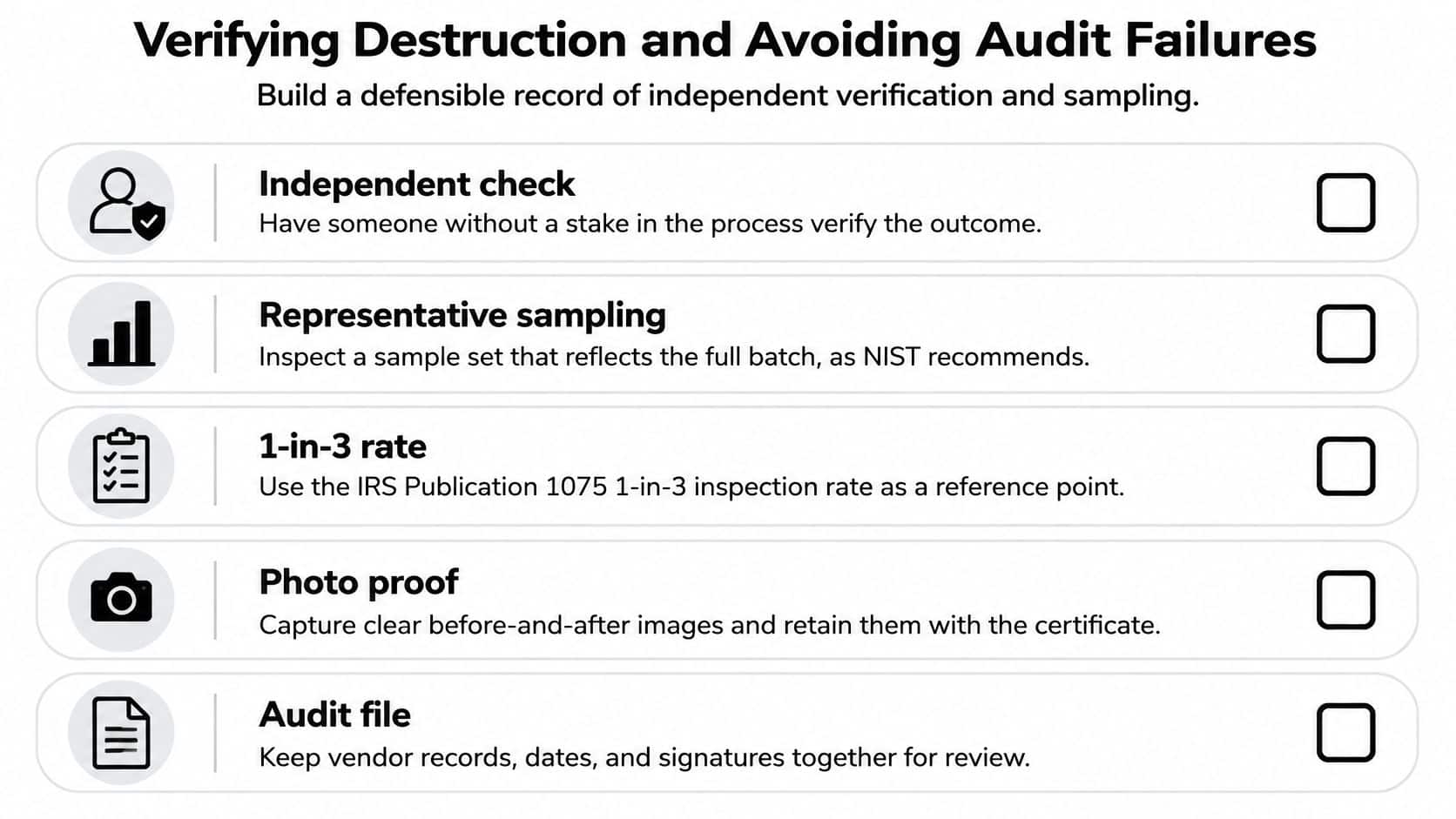
The operator's statement that the batch is finished is the start of verification, not its conclusion. Assign the check to someone who can reject incomplete work without being responsible for meeting the processing target.
NIST sanitization guidance and the associated federal-media verification benchmark support representative sampling and independent verification where possible; IRS Publication 1075 requires checking every third piece of physical electronic media containing federal tax information for appropriate destruction. That inspection rate is not a universal rule for recalled equipment.
Verify the outcome against the work order
The verifier should establish that the recalled device cannot be returned to operation or reconstructed as a usable product. Don't energize damaged equipment to test that conclusion; inspect the destruction outcome against the approved method.
For non-data stock, use appropriate lot-level sampling, weight reconciliation, identifier closure, and post-processing photographs. Weight can identify a discrepancy, but it cannot prove which serialized unit was destroyed.
Data-bearing equipment needs a separate media-destruction check and dual sign-off. Confirm that storage met its specified endpoint and that hazardous components have receiving records for their designated channels.
Assemble a retrievable audit file
Keep the following together under the batch ID:
- Authority: Recall notice, manufacturer correspondence, and regulatory release conditions.
- Identity: Inventory reconciliation, serial list, and explanations for exceptions.
- Execution: Before-and-after photographs, processing method, dates, and operator records.
- Custody: Transfer receipts and downstream facility documentation.
- Closure: Signed verification and the applicable recycling and destruction certificates.
Our certificates of recycling and data destruction are available for each load picked up. Serialized hard-drive shredding includes a Certificate of Destruction recording each drive's serial number, destruction method, and date.
Use our certificate of destruction for recalls guidance when defining the required record fields. A load-level recycling certificate and a drive-level destruction record answer different questions, so retain both when applicable.
Reject the failures that obscure accountability
A crushed pile with an intact drive or battery is incomplete processing. Recalled equipment mixed with salvage creates uncertainty about whether prohibited reuse occurred.
Missing serials during intersite transfers leave an identity gap. Reconcile each handoff instead of expecting the final processor to reconstruct the shipment history.
Certificates without the required identifiers or method leave the outcome unclear. Batteries or CRT glass routed to general waste leave an environmental-handling failure even if the surrounding chassis was destroyed.
If you can't connect the serial number, batch, transfer record, and final sign-off, you can't demonstrate that unit's destruction.
Record exceptions explicitly and hold closure until they're resolved. A neat certificate shouldn't conceal an unexplained inventory difference.
Vetting a Destruction Vendor and Booking Your Pickup
Choose the destruction partner before recalled stock moves. Collection capability alone doesn't establish that a provider can meet the recall conditions, protect regulated information, or produce an adequate final record.
The FTC Disposal Rule requires reasonable disposal measures for consumer report information held for a business purpose and permits contracting with a destruction provider after due diligence. That evaluation can include independent audits, references, recognized trade-association certification, and information-security procedures.
Test the proposed scope
Procurement should obtain written answers to operational questions, not accept a general promise of secure recycling.
- Documentation: Will the agreed records identify the relevant assets, methods, and processing dates?
- Government verification: Can the operation accommodate witnessing, an affidavit, or requested photographs?
- Downstream handling: Which facility receives each material stream, and how are exceptions reported?
- Liability: What transfers, when does it transfer, and what written terms establish that point?
- Stop-work authority: Who prevents processing when identification or authorization is incomplete?
Our step-by-step ITAD vendor selection guide for Georgia provides a procurement framework that business teams can adapt to their project.
Every load receives our Certificate of Recycling and Data Destruction, and all liability transfers to Beyond Surplus. Confirm the written terms and transfer point during contracting rather than assuming the collection receipt explains them.
Our Smyrna facility handles end-of-life IT equipment, regulated data destruction, asset value recovery, and reporting that supports EPA, HIPAA, GLBA, and SOX requirements. That reporting supports organizational compliance; it doesn't replace the organization's own recall obligations.
Book against a complete inventory
Use this sequence to turn approval into an executable pickup:
- Confirm the remedy in writing and resolve outstanding release conditions.
- Prepare segregated pallets with the reconciled serial list and handling restrictions.
- Share the recall notice and approved procedure with the processing team.
- Schedule electronic waste pickup with acceptance, access, and transport arrangements settled.
- Request the certificate requirements before departure, with final certificates issued after the documented processing occurs.
Free data destruction is offered on qualifying enterprise pickups, so retired equipment leaves the facility with its data already secured. Confirm eligibility and the agreed method without letting a pricing decision override a destruction requirement.
Use the company information below to begin a scope discussion, not as a substitute for batch-specific authorization.
Beyond Surplus offers commercial product destruction, secure electronics recycling, and IT asset disposal with documented chain of custody. Visit Beyond Surplus to discuss your recall notice, serialized inventory, data-destruction requirements, and pickup arrangements before releasing equipment from quarantine.


