

The advice that circulates after a commercial fan recall is simple. Box the units and drop them at a standard e-waste dock, or send them back to the retailer for credit. That advice fails as soon as the notice names a cord fire, a blade that can detach, a motor that overheats, or a lithium-ion pack. Recall status and battery condition change the disposal route. A normal electronics drop-off is not automatically safe, and documented destruction is often required even when a retailer still offers a return.
For sites in Atlanta, GA, recalled fan disposal services have to work as asset control, not a trash run. Facilities and IT leads need model-level identification, a quarantine that cannot leak back into stock, a chain-of-custody record, and a certificate tied to the batch. A cord, a mount, a motor, and a battery pack do not share one handling path. Pick the route from the recall notice before anyone books a truck.
Table of Contents
- How to Dispose of Recalled Fans in Seven Steps
- Match Each Recall Hazard to the Right Disposal Route
- Checklist for Choosing a Certified Disposal Provider
- Sanitizing Data-Bearing Components Before Disposal
- Chain-of-Custody Records Auditors Expect
- Frequently Asked Questions for IT and Facilities Managers
- Compare Logistics Options and Schedule Your Atlanta Pickup
How to Dispose of Recalled Fans in Seven Steps
Run this sequence on day one, before anyone talks about scrap value or a store credit.
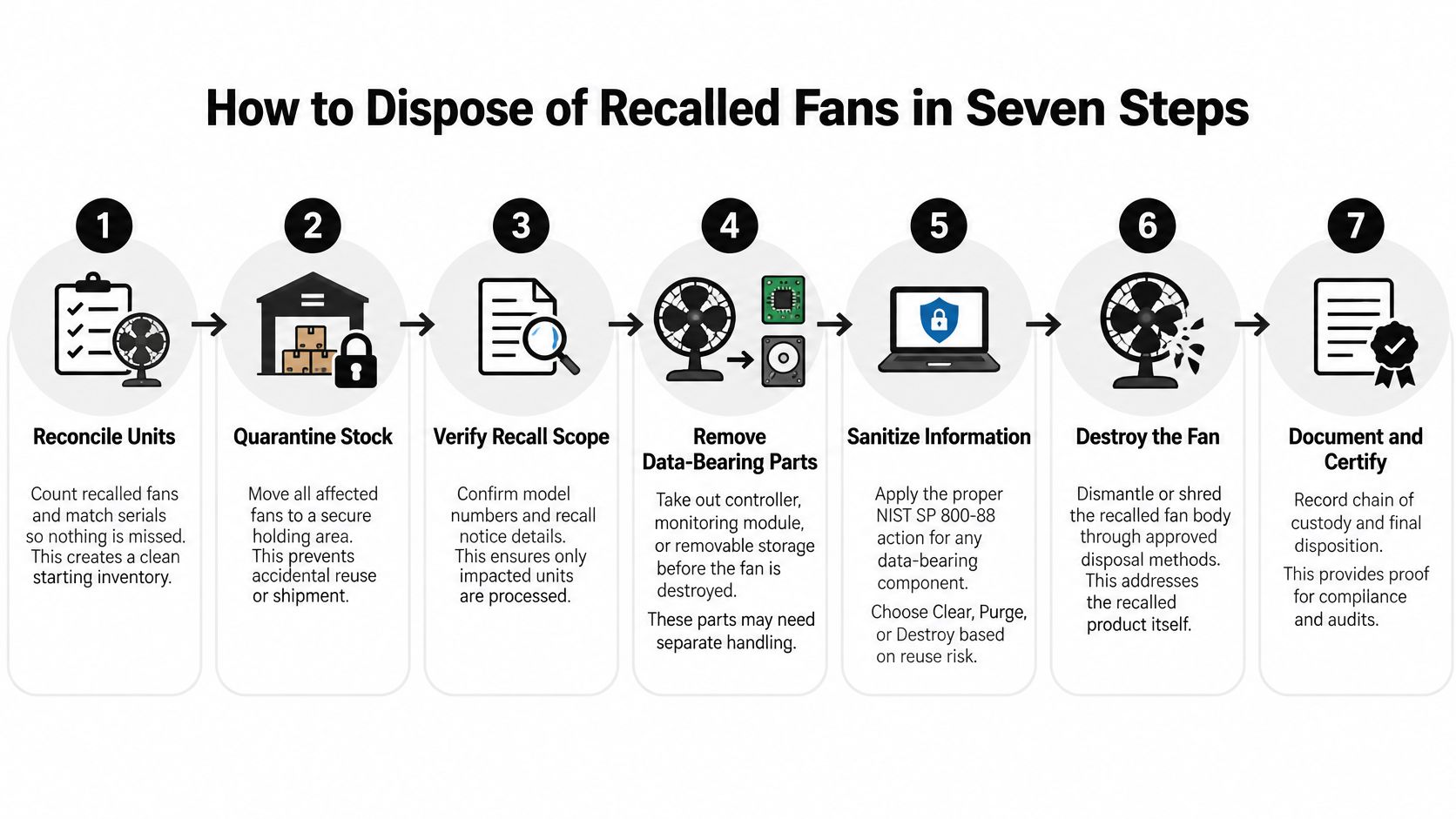
Reconcile units against the recall population. Match every fan on the floor and in the cage to the model list in the notice and to your asset register. Pull every flagged unit from service the same day. A fan still spinning in a break room or a mechanical room is still in use, whatever the email said.
Photograph the model label and the serial number. Shoot a readable image of each plate, and log any label that is worn, painted over, or missing. Those photos are what you send if the remedy later asks for identifiers, and they stop a dispute about which units you held.
Assign an asset or batch ID. Give each unit, or a sealed batch of identical units, an ID that appears on the quarantine tag, the manifest, and the final certificate. If the ID dies at the loading dock, you can't prove which fans left the building.
Quarantine in a restricted area. Segregate the fans and mark the cartons or the cage so they can't be picked for a work order, a spare, or a resale pallet. Recalled stock has to stay visibly out of commerce.
The scale problem isn't theoretical. In June 2004, the U.S. Consumer Product Safety Commission, SMC Marketing, and Home Depot announced the recall of approximately 2.2 million SMC-brand oscillating floor fans in the United States. The products were 18-inch pedestal fans, including models SR-18 and SP-18, after 31 reported incidents in which damaged power cords caused smoke and fires. At that volume, a casual "we pulled them" note is an audit gap. Keep model numbers, quantities, pickup dates, and proof the hazardous products left service. Move quickly even when the share of units that fail looks small, because the hazard can sit in the cord, the plug, or the wiring.
Get written disposition instructions from the recalling firm. Some remedies want a return. Others want the unit disabled, photographed, and destroyed before any refund. Don't shred a batch just because a vendor has a slot if the notice still requires the firm's method, or a witness, first. Put any verification request in writing before destruction starts.
Move the load under chain of custody. Use sealed, clearly marked cartons or labeled pallets. The paperwork should name the contents and prohibit commingling or salvage on the truck. An open mixed pallet is how a recalled fan becomes a parts donor.
Destroy or otherwise render each unit unusable by the approved method, then collect a signed destruction certificate tied to that batch. Off-site work closes with written vendor instructions and a certification of destruction. On-site work should record the date, the product, and the unit count, with an affidavit preferred.
Where the count falls apart
Recycled does not equal destroyed. Material recovery can leave a complete fan, or a hazardous cord and motor, available for resale. That's the failure mode I wouldn't accept on a recall.
Hold the team to two benchmarks. Zero unexplained quantity variance between the population you logged and the units on the certificate. One signed destruction certificate per batch, not a yearly letter that never names this load.
Match Each Recall Hazard to the Right Disposal Route
Your standard e-waste SOP is the wrong starting point. The hazard named in the notice sets the route, and the route decides whether a unit leaves as scrap, as regulated waste, or as a documented destruction case.
| Recall hazard | Documented example | Required handling and route |
|---|---|---|
| Damaged cord or plug causing fire | 2004 SMC oscillating fans | Isolate, do not resell; destroy through a certified vendor with a certificate |
| Blade or mount detachment | 2021 CPSC ceiling fan recall, blade detachment reports | Disconnect, photograph the disconnection, dispose per manufacturer instructions |
| Motor overheating and plastic ignition | 1979 Vernco and Sears portable fans, about 72,000 units | Quarantine, check age and distribution records, treat as destroy-only |
| Lithium-ion battery fire risk | Living Glow portable waist fans, battery fire hazard | Keep the unit out of general waste and ordinary battery-collection bins; confirm a hazardous-waste program accepts recalled lithium-ion devices first |
Rows that break a default SOP
Cord-fire units look like ordinary pedestal fans. They aren't parts inventory. Isolate them and destroy them through a certified vendor that issues a certificate. Parting out a recalled motor or cord puts the hazard back into commerce.
Blade cases surprise people because the fan may still run. A CPSC ceiling fan recall tied to blades detaching told owners to disconnect affected units, supply photographic evidence of the disconnection, and then dispose of or recycle the fan under the manufacturer's instructions. That sequence looks nothing like a curbside drop-off. A photo of a fan that is merely switched off isn't the record the notice asked for.
The older row catches facilities teams off guard. A 1979 recall covered approximately 72,000 Vernco and Sears portable electric fans manufactured in 1973 and 1974, because a locked rotor could overheat the motor and ignite plastic components, per the CPSC electric fan recall. Sale channel matters as much as age: a unit sold through a national retailer and never returned for the manufacturer's modification stays in scope. A decades-old portable fan in a plant cage can still be recall inventory, so check distribution history and purchase records before you clear it for scrap.
Battery condition changes the building
Recent CPSC instructions warn against placing a recalled battery-powered fan in household trash, curbside recycling, or ordinary retail battery-collection boxes, because damaged or defective lithium-ion batteries raise the fire risk, as in the Living Glow portable waist fan recall. Federal guidance steers devices that contain lithium-ion batteries toward certified electronics recyclers, participating take-back programs, or local solid-waste and hazardous-waste authorities. Confirm in advance that the program accepts recalled lithium-ion devices. A normal drop-off isn't automatically the right door.
Practical rule: When the recall notice states a disposal instruction, that instruction outranks your default recycling route.
Assign the route before anything is boxed. A carton holding a cord-fire fan and a battery fan moves as the most restrictive of the two, and the manifest has to say so.
Equipment that fails reuse standards, is unrepairable, old, obsolete, or isn't contractually permitted to be remarketed is recycled and completely destroyed by de-manufacture and/or physical shredding. For a recalled fan, that path belongs on a recalled electrical product destruction work order, not a remarketing pallet.
Checklist for Choosing a Certified Disposal Provider
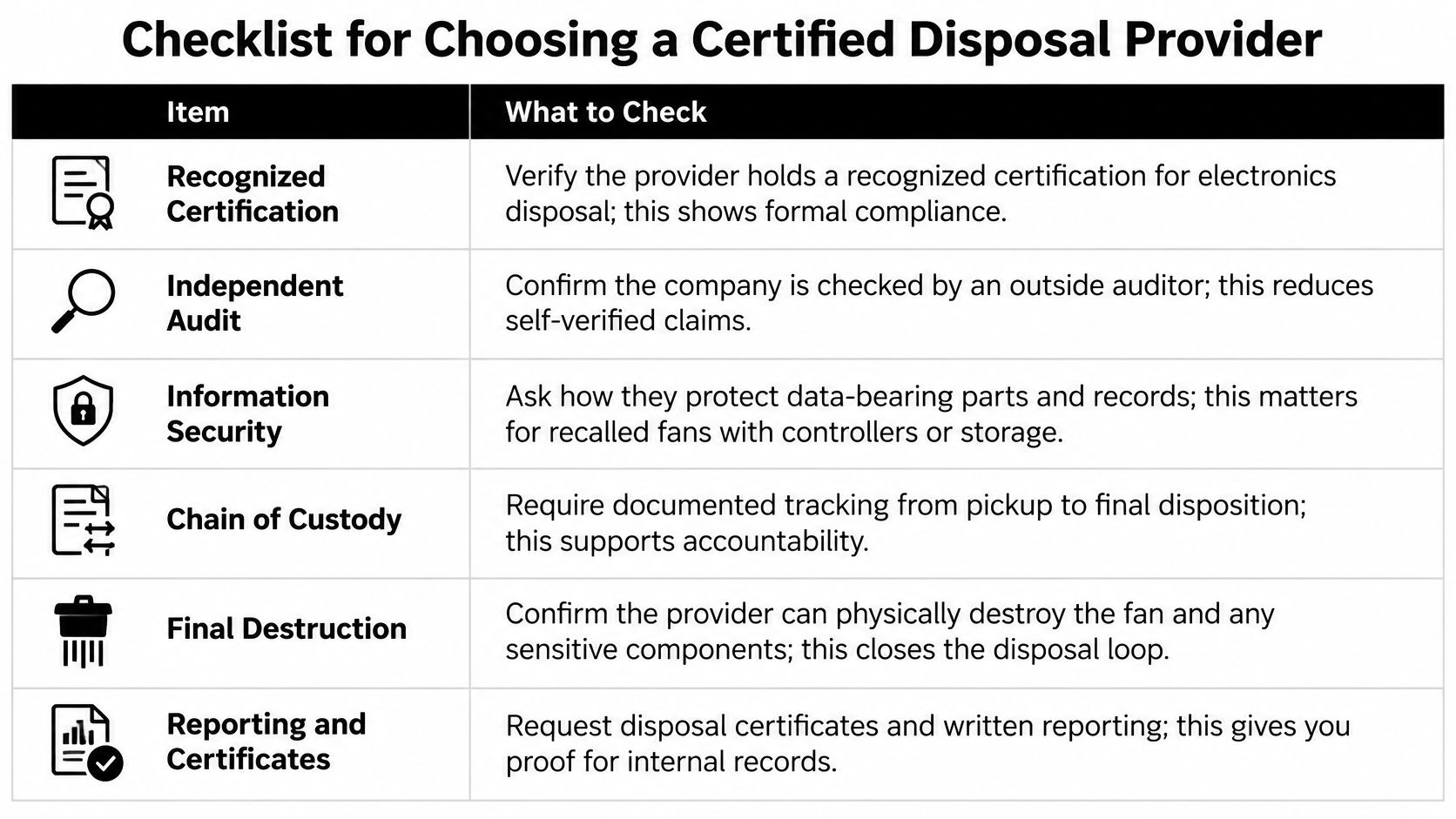
Sign nothing until the vendor can answer this list in writing.
| Criterion | What to request | Red flag |
|---|---|---|
| Recognized certification | Current R2 or e-Stewards certificate for the facility | Certificate that can't be verified or has lapsed |
| Independent audit | Most recent audit summary covering the processing facility | No audit, or an audit that covers only the sales office |
| Information-security policy | Written policy covering media and component handling | Verbal assurances only |
| Client references | Two or three references from comparable organizations | Refusal to share references |
| Certificate per load | Certificate of recycling and destruction for each pickup | One blanket certificate for the year |
| Destruction method | Named method for each media type handled | Generic recycling with no destruction step |
| Transport and insurance | Insured, sealed, manifested transport | Open trailers or unmanifested loads |
What the Disposal Rule asks you to check
The Federal Trade Commission's Disposal Rule applies to any person or organization, large or small, that maintains or uses consumer reports for a business purpose. It requires reasonable measures against unauthorized access to or use of that information during disposal. For electronic equipment, the FTC identifies destroying or erasing electronic files and media so the information can't be read or reconstructed. Due diligence means reviewing an independent audit, checking references, requiring a recognized certification, and evaluating information-security policies.
A recalled commercial fan can hold a controller, service logs, or other business information. Ordinary waste removal doesn't meet that bar.
Questions that end the conversation
- Downstream recycler: Name the facility that receives the material, not only the broker who books the truck.
- Witness option: State whether destruction can be witnessed when the remedy or your compliance office requires it.
- Resale block: Explain, in writing, how recalled units stay out of resale and parts harvesting.
Beyond Surplus issues certificates of recycling and data destruction for each load picked up, and corporate computer disposal stays compliant with local and federal laws on computer disposal. A vendor that can't match that paperwork, or that won't answer those three questions in writing, isn't ready for recall work. A longer screen for Georgia buyers is in our guide to choosing an ITAD vendor in Georgia.
Sanitizing Data-Bearing Components Before Disposal
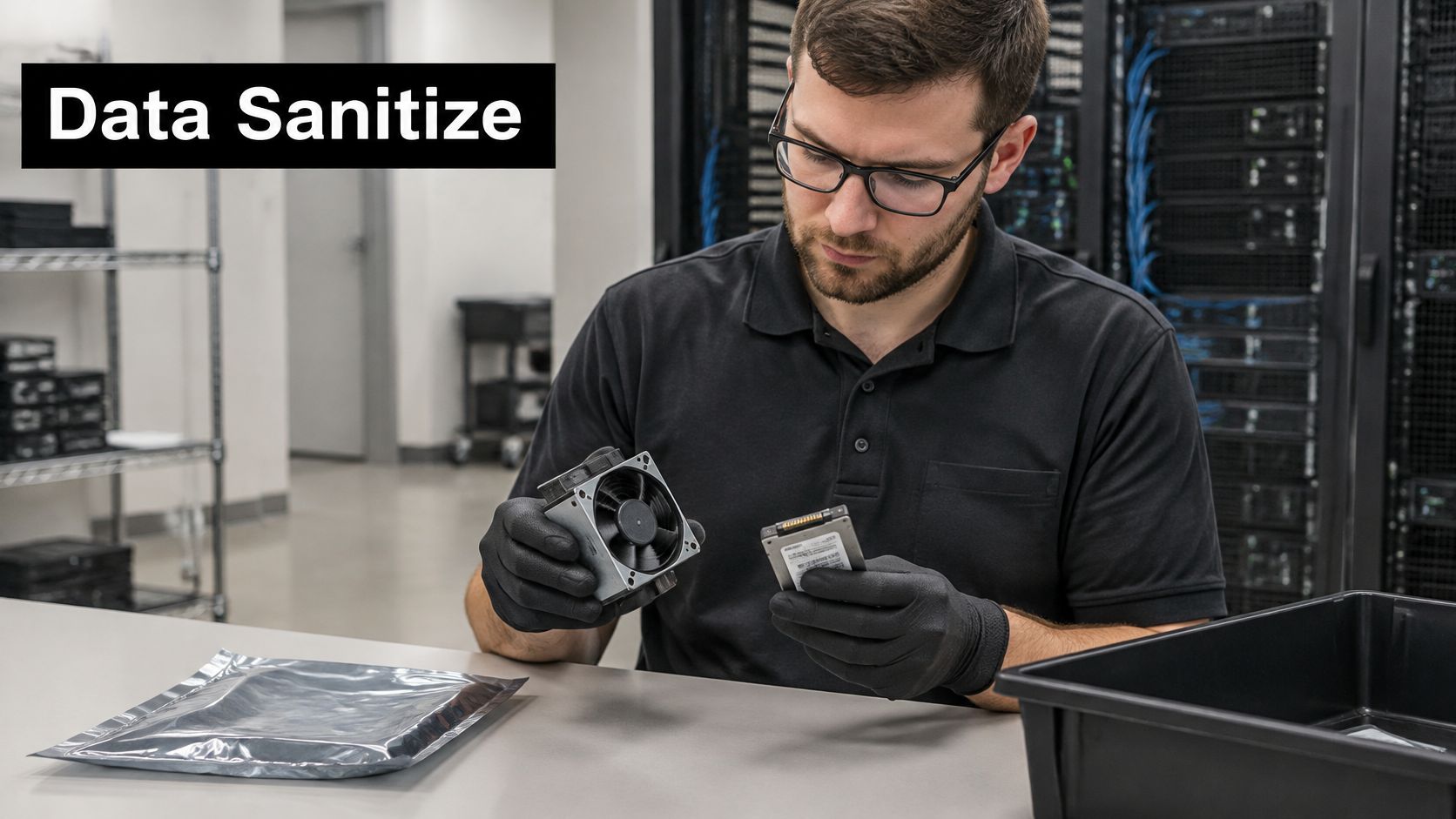
Destroying the fan housing closes the product hazard. It doesn't, by itself, close the data question. A controller, a monitoring module, or a removable card needs its own sanitization decision, recorded before the shell goes into the shredder.
NIST SP 800-88 defines three actions, and they aren't interchangeable.
Clear uses logical techniques through standard read and write commands, such as overwriting user-addressable storage or a manufacturer factory reset when rewriting isn't available. A basic Clear procedure is at least one pass with a fixed value such as zeros. It fits media that stays under your control and will be reused for the same purpose. It's the wrong end state for a recalled fan that's leaving the building.
Purge uses media-dependent techniques meant to make recovery infeasible. You have to verify that the manufacturer's method removes data, rather than deleting file pointers. Use Purge when the part will be repurposed or will leave your control and you aren't physically destroying that specific piece.
Destroy permanently prevents reuse through shredding, disintegration, pulverizing, or incineration in a licensed facility. This is the action I recommend for storage pulled from a recalled fan that won't be reused.
The reuse rule that keeps the choice honest
The IRS media sanitization guidelines state that simple disposal isn't an acceptable sanitization method for federal tax-information media. Media may be cleared, purged, or destroyed, and simple deletion doesn't satisfy Clear, because recovery tools might still retrieve information. The IRS calls physical destruction the ultimate method and lists disintegration, incineration, pulverizing, shredding, and melting. Clear media reused for the same purpose. Purge media that will be repurposed or that will leave organizational control. Destroy media that won't be reused.
If a recalled fan contains storage or networked components and will leave your control, use Purge or Destroy, and file that record with the batch.
Our data destruction methods render all media "unusable and/or inaccessible." Pair that result with the product record on recalled electronics disposal so the fan and the media aren't closed under one vague "recycled" line.
Chain-of-Custody Records Auditors Expect
Say a hospital facilities team is holding 38 recalled portable fans across three buildings. The manufacturer's remedy asks for photos of destroyed units and identifying information before a refund. Compliance wants proof those fans never went back into patient areas or into a recycle stream that still allows resale. Those are two different questions. One folder labeled "the recall" won't answer both.
Recent CPSC ceiling fan recall notices show remedies that require the user to stop using the fan, disable or destroy it according to instructions, photograph the destroyed product, and submit identifying information before a refund. Enterprises, schools, healthcare providers, and property managers then have to show who recorded the model and serial number, how custody moved, and how the equipment stayed out of ordinary recycling. EPA materials recommend certified electronics recyclers for unwanted electronics, including abandoned federal electronics. A consumer-facing notice that offers a retail return isn't automatically the right path for a multi-building inventory.
The record set, item by item
| Record | Required content | Purpose |
|---|---|---|
| Inventory register | Model, serial number, and quantity per building | Reconcile against the recall population |
| Chain-of-custody log | Signed entry at each handoff | Show continuous custody |
| Pickup manifest | Units, dates, and carrier details | Document transfer out of your control |
| Manufacturer submission | Destruction photos and identifiers | Satisfy refund or remedy terms |
| Destruction certificate | Date, method, unit count, and batch ID | Prove the batch was destroyed |
| On-site affidavit | Date, product, and unit count | Cover destruction performed on site |
Keep the manufacturer submission separate from the disposal evidence. The refund packet shows you met the remedy. The certificate and affidavit show the units were destroyed. Mixing them into one email thread forces an auditor to rebuild the story from attachments.
For on-site destruction, the affidavit should name the date, the product, and the unit count. For a vendor shipment, the manifest should identify the contents and bar salvage.
Close the count before you accept the certificate
Match the certificate's unit count to the original register, building by building. Any gap stays an open exception until someone explains it in writing. Don't let a refund photo set stand in for missing serials. The batch ID belongs on a certificate of destruction for recalls, tied to that same count.
Frequently Asked Questions for IT and Facilities Managers
Which recalled fans need a sanitization decision?
Any fan with a controller, a monitoring module, or removable storage. Record the Clear, Purge, or Destroy choice even when the housing will be destroyed. Skipping the note because the shell is headed to a shredder leaves you unable to show what happened to the media.
Can a recalled fan go to a standard e-waste recycler?
Only after the recall notice and the vendor's downstream chain are confirmed in writing. If the notice requires destruction, a photo, or a battery-specific program, the standard inbound dock is the wrong door. Match the route to the hazard before the unit leaves quarantine.
Does a manufacturer refund require proof of destruction?
Some remedies do. The written instructions you collect before transport decide the route, including photos and identifiers. A retail return line on a consumer notice doesn't replace that writing for a commercial batch.
How long should records be kept?
Set the retention period with legal or compliance counsel. The recall notice and the sanitization standard don't settle how long your organization must keep the register, the manifest, and the certificate. Write the period into the batch file when counsel gives it.
What if a count doesn't reconcile?
Hold the batch as an open exception. Document the gap, the building, and the last signed handoff before you accept any certificate. A certificate that outruns the count isn't a closeout.
Compare Logistics Options and Schedule Your Atlanta Pickup
Route choice follows the recall notice and the hazard, not the nearest dock. A fan with a damaged battery or a notice that requires destruction does not belong in a standard e-waste drop-off. The retailer's return line may be simple, but a commercial batch still needs documentation that ties each unit to the recall.
| Route | Best fit | Documentation |
|---|---|---|
| Drop-off at a certified facility | Small batches a team can transport safely | Receipt and destruction certificate |
| Scheduled commercial pickup | Multi-building or bulk recall units | Manifest, chain-of-custody log, and certificate |
| Mail-back under manifest | Units the manufacturer or vendor accepts by mail | Shipping manifest and certificate |
What to have in hand before you call
Build one inventory and send it the same day you request service. Quarantine list, truck paperwork, and the certificate should describe the same fans.
- Identity: Model, serial number, and quantity per location.
- Notice: Recall reference, hazard, and remedy.
- Disposition: Manufacturer's written instructions, especially if they require photos or destruction before a refund.
- Site work: Whether fans are fixed to mounts. We provide technicians to de-install equipment when necessary, so the nameplate stays with the unit.
- Radius and address: Free recycling pickup covers the area within 50 miles of Atlanta. Pickup is for businesses at a commercial address. Businesses outside that radius can call 404-905-8235 to ask about pickup options.
Request pickup by phone at 404-905-8235, by email, or through the online form. Before the truck leaves your dock, confirm the certificate of recycling and destruction for that load, the chain-of-custody record, and the manifest.
A carrier tracking number shows a carton moved. It doesn't show the fan was destroyed.
If the manufacturer accepts mail-back, still keep a manifest. Use a controlled product recall reverse logistics pickup rather than an unmarked parts return, and send the inventory the same day so the certificate ties to the recall record without a second count weeks later.
Recalled fans need certified electronics recycling, secure handling of data-bearing parts, and product destruction you can show an auditor. We run commercial pickup, chain-of-custody records, and certificates of recycling and data destruction for recalled electronics and IT assets. Contact Beyond Surplus to schedule certified electronics recycling and secure IT asset disposal for your Atlanta batch.


