

A recalled extinguisher isn't scrap you can roll to a dumpster between inspections. It's pressurized, serialized safety equipment that has failed a recall test, and you still have to protect the space it covered after it leaves. Get the identification, local route, or handoff wrong and you'll have a gap in coverage, a rejected load, or no proof for an auditor. Professional recalled fire extinguisher disposal services solve all three problems when you run them as a controlled process, not a cleanup task.
Table of Contents
- Why Recall Disposal Needs a Formal Process
- Sorting Recalled Extinguishers by Condition and Route
- Local Rules That Change the Disposal Route
- Vetting a Qualified Disposal Service
- Cost and Logistics Expectations
- How to Isolate and Document Recalled Units
- Documents That Prove Compliance
- Schedule Your Recalled Extinguisher Pickup
Why Recall Disposal Needs a Formal Process
A recall can affect units spread across leasing offices, maintenance vehicles, parking structures, and warehouses. Recalled and unaffected extinguishers may look identical, so a visual check cannot establish which units must be removed. The work needs a record linking each identified unit to its removal and final handoff.
The scale is clear in the U.S. Consumer Product Safety Commission recall announcement: it covers approximately 4.6 million Kidde disposable plastic fire extinguishers in the United States and another 175,000 in Canada, across 31 models with Zytel black plastic valves manufactured from July 23, 2013, through October 15, 2014. The listed serial numbers and date codes distinguish affected units from other stock.
What informal disposal misses
Putting a pressurized cylinder in ordinary trash can endanger collection crews and equipment. A receipt alone may also fail to show which recalled units were located, removed, and replaced. Keep an auditable record of the identification and handoff at each site, and choose the disposal route according to unit condition and local acceptance rules.
Use this sequence: sort units by condition, check local requirements, vet the provider, document and isolate each unit, then arrange pickup. Apply the same recordkeeping discipline to other product removals, including recalled kitchen product destruction.
Sorting Recalled Extinguishers by Condition and Route
Use this table during the walk-through. Assign every unit to one row before you call anyone.
| Unit condition | Immediate action | Disposal route |
|---|---|---|
| Charged, undamaged, under recall | Remove from service; keep it sealed and upright; replace coverage first | Manufacturer remedy or qualified fire-equipment service provider |
| Partially discharged | Keep upright and sealed; do not attempt to empty it | Hazardous-waste facility or fire-equipment service provider |
| Empty, no damage | Confirm local acceptance before moving it | Hazardous-waste site, transfer station or service provider; never ordinary trash |
| Damaged, corroded or leaking | Isolate away from traffic and heat; do not discharge or puncture | Qualified hazardous-material handler or authorized hazardous-waste channel |
| Exposed to fire or heat | Isolate in a ventilated area; handle only with trained staff | Qualified hazardous-material handler |
| Pressure or condition unknown | Treat as pressurized; do not depressurize | Qualified service provider with documented handoff |
How to read the rows
Charged and undamaged doesn't mean safe to keep. The recall itself takes the unit out of service, so seal it, keep it upright, and use the manufacturer's remedy or a qualified provider. Don't discharge a partially used unit to make transport easier. You'll create a mess, lose control of the agent, and still have a pressurized vessel.
Empty is the row people misjudge most often. Empty doesn't automatically mean curbside safe, because local waste authorities set different acceptance rules and some require hazardous-waste handling even then. Confirm acceptance first, then move it.
Any cylinder with unknown pressure, visible damage, corrosion, leakage, or heat exposure goes to a qualified handler. Never to a dumpster.
Damage changes the handler, not just the destination. A corroded or leaking unit needs isolation away from foot traffic and heat, plus staff who won't puncture, crush, or improvise depressurization. Treat an unreadable gauge the same way. If you can't confirm pressure, assume it's charged.
The coverage question that overrides the table
Ask one question for every location. Is this unit still providing required emergency coverage? If yes, a replacement must be mounted before removal, even if a truck could arrive tomorrow. If no, because another compliant extinguisher already covers the area within its required travel distance, removal can proceed once you've tagged and logged it.
That distinction also affects sequencing across a portfolio. A storage room with redundant coverage can clear quickly, while a clinic corridor or kitchen line waits for its replacement. Coordinating that timing is similar to planning recalled grill disposal services, where removal can't outrun site safety.
I would treat the table as a first sort only. Condition tells you how to handle the unit today. Local rules confirm where it can legally go tomorrow, and that's the decision you need in writing before pickup.
Local Rules That Change the Disposal Route
One company policy won't produce one disposal route. These examples show why.
| Jurisdiction | Acceptance rule | Limits or requirements |
|---|---|---|
| King County, Washington | Full or partially full units accepted at hazardous-waste sites | Up to 7.5 gallons per container, five tanks per trip, 25 gallons or 220 pounds total; eligible businesses submit a disposal form |
| Denver, Colorado | Pressurized units, including empty ones, go to specialized hazardous-waste facilities, not trash | Pressurized units can explode in trash trucks |
| New Hampshire | Acceptance varies by site; call ahead | Fees and pickup options differ among transfer stations, household hazardous-waste events, manufacturers and fire-protection companies |
The King County hazardous waste program guidance sets those quantity limits and business form requirements, while Denver and New Hampshire take different approaches. Transport adds another layer because pressurized cylinders moving between sites fall under hazardous-materials rules, so confirm your carrier's authorization.
A four step check for each site
- Verify the recall: Check the CPSC recall database for model and date code.
- Call the authority: Ask about acceptance, limits, fees, and forms.
- Get it in writing: Save the reply, not just a phone note.
- File it by site: Keep the answer with that location's records, as you would for recalled lighting product disposal.
Two sites under one owner can end up with different routes. That's normal. Don't force consistency where the rules aren't consistent.
Vetting a Qualified Disposal Service
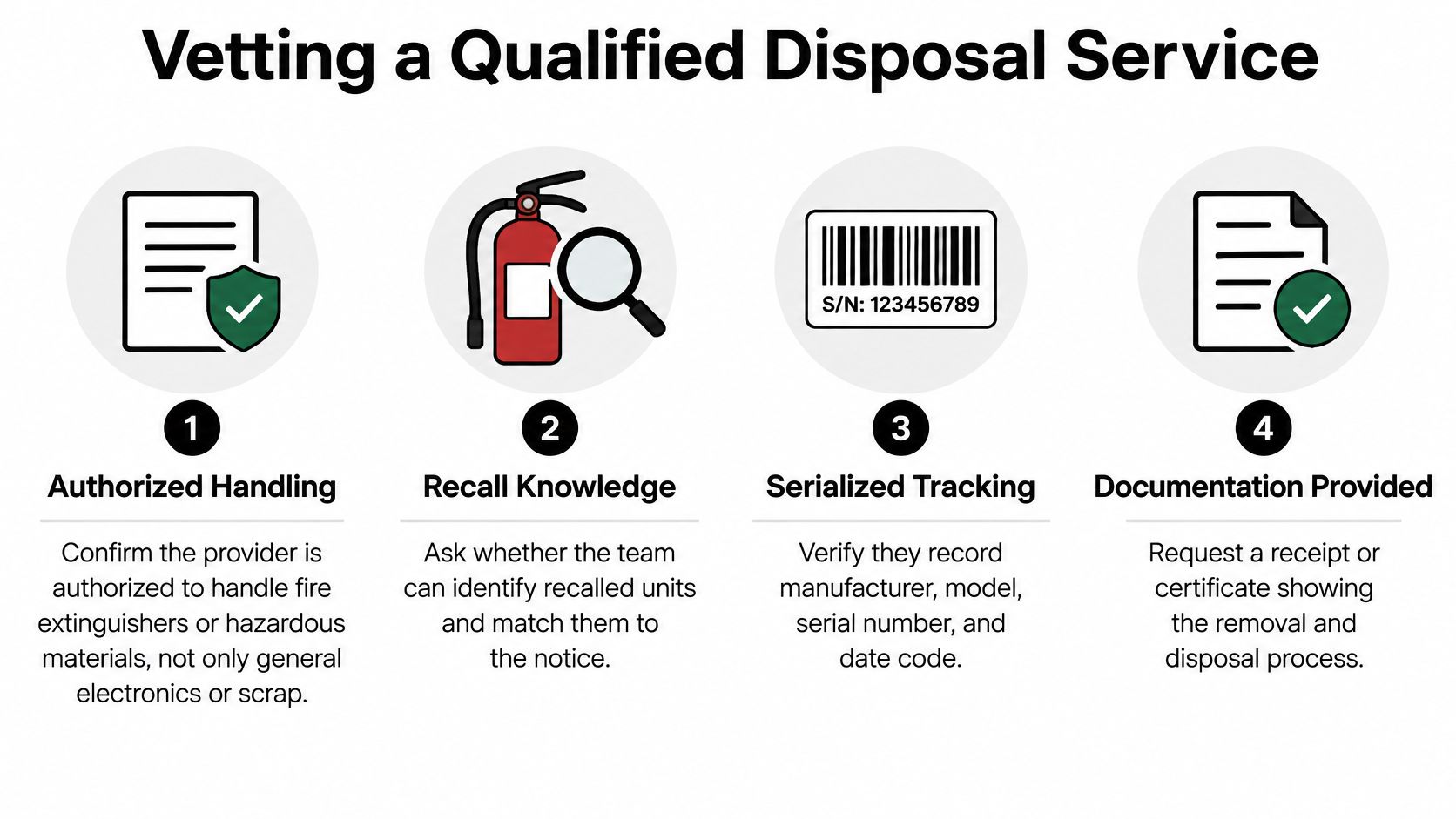
Run these checks on the first call. A capable provider answers without hedging.
- Authorized handling: Confirm authorization for fire extinguishers or hazardous materials, not just general electronics or scrap.
- Licensed transport: Ask who moves the load, whether they run their own fleet or use partners, and name the receiving facility.
- Serialized records: Require manufacturer, model, serial number, and date code for each unit, not a total count.
- Certificate per pickup: Request sample documents before signing and verify transport and handling insurance.
- Multi-site capacity: Confirm scheduling windows fit your recall timeline across every location.
Red flags to stop on
Walk away from a provider that won't commit to chain-of-custody paperwork, offers payment for units without documentation, or can't name the receiving facility. Those aren't minor gaps. They leave you holding liability you thought you'd transferred.
We issue certificates of recycling and data destruction for each load of equipment picked up, and that per-load standard is a useful benchmark for any vendor. Get at least two quotes and compare the documents side by side before you compare price. If the paperwork differs, the cheaper bid isn't cheaper once an audit starts.
Cost and Logistics Expectations
Pricing usually takes two forms. Per-unit pricing suits a small, uniform batch where every cylinder is in similar condition. Flat-fee pricing suits a defined pickup with mixed equipment, provided the scope is written tightly. Neither number means much until you know what's included.
What a complete quote should name
- Packaging and labeling: Who supplies it and who applies it
- Transport: Carrier, distance, and any hazardous-materials charges
- Final disposition: Receiving facility and treatment method
- Certificate issue: Whether it's included for each load
Expect higher costs for damaged, corroded, fire-exposed, or unknown-pressure cylinders. They need trained staff, protective packaging, and specialized transport, so they shouldn't price like clean, charged units. Multi-site recalls also cost more when pickups are fragmented. Ask whether the provider can consolidate locations into one schedule, similar to coordinating multi-location recall collection services.
Budget for replacement extinguishers alongside disposal. Removing coverage before the replacement is mounted leaves the site unprotected, and emergency replacement purchases usually cost more than planned ones. I would put both costs in one approval request so finance doesn't fund removal and stall coverage.
Quote rule: Don't accept a lower price from a provider that can't supply serial-level records. The audit gap costs more later.
Confirm logistics in writing before booking. That includes pickup windows, minimum volume or fees, dock access, who loads the truck, and lead time from booking to arrival. Then normalize every quote to the same units, services, and documents. Only then does the price comparison tell you anything useful.
How to Isolate and Document Recalled Units
Follow this routine at every site. Skipping the order creates the problems you're trying to avoid.
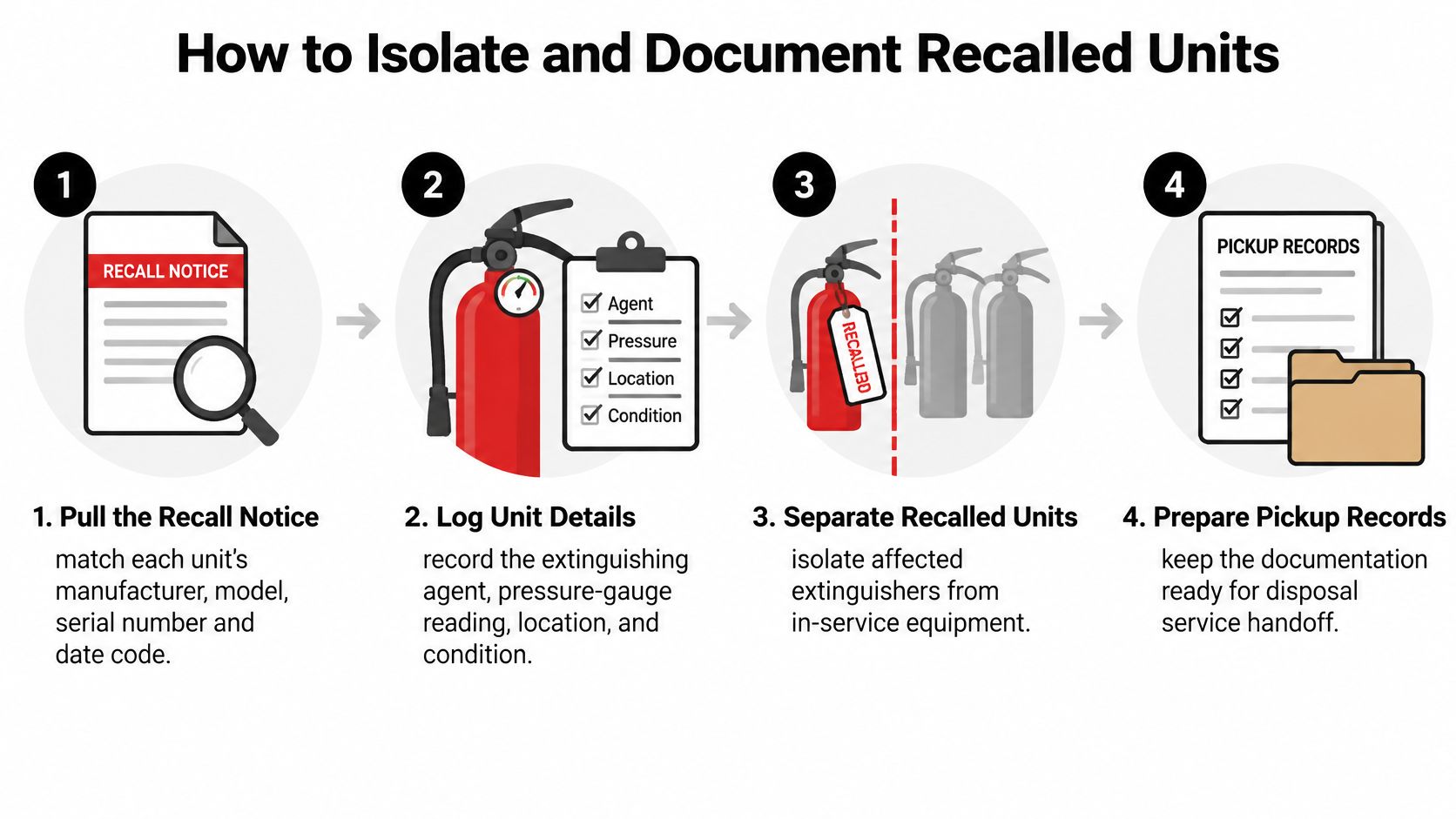
- Pull the recall notice: Match manufacturer, model, serial number, and date code unit by unit. Appearance isn't evidence, and a missed vehicle or storage cage is the usual failure.
- Log the details: Record extinguishing agent, pressure-gauge reading, exact location, condition, and owning site. The OSHA portable fire extinguisher standard requires workplace extinguishers to remain operable and properly located and requires failed or untestable shells, cylinders, and cartridges to be removed from service and the workplace, so your log must show both status and location.
- Tag and segregate: Mark each unit as recalled and move it away from in-service equipment. Don't stage tagged and untagged cylinders together, because someone will remount the wrong one.
- Replace coverage first: Mount equivalent protection before removal. This is the step rushed teams skip, and it leaves an occupied area unprotected during the gap.
- Don't depressurize it yourself: Never discharge, puncture, crush, or attempt informal depressurization, especially on damaged or corroded units. Leave them untouched for trained personnel.
- Pack for transport: Protect valves from impact, prevent rolling or shifting, and keep cylinders upright and secured. Hand off only to the qualified provider or authorized hazardous-waste channel you vetted.
- Close the custody chain: Keep an itemized log and obtain the receipt or destruction or recycling record at handoff. A count on a driver note doesn't reconcile serial numbers.
Treating a recall as ordinary scrap is the central compliance pitfall. It breaks identification, coverage, transport safety, and proof in one move. The document file described next is what turns these seven steps from a claim into evidence an inspector can verify.
Documents That Prove Compliance
A disposal receipt alone rarely proves a recall was handled correctly. It shows something left. It doesn't show that the right units left, that coverage stayed in place, or where each cylinder ended up.
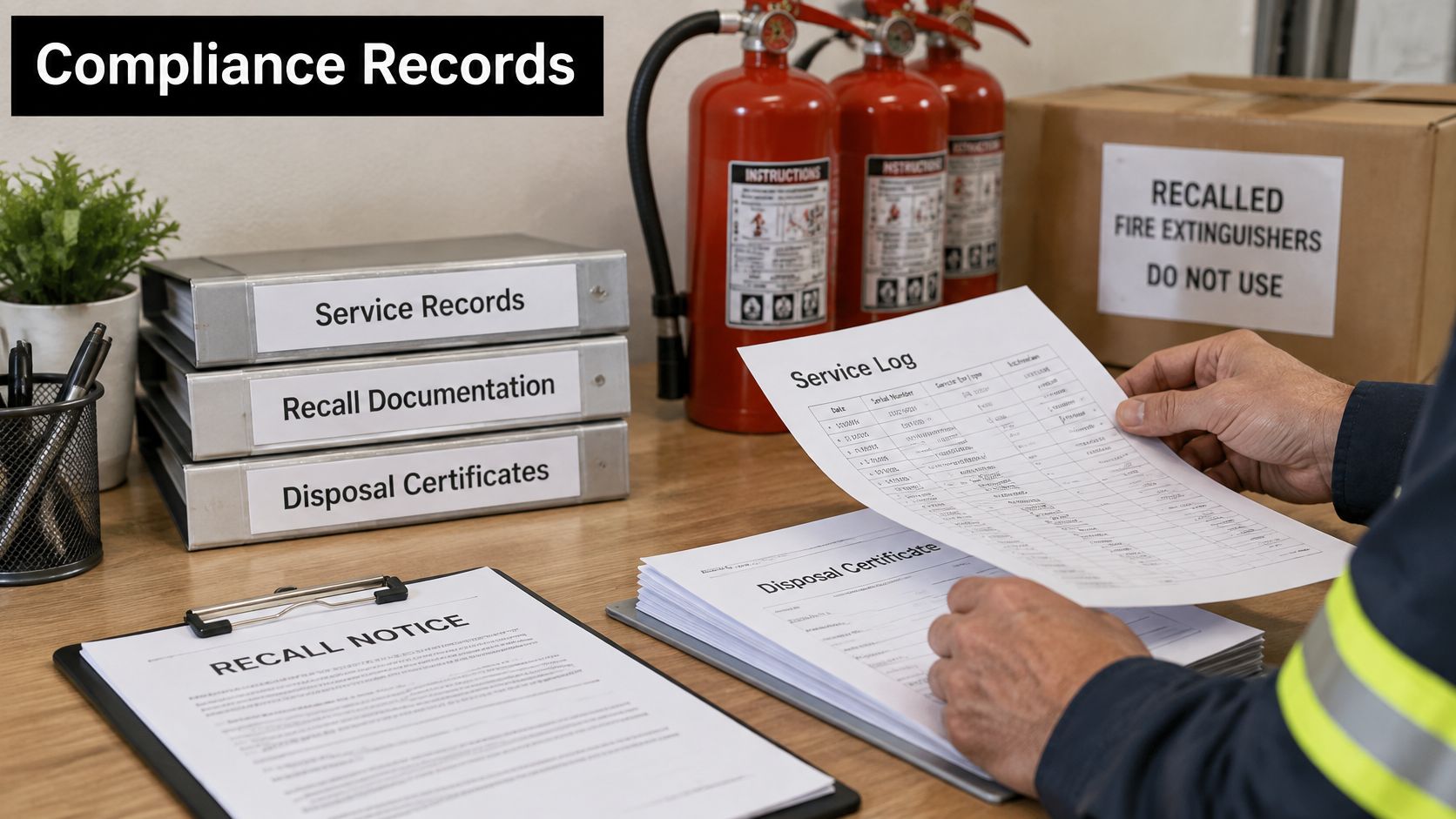
Build one file per site
- Recall notice: The exact notice used for matching
- Serialized inventory: Model, serial number, date code, agent, and condition
- Photographs: Tagged units in their segregated staging area
- Replacement record: What replaced each unit and when it was mounted
- Transporter and facility details: Who carried the load and who received it
- Signed chain-of-custody log: Names, dates, and unit counts by serial number
- Disposal receipt or certificate: Final disposition for the load
- Employee instructions: What staff were told not to touch, move, or use
Each item answers a predictable question. Inspectors ask which units were recalled and when they left service. Insurers ask whether coverage lapsed. EHS auditors ask who moved the cylinders and where they went. A complete file answers all three without reconstructing events from email.
The file, not the receipt, is what protects the site.
Liability language matters too. Every load we pick up receives a Certificate of Recycling and Data Destruction, and all liability transfers to Beyond Surplus for that load. Request the same written transfer from any provider, and understand how a certificate of destruction for recalls supports your records. Still keep your own file. A provider certificate doesn't replace your inventory or replacement evidence.
Store everything with facilities or EHS records, organized as one row per serial number. Each row should show date removed, who tagged it, handoff date, receiving provider, and certificate number. That format lets you reconcile a portfolio in minutes instead of hunting through pickup paperwork site by site.
Schedule Your Recalled Extinguisher Pickup
You can move from notice to booked pickup in five working days if each day has one owner and one output.
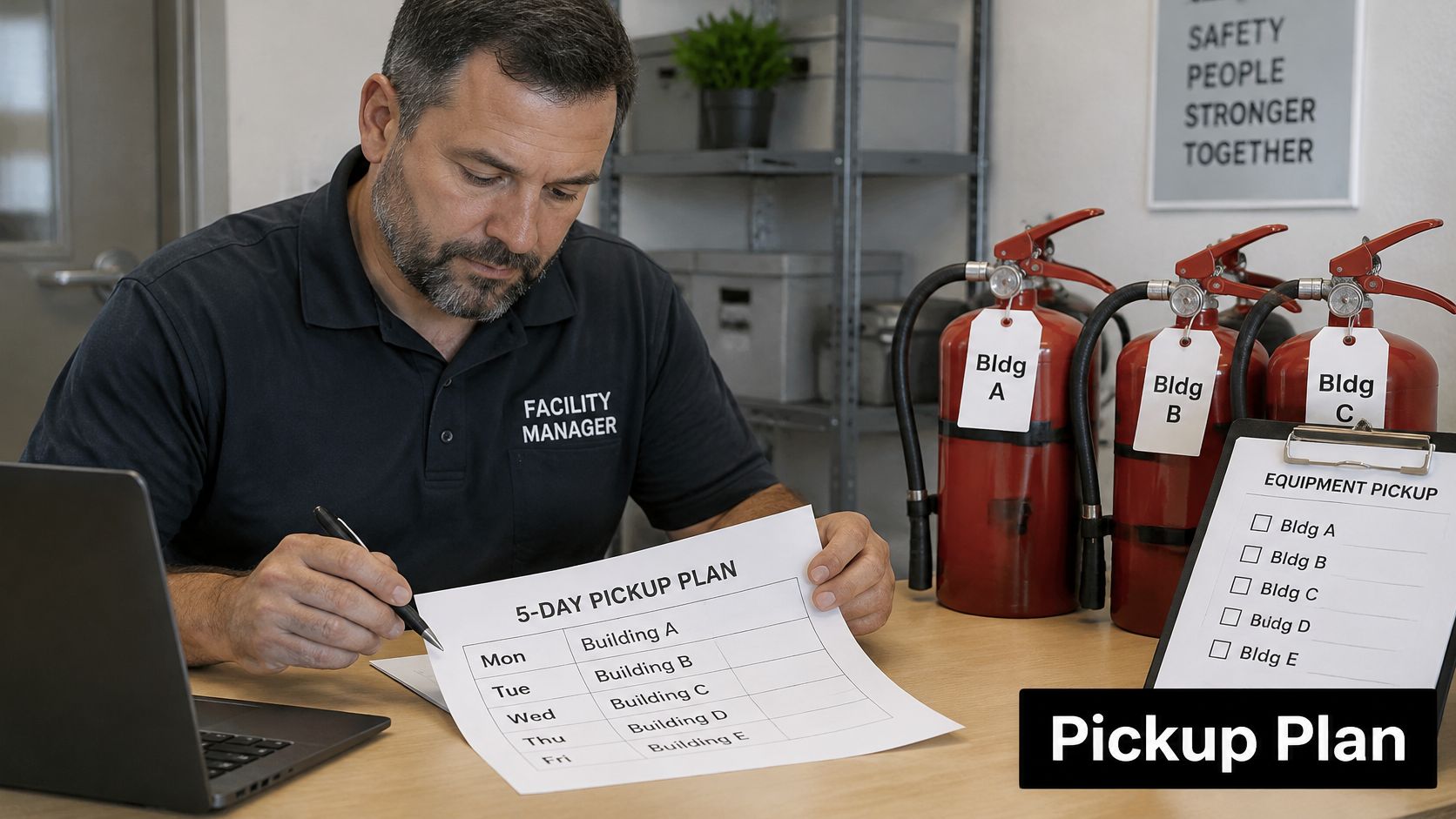
Day one finishes the serialized inventory against the recall notice for every site, including vehicles and storage areas. Day two sorts each unit by condition and confirms local acceptance in writing. Don't let day two end with verbal approvals.
Day three arranges replacement coverage and confirms mounting dates. Day four shortlists two providers and compares their sample custody logs and certificates. Day five books the pickup window and confirms packaging, transport, final disposition, and certificate issue in writing.
Order the pickup by risk
Move damaged and unknown-pressure units first, then fire or heat-exposed units, then the remaining recalled stock. That order reduces the time your highest-risk cylinders sit in staging. Bring the inventory, photographs, and written local acceptance reply to every provider call, because those three items determine price, vehicle, and schedule.
Contact Beyond Surplus for certified electronics recycling and secure IT asset disposal, and ask whether your recalled units fall within its pickup scope. Business customers can schedule pickups across the contiguous United States. Request a certificate for each load before the truck leaves your site, not after the paperwork has gone cold.
Don't leave recalled extinguishers sitting in a corner while coverage and custody records drift. Beyond Surplus provides documented pickup, certified recycling, and secure IT asset disposal for businesses, with a certificate issued for each load. Visit Beyond Surplus to discuss your sites, confirm scope, and schedule a pickup that closes the recall with evidence.


