

In Q3 2025, U.S. product recalls affected 258.98 million units, a 201.6% increase from 85.87 million units in Q2, according to Sedgwick's quarterly recall analysis reported by Risk and Insurance. That scale rewrites the job for multi-location recall collection services. You're not counting notices sent. You're reconciling every serial, lot, and site until a unit is quarantined, corrected, or destroyed with evidence.
Table of Contents
- Why One Warehouse Return Rarely Works
- Collection Models and When Each One Fits
- Sanitization Paths for Recalled Electronics
- Vendor Checks SLAs and Cost Drivers
- How to Execute Collection Across Every Site
- Site-Level Completion Metrics That Prove Recovery
- Audit the File and Schedule Certified Pickup
Why One Warehouse Return Rarely Works
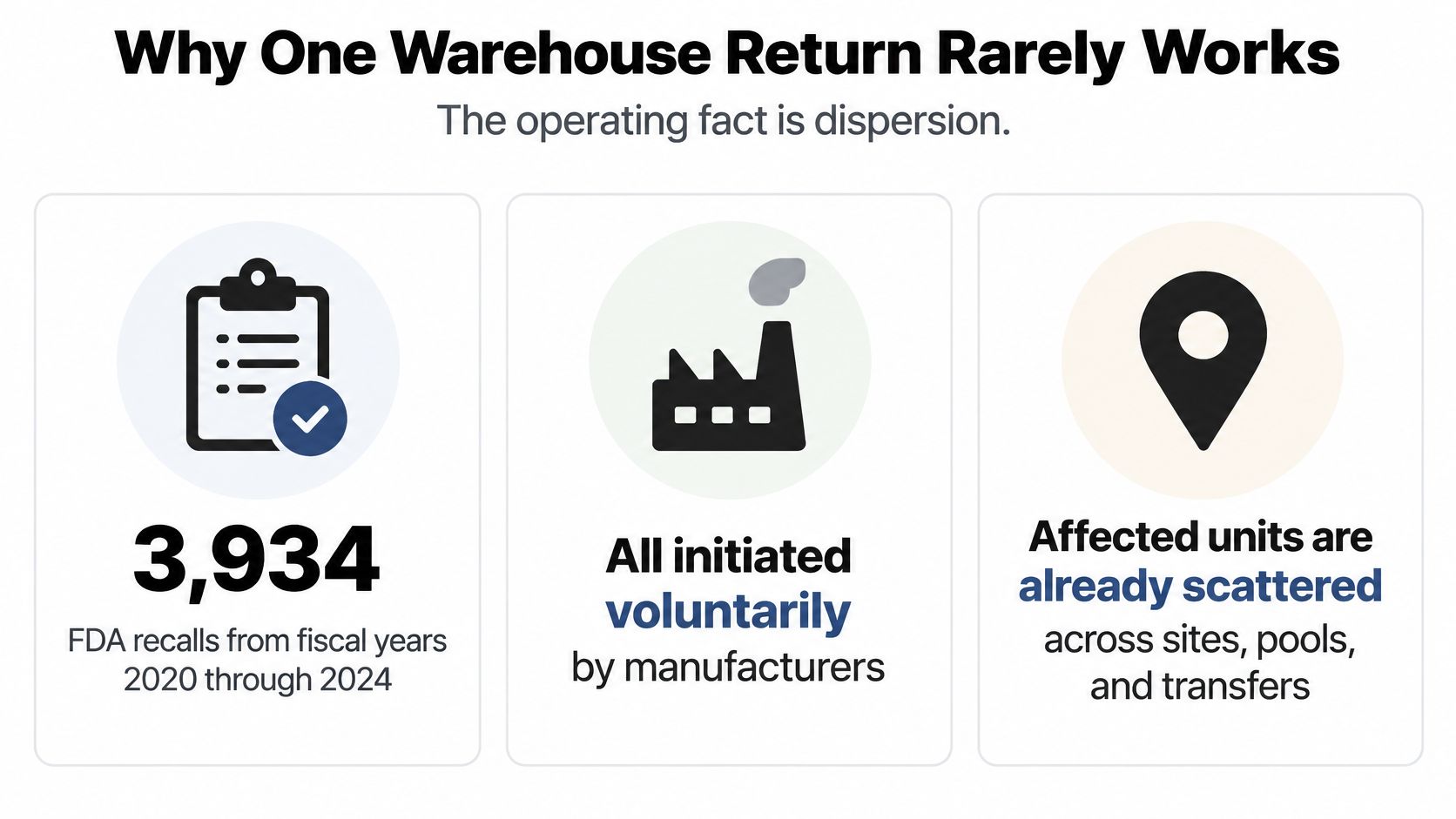
Say a manufacturer recalls a monitor, drive, or powered medical accessory after distribution. Units are already in branch offices, repair depots, leased pools, clinics, and employee workstations. Asking everyone to ship to one warehouse assumes labels are intact, site staff have time, and nobody transferred the asset internally. That assumption fails fast.
The Volume Is Dispersed, Not Theoretical
From fiscal years 2020 through 2024, the FDA oversaw 3,934 medical-device recalls, and "all initiated voluntarily by manufacturers" according to the U.S. Government Accountability Office report on FDA medical-device recalls. Class II moderate-risk devices accounted for 3,468 recalls, or 88%, while Class I highest-risk devices accounted for 350 recalls, approximately 9%, and Class III represented 116 cases, or about 3%. The FDA also reported 1,017 medical-device recalls in fiscal year 2024 alone.
Most recall work therefore isn't one dramatic failure. It's repeatable identification, retrieval, segregation, transport, and documented disposition across hospitals, clinics, distributors, and service contractors. That's the operating problem for IT managers, facility managers, quality leaders, and procurement staff pulling serialized electronics, drives, lab equipment, medical devices, or branded products from offices, warehouses, schools, and data centers.
A sent notice is not a removed unit. Recovery starts when the physical item is identified and controlled.
You'll get, in order, a way to choose a collection model, a site procedure, a completion dashboard, a sanitization path, vendor due diligence checks, and a closure audit. Start here, lock your scope and affected-population denominator before you schedule any pickup. If you don't freeze what's affected, where it went, and what counts as unavailable, every later report becomes negotiable.
Collection Models and When Each One Fits
Pick one primary model per asset class, not one model for the whole company. A sealed low-risk accessory and a data-bearing laptop with a swollen battery shouldn't travel the same way.
Recall Collection Models Compared
| Model | Best when | Identity control | Main risk | Evidence you get |
|---|---|---|---|---|
| Centralized return | Few sites, intact labels, low hazard | Strong only if serials are scanned at intake | Data and battery exposure in transit | One certificate with weaker site proof |
| Regional depot | Many states and medium volume | Good if every depot uses the same form | Mixed recalled and good stock | Regional manifests plus a final certificate |
| On-site secure pickup | Clinics, data centers, sites that cannot ship | Best; identity checked before the truck leaves | Missed units still inside the building | Site-level chain of custody |
| On-site wipe or destruction | Drives and devices that must not leave | Excellent when witnessed | Loses reuse or buyback value | Witness log and destruction certificate |
| Controlled prepaid ship-back | Small sealed items and staffed receiving | Weak if labels are damaged | Highest privacy and battery risk | Carrier scan alone is not enough |
Centralized return works when your site list is short, labels are readable, and the hazard is low. It's the wrong choice when you need proof by location, because the certificate is only as good as the intake scan. If the receiving team logs a pallet count instead of serials, you've lost site accountability.
Regional depots handle multi-state volume without forcing long hauls to one dock. They fail when each depot improvises its own quarantine form. Require the same serialized list, segregation rule, and transport document everywhere, or mixed lots will contaminate good stock with recalled stock.
Where Convenience Breaks Control
On-site secure pickup fits clinics, data centers, and plants that can't pause operations or legally ship certain batteries and drives through normal channels. Staff verify identity before the truck leaves, which gives you the strongest site record. It still won't find a unit locked in a manager's cabinet unless your site sweep includes storage rooms and repair cages.
On-site wipe or destruction fits media that must not leave the building. You trade resale value for a witnessed log, and that's often the right trade for high-sensitivity drives. Compare that trade carefully using a structured review of on-site versus off-site ITAD services before you commit a whole fleet to shredding.
Controlled prepaid ship-back is the weakest evidence path. It's defensible only for small, sealed, low-risk items going to a staffed receiving dock that scans on arrival. Uncontrolled mail-back mixes recalled and good stock and exposes personal data, lithium batteries, and hazardous components during handling.
For every model, require a serialized list, physical segregation, a transport document, and a named final disposition. Map high-hazard or data-bearing gear to on-site pickup or witnessed destruction. Move low-risk intact goods to a depot only after the form is standardized.
Sanitization Paths for Recalled Electronics
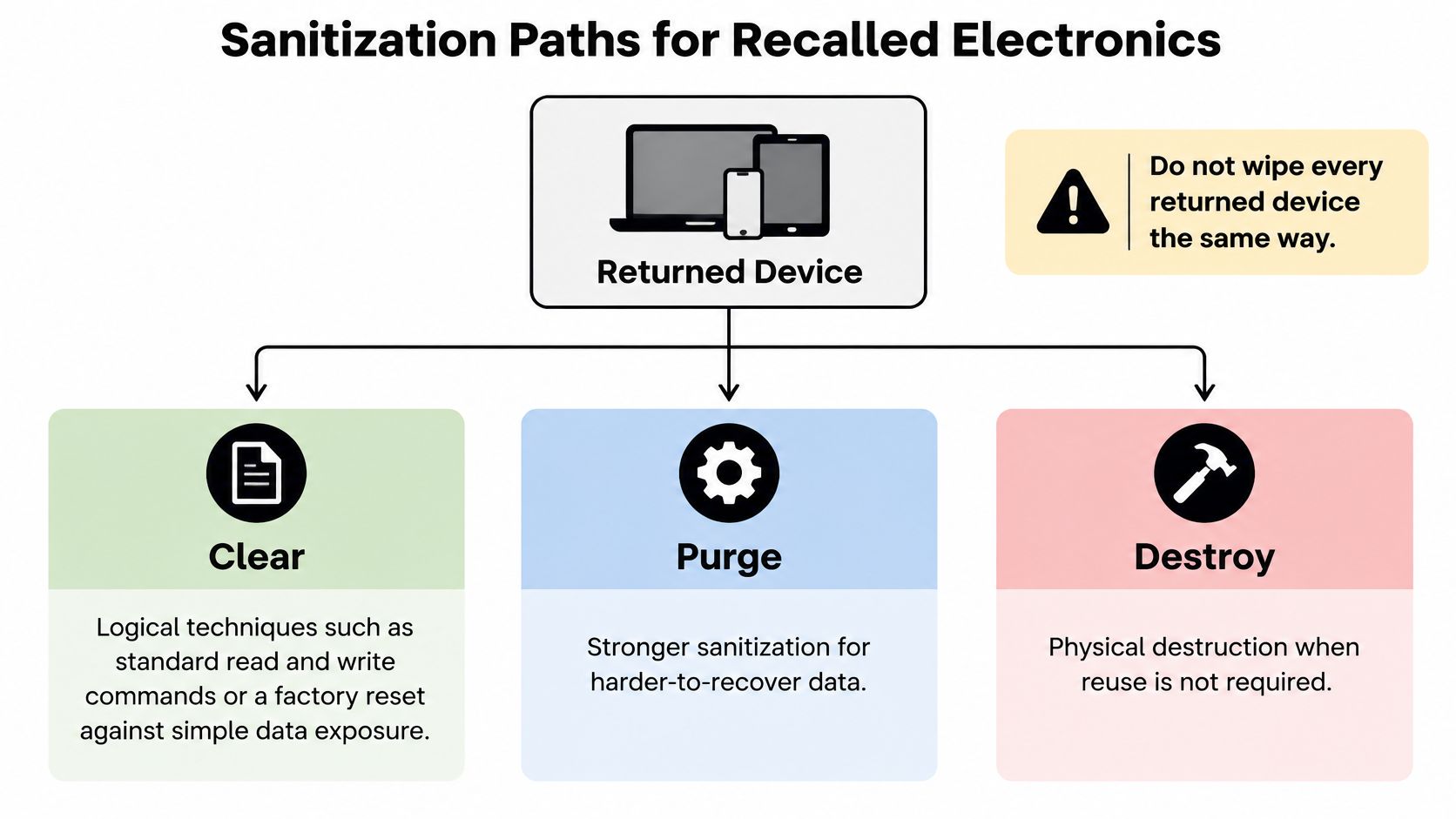
Don't wipe every returned device the same way. A recalled laptop cleared for redeployment, a failed solid-state drive, and a server pulled under terms that forbid reuse need different treatments, and your file should show why.
Clear, Purge, and Destroy in Plain Language
NIST SP 800-88 defines three methods. Clear uses logical techniques, such as standard read/write commands or a factory reset, to protect against simple, non-invasive recovery. Purge uses physical or logical techniques intended to make data recovery infeasible with state-of-the-art laboratory methods while potentially preserving the medium for reuse. Destroy makes recovery infeasible and prevents the medium from being reused for data storage.
- Recoverable equipment: Purge it, verify it, then consider resale or redeployment if recall terms allow reuse.
- Purge-eligible storage: Keep the medium in service only when the purge method fits that media type and verification passes.
- Destroy-only media: Shred or otherwise physically destroy failed drives, media with unknown encryption status, and any item the recall terms bar from reuse.
Physical destruction can include disintegration, incineration, pulverizing, shredding, or melting, and overwriting must cover all addressable storage locations rather than deleting files, as explained in NIST SP 800-88 on media sanitization methods. Record the method per device or batch, plus site, handler, date, and the tool or shredder used. Quarantine comes first, so pair this decision with disciplined recalled product quarantine services that keep unsanitized units away from cleared stock.
The Compliance File Behind the Method
The FTC Disposal Rule became effective June 1, 2005, under the Fair and Accurate Credit Transactions Act of 2003, according to the FTC announcement that the FACTA Disposal Rule goes into effect. It requires businesses holding consumer-report information to prevent unauthorized access or use during disposal. For electronic records, destroying or erasing media so information can't be read or reconstructed is the named example.
Healthcare, finance, and any firm holding consumer-report data should treat chain of custody and the certificate as the compliance file, not a courtesy document. Choose on-site destruction over off-site wiping for high-sensitivity drives, damaged devices that won't accept commands, or sites that can't release media. A certificate of recycling alone doesn't prove sanitization unless it names the method.
Vendor Checks SLAs and Cost Drivers
I would not award a multi-state recall lane on a per-pound quote. You're buying consistent control at every dock, and the vendor has to prove it before the first truck rolls.
Four Due Diligence Checks
The FTC guidance on disposing of consumer report information describes due diligence when hiring a disposal contractor, including reviewing an independent audit, checking multiple references, requiring recognized trade-association certification, and evaluating the contractor's information-security policies. Run all four. Then ask the vendor to prove the same controls apply at every branch, customer site, and subcontracted carrier, not just at headquarters.
Use targeted questions to ask before hiring an ITAD company to test whether answers are specific or rehearsed. Vague answers about downstream processing are a disqualifier when recalled product can't re-enter commerce.
SLA Terms to Put in Writing
- Response time by risk tier: Set a faster clock for high-hazard and data-bearing assets than for low-risk intact goods.
- Serialized intake: Require model, lot, or serial capture at pickup, not a pallet estimate at the warehouse.
- Custody events: Specify container seals, scan points, and carrier handoffs from dock to disposition.
- No commingling: Ban mixing recalled lots with routine e-waste or another client's product destruction load.
- Certificate timing: Set a deadline for certificates that name method, date, location, and serial or batch.
- Downstream proof: Require recycler certification, insurance, and exception reports, not only total pounds recycled.
What Actually Drives the Quote
Estimate cost in four parts. There's a fixed charge per site for pickup and paperwork, a per-unit charge for handling and wiping or destruction, labor surcharges for lift-gates, after-hours work, clinical access rules, and data center escorts, and storage fees while lots wait for reconciliation. Add an allowance for blank labels, silent sites, and partial pallets. A single national pickup rate hides those costs until change orders arrive.
Value recovery comes only after verification and the approved sanitization method. Buyback may not skip quarantine.
Practical rule: If the vendor can't show custody from dock to disposition, don't award the lane, whatever the price.
How to Execute Collection Across Every Site
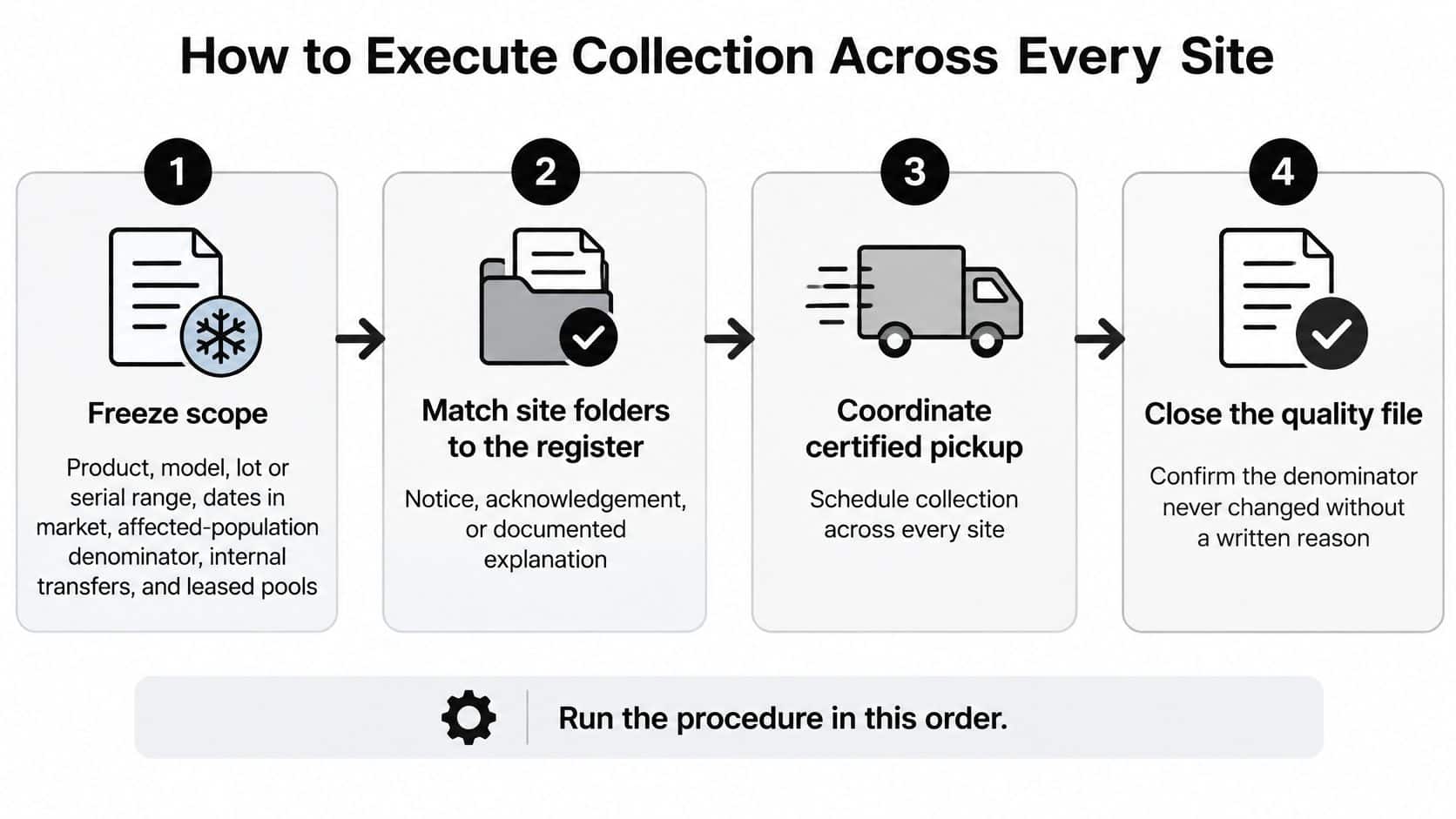
Run this in order. Skipping ahead to pickup before the register exists creates trucks full of unverified gear and a denominator nobody trusts.
The Nine Step Site Procedure
- Freeze scope: Define product, model, lot or serial range, dates in market, and the affected-population denominator, including internal transfers and leased pools. The record is a signed scope sheet.
- Build one affected-asset register: Issue each site a unique list, not a blanket email. Every asset gets one line that follows it to disposition.
- Notify the consignee: Record channel, date, and named owner for each site. Plan a second touch for silence by phone or visit, faster for high-hazard items.
- Verify and quarantine at intake: Check model, lot, or serial, move the unit away from good stock, and photograph damaged labels. Lookalikes stay out of the recalled cage.
- Record custody transfer: Log location, date, handler, seal or container ID, and carrier for every handoff. No seal number means no defensible transfer.
- Reconcile the same day: Match received units to the site denominator and flag duplicates, partial shipments, closed sites, and gear in repair channels or employee possession.
- Move only verified units: Send confirmed units to wiping, destruction, return to vendor, or correction, and write that disposition on the asset line.
- Escalate non-responders on a risk clock: Repeat communication, call, then visit. Don't mark a site complete because someone opened the notice.
- Close with documented gaps: Explain remaining units as exported, stolen, scrapped, or otherwise unavailable, with management sign-off.
That sequence matches FDA guidance on recalls, corrections, and removals for devices, which calls for effectiveness checks for every recall and tracking customers who fail to respond, then applying repeat communications, telephone calls, or personal visits. FDA defines effectiveness as confirming consignees received notice and took the required action, while termination requires reasonable assurance that affected products were removed or properly corrected. Outbound notification isn't completion.
Templates That Keep Sites Consistent
Every site notice should carry the recall ID, product and model, serial or lot range, required action, return deadline, named contact, and a request for written acknowledgment. Keep it short enough that a facilities lead can act without calling headquarters for interpretation.
Your second-touch script restates the deadline, confirms the unit count against the site list, and asks directly where unlocated units could be, including home offices, storage cages, and vendor repair queues. Log the call or visit as a dated record with the person reached. Keep one national file and one folder per site, so an auditor can trace any serial from notice to disposition without hunting through email.
Site-Level Completion Metrics That Prove Recovery
Report a completion ratio, not a contact count. Divide remedied or physically controlled units by the affected population, and remove only legitimate unavailable units such as exported, stolen, scrapped, or otherwise documented as gone.
The NHTSA report to Congress on improving vehicle safety recall completion rates calculates completion as remedied units divided by the affected population, excluding legitimate unavailable categories. It found mature vehicle recalls averaged only 65.8% completion for campaigns initiated from 2012 to 2022, another analysis found 61% remedied by the fifth quarter, and component-category rates commonly fell between 60% and 75%.
That isn't an electronics guarantee. It's a control baseline showing how fragmentation, outdated site lists, internal transfers, and silent recipients leave residual exposure even after a serious program. Use structured product recall chain of custody services so your numerator rests on scanned custody, not site assurances.
Site Completion Dashboard
| Metric | What to count | Control use |
|---|---|---|
| Units assigned | Affected population on the frozen site list | Denominator; do not shrink it casually |
| Units acknowledged | Consignee confirmed the notice | Shows reach, not recovery |
| Units physically received | Scanned into quarantine | Proves the item moved |
| Units verified affected | Model, lot, or serial match | Drops lookalikes and duplicates |
| Units destroyed or remediated | Final disposition on the asset line | Risk actually removed |
| Unresolved units | Missing, transferred, silent, or unlabeled | Escalation queue |
| Recovery percentage | Verified controlled units divided by assigned, excluding documented unavailable | Compare with a 60 to 75 percent baseline |
Six States, Not One Status
Separate notified, acknowledged, returned, quarantined, verified destroyed or corrected, and filed as evidence. A site can look finished at step two while devices sit in home offices, storage cages, leased pools, or repair depots. Collection rate isn't the same as risk removed until disposition is verified.
Set escalation by risk. High-hazard items get a short second-contact cycle and a named executive sign-off before closure. Low-risk items can run a longer follow-up window without weakening control.
Each week, sort unresolved units by age and hazard, not by which region replied first. That's your work queue.
Audit the File and Schedule Certified Pickup
Closure is a sign-off, not a feeling. The quality owner should be able to defend every line in the register before anyone declares the campaign done.

Closure Checklist for the Quality Owner
- Denominator integrity: Confirm it never changed without a written reason approved by the recall owner.
- Site folder match: Check notice, acknowledgment or documented second attempt, intake scan, quarantine record, custody timestamps, and final disposition against the register.
- Quantity reconciliation: Tie assigned, verified, destroyed or corrected, and unavailable totals together, and explain every gap over your risk threshold.
- Certificate quality: Attach certificates naming method, date, location, and serial or batch, using a proper certificate of destruction for recalls rather than a generic recycling letter.
- Exception evidence: Keep photos for damaged labels and a log covering duplicates, partial shipments, closed sites, and ownership transfers.
Hold the campaign open while high-hazard unresolved units remain. Closing early to hit a reporting date converts a known gap into an undocumented one.
Scheduling discipline matters here too. Rural and low-density sites need longer booking windows, the same planning problem discussed in practical guides to rural scrap car pickup lead times, where distance and route density shape realistic collection dates. Build that slack into your site calendar instead of promising every location the same pickup day.
When the file is ready, book execution with a certified commercial ITAD partner rather than ad-hoc office cleanouts. The decision is simple. If scope, denominator, and disposition method are written, schedule the pickups. If any of the three is missing, don't move assets yet.
Contact Beyond Surplus for certified electronics recycling and secure IT asset disposal, including nationwide business pickup, on-site or off-site data destruction, product destruction, and chain-of-custody certificates for multi-location recall collection. Visit Beyond Surplus to schedule a multi-site collection built around your frozen register, site deadlines, and verified disposition requirements.


