

Your marketplace listing is down, fulfillment has stopped, and the recall notice has gone out. Then a returns clerk scans another affected device into stock, a fulfillment partner asks whether to liquidate a pallet, and IT discovers that the returned equipment still holds customer information.
Recalled product disposal for e-commerce is a physical inventory operation, not just a listing-removal task. Business owners, IT managers, facility teams, and procurement leads need to know where each unit is, who controls it, and what evidence will prove its final disposition. The paper trail is part of the disposal itself.
Table of Contents
- Choose the Disposition Route for Each Recalled Unit
- How to Quarantine and Reconcile Recalled Stock
- Wiping Data and Vetting an ITAD Partner
- Transporting Recalled Units With Chain-of-Custody Controls
- Proving Destruction and Closing Out the Recall
Choose the Disposition Route for Each Recalled Unit
Removing an online offer doesn't remove the equipment from your warehouse, returns center, reseller network, or purchaser's premises. Until someone assigns a permitted route and confirms completion, those units can still be restocked, transferred, or sold.
Disposal also isn't the default recall remedy. The U.S. Consumer Product Safety Commission's five-year remedy data identify 1,105 recalls involving refunds, or 54.7% of recorded remedies, compared with 23 involving disposal, or 1.1%. That distinction matters operationally: a refund authorization, a repair instruction, and a destruction order require different handling.
Disposition route by recall situation
| Recall situation | Disposition route | Evidence to keep |
|---|---|---|
| Hazard removable by software update or part swap | Repair or retrofit, then return to sale only with regulator approval | Remediation log, serial numbers, approval reference |
| Customer refund or replacement still open | Hold at quarantine point and arrange return to manufacturer under the recall instructions; don't destroy yet | Carrier tracking, receipt date, remedy status per order |
| Lithium battery or fire-risk product | Authorized hazardous-waste processor, with battery isolation by trained personnel first | Processor certificate, battery condition log, transport declaration |
| Laptop, router, payment terminal or storage drive | Certified data erasure where safe and technically suitable, then shredding or recycling under the approved route | Erasure or destruction certificate listing each serial number |
| Remedy no longer available, unit unusable | Destruction or recycling through an authorized recycler | Quantities, dates, treatment route and processor name |
Start with hazard elimination, not material destruction. Ask whether a software fix, replacement component, repair, or controlled refurbishment can make the product safe under the approved remedy. Only move to destruction or regulated waste treatment when the authorized remedy calls for it or safe recovery isn't available.
An open refund doesn't automatically mean that every unit must wait indefinitely. It means customer service, compliance, and the manufacturer need to agree on the evidence required before processing, particularly where inspection, reimbursement, or an investigation remains outstanding.
Balance safety against recoverable value
Destroying every device prevents reuse, but it also discards equipment and materials that might be recoverable. Conversely, keeping equipment for its resale value is unacceptable if the repair doesn't eliminate the hazard or the recall terms prohibit redistribution.
A practical refurbish-or-recycle assessment should separate technical repairability from permission to return a product to commerce. A technician's successful bench test isn't a substitute for the required approval.
Disposition rule: Recover value only after you've established that the proposed route removes the hazard and complies with the recall.
Returns routing needs the same discipline. ServeApps' guide to handling returns and product recovery provides useful context for separating intake, inspection, recovery, and disposal workflows. For recalled inventory, disable any automatic restock or liquidation decision that would bypass compliance review.
Assign every affected SKU and lot a written route before releasing it from quarantine. Name the person authorized to approve exceptions, and require that person to record the reason, supporting evidence, and revised destination.
How to Quarantine and Reconcile Recalled Stock
Quarantine needs both a system block and a physical location. A warehouse-management flag won't stop a contractor from collecting an incorrectly labeled pallet, while a cage won't stop another fulfillment center from shipping its remaining stock.
The EU's general product-compliance guidance describes corrective measures including withdrawal, recall, and destruction, with reporting through the Safety Business Gateway when required. For businesses selling into that market, the remedy and reporting obligations need to travel with the inventory record, not sit in a separate legal inbox.
Establish control before processing
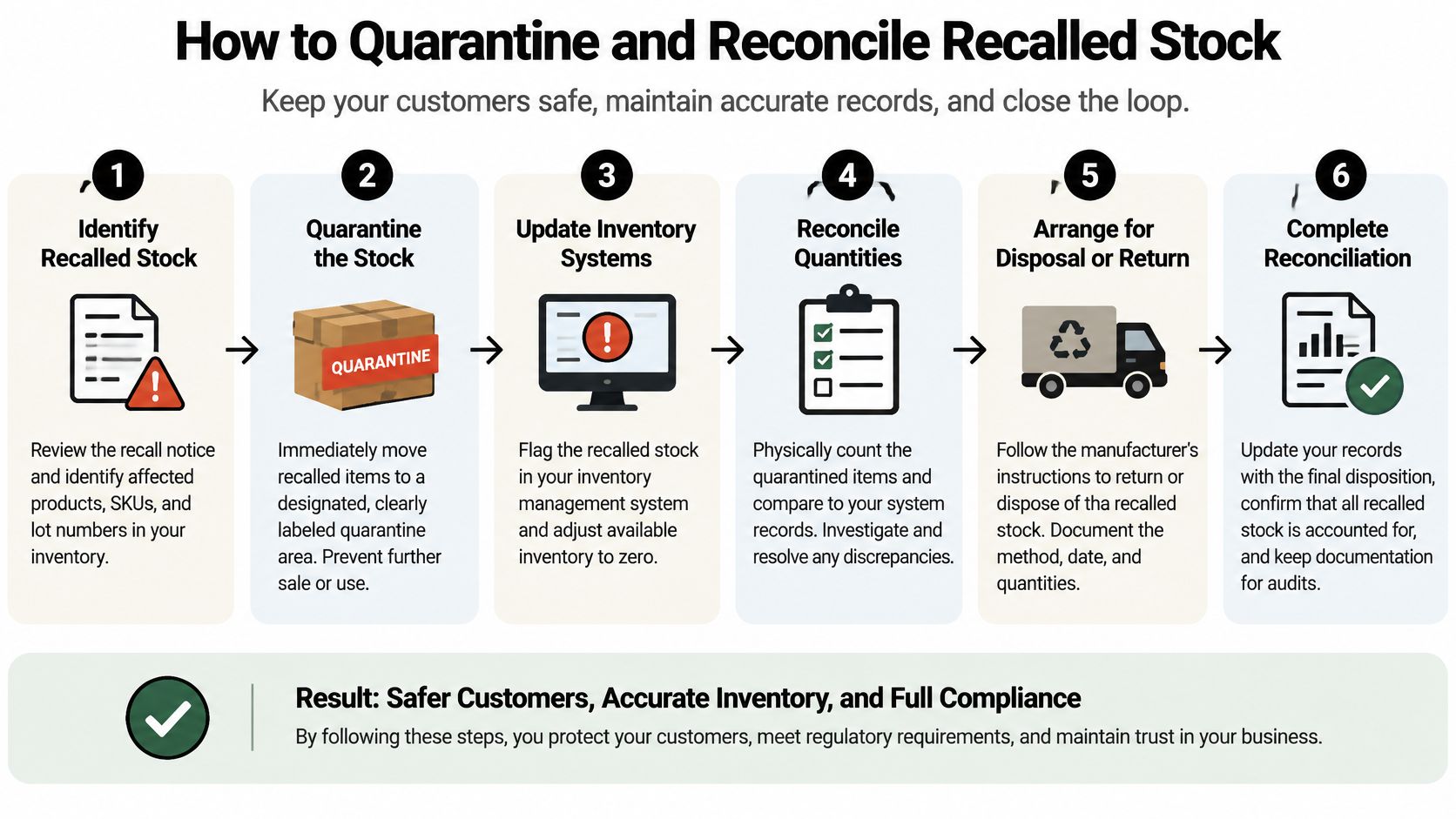
Freeze fulfillment and marketplace listings. Block the affected SKUs and lots in order management, warehouse management, and marketplace feeds, including bundles and replacement listings. Check seller and brand-name variations so an old product doesn't remain available under a new title.
Reconcile warehouse, returns, and in-transit inventory. Compare physical counts with purchase receipts, shipment records, customer orders, transfer orders, and returns authorizations. Log discrepancies as exceptions rather than silently adjusting the stock ledger to match the count.
Identify purchasers and tag affected orders. Use the recall's product identifiers and sale scope to build the outreach list, then attach recall status to each affected order. Include business accounts whose equipment may have moved to branch offices or downstream users.
Assign a unique disposition ID. Tie that ID to the serial number or lot, order reference, current location, hazard, and selected remedy. For unserialized products, preserve lot identification and controlled container records rather than inventing device-level traceability.
Move stock into access-controlled quarantine. Use labeled cages, bays, or approved hazard-specific storage, keeping affected and unaffected lots physically separate. Remove recalled products from ordinary returns benches so a clerk can't accidentally restock them after a cosmetic inspection.
Send notices with usable instructions. Record the notification timestamp, approved remedy, response, and return instructions against the order. Don't issue a generic shipping label before the logistics team has assessed the product's condition and transport requirements.
Make exceptions visible
Your working register should distinguish expected, located, notified, returned, and awaiting action. Those aren't interchangeable statuses: a purchaser acknowledging an email doesn't establish that the device has entered controlled custody.
Assign each discrepancy an owner and a next action. A missing pallet might require a fulfillment-center investigation; an unmatched return might need an order-history search; a device without a readable serial label might require photographs and manufacturer identification.
Use inventory optimization controls to keep available-to-sell stock separate from blocked inventory. Don't solve a recall-count problem by deleting the affected SKU or merging it into a replacement item, because that destroys the relationship between the original order and the physical product.
Keep the marketplace, seller, importer, manufacturer, and logistics provider's responsibilities explicit. Your internal recall lead coordinates their tasks, but a responsibility matrix doesn't itself determine or transfer statutory liability.
Before a batch leaves quarantine, its departure count must reconcile with the approved manifest. Zero unexplained variance is the release checkpoint, not a reason to delay emergency safety action: if a unit needs immediate specialist handling, record the exception and its custody movement as it happens.
Wiping Data and Vetting an ITAD Partner
The FTC Disposal Rule applies to businesses and individuals using consumer reports for a business purpose, including relevant service providers. It requires reasonable measures against unauthorized access during disposal and identifies destroying or erasing electronic information so it can't practicably be read or reconstructed.
That scope is specific. It isn't a universal electronics-recycling law, but it establishes an important baseline for covered information on recalled business equipment.
The FTC's Federal Register explanation also includes sale, donation, or transfer of media containing consumer information. Handing a recalled laptop to a recycler doesn't, by itself, resolve the data obligation.
Data sanitization method by device type
Select the method against the actual storage technology, device condition, and approved recall route. Don't power an unsafe device merely to run a wipe utility.
| Device or media | Sanitization method | Proof to file |
|---|---|---|
| Spinning hard drive | Certified overwrite with verification, or on-site or off-site shredding | Wipe report or shred certificate per serial number |
| SSD or NVMe drive | Validated cryptographic erase where supported and appropriate, or physical destruction; ordinary overwrites are unreliable on flash | Erase log or destruction record listing each drive serial |
| Laptop or desktop with intact drive | Remove and sanitize the drive safely, then recycle the chassis under the approved route | Drive-level certificate matched to asset tag |
| Router, firewall or payment terminal | Identify embedded storage; remove and destroy relevant memory modules where required, treating firmware-stored data as in scope | Destruction certificate with device count and serials |
| Smartphone or tablet fleet | Don't rely on factory reset alone; verify MDM wipe and use physical destruction for units assigned to destruction | Wipe confirmation and serial list |
| Copier or multifunction printer | Use a verified overwrite method or remove and sanitize the internal drive before transfer | Certificate listing each device serial |
Flash controllers can leave data in areas that a normal overwrite doesn't address. Cryptographic erase is appropriate only when encryption implementation and key destruction support the intended outcome; a command reporting success isn't enough without verification.
Factory resets also differ by device and configuration. The introduction to phone privacy with Used Mobiles 4 U offers accessible context, but enterprise acceptance should depend on documented sanitization results, not a reset screen.
Check the contractor's evidence
Ask prospective IT asset disposition partners to demonstrate their process before you release equipment.
- Independent audits: Review their scope, findings, and coverage of the facility that will handle your assets.
- References: Ask about comparable storage media, hazardous devices, and failed-erasure exceptions.
- Recognized certification: Check its validity and scope rather than accepting a logo on a proposal.
- Information-security policies: Examine access control, storage, incident response, subcontracting, and downstream handoffs.
- Sample reporting: Require serial-level results and an explicit route for unreadable or failed media.
A data-destruction standards assessment can help procurement translate security requirements into the statement of work. Specify whether verification happens before shipment, after receipt, or during witnessed destruction.
Beyond Surplus is an option for on-site or off-site hard drive shredding, certified data wiping, and documented electronics recycling. It provides chain-of-custody documentation and certificates of recycling and data destruction, with business pickups across the contiguous United States coordinated through its fleet and transportation partners.
Certificates support compliance and contractual accountability, but don't assume they erase every legal obligation. Confirm the service scope, responsibility allocation, processing location, and hazardous-product acceptance before booking.
Transporting Recalled Units With Chain-of-Custody Controls
Don't put recalled fire-risk battery equipment into an ordinary parcel return workflow. Have a qualified shipper assess battery condition, packaging, transport mode, and carrier acceptance before issuing instructions. A carrier that accepts routine battery shipments may not accept damaged or defective recalled batteries.
The scale of online enforcement makes physical coordination essential. The European Commission's Safety Gate report records 4,671 validated dangerous-product alerts and 5,794 follow-up actions in 2025, with follow-up actions increasing 35% from the previous year. Such actions can stop offers and distribution, but warehouse and logistics teams still have to control the equipment.
Build the pickup around the hazard
Start by sending the processor a condition assessment, product identifiers, battery information, and photographs taken without unsafe handling. Ask the receiving facility to confirm acceptance before the carrier arrives.
Packaging instructions should address the actual hazard. Keep units from moving inside containers, protect against accidental activation where safe, and preserve serial labels for receiving inspection. Trained personnel should determine battery isolation and packaging measures rather than asking warehouse staff to improvise.
Prepare the custody record before loading. Include the recall reference, disposition IDs, container identifiers, quantities, origin, destination, carrier, collection timestamp, and releasing and receiving parties.
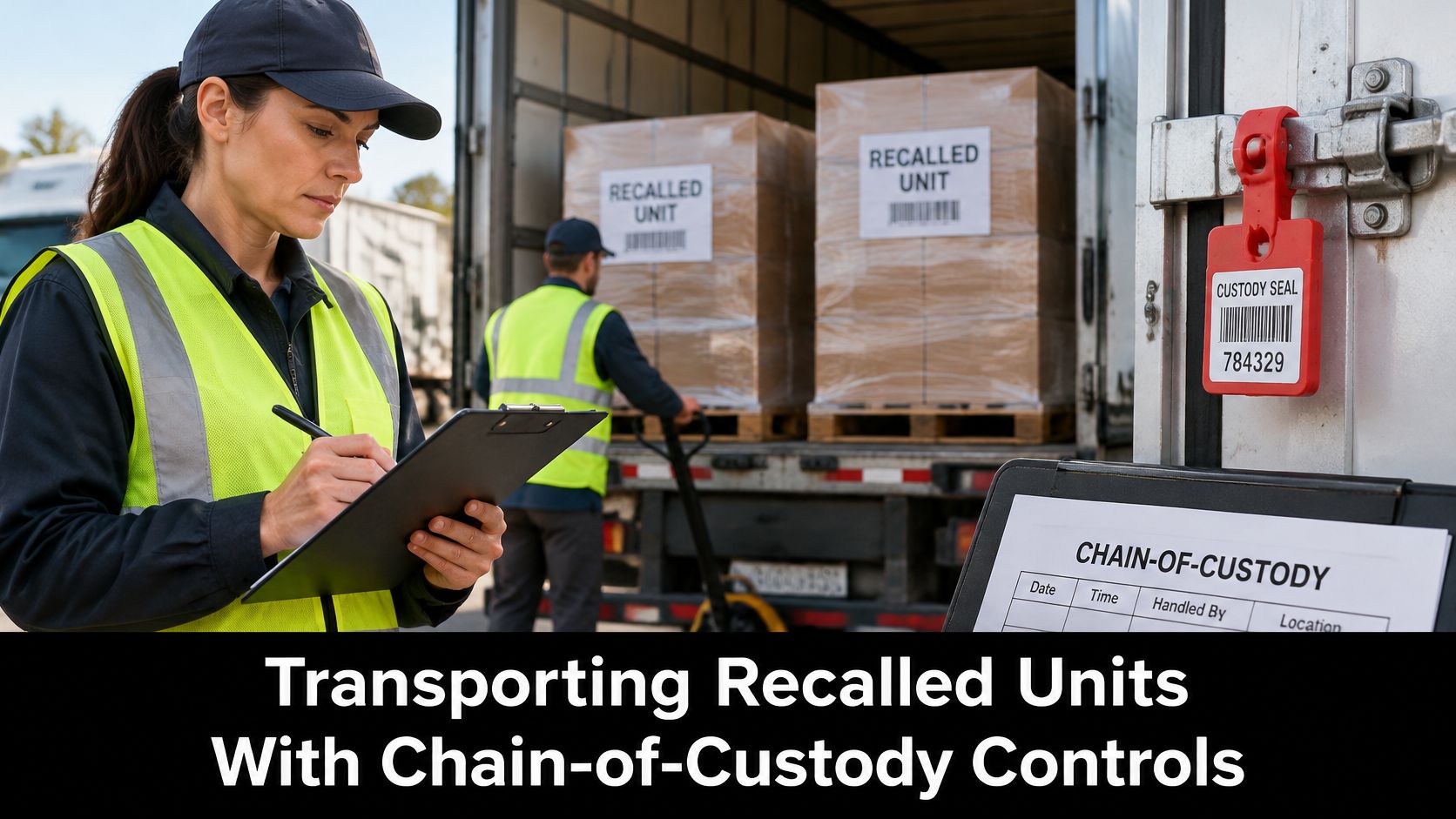
At pickup, match the manifest to the containers and photograph their condition and seals where appropriate. At receipt, require the processor to record actual quantities, seal condition, damage, and exceptions rather than merely signing the driver's paperwork.
A documented chain of custody for IT asset disposal should identify who accepted responsibility at each handoff. Carrier tracking establishes movement; it doesn't establish that the correct serial numbers reached the intended treatment line.
A customer's photo is never sufficient proof of destruction for battery or energized products. Use controlled collection and authorized treatment rather than asking someone to damage unsafe equipment.
Check location-specific obligations
An EPA overview of state electronics programs reported 25 states with e-waste recycling laws, including 15 with landfill-disposal bans. Treat that historical overview as evidence of state variation, not a current compliance checklist.
For each storage and processing location, confirm the applicable pickup, accumulation, transportation, recycling, and disposal rules. Determine whether the specific waste, business generator, and receiving facility fall within those requirements.
Cross-border movements need separate review. Don't describe defective equipment as reusable goods merely to simplify a shipment; verify waste classification, destination acceptance, export and import restrictions, and the permissions applicable to the proposed route.
Keep liquidation, donation, and export channels blocked unless expressly authorized. At receiving, match serials and product characteristics to the expected return so substituted equipment doesn't create a false completion record while the recalled unit remains in circulation.
Unexpected extra units need exception records too. They may be unrelated returns, duplicate entries, or additional affected stock, and the processor shouldn't make that determination by discarding them.
Proving Destruction and Closing Out the Recall
Set the closeout test as an internal control: 100% of identified recalled units assigned a disposition status, zero unexplained inventory variance, and documented custody at every transfer. A status can be outstanding, but it must have an owner and deadline; it isn't the same as a completed remedy.
The European Commission's guidance on unsold consumer products describes destruction as intentional damaging or discarding, excluding discarding solely to prepare a product for reuse, and addresses disclosures covering quantities, weights, reasons, and treatment proportions. These distinctions help prevent a business from treating every outbound recycling shipment as an identical outcome.
Require a certificate that identifies the work
A useful destruction or recycling certificate should include:
- Product and hazard: The affected product identifiers and relevant treatment precautions.
- Quantity and identity: Serial numbers, lot references, or an attached manifest tied to the processed batch.
- Receipt and treatment dates: Separate confirmation of arrival from confirmation of processing.
- Treatment route: The actual destruction, recycling, recovery, or other authorized process.
- Responsible processor: The facility and organization accountable for the work.
A certificate stating only “recycled” can't establish which devices were processed or whether hazardous components and storage media received the specified treatment. Use a recall certificate-of-destruction checklist when agreeing the reporting deliverables, not after the equipment has disappeared into a processing line.
The EU guidance on unsold-product destruction sets out a prohibition applying from 19 July 2026 to specified Annex VII categories, subject to exceptions, and describes five-year electronic record retention and provision within 30 days of an authority's request for qualifying records. Check applicability and exceptions rather than treating this as a blanket prohibition on safety-related recall destruction.
Reconcile evidence before closing
Say a hypothetical router recall covers 400 units, with 12 initially unaccounted for. Matching the serial register against processor receipts might show that those devices arrived under a separate consignment. Until that match is documented, a bulk invoice doesn't resolve the gap.
Mixed lots and premature removal of serial labels make that investigation harder. Preserve identification until the intake record and treatment manifest are matched.
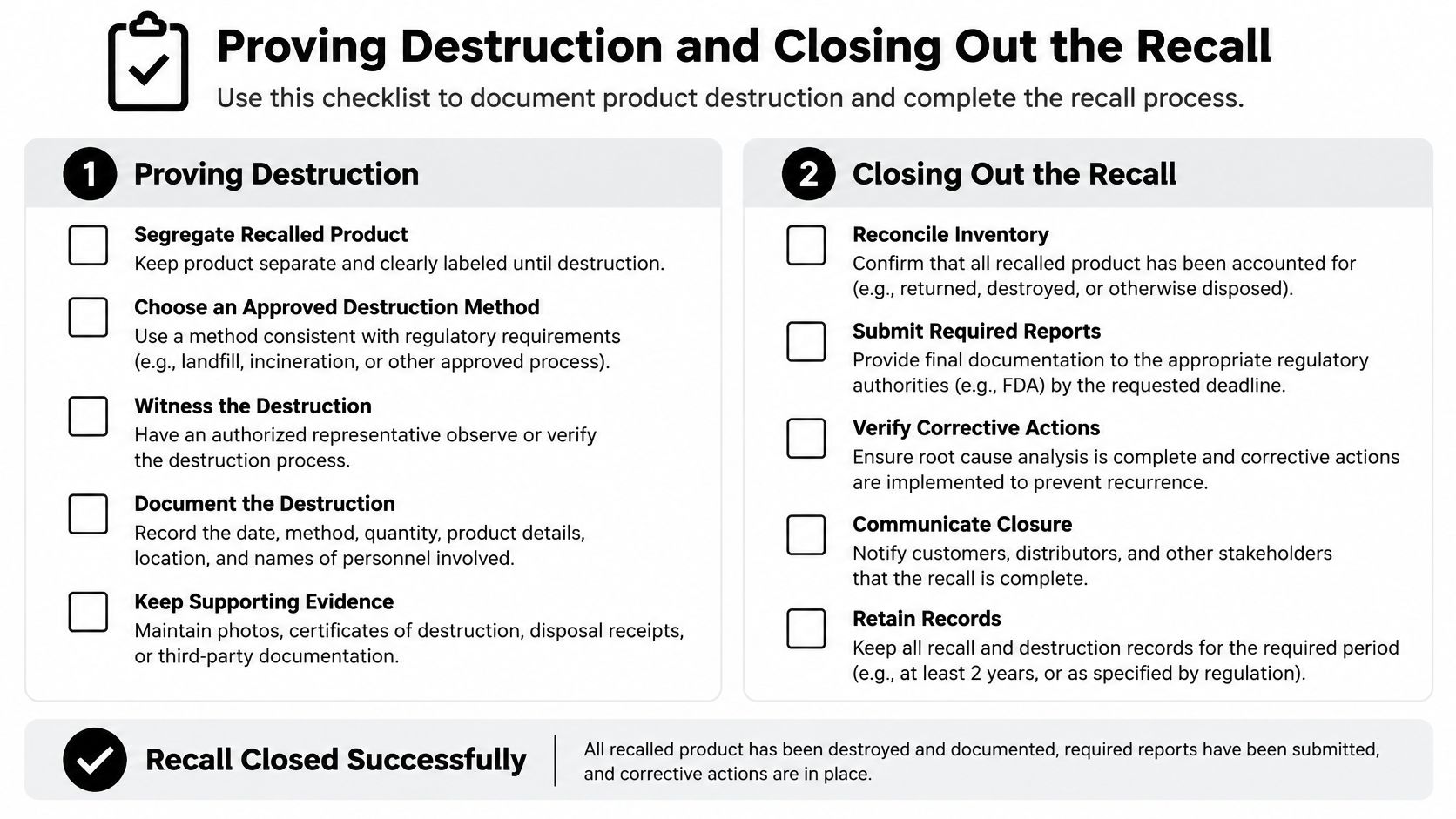
Use this closeout sequence:
- Confirm status. Record each SKU and serial as repaired, returned, destroyed, recycled, or outstanding with an owner and deadline.
- Run the mass balance. Match starting inventory and subsequent receipts against documented outcomes and remaining stock.
- Assemble the evidence. File certificates, custody logs, processor receipts, remedy records, and exceptions under the recall reference.
- Prepare remaining pickups. Provide unit counts, serial or lot lists, hazard classification, battery status, storage location, and access hours.
- Request a scoped quote. Use the provider's contact process to confirm whether on-site shredding, off-site treatment, or certified wiping fits the batch.
Contact Beyond Surplus for certified electronics recycling and secure IT asset disposal, with business pickups available across the contiguous United States. Share your recall reference, inventory manifest, battery condition, and data-security requirements so the team can scope collection, processing, and the documentation needed to close the recall.


