
You've got a cage, a closet, or half a server room in Atlanta, Georgia full of retired Dell, HP, and Lenovo hardware, and facilities wants it gone before quarter end. Procurement wants money back. Legal wants proof no data walks out with it. Those three goals don't automatically agree, and picking the highest bidder without sorting them out is how good IT directors end up explaining a recoverable drive months later.
Table of Contents
- When a Server Room Becomes an ITAD Project
- Preparing Assets With a Defensible Data Sanitization Plan
- How Buyback Value Actually Gets Calculated in Atlanta
- Paperwork and Compliance That Actually Holds Up to Audit
- On-Site Shredding, Off-Site Processing, and the Logistics Layer
- Maximizing Resale Value Without Trading Away Security
- A Reusable Workflow for Your Next Atlanta IT Equipment Buyback
When a Server Room Becomes an ITAD Project
A refresh cycle ends the same way in Midtown, Buckhead, and every office park along the Perimeter. New laptops go out, old rack servers come down, switches and storage shelves stack up on carts, and suddenly you've got a deadline tied to a lease return, a data center exit, or a finance write-off. The equipment still has value. It also still has logins, cached files, configurations, and sometimes regulated records sitting on drives nobody has touched since decommissioning.
That's the point where IT equipment buyback stops being a simple sale. You're not selling office furniture. You're transferring data-bearing assets to someone else, and your organization still owns the consequences if sanitization, custody, or downstream recycling fails. Treat it as a risk-adjusted disposition decision, not a single cash quote, and you'll make better choices on price, method, and paperwork.
The Questions That Actually Matter
Before you request bids, answer five questions in writing. Which assets hold data, and what kind? Which drives can be sanitized and resold, and which should be destroyed outright? What evidence will you keep after pickup? Who handles de-racking, packing, and transport? And what happens to gear with no resale market?
Those answers shape the quote more than model numbers do. A provider quoting data center ITAD services should be able to separate certified erasure, destruction, parts recovery, and recycling by asset class. If a bidder gives you one blended number for servers, laptops, networking gear, and loose drives, you don't have a plan. You've got a guess that hides where risk and fees sit.
My rule: Do not approve a buyback until every serialized asset has a named disposition path. Resale, harvest, destroy, or recycle. No asset should live in a miscellaneous category.
The environmental stakes reinforce why structure matters. The Global E-Waste Monitor 2024 reported 62 billion kilograms of e-waste generated in 2022, with only 22.3% documented as formally collected and recycled in an environmentally sound manner. Functional business equipment kept in productive use avoids that waste stream. Unusable equipment still needs regulated processing, not a dumpster or an undocumented downstream buyer.
For Atlanta IT equipment buyback to sell used business computers and servers responsibly, start with disposition logic first and price second. You'll usually recover more money that way too, because buyers pay with confidence when inventory, condition, and data handling are already clear.
Preparing Assets With a Defensible Data Sanitization Plan
Do not let a buyback partner discover your data problem for you. The work that protects your company starts before pickup, while the equipment is still under your control, and it looks like engineering controls rather than a factory reset.
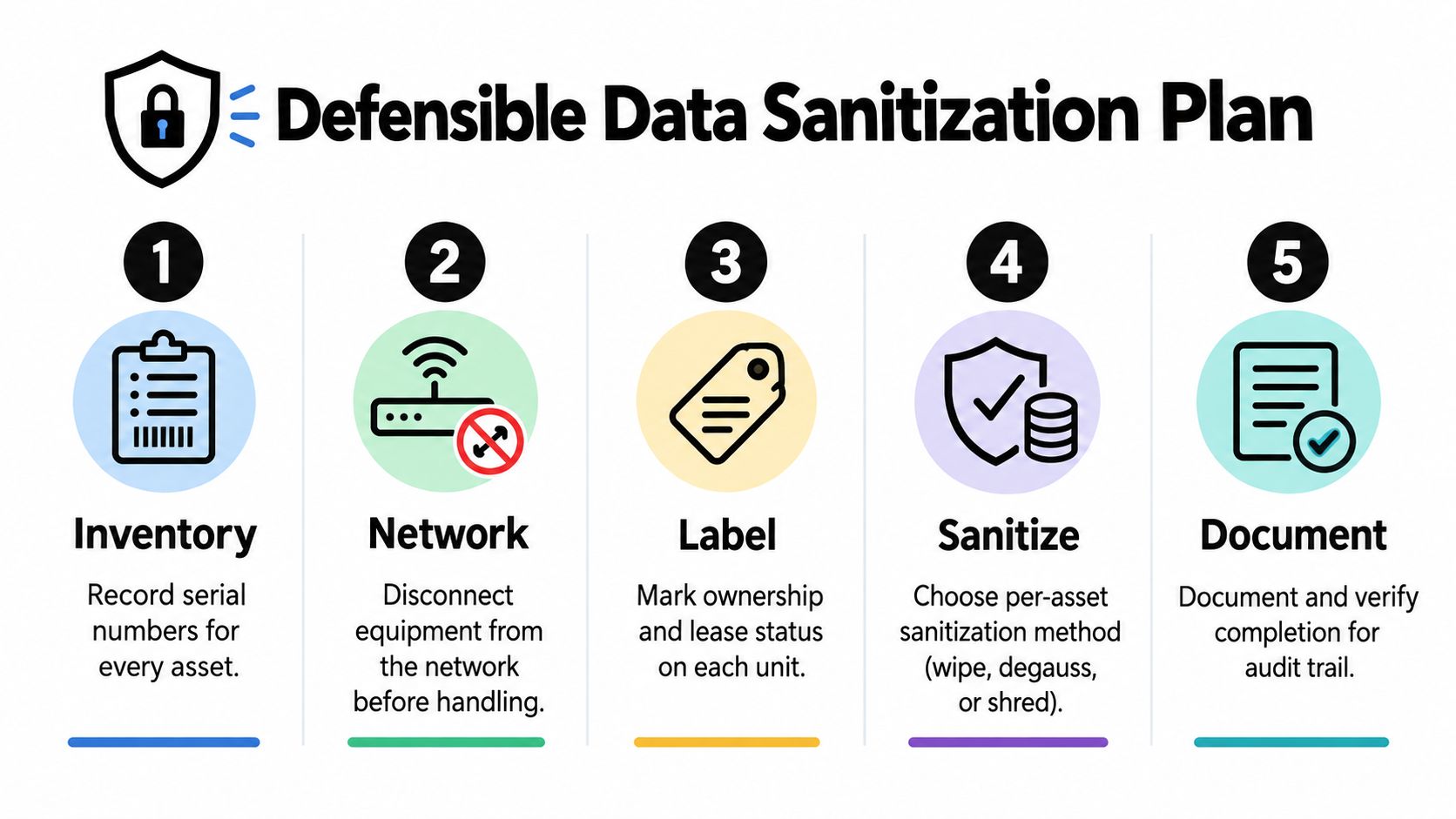
Start with a serial-number inventory. Record asset tag, make, model, serial number, media type, interface, and ownership status for every computer, server, array, and loose drive. Pull devices off production networks, remove management access, and keep unprocessed equipment physically separate from sanitized equipment. Mixing those two groups on the same pallet is the most common self-inflicted failure I see.
Choose Clear, Purge, or Destroy Per Asset
NIST SP 800-88 defines clear, purge, and destroy as its three media sanitization methods and states that purge should be used instead of clear when possible. Clear applies logical techniques to user-addressable areas and guards against simple recovery. Purge goes further, aiming to make recovery infeasible even with advanced laboratory methods while preserving the drive for reuse. Destroy makes the media unusable for storage.
For resale-bound laptops, desktops, and server drives, purge is usually the right target because it protects data without killing resale value. For failed drives, media that held highly sensitive records, or drives you cannot verify, destroy is the honest answer. Do not force every asset into one method to simplify a spreadsheet.
A deeper breakdown of NIST 800-88 data destruction for Atlanta IT managers helps when you're translating that guidance into an internal SOP, but the operating principle stays simple. Match method to media and confidentiality, then verify.
Where Teams Get Tripped Up
- Treating SSDs like spinning disks: Flash media handles remapped and overprovisioned cells differently, so a method that works on magnetic drives may not address the whole device.
- Trusting a success screen: A wipe tool reporting completion isn't independent verification. Check results and log failures as exceptions, not rounding errors.
- Losing lease and ownership labels: Mark leased, owned, and warranty-return assets before staging, or you'll sell equipment you don't own.
- Skipping reserved areas: Verification should account for accessible and reserved areas where the interface allows, not just visible partitions.
Artifacts to Capture Every Time
For each serialized drive, retain method, operator, timestamp, tool output, verification result, and final disposition. Note who handled custody transfers and where the asset went next. That evidence package is what lets a buyer resell the equipment confidently and lets your security team answer an auditor without reconstructing events from email threads.
A sanitized drive without a verification record is an assertion, not a control.
Build this checklist into your refresh process now, not during the week facilities needs the room back. Prepared lots move faster, price better, and create fewer disputes after receiving, because the buyback partner receives documented equipment instead of ambiguity.
How Buyback Value Actually Gets Calculated in Atlanta
The highest headline quote is often the worst deal. I've watched Atlanta teams celebrate a strong per-unit number, then lose the advantage to freight charges, failed-drive fees, missing accessories, and downstream deductions they never asked about. Judge offers on risk-adjusted net recovery, meaning expected payment minus logistics, testing, sanitization, documentation, and the cost of getting security wrong.
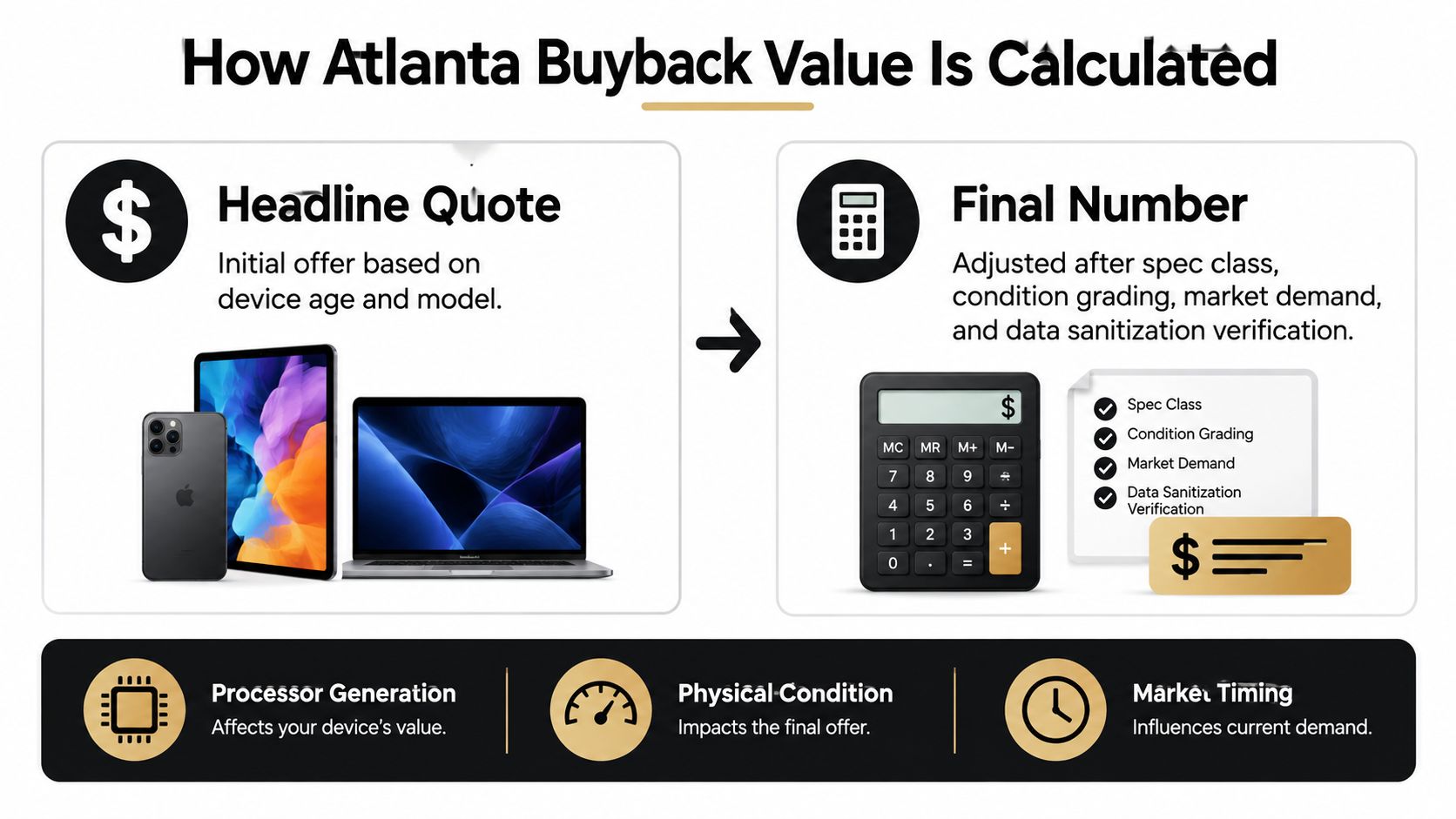
Buyers start with fundamentals. Processor generation, memory and storage configuration, chassis type, cosmetic condition, battery health on laptops, and included rails, power supplies, and cables all move the number. Quantity matters too. A uniform fleet of business laptops is easier to test and remarket than a mixed pile of one-offs, and enterprise servers, storage arrays, and networking gear sell into different secondary markets than office endpoints.
Why the Final Number Moves
Initial quotes rely on your inventory list. Final settlement depends on receiving and grading. If serial numbers don't match, configurations differ from the list, drives fail verification, or servers arrive without caddies and rails, the buyer reprices. That's not automatically bad faith. It's why you should require an equipment condition assessment process in writing, with grading definitions and a dispute window, before equipment leaves your dock.
Logistics also swing Atlanta deals. A consolidated pickup from one metro location costs a buyer less than scattered small pickups, white-glove de-racking, or urgent after-hours work. Ask whether freight, packing materials, de-installation, and destruction for failed media are included or deducted later. An attractive unit price that buries those costs isn't transparent.
Demand an Itemized Disposition Plan
Refuse a single blended price for a mixed lot. Require line items for certified erasure and resale, physical destruction, parts harvesting, and recycling. That structure forces the security conversation into the quote, where it belongs.
The tradeoff is real in both directions. Enterprise research found up to 47% of devices destroyed for security reasons were still functional, while 25% of laptops and desktops and 19% of data-center assets were refurbished without certified erasure, and 17% of organizations reporting a breach or leak attributed it to redeployed devices or drives still containing prior data. Shredding everything wastes recoverable value. Reselling everything without verifiable erasure gambles with breach risk.
Split the lot intelligently. High-value, verifiable gear goes to certified erasure and resale. Failed or high-risk media goes to destruction. Low-value complete systems may yield more as parts than as units. Dead equipment goes to recycling. That itemized approach is how Atlanta electronics recycling services and buyback should work together, and it's the fastest way to spot a quote hiding fees inside optimism.
Paperwork and Compliance That Actually Holds Up to Audit
Certificates aren't interchangeable, and treating them that way is how liability returns to your organization after pickup. Each document proves a different control. You need the full chain, not a single PDF with a reassuring logo.
A pickup receipt proves custody transferred at a location and time. A serial-number inventory proves which specific assets moved. A certificate of data destruction ties serialized media to a sanitization or destruction method, date, and processor. A certificate of recycling addresses material disposition. Downstream processing evidence shows where non-reusable materials went after your direct provider handled them. None of those documents substitutes for another.
The Federal Baseline
The FTC Disposal Rule, effective June 1, 2005, requires reasonable measures to prevent unauthorized access to consumer-report information during disposal and treats sale, donation, or transfer of computer equipment containing that information as disposal. That means buyback triggers the same duty as throwing equipment away. Electronic media should be destroyed or erased so information cannot be read or reconstructed.
The FTC also expects due diligence when you hire a disposal contractor. Review independent audits, check references, ask about recognized trade association certification, and evaluate information-security policies. Document that vetting. If you cannot show why you trusted the provider, your compliance story has a hole at its foundation.
Sector rules layer on top. Healthcare organizations handling electronic protected health information, financial institutions under GLBA expectations, and schools and government agencies with retention schedules all need records that map to their own obligations. Aligning your compliance documentation package to those requirements before pickup beats asking a vendor to reconstruct certificates months later.
What to Retain After the Truck Leaves
- Custody records: Pickup receipt, transporter details, dates, locations, and signatures for every transfer.
- Serialized disposition log: Each asset and drive connected to resale, destruction, parts recovery, or recycling.
- Sanitization evidence: Method, verification result, operator or processor, and exception handling for failures.
- Vendor due diligence file: Audits or certifications reviewed, references checked, and security policies evaluated.
- Settlement reconciliation: Quoted inventory matched against received, graded, and paid inventory.
Wiped does not automatically mean responsibly recycled, and recycled does not automatically mean securely sanitized.
Keep those records under your normal retention policy and make them retrievable by serial number. When an auditor, customer, or regulator asks what happened to a specific server, "our vendor handled it" isn't evidence. A serialized chain from your dock to final disposition is.
On-Site Shredding, Off-Site Processing, and the Logistics Layer
Choose the processing model based on risk, volume, and operational disruption, not habit. Both on-site and off-site routes can be defensible. Both can also fail if custody controls are sloppy.
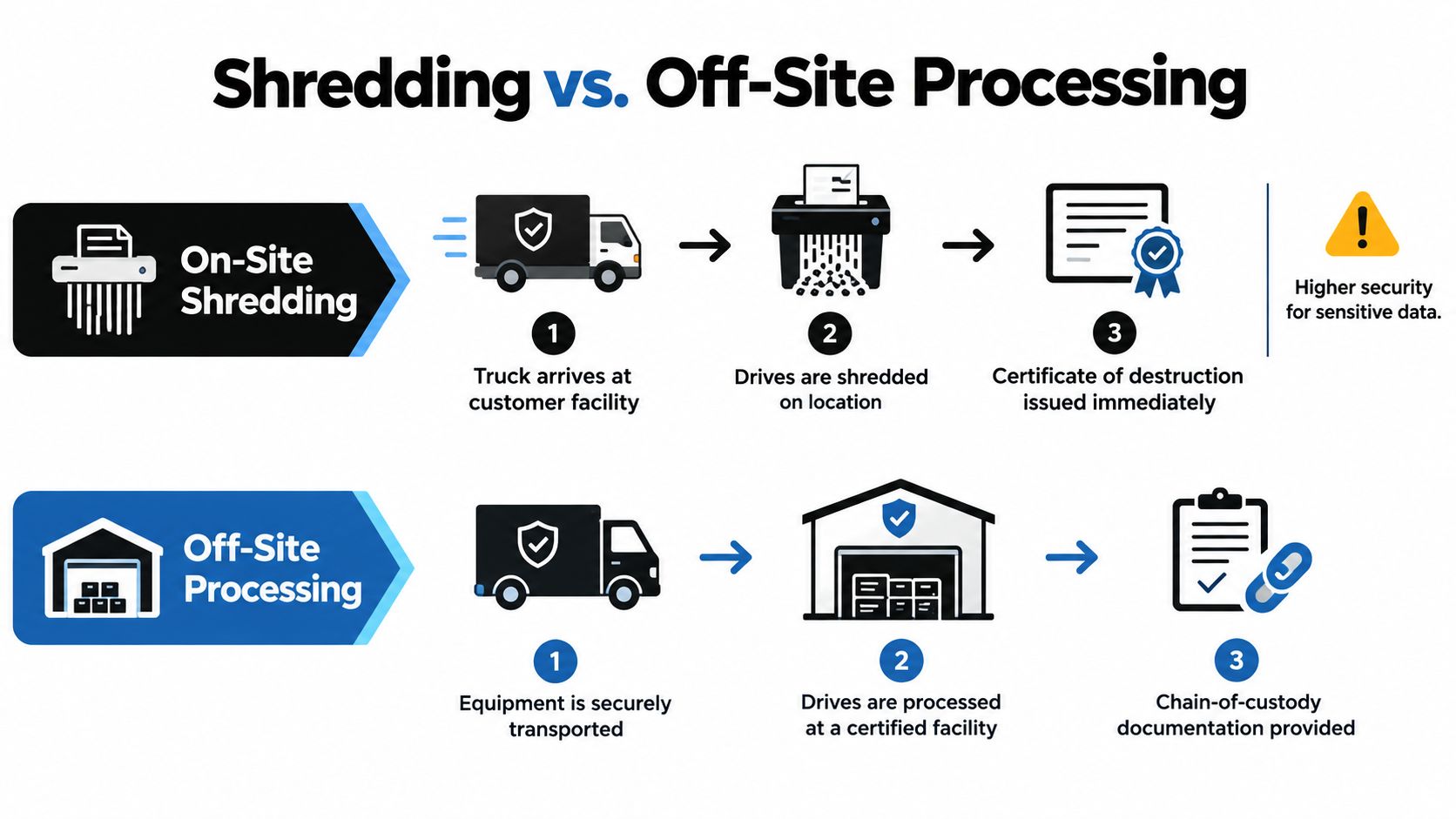
On-site shredding fits health systems, financial institutions, government agencies, and any team that cannot tolerate drives traveling before destruction. Media is destroyed at your facility, witnesses can observe, and certificates follow serialized destruction. The tradeoff is scheduling, space, noise, and lower throughput on very large projects.
Off-site processing scales better for data center decommissionings and refreshes involving large server rooms. Equipment moves to a secured facility for receiving, testing, sanitization, grading, and settlement. That model stays defensible when the provider uses documented chain of custody, serialized receiving, controlled access, and camera coverage during processing.
Match Logistics to the Job
Small remote offices may work best with secure crate-and-ship handling. Large Atlanta metro projects justify a dedicated truck and staged pickup windows. Data center work often needs de-racking, rail removal, palletizing, and freight coordination so servers arrive testable rather than damaged. Atlanta-area clients also have a drop-off option at the Smyrna facility for suitable business loads.
A side-by-side look at on-site versus off-site ITAD services in Georgia helps procurement compare cost and control, but insist on specifics for your project. Who packs drives? Are containers locked and serialized? When does title transfer? Who bears loss in transit?
Remember why these details carry legal weight. Under the federal Disposal Rule, disposal covers sale, donation, or transfer of any medium, including computer equipment, on which consumer information is stored. Resale, recycling, and buyback therefore trigger the same compliance duty, and the transit window is part of disposal, not a gap between responsibilities.
My recommendation is direct. Shred on-site when data sensitivity or policy demands witnessed destruction and volume is manageable. Use off-site processing when you need testing, grading, and resale at scale and the provider can prove custody at every handoff. Do not choose off-site solely because it's cheaper if you cannot document the journey.
Maximizing Resale Value Without Trading Away Security
You control more of the buyback price than many teams realize. Buyers discount uncertainty, damage, and missing parts. Remove those problems before pickup and the same equipment prices better, without weakening sanitization one bit.
Start with completeness. Keep matching power adapters with laptops, power cables and rails with servers, and drive caddies in their bays. Photograph high-value servers, arrays, and networking gear in place before de-racking so configuration disputes have a visual record. Separate battery-bearing laptops from desktops and rack gear, and flag swollen or damaged batteries for special handling instead of burying them in a pallet.

Tactics That Lift Net Recovery
- Consolidate volume: Combine departments or sister offices into one scheduled pickup so testing and freight spread across more units.
- Sell promptly: Older gear loses secondary-market appeal while it sits in storage, and delay also increases loss and damage risk.
- Keep configurations coherent: Do not strip memory or storage casually before valuation, because incomplete systems force buyers into parts pricing.
- Grade accurately: Note cracked screens, missing keys, failed drives, and cosmetic damage in your list so settlement matches expectations.
- Preserve accessories: Docks, adapters, rack rails, and original cables support resale as complete business systems.
Do not wipe equipment in a way that destroys your own verification trail just to feel proactive. If your team sanitizes before pickup, log it by serial number and share the records. If the buyback provider will sanitize, keep drives with their parent systems where resale is intended and clearly segregate media designated for destruction.
Split the Lot, Do Not Average It
The strongest recovery usually comes from segmentation. Current, complete, verifiable systems belong in certified erasure and resale. Older systems with scarce components may return more through parts harvesting. Failed drives and media that cannot be verified belong in physical destruction, with the remaining chassis recycled or harvested as policy allows.
That's not trading security for cash. It's refusing to let a one-size policy destroy value on low-risk assets or create risk on high-risk ones. For secure e-waste management and IT asset recovery to work together, every batch needs its own method, price logic, and evidence trail.
A Reusable Workflow for Your Next Atlanta IT Equipment Buyback
Turn the decisions above into a repeatable workflow your IT, procurement, and security teams can reuse at every refresh, lease return, and decommission. Consistency is what makes the second project cheaper and the audit easier.
- Inventory first: Capture serial numbers, configurations, ownership, location, and data-bearing components before requesting quotes.
- Classify by risk and value: Assign each asset to certified erasure and resale, destruction, parts harvesting, or recycling.
- Force itemized bids: Require pricing and fees by disposition path, including logistics, testing, sanitization, and documentation.
- Vet the provider: Document audits, references, certifications, and security policies, then confirm custody, receiving, and exception handling in writing.
- Execute and reconcile: Match pickup, receiving, sanitization, and settlement records by serial number, and resolve discrepancies before closing the project.
Measure environmental outcomes with the same discipline as financial ones. A 2025 industry roadmap reported that more than two-thirds of surveyed data-center operators lacked fleetwide quantitative reuse, recycling, and landfill-diversion data. Ask your provider for reuse, recycling, and downstream outcomes tied to your inventory so sustainability reporting rests on records, not estimates.
When you scope a project with Beyond Surplus, ask directly for serialized certificates of data destruction, certificates of recycling, downstream processor documentation, and whether on-site shredding fits your regulated assets. Put those deliverables in the quote, not in a follow-up email after pickup. A provider that welcomes those questions is signaling process maturity. A provider that waves them away is telling you exactly how your audit will go.
Contact Beyond Surplus for certified electronics recycling and secure IT asset disposal for your next Atlanta buyback, data center decommissioning, or business computer and server refresh. Share your serialized inventory and disposition requirements, and visit Beyond Surplus to schedule a business pickup and request an itemized valuation with documented data destruction.


