
A refresh deadline is closing in, the data center is coming apart, or a facility is shutting down. Rows of laptops, servers, network switches, and storage devices are waiting to leave, and nobody wants to be the person who approved a pickup without knowing where the data went or what happened to the equipment. Corporate IT equipment disposal isn't just a recycling problem. It's a series of asset-by-asset decisions about security, value, accountability, and responsible recovery.
The scale makes those decisions matter. The Global E-waste Monitor 2024 reported that the world generated approximately 62 billion kilograms of e-waste in 2022, or 7.8 kilograms per person. Just 22.3% was documented as formally collected and recycled in an environmentally sound manner, leaving roughly 77.7% outside documented formal recycling channels (Global E-waste Monitor 2024 figures and context). For a business, handing obsolete equipment to an unidentified downstream party doesn't prove secure handling or responsible recycling. A sound program creates a record from asset discovery through final disposition.
Table of Contents
- Why Corporate IT Equipment Disposal Demands a Real Playbook
- Inventory, Valuation, and the Reuse-versus-Destroy Decision
- Matching Sanitization Methods to Risk and Media
- Logistics, Pickup Coordination, and Chain of Custody
- Choosing an ITAD Vendor with Real Due Diligence
- Designing a Real Cost-Recovery and Buyback Program
- Closing the Loop with Audit-Ready Documentation
Why Corporate IT Equipment Disposal Demands a Real Playbook
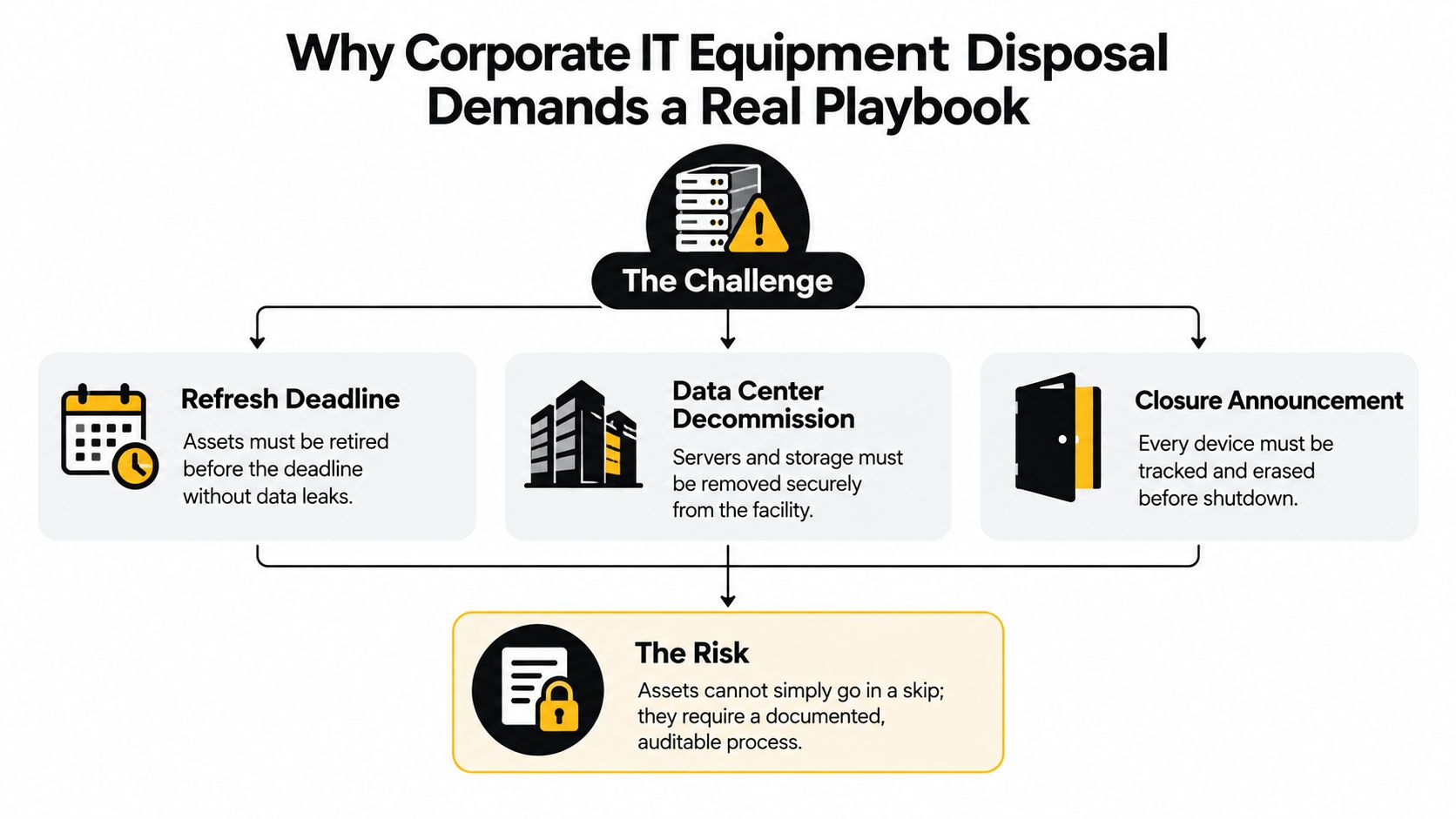
IT leaders usually face disposal under pressure. A refresh date is fixed, a data center decommission runs on a facility schedule, or a closure announcement leaves weeks to sort years of accumulated equipment. In that moment, a haul-away pickup can look like the fastest answer. It can also leave the organization with missing assets, unverified data handling, forfeited resale value, and no evidence of what happened after the truck left.
The compliance obligation is concrete. The FTC Disposal Rule took effect on June 1, 2005, implementing a requirement under the Fair and Accurate Credit Transactions Act of 2003. It applies to businesses and individuals that use consumer reports for business purposes, including service providers handling covered information. The FTC says disposal practices must be reasonable and appropriate to prevent unauthorized access to, or use of, information from consumer reports. Its examples include destroying or erasing electronic files or media so information can't be read or reconstructed, and using appropriate destruction contractors (FTC guidance on the Disposal Rule).
NIST SP 800-88 Revision 1, issued in 2014, defines media sanitization as making access to target data infeasible for a given level of effort (NIST's release of SP 800-88 Revision 1). That definition matters because it turns sanitization into a decision: the method should match the sensitivity of what the device held. A laptop, server, network appliance, or medical device can retain data long after it leaves service. One stray storage device creates real exposure. Working equipment routed straight to recycling gives up value the organization could have recovered.
This is why disposal deserves a playbook rather than a pickup order. Every asset forces the same sequence of decisions: can it be reused, resold, harvested, or destroyed, and what proof does each path require? The organizations that handle this well decide disposition first and let the compliance documentation follow from those decisions.
Write a policy your team can follow
A one-page memo that says “wipe and recycle old equipment” won't answer an auditor's questions. The policy needs to define which assets are in scope, how the organization classifies data, who approves each disposition, and what records prove the work happened. Include laptops, servers, network equipment, storage arrays, mobile devices, and medical or laboratory equipment where applicable.
Use plain-language sensitivity categories, such as public, internal, confidential, and regulated, then specify who can approve each path. A business laptop classified as internal might qualify for redeployment after approved sanitization and verification. A device holding regulated information may require a stricter method and a documented review before it can be reused or released.
Practical rule: If a device can store data, it stays in the inventory until its final disposition is documented.
A workable policy template fits on a few pages: scope and roles; classification and approval rules; acceptable sanitization methods; custody and transport controls; reuse, resale, destruction, and recycling criteria; exception handling; and closeout records. Set retention according to the legal, contractual, and records-management requirements that apply to your environment. Don't invent a universal retention period. Have legal and compliance approve the schedule.
The playbook runs end to end: policy, inventory, classification, sanitization, verification, logistics, vendor oversight, value recovery, and a final audit file. Skip the controls and you accept the risk without knowing which one materialized.
Inventory, Valuation, and the Reuse-versus-Destroy Decision
An asset list is useful only if it supports a disposition decision. Record a unique identifier, serial number, storage-media type, owner, sensitivity category, custody transfer, sanitization method, operator, timestamp, and intended final disposition for each device. Use the organization's equipment records as a starting point, then reconcile the physical items against them at intake.
Estimate value conservatively. Device condition, supportability, battery health, repair needs, and secure sanitization all affect whether reuse or resale makes sense. An equipment condition assessment can help establish a consistent basis for grading assets before you decide whether recovery is practical.
Asset-Level Disposition Decision Matrix
| Asset Profile | Recommended Path | Primary Trigger | Documentation Required |
|---|---|---|---|
| Supported laptop with usable life remaining | Redeploy internally | Sanitization and support are feasible | Asset record, sanitization result, approval |
| Working server or network device with resale value | Resell through a documented channel | Expected recovery justifies the data and handling controls | Serial-level inventory, verification, sale and custody records |
| Repairable device with low resale value | Harvest parts | Parts recovery is more practical than whole-unit resale | Components removed, remaining media disposition |
| Damaged or high-risk storage device | Destroy | Sanitization can't be verified or physical condition creates unacceptable risk | Media identifier, destruction record, exception closure |
| Equipment with no reuse or recovery path | Recycle through a verified downstream channel | Final processing can be evidenced | Manifest and documented recycling outcome |
Don't assume “recycle everything” is the responsible choice. Extending useful life can preserve value, but resale without secure processing and traceable custody can create data, warranty, export, and reputational risks. The right decision depends on each asset's condition, data risk, support status, and verifiable downstream route.
Before approval, check for devices that inventories routinely miss: secondary and hidden SSDs, backup tapes, RAID members, removable media, optical media, and embedded controller storage. Reconcile serial numbers after processing, and quarantine exceptions instead of removing them without notice from the list.
Matching Sanitization Methods to Risk and Media
NIST SP 800-88 Revision 1 groups sanitization into Clear, Purge, and Destroy. Clear uses logical techniques to protect against ordinary recovery attempts. Purge applies stronger methods intended to make data recovery infeasible for the relevant level of effort. Destroy makes the media unusable, which is appropriate when a device can't be reliably sanitized or when the data risk requires physical destruction.
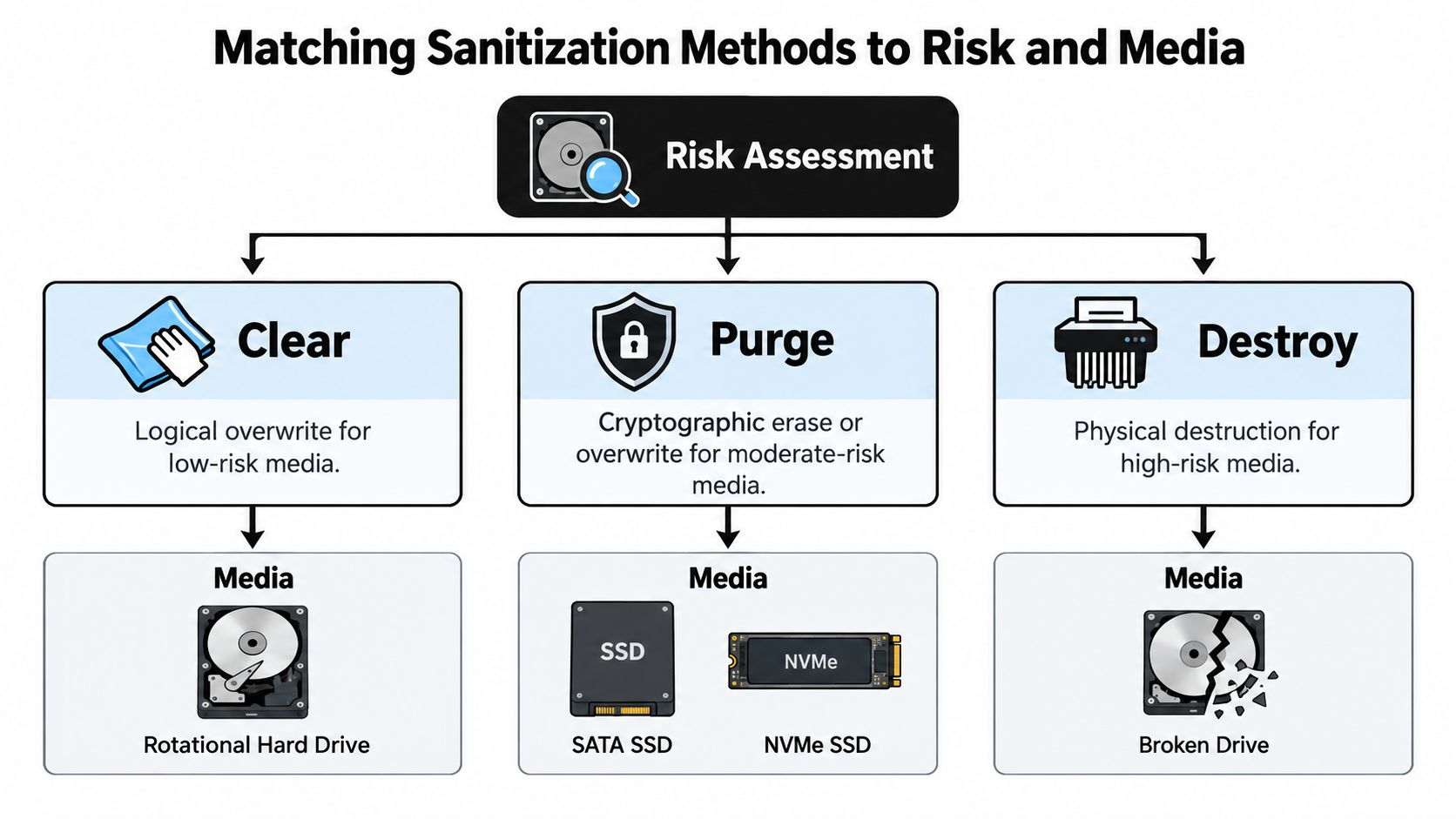
The method must fit the media. A validated overwrite may suit some rotational hard drives, while SATA and NVMe SSDs require methods appropriate to flash storage. A self-encrypting drive may support cryptographic erase if its implementation and key-handling controls are understood. RAID arrays need a plan for every member drive, and mobile devices, removable media, and tape each need a method that matches their technology and the information they held.
Don't treat every drive like a hard drive
Legacy overwrite assumptions don't automatically apply to modern flash storage. Hidden partitions, secondary drives, backup media, RAID members, and embedded storage are common blind spots. Identify all media before processing, then document why the selected method fits the data classification and reuse plan.
For low-risk equipment intended for continued use, Clear may be adequate when the media and procedure support it. Purge is the stronger choice when reuse or resale is planned but the information calls for stronger protection. Destroy is the defensible route when the device is damaged, the method can't be verified, or the risk doesn't justify release.
NIST recommends verification after applicable sanitization operations and through representative sampling. Its stronger secondary check uses a different tool from a separate developer, with full verification of at least 20% of sanitized media selected at random (NIST SP 800-88 Revision 1 sanitization guidance). A certificate alone isn't enough. Tie it to device-level records and verification evidence, and quarantine any failed or incomplete result.
For method selection and implementation details, use this NIST 800-88 data destruction standards guide alongside your organization's approved procedures. Keep the decision traceable: media identified, method approved, work performed, result verified, and exceptions closed before release.
Logistics, Pickup Coordination, and Chain of Custody
A mixed-equipment pickup needs one coordinated process, not a stack of disconnected handoffs. Before equipment leaves, consolidate it in a controlled area, separate it by destination or processing path, and match the physical items against the inventory. Use locked cabinets or sealed containers where appropriate, and restrict access to staff assigned to the move.

The manifest should make each transfer clear. Include the asset identifier and serial number, item description, releasing and receiving parties, custody transfer, date and time, destination, and any exceptions. Photograph or scan items at intake where it supports reconciliation. Keep collection and processing responsibilities distinct where practical, so one person's handoff isn't treated as independent verification of their own work.
Choose the destruction location deliberately
On-site shredding can make sense when equipment can't leave the facility before destruction, or when the organization's risk controls require it. It can also add scheduling and operational complexity. Off-site processing can be appropriate when transport is controlled, custody is documented, and the receiving facility follows approved procedures.
A pickup receipt proves a handoff. It doesn't prove what happened to each drive.
Coordinate with facilities, security, and IT before the pickup. Confirm loading access, equipment staging, building rules, and any after-hours work. For multi-site projects, standardize the manifest and intake process so teams don't improvise different records at each location.
Define how the driver and receiving technician will confirm quantities and identifiers, and how discrepancies will be handled before equipment moves into processing. Document the route and custody changes in the chain-of-custody record. A chain-of-custody process for IT asset disposal should connect site release to intake, processing, and final disposition without unexplained gaps.
Choosing an ITAD Vendor with Real Due Diligence
A polished proposal can hide a weak control set. I have seen providers win on pickup speed, then fail the audit because serial numbers stopped matching after consolidation. Treat vendor selection as the control plane for every reuse, resale, and destruction decision you already made.
The FTC identifies practical contractor checks, including reviewing an independent audit, checking references, and confirming recognized certification. Go further. Ask how the vendor secures data before the asset has a final path, how subcontractors are approved, and what evidence comes back when a drive fails wiping and changes route from resale to destruction.
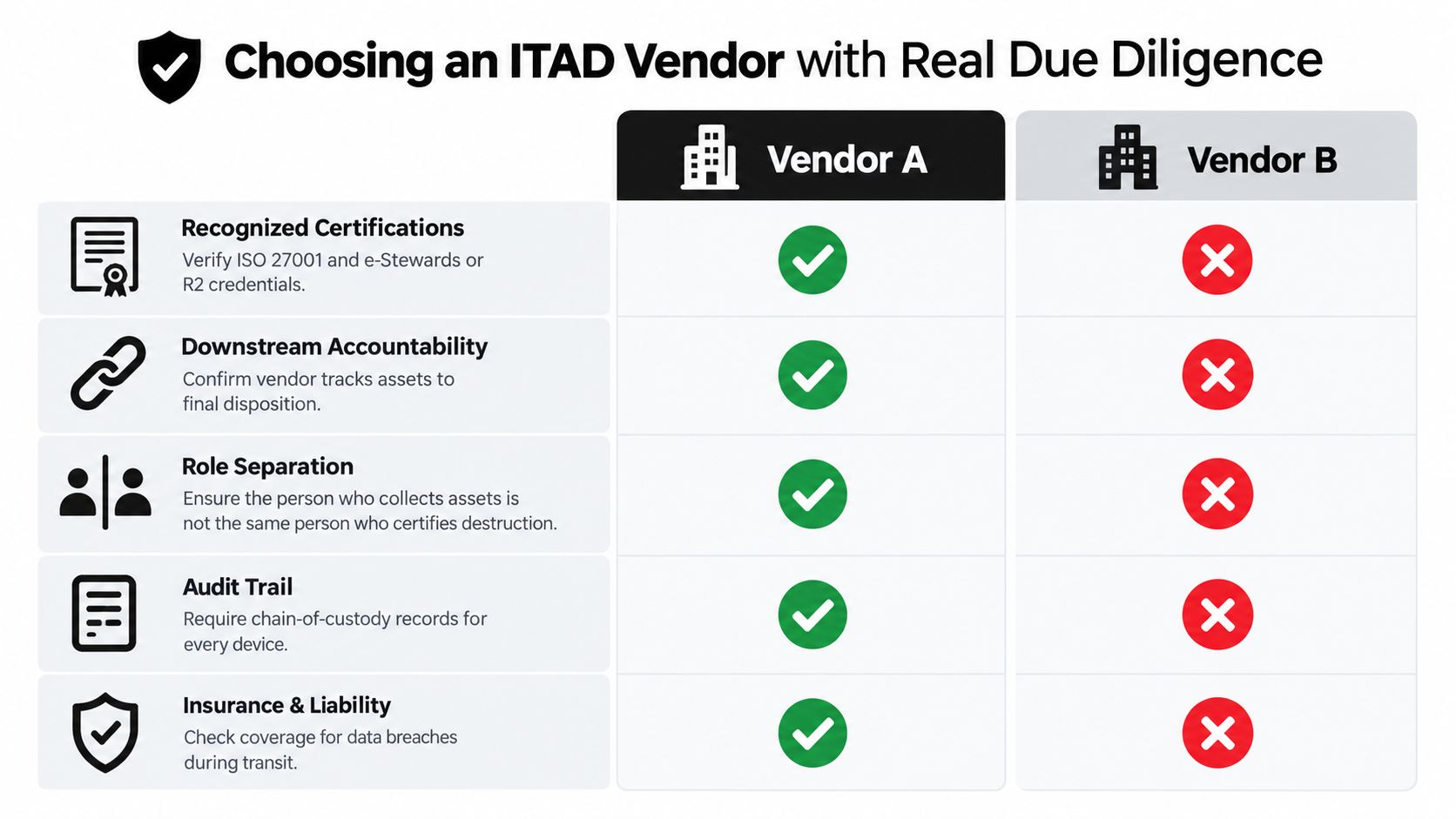
ITAD Vendor Evaluation Scorecard
| Criterion | Why It Matters | What to Ask the Vendor |
|---|---|---|
| Recognized certifications | Audited practices only count inside the certification scope | Which certifications are current, which sites are covered, and where is the audit evidence? |
| Downstream accountability | Assets can move beyond the first processor | Who touches each step, and can you show final disposition by serial number? |
| Role separation | One team should not approve its own work unchecked | Who sanitizes, who verifies, and who signs off on exceptions? |
| Audit trail | Auditors want device-level proof, not a shipment summary | Will certificates list each asset, method, result, and date? |
| Insurance and liability | Responsibility during transit and processing must be explicit | What coverage applies, and how fast must incidents be reported? |
Score candidates against edge cases and documented exceptions. Ask for failed verification, missing serial numbers, damaged media, subcontractor use, and reapplied labels after sorting. Certificates that list only pallet count or shipment weight leave too much unanswered. Walk away from vague processing claims, blocked audit rights, or custody gaps explained as standard practice.
Turn the scorecard into contract terms. Define data-security obligations, approved locations and methods, incident notification, downstream flow-down rules, audit rights, insurance expectations, and the records returned for each asset. A vendor due-diligence checklist can organize the review, while the contract makes the agreed controls enforceable.
Designing a Real Cost-Recovery and Buyback Program
For mid-life equipment, defaulting to recycling can destroy recoverable value. A structured buyback program can capture value through refurbishment, parts harvesting, trade-in credits, or a carefully documented sale. The right path depends on asset condition and supportability, and it only works when data risk and custody are controlled alongside the commercial decision.
A credible flow begins with an inventory and condition assessment. The organization sets eligibility rules, confirms ownership and any lease restrictions, approves sanitization, and documents the sale or transfer. The buyer or vendor should provide asset-level records that tie the device to its sanitization result and final destination. If equipment is donated, treat the transfer as a disposition that still requires appropriate data handling and documentation.
Compare recovery with the work it requires
Resale isn't automatically worthwhile. Low-value equipment can take staff time to grade, process, price, and reconcile that outweighs what it returns. Vendor-led recovery may reduce internal workload, while an in-house buyback desk gives the organization more direct control but requires people and a repeatable process.
Harvesting parts can make sense when repair is economical but whole-unit resale isn't. Donation can support a useful second life when the recipient and transfer are documented. Destruction is the sensible choice when physical condition or residual data risk makes release unacceptable. Recycling belongs at the end of the decision path, after reuse, resale, or parts recovery has been ruled out and the downstream channel can be verified.
The business case should account for net recovery, not an optimistic resale estimate. Subtract testing, sanitization, logistics, repair, administration, and any vendor charges before calling a program successful. A buyback contract should define valuation, title transfer, data responsibilities, payment or credit terms, exceptions, and evidence of final disposition.
Closing the Loop with Audit-Ready Documentation
Closeout is where a well-run project proves its work. Reconcile the original inventory against the equipment received, processed, returned, sold, destroyed, or recycled. Resolve unexplained differences before declaring the project complete, and keep an exception log that shows the issue, owner, corrective action, and closure approval.
Closeout checklist
- Reconcile every asset: Match identifiers and serial numbers across intake records, processing records, and final disposition.
- Close exceptions: Document failed verification, missing equipment, damaged media, or other deviations and obtain approval before release.
- Cross-reference certificates: Tie destruction or recycling documentation to the specific media and method, not only to a shipment.
- Archive custody evidence: Retain manifests, transfer records, and intake documentation.
- File approvals and assessments: Preserve regulatory attestations, vendor reviews, and applicable contract records.
- Review the project: Bring IT, security, facilities, and procurement together to capture process gaps and corrective actions.
Retain records according to legal, contractual, and internal records-management requirements. A useful compliance documentation process should let an auditor trace an asset from discovery to disposition without relying on verbal explanations. Reassess vendors when contracts, services, processing locations, or risk conditions change, and follow the review schedule your organization approves.
Common disposal questions
What should we do with leased equipment? Confirm the lease terms, ownership, return conditions, and approved handling with the lessor before sanitizing, selling, or dismantling it. Record the handoff and any required data-removal evidence.
What happens when a device fails verification? Quarantine it. Don't release it for reuse, resale, or recycling until an approved reprocessing method succeeds or the media is destroyed and documented.
How often should certificates be revalidated? Don't treat a certificate as a substitute for device-level evidence. Check each project's records against the inventory and verification results, and review the vendor's controls on the schedule established by your organization.
Beyond Surplus provides business IT asset disposition, secure data destruction, electronics recycling, IT buyback, and coordinated pickup, including nationwide service for organizations. Contact Beyond Surplus to discuss an asset-level plan that protects data, documents custody, and routes equipment to reuse, recovery, destruction, or verified recycling.


