

The recall email arrives while your warehouse team is preparing an outbound shipment. Some affected laptops are deployed, others are boxed for IT asset recovery, and nobody can yet confirm whether the returned units contain sensitive data. Your immediate problem isn't finding someone to collect them. It's stopping movement, establishing control, and proving what happens next.
Table of Contents
- When a Recall Notice Meets Your Loading Dock
- Why Recall Volume and Remedy Data Matter
- Identifying Units and Quarantining Inventory
- Ordinary Electronics Recycling Versus Recall Destruction
- Handling Data-Bearing Devices Inside the Recall
- Coordinating Pickup, Transport, and On-Site Versus Off-Site Destruction
- Choosing a Disposal Partner and Closing the Loop
When a Recall Notice Meets Your Loading Dock
Consider an IT manager checking a manufacturer's notice against a fleet spread across offices, repair benches, and warehouse shelves. The model name looks familiar, but the notice applies to a particular serial range. Meanwhile, procurement has already authorized an equipment refresh, and a recycling pickup is scheduled.
Pause the affected shipment. Don't let an existing disposal arrangement decide the outcome of a new recall.

Assign an owner before arranging a truck
Appoint a recall coordinator who can obtain answers from IT, facilities, procurement, and the recalling manufacturer. Give that person authority to hold inventory and resolve conflicting instructions.
The opening questions should be operational:
- Affected inventory: Which units match the notice, and which remain unverified?
- Current location: Are they deployed, awaiting shipment, with a repair vendor, or already transferred?
- Custody: Who controls each location and can confirm receipt of the hold?
- Information exposure: Which devices contain organizational or personal information?
These are working questions, not a substitute for the manufacturer's instructions. A laptop, laboratory instrument, or medical workstation may need a product-specific route that your ordinary computer recycling agreement doesn't address.
Define closure before authorizing disposal
The CPSC's recall handbook describes controls including segregation, monitoring third-party disposal providers, written off-site destruction instructions, and destruction documentation; agency approval may also be necessary.
That makes recalled consumer product disposal services an evidence-management engagement as much as a removal service. Ask who will approve the disposition and what records that approver expects before anyone loads a pallet.
Practical rule: A cleared loading dock isn't proof of a closed recall.
For a retailer, school, manufacturer, or healthcare organization, the useful endpoint is a reconciled inventory supported by approved disposition records. Establish that expectation at the beginning, rather than asking a processor to reconstruct it afterward.
Why Recall Volume and Remedy Data Matter
Treat recall handling as a standing operational capability, not an exception somebody will improvise around.
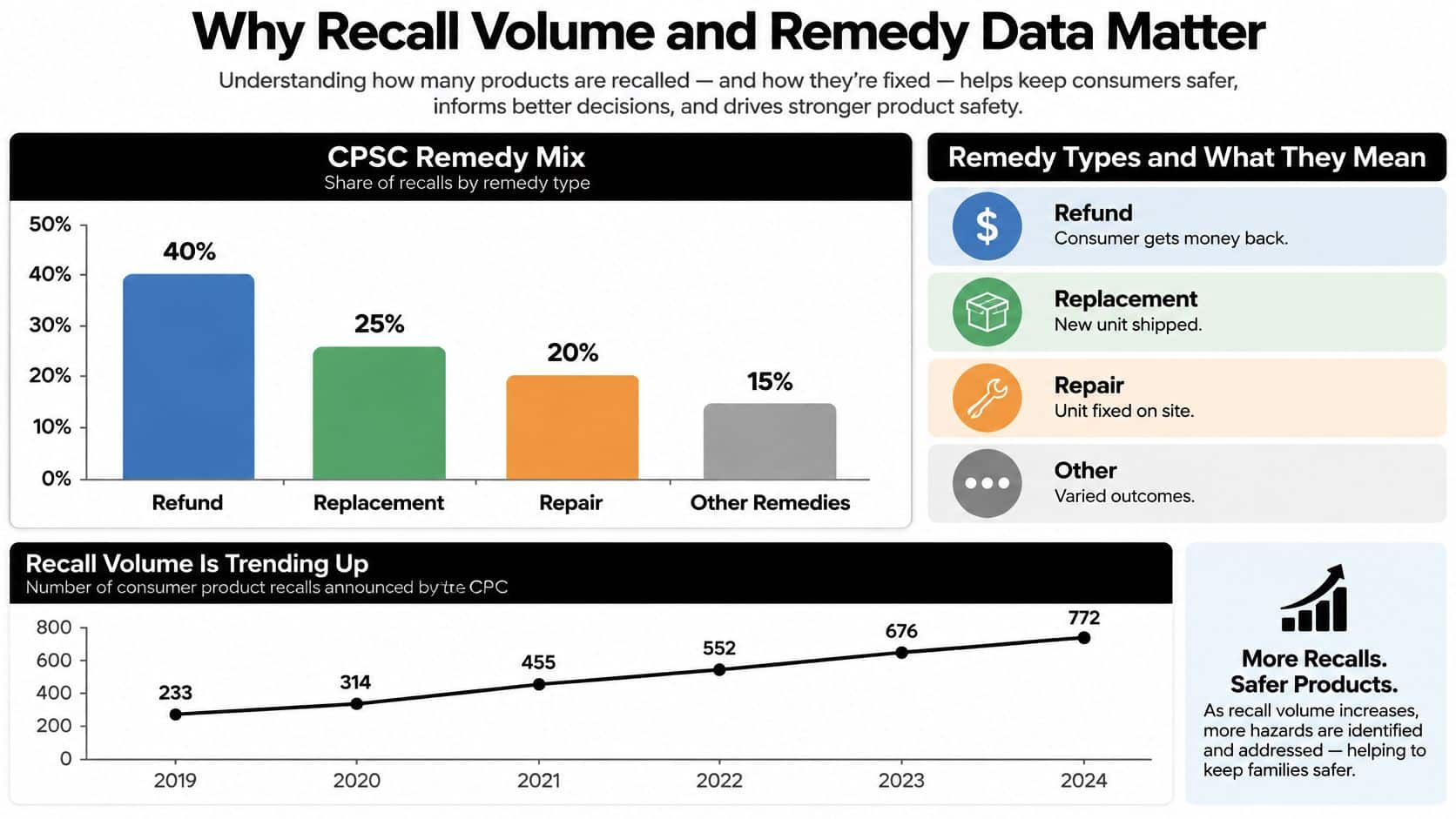
The CPSC recall data records 312 recalls in fiscal year 2023, compared with 260 in 2022 and 233 in 2021, increases of 20% and 33.5%, respectively; the 2023 total comprised 167 Fast Track, 83 regulatory, and 62 defect recalls. In that same dataset, regulatory recalls increased from 40 in 2021 to 83 in 2023, while defect recalls increased from 34 to 62.
Those figures support a practical planning decision: maintain a recall hold process, an approved escalation path, and a disposal-provider qualification file before the next notice arrives. They don't predict your organization's next incident, but they show why a standing capability is sensible.
Separate the customer remedy from the physical endpoint
For accuracy, use the agency's remedy figures rather than the illustrative percentages in the graphic: across its reported five-year dataset, refunds accounted for 1,102 cases, or 54.6%; repairs for 532, or 26.4%; replacements for 340, or 16.9%; and disposal for 23, or 1.1%, as reported in the CPSC data linked above.
A refund describes what the customer receives. It doesn't, by itself, authorize your warehouse to send the original product into a recovery channel.
| Planning question | Operational decision |
|---|---|
| What remedy is offered? | Coordinate the customer-facing response |
| What happens to the original unit? | Obtain the approved physical disposition |
| What proves completion? | Define the required evidence package |
Keep recall holds visible within inventory optimization planning. Otherwise, staff working from availability reports may treat blocked goods as usable stock.
My recommendation is straightforward: budget management attention for recall operations separately from routine electronics recycling. The public remedy and the warehouse disposition are connected, but they aren't interchangeable.
Identifying Units and Quarantining Inventory
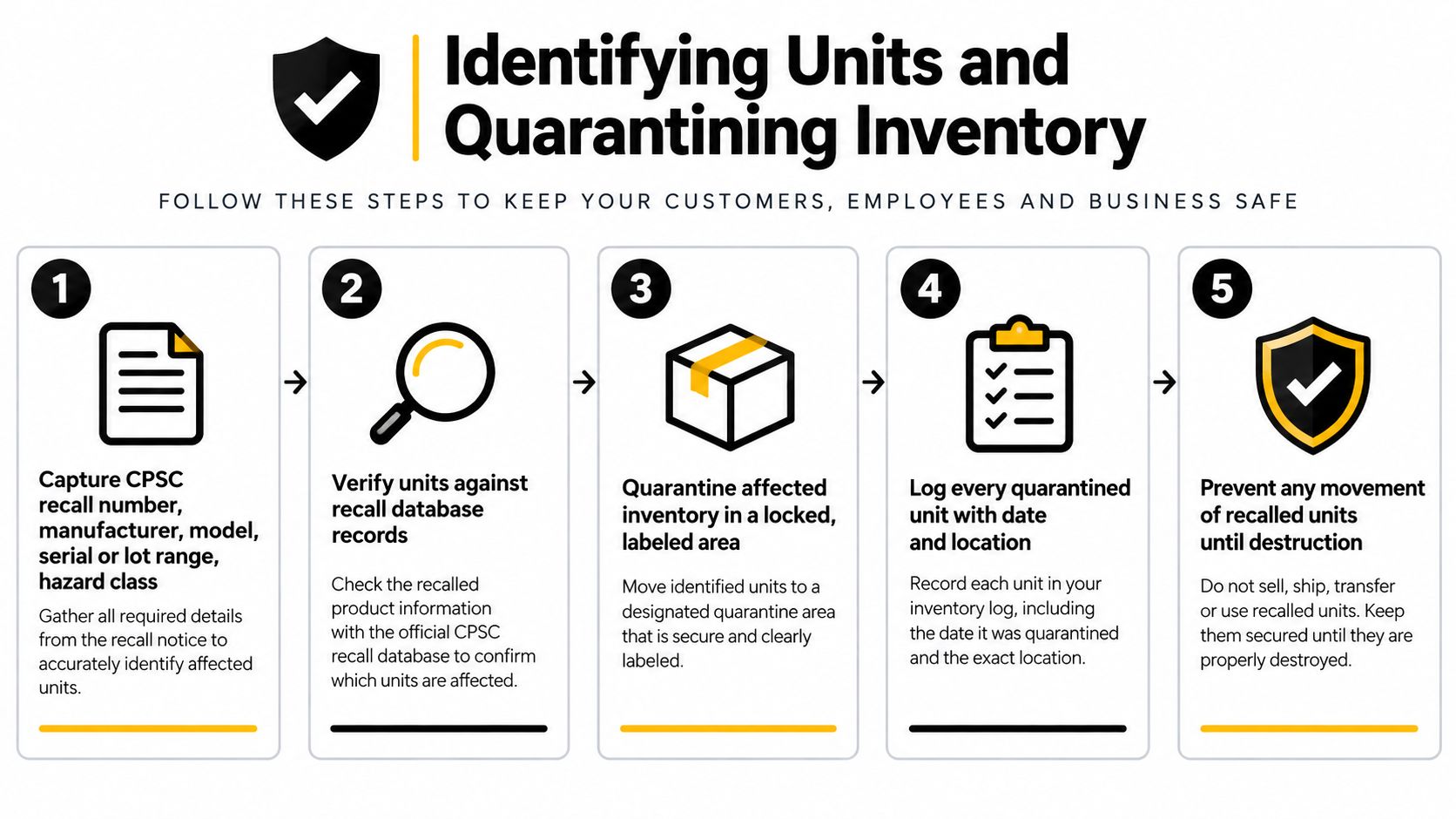
Verify identity before classifying inventory as affected or unaffected. A familiar product name isn't enough, and a barcode that identifies a product family may not resolve the serial or lot range in the notice.
Start with a controlled copy of the recall notice. Record its reference, manufacturer, model, affected serial or lot range, stated hazard, remedy, and any subsequent written clarification.
Build a usable hold register
Your warehouse or IT lead should be able to act from the register without interpreting scattered emails.
- Identification: Record the asset tag alongside the manufacturer's serial or lot identifier.
- Accountability: Name the location and responsible custodian.
- Status: Distinguish confirmed affected, verified unaffected, and awaiting verification.
- Movement control: Record the hold date, authorized transfers, and receiving party.
- Resolution: Connect the final disposition to its supporting evidence.
For units without readable identifiers, create an exception record and request a manufacturer determination. Do not classify them as unaffected because verification is inconvenient.
Make the physical hold match the system hold
Use a clearly labeled, access-controlled area suitable for the product and its hazard. Apply the corresponding block in inventory and asset-management systems so a picker, technician, or procurement coordinator can't accidentally release it.
Where affected and unaffected stock are mixed, reconcile identifiers individually. If you temporarily hold uncertain stock, document why it remains blocked and who can release it. Holding everything indefinitely isn't a verification process.
The infographic's destruction endpoint applies only where destruction is the approved remedy. Quarantine must end through an authorized disposition, which may instead involve approved repair, replacement, or return.
The GAO's review of CPSC recall effectiveness found that only 61% of firms submitted required progress reports more than 75% of the time for recalls closed between February 2016 and May 2020. GAO also found that correction metrics may omit low-cost products that recipients discard.
Don't depend on another organization's reporting to reconstruct your own actions. Preserve intake records, verification decisions, unresolved exceptions, and release approvals together. That gives an auditor or legal reviewer a traceable explanation of what your team controlled.
Ordinary Electronics Recycling Versus Recall Destruction
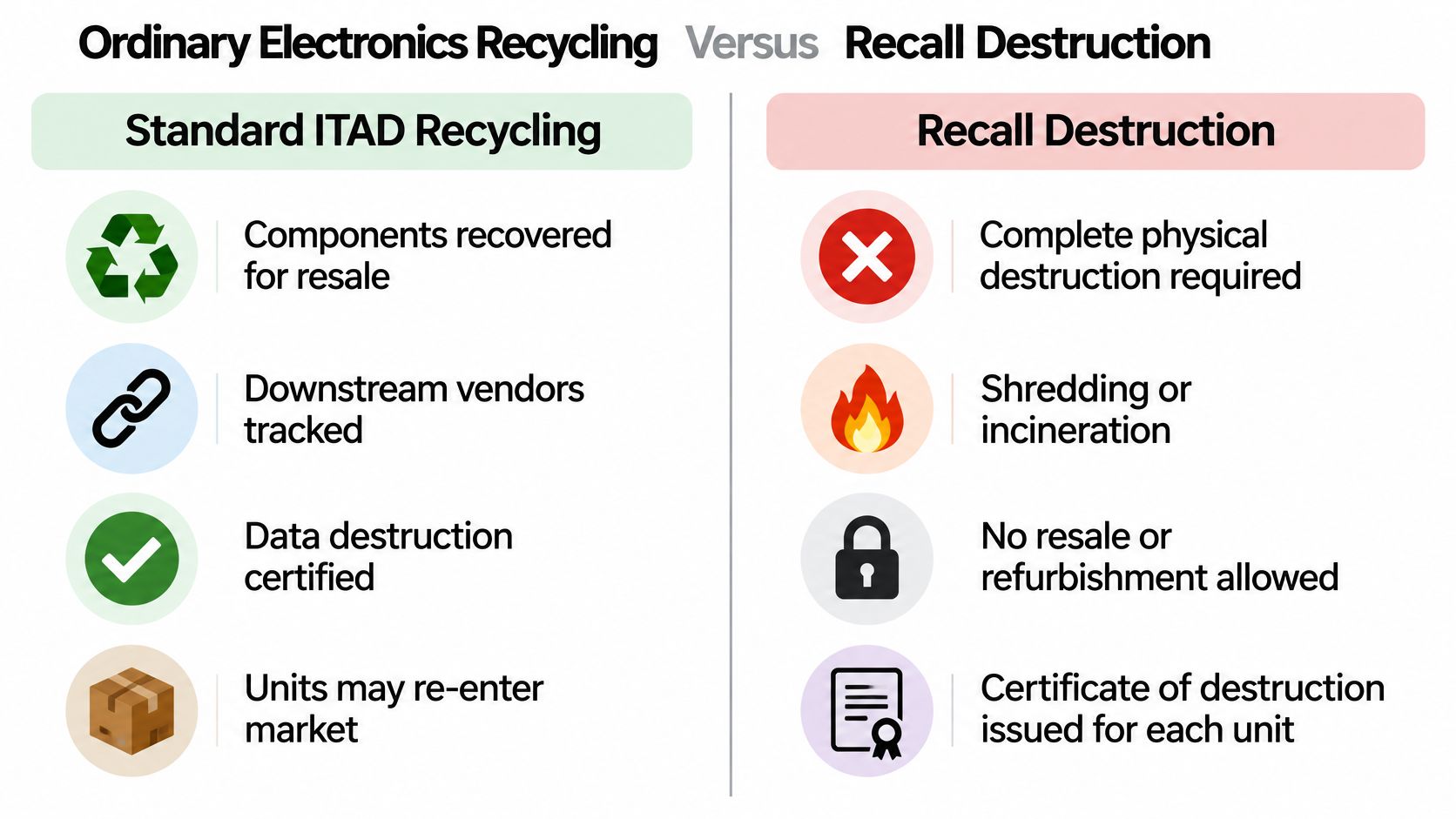
Recycled is not the same as destroyed. An agreement designed around material recovery or equipment remarketing may be unsuitable when a recall requires a particular component or complete product to become unusable.
The distinction is purpose. Ordinary IT asset disposition can seek reuse and value recovery where authorized. Recall processing must first satisfy the approved remedy and prevent prohibited recirculation.
Choose the endpoint before the recovery method
Read the graphic as a comparison of possible workflows, not a universal destruction mandate. Not every recall requires complete physical destruction, and neither shredding nor incineration is automatically the right method.
Use the manufacturer's approved instructions to decide whether an affected assembly can be repaired, returned, dismantled, or destroyed. Ask explicitly whether unaffected components may be recovered. Don't infer permission to sell parts from permission to recycle materials.
The distinction between ITAD and e-waste recycling is useful when defining service scope, but neither service label overrides recall-specific instructions.
A certificate of recycling may document a recycling transaction without establishing that the recalled product became unusable. Require evidence matched to the actual endpoint.
Collection isn't final processing
Earlier EPA analysis of electronics generation and recycling estimated that only 30–75% of electronics collected in 2013–2014 reached certified recyclers. That historical estimate isn't a current vendor-performance measure, but it demonstrates why collection and verified downstream processing are different questions.
Don't approve a destination because a truck can collect the material. Approve it because the provider can execute and document the required endpoint.
If the instructions are ambiguous, pause disposal and obtain written clarification from the recalling firm. For damaged devices or batteries, request handling and transport instructions before preparing the load.
The decision rule is simple: no release without written disposition instructions and provider acceptance of that specific route. Avoid an undocumented handoff that leaves your team explaining how a recalled item reached a resale, salvage, or donation channel.
Handling Data-Bearing Devices Inside the Recall
A recalled server can present a product-safety problem and an information-security problem simultaneously. Solving either one doesn't automatically solve the other.
Give the recall coordinator and information-security owner separate approval responsibilities. The former approves product disposition; the latter approves how stored information will be protected through that disposition.
Assign the sanitization outcome deliberately
NIST's media-sanitization definitions distinguish clear, purge, and destroy by their protection against recovery and whether the media remain usable.
Sanitization Levels for Recalled Data-Bearing Devices
| Sanitization Level | Method | Best Fit | Required Record |
|---|---|---|---|
| Clear | Logical techniques applied to user-addressable storage | Authorized reuse where the selected protection level is appropriate | Device identifier, technique, result, and verification |
| Purge | Suitable logical or physical techniques that make advanced recovery infeasible | Authorized reuse requiring stronger sanitization assurance | Media identifier, supported method, validation, and approval |
| Destroy | Physical processing that makes recovery infeasible and media unusable | Media assigned to destruction under security and disposition requirements | Media identifier, destruction method, completion date, and evidence |
Treat the records in the table as recommended procurement deliverables. NIST's categories don't mean that every factory reset qualifies for every device, or that purging authorizes a recalled product to return to service.
Before selecting a method, identify the storage technology and available device functions. A procurement team comparing replacement storage can browse computer storage parts UAE through Godukkan as a commercial reference, but a parts catalog isn't evidence that any sanitization method works on the affected media.
Put security instructions into the work order
The FTC's explanation of its flexible Disposal Rule standard requires reasonable and appropriate measures for covered consumer-report information, including destroying or erasing electronic information so it can't be read or reconstructed. It doesn't prescribe a universal destruction technology.
Require the disposal work order to identify:
- Approved outcome: Specify the required sanitization level and who authorized it.
- Execution conditions: State whether processing occurs before collection or under controlled vendor custody.
- Exception handling: Define what happens when a device won't power on or sanitization fails.
- Evidence delivery: Require records tied to the applicable device or media identifier.
Discuss these requirements when specifying data destruction services, not after pickup. Store sanitization results with the recall reconciliation rather than leaving them solely in an unchecked vendor portal.
Maintain parallel accountability for the product and its data. Closure requires both owners to accept the evidence.
Coordinating Pickup, Transport, and On-Site Versus Off-Site Destruction
Choose the processing location according to the approved method, product hazard, security requirements, and ability to verify completion. Don't choose on-site destruction merely because watching a machine feels reassuring.
On-site processing may support direct witnessing and reduce custody transfers. Off-site processing may be appropriate when the required equipment or controlled facility conditions aren't available at your premises.
Specify the handoff conditions
Use a written shipment plan that references the approved disposition. Carry the earlier quarantine controls into loading, transport, receipt, and processing.
- Intake: Reconcile identifiers and quantities against the release manifest.
- Packaging: Photograph prepared loads, label boxes or pallets, and record seal identifiers where used.
- Transport: Specify suitable vehicles, qualified drivers, approved destinations, and incident escalation.
- Receipt: Require the receiving facility to report discrepancies before processing.
- Visibility: Consider GPS tracking and witnessed destruction as contractual controls where risk justifies them.
These are service specifications to negotiate, not a claim that every recall legally requires identical equipment or tracking.
For organizations coordinating marketplace returns, the Amazon logistics services guide from Online Brand Growth provides adjacent commercial logistics context. Keep that planning separate from the recall authorization: a returns network doesn't determine whether recalled goods may be consolidated, salvaged, or destroyed.
Compare on-site and off-site ITAD services against your actual constraints. Ask the provider to explain how its proposed location supports the required endpoint and documentation.
Design the certificate before destruction
Don't accept a generic certificate template without checking whether it connects to your inventory. Agree on its contents while you can still change the work order.
| Evidence field | What your reviewer should be able to establish |
|---|---|
| Recall reference | Which notice and written instructions governed processing |
| Item identifiers and quantities | Which released assets the certificate covers |
| Method and date | What processing occurred and when |
| Facility and responsible personnel | Where processing occurred and who authorized or performed it |
| Reconciliation and exceptions | Whether received and processed inventory match |
| Approval or signature | Who attested to completion and who accepted it |
For on-site work, require a dated completion report identifying the products and quantities processed. For off-site work, connect dispatch, receipt, and completion records so the certificate isn't an isolated assertion.
Evidence test: A reviewer who wasn't present should be able to follow the product from release authorization to final disposition.
Have counsel or the designated recall approver review the proposed package in advance. A vendor's certificate supports your evidence; it doesn't automatically establish regulatory acceptance or transfer every liability.
Choosing a Disposal Partner and Closing the Loop
Select the partner on its ability to execute your written plan and produce verifiable records. A low collection price won't compensate for an unexplained inventory discrepancy.
Ask for evidence, not a sales assurance. The FTC Disposal Rule guidance identifies contractor due diligence, including independent operational audits, references, recognized trade-association certification, and review of information-security policies, as a compliance measure for organizations handling consumer-report information.
Evaluate scope rather than logos
Request current certification documentation where relevant, then confirm which facilities and activities it covers. If a bidder presents R2v3 or e-Stewards credentials, verify the scope instead of assuming the logo approves every proposed recall process.
Use a practical procurement checklist:
- Operational evidence: Review sanitization procedures, destruction controls, exception handling, and sample records.
- Downstream accountability: Identify subcontractors and require approval of changes affecting the disposition route.
- Comparable references: Ask about work involving similar products, hazards, and organizational controls.
- Insurance review: Have your risk team assess coverage and exclusions against the engagement.
- Document access: Establish delivery deadlines, retention responsibilities, and a process for correcting incomplete records.
A structured ITAD vendor selection process can support that review. Add recall-specific approval and evidence requirements rather than treating a standard recycling qualification as sufficient.
Close exceptions before closing the engagement
Assign someone other than the processing technician to review the final reconciliation. That reviewer should compare released inventory, received inventory, processing records, and unresolved exceptions.
Don't mark missing devices as destroyed just because the remaining batch has a certificate. Investigate discrepancies, document the resolution, and obtain the designated approver's acceptance.
Retain the notice, manufacturer instructions, inventory decisions, custody records, security evidence, completion documentation, and approvals as a connected file. Give procurement ownership of contractor commitments and the recall coordinator ownership of operational closure.
Your goal isn't the largest stack of paperwork. It's a coherent record that answers what was affected, who controlled it, what was authorized, and what happened.
Beyond Surplus offers commercial product destruction, electronics recycling, secure data destruction, and organizational pickup across the contiguous United States through its Atlanta-based ITAD operation. Visit Beyond Surplus to request a recall disposal plan and schedule pickup, with written agreement on custody tracking, on-site or off-site processing, and the certificates your recall approver requires.


