

A Georgia company finishes a laptop refresh, shuts down a small server room, or clears out a clinic storage closet. Suddenly there are pallets of retired desktops, failed drives, switches, monitors, and printers sitting in the way. Someone suggests calling an e-waste recycler. Someone else asks whether this should go through an ITAD vendor instead.
That choice matters more than is commonly expected. On paper, both services remove old electronics. In practice, they solve different problems. One is mainly about downstream material handling. The other is about data security, chain of custody, audit documentation, and value recovery.
That distinction matters because the global volume of retired electronics keeps rising. The world generated 62 million metric tons of e-waste in 2022, and only 22.3% was formally collected and recycled, according to the Global E-waste Monitor summary cited here. For Georgia businesses, that means retired equipment is no longer just a facilities issue. It's a procurement, compliance, and risk-management decision.
Making the Right Choice for Your Retired IT Assets in Georgia
A lot of teams start with the wrong question. They ask, “Who can pick this stuff up?” The better question is, “What risk is still attached to these assets?”
If the load includes monitors with cracked screens, dead keyboards, or non-networked peripherals, standard recycling may be enough. If it includes laptops, servers, storage arrays, mobile devices, or multifunction equipment, the risk profile changes immediately. Those assets can hold regulated data, credentials, cached records, or business information you can't afford to lose control of.
What Georgia businesses are usually balancing
Most organizations aren't choosing between a good option and a bad one. They're choosing between two services built for different outcomes.
| Decision area | Standard e-waste recycling | ITAD |
|---|---|---|
| Primary objective | Responsible disposal and material recovery | Risk control, value recovery, and documented disposition |
| Data-bearing assets | May not be the core focus | Core part of the process |
| Documentation | Often basic disposal records | Detailed inventory, chain of custody, and data destruction records |
| Financial outcome | Usually treated as a disposal cost | May include refurbishment, resale, or buyback value |
| Best fit | Broken, obsolete, low-value non-data equipment | Laptops, servers, drives, network gear, and regulated assets |
The practical issue most teams miss
An old server isn't just scrap metal. It's also a record of how your company handled end-of-life data. If that record is thin, the pickup solved the clutter problem but not the liability problem.
That's why many Georgia organizations build a routing policy instead of using one blanket disposal method. They separate true scrap from assets that need inventory control, certified sanitization, and resale review. If your team is comparing options, this guide on how Georgia businesses can maximize value with ITAD services is a useful next read.
The wrong disposition path usually doesn't fail at pickup. It fails months later, during an audit, an internal review, or a security incident.
Understanding Standard E-Waste Recycling
Standard e-waste recycling is a legitimate service. It plays an important environmental role. But businesses get into trouble when they assume it automatically covers security, compliance, and asset recovery.

What standard recycling is built to do
E-waste recycling is a materials recovery process. The goal is to keep electronics out of landfills and direct them into controlled downstream handling. Items are collected, sorted, dismantled, shredded, and separated into recoverable commodity streams such as metals, plastics, and glass.
That's the right model for equipment that has no practical reuse value left. Think damaged monitors, non-working peripherals, broken accessories, or low-value scrap from office cleanouts.
What it usually doesn't prioritize
A standard recycler may not operate with the same level of serialized tracking or asset-level reporting that an IT team expects. If you hand off mixed electronics in bulk, you may get confirmation that material was recycled without getting a detailed record of each device, each serial number, or each data-bearing component.
For many facilities managers, that's acceptable when the load is clearly non-sensitive. For IT, legal, healthcare, finance, and public-sector teams, it often isn't.
Here's where standard recycling works well:
- Non-data peripherals. Keyboards, mice, cables, docking stations, and similar accessories.
- Physically damaged display equipment. Broken monitors and other items with no practical resale path.
- Commodity scrap loads. Mixed electronics where residual value and device-level tracking aren't important.
And here's where teams get exposed:
- Mixed pallets that include both scrap and data-bearing assets
- Bulk pickups with weak inventory controls
- Assumptions that “recycled” means “securely sanitized”
A practical Georgia workflow is to keep standard recycling for clear scrap categories and route the rest through a controlled service line. If your organization is disposing of mixed business equipment, this overview of business e-waste recycling in Georgia helps clarify what belongs in each stream.
What is IT Asset Disposition (ITAD)
IT Asset Disposition, or ITAD, is a managed process for retiring business technology with security, auditability, and value recovery in mind. Recycling may still be part of the outcome, but it comes later, after the assets are evaluated and data risks are addressed.

How ITAD works in practice
A proper ITAD program starts before anything is processed. Assets are received under controlled logistics, identified, counted, and reconciled against what the client expected to send. Data-bearing devices are then routed for wiping or destruction under documented procedures.
After that, viable equipment may be tested, refurbished, and remarketed. Equipment that has reached true end of life moves into recycling.
That sequence matters. With ITAD, recycling is the fallback for assets that can't be reused or resold responsibly. It isn't the first and only answer.
Why companies choose ITAD
Organizations usually move to ITAD when one or more of these conditions apply:
- Sensitive data is involved. Laptops, desktops, servers, storage devices, mobile devices, and copiers need controlled sanitization.
- Assets still have residual value. Newer business hardware may support refurbishment or resale.
- Audit documentation matters. Security teams need records they can retain and produce later.
- Multiple departments are involved. IT, procurement, compliance, legal, and facilities all need the same disposition record.
Operational rule: If the device stores data or still has market value, don't treat it like anonymous scrap.
For teams that want the full workflow spelled out, this primer on what IT asset disposition means is a good reference point.
Key Differences in Process and Outcome
The simplest way to compare ITAD vs e-waste recycling in Georgia is to look at what each process is designed to prove at the end. Recycling proves electronics were diverted for responsible material handling. ITAD proves what happened to each asset, how data was handled, and whether any residual value was recovered.

Data security and sanitization
With standard recycling, data handling may be limited, inconsistent, or secondary to physical processing. With ITAD, data-bearing assets are the center of the workflow. Drives are identified, devices are tracked, and sanitization or destruction is documented.
That difference becomes critical when your retired assets include employee devices, endpoint fleets, SAN equipment, decommissioned servers, or healthcare and finance systems.
A recycler can remove equipment. An ITAD process creates evidence that the data risk was addressed.
Chain of custody and documentation
In audits, the gap becomes obvious. For compliance purposes, ITAD includes critical chain-of-custody controls and provides data destruction certificates. That documentation creates a defensible record for security audits, making ITAD a materially stronger choice for organizations handling regulated data because it's designed to support liability transfer, not just environmental disposal, as explained in this discussion of the difference between ITAD and recycling.
A chain of custody isn't paperwork for paperwork's sake. It answers basic but important questions:
- What was picked up
- Who handled it
- Where it went
- How data was sanitized or destroyed
- What happened to each asset afterward
Without that record, your internal team may have no solid way to prove that a retired device was handled correctly.
Value recovery versus disposal cost
Another major split is economic. Standard recycling treats old electronics as a waste stream. ITAD treats many of those same devices as assets first.
A recycler may dismantle a working laptop for material recovery. An ITAD provider may wipe it, test it, grade it, and sell it into a secondary market. The same applies to servers, networking gear, and some enterprise endpoints.
That doesn't mean every project generates return. Some loads are too old, too damaged, or too incomplete. But if a company skips valuation altogether, it gives up the chance to offset refresh costs.
Environmental outcome and business outcome
Both models can support environmental goals. The difference is scope.
Standard recycling asks, “How do we process this material responsibly?”
ITAD asks, “Can we securely extend the life of this asset before recycling it?”
That second question matters because reuse sits higher on the practical value ladder for many business devices. A company that refurbishes and remarkets appropriate assets can reduce waste while also improving financial recovery and preserving a stronger compliance trail.
Navigating Compliance Requirements in Georgia
Georgia businesses don't need a state-specific disposal crisis to have real liability here. The issue usually comes from federal privacy rules, contractual obligations, internal governance standards, and the simple fact that discarded devices often still contain sensitive information.
Healthcare organizations deal with protected information. Financial firms manage customer records. Schools, manufacturers, law firms, and government contractors all retain data that can't be left to an informal disposal chain. In those environments, “we recycled it” is not a sufficient control statement.
Where risk shows up
The biggest compliance problem usually isn't visible at pickup. It appears later, when a company is asked to produce evidence of disposal controls. If all you have is a generic pickup receipt, your legal and security teams may still have unanswered questions about the drives, the devices, and the downstream path.
That's why documented IT disposition matters so much in practice. Inventory verification, chain of custody, and destruction records help turn disposal into a defensible business process instead of a one-time logistics event.
What Georgia teams should require internally
A workable policy for commercial operations in Georgia usually includes:
- Asset-level identification for data-bearing devices
- Clear handoff procedures between internal staff and the vendor
- Document retention for destruction and recycling records
- Separate routing rules for scrap versus managed IT assets
For organizations tightening those controls, this Georgia secure IT disposal guide is a practical policy resource.
If your security team would need to explain the disposition event to an auditor, choose the service that generates evidence, not just pickup confirmation.
Decision Criteria for Your Business Needs
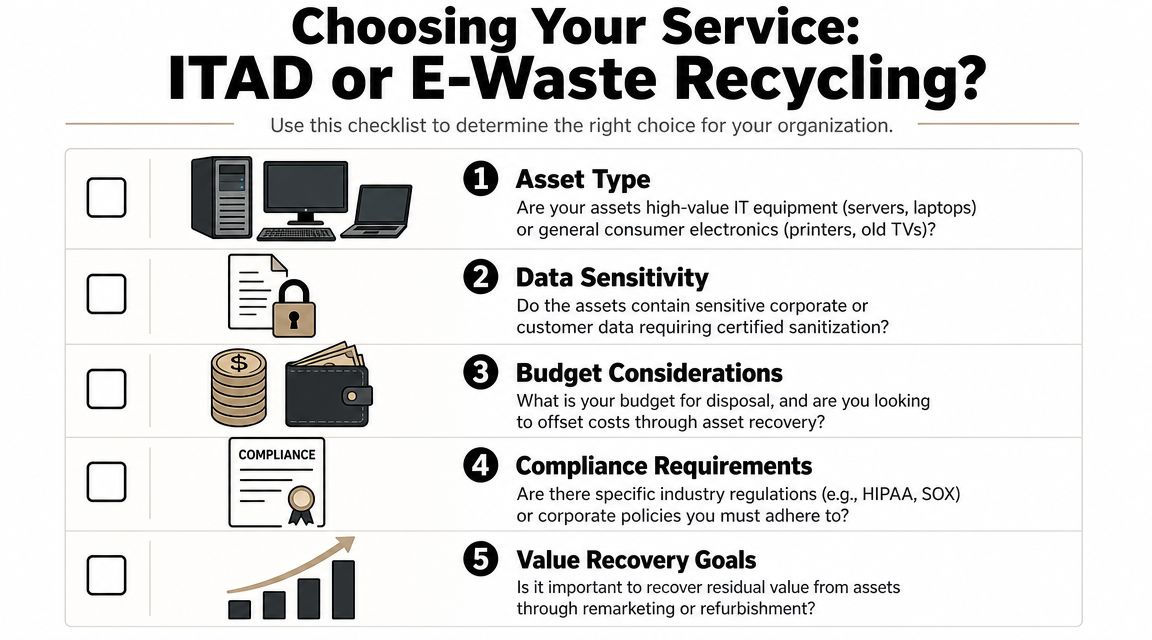
Most businesses in Georgia don't need to choose one service forever. They need to choose the right service for each asset category. That's the practical answer to ITAD vs e-waste recycling in Georgia.
Use standard recycling when the equipment is true scrap
Standard recycling is usually the right fit when the business objective is straightforward removal of non-sensitive, low-value material.
Good candidates include:
- Dead peripherals with no storage component
- Broken displays with no realistic refurbishment path
- Cables, adapters, and accessories from office cleanouts
- Mixed non-IT facility electronics where asset-level reporting isn't required
This is the disposal lane. Keep it for equipment that doesn't carry security exposure or meaningful residual value.
Use ITAD when risk or value is still attached
If the asset stores data, connects to core systems, or has reuse potential, route it through ITAD.
That usually includes:
- Laptops and desktops
- Servers and storage
- Network switches, firewalls, and telecom gear
- Mobile devices and tablets
- Copiers and multifunction devices
- Data center equipment
- Departmental refresh projects in regulated industries
A simple internal rule works well. If you'd inventory it when deploying it, you should probably inventory it when retiring it.
Build a decision filter your team can actually use
Ask five questions before anything leaves the building:
- Does it store data
- Does it still have resale or reuse potential
- Would an auditor ask for a record of its disposition
- Is the asset part of a larger refresh or decommissioning event
- Would a loss during transport create a problem
If the answer is yes to any of those, ITAD is usually the safer path. Teams formalizing that review process can use a vendor due diligence checklist to tighten handoffs and approval steps.
How to Select a Certified Partner in Georgia
Once you know which assets require ITAD and which can go to standard recycling, vendor selection becomes the next control point. A weak partner can undermine a solid internal policy.
Questions worth asking before pickup
Ask for proof of certifications, sample reporting, and examples of data destruction documentation. Ask how they handle inventory intake, whether they support on-site services when needed, and how they document chain of custody from your dock to final processing.
You should also ask how they separate assets for remarketing, recycling, and destruction. If a vendor can't explain that clearly, they probably won't execute it clearly either.
Practical signs of a strong commercial partner
Look for these markers:
- Recognized certifications relevant to recycling and data destruction
- Documented sanitization methods
- Clear reporting outputs including certificates and inventory records
- Secure transportation procedures
- Experience with enterprise, healthcare, finance, education, or government environments
For Georgia companies evaluating providers, Beyond Surplus is one example of a commercial ITAD and electronics recycling company that offers chain-of-custody documentation, certified data destruction records, logistics coordination, and both recycling and value-recovery services.
Contact Beyond Surplus for certified electronics recycling and secure IT asset disposal for businesses across Georgia. If your organization is planning a technology refresh, office cleanout, or data center decommissioning, start with a disposition plan that separates scrap from data-bearing assets and documents every handoff.


