

Since June 1, 2005, the FTC Disposal Rule has allowed either verified data wiping or physical destruction when consumer report information is rendered unreadable and unreconstructable. In Atlanta, wiping preserves resale value, while hard drive shredding guarantees irreversible destruction, so the right choice depends on whether the asset will be reused and how strict the data handling requirements are.
An Atlanta IT manager can face this decision with little warning. Servers are removed during a data center decommissioning, laptops collect dust in a locked staging room, or a storage array reaches the end of a refresh cycle before procurement has decided what happens next. The equipment still has value, but every drive may contain credentials, customer records, financial files, engineering data, or remnants of sensitive workloads.
The practical question isn't just whether wiping or shredding is “safer.” It's whether each asset has a legitimate reuse path, whether the chosen process can withstand an audit, and whether the provider can document every handoff. This comparison focuses on secure data destruction in Atlanta for commercial and enterprise environments, including IT asset recovery, data center disposal, and secure e-waste management.
| Decision factor | Certified data wiping | Hard drive shredding |
|---|---|---|
| NIST-aligned category | Clear or Purge | Destroy |
| Data handling | Logical sanitization using overwrite or device commands | Physical destruction of the media |
| Asset reuse | Possible when sanitization is successfully verified | Not possible |
| Best fit | Reuse, resale, redeployment, or remarketing | Maximum assurance and no reuse requirement |
| Documentation | Verification logs and certificate of data destruction | Destruction records and certificate of destruction |
| Main trade-off | Requires correct media-specific execution and verification | Sacrifices residual asset value and creates material for recycling |
Table of Contents
- The Atlanta Business Dilemma When IT Assets Reach End of Life
- How Data Wiping and Hard Drive Shredding Actually Work
- Compliance Requirements Under the FTC Disposal Rule and Industry Standards
- On-Site Versus Off-Site Destruction Logistics and Chain of Custody
- Cost, Value Recovery, and Environmental Impact of Each Method
- Decision Matrix for Choosing Between Wiping and Shredding
- Next Steps for Engaging a Certified Atlanta ITAD Provider
The Atlanta Business Dilemma When IT Assets Reach End of Life
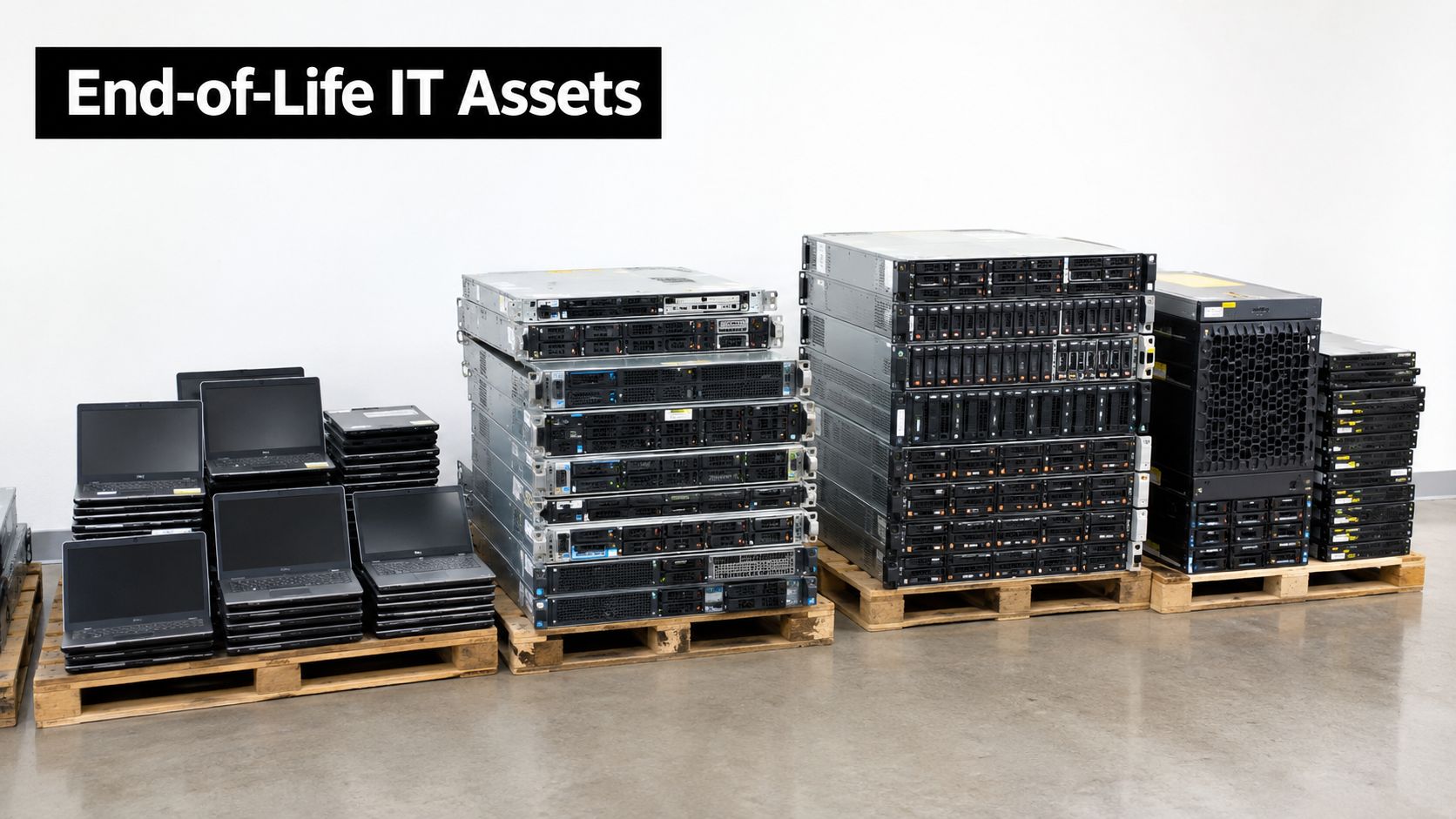
A technology company near Midtown Atlanta is consolidating equipment after a server refresh. Its operations team has racks of retired drives, laptops waiting for inspection, and networking hardware that procurement could remarket. The security team wants every data-bearing asset removed from risk immediately. Finance wants to know whether the equipment can generate recovery value instead of becoming scrap.
That tension appears in healthcare offices, financial institutions, universities, manufacturers, and government facilities across the metro area. A retired laptop isn't automatically waste. A functioning server may still support another department, enter a secondary market, or be refurbished for another organization. But the business can't pursue recovery by placing unverified equipment into a recycling stream.
The risk behind a routine pickup
The wrong disposition method creates two different forms of loss. Shredding a reusable drive removes its resale and redeployment potential. Sending a drive for remarketing without reliable sanitization can expose the organization to unauthorized access, weak audit evidence, and a breakdown in chain of custody.
The environmental decision matters too. Verified wiping can keep usable hardware in circulation, while shredding sends the asset directly into material recovery. Neither method should be selected from a blanket policy written for every device. The inventory needs to be divided by media type, condition, data sensitivity, and intended outcome.
Practical rule: Treat data destruction and electronics recycling as one controlled workflow, not as separate tasks handled by unrelated vendors.
For an IT director, that means connecting asset inventory with disposition instructions before equipment leaves the facility. Drives intended for reuse need a verified sanitization record. Drives that are damaged, obsolete, or subject to the highest security requirement may need physical destruction. The decision protects data while giving finance and sustainability teams a defensible explanation for what happened to each asset.
How Data Wiping and Hard Drive Shredding Actually Work
Data wiping and hard drive shredding solve the same business problem through different mechanisms. Wiping changes or removes the data logically while leaving the device available for another storage role. Shredding destroys the physical media so the device can no longer store data.
NIST SP 800-88 separates sanitization into Clear, Purge, and Destroy. Clear uses logical techniques suited to reducing the risk of ordinary recovery. Purge applies stronger techniques intended to make recovery infeasible at a more demanding level. Destroy makes the media unusable for data storage and targets recovery by state-of-the-art laboratory techniques.
What wiping does at the device level
A professional wipe addresses user-addressable storage locations with overwrite operations or device-level sanitize and reset commands. NIST's earlier guidance states that a Clear pass can use at least a single overwrite with a fixed value such as all zeros, while stronger Purge methods can apply where the risk profile requires them. The correct procedure depends on the drive technology and the sanitization objective, not on a generic “format” command.
A quick format, deleted files, or reinstalling an operating system isn't a defensible destruction process. Those actions can leave recoverable information or fail to address areas managed internally by the device. For practical guidance on the distinction between ordinary formatting and professional sanitization, see how to wipe a computer hard drive.
SSDs require particular care because flash storage uses controller-managed locations and wear leveling. Encrypted drives also need a documented approach that addresses the encryption state and the organization's recovery risk. A successful wipe should produce a device-specific result, an asset identifier, a verification status, and a certificate linked to the inventory.
What shredding does physically
Hard drive shredding is a NIST Destroy method. Physical destruction can include shredding, disintegration, pulverizing, incineration, or melting. For shredded or disintegrated media, NIST specifies residual particles with nominal edge dimensions of 5 mm and a surface area of 25 mm² as a concrete destruction benchmark. The NIST media destruction guidance connects particle size with the rigor expected from a physical destruction process.
Shredding works for HDDs, SSDs, removable storage, and other data-bearing media when the provider's equipment is designed for those materials. It eliminates reuse, so the resulting material must enter an appropriate electronics recycling stream. The benefit is finality. The cost is the loss of any remaining hardware value.
Compliance Requirements Under the FTC Disposal Rule and Industry Standards
The FTC Disposal Rule creates a baseline for organizations handling consumer report information. It requires disposal practices that are reasonable and appropriate to prevent unauthorized access and expressly allows physical destruction of paper records or destruction and erasure of electronic files and media so the information cannot be read or reconstructed. The FTC Disposal Rule guidance makes the important point clear: compliance is about the result and the reasonableness of the process.
That means verified wiping can be an appropriate path when the media will be reused, while shredding is appropriate when the organization needs physical destruction. A certificate alone doesn't make a weak process compliant. The organization needs evidence that the right method was applied to the right asset and that the provider maintained control throughout the workflow.
How standards clarify the choice
NIST SP 800-88 provides the operational language that many security and audit teams use to define sanitization. Its framework distinguishes logical sanitization from destruction and requires verification each time sanitization is applied. That verification requirement is why an ITAD report should do more than state that “drives were processed.” It should connect the result to identifiable equipment.
The IRS takes a stricter position for media containing federal tax information. It states that simple disposal isn't acceptable and identifies clearing, purging, or destroying as appropriate methods. The IRS media sanitization reference reinforces the importance of selecting a recognized sanitization path rather than relying on ordinary deletion.
Healthcare, finance, and government teams should also map the workflow to their internal controls and sector obligations. The label “HIPAA” or “GLBA” on a policy isn't enough. The policy should identify which assets carry regulated information, which method is approved, who verifies completion, and where the evidence is stored.
What an audit-ready record includes
A defensible file normally connects the original inventory to the final outcome. Useful records include:
- Asset identity: Serial numbers, asset tags, device type, and the originating location.
- Sanitization method: Clear, Purge, or Destroy, with the applicable procedure.
- Verification result: Pass, fail, exception, or rerouting decision.
- Chain of custody: Pickup, transport, intake, processing, and completion events.
- Certificate: A certificate of data destruction or recycling that matches the processed assets.
This documentation turns a disposal decision into evidence of due diligence. It also helps an Atlanta IT manager explain why some assets were wiped for recovery and others were shredded because reuse wasn't acceptable.
On-Site Versus Off-Site Destruction Logistics and Chain of Custody
The destruction location changes the operational risk, cost structure, and visibility of the project. On-site service keeps the media at the client's facility until processing occurs. Off-site service moves equipment to a controlled facility, where the provider can combine destruction, testing, remarketing, and electronics recycling in one workflow.
An on-site workflow
On-site destruction suits a high-security event, a sensitive data center decommissioning, or a business that wants staff to witness processing. The provider typically confirms the inventory, secures the media, performs wiping or shredding at the location, and issues documentation tied to the completed batch.
The arrangement reduces the time that drives spend outside the client's control. It doesn't eliminate the need for records. Before the truck arrives, the client should identify the assets, confirm the approved method, and designate a person responsible for sign-off. After processing, the provider should reconcile the completed list with the original manifest.
An off-site workflow
Off-site handling can support larger volumes and more integrated IT asset recovery. The process should still be controlled from the first handoff:
- Inventory and label: Record each data-bearing device and attach a durable identifier.
- Secure the load: Use locked containers or another controlled transport method.
- Document pickup: Record the date, location, responsible personnel, and asset count.
- Verify intake: Reconcile the shipment against the manifest before processing.
- Sanitize or destroy: Apply the approved method according to media type.
- Issue records: Deliver certificates and exception reports for the completed batch.
A provider's chain-of-custody process for IT asset disposal should make these handoffs visible. Ask how failed wipes are isolated, how damaged drives are routed, and how the provider handles a serial number that doesn't match the manifest.
The strongest chain of custody doesn't depend on a verbal promise. It gives every asset an identity, every handoff an owner, and every final result a document.
Cost, Value Recovery, and Environmental Impact of Each Method
Security is only one part of the disposition decision. A working enterprise drive, laptop, server, or networking device may have a second-use path. If the organization shreds it before assessing condition and demand, it converts a potentially recoverable asset into recyclable material.
Certified wiping supports that recovery path because the hardware remains functional after sanitization. The provider can test, grade, remarket, redeploy, or donate eligible equipment. The financial result varies by model, condition, age, market demand, logistics, and the quality of the asset record, so a responsible program shouldn't promise a fixed return before inspection.
Physical destruction produces a different cost profile. The organization pays for secure handling and processing, then gives up resale potential. It may still recover commodity value through recycling, but that isn't equivalent to remarketing a working device. Shredding can be the correct economic decision when the security consequence of reuse outweighs the asset's residual value.
A practical decision matrix
| Business priority | Wiping tends to fit when | Shredding tends to fit when |
|---|---|---|
| Financial recovery | Equipment is functional and has a realistic reuse route | Equipment is damaged, obsolete, or has no approved reuse path |
| Sustainability | Extending the hardware lifecycle is credible | Material recovery is the only practical outcome |
| Security | A documented Clear or Purge process meets the risk requirement | The organization requires physical destruction |
| Operations | The team can verify each device and manage exceptions | The batch needs a definitive, irreversible endpoint |
| Auditability | Logs, verification, and certificates are retained | Destruction records identify the media and final method |
A 2024 industry report says that up to half of destroyed devices were still functional, which highlights the business cost of treating shredding as the default. The Blancco data sanitization report connects that pattern with lost reuse value, unnecessary e-waste, and weaker sustainability outcomes when verified erasure could have supported a second life.
The environmental trade-off
Wiping can support circularity by keeping usable equipment in service and reducing demand for replacement hardware. Shredding ensures that data-bearing media doesn't re-enter circulation, but it also ends the device's useful life and shifts the next step to material processing.
The answer isn't to maximize reuse or maximize destruction across the entire inventory. It's to separate the inventory intelligently. Reuse eligible assets should receive verified sanitization. Assets with unacceptable residual risk should be destroyed, then routed through a documented recycling program.
Decision Matrix for Choosing Between Wiping and Shredding
A good policy starts with four questions: What data was on the asset? Will the device be reused? What does the applicable control require? Can the provider prove the result? If those questions produce different answers for different devices, the organization needs a segmented workflow rather than a single company-wide instruction to “shred everything.”
| Asset situation | Preferred route | Required control |
|---|---|---|
| Functional laptop planned for redeployment | Verified wiping | Device-specific result and certificate |
| Server with approved remarketing path | Clear or Purge based on risk | Inventory reconciliation and verification |
| SSD with uncertain sanitization status | Media-appropriate Purge or Destroy | Escalation for failed or unverifiable processing |
| Damaged drive with sensitive records | Shredding | Physical destruction record |
| Encrypted drive with controlled key management | Approved logical sanitization or destruction | Document the encryption and recovery assumptions |
| Media subject to the highest security requirement | Destroy | Certificate and full chain of custody |
Why wiping should usually be the reuse default
For assets that will be redeployed or sold, verified wiping preserves the option to recover value. That doesn't mean every wipe is sufficient. SSD architecture, device health, encryption, firmware behavior, and the required level of recovery resistance all matter. A failed verification should remove the asset from the reuse stream and trigger a defined escalation.
Industry awareness remains uneven. Only 37% of enterprises said they were aware of NIST SP 800-88, and 36% knew IEEE 2883-2022, according to the STS industry FAQ. Those figures help explain why organizations sometimes mistake a basic reset for a defensible sanitization procedure.
When shredding is the better answer
Shredding is the stronger choice when the organization has no reuse intent, the media is damaged or unreliable, or the risk owner requires irreversible physical destruction. It also removes uncertainty around hidden storage areas that a logical process may not adequately address.
AI-era hardware refreshes make this distinction more important. Accelerated infrastructure changes can create mixed batches containing reusable equipment, failed drives, encrypted devices, and media with different retention requirements. Sort first, then assign each asset a method. A one-size-fits-all destruction rule may reduce one risk while creating avoidable financial and environmental loss.
Next Steps for Engaging a Certified Atlanta ITAD Provider
Start with an inventory, not a service quote. Separate laptops, servers, HDDs, SSDs, backup media, networking equipment, and devices with unknown condition. Record serial numbers where available, identify the data owner, and mark whether each asset is intended for redeployment, resale, recycling, or destruction.
Then ask prospective providers direct operational questions:
- Method selection: Which NIST-aligned process will you use for each media type?
- Verification: What happens when a wipe fails or a device can't be accessed?
- Physical destruction: What particle-size benchmark applies to shredded media?
- Chain of custody: How are assets secured from pickup through final processing?
- Reporting: Will the certificate identify serial numbers, method, date, and exceptions?
- Reuse controls: How do you prevent an asset from entering remarketing before sanitization is verified?
- Logistics: Can you support on-site service, off-site processing, palletized loads, and multi-location pickups?
For Atlanta organizations planning a data center de-installation, schedule a site review before equipment is disconnected. The provider should understand access restrictions, loading conditions, rack removal, media counts, and the division between reusable hardware and destruction-only assets. Healthcare, finance, and government teams should also request sample certificates and confirm how long reports remain available for audits.
Beyond Surplus is one Atlanta-area option for ITAD services in Atlanta, including secure data wiping, hard drive shredding, electronics recycling, asset recovery, and documented disposition workflows. Evaluate any provider on its actual process, documentation, media expertise, and ability to match destruction intensity to the asset's risk.
The final service plan should state who owns each handoff, what happens to exceptions, when certificates are issued, and how recovered value is reported. That clarity keeps the project moving while giving security, finance, procurement, and sustainability teams a shared record of the outcome.
Beyond Surplus helps Atlanta businesses manage secure data wiping, hard drive shredding, electronics recycling, IT equipment disposal, and IT asset recovery with documented chain of custody. Visit Beyond Surplus to plan a media-specific disposition program that protects sensitive data while preserving reuse opportunities where they're appropriate.


