Replacement laptops are arriving, departments want old desktops removed, and facilities needs the storage room cleared before the next delivery. Across your Atlanta, Georgia, offices, monitors, network equipment, and servers may all be retiring during the same refresh window. The immediate pressure is to make space, but removing equipment isn't the same as closing its security, financial, and operational obligations.
A controlled Atlanta technology refresh connects each asset to an authorized destination and evidence of completion. For IT managers, procurement teams, and facility leaders, that means managing inventory, data treatment, disposition, custody, and documentation as a single project.
Table of Contents
- Plan the Atlanta Technology Refresh Before Equipment Leaves
- Inventory and Tag Every Retired Asset
- Choose the Best Disposition for Each Device
- Match Secure Data Destruction to Media Risk
- Coordinate Secure Pickup and Chain of Custody
- Apply Compliance Requirements to the Evidence
- Compare Cost, Value Recovery, and Vendors
Plan the Atlanta Technology Refresh Before Equipment Leaves
Start with the departments releasing equipment, not the truck schedule. Finance may need records preserved, IT may still depend on a retiring server, and facilities may have access restrictions that affect removal. Confirm those dependencies before assigning a pickup date.
Appoint a project owner with authority to resolve disagreements between security, operations, and procurement. Assign separate responsibility for approving data treatment, releasing equipment, and accepting final documentation. A vendor can perform the work, but your organization still needs someone to approve the outcome.
Define the release conditions
Use a written project scope to establish what can leave and what must remain on hold.
- Equipment scope: Identify endpoints, infrastructure, displays, peripherals, and specialized equipment included in the refresh.
- Business readiness: Confirm migration, backup, record-preservation, and operational release approvals.
- Data decisions: Identify who authorizes sanitization methods and handles failed verification.
- Disposition authority: Name the person who can approve reuse, resale, recycling, or destruction.
- Completion criteria: Specify the records procurement must receive before closing the project.
The planning sequence should connect departmental readiness to physical collection.
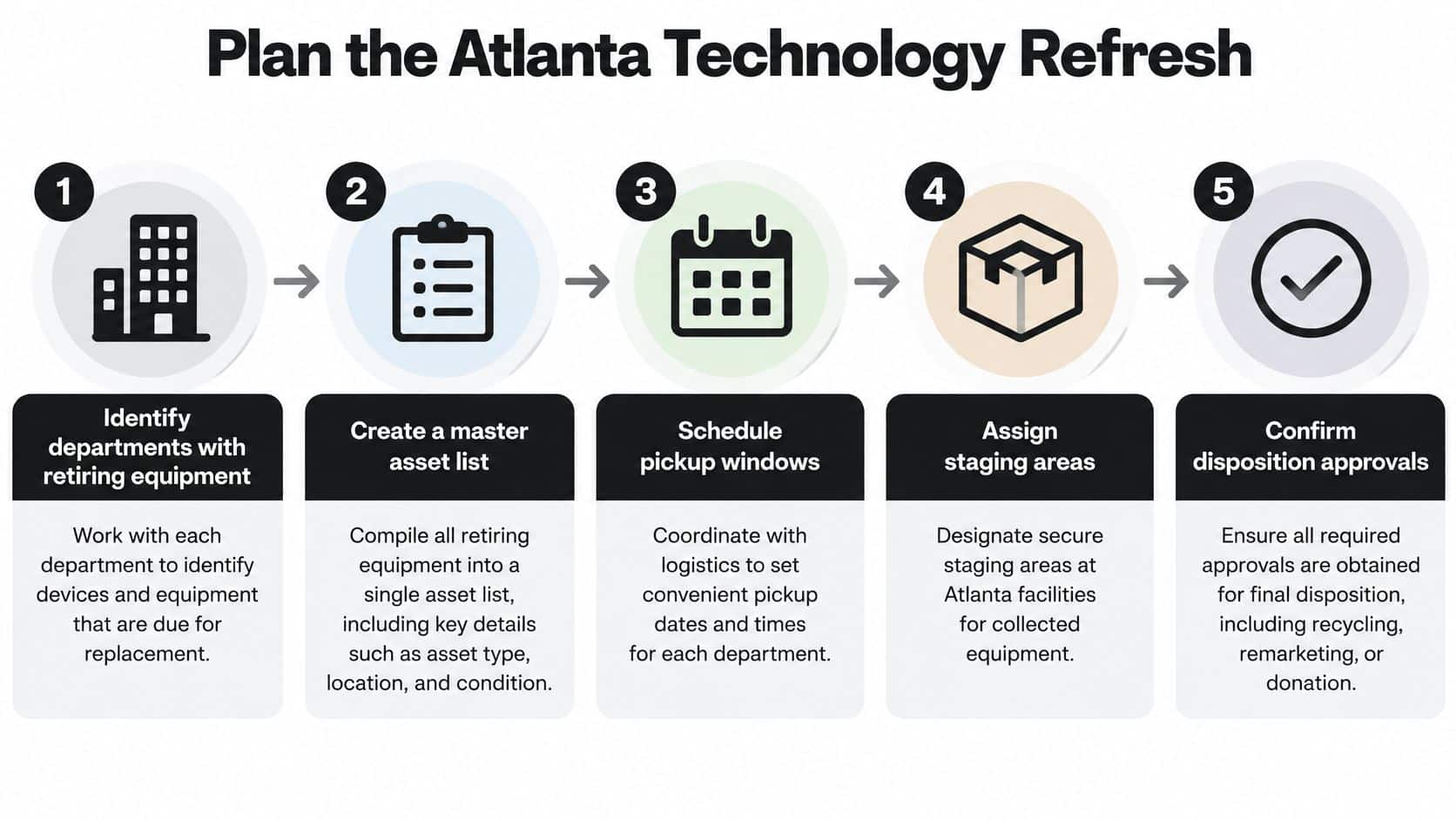
The environmental reason for disciplined planning is substantial. The UN-backed Global E-waste Monitor reported 62 million tonnes of electronic waste generated in 2022, with only 22.3% documented as formally collected and recycled in an environmentally sound manner, according to this summary of the Global E-waste Monitor findings. For an operations team, the practical response is to separate potentially reusable equipment from material requiring recycling, rather than authorizing an undifferentiated cleanout.
Make readiness visible
Create project statuses that distinguish equipment still in use, approved for retirement, awaiting data treatment, ready for collection, and awaiting final evidence. Don't mark something complete merely because it left the building.
Practical rule: Approve the destination and required evidence before approving the pickup.
Leave room in the schedule for exceptions. An unidentified server or an employee laptop under a preservation hold shouldn't enter the collection stream just because the loading dock is available.
Inventory and Tag Every Retired Asset
A pallet count tells facilities how much space equipment occupies. It doesn't tell security which drive was destroyed or finance which laptop was sold. The serialized inventory is the control point that connects discovery to final disposition.
Begin by reconciling purchasing records, asset-management exports, department lists, and the equipment physically present. Treat discrepancies as work to resolve, not as harmless administrative differences.
Build a record that survives the handoff
For every individually tracked asset, capture:
- Identity: Manufacturer, model, serial number, internal asset tag, and device category.
- Ownership: Responsible department, business owner, physical location, and assigned employee where applicable.
- Technical profile: Operating system, storage type, installed media, encryption status, and whether the device powers on.
- Risk classification: Data sensitivity, preservation restrictions, and approved treatment.
- Retirement status: Expected release date, proposed disposition, approval, and unresolved exceptions.
Keep operational identifiers separate from sensitive information. A visible tag should help a handler identify the asset, not advertise its former user's confidential role or the contents of its storage.
Use barcode labels where your inventory system supports them. Scan the manufacturer's serial number and the internal identifier into the same record, then check that the label remains readable during packing. For devices with removable drives, create a parent-child relationship between the chassis and each storage device.

Resolve uncertain equipment before release
Laptops and desktops usually fit familiar asset workflows. Servers need component-level attention, while printers and network appliances should receive an explicit storage assessment rather than being classified by appearance. Track displays and peripherals at the level your policy requires, without allowing bulk accessory counts to replace records for data-bearing equipment.
For remote employees and distributed facilities, ask the sender to confirm identifiers before shipping. Reconcile the returned device against that record when it arrives, and investigate substitutions or missing accessories separately.
Quarantine equipment with an unreadable serial number, unknown owner, inaccessible storage, or unexplained inventory mismatch. Assign a temporary identifier and an exception owner; don't silently substitute a guessed serial number.
An inventory optimization workflow can help organize discovery and reconciliation before collection. Preserve a dated, access-controlled copy of the approved manifest, and record later amendments rather than overwriting the baseline.
A useful inventory must support a simple question after processing: What happened to this particular asset? If the record ends at “collected,” the retirement process remains unfinished.
Choose the Best Disposition for Each Device
An operational business laptop may deserve redeployment. A damaged peripheral may belong in material recovery. A failed drive that can't be reliably sanitized may require destruction, even when its server chassis remains reusable.
Those outcomes shouldn't share a blanket disposal instruction. Evaluate condition, remaining usefulness, data risk, treatment feasibility, destination, and likely net recovery before approving a route.
IT Equipment Disposition Decision Matrix
| Disposition | Best Fit | Data-Control Expectation | Business Outcome |
|---|---|---|---|
| Reuse | Equipment that meets an internal business need | Approved sanitization and release before reassignment | Continued service without replacing the asset |
| Resale | Functional hardware with a practical buyer | Verified treatment, transfer approval, and traceable sale | Potential recovery after service costs |
| Recycling | Equipment unsuitable for further use | Storage addressed before material processing | Documented recovery through approved downstream channels |
| Destruction | Media that fails treatment or requires irreversible retirement | Recorded destruction linked to the affected media | Security outcome with no further storage reuse |
Separate hardware value from data risk
Consider an internally redeployed laptop. Its operating condition may justify keeping it, but reassignment should follow the approved data-treatment process. Don't use a functioning screen and successful startup as evidence that the device is ready for another employee.
Operational desktops may be candidates for resale after treatment and testing. Request a condition-based valuation and clarify whether storage, accessories, freight, testing, and service deductions affect the amount returned. A headline buyback estimate isn't a final settlement.
Damaged peripherals can move toward recycling after the storage assessment is resolved. Failed media should follow the security decision, while usable components can receive separate disposition approvals. Destroying a drive doesn't automatically require destroying the entire computer.
For a broader comparison of reuse and processing choices, consult this refurbish-or-recycle decision guide. Apply the decision to individual assets or clearly defined categories, not whatever happens to fit on a pallet.
Procurement staff comparing resale channels may also encounter Idaho Pawn & Gold Exchange's discussion of pawn shops that buy electronics. Treat that as background on an alternative transaction channel, not proof that a buyer can deliver enterprise sanitization, custody, or reporting requirements.
A buyer's willingness to pay for hardware isn't evidence that the hardware is safe to transfer.
Approve the route before transfer
Before releasing equipment, confirm:
- Security approval: The selected data treatment is appropriate and its required evidence is defined.
- Commercial approval: Ownership, expected recovery, deductions, and settlement terms are understood.
- Destination approval: The receiving party and permitted downstream handling are documented.
- Exception control: Rejected, unmarketable, or unverifiable assets can't change routes without authorization.
Physical destruction eliminates reuse of the destroyed media. Reserve it for a defensible security or product-control purpose, rather than using it as a substitute for classification.
Match Secure Data Destruction to Media Risk
A blanket instruction to wipe everything hides the decisions that matter. Storage technology, device condition, data sensitivity, and the intended destination determine whether a method is suitable.
NIST distinguishes clear, which addresses user-accessible storage against ordinary non-invasive recovery; purge, which makes recovery infeasible using state-of-the-art laboratory techniques while potentially preserving reuse; and destroy, which makes the media unusable for future storage, as described in NIST SP 800-88 Rev. 1. These are different outcomes, not interchangeable names for deleting files.
Match the method to the actual media
For a reusable magnetic hard drive, select an approved clear or purge technique supported by the device and your policy. Record the command or process, tool, operator, and completion result.
For an SSD, don't assume that a workflow designed for magnetic disks provides equivalent coverage. Require a media-aware procedure and evidence that the selected operation achieved the required outcome. Cryptographic erase also needs a defensible assessment of encryption and key handling, not merely a checked encryption setting.
Failed or inaccessible media needs a controlled exception path. If the required sanitization outcome can't be demonstrated, authorize destruction rather than repeatedly attempting an unverifiable wipe.
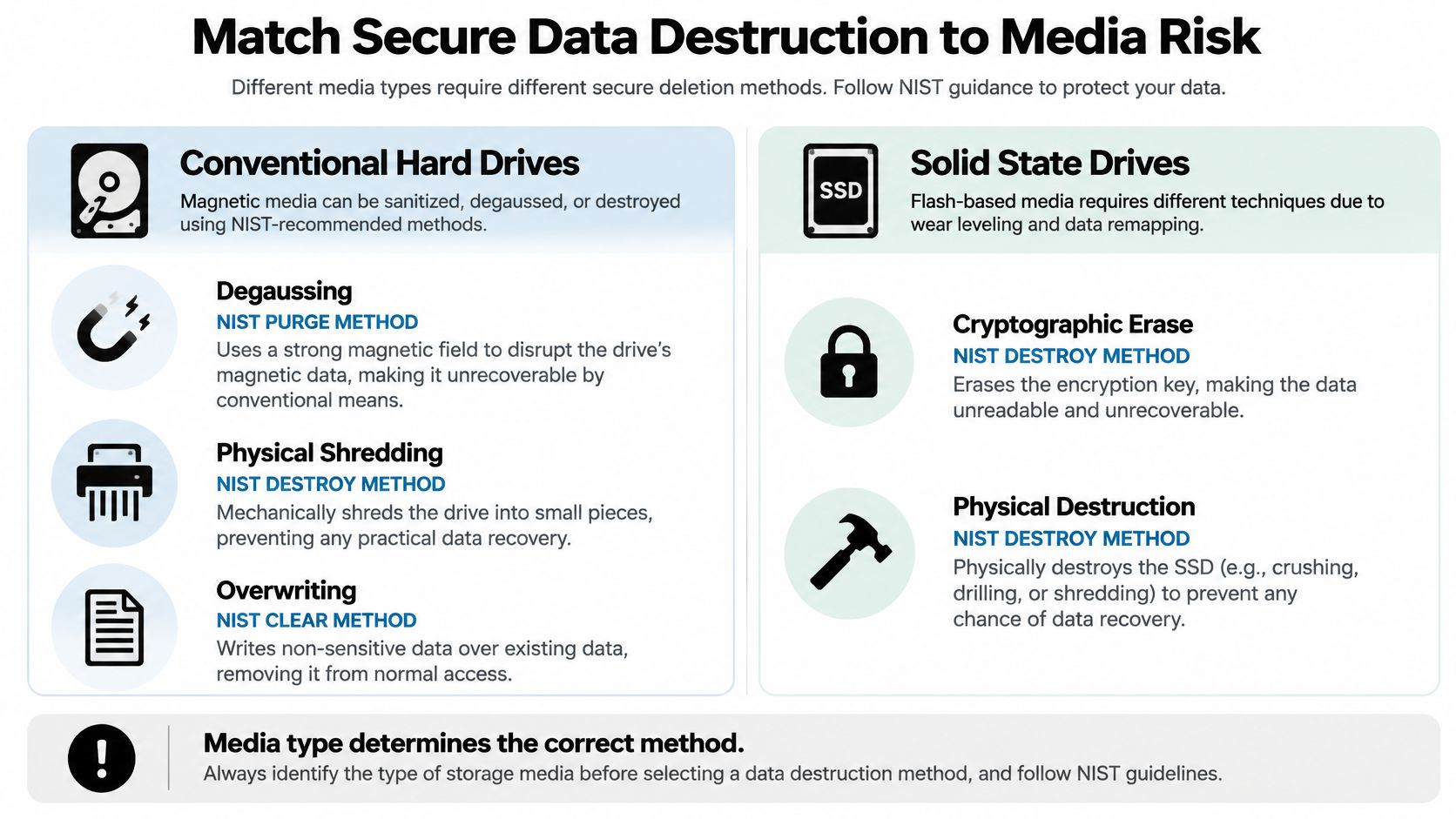
Treat complete servers and network appliances as assemblies requiring storage discovery. The disposition decision must cover installed media, not just the chassis recorded on the pickup manifest. Use this guide to NIST data-destruction standards to structure vendor discussions around methods and evidence.
Verify execution and validate acceptance
NIST's media-sanitization FAQ distinguishes operational verification from organizational validation. Verification checks whether the sanitization process completed without technical errors; validation reviews that evidence against the information's sensitivity and determines whether to accept the outcome or require stronger treatment.
Build the following controls into the work order:
- Execution evidence: Log the asset, media identifier, method, tool, technician, date, and result.
- Verification coverage: Address applicable user-accessible and reserved storage areas, rather than checking only visible partitions.
- Independent review: Define representative sampling and secondary checks using a different tool where appropriate.
- Exception handling: Reject incomplete results and document the authorized corrective action.
The common failures are avoidable: treating SSDs like magnetic disks, checking a predictable location, accepting a tool's completion message without review, or issuing a certificate disconnected from serial-numbered evidence. A verified purge may preserve value; an unsupported assertion of erasure does not.
Coordinate Secure Pickup and Chain of Custody
Collection starts when approved equipment enters controlled staging, not when the truck arrives. Facilities should provide a restricted area, while IT confirms that only released assets enter it. Keep unresolved devices physically separate and clearly marked.
Coordinate the pickup window with loading access, building security, elevators, parking, and the receiving team. Identify cables that must remain with operational systems before deinstallation, and flag battery concerns for an agreed handling plan rather than placing questionable equipment into an ordinary mixed load.
Record each custody change
A useful chain-of-custody process for IT asset disposal connects the approved manifest to collection, receiving, processing, and final destination.
- At staging: Scan assets into the collection area and record the responsible custodian.
- At loading: Reconcile identifiers, document container seals where used, and record the releasing and receiving parties.
- During transport: Identify the carrier, authorized destination, and handling responsibilities.
- At receipt: Confirm identifiers and seal condition, then report discrepancies before processing.
- At closure: Reconcile processing outcomes to the original shipment and resolve outstanding items.
Don't let a signature for a pallet stand in for confirmation of its contents. If the vendor receives sealed containers, specify when asset-level reconciliation occurs and who receives the discrepancy report.

Adapt the handoff without weakening it
For an office refresh, control the movement from desks to staging. For remote-worker returns, connect the employee's shipment record to receiving inspection. For multi-site collections, preserve each location's manifest instead of combining everything into an untraceable consolidated load.
During data-center deinstallation, require release authorization for the exact equipment being removed. Equipment still supporting production shouldn't become eligible for removal because it sits beside approved hardware.
Financial-services stakeholders may also review Kons Law's FINRA asset protection resources with counsel as separate legal background. Those materials aren't a substitute for an equipment custody procedure or evidence that a disposal workflow satisfies a particular regulatory obligation.
Handoff test: If an asset goes missing, the records should identify the last confirmed custodian and the next expected reconciliation.
Define an escalation owner before collection. A missing device, broken seal, unexpected drive, or failed treatment result should remain an open exception until someone with authority accepts the resolution.
Apply Compliance Requirements to the Evidence
Compliance starts with identifying the information and obligations involved. Don't apply a regulatory label to an entire refresh without checking which assets and records fall within its scope.
The FTC Disposal Rule took effect on June 1, 2005, and applies to businesses or individuals using consumer reports for a business purpose, according to the FTC's announcement of the rule's effective date. It requires reasonable and appropriate measures to prevent unauthorized access to or use of covered information, including electronic disposal methods that prevent reading or reconstruction.
Connect obligations to release decisions
Selling or donating equipment doesn't automatically remove disposal responsibilities. The FTC's regulatory definition of disposal includes the sale, donation, or transfer of a medium containing consumer information.
That distinction matters for refurbishment and IT asset recovery. The commercial destination may change, but covered information still needs an appropriate disposal control before transfer.
For HIPAA-sensitive environments, have privacy, security, and legal personnel determine the applicable risk analysis, policies, safeguards, and contractual requirements. Medical equipment disposal and laboratory equipment disposal should also receive organization-specific clearance for non-IT concerns before the recycling vendor accepts the equipment. Don't assume that an electronics-processing agreement addresses every specialized risk.
Ask qualified counsel to confirm applicable Georgia and local requirements. A national collection program should likewise account for the obligations attached to each participating business and location, rather than assuming the Atlanta project scope covers every site.
Build an evidence package around decisions
Use a compliance documentation framework that preserves the connection between requirements, approvals, execution, and acceptance.
- Inventory: Establish which equipment and media entered the project.
- Sanitization record: Show the authorized method and the actual execution.
- Verification result: Preserve the evidence used to assess completion.
- Custody log: Identify who controlled equipment during each handoff.
- Downstream record: Document the approved destination and subsequent processing.
- Exception report: Explain deviations, corrective action, and approval.
- Certificate: Summarize completion while remaining traceable to supporting records.
Set retention periods with legal and records-management teams. Keep the underlying records accessible in a durable format, rather than relying entirely on a vendor portal.
A recycling certificate may document material handling without establishing which storage device received which security treatment. Documentation should support the organization's compliance decision, not merely confirm that a collection occurred. Neither a certificate nor a contract should be treated as automatic elimination of all liability.
Compare Cost, Value Recovery, and Vendors
The lowest collection quote may exclude the work your team needs most. Compare proposals against the same scope, including preparation, secure logistics, media treatment, reporting, and exception resolution.
Build a total-project estimate that distinguishes service charges from potential hardware recovery. Ask vendors to explain the assumptions behind their estimates, especially equipment condition and the treatment required before resale.
Compare net outcomes rather than headline buyback value
Include inventory labor, deinstallation, packing, electronic waste pickup, transport, data destruction, recycling processing, and documentation. Identify which costs are fixed, condition-dependent, or triggered by exceptions.
Then assess potential resale proceeds after deductions. Clarify who owns the hardware during evaluation, who approves a revised valuation, how rejected assets are handled, and when settlement occurs. Don't authorize a sale based on an optimistic gross figure while leaving service deductions undefined.
Reuse deserves the same scrutiny. Keeping equipment only makes commercial sense if a department has a genuine use for it and the preparation effort is acceptable. Storage without an assigned purpose isn't value recovery.
For product destruction, specify the required outcome separately from ordinary computer recycling. Brand protection, contractual restrictions, and data security may lead to different acceptance criteria, so procurement should make the intended result explicit.
Ask vendors for evidence before signing
The FTC identifies contractor due diligence, including review of audits, references, recognized certifications, and information-security policies, in its business guidance on disposing of consumer-report information. Translate that into specific procurement questions.
- Asset controls: Can the vendor preserve your identifiers through processing and settlement?
- Security practices: What pickup, staging, access, and sanitization controls apply to your work?
- Independent evidence: Are relevant audits, references, and certifications available, and what operations do they cover?
- Insurance and contracts: Do coverage and contractual responsibilities match the proposed work?
- Downstream accountability: Which parties receive equipment or materials, and how are changes controlled?
- Reporting: Can the vendor provide sample manifests, treatment records, certificates, and exception reports?
Request redacted examples before the purchase order is issued. A promise to provide documentation later is weaker than an agreed reporting format attached to the scope.
Close the project in sequence
Approve the reconciled inventory, authorize treatment and disposition, release equipment for collection, and review receiving discrepancies. Accept processing evidence only after exceptions are resolved, then reconcile recovery payments and update asset and financial records.
Choose the vendor that can execute that complete scope at an understood net cost. For Atlanta electronics recycling services, the practical commercial test isn't whether equipment disappears on schedule. It's whether your team can defend where it went, how its data was treated, and what value was recovered.
Beyond Surplus offers business IT equipment disposal, secure data destruction, electronics recycling, and IT buyback options, with pickup coordination for Atlanta refreshes and nationwide organizational projects. Visit Beyond Surplus to discuss your equipment inventory, collection requirements, and asset-level documentation before scheduling removal.