
A recalled product doesn't stop being your problem when it leaves the shelf. It stops being your problem when you can prove where every unit went, how it was controlled, and what happened to it at the end. That's the difference between ordinary waste handling and secure disposal of recalled retail products. Destruction is the easy part. The evidence file is what closes the recall, and it's where most multi-site programs fall apart.
Table of Contents
- Recall Disposal Stages and the Evidence Each One Creates
- How to Freeze, Count and Quarantine Recalled Stock
- Choosing Between Return, Rework, Recycling and Destruction
- Hazardous Waste and Universal Waste Checkpoints
- Secure Transport and Verified Destruction Methods
- Building the Chain-of-Custody File and Destruction Certificate
- Vetting a Disposal Vendor and Closing the Recall File
Recall Disposal Stages and the Evidence Each One Creates
For products recalled in 2012, only 10% were successfully corrected or destroyed overall. Retailers possessed approximately 4% of recalled products and corrected or destroyed 52% of those units, according to the historical U.S. child-product recall analysis of 2012 correction rates.pdf). The figures show why physical handling alone cannot close a recall. A shipment to a disposal vendor does not establish that every affected unit was accounted for or that the final disposition was completed.
Treat each disposal stage as a control point with a record attached. The disposal method matters, but the file must also connect the affected inventory to its final disposition, with any gaps explained and approvals documented.
The Stage Map
| Stage | Core action | Evidence produced | Typical owner |
|---|---|---|---|
| Stop sale | Freeze SKU, lot and serial in POS and ERP | Timestamped hold record | Inventory control |
| Locate | Pull stock from stores, DCs, 3PLs and marketplaces | Location count by lot | Operations |
| Quarantine | Segregate, label and lock affected units | Quarantine log with photos | Site manager |
| Reconcile | Match counts to shipments and return records | Variance report with zero or explained gaps | Inventory control |
| Authorize | Confirm remedy and disposition with manufacturer or regulator | Written authorization on file | Compliance |
| Transport | Move units sealed, tracked and under custody | Bill of lading and custody transfer forms | Logistics |
| Destroy or recycle | Apply the method matched to the hazard | Destruction record with witness or photo evidence | Compliance with vendor |
| Close out | Issue certificate, update ERP and retain file | Signed certificate and closed recall file | Compliance |
Use these rows to test a live or recently completed recall. At each handoff, the records should identify what moved, who controlled it, and what happened next. A count that cannot be matched to shipment, return, or destruction records needs an explained variance, not an assumed resolution.
The closeout file should let a reviewer follow the sequence without relying on staff recollection: hold, location, quarantine, reconciliation, authorization, transport, disposition, and closeout. If a stage has no supporting record, the recall remains difficult to verify, even when the product was physically destroyed. A completed disposal means both the units and the evidence have reached a documented endpoint.
How to Freeze, Count and Quarantine Recalled Stock
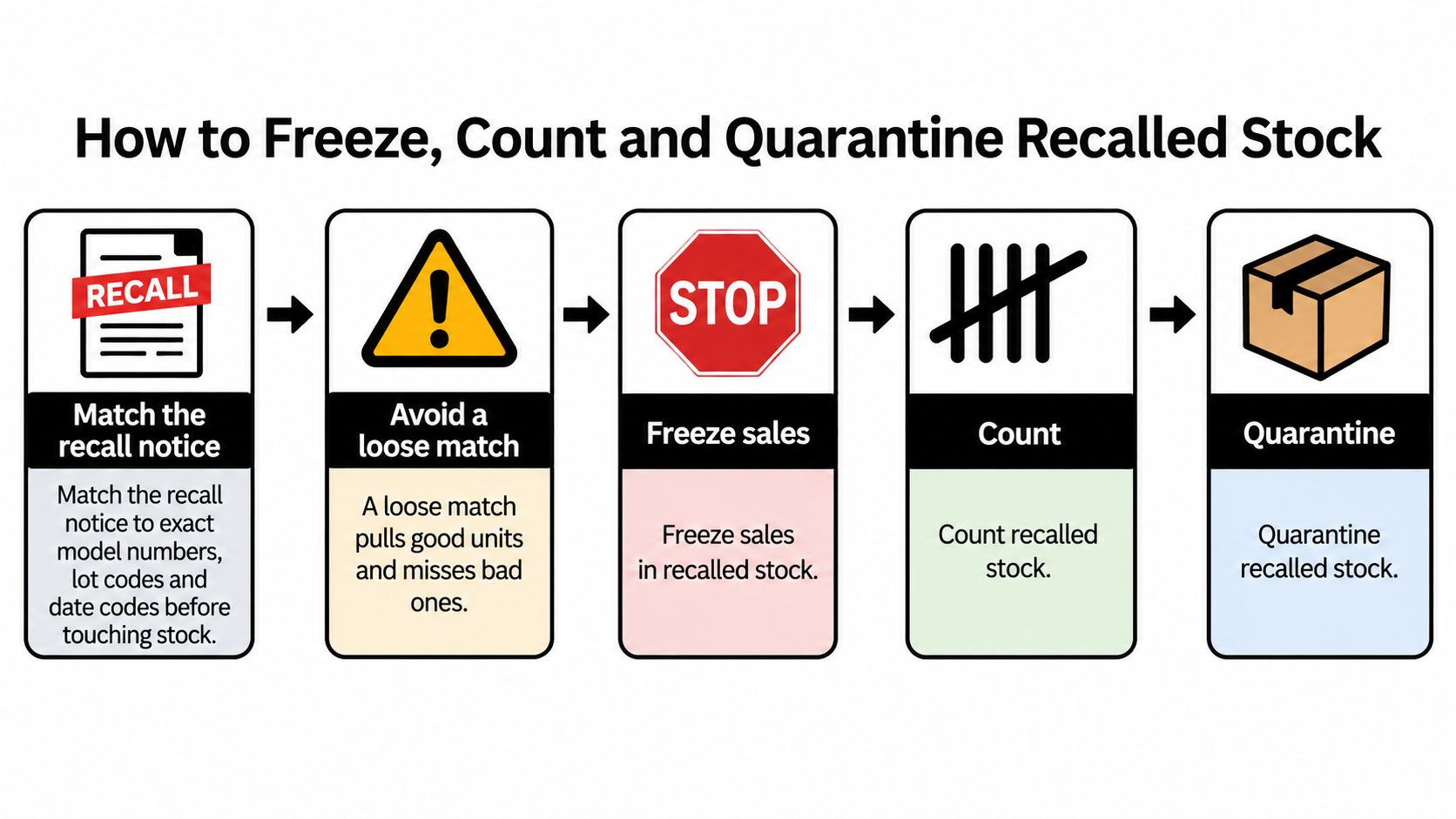
Don't touch stock until you've matched the notice precisely. A loose match pulls good units, misses bad ones, and creates a reconciliation you'll never clean up.
The Seven Steps
- Match the recall notice first. Confirm exact model numbers, lot codes and date codes before anyone moves product, because scope errors here contaminate every later count.
- Freeze sales in POS, ERP and marketplace listings. Freeze by SKU and lot, not just by product name, and record the time of the freeze so you can prove no units sold after notification. Marketplaces and 3PL pick faces are where freezes leak, so confirm them separately instead of assuming the ERP hold propagated.
- Count physically with two people. One counts, one records. For serialized electronics, capture each serial number and tie it to the asset register, because a lot-level total won't resolve a disputed shortage later. Use disciplined inventory control practices that keep recalled stock visible in your system rather than writing units off as soon as they leave the sales floor.
- Reconcile before anything moves. Match the physical count against distribution and return records. Escalate any variance now, while sites can still recount and search back rooms, returns cages and repair benches. Once a truck leaves, a shortage becomes an unexplained gap in the file.
- Label every unit or pallet. Use the recall ID, quarantine date and a clear do-not-sell tag. Labels should survive handling and transport, and they should be visible without opening the pallet wrap.
- Move units into a locked, access-logged area away from routine returns. This is the step that fails most often. Commingling recalled units with ordinary returns creates re-release risk and breaks reconciliation, because a returns associate can't tell a quarantined charger from a resaleable one. Recalled products must remain quarantined and segregated throughout the distribution chain, and firms must monitor third-party providers to ensure separation from other returned goods, per CPSC guidance on quarantining recalled stock by SKU, lot, serial number and location.
- Log every movement. Record who opened the quarantine area, when, and why. Adding late-arriving returns is normal. Doing it without updating the count sheet isn't.
If a recalled unit can be picked, returned to stock or donated by someone following their normal routine, your quarantine doesn't exist yet.
What Clean Looks Like
A clean quarantine ends with a count sheet that ties out to zero variance, or to variances that are explained in writing with names and dates. Every serial is accounted for, every pallet is labeled, and the locked area holds nothing except recalled units waiting for an authorized disposition. Keep consumer returns arriving after the initial sweep in the same locked area, but add them as new dated lines on the log. Don't overwrite the original count, because auditors need to see how the total grew. Photograph the sealed quarantine area and the pallet labels at handoff. Those photos cost nothing and they settle arguments about condition and quantity that otherwise turn into email chains months later. That record, not the physical cage, is what you'll defend later.
Choosing Between Return, Rework, Recycling and Destruction
Safe disposal is hazard-specific. It isn't a synonym for a dumpster, and it isn't automatically a recycler either. CPSC guidance recognizes several possible dispositions, including rework, component reclamation and destruction, and requires the recalling firm to coordinate the method with the agency and manufacturer, while FDA guidance says contaminated products must be secured so people and animals cannot access them and recalled food should not be donated or given away, as set out in FDA consumer guidance on securing contaminated recalled products.
Four Decision Gates
Apply these gates to every SKU before you authorize movement:
- Remedy named: Does the recall remedy already specify return, repair, replacement or disposal? If it does, you don't get to improvise a cheaper route.
- Hazard removable: Can the defect be fixed, or the hazardous component isolated, with proof? If you can't prove removal, rework and reclamation are off the table.
- Vendor acceptance: Will the downstream vendor accept recalled goods under a no-resale, no-commingling contract? A general recycler that treats your load as ordinary e-waste is a liability, and the analysis behind deciding whether equipment should be refurbished or recycled changes completely once a recall restricts resale.
- Resale and donation excluded: Is donation or resale expressly ruled out by the recall terms? For recalled consumer goods, assume yes unless you hold written approval.
Take a typical regional distribution center holding recalled laptop chargers with a battery defect. Rework isn't viable if the cell itself is the hazard. Component recovery might salvage cables or housings, but only with regulator sign-off and proof the battery stream is separated and routed as its own controlled waste. Without that sign-off, destruction of the battery-bearing unit is the defensible path, even if it discards usable plastic and copper. Teams trying to reduce that waste legitimately should explore circular economy business strategies for non-recalled streams, not use circularity as a reason to salvage recalled units.
| Disposition | Use when | Check before proceeding |
|---|---|---|
| Return for refund or replacement | The recall remedy calls for customer return | Units stay quarantined and separate from routine returns |
| Repair or rework | The defect is fixable and the regulator accepts the fix | Verified fix and documented sign-off before any resale |
| Component reclamation | The hazard sits in parts that can be isolated | Regulator coordination and proof the hazardous part is removed |
| Recycling | Material recovery is possible after the hazard is removed | Hazardous-waste determination and a recycler contract with no storage-before-recycling gaps |
| Destruction | The hazard persists or the regulator requires it | Witnessed destruction or written verification |
| Donation or resale | Rarely appropriate for recalled consumer goods | Written regulator approval; generally excluded |
Destruction reduces consumer risk while sometimes discarding usable material. Salvage preserves material while risking dangerous goods back in commerce. Either can be the right call, but the decision and its reason must be written down per SKU. An undocumented choice looks like an accident during review.
Hazardous Waste and Universal Waste Checkpoints
The destruction step may take minutes; proving that each regulated unit followed the right waste pathway takes a complete file. For medical equipment, distinguish a correction from a removal. A correction may involve repair, modification, adjustment, relabeling, destruction or inspection without moving the product elsewhere. A removal takes the device out of its commercial channel or point of use for one of those actions. Manufacturers must keep records of these actions, including those that are not reportable, under FDA rules for device corrections and removals under 21 CFR Part 806. Record the classification and the basis for it, so the file shows what happened and whether reporting was required.

Mercury-containing equipment, including thermostats, thermometers, switches, barometers and manometers, may qualify as universal waste. Applicable handling requirements include keeping containers closed and structurally sound, labeling them, training employees, tracking shipments and using proper transport. Federal rules allow mercury-containing universal waste to go to a permitted universal waste handler, a destination facility or a recycler, as applicable. Check state requirements before choosing the route, since they may be stricter. Use guidance on universal waste handling requirements for businesses to check the handling steps before staging these items with general e-waste.
A recall directive does not replace waste-law duties. For a recalled product that may be hazardous waste, the generator must determine its status and meet applicable storage, treatment, transportation and disposal requirements. Keep the determination with the SKU record, including the reason for the classification. Damaged or recalled lithium batteries also need a documented classification and suitable packaging before a carrier accepts the shipment.
Checkpoints by Material
| Material | Governing rule | Required action |
|---|---|---|
| Mercury-containing equipment | EPA universal waste rules | Label and secure containers, train staff, track handling, and use a permitted universal waste handler, destination facility or recycler as allowed by federal rules. Check state rules. |
| Medical devices | FDA 21 CFR Part 806 correction and removal reporting | Classify as a correction or removal, report if required, and keep records of each action |
| Damaged or recalled lithium batteries | DOT hazardous materials transport rules | Classify and package for shipment before pickup |
| Other RCRA-regulated recalled products | EPA RCRA generator requirements | Determine hazardous-waste status, then meet applicable storage, treatment, transport and disposal duties |
| Non-hazardous recalled electronics | Federal, state and local solid-waste rules | Confirm and document the basis for the hazardous-waste determination |
Use the same three checks for each SKU. Classify it before it moves, because mixed pallets can lead to the wrong handling route for hazardous items or unnecessary controls for the rest. Document the generator determination, including its basis, not only the conclusion. Check state rules at both the distribution center and the vendor's location, since requirements may differ. For any item that cannot be confidently classified during sorting, pause handling and obtain a qualified waste determination before it enters a general returns stream.
Secure Transport and Verified Destruction Methods
Counted, labeled units can still lose a defensible chain of custody in transit. An unsealed gaylord on a shared truck leaves the receiving facility unable to establish what arrived or whether the load remained intact. The physical destruction is often the easy part; the evidence must show the recalled units stayed controlled from pickup through disposition.

Transport Controls
- Sealed and numbered containers: Record seal numbers on the bill of lading and custody form. The receiver should verify each seal before opening the container.
- Locked trailers and a named carrier: Identify the carrier and avoid anonymous spot-market handoffs for recalled loads.
- No unscheduled stops or cross-docking: Each transfer increases the chance of commingling or an undocumented change in custody.
- Pre-notification before destruction: Notify CPSC staff before destruction, disposal or recycling begins. The agency may witness the process or require verification.
- Controlled dwell time: Set a maximum interval between pickup and destruction in the contract. Require locked, access-logged storage while units wait. Open-ended storage creates a risk that recalled goods enter salvage streams.
Methods Matched to the Hazard
| Method | Best suited to | Verification required |
|---|---|---|
| Shredding | Hard drives and data-bearing media; small electronics only after battery removal | Time-stamped photos, shred weight ticket, count reconciliation |
| Disassembly | Units with removable batteries or hazardous components | Photos of separated streams and custody transfer for each stream |
| Disabling | Units where housings can be reused after the hazard is removed | Photos before and after, regulator-approved method record |
| Controlled thermal or chemical treatment | Hazards that cannot be removed mechanically | Permitted facility certificate and treatment log |
| Degaussing | Magnetic storage media in recalled equipment | Degausser model and field strength log, media serials matched to the count, witness signature |
Match the method to the product's hazard and the evidence needed to close out the recall. Battery-bearing devices must have lithium cells removed and sent through a separate controlled stream before any shredding. The batteries and housings require separate custody records. Shredding a device with lithium cells still inside creates a fire risk; do not treat shredding as a one-step option for small electronics.
Disassembly separates removable batteries and other hazardous components for their appropriate handling. Disabling can preserve a housing, but only when the hazard is removed and the method is approved. Controlled thermal or chemical treatment belongs at a permitted facility, not in a warehouse. Degaussing applies to magnetic media only. It does not sanitize flash storage, so a degaussing record cannot prove that flash-based data was erased.
For data-bearing components, use wiping or physical destruction in line with NIST SP 800-88 media sanitization guidance, and record the route taken for each serial. A recalled laptop presents both a product-safety and a data-security issue. Addressing only one leaves the closeout incomplete.
Verification rule: If the method record lacks time-stamped evidence and a count reconciled against the quarantine log, the recall remains open.
Weight tickets support the file, but weight alone cannot prove serial-level completion. Pair them with unit counts, photos at loading, processing and final disposition, and a named witness when the regulator or company policy requires one.
Building the Chain-of-Custody File and Destruction Certificate
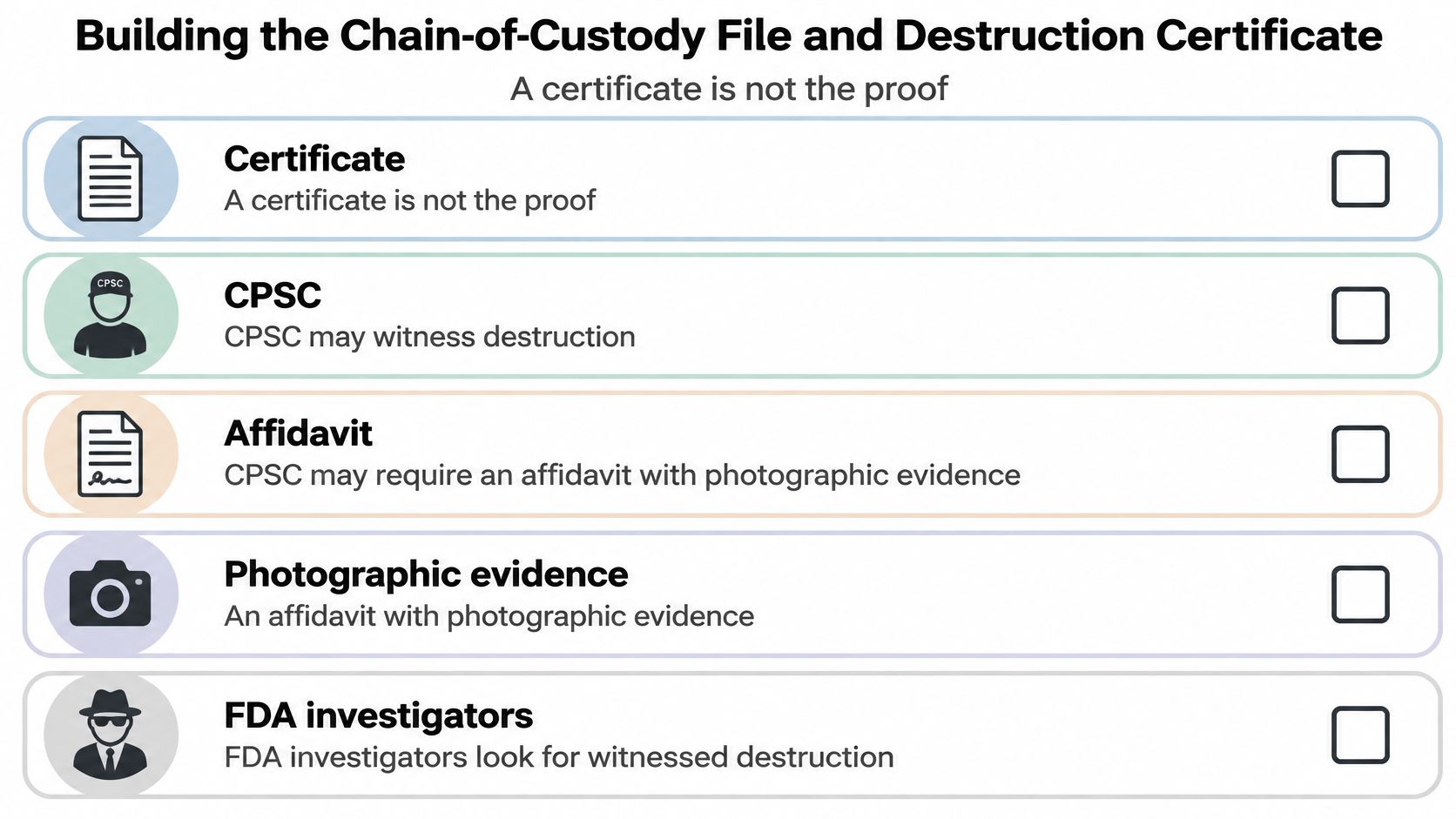
A certificate is not the proof. It's a summary of proof that must exist underneath it. CPSC may witness destruction or require an affidavit with photographic evidence, and FDA procedures call for investigators to witness destruction or reconditioning when possible, or obtain written documentation from the firm or from state or local authorities that witnessed or verified the disposition when direct observation isn't possible, as described in FDA recall closeout procedures for witnessed destruction and written verification. If your file is one signed page with nothing behind it, you're asking a reviewer to trust you. Reviewers don't close recalls on trust.
The Linked Records
Build the file as a chain, where each record references the one before it:
- Inventory reconciliation: Quantities received against quantities processed, by SKU, lot and serial. This is the document that proves completeness, and it's also where missing units surface. Define your escalation rule in advance, including who investigates a shortage, how long sites have to search, and who can sign off on an explained variance.
- Chain-of-custody form: Every transfer, with vehicle or container identifier, seal numbers, timestamps, facility controls and operator identity at each handoff. Strong chain-of-custody documentation for IT asset disposal uses the same transfer discipline, and recalled goods need it even more because re-entry into commerce is the failure mode.
- Destruction record: Method, date, quantities and facility, tied to the specific loads received. Where a method needs particular evidence, use the method-specific records set out in the destruction methods section above rather than inventing a generic form.
- Witness or verification packet: Photographs, video, weight tickets or a signed affidavit, matched to load identifiers so a reviewer can connect an image to a specific shipment.
- Certificate of destruction: The summary that names quantities, dates, methods, facility and the responsible individual who attests to completion.
Gaps That Fail Review
- Generic recycling receipt: A load-level receipt with no serial or lot reconciliation proves something was recycled. It doesn't prove your recalled units were.
- Unsigned handoffs: A custody form with blank receiver fields breaks the chain at exactly the point where diversion could occur.
- Certificate without underlying records: A vendor that issues certificates from a template, days before processing finishes, is producing marketing material, not evidence.
Retention deserves the same rigor. Keep the full file, not just the certificate, for as long as the recall file and any audit or litigation window require, and store it where compliance can retrieve it without asking operations to search email. Update the ERP so destroyed serials can't be received, resold or returned to vendor stock by mistake. That system step matters, because a serial that still looks active will eventually generate a transaction that contradicts your certificate.
A reviewer should be able to start at any serial number and walk it from shelf to destruction without asking your team a single question.
Test your file that way before you declare closure. Pick three serials at random, including one from a 3PL and one from a late consumer return, and trace them. If you can't, the physical work may be done, but the recall isn't.
Vetting a Disposal Vendor and Closing the Recall File
Your vendor either produces evidence or produces exposure. Vet for evidence. Use a structured vendor due diligence checklist for disposal partners and confirm each item in writing before the first pickup.
Vendor Checklist
- Signed destruction instructions: Written instructions the vendor signs, covering method, segregation and prohibited outcomes.
- Certificate template reviewed in advance: It must carry quantities by SKU, lot and serial, plus method, dates, facility and responsible individual.
- Insurance and audit access: Liability coverage for handling recalled goods, and real access to the processing facility and its records.
- Downstream transparency: A full list of subcontractors, with no undisclosed transfers.
- Recognized certifications: Certifications such as R2 or e-Stewards, each confirmed in the certifier's public directory rather than taken from a sales deck.
Contract clauses should include your right to monitor and witness destruction, a no-commingling clause covering all other returned goods, data-destruction warranties for data-bearing units, indemnity for improper handling, and a fixed deadline for delivering the signed certificate after destruction. CPSC requires recalling firms to monitor third-party destroyers, so a promise of access isn't enough. The contract must grant it, and you should exercise it at least once with an unannounced or witnessed load.
Close in three steps. Confirm the vendor against the checklist, schedule the first pickup with the quarantine count ready, and open the closeout file now so every record from the earlier stages lands in one place instead of being reconstructed at the end.
If your recalled electronics are sitting in quarantine while the evidence file stays empty, get a disposal partner that treats documentation as the deliverable, with commercial pickup, documented chain of custody, verified product destruction and certificates backed by reconciled records. Visit Beyond Surplus to schedule secure disposal of recalled retail products and close your recall file with proof, not promises.


