

A pallet of retired laptops is waiting beside the loading dock. A few UPS systems are mixed in with medical carts, handheld scanners, and equipment from a data center refresh. The pickup is scheduled for next month, but nobody has confirmed which batteries are installed, which are damaged, or how the shipment will be documented.
That gap creates the main challenge in lithium battery recycling. The chemistry matters, but so do identification, segregation, packaging, transport, chain of custody, and certificates. For a business, responsible handling starts before a recycler receives the equipment.
Table of Contents
- Why Lithium Battery Recycling Needs Its Own Playbook
- Understanding the Types of Lithium Batteries You Will See
- Safety and Environmental Risks You Cannot Ignore
- Regulations and Compliance Steps for Businesses
- How the Recycling Process Works from Collection to Recovery
- Safe Handling, Packaging, and Transport Best Practices
- Setting Up an Enterprise Lithium Battery Recycling Program
- Value Recovery and the Business Case for Certified Recycling
Why Lithium Battery Recycling Needs Its Own Playbook
Most enterprises already have an electronics recycling or IT asset disposition process. Circuit boards, laptops, monitors, and network equipment can usually be inventoried, palletized, and collected through an established workflow. Lithium batteries need a separate decision point because a damaged cell can store energy that releases rapidly when the cell is crushed, punctured, shorted, or exposed to heat.
A mixed load makes that risk harder to manage. A laptop with an intact internal battery isn't the same material as a loose battery pack, a swollen tablet, or a UPS unit with an attached battery system. Treating every item as ordinary e-waste can expose warehouse staff, transport workers, and downstream processors to avoidable hazards.
Practical rule: Never let a battery's small physical size determine the handling method. Its condition, format, chemistry, and installation status matter more than its weight.
A dedicated playbook should define who inspects incoming equipment, where battery-containing devices are staged, how damaged items are isolated, and which vendor receives each material type. It should also connect battery handling with data destruction, asset recovery, and product destruction. A laptop may contain recoverable hardware and sensitive data, while its battery requires controlled downstream processing. Learn how responsible electronics recycling supports data security and environmental responsibility.
The business case is practical. A documented process reduces fire exposure, supports defensible chain of custody, and helps facilities teams avoid last-minute decisions when a shipment includes mixed batteries.
Understanding the Types of Lithium Batteries You Will See
Start with the physical format. Think of battery formats as shipping containers. They hold similar basic materials, but their shape changes how workers identify, protect, and process them.
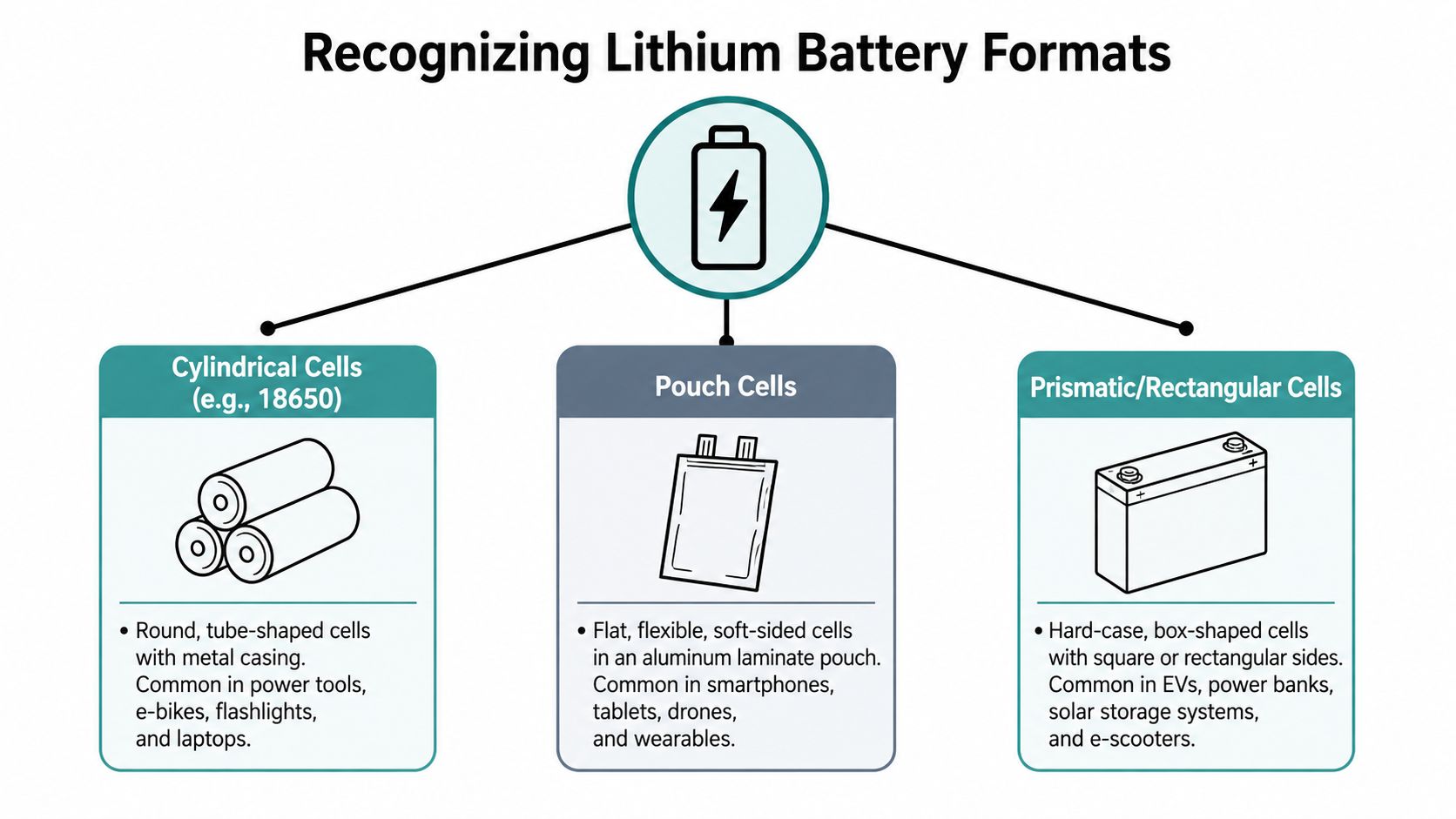
Three physical formats
Cylindrical cells look like small metal cans. Cells commonly identified as 18650s appear in battery modules for tools, laptops, and other equipment. Their uniform shape can simplify automated sorting, but exposed terminals and damaged casings still require protection.
Pouch cells use a flexible laminated package. They're common in slim electronics and some vehicle applications. A pouch can swell, crease, or tear, so staff should avoid pressing or stacking suspect units.
Prismatic cells use a rigid rectangular casing. They appear in larger modules, stationary storage, and vehicle battery assemblies. Their block-like shape can make them look solid, but internal damage isn't always visible.
Chemistry provides the second layer of identification:
- LCO, or lithium cobalt oxide: Often associated with compact consumer electronics, where energy density is important.
- NMC, or nickel manganese cobalt: Used across many mobility and energy applications, with a blend of performance characteristics.
- LFP, or lithium iron phosphate: Common in stationary storage and some mobility systems. It has a different material profile from nickel- and cobalt-containing chemistries.
- NCA, or nickel cobalt aluminum: Used in some high-energy applications, including electric vehicles.
Ask the equipment owner or manufacturer for a battery specification sheet before pickup. That document can identify chemistry, nominal energy, configuration, and handling requirements. It gives the recycler a cleaner basis for sorting and selecting a downstream process. Businesses can also review lithium battery recycling services for electronic equipment when batteries remain installed in eligible devices.
Safety and Environmental Risks You Cannot Ignore
Thermal runaway is best understood as a chain reaction inside a cell. Internal damage or an electrical short creates heat, rising heat accelerates chemical reactions, and those reactions release more heat. If the process isn't stopped, the cell can vent, ignite, or damage neighboring cells.
Workers don't need to diagnose the internal failure. They need to recognize visible warning signs and stop normal processing.
Signs that require isolation
Look for swelling, unusual heat, hissing, smoke, sharp odor, leakage, discoloration, or a damaged casing. A device that has been crushed, dropped, recalled, or exposed to water also deserves escalation, even when the battery looks intact.
A swollen laptop shouldn't go into a regular gaylord with other computers. A damaged UPS battery shouldn't be placed beside undamaged equipment while a team waits for a routine pickup. Create a controlled isolation area, restrict handling, and follow the instructions of a qualified battery logistics or emergency-response provider.
The environmental concern extends beyond fire. Battery materials and electrolyte residues can contaminate soil or water if a business sends them to an inappropriate disposal route. Proper recycling separates useful materials from contaminated fractions and directs them to facilities equipped for treatment.
Worker protection depends on consistent behavior, not informal experience. Train receiving, facilities, security, and shipping staff to identify battery-containing equipment. Give them a simple escalation path and prohibit untrained disassembly.
A battery program fails at the loading dock when employees can't distinguish an intact device from a damaged energy source.
The safest enterprise policy is conservative. If the condition, chemistry, or packaging requirement is uncertain, pause the shipment and request a technical determination rather than guessing.
Regulations and Compliance Steps for Businesses
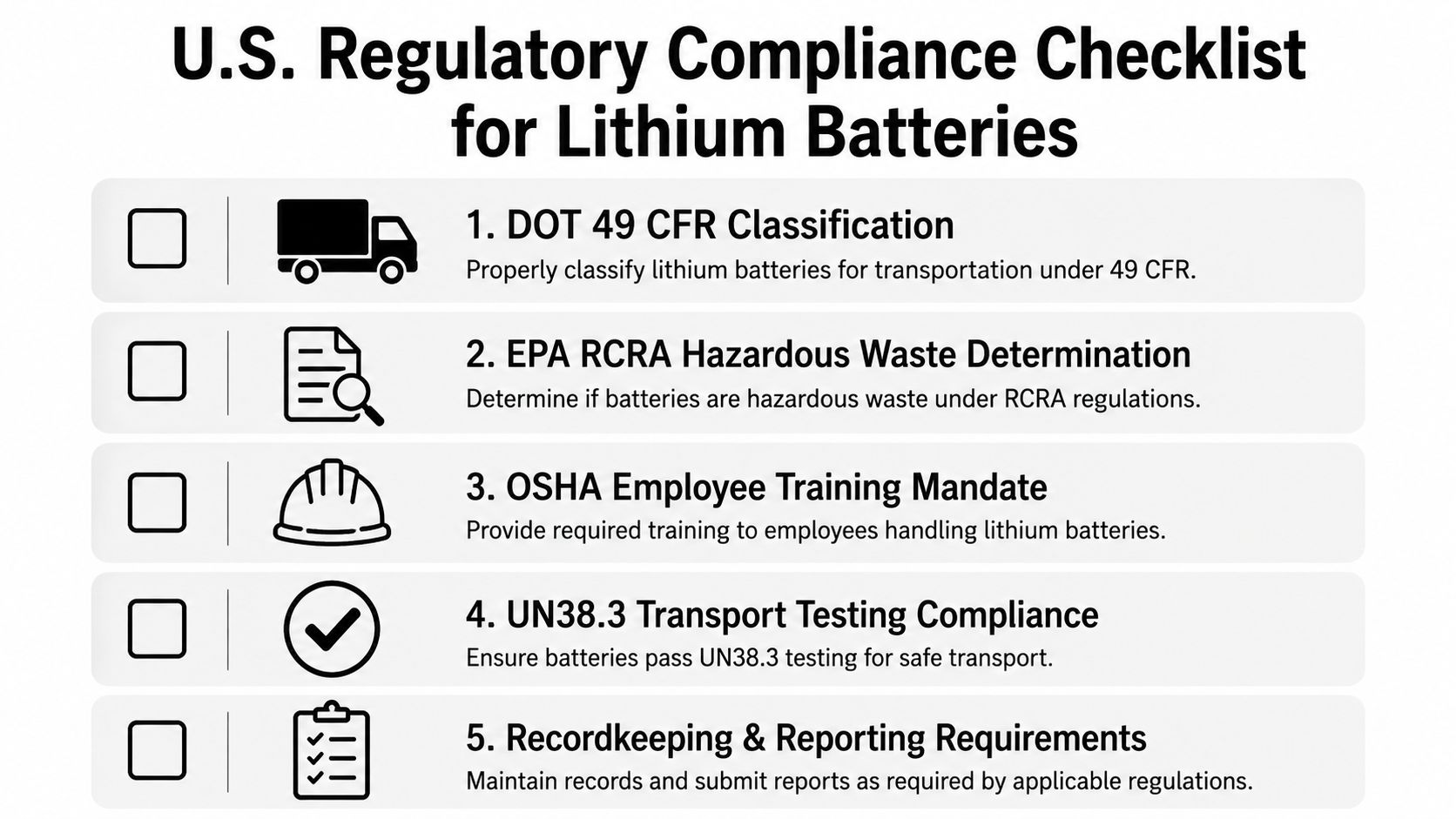
A battery may be recyclable and still require controlled handling. For a business, compliance connects three decisions: waste classification, employee safety, and transportation. DOT rules under 49 CFR govern applicable hazardous-material shipments. EPA RCRA requirements support hazardous-waste characterization, and state programs may add collection, labeling, reporting, and stewardship duties. Review EPA universal waste requirements for batteries before setting the facility's process.
The program needs a named owner for each decision. Facilities can manage staging, environmental teams can make waste determinations, procurement can vet vendors, and shipping staff can prepare transport documents. Put those responsibilities in one written SOP so a battery does not lose its compliance record between the storeroom and the carrier.
A practical compliance map
- Classify the material. Record whether the battery is installed in equipment, packed with equipment, or managed separately. Note its condition and known chemistry.
- Confirm the transport route. Ask the carrier and recycler which packaging, labels, training, and declarations apply to that shipment.
- Maintain chain-of-custody records. Keep manifests, pickup records, weights or item counts, photographs when appropriate, and receiving confirmations.
- Collect downstream certificates. Certificates of recycling and destruction document the material's destination and support audits, customer requirements, and disposal records.
- Align data and battery records. A laptop may require certified wiping or destruction before recycling. Battery records do not replace proof of data destruction.
The EU Battery Regulation 2023/1542 also affects companies selling into or supporting the EU market. It establishes recycled-content targets for batteries placed there, including 6% recycled lithium by 2031 and 12% by 2036, with cobalt and nickel targets that increase over time. The regulation's recycled-content requirements are summarized here.
The framework sets a lithium-ion battery recycling rate target of 65% from 2026 and 70% from 2031. Its stated lithium recycling requirement rises from 35% to 70% between 2026 and 2030. Review the collection and recycling milestones for businesses. U.S. teams serving global supply chains should confirm that their recycler can provide the material and audit data customers may request.
How the Recycling Process Works from Collection to Recovery
A recycler's process resembles a refinery. A refinery cannot produce a consistent output from unidentified, contaminated, or incompatible inputs. Battery recycling follows the same logic: the facility first creates a controlled feedstock, then selects the recovery route that fits its chemistry and condition.
From equipment to black mass
Collection and inspection establish what arrived. The operator records device type, battery condition, known chemistry, and whether data-bearing equipment requires separate ITAD treatment. These records connect the physical shipment to downstream documentation.
Pretreatment may include discharge, sorting, controlled shredding, sieving, and processing under an inert atmosphere or at low temperature. The goal is to produce black mass, a concentrated intermediate containing valuable battery materials. Cleaner pretreatment removes more foil, plastic, and electrolyte contamination, helping downstream leaching separate materials and supporting better recovery economics. This technical overview describes pretreatment and black-mass preparation.
| Process Family | How It Works | Best At Recovering | Commercial Maturity |
|---|---|---|---|
| Pyrometallurgy | Uses high-temperature smelting | Established metal streams, especially cobalt and nickel | Mature industrial route |
| Hydrometallurgy | Uses liquid reagents to leach and separate metals | Selective recovery of lithium, nickel, cobalt, copper, and manganese | Viable near-term route |
| Direct recycling | Preserves and regenerates cathode material | Cathode structure and active material | Developing commercial route |
| Mechanical pretreatment | Discharges, sorts, shreds, and sieves feedstock | Black mass and separated fractions | Essential front-end stage |
Hydrometallurgy remains a practical recovery route, with reported metal recovery of roughly 80% to 95% in recent research. Direct recycling can preserve over 95% of cathode structure and reduce energy use by 50% to 70% versus smelting. Mixed chemistries, inconsistent separation purity, operating costs, and market acceptance still restrict wider industrial adoption. Compare current recovery approaches and commercialization barriers.
Lithium recovery is less mature than cobalt and nickel recovery. In one LFP black-mass process, researchers reported 96.32% lithium leaching at 30 °C, using a 10 mL/g liquid-to-solid ratio, 0.5 mol/L formic acid, and 1.5% hydrogen peroxide over 2 hours. Review the reported LFP leaching conditions. These laboratory conditions provide a process benchmark, not a guaranteed result for every commercial shipment.
Before selecting a recycler, ask what happens after shredding, whether the facility processes black mass itself or sends it to a downstream partner, and which chemistries it accepts. See how recycled electronics move through downstream processing. This answer shows how collection records connect to actual material recovery.
Safe Handling, Packaging, and Transport Best Practices
The warehouse workflow should begin with identification and segregation, not with a box. Keep devices with intact installed batteries separate from loose batteries, damaged units, recalled products, and unknown materials. Don't remove batteries unless the SOP assigns that work to trained personnel with the right equipment.
A staging checklist
- Inspect condition: Look for swelling, heat, leakage, punctures, odor, or deformation.
- Separate categories: Keep damaged, recalled, loose, and intact installed batteries in clearly defined areas.
- Protect terminals: Tape exposed terminals with a non-conductive material to prevent contact and short circuits.
- Select approved packaging: Ask the carrier or recycler to confirm the appropriate UN-rated packaging and packing instructions.
- Prepare documents: Retain the battery specification sheet, Safety Data Sheet when available, shipment description, labels, and required shipper declarations.
- Vet the carrier: Confirm dangerous-goods training, acceptance criteria, emergency procedures, and delivery confirmation.
Standalone lithium-ion batteries are generally identified for transport as UN 3480, while batteries packed with or installed in equipment are associated with UN 3481. Air transport has tighter controls. A 2026 industry summary states that lithium-ion batteries shipped by air must be at 30% charge or less. Review practical battery shipping and stewardship considerations.
Use clear hazard communication at the staging area. A resource covering warning labels for fragile items UK can help teams think through visible handling labels, although lithium-battery transport marks and dangerous-goods labels must follow the applicable transport rules.
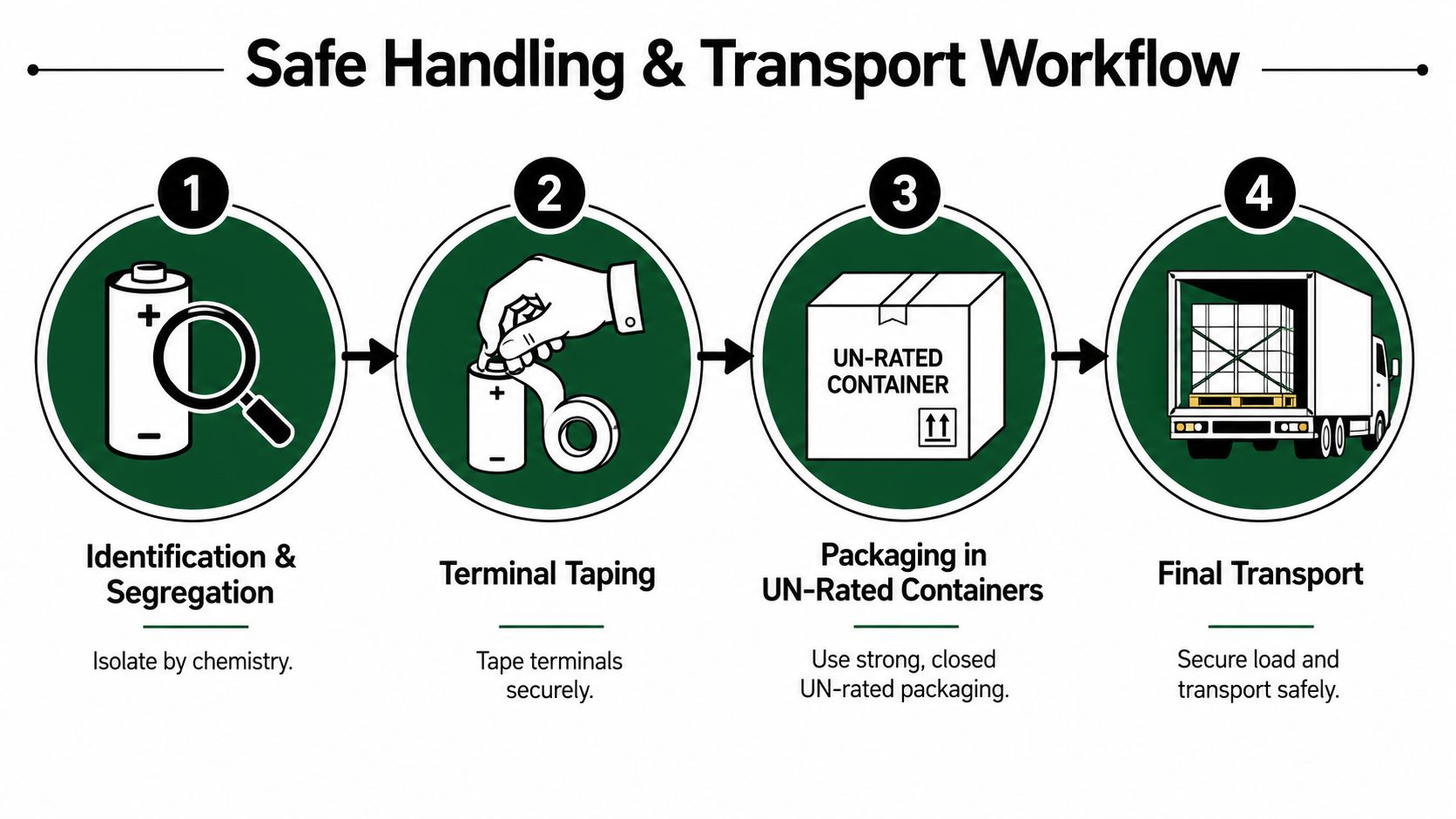
Don't place a swollen or leaking cell into ordinary packaging. Escalate it to the qualified recycler or dangerous-goods specialist, and document the decision. Use a consistent universal-waste labeling process so staff can identify the material before it reaches the dock.
Setting Up an Enterprise Lithium Battery Recycling Program
An effective program starts with an inventory, not a vendor quote. List each site, department, equipment category, battery format, known chemistry, approximate condition, and expected retirement schedule. Include laptops, UPS systems, medical carts, scanners, laboratory instruments, backup systems, and devices installed in remote cabinets.
Build the operating model
Write one SOP that covers intake, inspection, staging, escalation, pickup approval, data destruction, and certificate collection. A small office may need a labeled cabinet and scheduled service. A hospital, school system, financial institution, or government agency may need site-specific training, access controls, and documented approvals.
Choose service frequency based on operational risk and volume. Scheduled pickups can support predictable refresh cycles, while on-demand service may suit a facility handling an unexpected equipment replacement. Either way, define the maximum staging period internally and avoid accumulating damaged materials while waiting for a routine load.
Procurement should ask downstream questions before signing:
- Facility control: Does the vendor operate the processing facility or use documented downstream partners?
- Acceptance rules: Are loose batteries, damaged packs, and installed batteries handled differently?
- Documentation: Will the business receive certificates of recycling, destruction, and data destruction where applicable?
- Data controls: Can the vendor wipe or physically destroy storage media before equipment recycling?
- Value recovery: Are functional laptops, servers, or UPS units evaluated for IT buyback or residual resale?
Recycling and recovery aren't competing goals. A working server, laptop, or networking component may have resale value, while its battery and non-reusable fractions require controlled recycling. Separating those paths can reduce total program cost and prevent usable equipment from entering a destruction stream prematurely.
Connect the battery SOP to your ITAD ticketing system. Record asset identifiers, serial numbers, battery condition, pickup date, carrier, receiving facility, and certificate reference in the same audit trail. That structure helps compliance teams answer a simple question months later: who handled this asset, what happened to its data, and where did its battery go?
Value Recovery and the Business Case for Certified Recycling
A facilities team handling retired laptops, UPS units, and loose batteries faces two separate decisions. First, determine whether the equipment or battery still has usable value. Then document the recycling path for everything that cannot be reused. A certified program connects those decisions, recovering eligible equipment and battery materials while reducing exposure from unmanaged storage, transport, and disposal.
Functional equipment should receive an asset-recovery review before recycling. IT buyback may return value from eligible laptops, servers, networking equipment, and UPS systems. Data-bearing devices still need approved wiping or destruction, and devices containing batteries need a defined handling route in the SOP. A working laptop can follow a resale path while its damaged battery goes to controlled recycling.
Battery material value also depends on the quality of the information supplied at handoff. Accurate chemistry, condition, and format records help the recycler choose appropriate downstream processing. Mixed or contaminated feedstock requires more sorting and can reduce the usefulness of recovered fractions. The practical lesson is simple: improve inventory records, but do not attempt unsafe disassembly to make the load easier to process.
What certified documentation does
Certificates do not replace a compliant process. They make the completed process auditable by connecting each asset to its handling decisions, shipment, and final disposition. A complete file can include:
- Asset records: Serial numbers, equipment descriptions, and ownership details.
- Data records: Certificates of wiping or destruction for storage media.
- Battery records: Condition, category, packaging decision, and shipment information.
- Processing records: Certificates of recycling or destruction and downstream receipt.
- Exception records: Photos, incident notes, and escalation decisions for damaged material.
This evidence supports internal audits and customer reporting. It also gives teams a defensible basis for sustainability claims, rather than treating every outbound pallet as proof of environmental performance. The EU's recycled-content requirements make traceable recovery data more important for companies that sell products or services into regulated markets.
Environmental results can vary by chemistry, process, and operating conditions. A Stanford lifecycle analysis cited in recent research found that recycling may reduce greenhouse-gas emissions by 58% to 81%, water use by 72% to 88%, and energy use by 77% to 89% compared with mining virgin metals. These figures describe comparative lifecycle analysis, not a guaranteed result for every recycler or battery chemistry.
Procurement questions before approval
How can we verify downstream processing?
Request the processor's accepted-material list, facility details, certificates, insurance information, and downstream disclosures. Ask who receives black mass and whether the vendor can provide receiving confirmation. The goal is a chain of custody that extends beyond the first receiving dock.
What should we do with a swollen battery?
Stop routine packing. Isolate the item under the site emergency procedure and contact a qualified battery or dangerous-goods provider for instructions. Do not place it in a general electronics pallet.
Can a business use a mail-in option?
That depends on the provider's acceptance rules, packaging requirements, and volume. Loose lithium-ion batteries may be excluded, while batteries installed inside accepted electronic devices may follow a different route. Confirm the rules before shipping.
Do certificates cover data obligations?
A recycling certificate does not prove that a hard drive was wiped or destroyed. For equipment containing protected data, request separate data-destruction documentation and map it to the applicable FTC Disposal Rule, HIPAA, PCI, contractual, and organizational requirements.
Battery recycling infrastructure is expanding, but access remains concentrated. By 2023, estimated global lithium-ion battery recycling capacity reached 340 gigawatt-hours, with China accounting for roughly 80% of that total. A separate industry report listed established worldwide capacity at about 1.6 million tons per year, with planned facilities expected to push total capacity above 3 million tons annually. North America, including the U.S., was listed at 144,000 tons per year, while Asia exceeded 1.2 million tons per year. Review the global lithium-ion battery recycling market and capacity overview.
That concentration makes logistics and chain of custody business issues, not laboratory details. A recycler may have strong chemistry expertise, but the program still depends on safe collection, accurate sorting, and reliable downstream access. Contact Beyond Surplus to discuss certified lithium battery recycling for eligible electronics, secure IT asset disposition, data destruction, product destruction, and nationwide business pickup. Visit Beyond Surplus to plan a documented path for your organization's battery-containing equipment.


