In 2023, American Honda recalled approximately 391,800 lawnmower and pressure-washer engines because improperly manufactured camshafts could cause the starter rope to retract unexpectedly, according to the CPSC notice on gas-powered lawn mowers. Honda expanded that action in May 2024 to include about 200 additional replacement engines. By then the company had received 2,966 reports of camshaft failures since the prior recall, plus 2,197 reports tied to the September 2023 action, including 38 minor injuries.
A mower that still starts can still belong to that population. Recalled lawn equipment disposal services exist so a homeowner with one walk-behind unit, and a grounds lead with machines across several sites, can match the notice, hold the unit, and close the file with proof. Ordinary trash does not do that job.
Table of Contents
- Why a Recalled Mower Cannot Go in the Trash
- Find the Notice and Quarantine the Unit
- Pick the Right Outcome Before You Move It
- Prepare Fuel Oil and Lithium Packs Safely
- Choose a Service That Will Accept the Recalled Unit
- Build the Closing File and Release the Unit
Why a Recalled Mower Cannot Go in the Trash
A mower can start, cut, and still be subject to a recall. If its model and serial number match the notice, continued use or disposal in a dumpster can send a hazardous unit back into service or into the parts stream.
That applies to one mower in a garage as much as to equipment spread across several sites. The disposal record should connect the identified unit to its final outcome, like a receipt that follows a package from pickup to delivery.
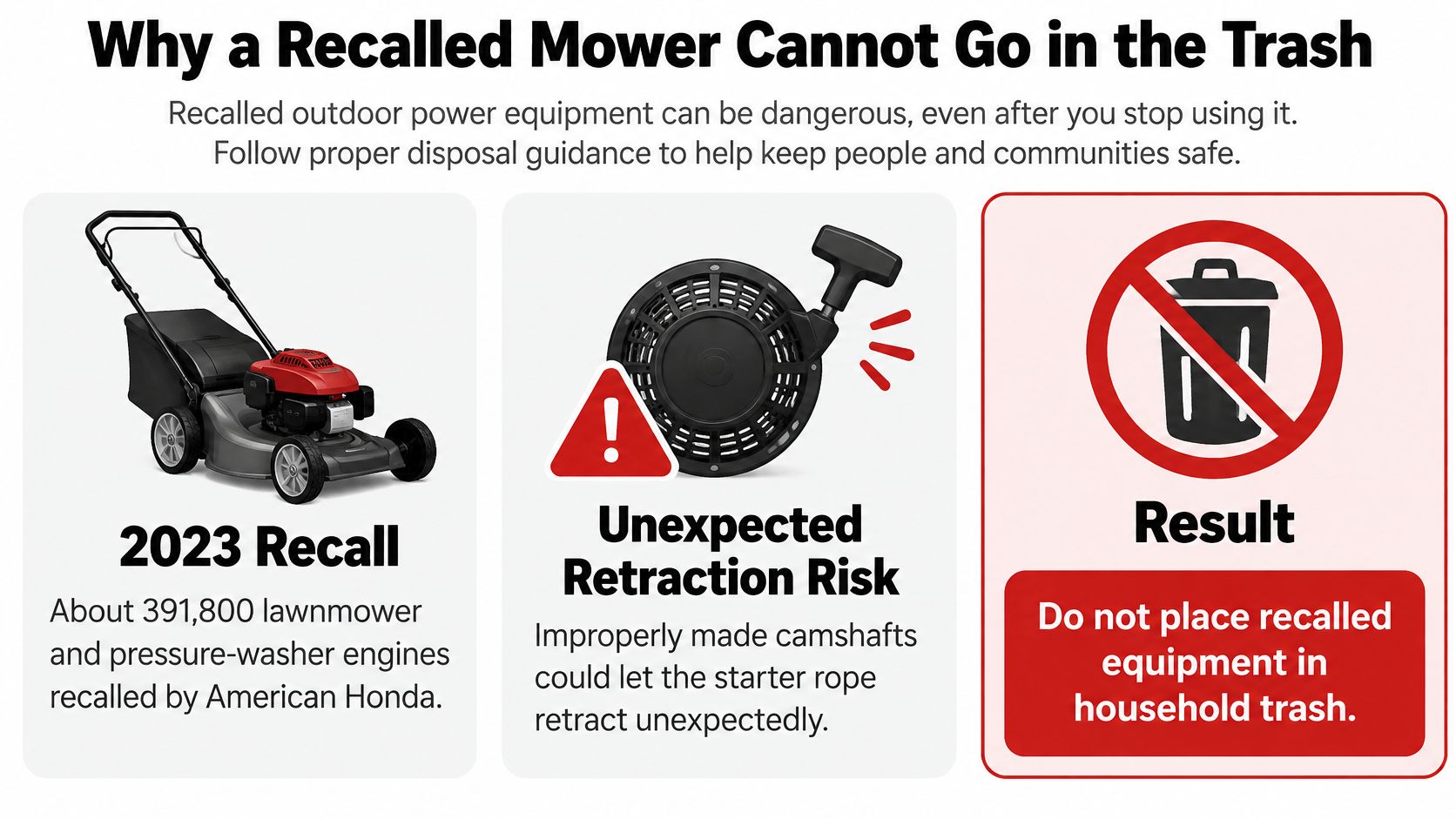
Working equipment is not cleared equipment. If the model and serial number fall within the notice, keep the unit out of use, resale, and ordinary trash until it follows an accepted recall outcome.
The sequence matters: match the notice, quarantine the unit, choose the outcome, get written acceptance from the service handling it, then file the proof that closes the recall. A recalled consumer product disposal service can handle the disposal step, but the notice determines which outcome is allowed. Booking scrap before confirming that path can put a defective unit back into the parts stream.
| Recall | Scale | Hazard | Disposal implication |
|---|---|---|---|
| American Honda engines, 2023 (expanded May 2024) | About 391,800 engines plus about 200 replacement engines | Camshaft defect; starter rope retracts unexpectedly | Quarantine, keep serial-level records, and follow an authorized return or controlled-disposal path |
| Black & Decker cordless mowers, 2002 (expanded 2006) | Multi-year recall of cordless mowers | Overheating electrical components; one fire spread beyond the mower | Treat battery and electrical controls as fire-risk items |
| Ariens walk-behind mowers, 2001 | Recall of walk-behind mowers | Blade or attaching part propelled from beneath the deck | Do not test-run; segregate the unit and document the blade and deck hazard |
| DR Power 62-volt, 5.0-Ah battery packs | Lithium packs under CPSC recall | Short-circuit and ignition risk | Follow the notice's destruction method; do not use trash, curbside collection, or retail battery boxes |
For a multi-site program, keep the chain of custody with the unit's serial record or photos, then file the final recycling or destruction certificate. Together, those records show that the identified mower stayed out of resale and reached its documented outcome.
Find the Notice and Quarantine the Unit
A recall notice is the control document for the unit: it identifies the affected model or serial range, names the hazard, and sets limits on handling. Start with the equipment plate, not a sales receipt or faded decal. Fire, blade movement, structural failure, and electrical defects each call for a different hold and handling plan.
The CPSC notice expanding the Black & Decker cordless mower recall describes overheating and fire risks, including a fire that spread beyond a mower. A test start is not a diagnostic. Ariens mower notices identify the risk of a blade or attaching component being propelled from beneath the machine. Do not pull a starter rope, engage a blade, or plug in a charger to see whether the fault repeats.
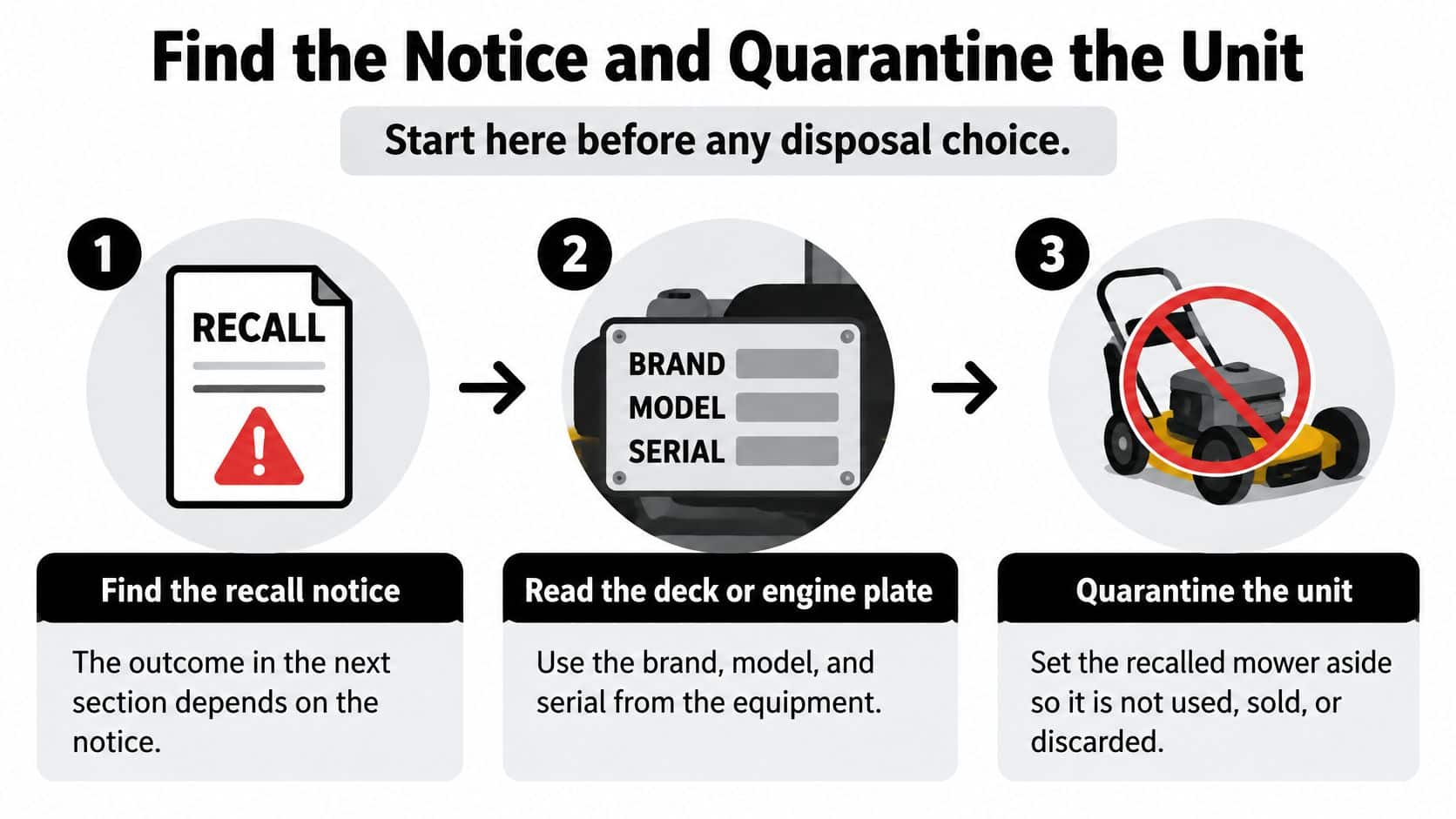
Seven actions before anyone moves the unit
- Read the plate, not the receipt. Copy the brand, model, and serial number from the deck or engine plate. A receipt confirms a purchase, not that the machine falls within the recall.
- Find the notice. Search the CPSC recall listings and the manufacturer's recall page by brand and model. Compare the serial range, manufacture dates, and hazard. A similar model number is not a match.
- Hold any unverified unit. If no notice matches, record the unit as unverified and keep it quarantined while the manufacturer or agency resolves the question. A search with no result is not clearance to release it as surplus.
- Stop use. Do not start the engine, engage the blade, or connect a charger. Testing can repeat the failure described in the notice.
- Tag and segregate it. Mark the unit recalled, put the notice number on the tag, and place it in a locked cage or marked bay away from sellable stock. For warehouse teams, a recalled product hold procedure helps keep the quarantine area separate from outbound freight.
- Block reuse in writing. Use a work order or short staff notice to prohibit lending, auctioning, or stripping the unit for parts. Written instructions remain visible across shift changes.
- Take only required photos. Photograph the equipment plate and whole unit when the notice or your records require it. Extra teardown photos may document a method the manufacturer did not authorize.
Keep the quarantine simple and visible. Electric models may contain batteries and wiring that need fire-risk controls. Gasoline equipment may still contain fuel or oil; drain it only if the notice and receiving site allow it. Render the unit unusable only when the manufacturer requires that step.
Pass check: The serial matches the notice, the unit is tagged, and nobody can start it. Control the key or battery path. If any check fails, keep the unit quarantined.
Pick the Right Outcome Before You Move It
The recall notice determines what happens to each unit. Record one outcome per serial number so a mixed load does not blur a return, repair, or disposal path. A returned engine and a battery pack may share a pallet, but each needs its own decision and record.
| Outcome | Use it when | Proof to keep | Where it goes |
|---|---|---|---|
| Manufacturer return or repair | The remedy is open and the notice names a dealer or prepaid return | Model, serial, and any form the maker requires; do not destroy the unit unless instructed | Authorized dealer or the maker's recall ship-back |
| Documented destruction for a refund | The notice requires photos or other proof that the part was destroyed | The destruction images and form specified in the notice, plus the serial | The method in the recall notice, not a generic shredder |
| Regulated recycling or HHW | The remedy has ended, or the maker says to dispose of the unit after removing the recalled part | Acceptance record, count or weight, and a recycling or destruction certificate | Recycler or HHW site that has accepted the recalled item in writing |
| Do not use trash or curbside | Any recalled mower, engine, or lithium pack, including a unit that still runs | None. This route does not close the recall | Household trash, curbside bins, and ordinary retail battery boxes |
Walk each row with a real case
Manufacturer return or repair. If a Honda engine is covered by an open repair program, send it through the authorized dealer or the maker's ship-back process. A scrap yard cannot provide the repair named in the notice. Cutting the engine could also end the remedy.
Documented destruction for a refund. In the DR Power recall, owners must stop using the battery and submit photographs showing destruction along with an online recall form. The CPSC notice on DR Power lithium-ion battery packs says disposal must follow local and state rules. Follow the notice's destruction method; cutting, dismantling, or puncturing a pack outside that method can create a fire hazard or leave you with proof the maker will not accept. Keep the recall identification, serial, any required photographs, facility acceptance, and final record.
Regulated recycling or household hazardous waste. Use this route after the remedy ends, or when the maker directs you to dispose of what remains after the recalled part is removed. Get written acceptance from the recycler or HHW site, then keep the count or weight and the recycling or destruction certificate. Some states require battery producers to operate approved stewardship programs. Check your state's rules before taking a damaged or defective battery to a drop-off site, and confirm that the site accepts it.
Trash or curbside. A recalled mower, engine, or lithium pack does not belong in household trash, curbside bins, or an ordinary retail battery box, even if it still runs. Those routes do not document the recall outcome.
Routine upkeep and recall handling serve different purposes. Pool & Landscaping of Vistancia mower tips can help a crew maintain machines that are not under a recall notice, but maintenance does not clear a serial number that matches one.
Take the notice name, serial number, and selected outcome into the service call. Ask the provider to confirm in writing that it accepts that specific recalled unit and outcome.
Prepare Fuel Oil and Lithium Packs Safely
Fuel residue and lithium packs create different hazards, so sort the load before anyone drains, tapes, or stacks equipment. Match each handling step to the recall notice and the receiving site's written acceptance rules.
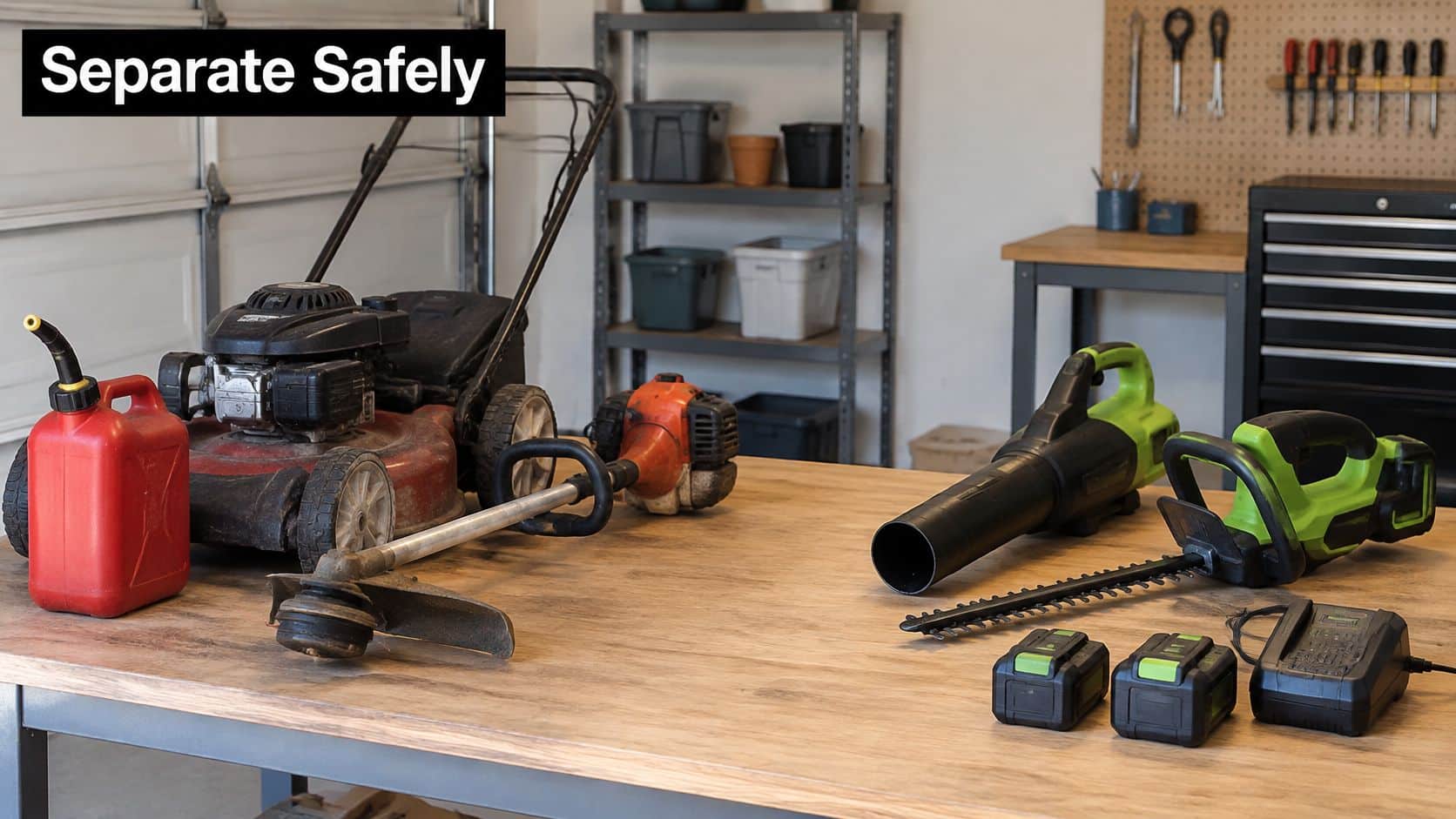
Gasoline machines
Keep liquid fuel and used oil out of household trash. Drain fuel only if both the recall notice and receiving site allow it. If permitted, use approved containers, work outdoors, and stay away from ignition sources. Keep used oil separate for re-refining or fuel processing. Send pesticides and other residues through the applicable household-hazardous-waste or regulated-waste channel.
Recycling a residue does not remove its hazards or the need to follow applicable rules. A winter storage routine, such as the winter mower advice from Barefoot Organics, applies to equipment you plan to run again. For a recalled unit, follow the notice and the receiving site's instructions instead.
Lithium packs
Recalled DR Power 62-volt, 5.0-Ah packs must stay out of trash, curbside recycling, and ordinary retail battery boxes. Before arranging a drop-off, ask the local household-hazardous-waste site whether it accepts that specific recalled battery. Photograph the label and the pack's condition. Remove a detachable pack only if the notice permits it. Do not press, bend, or probe the pack.
Check for swelling, heat, leakage, odor, or impact damage, and isolate any pack that shows these signs. Lithium-battery fires are a recognized hazard, so a wooden pallet is not a safe default for storage. Damaged packs need handling under the site's battery procedure and applicable local, state, and federal rules. Use a fire-resistant container, such as a metal drum with sand or another extinguishing medium, only when that procedure calls for it.
Three handling mistakes raise risk:
- Mixing packs. Keep recalled packs separate from intact batteries to avoid turning a routine storage area into a fire load.
- Taping a swollen pack. Terminal tape does not make an impact-damaged pack safe.
- Booking a generic recycler. Do not ship until the vendor has accepted recalled or damaged lithium in writing.
Household-hazardous-waste sites may refuse business packs. Organizations should use a licensed hazardous-waste or universal-waste handler that has accepted the item in writing. If a refund depends on documented destruction, retain the destruction photographs and the proof the manufacturer requires. A lithium battery recycling service is appropriate only after written acceptance, not as a substitute for a retail battery bin.
Choose a Service That Will Accept the Recalled Unit
Call before the unit moves. Acceptance rules differ by site, and a leaking tank or a recalled pack can be refused at the dock. The EPA page on recycling exclusions and hazardous waste warns that hazardous materials do not become nonhazardous merely because they are recycled, and generators remain responsible for determining the controls that apply. The benchmark is not a disposal "success rate." It is 100% traceability: photographs, recall identification, chain-of-custody timestamps, destination acceptance, weight or count, and a final recycling or destruction certificate.
Score the vendor before you book
| Check | Passing answer | Stop if you hear this |
|---|---|---|
| Recall status | They name the brand and accept it as recalled | We take all mowers as scrap |
| Fuel, oil, and batteries | They say what may arrive and what must be drained or packed first | Dump the gas in the trash and bring it in |
| Chain of custody | Timestamps, serials, and a count or weight | A bill of lading with no item list |
| Closing document | Recycling or destruction certificate that can name the recall | A generic payment receipt |
| Transport | Licensed path and containment for fuel or damaged cells | An unmarked van and a wooden pallet of packs |
Three channels cover almost every legitimate move.
Manufacturer recall logistics fit an open remedy with a dealer or a prepaid label. A single owner can usually use that label or a confirmed household-hazardous-waste appointment. You are not shopping for the cheapest tonnage rate. You are following the notice.
A licensed hazardous-waste or universal-waste recycler fits organizations once generator status is confirmed. The passing answer names the brand and the recalled status, states what may arrive, and promises a count or weight plus a certificate that can reference the recall. Businesses that need pickup plus a destruction record can use a handler such as Beyond Surplus for recalled product pickup and destruction, next to the maker's own logistics or another licensed handler that has accepted the item in writing.
A municipal household-hazardous-waste site is for household units only, and only after the site confirms it takes that recalled item. It is the wrong door for a business pack.
Two failures that reopen the recall
Booking the load as ordinary scrap before the recall check can return a dangerous product to service or contaminate a downstream shredder. Shipping wet fuel or batteries without written facility confirmation is the other failure. Local rules differ, so the receiving site should be contacted before the truck rolls.
For several sites, book one controlled pickup per site, or a routed pickup that keeps a serial list with each stop. Never consolidate packs onto a pallet. Ask the transporter what happens if a unit arrives leaking. A cash receipt with no serial numbers does not close anything.
Build the Closing File and Release the Unit
A recall stays open until the file shows where that serial went. Recycling weight on a scale ticket, with no serial attached, does not prove this mower left service. Auditors, insurers, and the manufacturer's refund desk all ask the same question: which unit, which outcome, which destination.
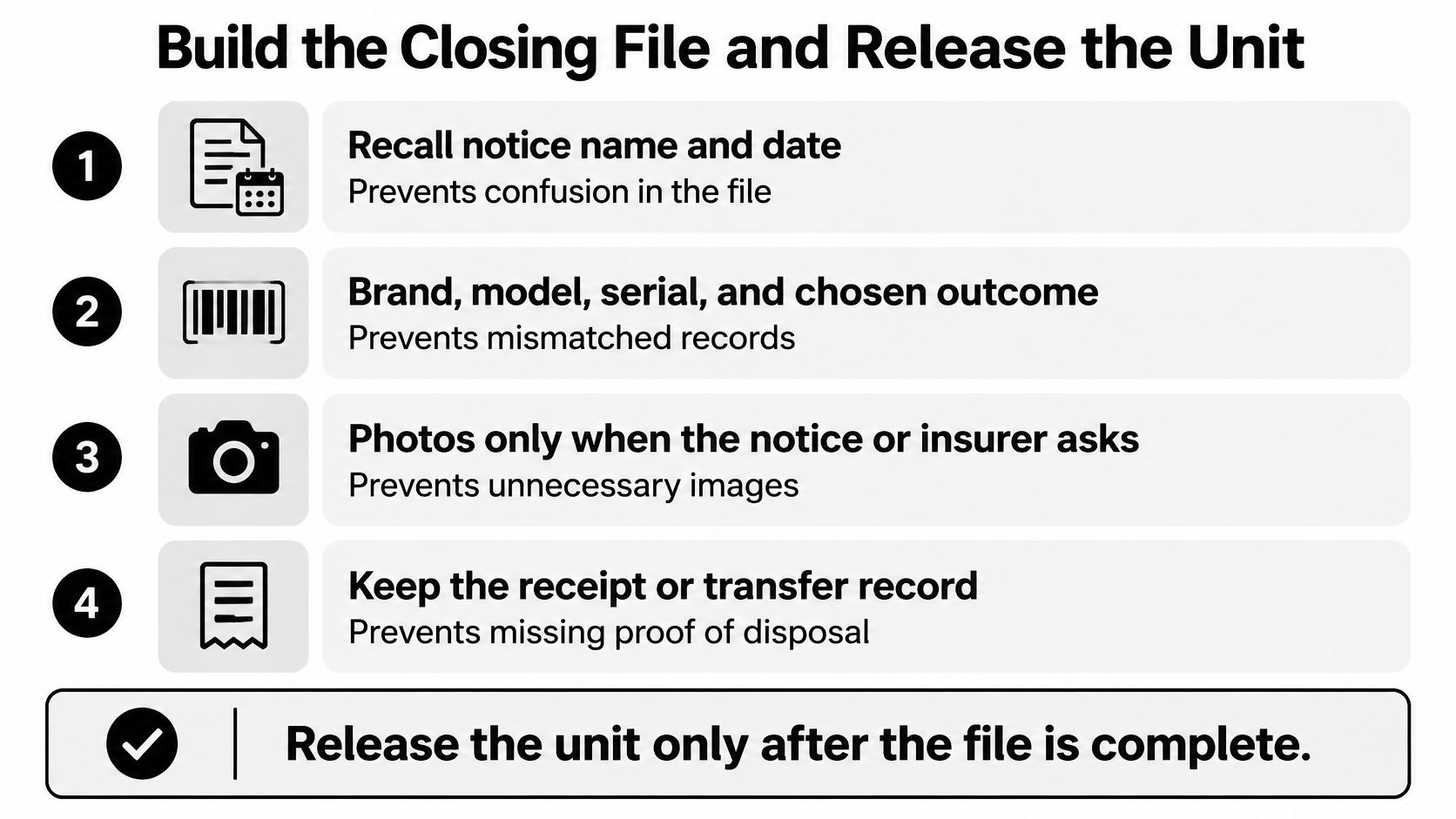
What belongs in the packet
Pair each item with the mistake it prevents.
- Recall notice name and date. Without it, a later reader cannot tell which action you followed.
- Brand, model, serial, and chosen outcome. A missing serial lets two similar mowers trade places in the file.
- Photos only when the notice or the insurer asks. Extra teardown images can document a method the maker did not allow, and that can sink a refund.
- Acceptance record. Date, time, count or weight, and the receiving site. A handshake at the dock is not a record.
- Recycling or destruction certificate. It must name the same serial. A certificate of destruction for recalls that only says "mixed electronics" does not close a named notice.
For a refund, match the file to the form fields before you submit. For multi-site teams, store one packet per serial. An auditor should see that the unit was identified, barred from resale, and received at the destination.
Three habits that keep the file usable
Write the serial on the tag before the plate becomes oily or is removed. Ask the certificate to reference the recall rather than generic mixed electronics. Never close the case on a scale ticket alone.
The four-part release test
Release the unit only when all four are true.
- The serial matches the notice.
- The outcome is return, prescribed destruction, or a site that accepted this item in writing.
- Fuel and batteries are packed as that site required.
- The file has a slot waiting for the certificate.
If any item fails, the unit stays in quarantine. A homeowner should schedule the maker's return or the confirmed household-hazardous-waste drop-off this week and save the confirmation with a serial photo. A grounds lead should run the same test at each site and keep recalled units off surplus sales and parts carts.
If you cannot show where that serial went, the recall is not closed.
Done means the unit has left the property or is in the maker's hands, and the certificate is filed to that serial. That is the whole path: notice, quarantine, a safe pack-out, one outcome, a service that said yes in writing, and a file that proves it.
Beyond Surplus picks up recalled products for organizations, destroys them under a documented process, and issues recycling or destruction certificates tied to the load. If your grounds fleet or warehouse still has a recalled mower, engine, or lithium pack in quarantine, line up the serial and the notice before you book the truck. Visit Beyond Surplus to schedule certified pickup and product destruction for business locations across the United States.