A recalled mower is still sitting on your Atlanta, GA loading dock, tagged with yesterday's crew notes and mixed onto a pallet headed for a routine electronics pickup. The recycler is booked. The serial list is incomplete. That unit is not ordinary scrap until the remedy is finished, the fluids and battery are classified, and the file can prove the unit never went back into service or resale.
Recalled outdoor power equipment disposal is a site-operations job, not a housekeeping errand. For a landscaping fleet, a rental yard, or a facilities team, the paper trail is part of the work. A routine e-waste truck fails when the remedy says return, the battery is swollen, or the counts on the certificate do not match what left the dock.
Table of Contents
- Which Disposal Path Fits Each Recalled Unit
- Quarantine, Verification and Audit Trail
- Battery Inspection, Classification and Safe Removal
- Recycling and Processing Options for Recalled Units
- Atlanta and Georgia Disposal Resources
- Transport Paperwork and Booking a Compliant Pickup
Which Disposal Path Fits Each Recalled Unit
A routine e-waste pickup can put a recalled unit on the wrong route. The remedy determines whether equipment goes back to the manufacturer, gets repaired or replaced, or must be destroyed. Confirm the route before booking the truck, and keep unlike units off the same pallet.
| Situation | First Action | Disposal Route | Proof to Keep |
|---|---|---|---|
| Recalled, repair, replacement or refund remedy offered | Hold for manufacturer return | Return under remedy process | Remedy correspondence and serial log |
| Recalled, manufacturer requires destruction | Obtain written approval and advance arrangements | Certified destruction | Destruction certificate with counts |
| Recalled battery-powered unit | Inspect battery condition before any move | Battery route set by condition | Facility acceptance and shipping records |
| Not recalled, end-of-life, no battery damage | Remove from service and log it | Standard certified recycling | Recycling certificate |
CPSC recall notices cover different products and remedies, so route each unit by its own notice rather than by equipment type alone. A rental inventory or grounds fleet may hold serial numbers that belong on several rows of the table. A unit awaiting return stays out of the destruction load; one slated for destruction does not go to resale. Battery-powered equipment needs its own route based on the battery's condition.
Keep serial records for mowers, blowers, and saws alongside other grounds assets. Teams tracking irrigation failures before costs escalate can apply the same unit-by-unit recordkeeping to recalled equipment, so the status and destination are clear before pickup.
Break mixed pallets apart before the truck arrives. Otherwise, a return unit could be shredded or a destruction unit diverted to resale. For equipment with no recall notice on file, check the model and serial against the manufacturer's information before moving it. Similar-looking housings do not establish that a unit is clear for disposal.
Quarantine, Verification and Audit Trail
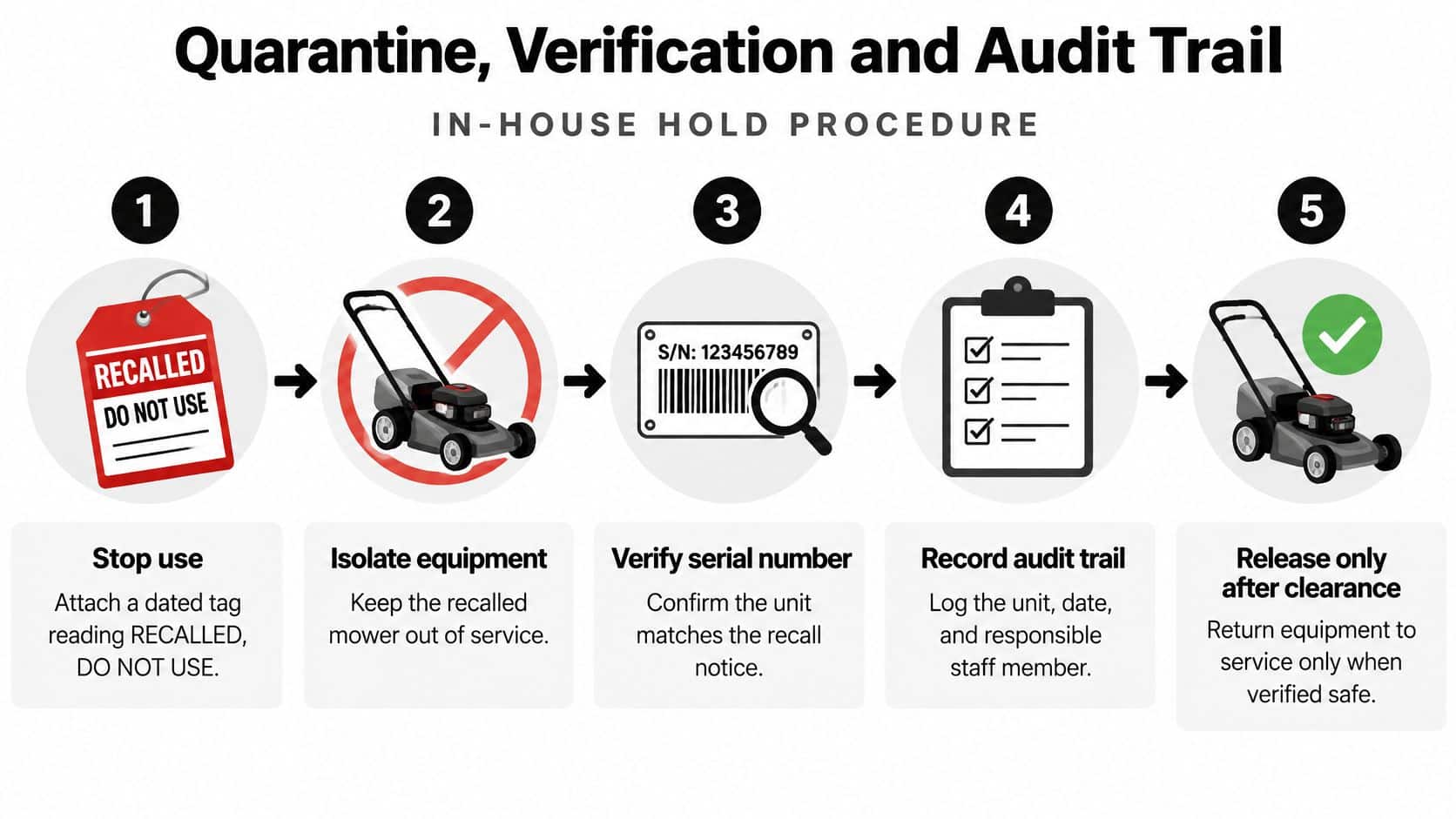
The crew is loading for the route when a recall notice arrives. Stop the affected unit before it goes back out, then create a record that follows it through the remedy.
- Stop use and tag it. Attach a dated tag that reads RECALLED, DO NOT USE. Remove the key and keep the unit out of service.
- Match model and serial. Check both against the CPSC listing and the manufacturer's notice. If the serial falls outside the listed range, keep the unit on hold until the manufacturer confirms its status in writing.
- Quarantine it. Move the unit to a marked area separate from returns, loaner stock, and scrap metal. The CPSC recall handbook recommends keeping recalled products segregated through the distribution chain, marking containers or pallets clearly, and preventing shipment to salvage.
- Log the hold. Record the serial, location, hold date, and name of the person who placed the unit on hold. Photograph the label.
- Get written instructions. Request the manufacturer's corrective-action instructions. Keep the unit out of resale and salvage while you wait.
- Follow the specified remedy. Return, repair, replacement, or destruction must follow the written instructions, not the scrap schedule. Destruction may require CPSC approval or advance arrangements for verification.
Build the six-record file
The hold needs a matching paper trail. The file should show how each recalled mower or battery was quarantined, identified by serial, handled under the remedy, and kept out of resale or redeployment. Check the applicable CPSC recall notice, because remedy requirements differ by product.
Some notices offer replacement components, refunds, or disposal instructions. One may require the battery to be marked recalled and lawful disposal confirmed before a refund; another may direct users to obtain a replacement battery and return the recalled unit on a prepaid label. Shredding or recycling before the required remedy can void it.
Keep these six records together:
- Inventory hold entry: Serial, location, hold date, and the person who tagged the unit.
- Photographs: Dated images of the label, model plate, and any visible damage.
- Serial and model capture: Transcribed from the plate, not a packing list that may refer to another lot.
- Recall-case correspondence: The notice, your request, and the manufacturer's written instructions.
- Transporter and facility records: Written scope, quantities shipped and received, and a prohibition on commingling.
- Signed certificate: Product description, quantity, date, and destruction or recycling method. Add a data-destruction certificate if a controller stored operational data.
Compare shipped counts with returned or destroyed counts before closing the file. Treat a missing serial as an open item: flag the gap and leave the case open until it is resolved.
Practical rule: Recall disposal is a safety action, a remedy process, and an audit trail. A routine e-waste pickup can fail when recalled units are mixed into a general load, leaving no reliable proof that each unit followed its required remedy.
For off-site work, the written scope should identify the recalled product, prohibit mixing it with other loads, and require a signed destruction certificate or affidavit. Keep the same records with insurance and environmental files. A product recall chain-of-custody record helps document whether each serial remained controlled through pickup and final disposition.
Battery Inspection, Classification and Safe Removal
A recalled mower may have an intact battery, a damaged pack, or a condition the crew cannot confirm. Classify the battery before removal because its condition determines how it must be handled and where it can go.
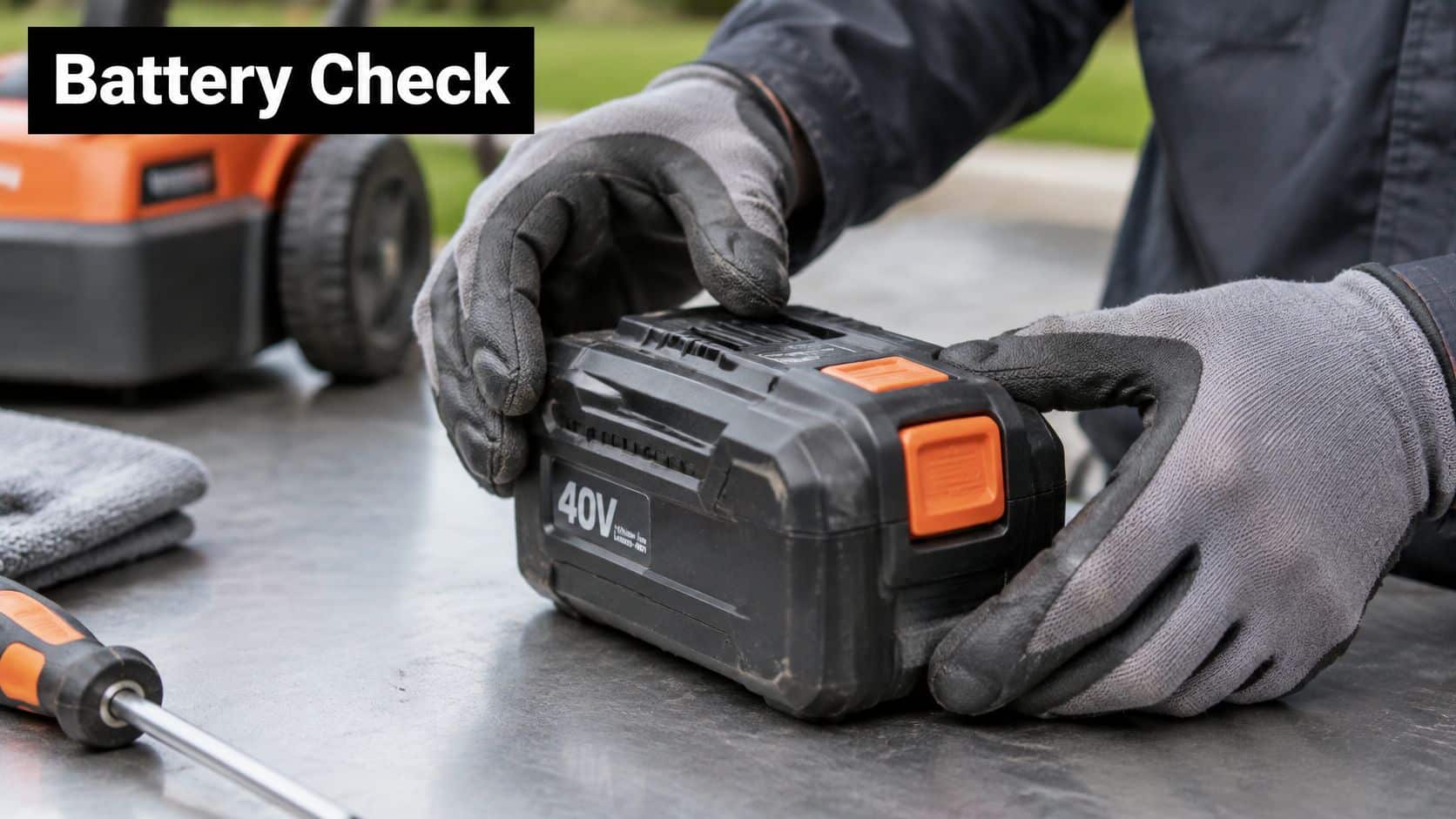
Check for punctures, crushed or swollen casing, leakage, heat marks, and other visible damage. EPA guidance says businesses should consider managing used lithium batteries as hazardous waste under the federal universal-waste rules in 40 CFR Part 273. Rechargeable lithium-ion and single-use lithium-primary batteries may qualify for that pathway. A breached cell does not; it must follow the hazardous-waste rules that apply to generators and transporters handling non-universal hazardous waste.
| Battery Condition | Regulatory Pathway | Handling Before Pickup | Accepting Facility |
|---|---|---|---|
| Intact cells, no swelling or leakage | Universal-waste management under 40 CFR Part 273 | Keep whole, label, store away from combustibles | Hazardous-waste recycler or permitted facility |
| Breached cell (puncture, crush or cell damage) | Hazardous-waste rules for generators and transporters | Isolate; do not repackage casually | Permitted hazardous-waste facility |
| Swollen or leaking | Treat as breached until a specialist confirms | Keep clear of the pack and get handling instructions before moving it | Facility confirmed to accept damaged lithium-ion batteries |
| Recall-marked, condition unknown | Hold for assessment before packaging | Keep isolated and labeled as recalled | Local household-hazardous-waste authority for instructions |
Removal order for the crew
Classify the pack before starting work. If it is hot, hissing, or leaking, step away from it, keep others clear, move nothing else near it, and call the fire department or the local household-hazardous-waste authority for instructions before touching it again.
- Work outdoors or in a ventilated bay, away from open flame, sparks, and hot equipment. Wear gloves and eye protection.
- Drain fuel into a labeled, approved container. Fuel left in a recalled tank can leak or break down while the unit sits.
- Drain engine oil into a sealed container for used-oil collection.
- Power down the unit and disconnect battery equipment before handling the pack.
- Do not charge, disassemble, puncture, crush, or casually carry a recalled lithium-ion battery. CPSC warns that recalled batteries must not go in household trash, curbside recycling, or standard retail battery-collection boxes because damaged or defective cells present a fire risk.
- Stage a stable pack on a non-combustible surface, clear of paper, rags, and fuel cans.
- Before delivery, call the local household-hazardous-waste authority. Confirm it accepts recalled or damaged lithium-ion batteries, then follow its packaging, labeling, and transport instructions.
- If the authority will not accept the pack, get written direction from the municipality or manufacturer. Do not improvise a drop box.
Keep intact and breached packs in separate, labeled areas, and record each battery's condition on the hold sheet. Manage covered material to prevent releases, follow a release-response procedure, and send it to a permitted or designated facility.
A removable pack does not belong in ordinary electronics recycling just because the mower frame appears undamaged. Its recall status and cell condition determine the route. Use a lithium battery recycling pathway that accepts the battery's documented condition, not a route that only matches last year's scrap agreement.
Recycling and Processing Options for Recalled Units
Processing starts only after the remedy is complete or destruction is approved in writing. Match each commodity to its own outlet. One certificate that says "recycled" without naming the method will not close a recall file.
Certified destruction is shredding or crushing under that written approval. Counts go out, counts come back, and the certificate names the method and the date. If the numbers do not match, the case stays open.
Metal recycling covers steel housings, decks, and blades once fluids are out. The downstream metals processor should document commodity and weight. A scale ticket with no product description is a weak record.
Engine handling is separate. An engine moves only after fuel and oil are drained, and only to a recycler that certifies that drained-fluid status. A wet engine on a metals load is a spill waiting for the highway.
Battery packs stay on the battery pathway. They do not enter the metal stream or the plastics stream, intact or breached.
Plastics and electronics include housings, wiring, and controllers. Those go to certified electronics recycling. A controller that stored route data, telematics, or access credentials gets secure destruction, not a resale bench. Ask what happens to recycled electronics by commodity, and keep each processor's certificate with the serial log.
Resale, donation, salvage, and export as used product are outside every route that is still open for a recalled unit. A buyer who wants "as-is outdoor power equipment" is asking you to undo the hold.
Atlanta and Georgia Disposal Resources
Atlanta sites answer four checks before a truck is booked. Write down who answered, and file that note with the shipping packet.
| Resource | What it confirms | When you contact it |
|---|---|---|
| Georgia Environmental Protection Division | State hazardous-waste generator requirements and your site's generator status | Before you classify fuel, oil, or batteries as waste |
| County household-hazardous-waste program for the loading address | Battery acceptance, packaging, and delivery rules | After inspection, before you move a pack |
| CPSC recall listing and the manufacturer's notice | Model and serial match | Before quarantine is released or a remedy is closed |
| Hauler and receiving facility | EPA identification numbers and transport authorizations | Before the pickup is booked |
Generator status comes first. The Georgia Environmental Protection Division sets the hazardous-waste generator requirements a business has to follow. Confirm the site's status before anyone labels a drum. A satellite shop and a main yard can sit in different categories.
The household-hazardous-waste program covers the loading address, not the mailing address on the invoice. A site near a county line can fall under a different program than the front office expects. Call that program, confirm it will take recalled or damaged lithium-ion batteries, and keep the answer.
Serial clearance still comes from the recall listing and the manufacturer, not from a local hauler. Release quarantine only after that match is in the file.
Haulers and receiving facilities should show EPA identification numbers and transport authorizations before you give them a dock time. A business card is not an authorization. Local environmental laws are the checkpoint for which rule applies at that address, and the confirmation belongs in the same folder as the bill of lading.
Transport Paperwork and Booking a Compliant Pickup
The paperwork should match the load before the truck arrives. Under EPA universal-waste rules, leaking or damaged batteries must go into closed, structurally sound containers compatible with the battery. Do not open, disassemble, or repackage a recalled pack unless the recall hold instructions and receiving facility allow it. Prevent releases, label the shipment, and have a release-response procedure in place. Confirm that the destination is permitted or otherwise authorized to receive the waste.
Run this list before booking:
- Confirm the receiver. Check the facility's authorization and acceptance requirements before reserving a slot.
- Identify the hauler. Get permits and carrier status in writing.
- Set the scope. List the recalled products and specify whether they must remain separate from other loads.
- Match the counts. Reconcile shipping paperwork with the units loaded, including serial numbers.
Send the model list, serial numbers, recall notices, and photos of battery damage with the booking request. The receiver and hauler need these details to confirm acceptance, packaging, and handling before dispatch.
Beyond Surplus is an Atlanta-based IT asset disposition and electronics recycling company serving Georgia businesses, with pickup coordination across the contiguous United States through its own fleet and transportation partners. It provides on- or off-site secure data destruction for units that hold data. For equipment requiring documented destruction rather than a mixed scrap load, review recalled product pickup and destruction.
A recalled unit is not cleared until the shipment record closes the chain of custody. Keep the completed paperwork with the recall and disposal records. For commercial pickup, certified electronics recycling, or documented destruction, contact Beyond Surplus.