In November 2019, Stanley Black & Decker recalled approximately 211,000 Stanley 16-ounce wooden-handle nailing hammers because the molded grip could detach and create an injury hazard. The CPSC tools-and-hardware recall listing records one reported incident and no injuries at the time, and it told people to stop using the hammers and return them to Walmart for a refund. At that count, a retailer, distributor, or contractor is running a controlled recall, not emptying a trash cart.
Recalled hand tool disposal services fail when the first call is to a scrap buyer. I would not treat recycling as step one. Environmentally preferable recycling is not the correct first step, because a green outlet can put a defective tool back on a job site. Controlled recall disposition blocks resale, donation, and parts salvage until the approved remedy allows destruction or recycling.
Table of Contents
- Match the Remedy Before You Call a Hauler
- Classify Every Tool and Isolate Batteries
- Choose the Route and Book After Authorization
- Build the Chain of Custody File
- Answer the Compliance and Cost Questions
Match the Remedy Before You Call a Hauler
The recall notice controls the remedy. Refunds, repairs, and replacements are more common outcomes than disposal, so do not treat a recall as permission to scrap the product. The CPSC recall listings identify recall notices; check the specific notice for the required action and return instructions.
Disposal is a controlled endpoint, not a default. Keep recalled tools out of resale, donation, and parts salvage until the recall owner authorizes the remedy. Match the product to the notice, segregate it from usable stock, and document each transfer through approved destruction or recycling. A hauler arriving before the remedy is confirmed can mix return-eligible units into scrap, making them difficult to recover.
Read the remedy row first
| Remedy | Holder action |
|---|---|
| Refund | Stop sale and use; follow the manufacturer or retailer return path |
| Repair | Quarantine the tools and send them only through the approved repair channel |
| Replacement | Hold the units and follow the replacement return instructions |
| Disposal | Arrange destruction or recycling only under an approved, documented plan |
A dock supervisor can establish control before the next shift.
- Log the scope. Record the manufacturer, model, serial or lot range, defect, quantity, ownership, and stated remedy on one shared log.
- Stop commerce. End use, sale, rental, and donation once the match is confirmed.
- Separate the units. Move them to a marked quarantine area, away from returns and salvage.
- Label each carton or pallet as recalled so it cannot be picked back into stock.
- Reconcile the count against purchasing or store records. Record discrepancies before any unit leaves the site.
- Follow the remedy. Keep refund, repair, and replacement units on the manufacturer's return path. Arrange destruction only when the notice specifies disposal or the recall owner authorizes it in writing.
Practical rule: Do not schedule a scrap pickup until the recall notice and written authorization agree on the disposition.
A complete log and controlled holding area prevent return-eligible tools from disappearing into a mixed load. If the quarantine area is full, use a warehouse recalled-product holding and disposal plan to keep units counted and segregated while the remedy is confirmed.
Classify Every Tool and Isolate Batteries
A steel wrench and a cordless drill need different disposition routes. Classify each tool before arranging transport: a unit may contain a battery, capacitor, mercury switch, or fuel residue, and the load must be handled for its most restrictive item.
EPA universal waste rules cover batteries, lamps, mercury-containing equipment, pesticides, and aerosol cans. They do not cover ordinary steel hand tools. Once recall controls are in place, non-powered tools may follow commercial-metal or approved product-destruction rules. Battery-powered tools need a separate battery route. Universal-waste handlers must address labeling, storage, employee training, release response, and tracking. The general on-site storage limit is one year.
Sort the form, then the pack
| Tool form | Regulatory cue | Handling before transport | Do not |
|---|---|---|---|
| Non-powered steel or wood tool | Not EPA universal waste | Use approved destruction or commercial metal only after the recall owner allows it | Donate, resell, or mix into ordinary scrap early |
| Corded electric tool | May contain capacitors or switches | Inspect and keep electronics separate from clean steel | Assume the whole unit is inert scrap |
| Cordless tool with lithium-ion pack | Battery pathway is separate from the body | Remove the pack only if safe; package body, pack, and charger apart | Put it in trash, curbside recycling, or a standard battery box |
| Swollen, hot, leaking, or punctured pack | Elevated fire risk | Use a compatible container, isolate terminals, and assign trained hazmat staff | Charge, test, or ship as a normal return |
| Fuel, solvent, mercury, or aerosol component | Universal-waste rules apply only to covered batteries, lamps, mercury devices, pesticides, or aerosols | Label, train, track, and respect the one-year storage limit where applicable | Store unlabeled for convenience |
Inspect corded drills for capacitors and switches before routing them as metal. Treat a cordless driver as separate body, pack, and charger streams. Remove a pack only when it is intact and cool, and its terminals can be covered without force. If it is stuck, swollen, or hot, leave it in the tool and isolate the whole unit.
Packs that fail a look and a touch
Some recalled cordless-tool notices identify the battery, charger, and charging method as possible defect sources. Treat the charger and any inserted pack as potential defect sources too. Do not charge or function-check recalled equipment, and keep the body and pack out of a shared scrap container. Follow the recall owner's approved remedy before destruction or recycling; environmentally preferable recycling is not the first step if it would allow resale, donation, or parts salvage.
Give swollen, leaking, punctured, or hot packs their own row on the inventory. Stage them in a compatible container, keep terminals away from conductive metal, and separate incompatible streams. Use trained hazardous-materials staff and a carrier-approved pack-out. Recalled lithium-ion batteries do not belong in trash, curbside recycling, or an ordinary battery box.
A certificate that says only “recycled” and does not count the packs does not show that the fire risk was controlled.
Record the battery count and condition on the manifest before pickup. Bodies, packs, chargers, and accessories may require separate packaging and downstream processing. For business lots of damaged packs, use a lithium battery recycling service for commercial quantities rather than a drop box by the time clock.
Choose the Route and Book After Authorization
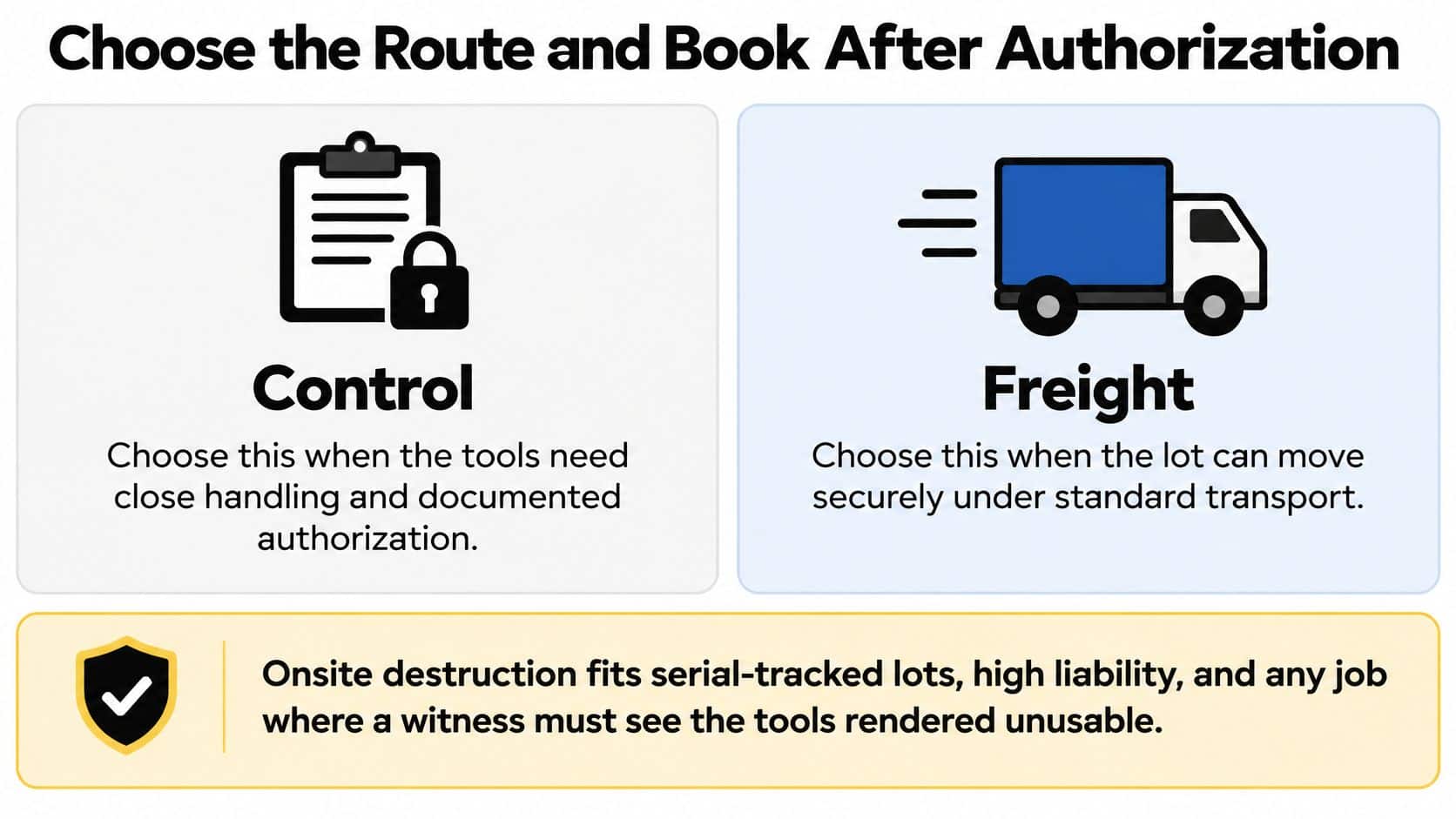
The choice is control versus freight, not which vendor has the greener logo. Onsite destruction fits serial-tracked lots, high liability, and any job where a witness must see the tools rendered unusable before they leave the building. You pay in mobilization and dock downtime. Offsite destruction fits stable, non-battery tools on consolidated pallets when written instructions ban commingling, parts harvesting, and salvage, and the facility will name method, date, and signatory.
The route diagram below is the decision, not a branding chart.
Match the lot to the building
CPSC recall handbook guidance says recalled products must be quarantined, physically marked as recalled, kept separate from normal inventory, and stopped from reentering commerce. Third-party destruction has to be monitored and documented. An employer, retailer, school, or contractor cannot assume a recycler, a donation pallet, or ordinary scrap is allowed. Permission sits in the manufacturer's approved corrective-action plan and, in some cases, in CPSC approval or verification of destruction.
Salvage recreates the hazard if a defective driver reaches another buyer. Sell controlled recall disposition, not generic metal recycling. Donation, resale, parts harvesting, and mixed scrap stay off the table until the recall owner authorizes them.
| Factor | Onsite destruction | Offsite destruction |
|---|---|---|
| Best fit | Serial-tracked or high-liability lots | Stable tools already cleared for off-site processing |
| Re-commerce control | Witnessed on your floor | Contract ban on commingling, salvage, and resale |
| Batteries | Isolate and stage before the crew arrives | Carrier-approved packaging and a separate battery count |
| Evidence | Photos, counts, and a signatory at your dock | Manifest plus facility, date, method, and certificate |
| Main cost driver | Mobilization and downtime | Freight plus per-pallet or per-pound processing |
| Failure mode | Crew treats the lot as ordinary scrap | Units disappear into mixed metal without a reconciliation |
Onsite fails when the work order never says the cage is recalled and must be made unusable in front of your witness. Offsite fails when pieces are not reconciled and the metal just joins a mixed pile. I would pay for the witness when serials carry the liability, and I would pay for freight only after the salvage ban is already signed.
Book only after the owner says go
Don't ship until the corrective-action owner confirms return, destruction, or recycling, and until batteries are split from tool bodies. If the notice still offers a refund or replacement, use that channel. A destruction quote is the wrong document.
Build the booking packet in dispatch order.
- Recall number, model, and lot.
- Piece count, not a guessed pallet weight.
- Battery count and condition, including how many packs are damaged.
- Onsite or offsite preference, plus dock hours and who will witness.
- A written ban on salvage and resale, plus the certificate fields the custody file will demand.
Ask the vendor for an independent audit or recognized trade certification, references, insurance, and a sample certificate that lists battery counts apart from tool bodies. Where the recall owner has already authorized destruction and the lot includes batteries or stored data, Beyond Surplus can scope certified electronics recycling and product destruction through product recall reverse logistics.
Build the Chain of Custody File
A generic recycler receipt is not the benchmark. CPSC disposition guidance says destruction may require agency approval, witnessing, or written verification. A scale ticket proves pounds. It does not prove those drivers or saws were the recalled ones, or that nobody can still use them.
The file is a sequence, not a folder of random photos.
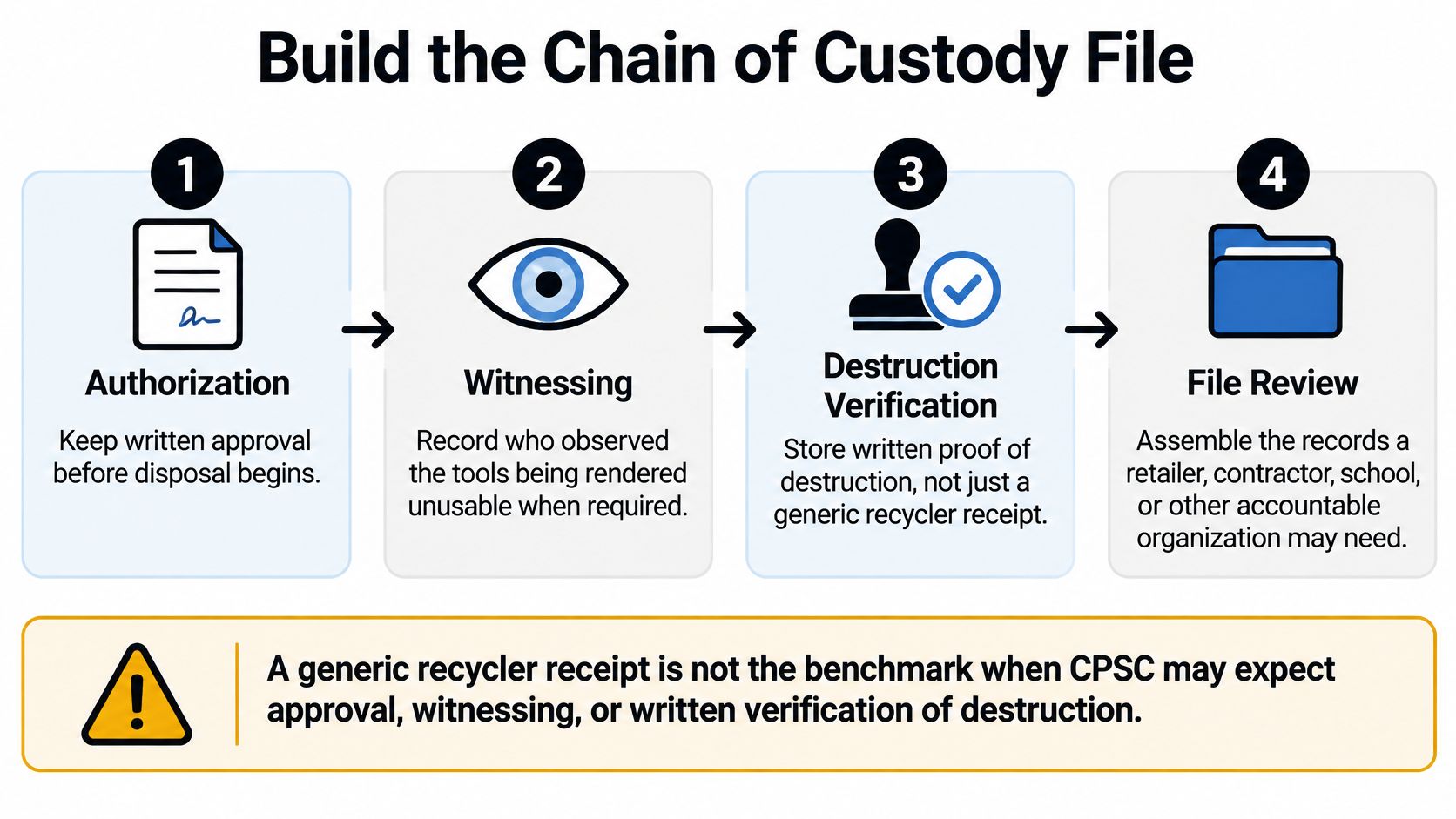
Seven records an auditor can follow
Quarantine is already done if you followed the remedy row. The file is what you can hand a manufacturer, a regulator, or your own counsel.
- Written scope. Manufacturer, model, serial or lot range, defect, quantity, owner, and the approved remedy.
- Written disposition plan. Say whether units will be returned, reworked, dismantled for component recovery, or destroyed, and name who monitors any third party. CPSC expects tracking of defective material and oversight of a destruction vendor.
- Photos of labels and serials taken before the goods move. Stretch-wrap hides the only proof you had.
- A unit-level or pallet-level manifest. Pallet count alone hides a missing carton.
- A custody log for every handoff, including carrier and facility.
- A reconciliation of collected quantity against destroyed or returned quantity.
- A closing certificate or affidavit naming the product, quantity, date, method, facility, and a responsible signatory.
For off-site work, the instructions should prohibit commingling and salvage in writing. The evidence package should identify the product, quantity, destruction date, method, facility, and signatory. If a cordless tool or a dock scanner holds stored business records, the same file should say the media was sanitized, not merely that the housing went to metal recovery.
Shortcuts that feel responsible and aren't
- Mixed scrap, donation, and parts harvest: Don't use them before the manufacturer authorizes that stream. The shortcut looks tidy and recreates the hazard.
- Serial photos: Shoot them before wrap, tape, or a gaylord lid covers the label.
- Piece reconciliation: Count tools, not only pallets. One missing carton is an unprovable claim.
- Battery lines on the certificate: Don't accept a line that only says recycled. State how many packs were damaged and that they did not ride with ordinary scrap.
- A missing prepaid return label: Don't invent a mail-back. Record battery count and condition, then ask the recall owner which stream is still open.
If a buyer could still use the tool, the disposition is not finished.
What you hand an auditor is one packet that ties the recall number to the last pound processed. A certificate that names method, facility, date, and signatory is the closeout, and certificate of destruction for recalls is the record shape to demand before the truck leaves.
Answer the Compliance and Cost Questions
Procurement will ask five questions. Answer them from the notice and the file, not from a hauler's brochure.
Can we donate, resell, or scrap them?
Not until the manufacturer's approved corrective-action plan, or CPSC verification of destruction, allows that outlet. A school shop, a contractor yard, and a retail back room are under the same stop. Ordinary scrap, a donation bin, and a parts cart are commerce if someone can still use the tool.
Do people handling damaged packs need training?
Yes. Staff who isolate, stage, or load damaged packs need hazard training and written handling steps before they touch a swollen pack. A verbal "be careful" at the dock door is not a procedure. Name who may stage packs, what container they use, and who calls the carrier.
Does the FTC Disposal Rule apply to a tool lot?
Only when your business uses consumer reports for a business purpose. The FTC Disposal Rule guidance also covers organizations that maintain consumer-report information as service providers. Disposal practices must be reasonable and appropriate to prevent unauthorized access or use. For electronic records, destroy or erase files or media so the information cannot be read or reconstructed. The same guidance recommends due diligence on a destruction provider: independent audits, references, information-security policies, and recognized trade-association certification. Use that checklist when a recalled scanner or connected tool may hold business records, not only when you are retiring laptops.
How should stored data be sanitized?
NIST SP 800-88 Revision 2 defines media sanitization as a process that makes access to target data infeasible for a specified level of effort. It organizes the work into three methods.
- Clear uses logical techniques against ordinary, noninvasive recovery.
- Purge uses physical or logical techniques so recovery stays infeasible even with laboratory methods, and the medium might still be reused.
- Destroy makes recovery infeasible and the medium cannot be reused for storage.
The September 2025 NIST revision notes shift the emphasis from one-off wiping to an enterprise program, aligned with controls such as SP 800-53 and ISO/IEC 27040. Technique detail points to IEEE 2883, NSA specifications, or a standard your organization has approved, including cryptographic erase and key sanitization. Pick clear, purge, or destroy from data sensitivity, write the method into the custody file, and keep evidence it matched your internal standard. A metal-recycling line on the certificate does not replace that sentence.
What actually drives the invoice?
Three lines, and you should see each of them.
- Onsite work: mobilization and the downtime while a witness watches the tools made unusable.
- Offsite work: freight, then per-pallet or per-pound processing.
- Damaged packs: carrier-approved packaging, listed apart from the tool bodies.
Ask for a scoped quote that prints those lines instead of one blended rate. A single number hides whether you paid for destruction or for a mixed load. For lots that already have owner authorization and have to move across sites, nationwide recalled product destruction is the commercial lane to price against your own packet, with piece counts and battery counts attached.
Beyond Surplus picks up business lots in the contiguous United States and documents product destruction when a recall owner has authorized that endpoint for tools that also carry batteries or stored data. If the quarantine is staged, the remedy row is confirmed, and you need chain-of-custody records rather than a mixed-metal ticket, visit Beyond Surplus to schedule a commercial pickup. Contact Beyond Surplus for certified electronics recycling and secure IT asset disposal.