Only 1.1% of recalls recorded over a five-year period listed disposal as the remedy, according to CPSC recall data. That's the number facility managers should consider before booking a truck. A recalled appliance isn't automatically scrap, and destroying it too early can interfere with the manufacturer's remedy.
For businesses, recalled appliance disposal services should manage an authorized disposition, not just remove equipment. The job requires an identified unit, an approved destination, controlled transport, appropriate hazard handling, and records showing what happened after pickup.
Table of Contents
- Check the Recall Remedy Before Anything Leaves Your Site
- How to Dispose of a Recalled Appliance Step by Step
- Sanitizing Data on Smart and Connected Appliances
- Refrigerant, Battery and Hazardous Part Handling
- Vetting a Certified Recycler and Planning Pickup
- Frequently Asked Questions About Recalled Appliance Disposal
- Can a certified processor send a recalled unit through ordinary scrap?
- Can we donate it, sell parts, or move it back into warehouse inventory?
- Who pays for disposal when the remedy is a refund?
- What if a hazardous-waste facility refuses a recalled battery?
- Is a certificate necessary if the notice gives no disposal instruction?
- Keep Proof of Destruction and Book Your Pickup
Check the Recall Remedy Before Anything Leaves Your Site
Read the remedy before issuing the removal order. A refund, repair, replacement, and destruction instruction create different obligations. Your procurement team shouldn't approve disposal just because a maintenance ticket says the appliance is recalled.
The same five-year CPSC record assigns 54.6% of recalls to refunds, 26.3% to repairs, and 16.9% to replacements. Disposal or destruction accounted for 23 cases. These are shares of recalls, not shares of appliances or a forecast of what your organization will encounter.
Recall remedies and what each means for disposal
| Recall remedy | Share of recalls | What it means for disposal |
|---|---|---|
| Refund | 54.6% | No disposal step required by the remedy; confirm whether the manufacturer wants the unit returned |
| Repair | 26.3% | Unit may return to service after repair; don't dispose unless the notice says so |
| Replacement | 16.9% | Old unit is usually returned or destroyed per manufacturer instructions; keep the replacement record |
| Disposal or destruction | 1.1% (23 cases) | Destruction certificate and documented chain of custody are typically required |
Treat those percentages as context, not permission. The notice for your exact model determines the next action.
Before releasing equipment, have the recall coordinator answer these questions:
- What is the authorized remedy? Save the notice and any subsequent manufacturer correspondence.
- Is proof of destruction required? Identify the required photographs, certificate wording, or claim submission process.
- Is a refund or replacement still available? Confirm eligibility before altering the appliance or surrendering its identification label.
- Who accepts the item afterward? Obtain acceptance for the specific recalled product, not merely the general equipment category.
For schools, healthcare facilities, and commercial property portfolios, confirm eligibility unit by unit. Appliances that look identical may have different serial ranges, purchase histories, or remedy requirements.
Release rule: Authorize destruction only when the applicable remedy permits it. Otherwise, keep the unit isolated while the manufacturer's process remains unresolved.
Assign a named employee to approve disposition. A hauler's willingness to collect the item isn't manufacturer authorization, and a replacement purchase order doesn't establish what should happen to the recalled asset.
How to Dispose of a Recalled Appliance Step by Step
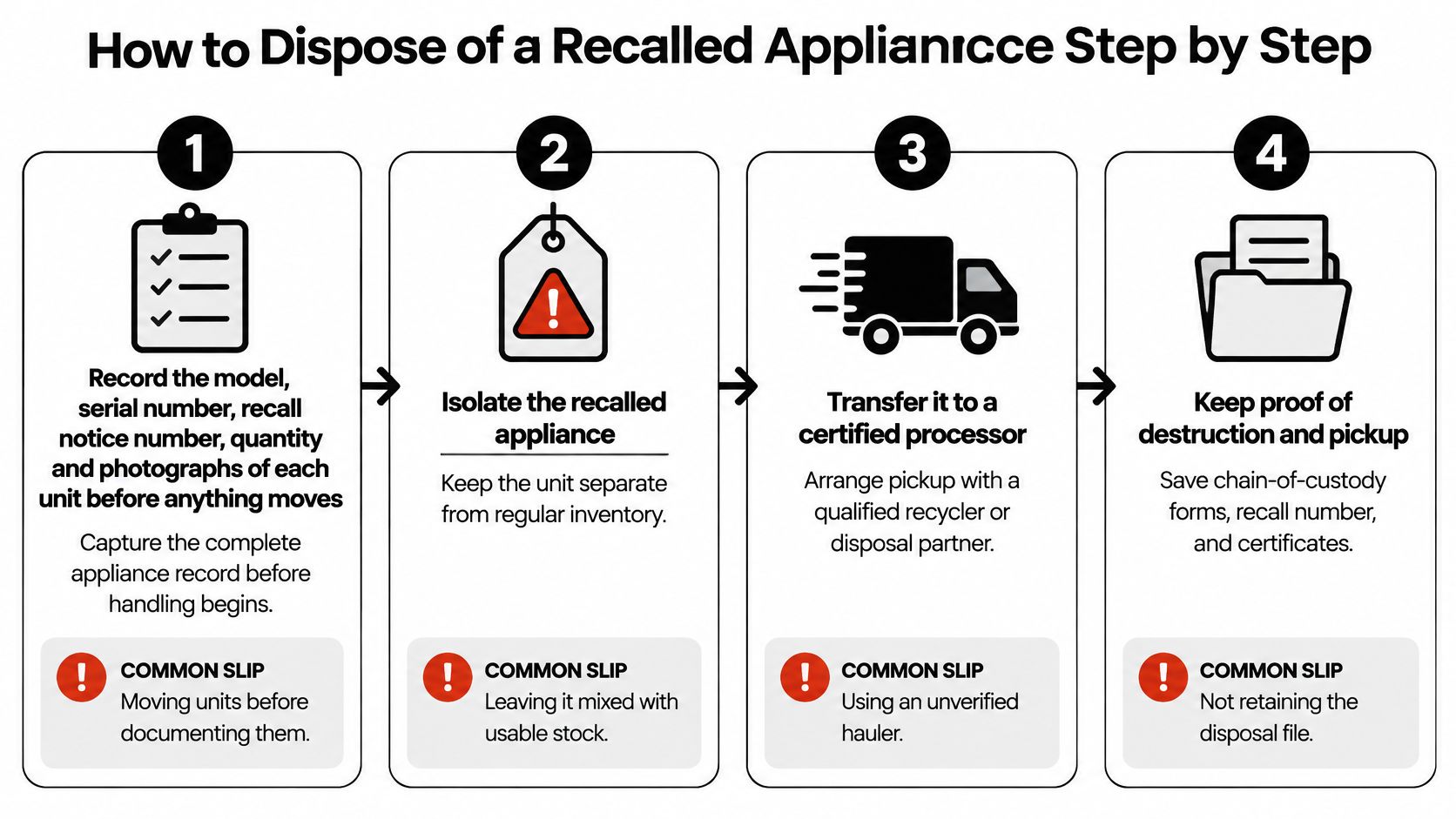
The CPSC Recall Handbook calls for isolation of recalled products and written controls for off-site destruction, including identification, segregation, marking, and destruction confirmation. Destruction should occur only with manufacturer authorization and, where applicable, CPSC approval.
Control the unit before controlling the shipment
Capture identification before moving anything. Record the model, serial number, recall notice number, quantity, and photographs showing the unit and its label. Moving equipment first creates an avoidable reconciliation problem when labels detach or similar units become mixed.
Disconnect and secure the appliance safely. Use qualified personnel where electrical, plumbing, or fixed connections require them, and preserve safety features and components needed for inspection. Don't remove a control board merely to make the unit look disabled.
Apply a durable recall label. Mark each appliance and its shipping container Recalled, do not use or resell, and maintain a separate quarantine location. A tag on the warehouse shelf won't protect an unmarked unit after someone moves it.
Document every custody transfer. Match the loading list to the serial register, obtain signed handoffs, and prohibit commingling, salvage, and unauthorized subcontracting in the work order. Complete safe data sanitization before release, or document controlled transfer to the contracted destruction provider when on-site sanitization isn't possible.
Reconcile the processing evidence. Obtain the processor's destruction or recycling evidence and match it to the authorized treatment for each unit. A receipt stating only mixed scrap received doesn't demonstrate that the recalled products were permanently taken out of circulation.
Don't confuse disabling with final processing
Ordinary scrap processing isn't automatically recall destruction. A processor needs written instructions describing the permitted outcome, not just a request to recover metal.
Cutting a cord or removing a control board may prevent reuse in an authorized procedure, but neither action replaces refrigerant recovery or proper management of oils, mercury-containing components, capacitors, and batteries. When instructions are missing, request clarification instead of improvising destructive work.
For larger inventories, establish recalled-product disposal controls for warehouses before scheduling loading. Warehouse personnel need the same disposition instructions as the contractor.
Built-in equipment also needs a removal plan that protects surrounding fixtures. Jennifer Gilmer Kitchen & Bath's guidance on how to coordinate appliances with custom cabinetry can help facilities staff understand integration constraints when planning replacement access, though the recall notice must still govern disposition.
Sanitizing Data on Smart and Connected Appliances
Networked refrigerators, smart ovens, connected displays, and similar equipment can retain Wi-Fi credentials, account associations, usage histories, or user profiles. Check what the specific device stores rather than assuming an appliance has no information worth protecting.
Deleting files isn't sanitization. The IRS media-sanitization guidelines state that simple deletion is insufficient for clearing and identify methods including overwriting, appropriate purging techniques, and physical destruction.
Choose a method the storage media supports
NIST Special Publication 800-88 Rev. 2 distinguishes clear, purge, and destroy, and prefers purge over clear when feasible:
- Clear uses logical techniques against ordinary, non-invasive recovery attempts. Overwriting is an example, but embedded appliance storage may not offer an accessible, validated overwrite function.
- Purge makes recovery infeasible using state-of-the-art laboratory techniques while potentially preserving media for reuse. Secure Erase for suitable ATA drives and degaussing for appropriate magnetic media are examples, not universal instructions for every storage device.
- Destroy makes recovery infeasible and leaves the media unable to store data again. Physical methods include shredding, pulverizing, incineration, melting, and disintegration, selected for the actual media.
Don't apply a laptop procedure blindly to an appliance controller. Flash storage, magnetic disks, and embedded memory need different treatment, and degaussing isn't a solution for flash media.
For an appliance already authorized for destruction, specify destruction of its data-bearing components. For storage approved to leave the organization for reuse, select a supported purge method and verify the result. A recalled product's storage reuse must not undermine the manufacturer's no-salvage instructions.
Finish account removal without reactivating a hazard
Remove the device from the manufacturer account and management app, revoke associated access, and clear stored network credentials when this can be done safely. Never power up a stop-use appliance solely to perform a reset. Arrange controlled media destruction instead.
Use a data-sanitization procedure that records the asset identifier, storage component, method, operator or contractor, and verification outcome. Account removal and factory reset are useful administrative steps, but they don't independently prove that all stored information is unrecoverable.
Record what was actually sanitized. A certificate for a removed drive doesn't establish that separate embedded storage received treatment.
Refrigerant, Battery and Hazardous Part Handling
A recalled appliance enters a documented chain of custody as soon as it leaves your site. Refrigerant equipment and lithium-ion products need separate handling routes, and the records should identify what happened to each unit.
Cooling equipment needs recovery evidence
Refrigerant must be recovered before recycling or disposal. Keep the processor's recovery record, along with documentation for compressor oil and other hazardous components. EPA appliance-disposal guidance estimates that 11–13 million refrigerated household appliances reach end of life annually and reports that RAD participants safely disposed of more than 543,000 hazardous internal components between 2006 and 2025. These figures describe the broader appliance stream, not commercial recall volumes.
Confirm the window air-conditioner disposal arrangements before staging cooling units with general electronics. Do not let workers puncture refrigerant lines or drain equipment to reduce loading weight. Match recovery records to the relevant units or shipment.
Battery acceptance must be explicit
Before transport, get written confirmation that the receiving facility accepts commercial quantities of recalled lithium-ion products. Household hazardous-waste programs may not accept business shipments. Keep the acceptance confirmation and transport record with the unit or batch identifiers.
Intact recalled products can follow the manufacturer's approved battery route after written acceptance. Do not remove integrated batteries unless the approved procedure requires it.
Emergency condition: A hot, smoking, hissing, or burning battery requires emergency services, not a routine pickup. Escalate swelling or damage immediately to your site's safety lead and obtain specialist handling advice. Do not transport a damaged battery in an employee's personal vehicle.
Hazard, handling and proof by recalled appliance type
| Appliance type | Main hazard | Required handling | Proof to keep |
|---|---|---|---|
| Refrigerators and freezers | Refrigerant and compressor oil | Refrigerant recovery before recycling or disposal | Processor's refrigerant recovery record |
| Window air conditioners and dehumidifiers | Refrigerant and oil | Refrigerant recovery before final processing | Recovery documentation and destruction certificate |
| Laptops, cordless tools and backup batteries | Lithium-ion fire risk | Keep out of trash and curbside recycling; confirm acceptance for business-origin recalled items; segregate damaged cells under specialist direction | Acceptance confirmation and transport record |
| Small kitchen appliances such as air fryers | Electrical and fire hazard; possible capacitors | Follow manufacturer destruction instructions; keep separate from other stock | Destruction certificate matched to serial numbers |
Vetting a Certified Recycler and Planning Pickup
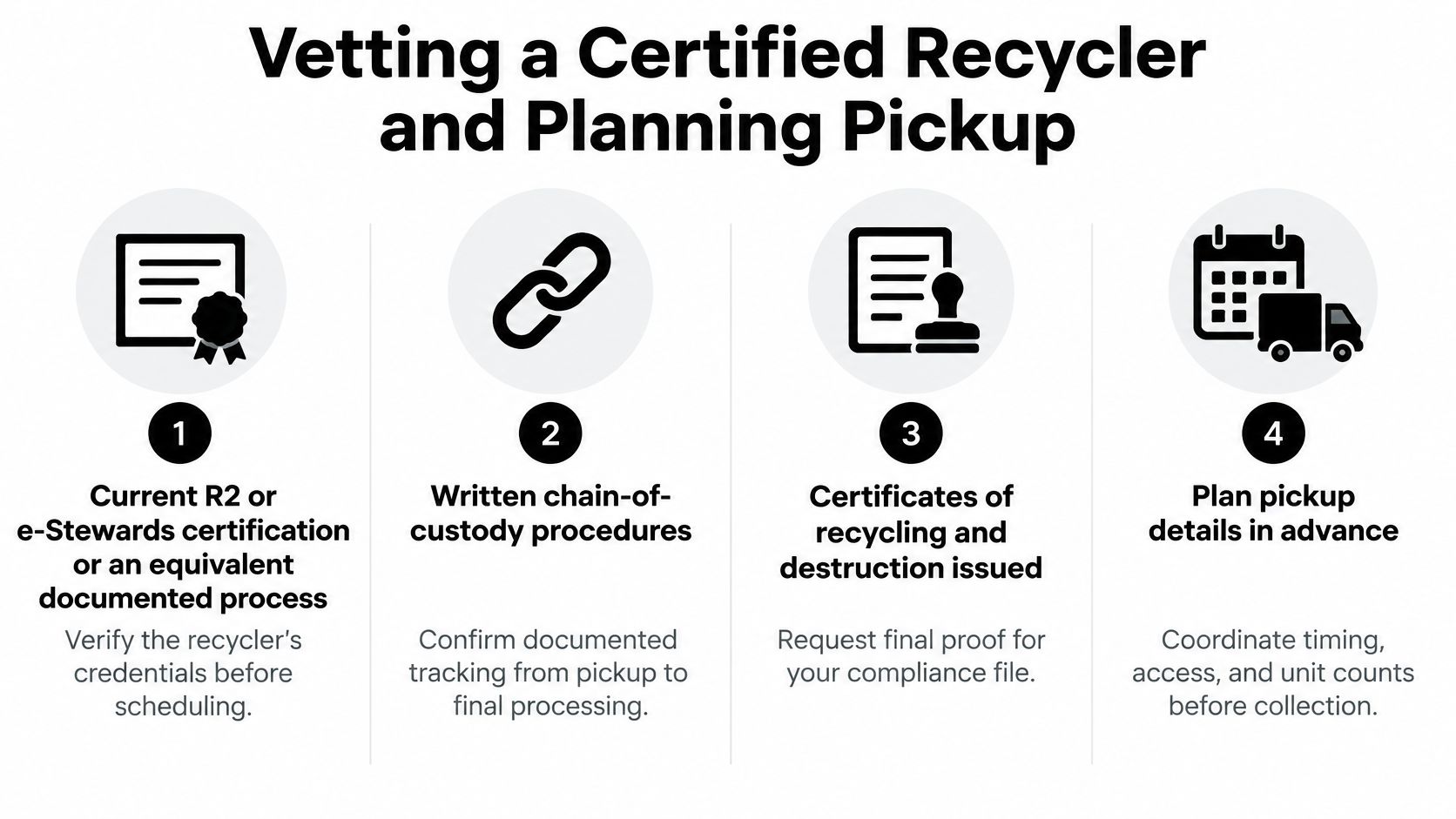
The pickup record should account for every recalled unit from site handoff through final processing. A certification logo alone does not establish that the recycler can follow the manufacturer's remedy or document the required disposition.
Compare scope before comparing price
Use a vendor due-diligence checklist to request:
- Current credentials. Verify R2 or e-Stewards certification and the facilities covered, or review an equivalent documented process. Describe an alternative process accurately; it is not certification.
- Custody procedures. Require named destinations, subcontractor controls, and signed transfer records.
- Processing evidence. Specify batch- or serial-level recycling, product-destruction, and data-destruction certificates.
- Hazard capability. Confirm refrigerant recovery and a documented route for recalled lithium-ion batteries.
- Commercial protections. Review insurance, transport credentials, and references from organizations with comparable requirements.
For data-bearing equipment, ask the contractor to name the treatment rather than promise secure disposal. NIST's media-sanitization guidance describes methods for sanitizing media. Use a defined treatment in the service scope, not an unsupported marketing claim.
Compare quotations against the same scope:
- Collection work. Unit count, distance, loading access, stairs, docks, and required equipment.
- Special processing. Hazard segregation, refrigerant recovery, and on-site or off-site destruction.
- Documentation and recovery. Certificate detail, reconciliation work, and any permitted residual-value credit.
A lower quote that omits hazardous handling or final evidence does not cover the same service.
Prepare the site for a controlled handoff
Set aside a labeled quarantine area. Match the staging list to serial numbers, prepare a signed manifest, and name a site contact. Tell the contractor about access restrictions and hazardous conditions before dispatch.
Beyond Surplus is an Atlanta-based ITAD and electronics recycling company that serves businesses across Georgia and schedules business pickups across the contiguous United States. It offers on- or off-site hard-drive shredding and certified data wiping, with recycling and data-destruction certificates. Confirm acceptance and the required processing route for each recalled appliance before booking.
Keep appliance disposal within the contractor's confirmed scope. If a separate project involves an oil tank, consult this guide to oil tank removal permits and steps, which addresses that distinct job rather than appliance processing.
Frequently Asked Questions About Recalled Appliance Disposal
Can a certified processor send a recalled unit through ordinary scrap?
Not solely because it's certified. Require the processor to satisfy the manufacturer's disposition instructions and produce evidence of the authorized treatment; routine material recovery doesn't establish permanent product destruction.
Can we donate it, sell parts, or move it back into warehouse inventory?
Don't release an unresolved recalled product into usable inventory, donation, or parts sales. Keep it in controlled quarantine unless the manufacturer authorizes a disposition that permits that specific activity.
Who pays for disposal when the remedy is a refund?
Don't assume a refund includes third-party hauling or destruction fees. Obtain written confirmation of manufacturer reimbursement, return shipping, contractor charges, and claim requirements before your procurement team approves the service.
What if a hazardous-waste facility refuses a recalled battery?
Ask the manufacturer and your commercial recycler for an accepted recalled-battery route in writing. Keep the item under the site's safety controls while arranging specialist handling, and contact emergency services if it develops signs of imminent fire.
Is a certificate necessary if the notice gives no disposal instruction?
Require a documented disposition record as your business control, even when the notice doesn't expressly require a certificate. First confirm that disposal is authorized; a processor certificate cannot correct an unauthorized decision to destroy the appliance.
Procurement standard: Put the required evidence in the purchase order. Asking for serial-level proof after processing is too late if the contractor never captured it.
These answers distinguish manufacturer requirements from internal risk controls. Don't turn a sensible records policy into a claim that every recall carries the same legal certificate requirement.
Keep Proof of Destruction and Book Your Pickup
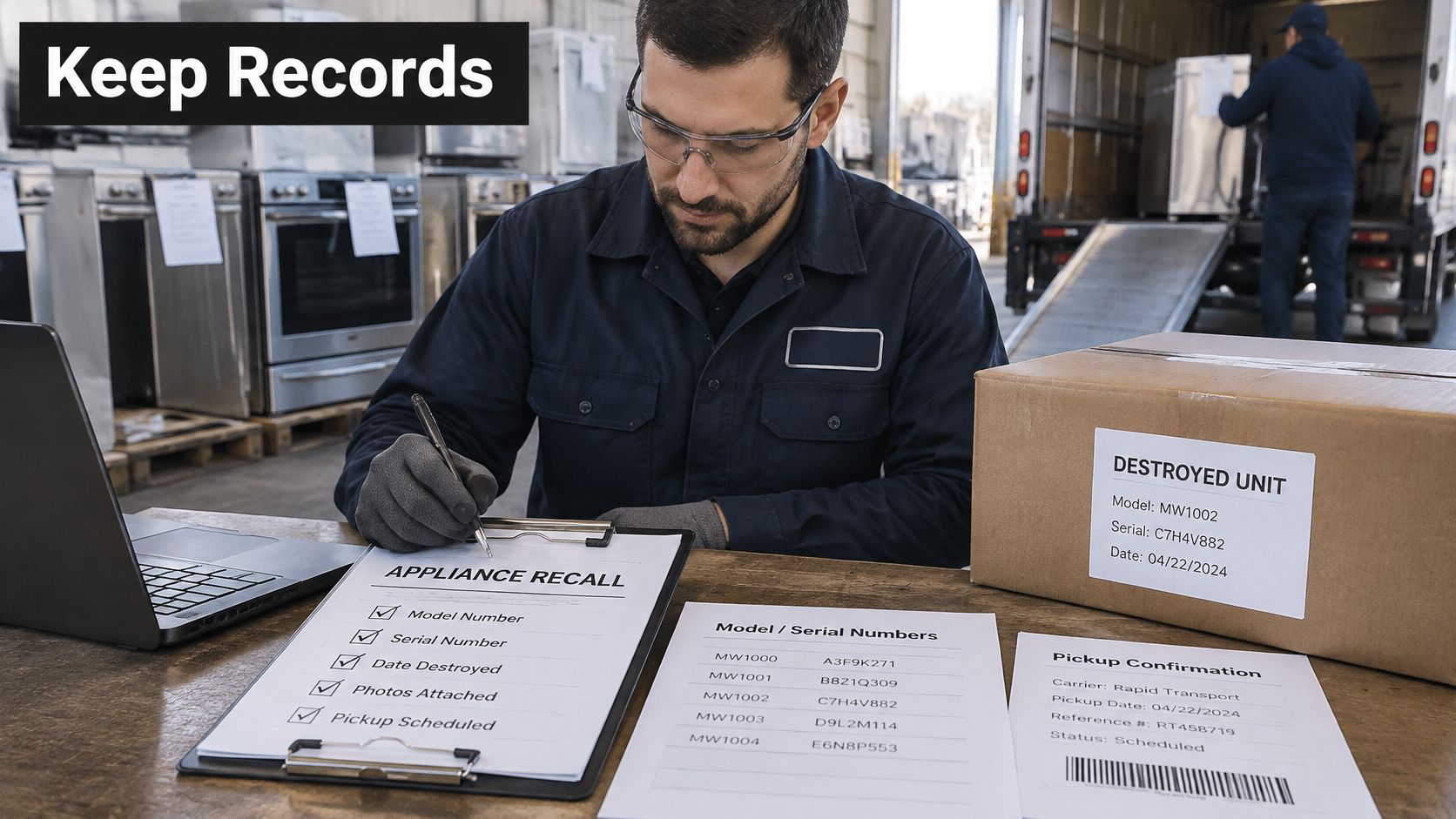
A loading receipt proves that someone collected equipment. A complete disposal file connects the recall, the asset, the authorized remedy, and the final outcome. That connection is what your team needs when a manufacturer questions a claim or an auditor asks where recalled stock went.
Build a file someone else can reconcile
Keep the following together:
- Recall authority. Recall number, saved notice, remedy confirmation, and destruction authorization where applicable.
- Asset identity. Model and serial list, quantities, photographs, and internal asset references.
- Event history. Isolation, release, collection, and processing dates.
- Custody evidence. Signed handoff forms, shipment identifiers, receiving facility, and processor name.
- Final treatment. Destruction or recycling certificates, data-treatment evidence, and any refrigerant recovery documentation.
- Claim closure. Manufacturer acceptance, refund or replacement correspondence, and explanations for discrepancies.
Set the expected certificate format before collection. Use the certificate-of-destruction requirements for recalls to define what must match your asset register, rather than accepting a generic statement that electronics were recycled.
Apply the privacy rule to the information it covers
The FTC Disposal Rule applies to businesses and individuals that use consumer reports for a business purpose, not only credit bureaus. It requires reasonable and appropriate disposal practices and gives examples including making electronic information unreadable or unreconstructable and conducting due diligence on destruction contractors.
That rule doesn't apply to every recalled appliance because it's electronic. Its relevance here is to units or media containing consumer-report information and related records. Other privacy or contractual obligations may require separate review.
For recalled stock without that information, keep the same disciplined disposition file anyway. It supports manufacturer claims, inventory reconciliation, and audits without overstating the FTC rule's scope.
Close the job after processing, not after pickup
Pull the applicable notice for every unit, quarantine the affected stock, confirm the remedy, and approve a qualified pickup only after acceptance and treatment are documented. Assign an employee to reconcile certificates against the serial list promptly after processing, with a contractual delivery deadline for the contractor's evidence.
Leave unresolved assets open in the register. If a certificate omits a unit, names an unexpected facility, or describes the wrong treatment, investigate before closing the disposal order or manufacturer claim.
Contact Beyond Surplus for certified electronics recycling and secure IT asset disposal, with business pickup scheduling across the contiguous United States. Provide your recall notices, serial inventory, equipment condition, and site-access details so the team can confirm acceptance, processing requirements, and documentation before collection.