

Georgia businesses lost roughly $420 million to cybercrime in the last reported year, and that figure only reflects reported losses, not the full exposure hiding inside unfiled incidents and quiet internal damage Georgia Attorney General cyber guidance. If you run payroll, approve vendor invoices, or store customer records, that number should change how you think about cybersecurity. This is not a back-office IT problem, it is a direct threat to cash flow, operations, and trust.
What makes the risk more dangerous is that Georgia's attack surface isn't limited to servers and firewalls. Retired laptops, discarded hard drives, and poorly controlled equipment handoffs can turn a routine refresh into a data incident. For Georgia companies, cybersecurity now includes how hardware is collected, wiped, transported, and destroyed.
Table of Contents
- The Financial Reality of Cybercrime in Georgia
- Threat Vectors Accelerating Across the State
- Why Small and Mid-Sized Businesses Face Outsized Risk
- How Improper IT Asset Disposal Creates Breach Pathways
- Regulatory and Compliance Pressures on Georgia Organizations
- Building a Secure IT Asset Disposition Strategy
- Protecting Your Business Beyond the Network Perimeter
The Financial Reality of Cybercrime in Georgia
The headline numbers are already bad enough. The FBI's Internet Crime Complaint Center says Georgians lost roughly $534 million to cyber-enabled crime in the last reported year, while national losses exceeded $20 billion Georgia cyber guidance. Independent reporting also said Georgia residents and organizations filed enough complaints in 2024 to rank the state 11th nationally, with potential losses of more than $420 million and a 40% year-over-year increase FBI Atlanta 2024 internet crime report.
Those numbers matter because they map directly to business functions. Investment fraud and business email compromise sit among the costliest categories, which means the damage often lands in the exact places owners watch every day, payroll, vendor payments, and customer trust Georgia cyber guidance. A stolen login is not just an IT event. It can become a wire transfer, a fake invoice, or a customer breach notice.
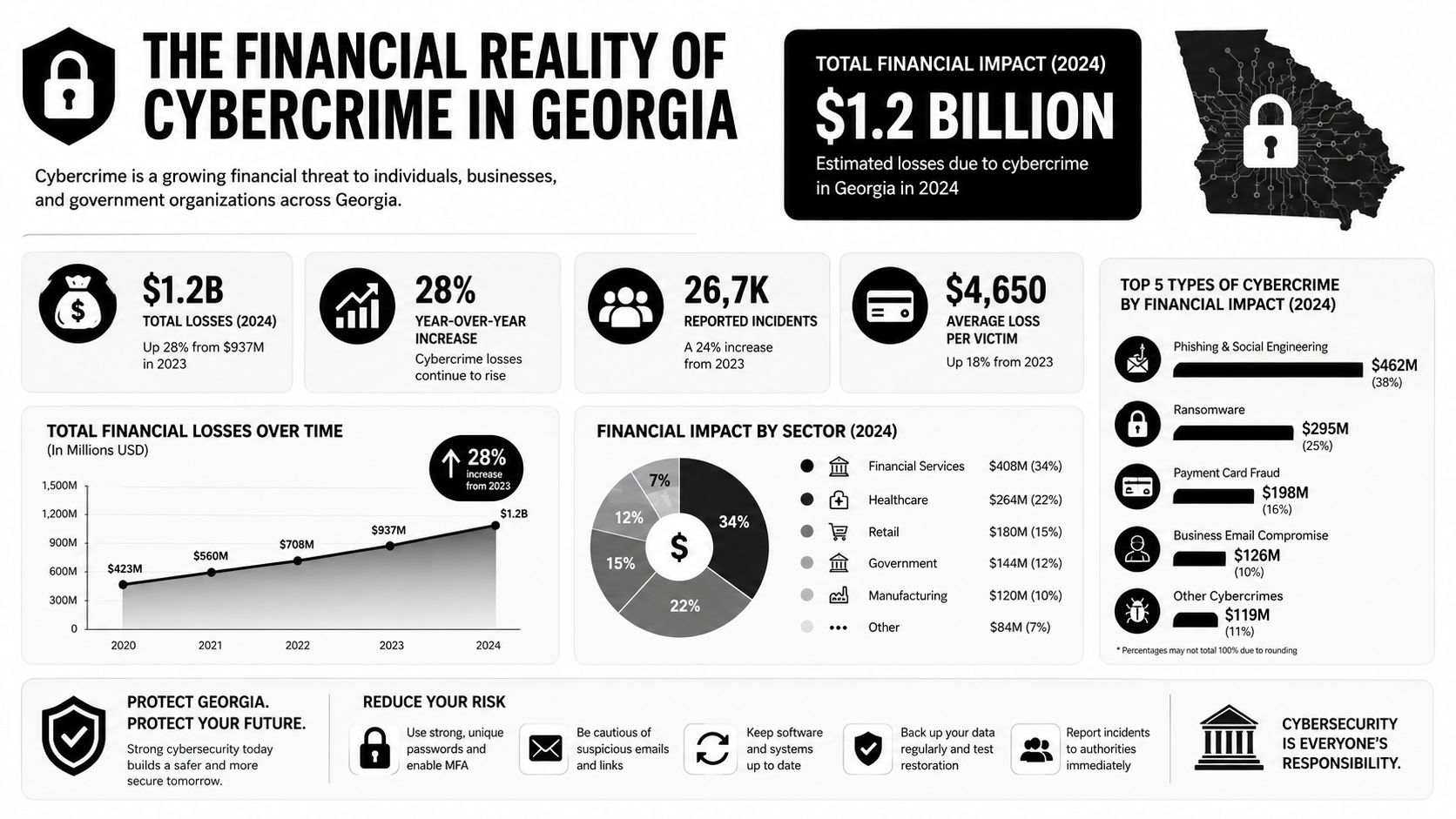
Practical rule: If a cyber event can interrupt cash movement, it belongs on the same risk register as any other revenue-threatening outage.
Georgia's Attorney General's office also warns that IC3 reporting only counts losses that were reported, which means the total exposure is likely higher than the headline number Georgia cyber guidance. That should push leaders to stop treating security as a compliance box and start treating it as recurring financial risk. If your team is still tracking this as an annual IT project, you're already behind.
For companies that still have a stack of unreturned devices in storage, the math can get worse fast. How much do unreturned employee laptops cost your business? is the right question because every forgotten endpoint is another place where data exposure, loss, or misuse can begin.
Threat Vectors Accelerating Across the State
Georgia's threat environment is changing in ways that make old security assumptions brittle. One 2026 threat roundup reported a 45% rise in ransomware incidents, a 30% rise in IoT-based breaches, supply-chain cyberattacks affecting over 40% of Georgia companies, and 28% of threats using AI to evade detection and automate attacks StateGlobe Georgia threats. That mix matters because attackers are no longer picking just one entry point. They're looking for the weakest business process, then chaining it to a payout.
Email, vendors, and payment diversion
Business email compromise and phishing are especially dangerous for companies that run invoicing, approvals, and remote access through email. Once an attacker can impersonate a vendor or an executive, a transfer request can look routine enough to pass quickly. That's why payment diversion keeps showing up in financially motivated incidents, it exploits trust, not just software.
Georgia's state-specific reporting also says crypto-related crimes in the state jumped 122%, and losses from those crimes rose 66% FBI Atlanta 2024 internet crime report. The operational lesson is simple. If money moves through email, chat, or cloud approvals, it's a target.
Connected devices and vendors widen the blast radius
IoT-based breaches are rising because printers, cameras, HVAC controllers, and similar devices often sit outside standard patching discipline. Supply-chain attacks are even worse, because a trusted vendor can carry the attacker past perimeter defenses. Once that happens, signature-based tools have a hard time keeping up, especially when AI helps generate convincing lures or automate the next step.
For practical control guidance, Georgia firms should review vendor access, segment connected devices, and force offline recovery options for critical systems. The broader risk picture is consistent with Beyond Surplus's overview of Atlanta cybersecurity trends, but the point for operators is plain. You can't defend only what sits inside the office network anymore.
If a vendor can reach your data, your production tools, or your payment systems, that vendor is part of your security perimeter.
Why Small and Mid-Sized Businesses Face Outsized Risk
Small and mid-sized businesses do not have the margin for security failure that large enterprises do. The Georgia Department of Consumer Protection cites Ponemon Institute research showing 67% of U.S. small and medium-sized businesses were victims of a cyberattack in 2018, with an average cost of $383,365 per incident Georgia consumer guidance. It also reports average operational-disruption losses of $1,562,124 and average damage or theft of IT assets and infrastructure of $1,426,422 Georgia consumer guidance.
Those figures matter because SMBs usually run lean. One incident can hit billing, shipping, access control, and customer service at the same time. That's not just a bad quarter, it's a survival problem.
Survival depends on control, not optimism
The same Georgia guidance says 60% of hacked SMBs go out of business after six months Georgia consumer guidance. That's the number owners need to remember when they delay hard drive shredding, skip device inventory, or let retired equipment sit in a closet. Once you lose track of the asset, you've lost track of the data inside it.
Practical rule: If your company can't prove where retired devices are, it can't prove the data on them is protected.
This is why data destruction and device retirement controls aren't optional add-ons. Asset-heavy organizations, schools, healthcare groups, logistics firms, and regulated businesses need chain-of-custody records because a disposal gap can become a breach gap. ITAD for small businesses in Georgia, cost and benefits is worth reviewing if your team still treats end-of-life hardware as a warehouse issue instead of a cyber risk.
How Improper IT Asset Disposal Creates Breach Pathways
Retired hardware doesn't forget your data when your staff does. Laptops, servers, phones, and drives can still contain recoverable information after ordinary deletion, and careless disposal creates a clean path for exposure. The problem is usually not sophistication, it's process failure.
Where the breach starts
A reseller receives a batch of used laptops with cached browser sessions and local files still intact. A donated server leaves the building with old credentials and shared folders still accessible. A hard drive goes through an unverified recycling channel, and no one can prove who handled it last. Those are all disposal problems, but they become security problems the moment sensitive data leaves your control.
The fix is certified data destruction, not hope. Secure wiping, hard drive shredding, and documented chain of custody reduce the chance that a discarded asset becomes a data source for the wrong person. If your process depends on “we usually erase them,” you're taking a risk you can't defend.
What to require before anything leaves the building
- Inventory every asset: Match serial numbers, assigned users, and retirement dates before release.
- Separate storage and transport: Keep decommissioned gear in a controlled area until pickup or destruction.
- Document each handoff: Every transfer should have a name, date, and destination.
- Verify destruction methods: Match the treatment method to the sensitivity of the data and device type.
For a practical how-to on one of the most common weak points, see how to erase a hard drive securely for your business. The bigger point is simple. Secure IT asset disposition is a cybersecurity control, not an environmental extra.
Regulatory and Compliance Pressures on Georgia Organizations
A disposal mistake can turn into a regulatory problem fast. Healthcare, finance, education, and government organizations have to control what happens when equipment leaves service, because regulators care about the full lifecycle of the information, not just the active system. Disposal policy belongs in the same conversation as access control and incident response.
What auditors want to see
Auditors and investigators look for proof, not intent. They want certificates of recycling and data destruction, documented chain of custody, and evidence that sensitive media did not stay in circulation. Those records matter because they show how the asset was handled when responsibility changed hands.
The FTC Disposal Rule and HIPAA both push organizations toward secure handling of sensitive information. Georgia businesses also need to meet state-level expectations for data protection during retirement and disposal, as outlined in Electronics recycling laws in Georgia and ITAD compliance. If your current vendor cannot produce clear paperwork, the exposure is real.
Make compliance operational
Build disposal into procurement and offboarding. Require policy-backed signoff before devices are retired, and keep records long enough to answer an audit question without scrambling. A clean disposal file should tell a complete story, what left, who handled it, how it was treated, and who received the final certificate.
Building a Secure IT Asset Disposition Strategy
A secure disposition program should be boring, repeatable, and documented. If every refresh cycle feels improvised, your risk stays high. The fix is a disciplined vendor process that treats retired hardware like sensitive cargo.
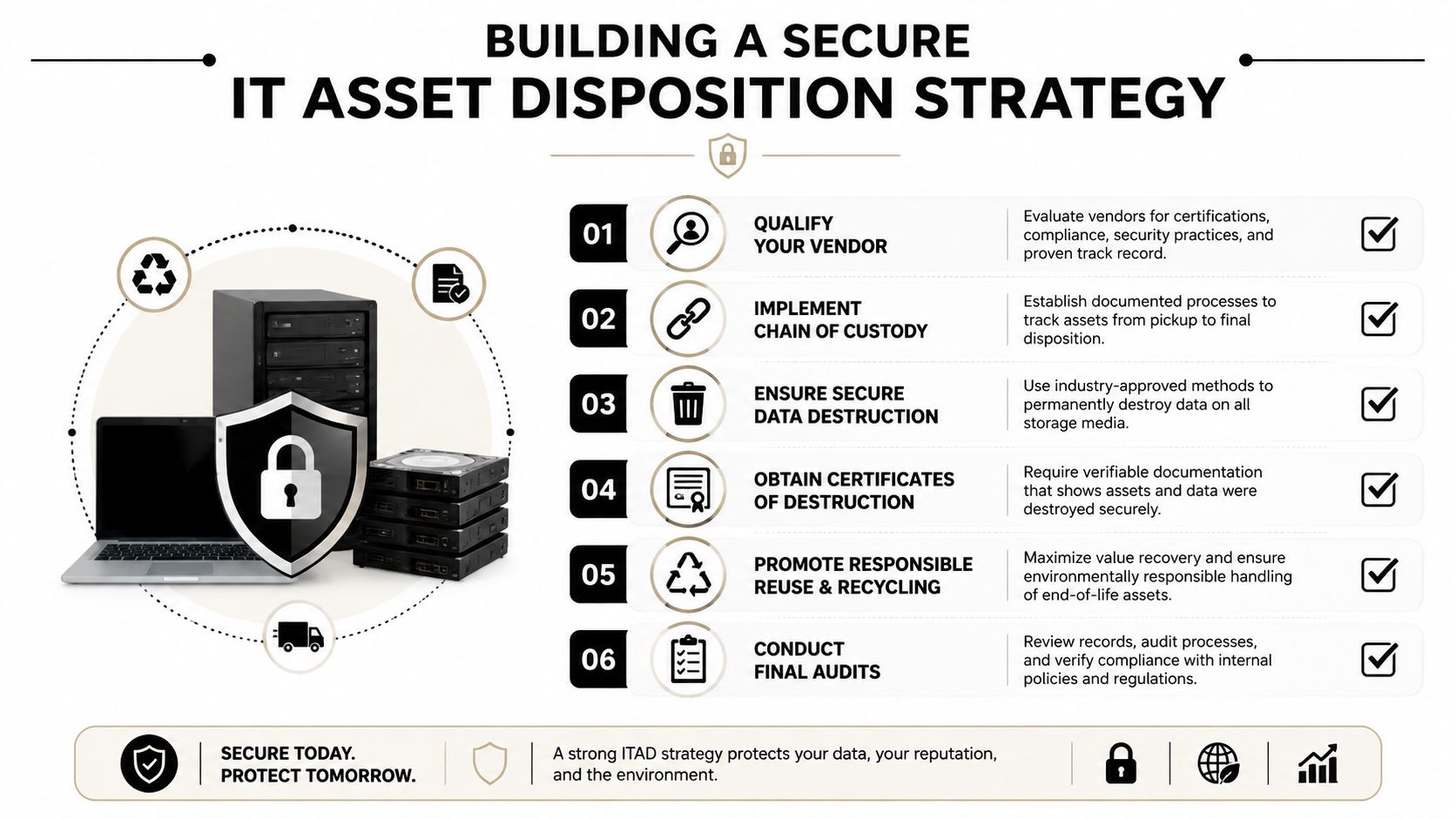
Use a short vendor checklist
- Qualify your vendor: Ask about certifications, destruction methods, insurance, and documentation practices.
- Implement chain of custody: Require signed handoffs from pickup through final processing.
- Choose the right destruction method: Use shredding, wiping, or combined controls based on sensitivity.
- Audit the paperwork: Confirm certificates of destruction and recycling match the serial numbers removed.
- Plan for logistics: Coordinate multi-site pickups so devices don't sit exposed in offices or closets.
- Tie disposal to recovery: If equipment still has value, consider IT buyback as part of the same controlled process.
One option businesses use is Beyond Surplus, which provides secure data destruction, pickup coordination, and certificates of recycling and data destruction. The value is in the control trail, not the branding. If your provider can't prove where each asset went, you have a problem.
Fold disposal into business continuity
Retirement planning belongs beside incident response and backup recovery. If a laptop is lost, a drive is replaced, or a site is shut down, your team should already know how to remove equipment from service without exposing data. That's how you reduce the chance that a refresh cycle becomes a reportable event.
Protecting Your Business Beyond the Network Perimeter
Cybersecurity for Georgia businesses starts on the network, but it doesn't end there. The state's loss figures, rising ransomware and phishing pressure, SMB failure risk, and compliance obligations all point to the same conclusion, every retired device is part of the attack surface Georgia cyber guidance FBI Atlanta 2024 internet crime report Georgia consumer guidance. If hardware leaves your building without control, the network perimeter already failed somewhere upstream.
Supply chain discipline matters here too. A useful benchmark is the Peak Transport supply chain security best practices resource, because the same thinking applies to retired IT assets, verify who touches the cargo, when they touch it, and what happens next. That mindset is what separates a real security program from a set of tools.
Your next step is straightforward. Audit every retired device path, verify your vendor's certifications, and demand chain-of-custody records before the next refresh cycle starts. Georgia businesses can't afford to leave data destruction to chance.
Contact Beyond Surplus for certified electronics recycling and secure IT asset disposal. If you need documented pickup, hard drive shredding, or data destruction for business equipment, visit Beyond Surplus and set up a controlled disposal process before your next asset retirement.


