

If you're running a small business in Georgia, there's a good chance you have a closet, back office, or server nook holding retired laptops, dead monitors, aging switches, and a few mystery boxes no one wants to open. The equipment is out of production, but the risk isn't. Old devices can still hold customer data, employee records, license keys, and internal files long after the business stops using them.
That pile also ties up money and space. Some assets still have resale value. Others will cost money to move, process, and document correctly. The challenge isn't just disposal. It's deciding what to wipe, what to resell, what to recycle, and how to do it without creating a compliance problem.
This is why IT asset disposition, or ITAD, matters. For Georgia businesses, this isn't a niche issue. The SBA's Georgia profile reports 485,000 small businesses, making up 99.6% of all businesses in the state and employing 1.2 million people, according to the SBA Georgia small business economic profile. When that many companies rely on laptops, servers, phones, and network gear to operate, end-of-life handling becomes an operating discipline, not a cleanup task.
The Hidden Value in Your Office Storage Closet
Most small companies don't create an e-waste problem overnight. It builds one refresh cycle at a time.
A sales team gets new laptops. The old ones go on a shelf until someone has time to deal with them. A server is replaced after a software migration. Two monitors stop matching the new docking stations. Then a move, remodel, or audit forces the issue, and now the business owner has to make decisions fast.
What that equipment really represents
Retired hardware usually falls into three buckets:
- Recoverable assets that may still have resale demand if they're audited, tested, and handled correctly
- Risk-bearing devices that hold data and need verified sanitization or destruction
- Pure cost items such as obsolete peripherals or broken displays that require compliant downstream recycling
The mistake I see most often is treating all three the same way. If you send everything out as scrap, you lose recoverable value. If you keep everything in storage, you create security and space problems. If you trust a vague pickup offer with no reporting, you may save time now and pay for it later.
Old equipment doesn't become harmless just because it's unplugged.
Why Georgia businesses should care now
For many owners, ITAD sounds like enterprise jargon. In practice, it's the process that keeps a routine technology refresh from turning into a security event, a surprise invoice, or a messy year-end cleanup.
That matters in a state where small firms make up nearly the entire business base. If your company depends on technology to bill clients, run payroll, manage patient files, process payments, or coordinate field work, the end of that equipment's life deserves the same discipline as the purchase did.
A neglected storage closet is rarely just clutter. It's a mix of dormant value and active liability.
What Exactly Is IT Asset Disposition
ITAD is broader than electronics recycling. Recycling is one possible endpoint. IT asset disposition manages the full end-of-life path for business technology, from inventory to final documentation.
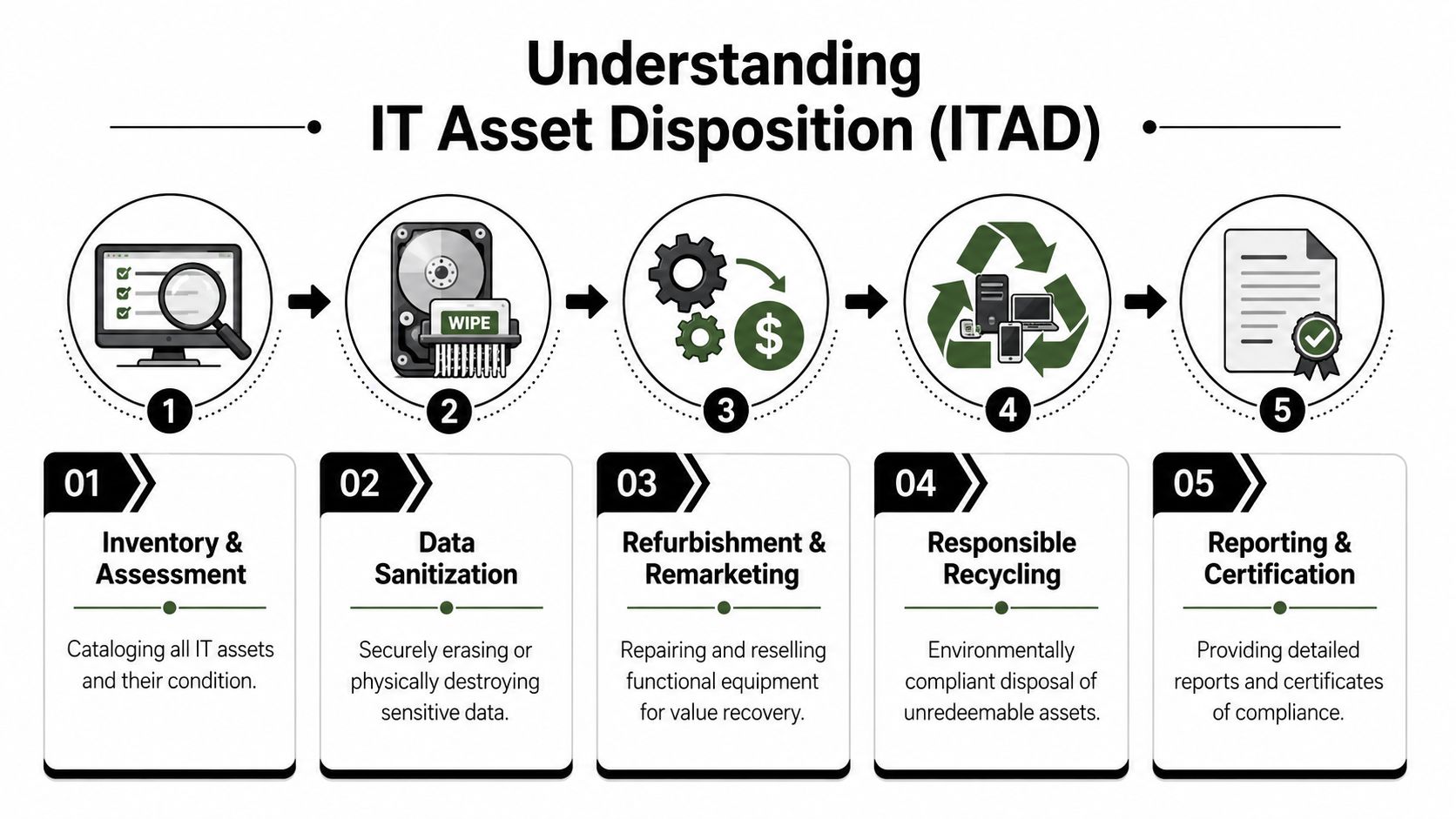
The five parts that matter
Think of ITAD like fleet retirement for technology. A company doesn't just abandon old vehicles in a parking lot. It tracks them, removes identifying information, evaluates resale potential, disposes of unsafe components, and keeps records. The same logic applies to computers and infrastructure.
Inventory and audit
Every item is identified. Model, serial, condition, storage media, and location all matter.Chain of custody
Once devices leave a desk or server room, the business should know who handled them and when.Data sanitization or destruction
Drives are wiped or physically destroyed based on the device, data sensitivity, and policy requirements.Remarketing and refurbishment
Equipment with market demand may be tested, refurbished, and resold.Recycling and reporting
Non-resalable equipment is processed through approved recycling channels, with documentation issued at the end.
Why this is different from a simple pickup
A truck pickup alone doesn't solve the hard part. The hard part is control. Businesses need item-level visibility, proof that data was handled properly, and a clear answer on whether each asset was resold, destroyed, or recycled.
If you're comparing providers, this breakdown helps clarify the difference between secure disposition and generic recycling. The distinction is well explained in this guide on ITAD vs. e-waste recycling in Georgia.
Practical rule: If a vendor can't explain its chain of custody and reporting process in plain language, keep looking.
Decoding ITAD Costs for Your Georgia Business
Cost is where many small businesses get frustrated. The quote looks simple at first, then transport, sorting, certificates, and non-resalable items start showing up as separate charges. That's why "free ITAD" often disappoints companies with mixed inventories.
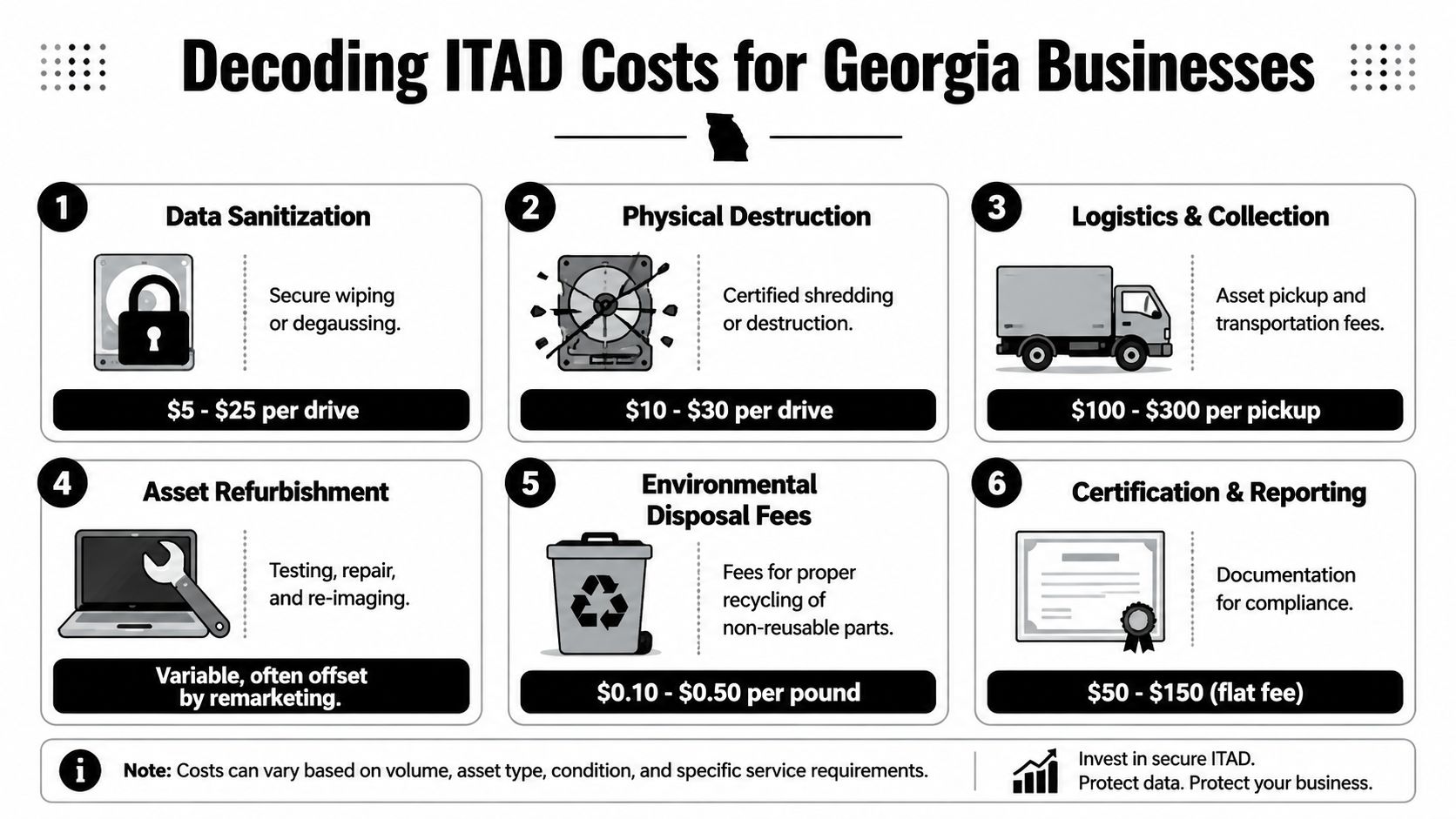
Lot size drives the math
One public benchmark shows ITAD pricing at $25 per asset for lots of 1 to 500 assets, with a $2,500 minimum for small engagements. That same benchmark drops to $20, $18, and $15 per asset at larger volumes, as shown in ReluTech's ITAD pricing overview. The lesson is straightforward. Small lots carry more overhead per unit.
The work that creates cost doesn't disappear just because you only have a few dozen devices:
- Intake handling still has to happen
- Asset auditing still takes labor
- Secure packing and transport still need coordination
- Certificates and reporting still require administrative work
A hundred-device project usually has a higher per-unit burden than a much larger refresh.
Why free offers can become expensive
Free ITAD usually works only when the provider expects enough resale value to offset labor and logistics. That can happen with newer laptops, current-generation servers, and business-class networking gear in decent condition. It usually doesn't work with old desktops, cracked monitors, mixed peripherals, or low-demand hardware.
For low-resale inventory, hidden fees become the primary budget issue:
- Non-resalable hardware fees can run $15 to $45 per unit
- Certificates for data destruction may carry separate charges
- Packaging and shipping are often excluded from the base quote
Those hidden fees for non-resalable hardware are part of the same pricing reality small businesses need to model before approving a pickup. This is also why the question isn't "Is it free?" but "What's the total landed cost after transport, handling, and documentation?"
What usually works better
A better buying approach is to request pricing in categories rather than one blended promise.
| Cost area | What to ask |
|---|---|
| Asset processing | Is pricing per asset, per pallet, or by mixed load |
| Logistics | Are pickup, packing, and freight included |
| Data handling | Is wiping included, or billed separately from shredding |
| Reporting | Are certificates and audit reports included |
| Low-value gear | What happens to obsolete monitors, printers, and accessories |
For companies comparing service models, this breakdown pairs well with a review of onsite vs. offsite ITAD services in Georgia. The right answer depends on data sensitivity, asset volume, and how much labor you want your own staff to absorb.
The Four Pillars of ITAD Benefits
The best reason to invest in ITAD isn't environmental branding alone, and it isn't resale alone. The strongest business case is the combination of cost recovery and risk transfer. Industry guidance summarized in CXtec's review of secure ITAD benefits points to that pairing directly: secure data handling plus remarketing can recover residual value while certificates of destruction support compliance and auditability.
Security comes first
Every retired workstation, phone, firewall, and server should be treated as if it still contains usable information until proven otherwise. Secure ITAD closes that gap with documented wiping or destruction.
This matters most for firms handling customer files, payment information, employee records, legal documents, engineering drawings, and healthcare or financial data. The risk isn't theoretical. It's operational. A single unmanaged drive can turn a routine office cleanup into a legal and reputational problem.
Compliance needs proof
Many business owners think compliance means good intentions. It doesn't. Compliance means records.
A solid ITAD process gives you audit trails, serialized reporting, and certificates that show what happened to each asset class. That's the difference between saying devices were "taken care of" and being able to demonstrate that the business followed a defensible process.
Value recovery changes the conversation
The second pillar is often overlooked. Some assets still have a secondary market. If the provider can test, grade, and remarket them properly, retired equipment can offset project cost.
That resale ecosystem is visible outside enterprise channels too. The demand for refurbished devices is one reason secondary markets remain active, whether you're looking at corporate buyback streams or retail channels such as UsedMobiles4U iPhones, which shows how refurbished Apple hardware continues to attract buyers.
If a device still has market demand, disposal is the wrong first assumption.
Sustainability still matters
Responsible recycling is the fourth pillar, but it shouldn't be treated as a soft benefit. Customers, boards, procurement teams, and internal stakeholders increasingly ask what happened to retired electronics. A documented ITAD program helps answer that clearly.
For Georgia organizations tying asset retirement to broader environmental goals, this overview of sustainable IT disposal in Georgia and ESG-focused ITAD is a useful next read.
Navigating the Georgia Specific ITAD Landscape
Georgia businesses operate in a practical compliance environment. Federal requirements around secure disposal still matter, especially for companies that handle sensitive consumer, financial, or healthcare information. At the state level, the more immediate issue for many firms isn't a unique disposal mandate. It's execution across different geographies, facilities, and refresh cycles.
The rural problem most providers gloss over
A major gap in Georgia ITAD planning is the difference between metro service and rural service. A 2024 Georgia report found that 42% of rural small businesses delay IT disposal because of logistics costs, and rural pickup fees averaged 2.3x metro rates, $120 versus $52 for same-day service. The same report frames statewide logistics capability as a critical factor in provider selection, especially outside the Atlanta area.
If you're in North Georgia, South Georgia, or a smaller market between major metros, the challenge isn't just finding someone who says they handle ITAD. It's finding a provider that can do secure pickup, maintain chain of custody, and keep pricing predictable when your volume is modest and your location is farther from the usual route density.
Why statewide coverage matters
The operating model matters more than marketing language. A business with one office near Atlanta can get by with a narrow local service footprint. A company with branch locations in Savannah, Macon, Columbus, or rural counties needs a provider that can coordinate pickup standards across all sites.
Beyond Surplus is one example of a Georgia-based option that offers business ITAD, secure data destruction, logistics coordination, and documentation support across the state. The important point isn't the brand. It's the coverage model. For Georgia companies with multiple locations, a single statewide process usually works better than piecing together different local recyclers with different paperwork and custody practices.
Rural delay usually isn't a policy problem. It's a logistics problem.
A Sample ROI and Decision Checklist
Consider a small Georgia firm replacing a batch of office laptops, a few monitors, and one server. Some of the laptops are recent enough to have resale value. The monitors likely aren't. The server needs stricter handling because of the data it held.
The ROI decision isn't just about whether the service invoice is low. It's about whether the project produces a better business outcome than doing nothing, storing everything, or using an unstructured hauler.
A practical way to think about ROI
Use a simple framework:
- Recovered value from equipment that can be remarketed
- Avoided internal labor spent sorting, storing, packing, and documenting assets
- Reduced liability through verified data destruction and certificates
- Minus total service cost, including pickup, processing, and any low-value equipment charges
If that equation leaves you with cleaner records, reclaimed space, less staff distraction, and some recovered value, the project likely makes sense even before you assign a dollar figure to risk avoided.
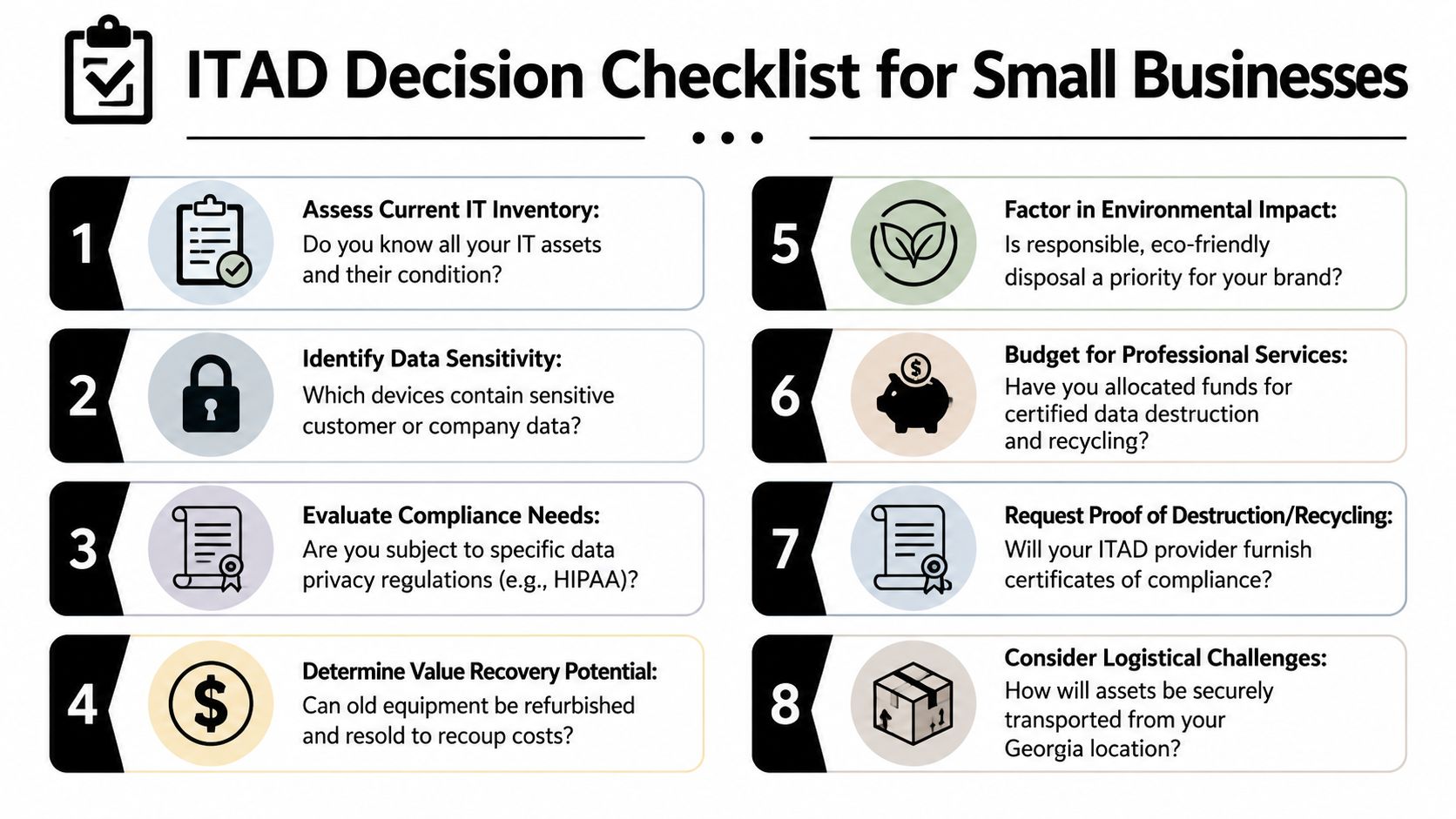
Questions to ask before signing anything
- What inventory reporting do you provide for each serialized asset
- How do you handle data-bearing devices that fail wiping
- Are certificates included or billed separately
- What equipment qualifies for value recovery and what goes straight to recycling
- How are non-resalable items priced
- Who controls transportation and chain of custody
- What happens at rural or multi-site locations
- Can you support a documented destruction workflow that fits internal audit needs
A provider should be able to answer those questions clearly. If the answers stay vague, pricing probably will too. This additional certified data destruction checklist for Georgia ITAD projects is a good screening tool before you request final quotes.
Take the Next Step to Secure Your Assets
The core decision is simple. You can keep retired equipment sitting in storage, let uncertainty build, and hope there isn't sensitive data left on anything. Or you can treat end-of-life technology as a managed business process.
Good ITAD protects data, improves audit readiness, and gives you a cleaner financial picture of what your old equipment is worth. It also exposes the offers that look cheap on the surface but become expensive once low-value gear, transport, and documentation are added back in.
For Georgia businesses, especially those outside the Atlanta core, the right provider is the one that can explain logistics, pricing, chain of custody, and reporting without evasive language. That's the baseline.
If you're evaluating vendors, start with a structured comparison and use a practical framework like this guide on how to choose an ITAD vendor in Georgia step by step. Then gather your inventory list, identify which devices held sensitive data, and ask for a scope that separates remarketing value from processing cost.
A disciplined ITAD program isn't just disposal. It's asset recovery with controls.
Contact Beyond Surplus for certified electronics recycling and secure IT asset disposal for your Georgia business.


