

Atlanta companies aren't waiting to see whether AI belongs in cybersecurity, they're already deploying it while attackers do the same. In the 2025 ISC2 AI Pulse Survey, 30% of cybersecurity professionals said their teams had already integrated AI security tools, 42% were actively evaluating or testing them, and that means 72% were already beyond the “no plan” stage (ISC2 AI Pulse Survey). That matters in Atlanta because metro businesses are scaling AI use inside a threat environment that's getting noisier, faster, and less forgiving.
Table of Contents
- Why Atlanta Is a Live Case Study for AI and Cybersecurity
- What AI Changes in a Security Stack
- The Governance Gap Atlanta Regulators Already Notice
- How Atlanta Sectors Are Adapting in Practice
- Practical Steps Atlanta IT and Security Leaders Should Take Now
- Choosing the Right Path for Secure Data Destruction and ITAD
- Compliance, Local Resources, and What Auditors Will Ask
- A 30-60-90 Day Action Plan for Atlanta Security Leaders
Why Atlanta Is a Live Case Study for AI and Cybersecurity
Metro Atlanta is a useful test bed because the pressure is real on both sides of the equation. One Atlanta business source says 60% of companies plan significant AI integration by the end of 2026, while metro-area ransomware attacks on small businesses rose 35% in the last year (Atlanta businesses ride the tech wave or sink). That is the actual context for local leaders, not abstract futurism.
Why the city matters now
Atlanta's mix of finance, healthcare, logistics, technology, and government creates exactly the kind of environment where AI security decisions stop being optional. These organizations run 24/7 operations, handle sensitive records, and depend on tight uptime. If you manage a bank, hospital, carrier, or public-sector network here, you're dealing with the same scaling problem larger U.S. markets face, but with local procurement, compliance, and staffing realities layered on top.
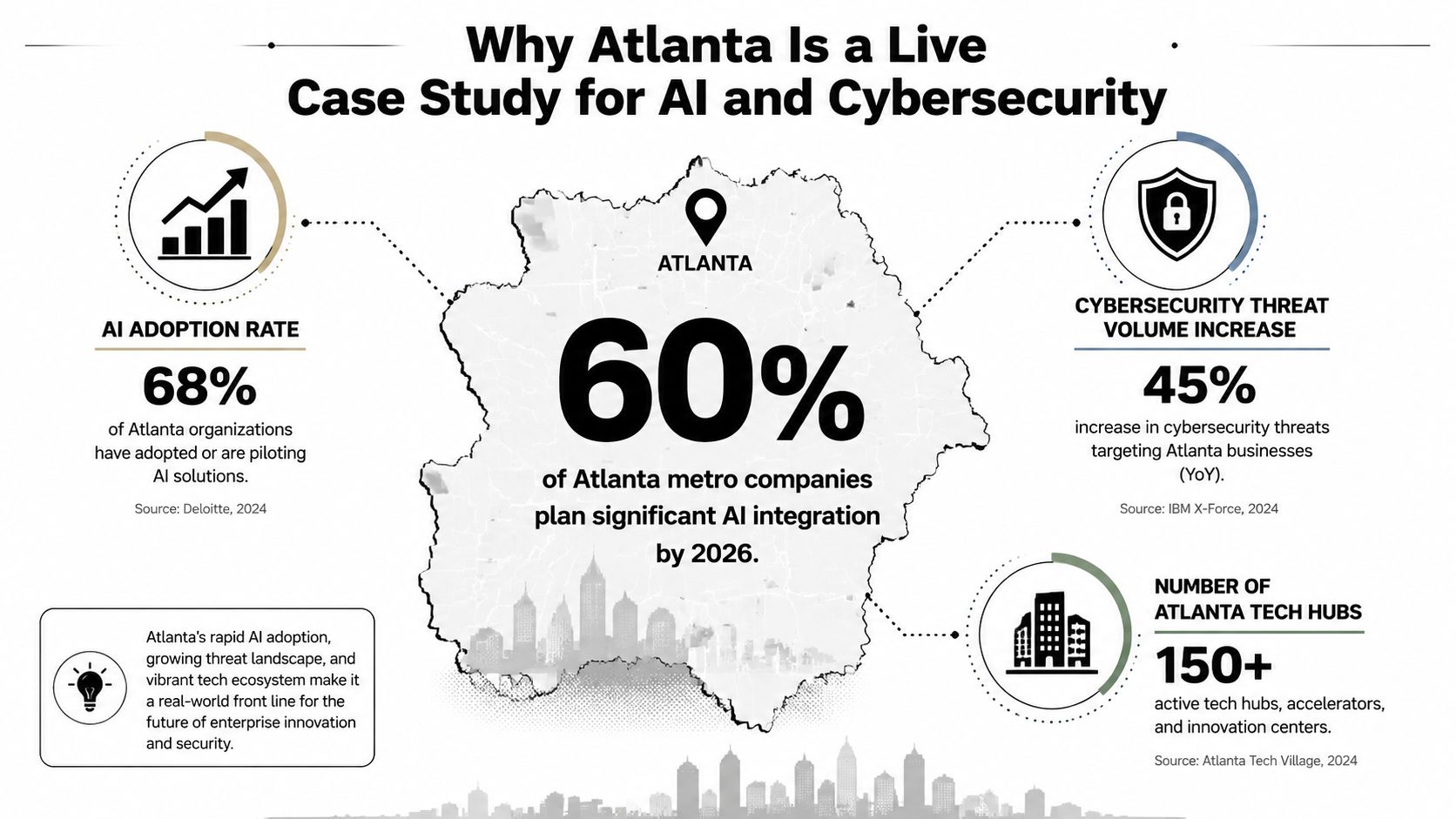
The right read on Atlanta is simple. AI is already moving into the stack, and the threat environment is already forcing faster detection, tighter oversight, and more disciplined data handling. If you're still treating AI security as a pilot project, you're behind the operational curve.
Practical rule: If AI touches detection, triage, or response, it belongs in the security budget and the audit conversation, not the innovation slide deck.
The most useful way to think about AI and Cybersecurity: How Atlanta Companies Are Adapting is this, the city is showing what happens when a fast-growing enterprise base tries to modernize security while attack volume, compliance expectations, and workforce constraints all rise together. That makes Atlanta a bellwether, not a special case.
Why Atlanta is becoming the South's tech hub
What AI Changes in a Security Stack
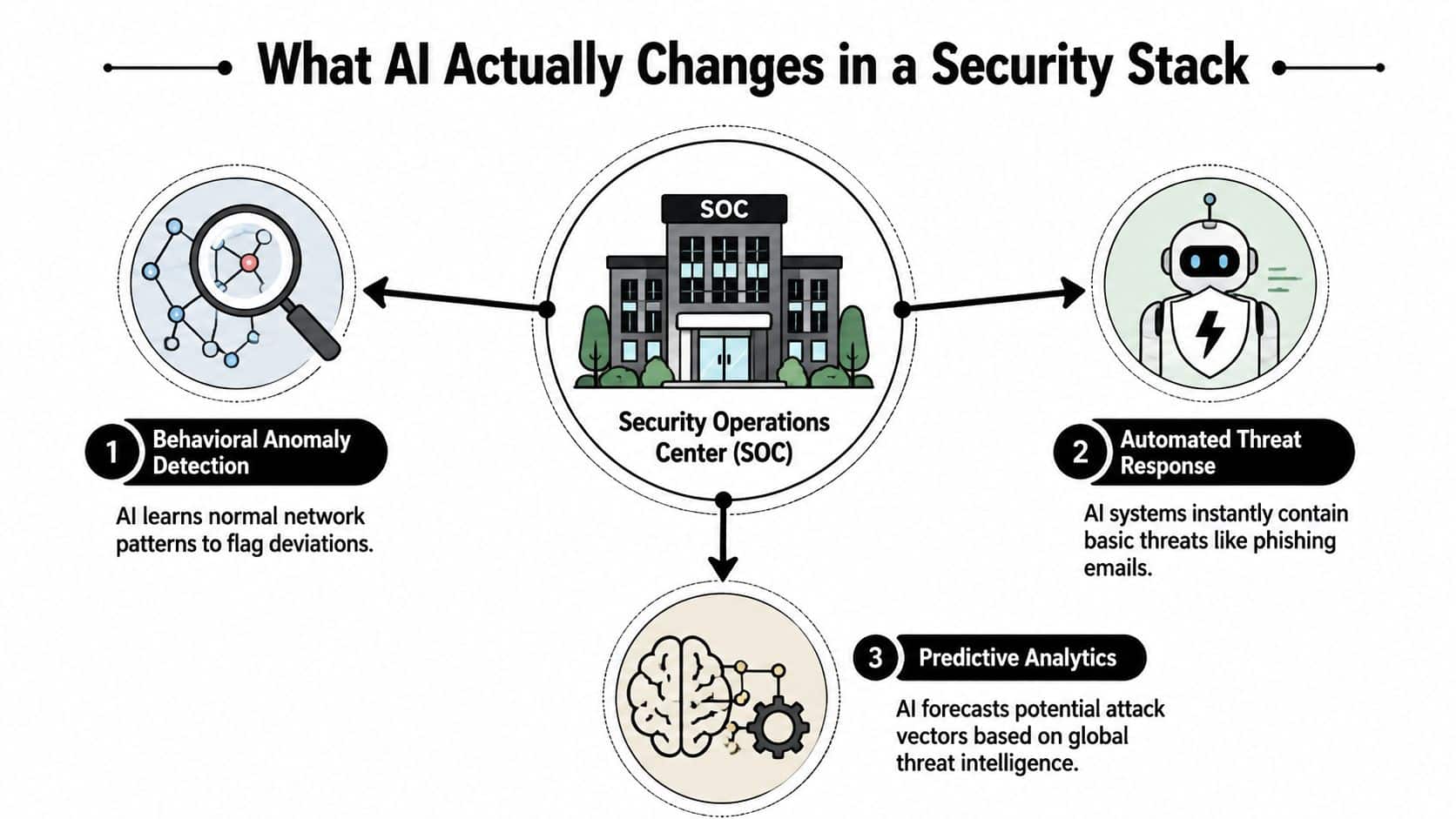
AI doesn't replace a security team. It changes how fast analysts can separate signal from noise. In practice, that means AI helps with behavioral anomaly detection, alert triage, phishing and malware analysis, identity-behavior analytics, and red-team simulation. It works like a 24/7 triage nurse, while the security team still makes the judgment calls.
What it does inside the SOC
The SANS Institute survey release reported that AI use in cybersecurity jumped from 50% to 78% in one year, and that 61% of practitioners now use AI in red-team work, up from 33% in 2025 (SANS Institute survey release). That shift says AI is no longer a side experiment. It is part of how defenders test, detect, and respond.
In a real security operations center, the value is operational, not magical. AI can sort through telemetry faster than a human analyst, flag deviations from normal behavior, and push routine alerts into a queue that a person can work. It can also help analysts decide whether a login pattern looks like a stolen credential, a compromised endpoint, or just an unusual but harmless user session.
For executives, the point is simple. Signature tools look for known bad patterns, while AI can learn what normal looks like and call out what does not fit. That matters in Atlanta sectors with constant traffic and sensitive data, because normal in a hospital, a bank, or a logistics operation is already noisy.
Where the gains are real
The strongest gains show up in detection speed, triage consistency, and red-team preparation. The weak point is still human oversight. AI can narrow the blast radius of routine threats, but if your data is messy or your controls are weak, it just makes bad processes faster.
Top AI tools every Atlanta business owner should know can help teams compare practical uses without getting lost in vendor hype.
The best use of AI in security is boring. Reduce queue clutter, surface the right alert, and give analysts room to think.
That is why adoption is concentrating first in organizations that cannot afford downtime and cannot afford data mistakes. The pattern is operational, not hype-driven. Compliance-minded teams in banking should also keep an eye on compliance AI in banking, because the tool choice only matters if it fits policy, logging, and oversight requirements.
The Governance Gap Atlanta Regulators Already Notice
The mistake I keep seeing is simple, executives buy AI tools and assume the tool is the control. It isn't. If staff can paste sensitive data into public models, if model inputs aren't logged, or if third-party datasets aren't reviewed, you've added risk instead of reducing it.
Shadow AI is the real control problem
Generative AI use has spread faster than policy in most firms. McKinsey reported that generative AI use rose from about one-third of organizations at the end of 2023 to nearly 80% by early November 2025, which shows how quickly usage is outrunning governance maturity (AJC coverage on AI and cybersecurity). For Atlanta's regulated sectors, that gap is where auditors will focus.
The uncomfortable reality is that many teams are already using AI informally for drafting, summarizing, code assistance, or analysis. The security issue isn't the model itself, it's the lack of rules around what data can be entered, where it's stored, who can see it, and how long it lives. If those questions aren't answered, the organization is operating on trust instead of control.
What regulators care about
Finance, healthcare, and government don't just need a secure posture, they need evidence. That means access controls, logging, policy enforcement, and documented oversight. If you can't show how AI outputs are reviewed, how datasets are screened, and how misuse is handled, your control story is weak.
For banking teams, a helpful benchmark is compliance AI in banking, because the core issue isn't whether AI can help with fraud or monitoring, it's whether the bank can prove it governed the system responsibly. That's the same question compliance officers will ask about any AI-assisted workflow.
Atlanta cybersecurity trends every business should watch
Bottom line: Buying AI without rewriting policy and access rules is a faster way to create audit findings.
Tenable's guidance on AI cybersecurity also makes the point clearly, organizations need to harden model inputs, review third-party datasets and open-source models for supply-chain integrity issues, and document intended use and limitations (Tenable AI cybersecurity principles). That's not a future problem. It's already the governance gap.
How Atlanta Sectors Are Adapting in Practice
The changes that matter are specific to each business model. A bank, a hospital, and a logistics operator can all use AI in security, but they won't govern it the same way because their risks aren't the same.
Financial services tighten identity and access
A regional bank using AI for fraud detection shouldn't give broad model access to everyone in security or operations. The smarter move is least-privilege access, just-in-time elevation, and tight logging around model inputs and outputs. If a fraud model is making decisions based on transaction behavior, the bank needs to know who can tune it, who can override it, and which changes were made.
Healthcare protects clinical data and workflow trust
A metro hospital system using ambient-documentation AI has a different problem. Clinicians want speed, but the system still touches PHI, and that means policy, training, and vendor review have to come first. The right control set includes employee guidance on what can be entered, review of vendor data retention terms, and clear handling rules for misfires or hallucinated notes.
Logistics hardens the network and the runbook
A logistics operator has to protect uptime. If AI is flagging traffic anomalies or assisting with incident detection, the company should test how alerts flow into its incident-response runbook and how the team escalates when the model is wrong. The useful habit is to log both the model's recommendation and the human analyst's decision, because that gives you a defensible record later.
| Sector | Primary AI Use Case | Key Governance Change | Residual Risk |
|---|---|---|---|
| Financial services | Fraud detection and alert triage | Least-privilege access and just-in-time elevation | Model tuning errors and over-reliance on automation |
| Healthcare | Ambient documentation and security monitoring | PHI handling rules and vendor review | Data leakage and clinician workarounds |
| Logistics | Network anomaly detection | Incident-response runbook updates and logging | False positives and missed edge cases |
The World Economic Forum's guidance is practical here, start with one or two high-impact use cases, validate data readiness, then scale in stages (WEF AI for Cybersecurity 2026). That is the right sequence for Atlanta too, because control maturity has to rise with deployment.
How to choose an ITAD vendor in Georgia step by step
Practical Steps Atlanta IT and Security Leaders Should Take Now
Stop trying to solve this with a single platform purchase. The winning move is a control stack that matches how employees work.
Start with policy, then lock down access
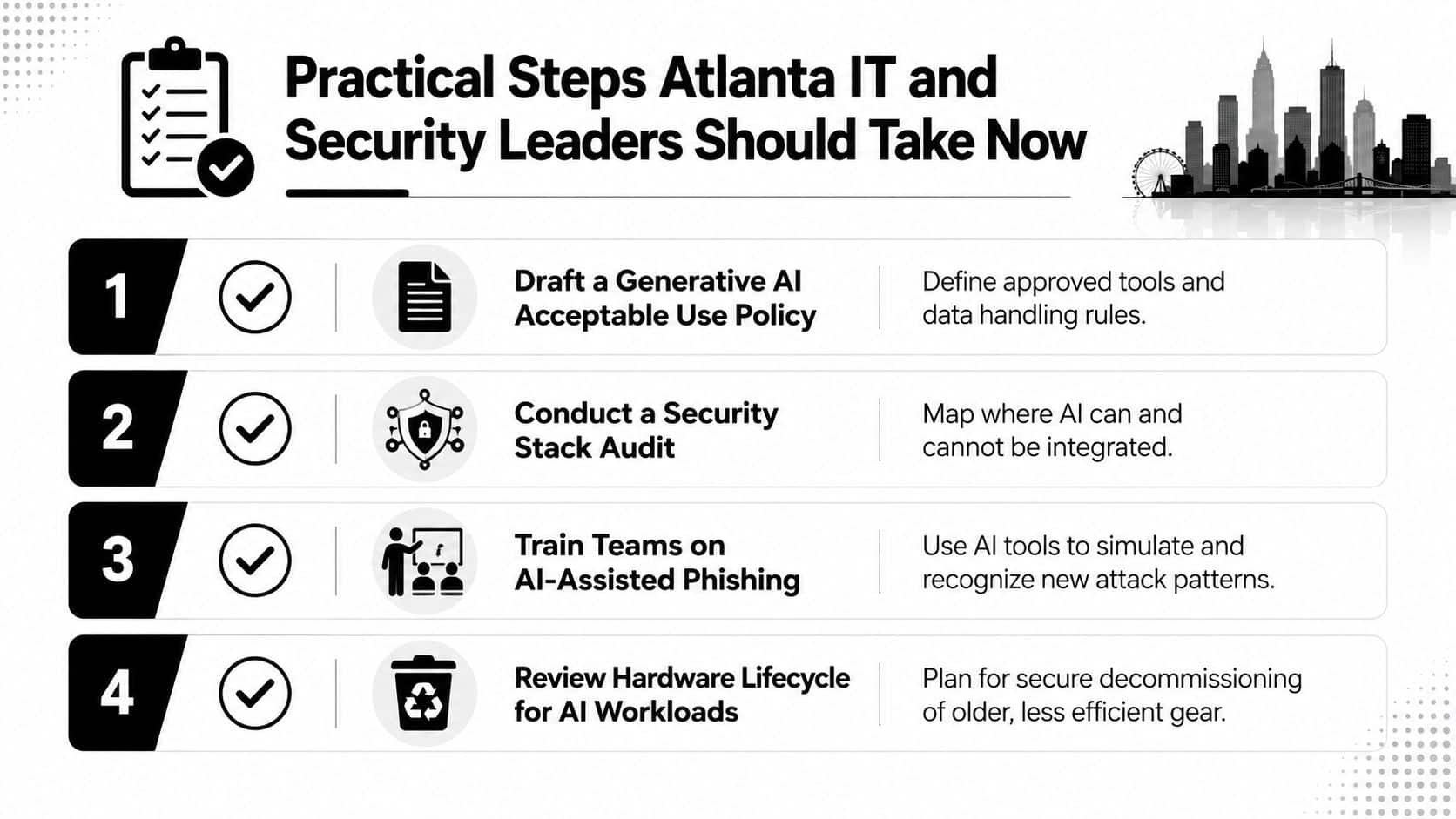
Draft a generative AI acceptable-use policy that says which tools are allowed, which data types are banned, and who approves exceptions. Then review who can touch AI systems, especially anything tied to logs, customer data, or regulated records. If you can't explain access on one page, the access model is too loose.
Make data handling and monitoring nonnegotiable
Integrate AI-SPM, review the model and dataset supply chain, and turn on logging for prompts, outputs, overrides, and admin changes. Use those logs. Don't just collect them. If you can't reconstruct how an AI decision was made, the system will fail an audit even if it works technically.
Operational rule: AI is only as useful as the data, permissions, and logs around it.
Train the team and retire old gear cleanly
Security awareness training now has to cover AI-assisted phishing, prompt misuse, and the habit of dropping sensitive data into public tools. Atlanta companies also need to plan for the hardware lifecycle. AI-touched workstations, storage arrays, GPUs, and decommissioned servers should be retired with the same discipline as any other sensitive system.
That is where secure disposal matters. Beyond Surplus is one option for certified electronics recycling and secure IT asset disposition, especially when the hardware held customer data, model artifacts, or AI-related logs. For organizations that need disposal evidence, the process matters as much as the pickup.
What to skip
Skip broad “AI transformation” programs that never touch policy, access, or retention. Skip pilots with no logging. Skip hardware refreshes that don't include data destruction planning. Those are vanity projects, not controls.
Choosing the Right Path for Secure Data Destruction and ITAD
Once AI touches servers, developer workstations, or storage, end-of-life handling becomes part of the cyber program. I'd treat that as mandatory, not optional.
Pick the method by risk, not convenience
On-site shredding makes sense when the asset never should leave your control. Off-site shredding at a certified facility can be fine when chain-of-custody is tight and documentation is complete. Certified wiping works for some devices, but it isn't the right answer for every scenario, especially when the data exposure risk is high.
Physical destruction is the blunt instrument. It's appropriate when the goal is certainty, not reuse. Wiping is more about value recovery, while shredding is about liability reduction. If the hardware held model data, customer data, or sensitive operational information, certainty usually wins.
| Scenario | Better Choice | Why |
|---|---|---|
| Data center decommissioning | Certified ITAD with chain-of-custody | Large asset volume and documentation needs |
| Laptop refresh | Certified wiping or destruction, depending on data sensitivity | Balance of recovery and risk |
| Medical equipment disposal | Physical destruction or tightly controlled ITAD | Sensitive records and regulated workflows |
| Product destruction | Documented destruction with certificates | Proof matters as much as disposal |
A generic e-waste recycler can move boxes. That's not enough for regulated or AI-touched assets. You want a partner that provides certificates of recycling and data destruction, because those records help transfer liability and support compliance.
The key distinction is simple, ITAD is about asset disposition with evidence, not just hauling hardware away. If your organization can't prove what happened to the drives, GPUs, and storage media, you haven't really closed the loop.
Compliance, Local Resources, and What Auditors Will Ask
Auditors will ask for proof, not good intentions. For Atlanta companies, that means documented handling aligned to the FTC Disposal Rule, HIPAA and HITECH for healthcare, GLBA and PCI-DSS for financial institutions, and Georgia breach-notification requirements.
The evidence trail matters
If you already have an incident log, a policy, and a certificate of destruction, the conversation is easier. If you don't, you'll spend time reconstructing decisions after the fact. That's why secure disposal and AI governance belong in the same control environment.
For documentation-heavy teams, AI hiring audit trail support is a useful reminder that auditability is a systems problem, not a paperwork exercise. The same logic applies to AI use, access decisions, and hardware retirement.
Local organizations should also keep an eye on resources such as the Metro Atlanta Chamber, the Georgia Technology Authority, and the Atlanta Cyber Center. For certified electronics recycling and secure IT asset disposition, vetted providers like Beyond Surplus fit naturally into the compliance chain when the hardware has to be removed without creating data exposure.
National Institute of Standards and Technology SP 800-88 guidance
A 30-60-90 Day Action Plan for Atlanta Security Leaders
In the next 30 days, inventory every AI tool in use, draft the acceptable-use policy, and confirm destruction certificates for current refreshes. In days 31 to 60, tighten access with least privilege and just-in-time controls, turn on logging, and wire in AI-SPM. In days 61 to 90, run tabletop exercises that include AI-specific scenarios, review vendor and model supply chains, and schedule hardware retirement through a certified ITAD partner.
That sequence works because it forces discipline in the right order. Policy first. Control second. Disposal and audit evidence last, but never optional.
If your Atlanta team is deploying AI and still retiring hardware like it's a standard office cleanup, that gap needs to close now. Beyond Surplus handles certified electronics recycling, secure IT asset disposal, and data destruction for businesses that need a documented chain of custody and a cleaner compliance story. Visit Beyond Surplus to line up secure disposition that fits your AI, security, and audit requirements.


