

In 2021, Atlanta surpassed Chicago, Austin, and San Francisco in tech job postings, a turning point that signaled more than momentum. It showed that the center of gravity for Southern tech had shifted toward Atlanta, where major employers, startup activity, and digital infrastructure were converging in one market. That milestone, documented by Built In's coverage of Atlanta's rise, is the clearest starting point for understanding why Atlanta is becoming the South's tech hub.
For IT leaders, though, the true impact isn't just job growth or new office announcements. Growth changes operations. More hiring means more laptops, more servers, more network gear, more mobile devices, more lab and medical equipment, and more end-of-life hardware that has to be tracked, wiped, removed, recycled, or destroyed without creating a security problem. That's where the headline story gets more practical.
Atlanta's Unstoppable Rise in the Tech Sector
Atlanta moved into the top tier of U.S. tech markets on the strength of hiring demand, but the more important signal for operators is durability. This market is growing across software, cybersecurity, analytics, fintech, health IT, and enterprise support functions, which means companies are adding systems, sites, and devices at the same time. That kind of expansion creates opportunity, but it also creates operational exposure if asset controls lag behind growth.
Growth looks different from inside IT operations
Inside IT, a growing tech hub is visible long before it shows up in a press release. It shows up in longer procurement cycles, faster onboarding, more remote deployments, more office consolidations, and more equipment reaching end of life. As Atlanta attracts large employers and scaling startups, IT teams have to support expansion without losing control of inventories, data-bearing assets, or disposal records.
That is the part of the story many growth pieces miss. Every new office, hardware refresh, lab upgrade, cloud migration, or merger produces retired laptops, failed drives, networking gear, deinstalled racks, and mobile devices that still carry security and compliance risk. If those assets sit in storage rooms, move between locations without documentation, or leave the business through informal recycling channels, the problem shifts from operations to audit, legal, and security.
What smart operators pay attention to
- Integrating procurement and disposition into one auditable workflow: Teams need purchase, deployment, redeployment, and retirement records tied to the same asset record.
- Assigning a named owner for chain of custody on retired data-bearing assets: Without clear ownership, devices get boxed, moved, and forgotten.
- Planning for site closures, relocations, and hardware refreshes before the project starts: Disposal backlogs build fast during office moves and data center changes.
- Requiring certificates, serialized reporting, and data destruction documentation from downstream vendors: In regulated environments, pickup confirmation is not enough.
- Separating resale value decisions from security decisions: Holding obsolete equipment too long can reduce recovery value and increase exposure at the same time.
For a broader view of the startup side of this trend, see how Atlanta became a top destination for tech startups. The business upside is clear. The operational burden is real too.
Atlanta's tech boom is real. The harder question for IT leaders is whether asset governance, data destruction, and compliance controls are scaling with it.
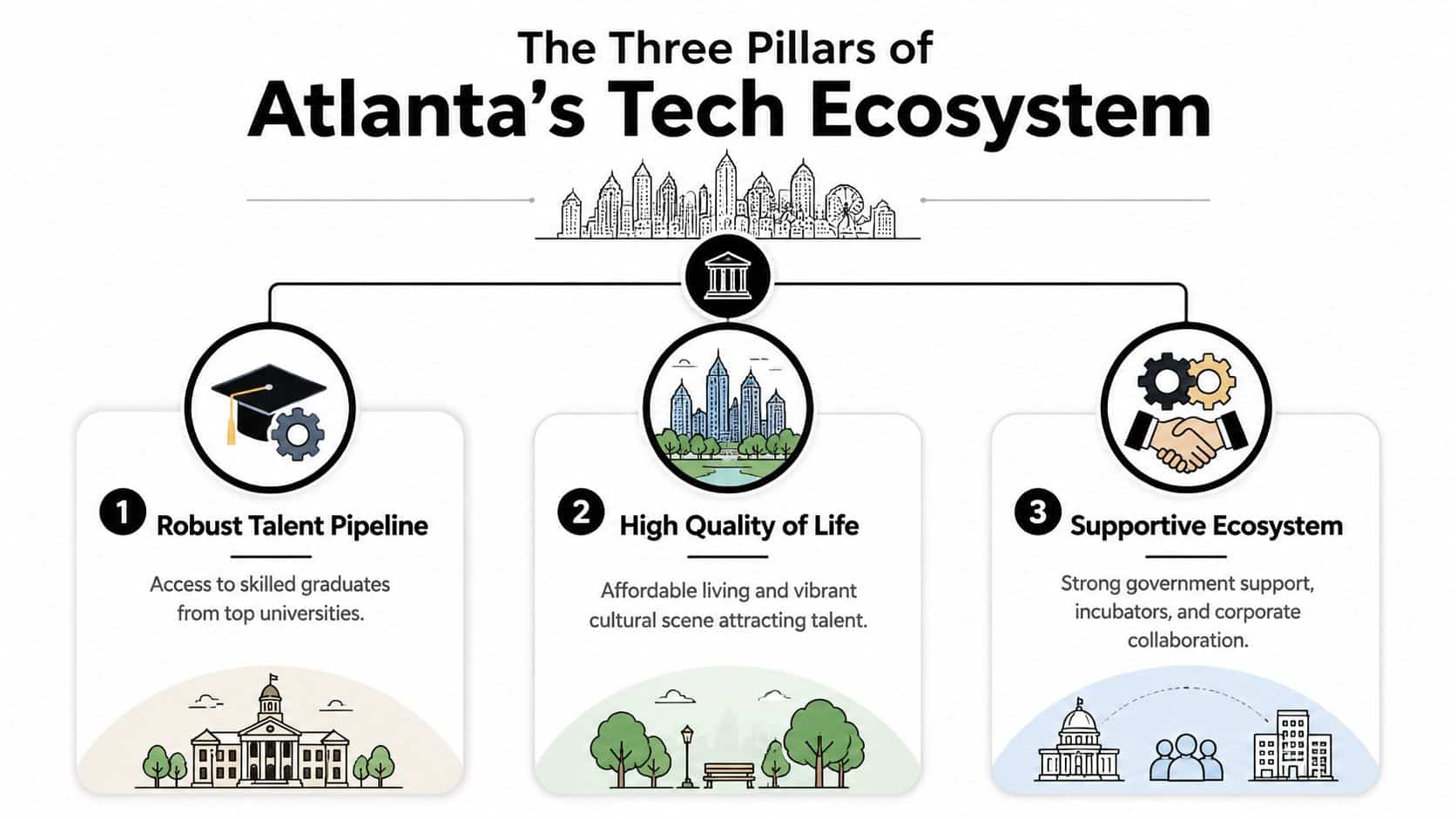
The Three Pillars of Atlanta's Tech Ecosystem
Atlanta has durable advantages. The city doesn't depend on a single industry narrative, which makes its tech expansion more resilient than many markets that ride one sector cycle.
Talent pipeline
A tech hub needs more than recruiters. It needs a repeatable way to develop engineers, analysts, operators, and founders. Atlanta benefits from strong university output and a local environment that keeps technical talent connected to employers, labs, and enterprise teams.
For employers, this matters because a stable talent pipeline lowers execution risk. It's easier to support internal IT, cybersecurity, cloud operations, and support functions when the labor market has depth. That doesn't eliminate competition for talent, but it does make long-term planning more realistic.
Quality of life and retention
People don't just move for salary. They stay for livability. Atlanta gives companies a market where talent can build a career without some of the cost pressure that defines older coastal hubs. That changes recruiting conversations and retention economics.
The effect is especially visible in mid-career hiring. Senior technical staff often want strong compensation, but they also want easier housing decisions, airport access, and room to move between employers without relocating again. Atlanta checks those boxes.
Supportive ecosystem
The strongest tech markets create connections between startups, large enterprises, advisors, logistics providers, and infrastructure partners. Atlanta has built that kind of environment. That doesn't mean every company scales cleanly, but it does mean firms can find specialized support faster than in thinner markets.
A good local example is Atlanta Tech Village, which reflects the collaborative side of the city's business infrastructure.
Operational takeaway: Ecosystems matter because they shorten the distance between a business problem and a workable solution.
Fueling Growth with Investment and Digital Infrastructure
Atlanta's growth story gets more interesting when you separate startup finance from physical infrastructure. The two don't always move in the same direction.
Venture capital isn't the whole story
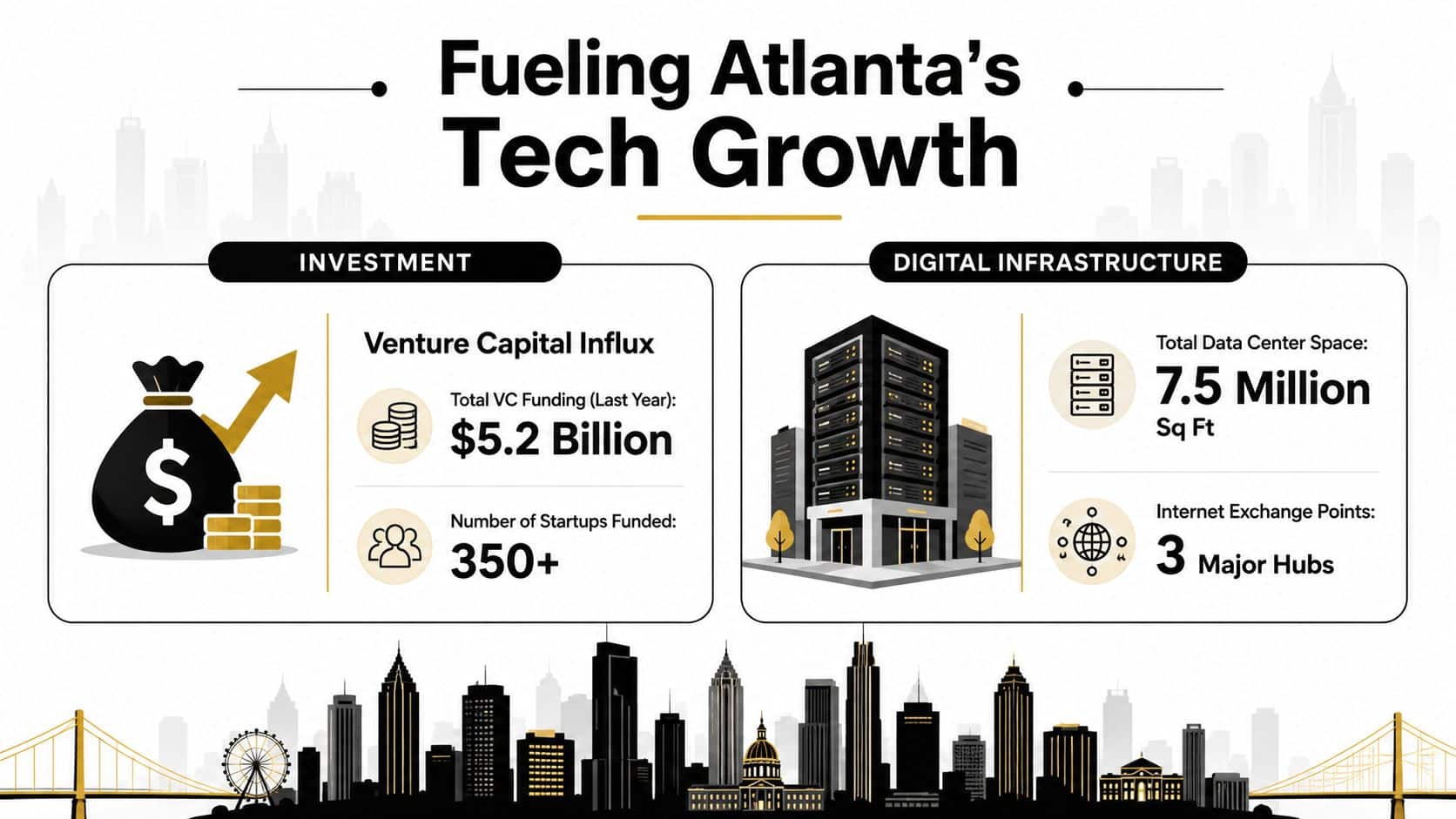
A Boston Consulting Group report published on January 23, 2024 found that venture capital funding declined by more than 40% from 2021 to 2022, and new startups fell 64% from 444 in 2017 to 158 in 2022. The same report said Atlanta would need to launch approximately 2,000 startups annually to earn a place among the nation's top five technology hubs, according to Yahoo Finance's report on the BCG findings.
That matters because mature ecosystems need more than branch offices and hiring spikes. They need repeatable startup formation, early funding, and operator talent willing to build from scratch. If you're advising founders, this is also why resources on bootstrapping a startup effectively can be useful when venture markets tighten.
Infrastructure is expanding fast
Physical build-out tells a different story. According to GovTech, Atlanta's data center construction volume has doubled every six months since mid-2023, with roughly 2x year-over-year growth in under-construction capacity. GovTech also attributes that acceleration to Georgia's $296 million statewide sales tax waiver and hundreds of millions in local property tax incentives targeted at data center development in its reporting on the Atlanta data center market.
For IT operations, this is the signal to watch. Data centers don't just represent compute. They create procurement waves, migration projects, rack retirements, cable removal, device rotation, and eventual decommissioning work. When infrastructure scales this quickly, disposal discipline has to scale with it.
A related local perspective appears in this roundup of major IT investments coming to Atlanta in 2026.
| Area | What it means on the ground |
|---|---|
| Startup funding | More selective growth, tighter capital discipline |
| Data center build-out | More hardware entering and exiting managed environments |
| Incentives | Faster expansion, but also faster infrastructure turnover |
The Compelling Business Case of Cost and Incentives
Atlanta is attractive because the economics are easier to defend in a boardroom. Companies can tell a stronger operating story here than they can in many legacy tech markets.
Cost structure changes strategy
Georgia's business-friendly regulatory framework, including low corporate tax rates and right-to-work laws, combines with Atlanta's housing cost advantage to lower pressure on both employers and employees. Orbit Analytics states that housing costs are approximately 60% lower than San Francisco and 45% lower than Seattle, and that this cost differential can help tech firms reduce total IT infrastructure spend by 25 to 35 percent while maintaining enterprise-grade security and compliance in its analysis of Atlanta's continuing growth.
That's not a small distinction. In practice, lower operating pressure gives companies more flexibility in staffing, office footprint, hybrid work support, warehousing, deployment logistics, and refresh planning. It also gives procurement and infrastructure leaders more room to choose vendors based on process quality instead of making every decision on the lowest upfront bid.
What works and what doesn't
What works in Atlanta is using the cost advantage to build a cleaner operating model. That means standardizing refresh cycles, documenting data destruction requirements, and tying infrastructure decisions to compliance from the start.
What doesn't work is using lower costs as permission to tolerate loose inventory controls or informal disposal practices. Savings disappear quickly when retired assets sit in storage cages, branch closets, or vacated office suites because no one defined an end-of-life process.
- Good use of incentives: Build scalable procurement and retirement workflows.
- Bad use of incentives: Expand quickly without governance for surplus equipment.
- Good CFO logic: Treat compliance and asset recovery as cost-control levers.
- Bad CFO logic: Assume disposal is a minor facilities task.
The Hidden Challenge of Hyper-Growth Managing IT Assets
Atlanta's growth story usually focuses on hiring, startups, and real estate. The less visible issue is what happens after the hardware arrives, gets deployed, and ages out.
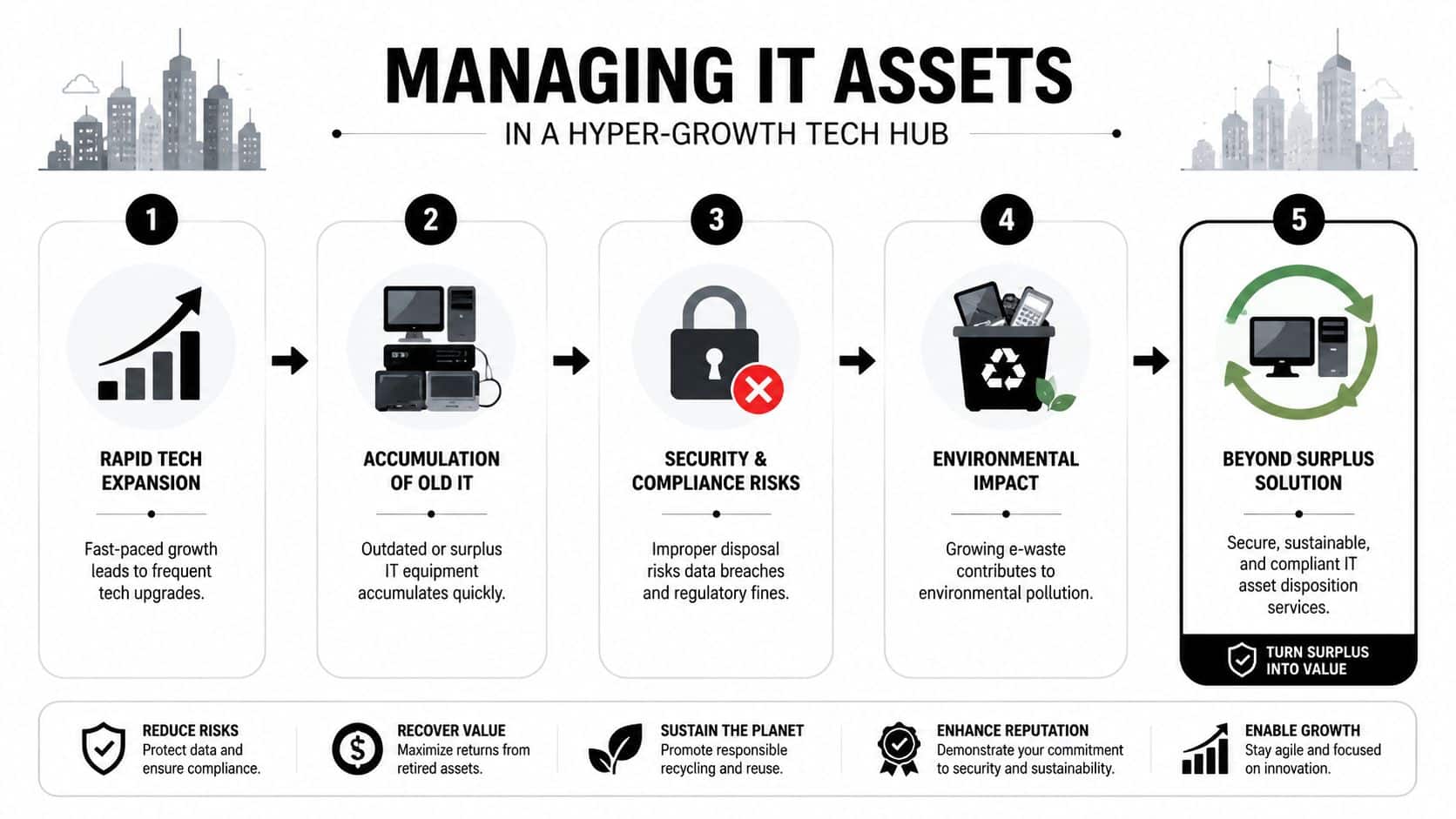
The overlooked bottleneck is end-of-life IT asset management. A source focused on this gap notes that while coverage often celebrates Atlanta's 13,000+ tech companies and $5.8B Georgia Tech engine, it rarely connects that growth to the rising need for decommissioning, verified data destruction, and electronics recycling in this discussion of Atlanta's scaling challenges.
Why growth creates disposal risk
Every office opening, cloud expansion, lab upgrade, healthcare rollout, or network modernization project creates a future retirement event. Devices leave service. Storage media holds sensitive data. Equipment moves off lease. Branches close. Data centers consolidate. If teams don't have chain-of-custody controls, the risk doesn't stay theoretical.
The FTC Disposal Rule exposure mentioned in the verified background is a good example of why this isn't a back-office detail. For healthcare, finance, education, and government organizations, bad disposal practices can create legal, contractual, and reputational problems at the same time.
Where companies usually fail
The failures are familiar:
- Untracked storage media: Drives leave service with unclear custody.
- Ad hoc office cleanouts: Facilities teams remove equipment without data review.
- Delayed pickups: Surplus accumulates in unsecured rooms.
- Incomplete records: Audit trails end at “recycled” with no proof of destruction.
A related challenge appears in distributed environments, where offboarding and equipment retrieval become inconsistent. This is why many IT teams are rethinking remote workforce IT asset management and equipment returns.
Practical rule: If your refresh program moves faster than your retirement program, you don't have an asset lifecycle strategy. You have a storage problem with compliance exposure.
Actionable ITAD Strategies for Atlanta Businesses
The answer isn't more hardware storage. It's a stronger ITAD program with clear ownership, documented controls, and service partners that understand regulated environments.
Start with data destruction standards
Any device that has stored or processed sensitive data needs a defined disposition path. That includes laptops, desktops, servers, backup devices, networking gear with embedded storage, medical devices, and mobile hardware. Your policy should specify when to use certified data wiping, when physical destruction is required, and who signs off before assets leave a site.
Healthcare organizations need to be especially disciplined. Market Research Future identifies healthcare as the fastest-growing vertical segment in the IT asset disposition market because HIPAA requires certified data destruction for devices that processed protected health information in its ITAD market report.
Build process before volume hits
A solid ITAD operating model usually includes:
Asset identification
Tag data-bearing devices early and classify them by risk.Removal controls
Require documented pickups, serialized inventories, and custody records.Disposition method selection
Match wiping, shredding, resale, recycling, or product destruction to the asset and risk profile.Certificates and reporting
Keep formal records for destruction, recycling, and downstream compliance.
Focus on value recovery and decommissioning readiness
Not every retired asset is waste. Some equipment still has recovery value, especially when it's removed on schedule, sorted correctly, and kept in marketable condition. But value recovery only works when it doesn't compromise security. If a team chases resale before chain of custody, they're solving the wrong problem first.
For Atlanta businesses managing server rooms, lab spaces, hospital environments, and multi-site offices, the strongest programs treat ITAD as part of change management. Office closures, migrations, and hardware refreshes should trigger disposal planning at the same time they trigger procurement and deployment planning.
The best ITAD programs aren't reactive. They're written into the operating calendar.
Partnering for Sustainable Tech Growth in Atlanta
Atlanta's tech expansion will reward companies that treat asset retirement as an operating discipline, not an afterthought. In practice, sustainable growth depends on who owns end-of-life decisions, how consistently devices are tracked out of service, and whether security, compliance, and environmental targets are managed together instead of in separate workflows.
That matters at the executive level. Boards may talk about ESG in broad terms, but IT leaders have to turn those goals into documented disposal processes, auditable vendor standards, and defensible chain-of-custody records. A useful local perspective is this look at ESG trends in Atlanta and sustainable IT practices.
The strongest Atlanta organizations usually share three habits: clear ownership between IT, security, facilities, and procurement; disposition records that hold up during audits and contract reviews; and vendor relationships that support both data destruction and downstream recycling accountability. That is how growth stays controlled as device counts, locations, and regulatory exposure increase.
Contact Beyond Surplus for certified electronics recycling, secure IT asset disposal, data destruction, product destruction, and data center decommissioning support for your Atlanta business.


