

Tuesday morning, an Atlanta IT manager is staring at three separate retirement projects: 140 desktops coming off lease at a Midtown professional services firm, a Buckhead server room being decommissioned, and a copier lease ending in Duluth. The equipment is ready to leave, but the documentation probably isn't. If a misplaced drive still contains client Social Security numbers, the incident can trigger breach obligations. If the disposal record is incomplete, the company may struggle to demonstrate reasonable controls under the FTC Disposal Rule or defend its handling of protected health information under HIPAA.
That makes computer recycling in Atlanta a documentation problem before it's a logistics problem. The risk window opens when devices leave the loading dock without a verified chain of custody. A defensible process connects the inventory to the destruction method, the certificate, and the retained evidence. The cheapest hauler may remove equipment quickly, but speed alone doesn't prove what happened to each serialized asset.
Table of Contents
- The Atlanta IT Manager's End-of-Life Moment
- Asset Assessment and Inventory Before Pickup
- Data Destruction Methods That Actually Hold Up
- Chain of Custody and Certificates of Destruction
- FTC Disposal Rule, HIPAA, and Georgia Compliance
- Logistics, De-Installations, and Value Recovery
- Choosing an Atlanta ITAD Partner and Next Steps
The Atlanta IT Manager's End-of-Life Moment
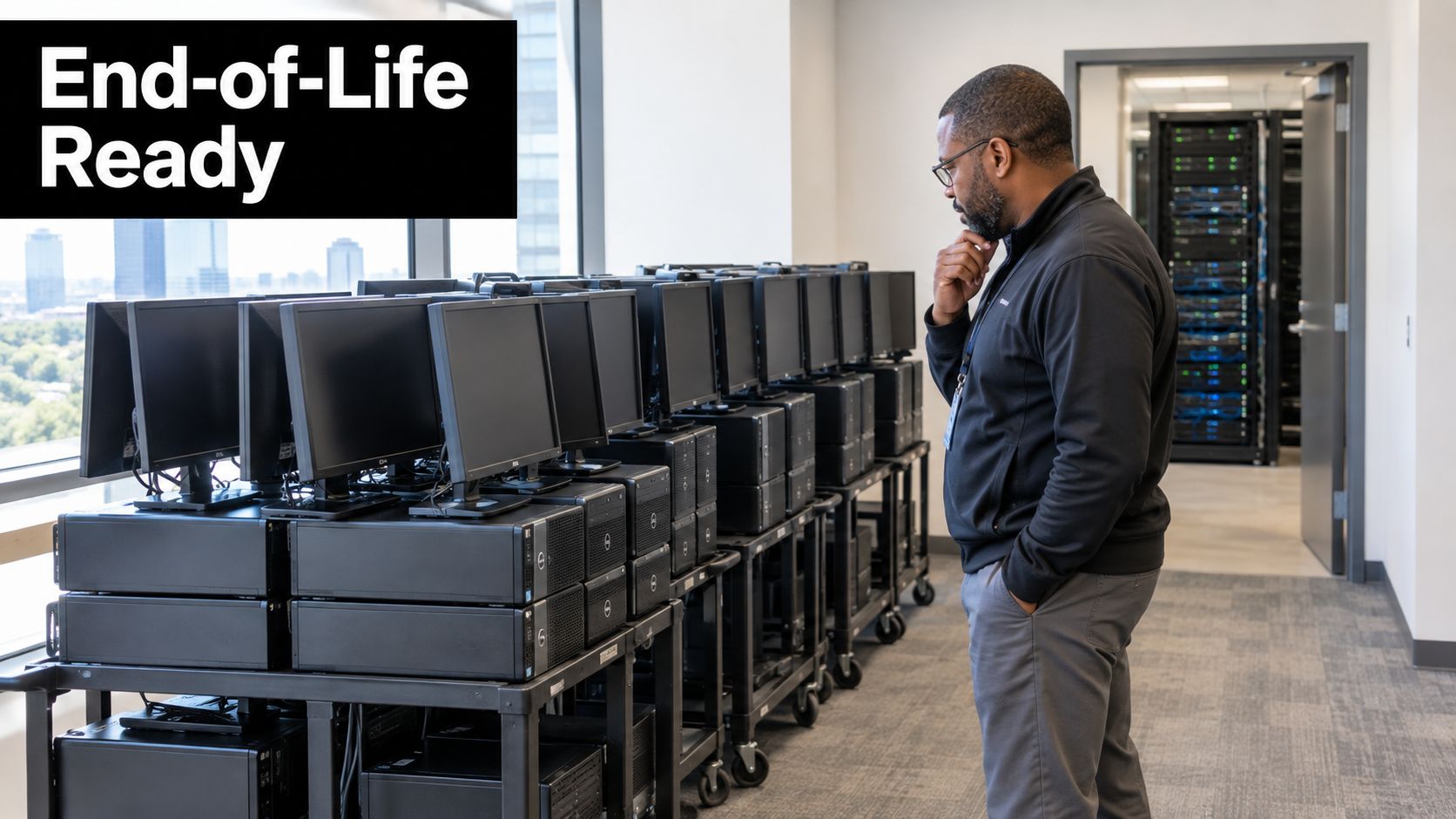
The loading dock is where informal disposal plans become business risk. A device can be counted in a storage room, loaded into a truck, and still disappear from the records your auditor needs. The question isn't merely whether the recycler picked up the computers. It's whether your team can prove which device left, who accepted it, how its data was handled, and where the final record sits.
For Atlanta businesses, that concern extends well beyond desktop towers. A server room may contain hard drives, solid-state drives, backup media, network appliances, and equipment with embedded storage. The copier heading out of Duluth may also contain a drive. Treating only laptops and servers as data-bearing assets creates a documentation blind spot.
The four records that matter
Build the disposal file around four linked documents:
- Inventory record: Identify the asset ID, serial number, device class, storage media, and data status.
- Disposition decision: State whether the media will be cleared, purged, or destroyed, and why that method fits the device.
- Custody evidence: Record the pickup, seal, carrier, handoff, and receiving facility.
- Final certificate: Tie the destruction or recycling outcome to each serialized asset.
The FTC Disposal Rule guidance recognizes reasonable and appropriate safeguards, including destroying or erasing electronic files or media so they can't be read or reconstructed. It also applies when equipment is sold, donated, or transferred, not only when it's discarded.
Practical rule: If the certificate doesn't identify the specific drive or device, it doesn't close the evidence gap.
Atlanta computer disposal should therefore begin with an asset register and a documented decision, not a request for a truck. Once the equipment leaves your control, the quality of those records determines whether the process looks controlled or careless.
Asset Assessment and Inventory Before Pickup
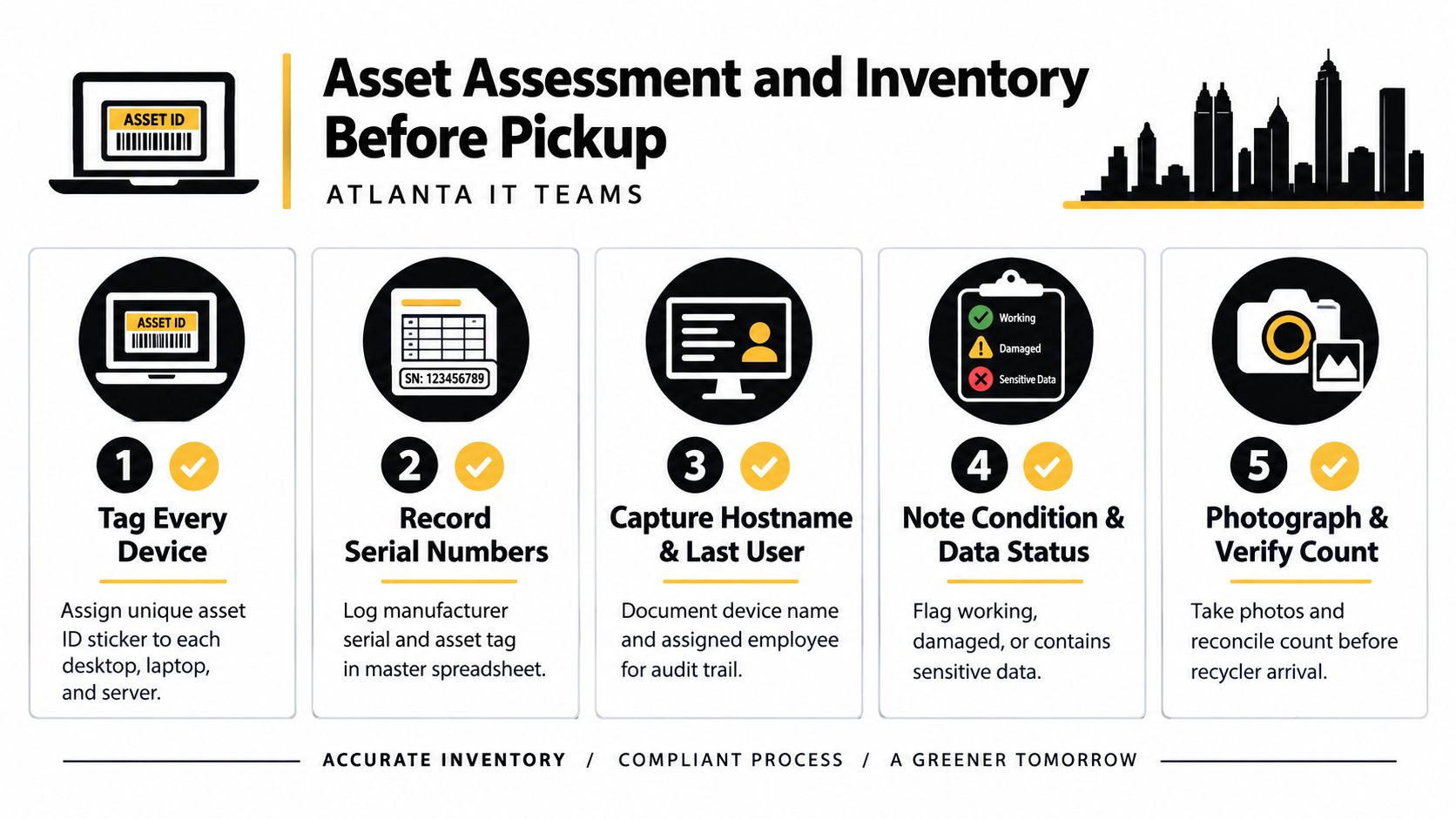
Start the inventory before a recycler schedules a crew. Assign every desktop, laptop, server, monitor with storage, and network appliance a unique asset ID. Then reconcile that ID with the manufacturer serial number, make, model, hostname, and last assigned user.
The last-user field matters because it helps IT confirm whether the device has been removed from service, backed up, and released by the responsible department. It also gives an auditor a readable trail when the asset register, endpoint system, and recycler's report use different naming conventions.
Capture the equipment people overlook
Don't limit the spreadsheet to obvious computers. Add a separate review for equipment that often contains embedded or removable storage:
- Office copiers: Multifunction devices may retain documents, address books, and authentication data.
- POS terminals: Retail systems can hold transaction or customer information.
- Security DVRs: Video systems use hard drives that rarely appear in the standard desktop retirement list.
- Badge readers and access systems: Controllers may retain logs or configuration data.
- Company-issued phones: Mobile devices require a recorded disposition even when they aren't part of the desktop refresh.
Record whether each item is under warranty, part of a lease return, eligible for resale, or destined for recycling. A working server with residual value shouldn't be mixed into an end-of-life scrap category before the ITAD partner evaluates it.
Make the spreadsheet the source of truth
At minimum, include:
| Field | Why it belongs in the record |
|---|---|
| Asset ID and serial number | Connects the physical item to every later report |
| Make, model, and device class | Clarifies the equipment and its processing path |
| Drive type | Separates HDD, SSD, flash, and other media decisions |
| Hostname and last user | Preserves the internal ownership trail |
| Condition and data status | Supports resale, redeployment, wiping, or destruction |
| Final disposition | Records the selected outcome and certificate reference |
Photograph device tags in batches before pickup. Keep the images with the inventory export, then compare the physical count against the spreadsheet while the recycler is still on site. That simple verification can expose a missing laptop or an unlisted copier before custody changes hands.
Data Destruction Methods That Actually Hold Up
A reformat or factory reset isn't a sanitization method you should defend to an auditor. Those actions change how the operating system sees the storage, but they don't establish that the underlying information can't be recovered or reconstructed.
Use three distinct workflows, commonly described as Clear, Purge, and Destroy, and choose among them based on media type, reuse plans, and regulatory exposure. The NIST 800-88 data destruction standards provide the framework, but the practical decision belongs in your asset record before pickup.
Match the method to the media
| Method | HDD Suitability | Result |
|---|---|---|
| Clear | Suitable for lower-risk internal reuse when the device remains controlled | Logical sanitization through an approved process |
| Purge | Stronger choice for reuse when data exposure requires enhanced controls | Sanitization designed to make recovery impractical while preserving the asset where possible |
| Destroy | Appropriate for failed, high-risk, or non-reusable media | Physical destruction eliminates the storage medium as a readable device |
For traditional hard disk drives, software wiping can preserve resale value when the process is verified per drive. Cryptographic erase can also be appropriate when encryption and key management support it. The certificate should identify the individual drive, the method, the completion point, and the operator or system that performed the work.
Solid-state drives require more care. Flash controllers remap storage blocks, so conventional overwriting may not address every location that previously held data. Secure Erase, cryptographic erase, or physical destruction may be more defensible, depending on the device and exposure.
Decide where destruction should happen
On-site service makes sense for regulated data, executive devices, and any project where an uncontrolled transport leg creates unacceptable exposure. Off-site processing can work when the recycler uses sealed containers, documented handoffs, and verified receiving controls.
The right question isn't “What does destruction cost per pound?” It's “Which method produces defensible evidence for this media?”
Degaussing belongs only in a carefully defined media strategy because it targets magnetic storage and doesn't solve the same problem for flash media. Physical shredding offers a straightforward endpoint for drives that won't be reused, but it must still produce serial-level evidence. Data destruction is complete only when the method and the specific asset are connected in the records.
Chain of Custody and Certificates of Destruction
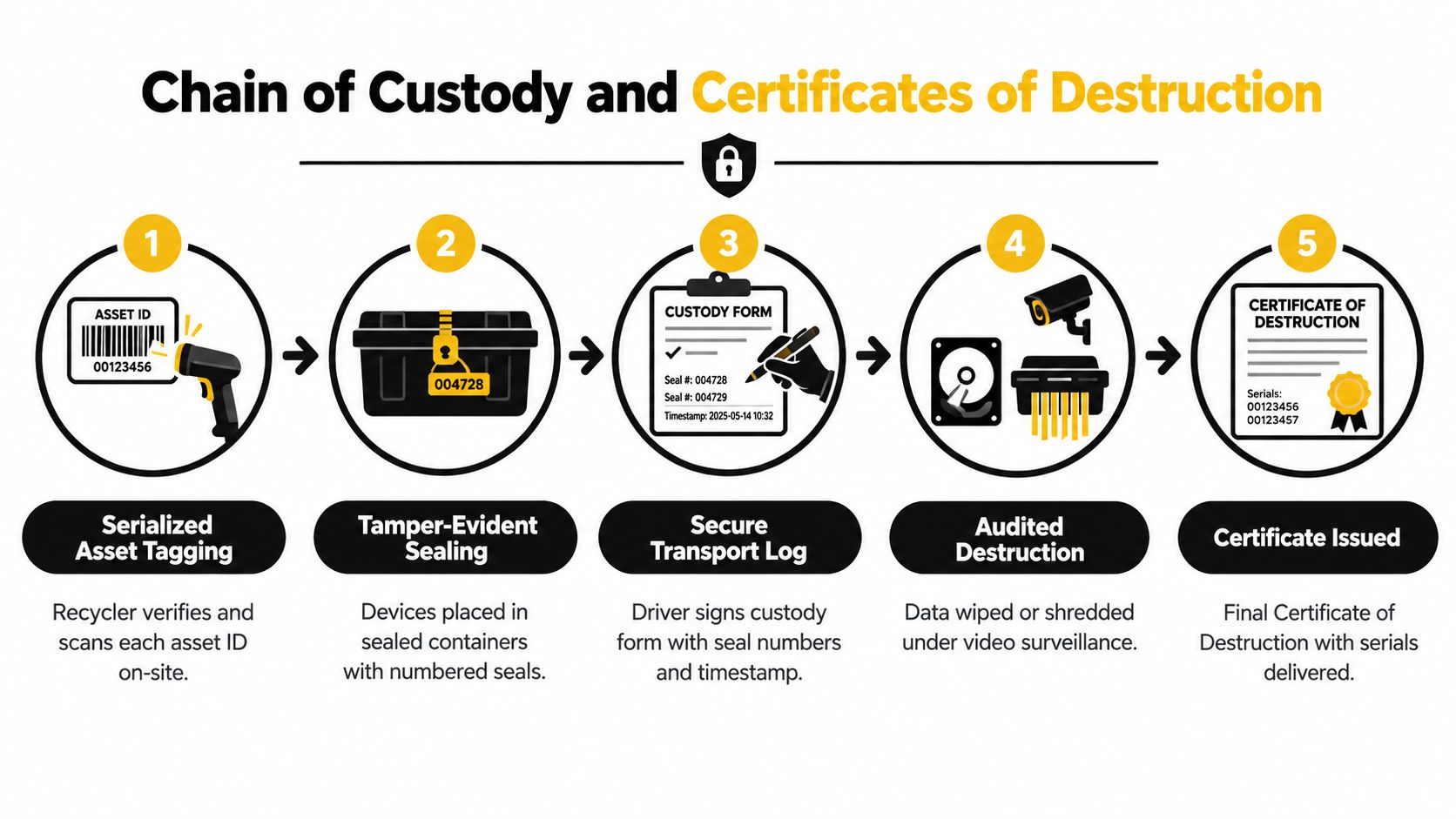
Chain of custody starts before the truck moves. The recycler should verify the serialized inventory at pickup, place assets into controlled bags or containers, apply tamper-evident seals, and record the seal numbers on the custody form. The driver signs for the handoff, transport information is retained, and the receiving facility documents acceptance.
GPS tracking can strengthen the transport record, but it doesn't replace asset-level reconciliation. A route proves where the vehicle traveled. It doesn't prove which drive was inside unless the device list, container, seal, and handoff records match.
Demand an evidence pack, not a vague PDF
A defensible Certificate of Destruction should identify:
- The destruction method: Wipe, purge, shredding, or another defined treatment.
- The serialized assets: Each drive or device should appear by serial number and asset ID.
- The event details: Date, time, location, and processing facility.
- The responsible technician: Include credentials or an identifiable operator record.
- The standard applied: Note alignment with NIST 800-88 where applicable.
- The recycling outcome: Keep recycling documentation separate from data-destruction evidence.
The chain-of-custody process should remain traceable from your dock to the processing point. The serial-number evidence pack is the artifact that lets you answer a direct question: what happened to this particular machine?
Reject these documentation failures
Shared certificates are weak because they group multiple customers or devices without proving individual treatment. Missing serial numbers create the same problem. A certificate dated before the actual destruction event is another warning sign, especially when the processor hasn't yet received or inspected the equipment.
Keep the pickup manifest, seal log, driver acknowledgment, receiving confirmation, destruction report, and recycling certificate together. Your records should make the entire path readable without requiring the vendor to reconstruct the story later.
FTC Disposal Rule, HIPAA, and Georgia Compliance
The legal analysis starts with the data your organization maintains. Businesses that handle consumer report information must apply reasonable and appropriate measures so discarded or transferred records can't be read or reconstructed. That includes electronic media and equipment leaving through donation, resale, lease return, or vendor transfer.
Healthcare organizations face a separate layer of responsibility for protected health information. HIPAA disposal controls should connect written procedures, workforce responsibilities, vendor oversight, and evidence that sanitization occurred. A healthcare provider shouldn't accept a generic “recycled” statement when a serialized storage device held patient information.
Separate obligations by business profile
| Regulation | Applies To | Required Disposal Control | Records to Keep |
|---|---|---|---|
| FTC Disposal Rule | Businesses maintaining covered consumer report information | Reasonable safeguards, documented erasure or destruction, and due diligence over contractors | Policies, vendor review, custody records, destruction evidence, and certificates |
| HIPAA | Covered healthcare entities and business associates handling PHI | Sanitization or destruction that prevents unauthorized access, supported by administrative and technical controls | Policies, workforce records, vendor agreements, serialized destruction reports, and certificates |
| Georgia framework | Businesses operating within Georgia's solid-waste and local-program structure | Vet the recycling route and downstream processors rather than assuming disposal alone establishes responsible handling | Processor qualifications, downstream disclosures, recycling records, and asset manifests |
Georgia doesn't have a statewide e-waste law that broadly bans all electronics from landfills or requires every business to recycle retired electronics, according to this Georgia e-waste compliance overview. That gap changes the procurement question. Legal minimums don't automatically prove responsible downstream processing.
Put vendor controls in writing
Require a destruction SOP, subcontractor disclosure, downstream liability language, and a retention policy aligned with the longest applicable audit requirement. HIPAA records may need to be retained for 6 years, as specified in the applicable rule and guidance. For FTC-covered records, follow the organization's Records Retention schedule and document why that schedule applies.
A contract should also state who owns the evidence, who may process the media, and what happens if a downstream processor changes. Compliance isn't a logo on a proposal. It's a set of controls your team can inspect.
Logistics, De-Installations, and Value Recovery
A secure Atlanta ITAD pickup needs an operational brief before the crew arrives. Send the equipment list, identify the loading dock, document elevator or parking restrictions, and explain escort requirements. The recycler should know whether devices are staged, racked, boxed, palletized, or still installed.
Pickup, drop-off, and de-installation aren't interchangeable services. Removing loose desktops from a controlled staging area is different from dismantling a server room, labeling rack hardware, disconnecting power and network equipment, and clearing the space for a construction or facilities team.
Scope the physical work correctly
Ask the provider to define:
- Pickup conditions: Access hours, dock rules, security check-in, and staging requirements.
- De-installation scope: Rack removal, cabling, batteries, consoles, and packaging responsibilities.
- Transport controls: Container type, seal process, vehicle assignment, and custody records.
- Project closeout: Count reconciliation, destruction reporting, recycling certificates, and value-recovery statements.
Data center decommissioning should be quoted as a scope, not buried as a line item. The data center logistics service should account for sequencing, safety, equipment identification, and the evidence required after each phase.
Protect value without weakening security
Separate assets into reuse, recovery, and recycling paths only after the data decision is documented. Grade-A and Grade-B descriptions can help buyers understand condition, but resale classification must never override the required sanitization method.
Ask whether the provider offers revenue share or outright buyback. Revenue share may provide more transparency into downstream sale proceeds, while outright buyback can simplify budgeting. In either model, require the asset list, disposition outcome, and destruction evidence before value recovery is treated as complete.
Don't accept a quote based only on weight. Weight can help estimate freight or commodity handling, but it can't price serialized servers, networking equipment, laptops, or storage media responsibly. A device-level inventory review is the proper starting point.
Choosing an Atlanta ITAD Partner and Next Steps
Choose an ITAD partner based on the records it can produce after pickup, not only its trucks or processing capacity. Start with disqualifiers. A provider that cannot show R2v3 or e-Stewards certification, an audited custody process, and certificates naming drive serial numbers has not earned access to retired data-bearing equipment.
Reject any weight-based quote issued before inventory review. It prices a load rather than managing serialized assets, data decisions, and liability evidence.
Use this vetting screen
| Signal | Red Flag Avoid | Green Flag Prefer |
|---|---|---|
| Certification | No R2v3 or e-Stewards evidence | Current certification details and audit scope |
| Data destruction | Reformat, reset, or generic wipe language | Media-specific Clear, Purge, or Destroy decisions |
| Chain of custody | Shared manifest or unexplained subcontractors | Seals, signatures, handoffs, and receiving records |
| Certificate | No drive serials or premature issuance | Serialized certificate tied to the inventory |
| Value recovery | Opaque deductions or unexplained pricing | Transparent split or clearly defined buyback |
| Service model | Weight quote without inspection | Named account contact and site walkthrough |
Use this step-by-step guide to choosing an ITAD vendor in Georgia to structure the comparison, then require the provider to support each answer with documentation.
Ask questions that expose weak processes
Request a sample Certificate of Destruction. Check for serial numbers, destruction method, location, event details, technician identification, and standards alignment. Ask for references from regulated Atlanta clients in law, healthcare, or finance. Those conversations can reveal whether the vendor's reports withstand real scrutiny.
If hard-drive shredding is included, confirm NAID AAA status and ask which media the certification covers. Request the downstream vendor list, or define the subcontractor and processor disclosure required by the agreement.
Schedule a walkthrough before signing the master service agreement. Have the provider identify secure staging areas, overlooked storage-bearing equipment, proposed destruction paths, custody checkpoints, and final records. Require written handling for exceptions, rejected assets, missing serials, and damaged media.
Your approval file should connect the original inventory to every custody event, disposition, certificate, and recovery statement. If that trail cannot be assembled before the truck leaves, the partner is not ready for the job.
Beyond Surplus provides Atlanta business computer recycling, IT asset disposition, secure data wiping and shredding, equipment pickup, de-installation, value recovery, and certificate-backed recycling documentation. Visit Beyond Surplus to request a review of your serialized inventory and build a defensible disposal plan before your next pickup.


